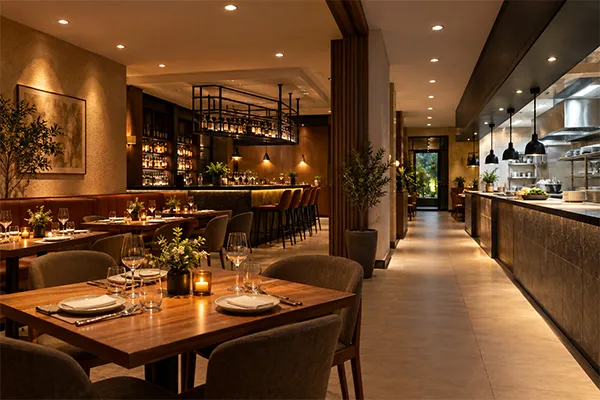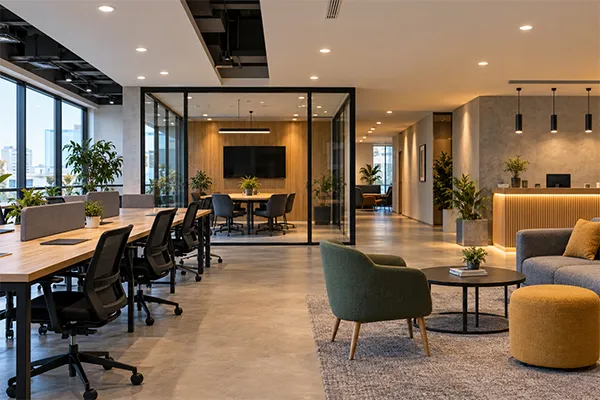
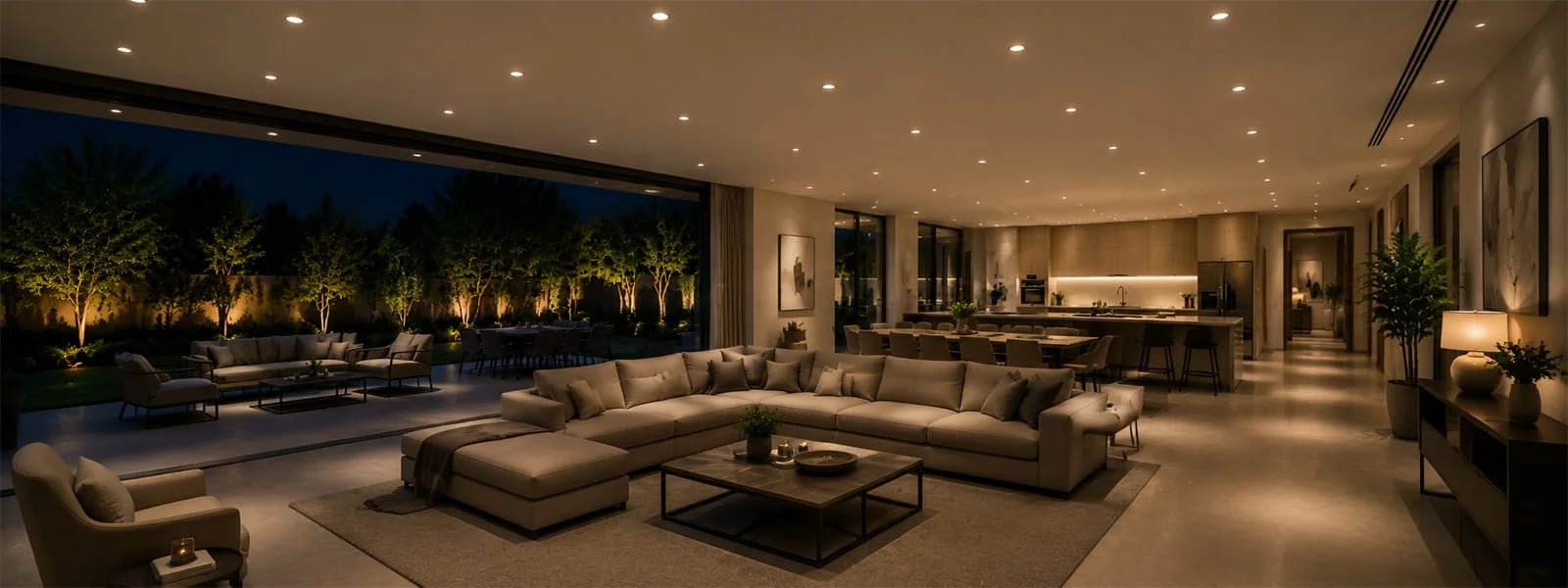
LED downlight demand is changing because smart-building projects require more than a fixture that can simply switch on, off, or dim. Buyers increasingly need downlights with confirmed driver behavior, suitable dimming interfaces, stable lighting quality, and practical integration with the selected control system. The right specification depends on the project architecture, not the “smart” label alone.
Smart buildings are increasing LED downlight demand for products that work reliably with defined control methods, such as phase-cut, 0–10V, DALI, or other project-selected systems1. A downlight may not need an integrated smart module, but its driver, dimming range, flicker behavior, installation design, and replacement plan must suit the complete lighting-control strategy.
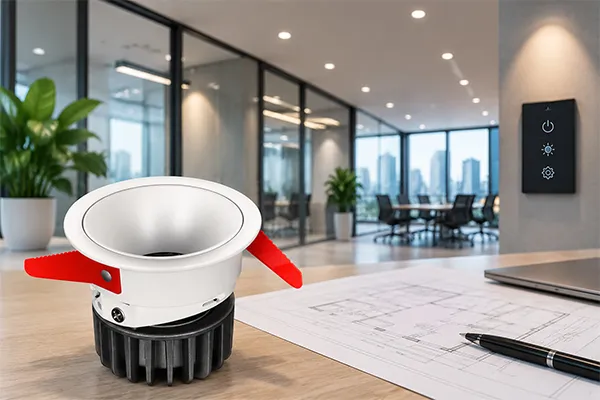
At Upward Lighting, we often receive requests for a “smart downlight” before a customer has shared the control protocol, dimming method, or installation plan. I have learned that the most useful first step is to turn that broad request into a specification checklist that purchasing, technical, and project teams can confirm.
Why Is LED Downlight Demand Rising in Smart-Building Projects?
LED downlight demand is rising in smart-building projects because buyers need lighting that can support more responsive and manageable spaces. However, a vague control requirement can create procurement risk. A fixture may look suitable in a catalogue, yet still perform poorly if its driver and dimming method do not match the project design.
Smart-building projects increase demand for LED downlights because downlights are widely used in offices, hotels, retail spaces, corridors, residences, and public areas2 where lighting may need zoning, scheduling, scene setting, occupancy response, or central monitoring3. The demand is strongest for fixtures with verified compatibility and consistent core lighting performance.
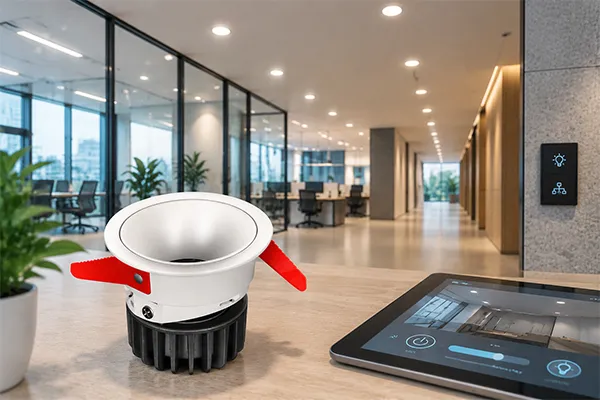
Smart Buildings Change the Buying Conversation
Traditional lighting procurement often focused on a short list of fixture characteristics:
- Wattage
- Lumen output
- Color temperature
- Cutout size
- Beam angle
- Housing color
- Price
These specifications remain important. Yet smart-building projects add another layer of questions. Buyers may need to know how the fixture will dim, what driver is installed, whether the driver can be replaced, and which party will test the final installation.
In our customer discussions, a contractor may initially ask, “Can this downlight be connected to our smart system?” That is not a complete technical question. We normally need more information before a product can be evaluated responsibly.
For example, we would ask:
-
Which control method does the project use?
The answer could involve phase-cut dimming, 0–10V, DALI, a wireless controller, or another system selected by the project team. -
Is the intelligence inside the fixture or outside it?
Some projects use a centralized controller, gateway, sensor network, or building-management system. In those cases, the downlight may only need a compatible driver and control input. -
What dimming behavior is required?
The required minimum dimming level, fade smoothness, flicker expectation, and switch-off behavior should be identified. -
How will the lighting be maintained?
A product that works during commissioning but is difficult to replace after several years may create unnecessary operating risk.
Demand Is Moving Toward Confirmable Specifications
I do not see smart-building demand as a simple shift toward the most complex fixture. Instead, I see demand shifting toward better-defined LED downlight specifications.
A small office renovation may only need dependable 0–10V dimming. A hotel may require scene control across guest rooms and public zones. A commercial tower may use a more extensive lighting-control architecture. Each project can require a different fixture-and-driver combination.
A “smart” label does not replace a control compatibility review.
For importers, distributors, and local lighting brands, this trend also affects stocking decisions. It may not be practical to stock every possible driver configuration. However, it can be valuable to work with a manufacturer that can confirm driver options, support small-batch customization where appropriate, and provide samples for project evaluation.
At Upward Lighting, we can customize parameters such as wattage, color temperature, beam angle, CRI, and finish color. For control-related requests, we recommend confirming the selected driver and interface before production rather than relying on a general description in a purchase order.
Does Dimmable Mean Smart-Building Compatible for LED Downlights?
Many buyers assume that a dimmable product will work with a smart-building control system. This assumption can cause costly delays. A downlight can be dimmable and still be unsuitable for the installed dimmer, control line, driver requirement, or system architecture.4
No, dimmable does not automatically mean smart-building compatible. LED downlights must be assessed according to the exact dimming method, driver design, control interface, load conditions, system wiring, and expected dimming performance. Compatibility should be confirmed using project documentation and, where needed, representative test samples.
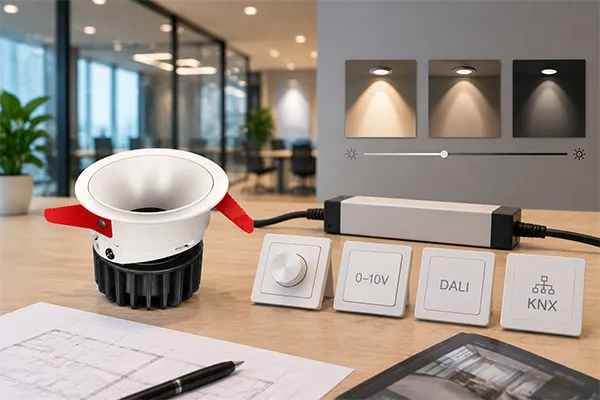
Common Dimming Methods Require Different Checks
The following table gives a high-level procurement view. It does not replace the project electrical design, driver documentation, or field testing.
| Control approach | What buyers should confirm | Common procurement risk |
|---|---|---|
| Phase-cut dimming | Leading-edge or trailing-edge requirement, dimmer model, minimum load, dimming range | Flicker, unstable dimming, audible noise, or limited low-end dimming5 |
| 0–10V dimming | Driver input, polarity requirements, control wiring, dimming curve | Incorrect wiring assumptions or mismatch between controller and driver |
| DALI-based control | Driver type, addressing expectations, system component selection, commissioning responsibility | Assuming a DALI-marked component guarantees complete system integration |
| Wireless control | Gateway, controller, signal coverage, driver interface, maintenance access | Treating a wireless module as a complete building-control solution |
| Switched-only lighting | Circuit layout, occupancy sensor strategy, driver start-up behavior | Buying premium control-ready products where basic switching is sufficient |
A Driver Is Not a Minor Component
The driver is often the key link between the power supply, control signal, and LED module.6 Yet buyers sometimes focus on the exterior trim, color, and lumen figure while overlooking driver selection.
I have seen customers ask for “the same downlight, but smart.” In many cases, the housing and LED module do not need to change. The actual change may involve:
- A different dimmable driver
- A compatible control input
- Revised wiring requirements
- A suitable junction box arrangement
- A change to the product’s maintenance and replacement procedure
This is why quotations should state the driver option clearly. A generic phrase such as “dimmable driver included” may not be enough for a controlled lighting project.
Use a Sample-Based Compatibility Process
For a project with meaningful technical or commercial exposure, I recommend a simple validation sequence:
- Collect the control-system requirement from the project control, electrical, or consultant team.
- Confirm the proposed driver model and control interface with the lighting supplier.
- Review the fixture datasheet and driver datasheet together.
- Test representative samples with the intended dimmer, controller, or gateway where possible.
- Record the expected dimming range and operating behavior.
- Agree on responsibility for final installation, commissioning, and system-level acceptance.
Our role as a lighting manufacturer is to provide accurate product and driver information, samples, and production consistency within the agreed specification. The final building-control design and commissioning should be validated by the relevant project control specialists, electrical installers, and technical teams.
What Smart-Building Requirements Affect LED Downlight Selection?
A smart-building specification can distract buyers from basic lighting quality. That creates a different kind of risk. Even when control compatibility is confirmed, the LED downlight still needs to provide suitable light output, visual comfort, thermal management, and installation fit for the intended space.
Smart-building requirements affect LED downlight selection by adding control and driver criteria to fundamental lighting decisions. Buyers should evaluate flicker behavior, dimming range, color consistency, CRI, beam angle, glare control, cutout size, heat management, and maintenance access7 alongside the selected control interface.
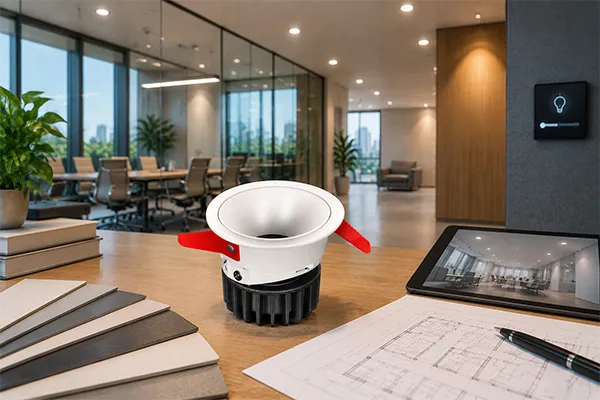
Lighting Quality Still Comes First
A well-controlled downlight is not automatically a well-specified downlight. The product must still suit the room, ceiling construction, visual task, and target atmosphere.
Here are the main product factors we discuss with buyers.
Color Temperature and Color Consistency
Color temperature affects the visual character of a space. Warm tones may suit hospitality or residential settings, while neutral or cooler tones may be selected for offices, retail, or task-oriented spaces. The selected color temperature should be consistent across the project.
Buyers should also ask how color consistency will be managed across production batches, especially for phased projects or repeat orders. A sample approved today should be linked to a clear production specification for later deliveries.
CRI and Visual Requirements
CRI is an important consideration where color appearance matters.8 Retail displays, hospitality interiors, and premium residential spaces may require more careful evaluation than utility corridors or storage areas.
However, I advise buyers not to select CRI in isolation. The final choice should balance visual requirements, efficacy targets, budget, and the project’s approved lighting design.
Beam Angle and Glare Control
Beam angle helps determine how light is distributed. Narrow beams can create stronger accents, while wider beams can support general illumination. Glare control also matters, particularly in offices, corridors, reception areas, and spaces where occupants frequently look toward the ceiling.9
A recessed anti-glare design, deeper reflector position, or suitable optic may be relevant, but the correct choice depends on the installation height and lighting layout. The project lighting designer or technical team should assess application-specific visual comfort.
Dimming Performance Must Be Defined
A request for “smooth dimming” is understandable, but it remains subjective unless the project team defines expectations. Buyers can make the requirement more practical by asking:
- What is the required dimming range?
- Is dim-to-off necessary?
- Is a minimum light level acceptable?
- Must the fixture operate without visible flicker at low output?10
- Will cameras be used in the space?
- Are there known dimmer or controller models?
- Does the project require scene transitions or only basic adjustment?
I remember a project customer who wanted deep dimming in a hospitality setting but had not selected the control equipment. We could discuss feasible driver options, but we could not responsibly promise final system behavior until the intended controller and installation conditions were identified.
Installation and Maintenance Are Part of the Specification
Smart-building projects may add sensors, controllers, gateways, or extra wiring. These components can affect ceiling-space planning and maintenance access. The downlight itself must also fit the ceiling cutout, depth, insulation condition, and heat environment.
For procurement teams, the maintenance plan should address:
| Question | Why it matters |
|---|---|
| Can the driver be accessed or replaced? | A failed component should not automatically require disruptive ceiling work. |
| Is the cutout size standardized? | Standardization can simplify future replacement and inventory planning. |
| Are spare drivers or fixtures available? | Projects may need matching replacements over time. |
| Is the driver specification documented? | Documentation helps prevent unsuitable substitutions. |
| Who owns commissioning responsibility? | Clear ownership reduces gaps between fixture supply and controls integration. |
At Upward Lighting, every product undergoes a 100% aging test for approximately 4 to 8 hours before shipment, according to the agreed product process. This is a manufacturing quality-control step. It should not be treated as proof that a fixture will integrate with every controller, protocol, or building-management system in a finished project.
How Should Buyers Verify Smart LED Downlight Compatibility?
LED downlight demand can create pressure to make fast product decisions. Purchasing teams may be asked to quote quickly, while project teams need confidence that the selected product will work. The best response is not to overpromise. It is to create a documented compatibility review before volume procurement.
Buyers should verify smart LED downlight compatibility by confirming the project control protocol, exact driver model, dimming method, wiring arrangement, performance expectations, sample-test process, integration responsibility, and maintenance plan. Product certificates and datasheets support evaluation, but they do not by themselves prove complete system compatibility.
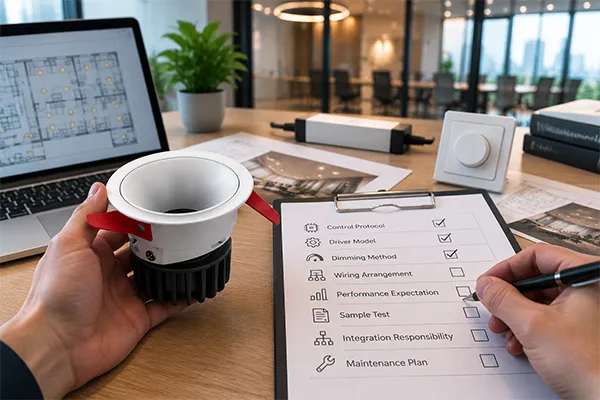
The Practical Buyer Checklist
When a customer sends us a request for smart-building downlights, I find that the following checklist helps transform an unclear inquiry into a quote that can be reviewed properly.
1. Control and Protocol Details
Ask the project team to identify:
- The selected control method or protocol
- The dimmer, controller, gateway, or system brand and model, if known
- Whether the system is wired, wireless, centralized, or room-based
- Whether sensors, schedules, scenes, or daylight response are expected
- Who will configure and commission the system
Buyers should avoid statements such as “compatible with all smart systems.” Real compatibility depends on the complete project configuration.
2. Downlight and Driver Specification
The product request should state:
- Wattage and target lumen output
- Color temperature
- CRI requirement
- Beam angle
- Trim color and housing finish
- Cutout size and installation depth
- IP rating where relevant
- Driver brand, type, and dimming interface
- Required dimming range and expected low-end behavior
For OEM and ODM projects, these details allow us to evaluate a suitable product configuration rather than merely offering a standard catalogue item.
3. Quality and Documentation Review
Buyers should request and review applicable documents, which may include:
- Product datasheet
- Driver datasheet
- Dimmer or controller compatibility information where available
- Test reports relevant to the specified product
- Packaging and labeling requirements
- Product samples for approval
Our products can be supplied with certifications such as CE and RoHS for applicable market-entry and environmental requirements. Buyers should verify the validity, scope, product coverage, and relevance of all certification documents for their destination market and project requirements. Certification is important, but it is not evidence that a complete control system will operate correctly together.
4. Supply and Lifecycle Requirements
A smart-building project can involve phased construction, repeat orders, and future maintenance. Therefore, purchasing teams should also ask about:
- Minimum order quantity for customized drivers or finishes
- Sample lead time and production lead time
- Driver availability for future replacement
- Batch consistency controls
- Spare-unit recommendations
- Product change-control procedures
- Packaging requirements for distribution or project delivery
At Upward Lighting, we support OEM/ODM requirements, small-batch discussions, and fast quotation processes where the specification is sufficiently clear. I believe the fastest quote is not always the best quote. A quote that identifies the driver and control assumptions can reduce later revisions.
Frequently Asked Questions
Does every smart building need an integrated smart LED downlight?
No. Many smart-building projects place intelligence in external drivers, controllers, gateways, sensors, or a building-management system. The LED downlight may only need an appropriate driver and control interface. The final approach should be confirmed by the project’s electrical and control teams.
Can a DALI driver guarantee full building-system compatibility?
No. A DALI-capable driver may be suitable for a DALI-based lighting design, but full compatibility depends on the entire system, including controllers, addressing, wiring, commissioning, and project configuration. Buyers should review the relevant documentation and test samples where practical.
What should I ask a downlight supplier before ordering for a smart project?
You should ask for the exact driver model, control interface, dimming range, fixture datasheet, driver datasheet, installation dimensions, and sample options. You should also confirm who is responsible for system integration, commissioning, and future replacement planning.
Are CE and RoHS documents enough for smart-building downlight procurement?
No. CE and RoHS documents may be relevant to safety, environmental, or market-entry requirements11, depending on the product and destination. They do not prove that the fixture, driver, controller, and building-management system will work together in a specific project.
Why does low-end dimming matter for LED downlights?
Low-end dimming affects visual comfort, scene quality, and user expectations in spaces such as hotels, restaurants, residences, and presentation areas. Buyers should define the required dimming behavior and validate it with the selected control equipment before confirming a volume order.
Conclusion
Smart buildings are changing LED downlight demand by making compatibility, driver selection, and system planning more important during procurement. Dimmable does not automatically mean smart-building ready, and an integrated smart module is not always necessary. I recommend that buyers evaluate the control method, driver, lighting performance, installation constraints, documentation, samples, and replacement strategy as one package. If you are sourcing customized downlights for a controlled lighting project, contact Upward Lighting with your specification so we can help you review practical fixture and driver options before production.
"[PDF] Controls for LED Lighting - eere.energy.gov", https://www1.eere.energy.gov/buildings/publications/pdfs/ssl/rmiller_controls_pittsburgh2012.pdf. Lighting-control guidance identifies phase-cut, 0–10 V, and DALI as distinct dimming or digital-control approaches used with compatible lighting equipment. Evidence role: definition; source type: institution. Supports: That phase-cut, 0–10 V, and DALI are established approaches for controlling dimmable lighting equipment.. Scope note: The source can establish the control-method categories but cannot determine compatibility for a particular fixture, driver, and installed system. ↩
"[PDF] Are LEDs Ready for Recessed Downlight Applications", https://www1.eere.energy.gov/buildings/publications/pdfs/ssl/leds_may_applications.pdf. Lighting-design references describe recessed downlights as commonly used for general, task, and accent illumination across residential and commercial interiors. Evidence role: general_support; source type: education. Supports: That recessed downlighting is used for general, task, accent, and circulation-area lighting in varied interior building types.. Scope note: Typical application guidance does not quantify downlight use or demand in each named building sector. ↩
"[PDF] Exterior Lighting Control Guidance - Better Buildings Solution Center", https://betterbuildingssolutioncenter.energy.gov/sites/default/files/attachments/exterior-lighting-control-guidance.pdf. Building-lighting control guidance describes automated systems that can schedule operation, respond to occupancy, manage zones or scenes, and support centralized monitoring. Evidence role: general_support; source type: government. Supports: That networked and automated lighting controls can provide scheduling, occupancy-based control, zoning, scene control, and monitoring functions.. Scope note: Available functions depend on the control architecture, installed devices, configuration, and commissioning. ↩
"[PDF] LED Dimming: What you need to know - eere.energy.gov", https://www1.eere.energy.gov/buildings/publications/pdfs/ssl/dimming_webcast_12-10-2012.pdf. Technical guidance on LED dimming notes that satisfactory operation depends on compatibility between the LED driver or luminaire and the selected dimmer or control system. Evidence role: mechanism; source type: government. Supports: That LED dimming performance and compatibility depend on the interaction of the lamp or luminaire driver with the selected control device and wiring arrangement.. Scope note: General compatibility guidance does not substitute for testing a specified driver with the actual project controls. ↩
"[PDF] Dimming, Flicker, and Power Quality Characteristics of LED A Lamps", https://energy.gov/sites/prod/files/2015/01/f19/caliper_retail-study_3-1.pdf. Studies and technical guidance on LED dimming report that driver–dimmer incompatibility can produce flicker, unstable output, audible noise, and limited low-end dimming. Evidence role: mechanism; source type: research. Supports: That incompatible LED drivers and phase-cut dimmers may produce flicker, instability, audible noise, or restricted dimming range.. Scope note: The occurrence and severity of these effects vary by driver, dimmer, load, wiring, and operating conditions. ↩
"[PDF] LED Dimming: What you need to know - eere.energy.gov", https://www1.eere.energy.gov/buildings/publications/pdfs/ssl/dimming_webcast_12-10-2012.pdf. LED-driver technical references explain that the driver converts and regulates electrical power for the LED load and may implement dimming through a compatible control input. Evidence role: mechanism; source type: research. Supports: That an LED driver regulates electrical power to LEDs and may receive dimming or control inputs.. Scope note: Driver functions and available interfaces vary among constant-current, constant-voltage, integral, and remote driver designs. ↩
"[PDF] REA Refrigerated Display Case LED Lighting Performance ...", https://www.energy.gov/sites/prod/files/2014/04/f14/rea_refrig_display_spec.pdf. Lighting-specification guidance treats photometric quality, color rendering and consistency, glare, flicker, thermal performance, installation constraints, and maintenance as relevant luminaire-selection considerations. Evidence role: general_support; source type: institution. Supports: That luminaire evaluation commonly includes photometric performance, color quality, glare, flicker, thermal behavior, physical installation, and maintainability.. Scope note: The relative importance and acceptable thresholds for these criteria are application- and jurisdiction-specific. ↩
"Purchasing Energy-Efficient Light Bulbs", https://www.energy.gov/cmei/femp/purchasing-energy-efficient-light-bulbs. Color-rendering guidance defines CRI as an index describing the fidelity with which a light source renders colors relative to an appropriate reference illuminant. Evidence role: definition; source type: government. Supports: That CRI is a metric used to describe how a light source renders object colors relative to a reference illuminant.. Scope note: CRI does not fully predict every aspect of perceived color quality, preference, or the suitability of a source for a specific application. ↩
"Glare | Department of Energy", https://www.energy.gov/cmei/ssl/glare. Lighting research recognizes discomfort glare as a factor that can impair visual comfort, making luminaire luminance, shielding, position, and viewing direction relevant design considerations. Evidence role: mechanism; source type: research. Supports: That discomfort glare can affect visual comfort and should be considered in interior lighting design.. Scope note: Actual glare perception depends on the observer, task, room geometry, daylight, surface reflectance, and lighting layout. ↩
"[PDF] LED Dimming: What you need to know - eere.energy.gov", https://www1.eere.energy.gov/buildings/publications/pdfs/ssl/dimming_webcast_12-10-2012.pdf. Research on temporal light modulation reports that LED flicker can arise from driver and dimming behavior and may be perceptible under certain operating conditions. Evidence role: mechanism; source type: paper. Supports: That temporal light modulation in LED systems can occur under some dimming conditions and may be visible or otherwise relevant to users.. Scope note: Visibility and possible effects depend on modulation characteristics, ambient conditions, observer sensitivity, movement, and camera use. ↩
"RoHS Directive - Environment - European Commission", https://environment.ec.europa.eu/topics/waste-and-recycling/rohs-directive_en. European Commission guidance distinguishes CE marking, which concerns conformity with applicable EU requirements, from RoHS obligations restricting certain hazardous substances in electrical and electronic equipment. Evidence role: definition; source type: government. Supports: That CE marking indicates conformity with applicable EU requirements, while RoHS restricts specified hazardous substances in electrical and electronic equipment.. Scope note: Applicable legal obligations depend on the product, applicable legislation, economic operator role, and destination market; neither document alone verifies project-specific controls interoperability. ↩