

Supplier support helps an LED downlight business grow when it prevents the small coordination failures that can quietly reduce margin and damage customer confidence. A low unit price can look attractive at first, but unclear specifications, slow updates, and weak post-sample communication can create expensive problems. I see stronger supplier support as a practical way to control these risks.
Supplier support helps LED downlight business growth by reducing specification errors, improving order coordination, supporting controlled customization, and providing earlier visibility into delivery changes. Buyers should assess support before placing a purchase order because communication quality affects product consistency, inventory planning, customer commitments, and the total cost of each order—not only the quoted unit price1.

In my work with overseas lighting buyers, I often find that the most important supplier conversations happen before production begins. The quotation stage, sample review, customization discussion, and delivery planning stage can all reveal whether a supplier is prepared to support long-term business needs rather than simply accept an order.
Why Does Supplier Support Matter for LED Downlight Business Growth?
Poor supplier support can turn a routine LED downlight purchase into a chain of avoidable changes, missed deadlines, and customer complaints. These problems often appear after the price has already been agreed. I believe buyers need support that makes risks visible early, when changes are still easier and less costly to manage.
Supplier support matters because LED downlight business growth depends on consistent specifications, reliable communication, and predictable order execution. When a supplier confirms details early and communicates changes clearly, buyers can better protect their margins, launch schedules, inventory plans, and relationships with contractors, distributors, or end customers.

A low price can hide a higher operational cost2
I do not believe the lowest price is always a bad choice. Many buyers need competitive pricing to win tenders, protect wholesale margins, or introduce a new lighting range. However, I have learned from recurring buyer conversations that unit price is only one part of the commercial decision.
A quotation becomes less competitive when weak coordination creates downstream costs such as:
- Reworking product labels, cartons, or instruction documents
- Replacing stock because a color temperature or cutout size was misunderstood
- Delaying a customer launch due to late sample confirmation
- Paying for air freight after production timing changes
- Managing complaints caused by inconsistent product parameters
- Holding inventory that does not match local market demand
For example, a buyer may request a 12W recessed LED downlight with a 90 mm cutout, 4000K color temperature, white trim, and a specific driver input requirement. If the supplier only confirms “12W downlight” without documenting each relevant parameter, both parties may assume different configurations3. The issue may not become obvious until sampling, production inspection, or installation.
That type of mismatch can affect more than one order. A distributor may have already printed a catalog, given a quote to a contractor, or promoted the item to local dealers. I cannot predict every buyer’s commercial outcome, but I can see how a small technical misunderstanding can become a larger sales and customer-service issue.
Support is a risk-control function, not just a courtesy4
I view practical support as a form of procurement risk control. It includes the actions that help a buyer make informed decisions and avoid preventable ambiguity.
| Support activity | Risk it addresses | Buyer benefit |
|---|---|---|
| Clear quotation confirmation | Missing or conflicting parameters | More accurate product comparison |
| Sample coordination | Incorrect expectations before mass production | Safer approval decisions |
| Document coordination | Missing compliance or product information | Better market-entry preparation |
| Production updates | Inventory and project scheduling uncertainty | More time to adjust plans |
| Early warning of changes | Last-minute surprises | Better control of customer commitments |
| After-sales communication | Delayed issue handling | Faster fact-finding and response planning |
At Upward Lighting, I see these activities as part of order coordination rather than an optional extra. We work with LED downlights and other architectural and outdoor LED products, so I know that a buyer’s requirements can change from one project, market, or customer segment to another.
I have found that the best supplier conversations are often the ones that identify uncertainty before a buyer pays a deposit, prints packaging, or commits a delivery date to a customer.
How Can Supplier Support Prevent LED Downlight Specification Mistakes?
An LED downlight can look simple in a product photo, yet its commercial suitability depends on a group of connected specifications5. Buyers can face trouble when the quotation, sample, purchase order, packaging, and production instructions do not reflect the same agreed configuration. I recommend treating parameter confirmation as a structured process, not a quick email exchange.
Supplier support prevents LED downlight specification mistakes by documenting the agreed product configuration before production. Buyers should confirm wattage, lumen expectations, color temperature, beam angle, cutout, driver details, finish, CRI, packaging, labeling, and applicable documents so that each party works from the same commercial reference.
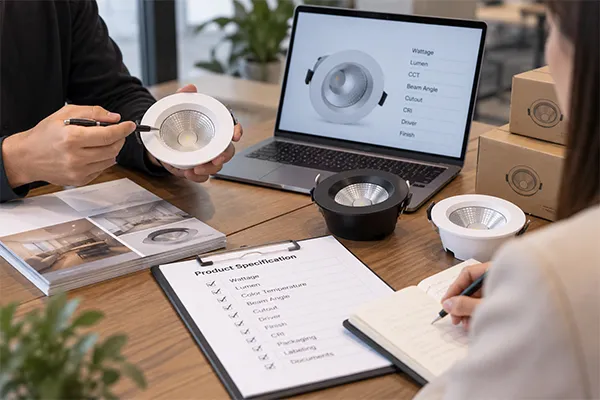
The parameters that deserve written confirmation
I regularly see buyers focus first on wattage and price. Those are important, but they do not define the whole product. A suitable LED downlight for a hotel corridor, retail store, residential project, or distributor shelf may need very different optical, installation, and packaging characteristics.
Before placing an order, I suggest confirming the following items in writing:
-
Product construction
- Recessed, surface-mounted, adjustable, or fixed downlight
- Housing material and trim appearance
- IP rating where relevant to the intended environment
- Required dimensions and ceiling cutout size
-
Lighting performance
- Rated wattage
- Requested color temperature, such as 3000K, 4000K, or 6500K
- Beam angle
- CRI requirement
- Dimming or non-dimming requirement
- Lumen output expectations and test conditions, where applicable
-
Electrical configuration
- Input voltage range
- Driver type and driver placement
- Plug, connector, or wiring requirement
- Dimming protocol, if requested
-
Commercial presentation
- Product label details
- Inner box and master carton requirements
- Brand logo, barcode, artwork, and language needs
- Spare parts or accessory requirements
Why samples are useful but not enough
A sample is valuable because it helps buyers check appearance, installation fit, light output impression, and basic functionality. Still, I do not think a sample alone should replace a written specification sheet.
A sample may be hand-prepared, supplied from existing stock, or configured before all packaging details are finalized6. Mass production needs a clearer reference. I encourage buyers to align the approved sample with the final purchase order, product drawing, labeling requirements, and any approved artwork.
Here is a practical comparison:
| Stage | Main buyer question | Useful supplier support |
|---|---|---|
| Initial quotation | Can this product fit my target market? | Basic parameters, pricing basis, MOQ discussion |
| Sampling | Does the product meet my visual and functional expectations? | Sample configuration confirmation and feedback tracking |
| Pre-PO review | Have all commercial and technical details been agreed? | Final specification checklist and document review |
| Production | Is the factory making the approved version? | Coordination between sales, purchasing, and production |
| Pre-shipment | Does the shipment match the agreed order? | Inspection records, packing list, and shipment communication |
At our factory, we can discuss customization of color temperature, wattage, beam angle, CRI, and surface finish colors for relevant LED lighting orders. I always recommend that buyers evaluate whether each requested change is technically feasible, commercially suitable, and realistic for the order quantity and delivery window. Customization can create differentiation, but it also adds coordination points that require careful confirmation.
Can OEM, ODM, and Small-Batch Supplier Support Help Buyers Test New SKUs?
New LED downlight SKUs can create opportunity, but they also create inventory and forecasting risk. A buyer may want to test a new trim color, wattage, CCT, or private-label presentation without making a large commitment. I have seen this concern frequently among importers, distributors, local lighting brands, and traders.
OEM, ODM, and small-batch supplier support can help buyers test LED downlight SKUs with lower initial inventory exposure. The approach works best when the supplier clearly explains customization limits, minimum order requirements, sample timing, artwork approval steps, and production coordination requirements before the buyer commits.
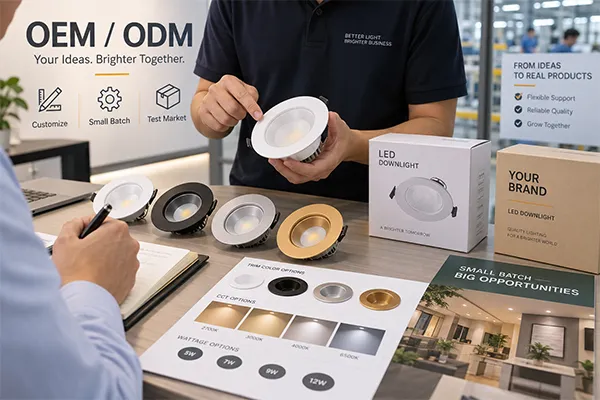
Small orders are not automatically simple orders
A smaller order may reduce the buyer’s inventory commitment, but it does not remove production complexity. In some cases, a custom small batch needs more coordination than a standard larger order because materials, labels, drivers, packaging, or trim colors may need separate preparation.
I think buyers should ask direct questions before using a small order to test a new product line:
- Is the requested LED downlight based on an existing model or a new development?
- Which changes are cosmetic, and which changes affect electrical or optical performance?
- Does the requested color temperature require a separate LED component arrangement?
- Will customized packaging require an artwork approval process?
- Are there material minimums that differ from finished-product minimums?
- Can future repeat orders use the same configuration?
- What information must be finalized before production starts?
An anonymized coordination scenario
I recall a recurring type of order discussion rather than a single universal outcome: a buyer wants to introduce a private-label recessed LED downlight in a limited quantity. The buyer may request a specific trim color, a selected CCT, branded cartons, and a local-market label.
The commercial opportunity looks straightforward. However, each request adds a decision point. The trim color may need confirmation against a reference. The carton artwork may require approval before printing. The label may need exact electrical information. The selected driver configuration may affect lead time or cost.
In that situation, I would not describe supplier support as simply “accepting a small order.” The useful support is helping the buyer map the order into manageable steps:
- Confirm the base LED downlight model.
- Separate standard features from custom features.
- Review the buyer’s branding files and label content.
- Confirm the sample requirement.
- Identify the production-critical approval dates.
- Discuss realistic production and shipment expectations.
- Keep records of final approved parameters.
This process does not guarantee that a new SKU will sell well. The buyer still needs to assess local demand, pricing, channel fit, and application requirements. However, better coordination can help reduce the chance that the first order is built around unclear assumptions.
OEM and ODM support should be evaluated carefully
Buyers should also distinguish between OEM and ODM discussions:
| Option | Typical meaning | Buyer evaluation focus |
|---|---|---|
| [OEM | A supplier produces a product using the buyer’s branding or defined requirements](https://en.wikipedia.org/wiki/Original_equipment_manufacturer)%%%FOOTNOTE_REF_7%%% | Brand assets, labels, packaging, specification control |
| [ODM | A supplier adapts or offers an existing product design for the buyer’s market](https://en.wikipedia.org/wiki/Original_design_manufacturer)%%%FOOTNOTE_REF_8%%% | Product suitability, customization boundaries, differentiation |
| Standard catalog product | Buyer selects an existing configuration | Availability, documentation, pricing, and consistency |
I encourage buyers to ask for clear records rather than relying on verbal expectations. A supplier’s willingness to customize is useful only when the supplier can coordinate the changes consistently through sourcing, production, quality control, packing, and shipment.
How Does Supplier Support Improve LED Downlight Delivery Reliability?
A promised lead time can be useful, but delivery reliability involves more than a date written on a quotation9. Buyers need visibility into whether materials, production capacity, approvals, packaging, and shipment arrangements are progressing as planned. I believe proactive communication becomes especially important when a buyer has committed stock or installation dates to others.
Supplier support improves LED downlight delivery reliability when it combines realistic lead-time discussions, production coordination, regular progress updates, and early warning of material, approval, or shipping changes. Buyers can then make better inventory, project, and customer communication decisions before a delay becomes urgent.

Lead time should be discussed as a process
In my experience, buyers sometimes ask for one number: “What is the delivery time?” That is a reasonable question, but the answer depends on order conditions. A standard LED downlight in a familiar configuration may follow a different schedule from a custom private-label model with new packaging or a special driver.
A more complete lead-time discussion should consider:
- Sample approval status
- Deposit and purchase order confirmation
- Component availability
- Customization requirements
- Packaging artwork approval
- Production schedule
- Aging and inspection activities
- Export packing and shipping arrangement
- Seasonal congestion or logistics disruption
At Upward Lighting, our products undergo a 100% aging test of approximately 4 to 8 hours before shipment10, depending on the product and order arrangement. I present this as one quality-control mechanism in our process, not as a guarantee that every field condition or project outcome will be risk-free. Buyers should still establish appropriate incoming inspection, application review, and installation controls.
Early warnings help buyers protect their own commitments11
No supplier can control every supply-chain or logistics condition. Materials can change in availability. Shipping schedules can move. A buyer may also request changes after the original order confirmation.
The practical question is not whether every order will face no change. The practical question is whether the supplier communicates early enough for the buyer to respond.
For a distributor, early notice may allow an inventory reallocation decision. For a contractor, it may support a discussion with the project team. For a local lighting brand, it may affect a product launch or promotional calendar. For a trader, it may influence booking and consolidation planning.
I recommend asking suppliers how they manage updates:
- Who is responsible for order communication?
- What milestones do they track?
- How are specification changes documented?
- When will the buyer be informed of a material or schedule issue?
- Can the supplier explain the effect of a requested change on timing?
- What pre-shipment information will the buyer receive?
These questions help buyers compare suppliers beyond an initial price sheet. They also show whether a supplier understands that delivery communication affects the buyer’s reputation in its own market.
Frequently Asked Questions
What is supplier support in the LED downlight industry?
Supplier support includes the practical coordination that helps buyers purchase and manage LED downlights successfully. It may include quotation clarification, sample handling, parameter confirmation, customization discussions, document coordination, production updates, quality-process communication, and shipment planning. Buyers should evaluate the actual process, not only general service claims.
Should I choose the lowest-priced LED downlight supplier?
I do not think buyers should reject low pricing automatically. Instead, buyers should compare the total business cost. A lower quote may be suitable if the supplier can also provide clear specifications, reliable communication, appropriate documents, and realistic delivery coordination for the buyer’s order requirements.
What should I confirm before ordering customized LED downlights?
Buyers should confirm the base model, wattage, CCT, beam angle, CRI, cutout, driver details, finish, labels, packaging, order quantity, sample approval process, and estimated production timing. Buyers should also ask which custom elements can be repeated consistently in future orders.
Do CE and RoHS documents guarantee that LED downlights are suitable for every market?
No. CE and RoHS documentation can be relevant to market-entry and product compliance requirements12, but buyers should verify the applicable documents, product scope, destination-market rules, and customer requirements. Buyers should seek qualified professional guidance for application-specific, regulatory, and installation decisions.
How can I assess an LED downlight supplier before placing a purchase order?
I recommend evaluating quotation clarity, response quality, sample consistency, customization capability, document availability, quality-process explanations, delivery communication, and willingness to identify limitations. Buyers can also request references, relevant product records, and clear written confirmation of the agreed order configuration.
Conclusion
Supplier support can contribute to LED downlight business growth when it reduces preventable specification mistakes, coordination gaps, delivery uncertainty, and after-sales pressure. I believe buyers should look beyond unit price and examine how a supplier handles quotations, samples, customization, production updates, and quality communication. At Upward Lighting, I support buyers with OEM/ODM discussions, small-batch coordination, parameter confirmation, supply-chain communication, and aging-test processes. Contact our team to discuss your LED downlight requirements and evaluate a sourcing approach that fits your market and order plan.
"Supply chain resilience: A review from the inventory management ...", https://pmc.ncbi.nlm.nih.gov/articles/PMC11997565/. Research on supply-chain integration finds that timely information sharing and coordinated buyer-supplier relationships are associated with improved operational performance, including planning and responsiveness; the evidence addresses organizational relationships generally rather than LED-downlight transactions specifically. Evidence role: general_support; source type: research. Supports: Evidence that information sharing and supplier-buyer coordination are associated with supply-chain performance, inventory management, and operational outcomes.. Scope note: The source should be interpreted as general supply-chain evidence and does not establish the outcome of any individual order. ↩
"Supply Chain Management - NIST", https://www.nist.gov/mep/supply-chain. Public-procurement guidance on total cost of ownership explains that an acquisition decision can involve costs beyond the quoted purchase price, including costs incurred during delivery, use, maintenance, and disposal. Evidence role: general_support; source type: government. Supports: Guidance that procurement decisions may account for costs beyond the initial purchase price, such as logistics, maintenance, administration, and lifecycle costs.. Scope note: Total-cost frameworks identify relevant cost categories but do not demonstrate that every low-priced LED downlight has a higher total cost. ↩
"[PDF] Quality Management System Guidelines - 2019", https://www.transit.dot.gov/sites/fta.dot.gov/files/docs/funding/grant-programs/capital-investments/8536/final-qms-guidelines-2019.pdf. ISO 9001 guidance requires organizations to determine and review customer and product requirements before committing to supply, supporting the use of documented specifications to reduce ambiguity between agreed and delivered configurations. Evidence role: mechanism; source type: institution. Supports: Quality-management requirements to determine, review, and communicate customer and product requirements before an organization commits to supply products or services.. Scope note: The standard specifies a management-system approach and does not prove that documentation will prevent every configuration error. ↩
"OECD Supply Chain Resilience Review: Navigating Risks", https://www.oecd.org/content/dam/oecd/en/publications/reports/2025/06/oecd-supply-chain-resilience-review_9930d256/94e3a8ea-en.pdf. Supply-chain risk-management guidance describes supplier oversight, information exchange, and timely communication as controls that help organizations identify, assess, and respond to supply disruptions and other procurement risks. Evidence role: mechanism; source type: government. Supports: Risk-management guidance recognizing communication, information sharing, and supplier oversight as elements of identifying and managing supply-chain risks.. Scope note: Such frameworks support the risk-control rationale generally and do not evaluate the support practices of a particular lighting supplier. ↩
"[PDF] No-Regrets Remodeling - eere.energy.gov", https://www1.eere.energy.gov/buildings/publications/pdfs/building_america/no_regrets_remodeling_ornl.pdf. LED-lighting guidance identifies color characteristics, light distribution, output, electrical compatibility, installation conditions, and environmental ratings as relevant factors in selecting a suitable luminaire. Evidence role: general_support; source type: government. Supports: Technical guidance that LED-luminaire selection involves photometric characteristics, color quality, electrical compatibility, physical installation dimensions, and environmental suitability.. Scope note: General lighting guidance cannot determine whether a specific downlight configuration is suitable for a particular project or market. ↩
"Testing the Digital Thread in Support of Model-Based Manufacturing ...", https://pmc.ncbi.nlm.nih.gov/articles/PMC4904719/. First-article and production-verification practices require inspection of an initial production unit against approved requirements, reflecting the possibility that development or sample units do not fully demonstrate final production conformity. Evidence role: mechanism; source type: government. Supports: Quality-assurance practices requiring verification of the first production article or production configuration because pre-production samples may differ from regular production output.. Scope note: The practice supports additional production verification but does not mean that every supplier sample differs from mass-produced goods. ↩
"Original equipment manufacturer", https://en.wikipedia.org/wiki/Original_equipment_manufacturer. An original equipment manufacturer is commonly defined as a company that produces equipment or components that may be marketed by another company, although commercial use of the term varies by industry and contract arrangement. Evidence role: definition; source type: encyclopedia. Supports: A standard definition of original equipment manufacturer and the common use of the term in manufacturing supply arrangements.. Scope note: OEM terminology is not legally uniform; the parties' contract should define branding, design ownership, and specification responsibilities. ↩
"Original design manufacturer", https://en.wikipedia.org/wiki/Original_design_manufacturer. Original design manufacturing commonly describes an arrangement in which a manufacturer designs and produces a product that another business brands or markets, with the extent of adaptation governed by the commercial agreement. Evidence role: definition; source type: encyclopedia. Supports: A standard definition of original design manufacturing as an arrangement in which a manufacturer designs and produces a product that another company markets.. Scope note: Specific ODM arrangements vary in design rights, exclusivity, tooling, and customization scope. ↩
"What is Supply Chain Management? Components and Careers", https://www.scu.edu/business/blog/business-concepts/what-is-supply-chain-management/. Operations and supply-chain research treats delivery reliability as the result of interdependent material availability, production scheduling, capacity, order processing, and transportation activities rather than a date stated in isolation. Evidence role: mechanism; source type: research. Supports: Evidence that delivery performance is affected by interdependent factors including supply availability, production scheduling or capacity, and transport logistics.. Scope note: The relative importance of these factors varies by product, supplier, transport mode, and order conditions. ↩
"[PDF] assessment of fides reliability prediction methodology - UMD DRUM", https://drum.lib.umd.edu/bitstreams/a49b0858-d6a6-451c-a9e8-6a02ce8a0878/download. Reliability literature describes burn-in testing as a controlled screening process intended to expose certain early-life electronic failures; it does not by itself demonstrate the duration, coverage, or effectiveness of any supplier's stated pre-shipment test. Evidence role: mechanism; source type: research. Supports: Evidence that burn-in or aging tests are used in electronics reliability practice to screen for some early-life failures under defined test conditions.. Scope note: Verification of the claimed 100% coverage and 4-to-8-hour duration requires the supplier's production records, test procedures, or independent audit evidence. ↩
"Supply chain resilience: A review from the inventory management ...", https://pmc.ncbi.nlm.nih.gov/articles/PMC11997565/. Supply-chain resilience guidance identifies early warning and timely exchange of disruption information as capabilities that allow organizations to assess exposure and implement mitigation measures before impacts escalate. Evidence role: mechanism; source type: institution. Supports: Supply-chain resilience guidance showing that early warning and timely information improve an organization's ability to assess disruptions and take mitigating action.. Scope note: Early notice improves the opportunity to respond but cannot eliminate disruption effects or guarantee that customer commitments can be met. ↩
"CE marking – obtaining the certificate, EU requirements - Your Europe", https://europa.eu/youreurope/business/product-rules-compliance/general-product-compliance/ce-marking/index_en.htm. European Commission guidance explains that CE marking applies only where EU rules require it and that the RoHS Directive restricts specified hazardous substances in covered electrical and electronic equipment, subject to defined scope and conformity obligations. Evidence role: general_support; source type: government. Supports: Official EU information on CE marking and RoHS restrictions, including their applicability to relevant products and associated conformity or technical-documentation obligations.. Scope note: Applicability depends on the product, intended market, and current legal requirements; documentation alone does not establish compliance for every configuration. ↩