
An LED downlight supplier can look attractive when the first quotation is low, but the real problem appears after repeated orders. Small differences in color temperature, driver quality, packaging, labels, or delivery timing can disturb projects and channel sales. I believe the solution is to evaluate the supplier as a long-term operating partner, not only as a price source.
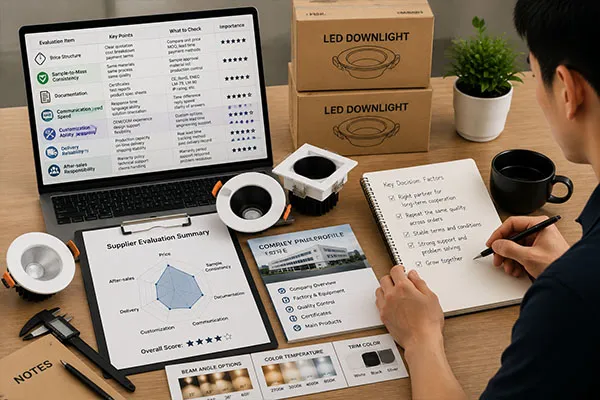
To choose an LED downlight supplier for a long-term partnership, I recommend verifying price structure, sample-to-mass-production consistency, documentation, communication speed, customization ability, delivery reliability, and after-sales responsibility. The best supplier is not always the cheapest one; it is the one that can repeat the same quality, terms, and support across multiple orders.
Many buyers ask me for the best price first. I understand that. However, after many overseas quotation discussions, sample confirmations, OEM coordination, and repeat orders, I have learned that the first price is only one part of the real purchasing cost1.
How Should You Evaluate an LED Downlight Supplier Beyond the Unit Price?
A low quotation can solve an immediate sourcing problem, but it can also hide future risks. If I only compare unit prices, I may miss driver quality, packaging strength, warranty terms, certification scope, or batch consistency. The better approach is to ask what the price includes and what it leaves out.
A good LED downlight supplier should provide a clear quotation that explains product specifications, materials, driver options, packaging, MOQ, delivery time, payment terms, warranty scope, and document availability. Low price is not automatically bad, but the buyer should verify whether the lower cost affects consistency, compliance documents, delivery, or after-sales responsibility.
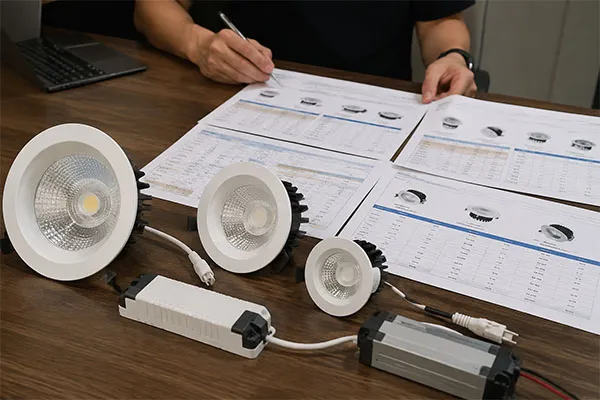
A low price is a question, not a conclusion
In my experience as a China-based LED lighting manufacturer, many serious buyers start with a simple sentence: “Please send your best price.” I do not think this is wrong. Importers, wholesalers, and contractors all face price pressure from their own markets. However, I usually see that the real discussion begins after the first quotation.
A price for LED downlights can change because of many practical factors:
- LED chip brand and binning
- Driver type and power factor
- Housing material2 and heat dissipation design
- Color rendering index
- Beam angle and lens or reflector choice
- Dimming requirement
- Surface finish
- Individual box, master carton, and pallet packaging
- Private label or neutral label
- Certification documents3 and test report requirements
- Order quantity and production schedule
If two suppliers quote different prices, I do not suggest assuming that the higher price is honest or that the lower price is risky. I suggest asking for a specification-by-specification comparison.
| Quotation Item | Why It Matters for Buyers | Risk If It Is Unclear |
|---|---|---|
| Power and lumen output | It affects project lighting performance | Customer complaints about brightness |
| CCT and CRI4 | It affects visual comfort and stock consistency | Mixed color appearance in repeat orders |
| Driver specification5 | It affects stability and dimming compatibility | Flicker, failures, or site complaints |
| Housing material | It affects heat management and durability | Shorter product life or deformation |
| Packaging | It affects transport protection and retail presentation | Damage, repacking cost, or brand issues |
| Warranty terms | It affects after-sales responsibility | Disputes when problems occur |
| Certification documents | They affect market access and project approval | Customs, tender, or compliance problems |
I look for complete quotation terms
A complete quotation reduces misunderstanding before production. I prefer quotations that clearly mention:
- Model number
- Power
- Input voltage
- Color temperature
- Beam angle
- Cut-out size
- Body color
- Driver type
- Unit price
- MOQ
- Lead time
- Packaging method
- Payment terms
- Incoterms
- Validity period
When I discuss with overseas buyers, I see that unclear quotation terms often create hidden costs later. For example, one buyer may assume that the quoted price includes individual color boxes, while the supplier quoted only brown box packaging. Another buyer may assume that the same downlight can support dimming, while the quoted driver is non-dimmable.
I treat a quotation as a risk-control document, not just a price list.
A long-term supplier should be willing to explain the price. If the supplier cannot explain why one option costs more than another, the buyer may face surprises during production, inspection, or after-sales communication.
Why Is Sample Consistency Critical When Choosing an LED Downlight Supplier?
A first sample can impress a buyer, but it does not prove long-term reliability by itself.6 The real problem appears when mass production, repeat orders, labels, packaging, and future replenishment do not match the approved sample. I always recommend treating the sample as the beginning of verification.
When choosing an LED downlight supplier, buyers should confirm that the approved sample specifications will match mass production and repeat orders. The supplier should document power, CCT, beam angle, finish, driver, packaging, labels, and certification version.7 Sample approval should become a production reference, not only a visual impression.
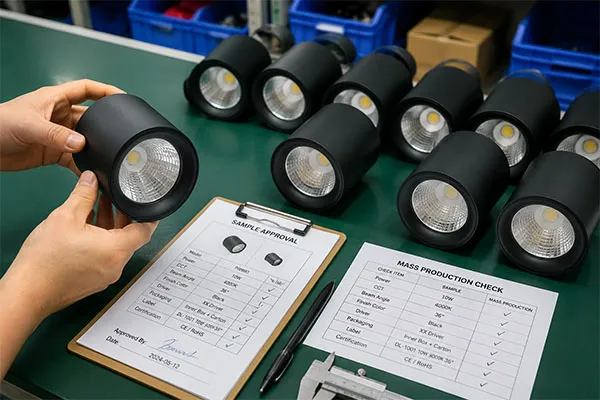
The first sample should become a controlled standard
I often see buyers focus on whether the first sample looks good. That is natural. A downlight is a visual product, and appearance matters. However, for importers, distributors, and project contractors, the more important question is this:
Can the supplier reproduce the same product again and again?
For LED downlights, sample consistency includes more than the housing shape. It includes technical, commercial, and packaging details.
Key sample details to record
I recommend that buyers keep a simple sample approval sheet. It does not need to be complicated, but it should record the items that affect future orders.
| Sample Detail | What to Confirm | Why It Matters |
|---|---|---|
| Power | Actual rated wattage | It affects catalog and project specification |
| CCT | 3000K, 4000K, 6000K, or custom | It affects visual consistency |
| Beam angle | Narrow, medium, or wide beam | It affects lighting layout |
| CRI | Standard or high CRI option | It affects color appearance |
| Driver | Brand, dimming type, voltage range | It affects electrical compatibility |
| Housing finish | White, black, silver, or custom | It affects brand and design consistency |
| Cut-out size | Ceiling opening requirement | It affects installation |
| Packaging | Inner box, master carton, label | It affects resale and logistics |
| Label | Neutral, OEM, or private label | It affects channel sales |
| Documents | CE, RoHS, reports, data sheet | It affects compliance review |
In our own manufacturing process, we require products to go through aging before shipment. Our common practice is 100% aging testing for 4 to 8 hours, depending on the product and order requirement. I do not present this as a universal industry guarantee. I present it as one practical quality-control step that buyers can ask suppliers to explain.
Repeat orders create the real test
A sample may be made with extra care. That is why buyers should ask how the supplier controls mass production. Useful questions include:
- Will the same LED chip specification be used in mass production?
- Will the same driver model be used?
- Will the same housing mold and finish be used?
- Will the same CCT tolerance be controlled?
- Will the same label artwork be applied?
- Will the supplier inform the buyer before changing components?
- Will the supplier keep records for repeat orders?
For local lighting brands and distributors, this is especially important. If a customer buys 3000K downlights this month and returns three months later for the same model, the new batch should not look obviously different. A small color difference may create a big complaint when products are installed side by side.8
Documentation should match the approved product
I also recommend checking that certification documents match the product version. CE, RoHS, and other documents can be important for import, tender, or channel sales. However, buyers should verify whether the documents apply to the exact model, input voltage, driver, and target market requirements.
I avoid saying that one document automatically solves every compliance issue. Different countries, projects, and customers may require different documentation. A serious supplier should provide available documents and support the buyer’s verification process.
What Communication Habits Show That an LED Downlight Supplier Is Reliable?
Poor communication can damage a good product.9 If a supplier answers slowly, avoids details, or confirms specifications casually, the buyer carries extra risk. I see communication as part of product reliability because clear discussion prevents wrong production, delayed shipment, incorrect labels, and after-sales disputes.
A reliable LED downlight supplier communicates quickly, confirms specifications before quoting, explains trade terms clearly, and documents agreed details. Good communication should cover power, CCT, beam angle, finish, packaging, labels, delivery schedule, payment terms, and after-sales procedure. The supplier should reduce uncertainty before production starts.
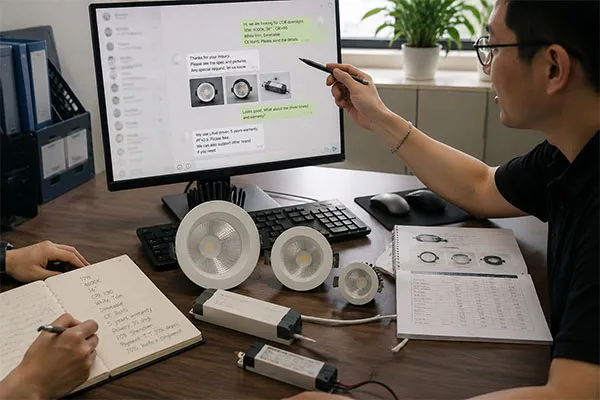
Fast response is useful, but clear response is better
I know that many overseas buyers compare suppliers based on response speed. A fast reply matters, especially when a contractor has a project deadline or an importer needs a replenishment order. However, speed alone is not enough. A fast but incomplete answer may create more work later.
For example, if a buyer asks for “10W LED downlight price,” I usually need to confirm:
- What input voltage is required?
- What color temperature is needed?
- What cut-out size is needed?
- Is the product recessed, surface-mounted, or adjustable?
- Is dimming required?
- What beam angle is preferred?
- What housing color is needed?
- Is the order neutral brand or OEM?
- What packaging is expected?
- What certification documents are required for the market?
If a supplier quotes immediately without asking any of these questions, the price may not be wrong, but it may be incomplete. The buyer may later discover that the quotation does not match the actual project or market demand.
Good communication lowers long-term cost
In B2B lighting procurement, communication affects many hidden costs:
-
Wrong samples
If the buyer needs 4000K and receives 6000K, the sample stage becomes slower.
-
Wrong packaging
If the buyer expects private label boxes but receives neutral cartons, resale becomes difficult.
-
Wrong driver
If dimming is not confirmed, installation complaints may appear.
-
Wrong delivery expectation
If lead time is vague, the buyer may miss a project deadline.10
-
Wrong document expectation
If certificates are not checked early, customs or project approval may be delayed.
I value written confirmation
I recommend keeping important decisions in writing. A professional supplier should be comfortable confirming order details through PI, specification sheet, sample approval form, packing list, label artwork, and email records.
Useful written confirmations include:
- Final model number
- Final unit price
- Final quantity
- Final technical specification
- Final packaging
- Final label artwork
- Final carton mark
- Final delivery date
- Final payment terms
- Final shipping method
- Final warranty terms
This practice may seem basic, but it prevents many disputes. When I handle OEM or ODM orders, I prefer to confirm details before production instead of explaining problems after shipment.
Transparent problem handling matters
No manufacturer should claim that problems never happen. Lighting products move through design, production, packaging, inland transport, sea freight or air freight, customs, storage, installation, and use. A problem may come from the product, installation, transport damage, wrong environment, voltage instability, or communication error.
A long-term supplier should help analyze the issue instead of simply rejecting responsibility. In my view, a useful after-sales conversation includes:
- Photos and videos from the site
- Batch number or order reference
- Installation environment
- Failure quantity and failure rate
- Driver and wiring condition
- Packing condition
- Shipping record if damage is suspected
- Possible replacement or credit solution
I do not expect buyers to accept vague answers. I also do not think suppliers should accept every claim without evidence. The best long-term cooperation is built on a clear process for investigation and fair solution.
How Can an LED Downlight Supplier Support OEM, ODM, and Repeat Orders?
Private label and project buyers often need more than standard products. They need stable appearance, consistent labels, custom packaging, adjusted beam angle, special color temperature, or surface finish. If the supplier cannot manage these details repeatedly, the buyer may lose brand trust or project control.
An LED downlight supplier can support OEM, ODM, and repeat orders by controlling specifications, artwork, packaging, production records, and component changes. Buyers should check whether the supplier can customize CCT, wattage, beam angle, CRI, finish, labels, and packaging while keeping future batches consistent.
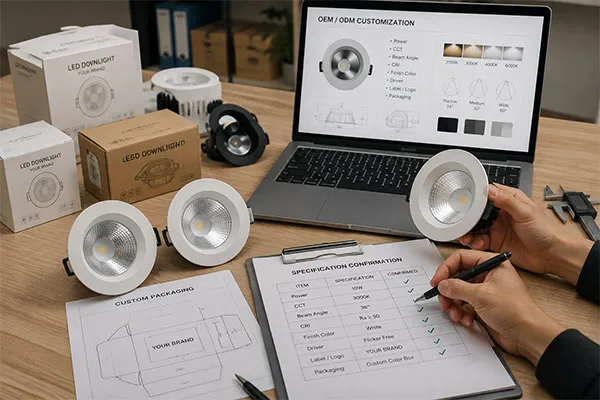
OEM support is not only printing a logo
Many buyers think OEM means adding a logo to a box or label. That is part of it, but long-term OEM supply requires more control. A local lighting brand may sell the same downlight model for years. If the product changes without notice, the brand may face complaints from distributors and installers.
For LED downlights, OEM and ODM support may include:
- Logo printing on product label
- Private label packaging
- Customized instruction sheet
- Different body colors
- Different CCT options
- Different beam angles
- Different CRI levels
- Different power versions
- Different driver solutions
- Market-specific plug or wiring preference
- Custom carton marks
- Product data sheet support
Our own customer base includes contractors, importers, wholesalers, trading companies, distributors, and local lighting brands. These customers often care about different things. A contractor may care most about delivery time and installation reliability. A distributor may care about stock consistency and packaging. A local brand may care about appearance, labels, and repeatable specifications.
Customization should be connected to real use
I do not recommend customization for decoration only. Every customized detail should solve a real business need.
| Buyer Type | Common Need | Supplier Risk to Check |
|---|---|---|
| Importer | Stable replenishment stock | Batch color and packaging consistency |
| Wholesaler | Competitive pricing and fast delivery | Clear MOQ and lead time |
| Distributor | Sellable packaging and labels | Label accuracy and carton strength |
| Contractor | Project deadline and site compatibility | Delivery schedule and technical confirmation |
| Local brand | OEM appearance and documentation | Logo, packaging, and document consistency |
| Trader | Flexible order support | Communication speed and small MOQ support |
Repeat-order management is a serious supplier skill
In long-term business, repeat orders are often more important than the first order. A buyer may start with one container or even a small trial order, but the relationship becomes valuable only if the supplier can repeat the same result.
I suggest asking these repeat-order questions:
- Do you keep production records for each order?
- Can you repeat the same packaging and label artwork?
- Will you notify me before changing LED chips or drivers?
- Can you support small replenishment orders?
- Can you separate different CCTs clearly in cartons?
- Can you provide updated data sheets when specifications change?
- Can you support mixed orders with indoor and outdoor LED products?
A supplier with a complete supply chain can often respond faster when buyers need custom requirements. However, the buyer should still verify every detail. Fast customization without confirmation can create mistakes.
Small orders can reveal supplier attitude
Some factories only focus on large orders. That may be reasonable for their production model. However, many overseas buyers need trial orders, sample orders, or small replenishment orders before committing to bigger cooperation.
A supplier that supports small batch orders may help buyers test a new market, confirm customer response, or fill stock gaps. However, the buyer should still expect clear terms. Small order support should not mean casual production. The same standards for specification confirmation, packaging, and inspection should apply.
What Quality Control and Documentation Should Buyers Verify?
Quality control can sound simple, but it must be practical. A buyer does not only need a beautiful product photo. A buyer needs evidence that the supplier can control incoming materials, production process, aging tests, packaging, and shipment checks. Without this, repeat orders become uncertain.
Buyers should verify that the LED downlight supplier has practical quality-control steps and matching documentation. Important checks include incoming material control, production inspection, aging test, appearance check, packaging inspection, carton labeling, and available CE, RoHS, or market-specific documents that match the product version and target market.
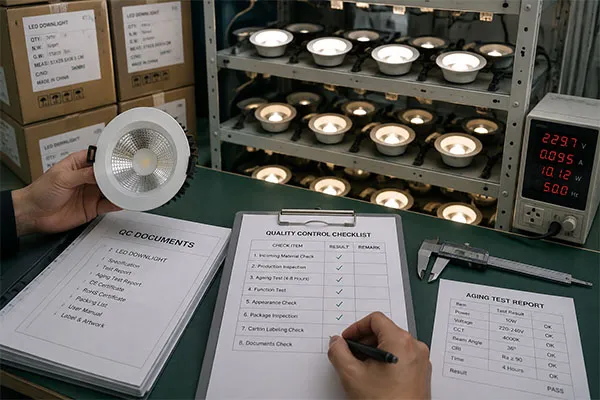
Quality control should be visible in the process
I prefer quality control that buyers can understand and verify. A supplier may say “good quality,” but that phrase is not enough for serious procurement. The buyer should ask how quality is controlled before, during, and after production.
Common quality-control points include:
-
Incoming material inspection
The supplier checks LED chips, drivers, housings, lenses, screws, wires, and packaging materials.
-
In-process inspection
The supplier checks assembly, wiring, polarity, appearance, and basic function during production.
-
The supplier runs products for a defined period to identify obvious early failures.
-
Final inspection
The supplier checks appearance, lighting function, labels, cartons, and quantities before shipment.
-
Packaging inspection
The supplier confirms inner boxes, master cartons, carton marks, and protection.
In our factory practice, products go through 100% aging before shipment, usually for 4 to 8 hours according to product type and order needs. I mention this because it is a practical question buyers can ask any supplier: What aging test do you perform, and how do you record it?
Documents should be checked before the order
Documentation is not only a customs issue. It can also affect tenders, project approvals, distributor onboarding, and brand trust. Buyers should ask for documents early instead of waiting until the shipment is ready.
Useful documents may include:
| Document | Buyer Use | What to Verify |
|---|---|---|
| Product data sheet | Sales, technical review, project submission | Model, power, CCT, beam angle, dimensions |
| CE document | EU-related safety review | Product scope and valid version |
| RoHS document | Environmental compliance review | Product scope and applicable standard |
| Test report | Technical verification | Model and tested parameters |
| Installation instruction | Contractor and end-user support | Wiring and safety information |
| Packing list | Shipment and warehouse receiving | Quantity and carton details |
| Commercial invoice | Customs and accounting | Product description and value |
| Label artwork | OEM and brand control | Logo, model, voltage, CCT, marks |
I recommend buyers verify certification requirements for their target market and project. A CE or RoHS document should not be treated as a universal solution for every country or every application.12 A qualified compliance professional, importer of record, or project consultant may be needed for market-specific decisions.
Packaging is part of quality
Many buyers focus on the downlight itself and overlook packaging. I understand this because the lighting fixture is the main product. However, damaged cartons, weak inner boxes, unclear labels, or mixed CCT cartons can create real cost.
Good packaging should protect the product and support the buyer’s sales channel. For wholesalers, carton strength matters because products may move through warehouses. For retailers and local brands, box design and label accuracy matter. For contractors, clear carton marks help site teams identify models quickly.
I recommend checking:
- Inner box size and material
- Master carton strength
- Quantity per carton
- Gross weight and net weight
- Product label content
- Carton mark information
- CCT separation method
- Pallet requirement if needed
- Drop-test or transport protection expectation if applicable
After-sales records help future improvement
A long-term supplier should learn from after-sales cases. If failures happen, the supplier should help identify the possible cause and adjust future production or packaging if needed. The buyer should also provide clear evidence so the supplier can investigate properly.
In long-term cooperation, after-sales communication should become a feedback loop. It should not be only a negotiation about compensation. It should help both sides reduce repeat problems.
Frequently Asked Questions
What is the most important factor when choosing an LED downlight supplier?
The most important factor is repeatable consistency. I recommend checking whether the supplier can deliver the same approved specification, packaging, labels, documents, and communication quality across multiple orders. A low price is useful only when the supplier can maintain stable product and service performance.
Is the cheapest LED downlight supplier always risky?
The cheapest supplier is not always risky. I suggest treating a very low price as a verification point. Buyers should check what components, packaging, warranty terms, documents, and delivery conditions are included. The risk appears when the low price sacrifices details that the buyer actually needs.
Should I trust the first sample from an LED downlight supplier?
I would treat the first sample as the starting point, not the final proof. Buyers should compare mass production with the approved sample and record key specifications such as power, CCT, beam angle, driver, finish, label, and packaging. Repeat-order consistency is the real test.
What documents should I request from an LED downlight supplier?
I suggest requesting a product data sheet, quotation, proforma invoice, packing details, label artwork, installation instructions, and available CE, RoHS, or test documents. Buyers should verify that documents match the exact product version and target market requirements before confirming the order.
Why does supplier communication matter in LED downlight procurement?
Supplier communication matters because unclear details can cause wrong samples, wrong packaging, delayed shipment, or after-sales disputes. I recommend choosing a supplier that confirms specifications, explains quotation terms, responds quickly, and handles problems with evidence and practical solutions.
Conclusion
Choosing an LED downlight supplier for long-term partnership is not only a price decision. It is a risk-control decision. I recommend verifying quotation details, sample consistency, communication habits, OEM support, quality-control process, documentation, packaging, and after-sales response before scaling orders. If you are comparing suppliers for project supply, wholesale distribution, private label business, or repeat stock replenishment, I can help you review specifications and prepare a practical quotation based on your market requirements.
"Advanced Procurement - Analyzing Costs Using Total Cost of Ownership", https://psep.smeal.psu.edu/short-courses/supply-chain-accelerator/advanced-procurement-analyzing-costs-using-total-cost-of-ownership. Procurement research on total cost of ownership treats purchase price as only one element of supplier cost, alongside quality, delivery, service, and transaction-related costs. Evidence role: general_support; source type: paper. Supports: Total cost of ownership frameworks in procurement consider acquisition price together with logistics, quality, service, warranty, and transaction costs.. Scope note: The support is contextual because total cost of ownership literature is not specific to LED downlights. ↩
"Impact of Thermal Dissipation on the Lighting Performance ...", https://pmc.ncbi.nlm.nih.gov/articles/PMC8776062/. Research on LED reliability identifies junction temperature and heat dissipation as important determinants of lumen maintenance and lifetime, supporting the article’s link between housing design and durability. Evidence role: mechanism; source type: paper. Supports: Thermal management and heat dissipation affect LED junction temperature, lumen maintenance, and service life.. Scope note: The evidence is about LED devices and luminaires broadly, not a direct test of the supplier’s specific housing materials. ↩
"Europe", https://en.wikipedia.org/wiki/Europe. European Commission guidance states that CE marking and conformity documentation are used to demonstrate compliance with applicable EU product requirements before products are placed on the market. Evidence role: general_support; source type: government. Supports: For regulated products in the EU, CE marking and related technical documentation are part of conformity assessment and market placement requirements.. Scope note: The support is jurisdiction-specific and does not establish requirements for every country, project, or lighting application. ↩
"Color rendering index", https://en.wikipedia.org/wiki/Color_rendering_index. Lighting standards and technical references define correlated color temperature as a descriptor of light appearance and color rendering index as a measure of color rendering performance, supporting the article’s use of CCT and CRI as relevant specification controls. Evidence role: definition; source type: institution. Supports: CCT describes the apparent color of light, and CRI describes how accurately a source renders object colors compared with a reference illuminant.. Scope note: The source supports the meaning and relevance of the metrics, but not any specific comfort outcome for a particular installation. ↩
"LED Dimming: What you need to know", https://www1.eere.energy.gov/buildings/publications/pdfs/ssl/dimming_webcast_12-10-2012.pdf. Technical guidance on LED lighting explains that driver electronics and dimmer compatibility influence flicker and stable operation, supporting the need to verify driver specifications before procurement. Evidence role: mechanism; source type: government. Supports: LED driver design and dimming compatibility can affect flicker, stability, and lighting performance.. Scope note: The source may address LED lighting systems generally rather than the exact downlight models discussed in the article. ↩
"6. Process or Product Monitoring and Control", https://www.itl.nist.gov/div898/handbook/toolaids/pff/pmc.pdf. Quality-control guidance explains that inspection and process control are needed to manage variation in production, supporting the article’s distinction between an approved sample and repeatable manufacturing reliability. Evidence role: general_support; source type: government. Supports: Quality assurance relies on process control, inspection, and records over production, not merely approval of one sample.. Scope note: The source supports general quality-control reasoning rather than LED downlight sample approval specifically. ↩
"EQA_Exh5.docx", https://science.osti.gov/-/media/SCMS/Management-Systems/QUAL/EQA/EQA_Exh5.docx. Quality-management standards emphasize documented product requirements, controlled production conditions, and traceability where needed, supporting the article’s recommendation to record specifications and certification versions. Evidence role: expert_consensus; source type: institution. Supports: Quality-management systems require documented information and controlled production conditions where necessary to ensure conformity to product requirements.. Scope note: The source supports a general quality-management principle and does not prescribe the exact list of downlight fields in the article. ↩
"ANSI_NEMA_ANSLG C78.377-2008 American National ...", https://ptacts.uspto.gov/ptacts/public-informations/petitions/1553636/download-documents?artifactId=uT6ZhRErO6Ggr0AebIdnW7bjhgs_wpt-_GXHf5vg37F2KTPDAteY72g. Lighting-industry standards and guidance on LED chromaticity tolerances recognize that color differences can be perceptible, especially when sources are compared in the same visual field. Evidence role: mechanism; source type: institution. Supports: Human observers can notice chromaticity differences, and LED standards use chromaticity tolerances to manage color consistency.. Scope note: The evidence supports perceptibility of color variation but does not measure complaint rates among the article’s buyer groups. ↩
"Information Sharing, Buyer-Supplier Relationships and Firm Performance", https://oasis.library.unlv.edu/mib_fac_articles/14/. Supply-chain management research links buyer-supplier communication and information sharing with better coordination and performance, supporting the article’s claim that communication is part of procurement reliability. Evidence role: general_support; source type: paper. Supports: Buyer-supplier communication and information sharing are associated with coordination, reduced errors, and improved supply-chain performance.. Scope note: The support is general supply-chain evidence, not a direct study of LED downlight procurement. ↩
"Risk Mitigation in Project Management - Schedule ...", https://www.ascertra.com/blog/risk-mitigation-in-project-management?hs_amp=true. Project-management guidance treats procurement timing and delivery uncertainty as schedule-planning considerations, supporting the article’s warning that vague lead times can threaten project deadlines. Evidence role: general_support; source type: institution. Supports: Project schedules depend on defined procurement lead times, and uncertainty in deliveries can create schedule risk.. Scope note: The source supports schedule-risk logic generally and may not discuss lighting projects specifically. ↩
"Lifetime and Reliability", https://www1.eere.energy.gov/buildings/publications/pdfs/ssl/life-reliability_fact-sheet.pdf. Reliability-engineering literature describes burn-in testing as a method for screening early-life failures in electronic products, supporting the article’s treatment of aging tests as a quality-control measure. Evidence role: mechanism; source type: paper. Supports: Burn-in or aging tests are used in reliability engineering to precipitate or detect early-life failures in electronic components and assemblies.. Scope note: The source supports the mechanism of burn-in generally; it does not verify that a 4-to-8-hour test is sufficient for all LED downlights. ↩
"EU - EU Legislation and CE Marking", https://www.trade.gov/country-commercial-guides/eu-eu-legislation-and-ce-marking. Official EU guidance describes CE marking and RoHS obligations as requirements within defined European regulatory scopes, supporting the article’s caution that these documents are not universal compliance solutions. Evidence role: historical_context; source type: government. Supports: CE marking and RoHS compliance are tied to specific EU regulatory frameworks and product scopes rather than universal global approval.. Scope note: The source clarifies EU scope but does not enumerate every alternative requirement in non-EU markets. ↩