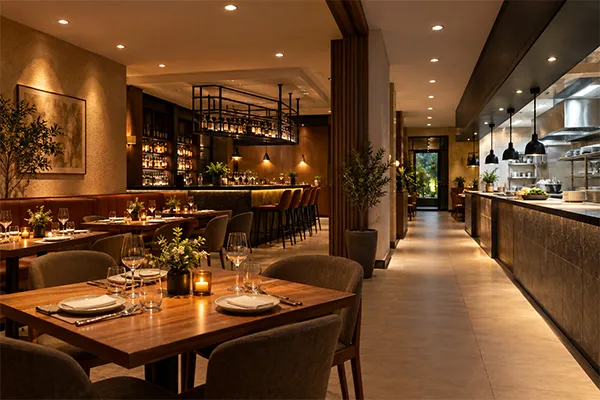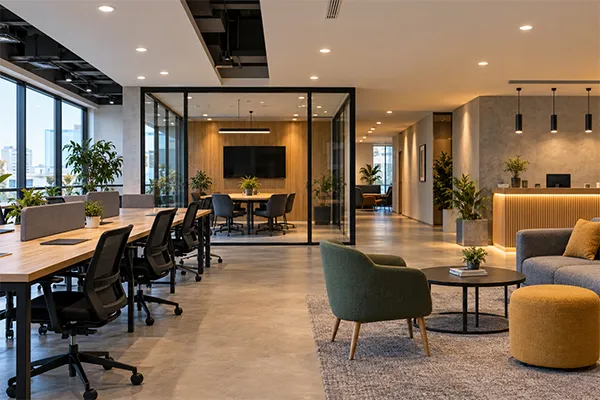
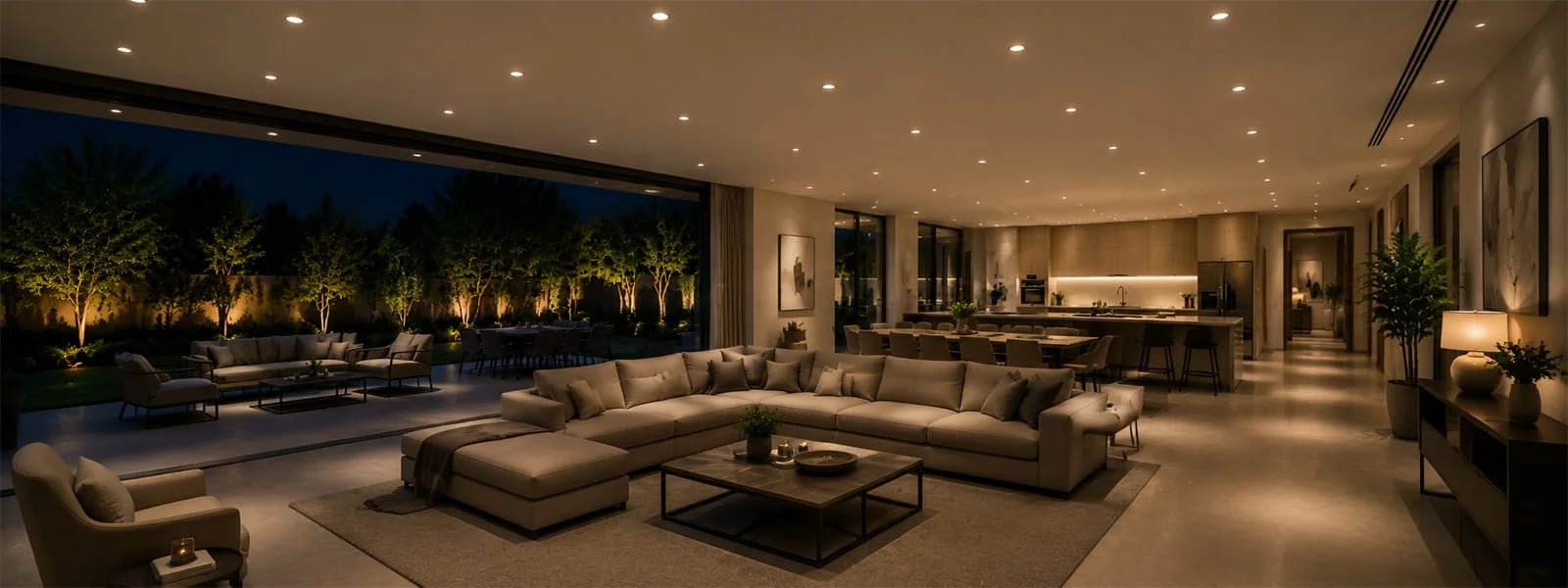
Beam angle for COB downlight is one of the most common details that buyers overlook until the lighting result looks wrong. A project may have good wattage, good color temperature, and good housing quality, but the wrong beam can still create glare, dark zones, weak illumination, or customer complaints. The solution is to match beam angle with the real application.
To choose beam angle for COB downlight, match the angle to the lighting task, mounting height, fixture spacing, and target area. Narrow beams usually suit accent lighting, medium beams suit many commercial and general applications, and wider beams suit broader coverage. The final choice should always be confirmed with site conditions and installation goals.
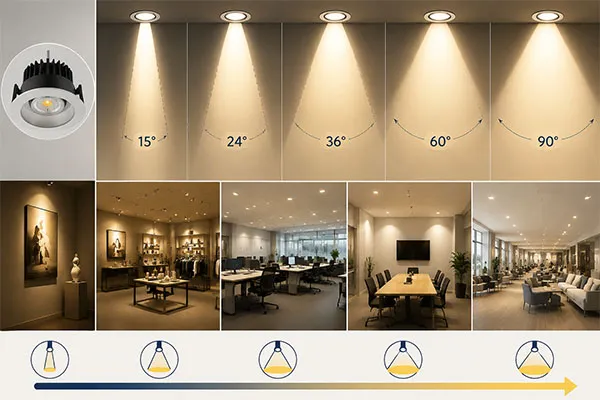
I have seen many customers start with “Do you have 24°, 36°, or 60°?” That is a normal starting point, but it is not enough. In real projects, I ask more questions before I suggest a lens angle, because the same COB downlight can perform very differently after installation.
What Does Beam Angle for COB Downlight Really Mean?
Many buyers know the number, but they do not always know what the number changes on site. This creates a problem because a 24° beam, a 36° beam, and a 60° beam can produce very different effects even with the same wattage. If the meaning is unclear, stock decisions and project choices become risky.
Beam angle for COB downlight describes how wide the main light output spreads from the fixture.1 A narrower angle concentrates light into a smaller area, while a wider angle spreads light over a larger area. However, the practical result depends on mounting height, spacing, surface reflectance, and the lighting purpose.
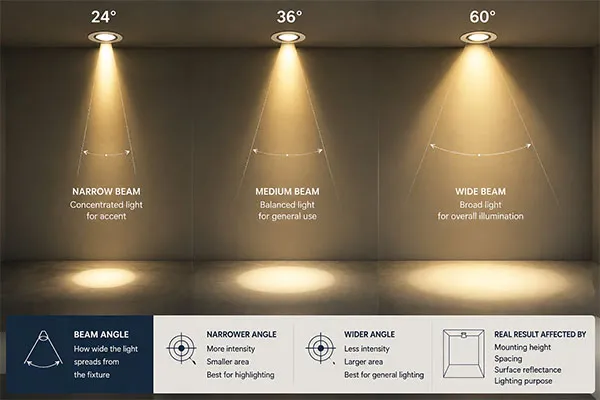
Beam angle is about light distribution, not only brightness
A COB downlight uses a chip-on-board LED source, usually combined with a reflector or lens.2 The beam angle is mainly shaped by this optical part. When I discuss COB downlight beam angle with customers, I normally explain it as a “distribution decision,” not a simple brightness decision.
Wattage tells us how much electrical power the fixture consumes. Lumen output tells us how much visible light the fixture produces. Beam angle tells us where that light goes.3
For example, two COB downlights may both be 20W and both have similar lumen output. But if one uses a 24° beam and the other uses a 60° beam, the visual result can be very different:
| Item | Narrow Beam COB Downlight | Wide Beam COB Downlight |
|---|---|---|
| Light spread | Smaller area | Larger area |
| Center intensity | Usually stronger | Usually softer |
| Risk if misused | Bright spots and dark gaps | Weak target illumination |
| Common use | Accent, display, focused lighting | General coverage, lower ceilings |
| Key condition | Accurate aiming and spacing | Enough output and proper layout |
Common beam angle ranges
Different factories may define optical angles slightly differently, but in many COB downlight projects, I see these common ranges:
- 15° to 24°: narrow beam for focused light or accent effects
- 30° to 40°: medium beam for many retail, hotel, corridor, and commercial areas
- 50° to 60° or wider: broad beam for wider coverage and softer distribution
These are only starting points. I do not recommend choosing beam angle only from a catalog table. The ceiling height, installation spacing, and lighting task matter more than the number alone.
Why the same angle may not feel the same in every project
A 36° beam in a low ceiling shop may feel focused and bright. The same 36° beam in a high ceiling lobby may create a smaller bright area and leave surrounding zones darker. Also, wall color, floor reflectance, furniture layout, and the presence of other lights can all change the final perception.
In my factory work, I often receive feedback after customers test samples. Sometimes they ask to change from 24° to 36° because the original beam looks too sharp. Sometimes they change from 60° to 38° because the display surface does not feel strong enough. This is why I always treat beam angle as a project-matching parameter, not a fixed answer.
How Does Mounting Height Affect Beam Angle for COB Downlight?
Mounting height is one of the biggest reasons why beam angle choices go wrong. A beam that works well at 2.8 meters may not work at 5 meters. If buyers ignore ceiling height, they may receive complaints about dim areas, uneven floors, or uncomfortable contrast.
Mounting height affects beam angle for COB downlight because the light cone becomes larger as the distance from the fixture increases. Higher ceilings often need a more controlled beam or higher output, while lower ceilings may need wider or softer distribution to avoid harsh spots.4 The correct choice should match both height and target coverage.
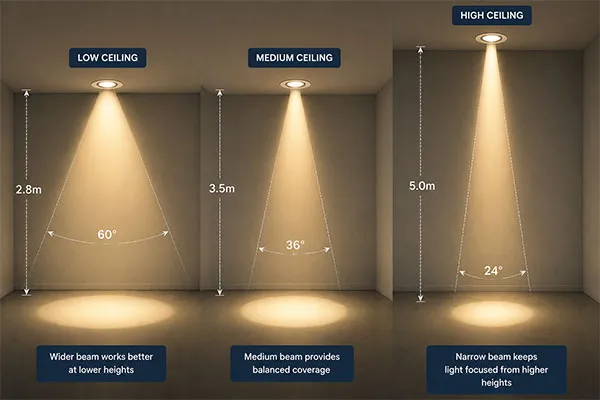
Higher ceilings change the practical beam spread
The beam angle number does not change after installation, but the illuminated area changes with distance. When the fixture is mounted higher, the beam travels farther before reaching the floor, table, product shelf, or counter. This means the light circle becomes larger. At the same time, the light intensity on the target surface normally becomes lower.5
This is why a wide beam can become too soft in a high ceiling space. The light spreads broadly, but the target may not receive enough useful illumination. In contrast, a narrow or medium beam may help deliver more light to the target surface, but it may also create obvious bright zones if spacing is not designed well.
Lower ceilings need comfort and control
In lower ceilings, the fixture is closer to people’s eyes and working surfaces. A very narrow beam may create strong contrast on the floor or table. It may also make the ceiling layout look spotty. A wider beam may help create smoother coverage, but it still needs glare control and suitable fixture design.6
I have seen customers use narrow beams in low-ceiling retail areas because they wanted a “premium” spotlight effect. After installation, the result looked too dramatic for the space. The products under the beams looked bright, but the walking path between fixtures looked dark. The customer later tested a medium beam and the result became more balanced.
Practical starting points by ceiling condition
The table below is not a fixed rule. It is only a practical way to start discussion with a supplier or lighting designer.
| Ceiling / Mounting Situation | Beam Angle Starting Point | Main Risk to Check |
|---|---|---|
| Low ceiling, general area | Medium to wide beam | Glare, visible hot spots |
| Standard commercial ceiling | Medium beam | Uneven spacing or weak edges |
| Higher ceiling | Narrow to medium beam | Dark zones between fixtures |
| Product display wall | Narrow or medium beam | Wrong aiming or excessive contrast |
| Corridor or circulation area | Medium beam often works | Patchy floor pattern |
Mounting height should be shared before ordering
When customers ask me for a COB downlight quotation, I prefer to know the mounting height before suggesting the lens angle. If the customer only says “20W COB downlight, 36 degree,” I can quote it, but I cannot know whether it is truly suitable.
Useful mounting details include:
- Ceiling height from floor
- Distance from fixture to target surface
- Whether the light hits floor, wall, shelf, table, or product
- Whether fixtures are recessed, surface-mounted, or adjustable
- Whether the area has other lighting sources
These details help reduce wrong beam angle selection. They also help avoid slow-moving stock for wholesalers and distributors. A common angle may sell well, but a project order needs better matching.
Which Beam Angle for COB Downlight Fits Accent, General, and Wide Coverage?
Many buyers want one standard beam angle that can cover every project. I understand that because stock management becomes easier. However, one angle rarely fits all lighting tasks. If the task is not clear, the same COB downlight may look excellent in one project and disappointing in another.
The best beam angle for COB downlight depends on whether the goal is accent lighting, general illumination, or wide coverage. Narrow beams normally support focused highlights, medium beams fit many commercial downlight applications, and wider beams support broader distribution. The final selection still depends on height, spacing, and target size.
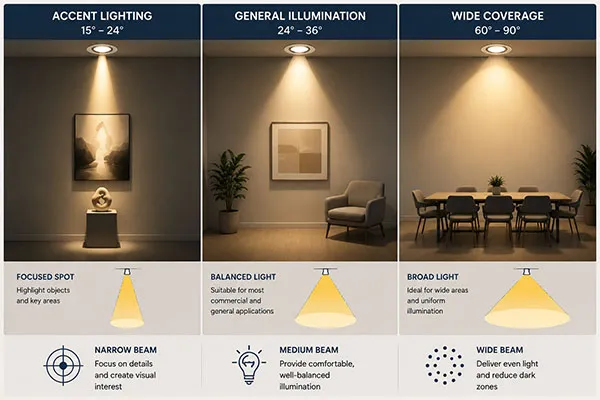
Accent lighting needs control
Accent lighting is used to make something stand out. It may be a product display, hotel artwork, showroom wall, restaurant table, jewelry counter, or retail focal point. In these situations, a narrower beam can help concentrate light on the object.7
However, narrow beam COB downlights are not always better for accent lighting. If the object is large, a very narrow beam may only brighten one part. If the fixture position is not aligned with the target, the beam may miss the object. If the ceiling is low, the bright spot may look too strong.
Common accent lighting considerations include:
- Target size: Small products can use tighter beams. Large displays may need wider beams or multiple fixtures.
- Mounting position: Adjustable COB downlights may help when the fixture is not directly above the target.
- Surface reflectance: Glossy surfaces may create glare or reflections.
- Contrast goal: Luxury retail may want stronger contrast. Offices may not.
General lighting usually needs balance
Many commercial areas need a balance between usable light and visual comfort. This includes shops, corridors, hotel areas, reception spaces, showrooms, and some office-related areas. In these cases, a medium beam angle is often a practical starting point.
A medium COB downlight beam angle can reduce the risk of extreme hot spots compared with narrow beams.8 It can also deliver better target intensity than very wide beams in many spaces. But again, spacing and ceiling height decide whether it works.
In my experience, many buyers choose 36° as a familiar middle option. I do not treat 36° as a universal answer. I treat it as a useful starting point for discussion. A project may still need 24°, 38°, 45°, or 60° depending on layout.
Wide coverage needs enough output
Wider beam angles can help cover larger areas and create softer transitions between fixtures. This can be useful in lower ceilings, residential-style commercial interiors, public areas, or spaces where the customer wants less contrast.
The risk is that a wide beam spreads the same light over more area. If the wattage and lumen output are not enough, the surface may look weak.9 Some customers choose 60° because they want “more coverage,” but after installation they feel the light is not strong enough on the floor or products.
Application-based comparison
| Lighting Task | Typical Beam Direction | Possible Beam Choice | What I Check First |
|---|---|---|---|
| Product accent | Focused on display | Narrow to medium | Target size and aiming |
| General shop lighting | Downward or semi-focused | Medium | Spacing and ceiling height |
| Hotel corridor | Downward rhythm | Medium | Floor uniformity and glare |
| Large open area | Broad coverage | Medium to wide | Output and fixture quantity |
| Wall feature | Adjustable direction | Narrow to medium | Distance from wall |
Do not separate beam angle from the lighting task
When I help customers choose beam angle for COB downlight, I usually ask, “What do you want the light to do?” That simple question often gives more value than asking about wattage first.
A downlight can:
- Highlight a display
- Light a walking path
- Create a comfortable dining mood
- Support general visibility
- Add contrast to an interior
- Replace an old fixture with similar effect
Each goal can lead to a different optical choice. This is why I recommend importers, wholesalers, and local lighting brands keep several beam options when their customers work on different project types.
How Do Spacing and Target Area Change Beam Angle for COB Downlight?
Fixture spacing is another common cause of lighting complaints. Even with the right product quality, poor spacing can make the area look uneven. If the beam is too narrow for the spacing, dark gaps appear. If the beam is too wide for the target, the light may feel flat or weak.
Spacing and target area change beam angle for COB downlight because they decide how light beams overlap.10 Wider spacing may need wider beams or more fixtures, while focused target areas may need narrower beams. The goal is to create the desired coverage without strong hot spots, dark zones, or wasted light.
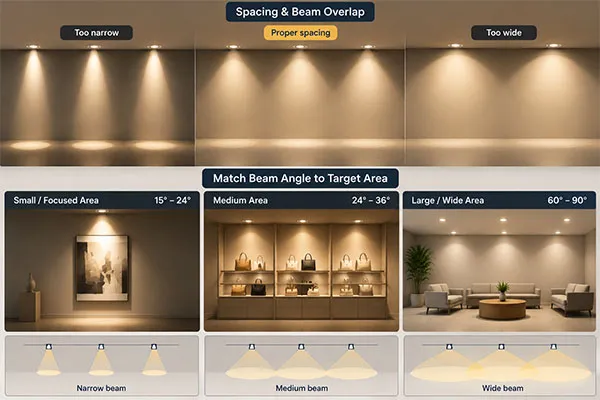
Beam overlap affects uniformity
In many ceiling layouts, each COB downlight creates a beam pattern on the floor or target surface. When fixtures are placed correctly, these beam patterns overlap in a controlled way. The space looks smooth, and the customer feels the lighting is comfortable.
If the beam is too narrow and spacing is wide, the light patches may not overlap enough. The floor may show bright circles and dark areas.11 This is especially noticeable in corridors, retail aisles, and hotel public spaces.
If the beam is too wide and fixtures are close together, the area may become bright but not focused. This is not always bad. Some projects want soft general lighting. But for display lighting, too much wide spill can reduce product contrast.
Target area matters more than catalog habit
A catalog may show 24°, 36°, and 60° options. But the target area decides which one makes sense.
For example:
- A small jewelry display may need a controlled beam.
- A wide supermarket aisle may need broader and more even coverage.
- A hotel reception desk may need both functional light and visual comfort.
- A feature wall may need several adjustable downlights with controlled beams.
- A restaurant table may need warm, focused light without harsh glare.
When the target is small, a wide beam may waste light around it. When the target is large, a narrow beam may require more fixtures or better aiming. This is why beam angle for COB downlight should always be connected to the target size.
A simple decision process I use with customers
I often use a simple process before confirming a COB downlight lens angle:
-
Define the target
- Floor, wall, product, table, counter, artwork, or general area.
-
Check the mounting height
- The same beam angle covers a larger area at greater distance.
-
Review fixture spacing
- Wide spacing needs careful overlap.
- Close spacing may allow narrower or medium beams.
-
Confirm the visual effect
- Uniform, focused, soft, dramatic, premium, or functional.
-
Compare with existing fixture
- If replacing old lights, the current beam angle and installation feedback are valuable.
-
Test sample when possible
- A real sample test often prevents large-order problems.
Why wrong spacing causes stock and project problems
For wholesalers and distributors, wrong beam angle selection can become a stock issue. A customer may buy one “standard” beam angle in bulk. Later, contractors report that it does not suit a high-ceiling shop or a low-ceiling corridor. Then the distributor must handle returns, discounts, or replacement orders.
For contractors, the problem is even more direct. If the installed lighting looks uneven, the end customer may not care whether the fixture quality is good. They only see the result. They may ask for replacement, rework, or extra fixtures.
I once received feedback from a customer who used a narrow beam in a commercial area with wide fixture spacing. The COB downlight itself passed aging tests and worked normally, but the floor showed clear bright and dark zones. After reviewing the layout, the customer tested a wider lens option and adjusted part of the spacing. The final result became more acceptable.
This kind of issue is not only a product issue. It is an application matching issue.
What Information Should You Send Before Choosing Beam Angle for COB Downlight?
Many quotation requests are too short. A buyer may send only wattage, color temperature, and quantity. That is enough for a price, but it is not enough for a reliable beam angle suggestion. Missing project information can lead to wrong samples, slow confirmation, and weak installation results.
Before choosing beam angle for COB downlight, send the supplier mounting height, fixture spacing, ceiling layout, application area, lighting task, target surface, desired effect, and existing fixture details. Useful existing specs include wattage, CCT, CRI, cut-out size, current beam angle, and any installation complaints.
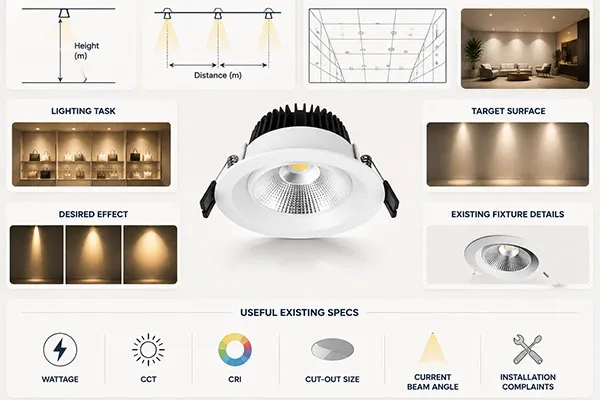
The minimum project information I like to receive
When I work with importers, contractors, and lighting brands, I do not need a perfect lighting design file at the first stage. But I do need enough information to understand the project.
Here is a practical checklist:
| Information | Why It Matters |
|---|---|
| Mounting height | Changes beam spread and target intensity |
| Fixture spacing | Controls overlap and uniformity |
| Application area | Retail, hotel, office, corridor, villa, showroom, etc. |
| Lighting task | Accent, general, wall wash, display, circulation |
| Target surface | Floor, product, wall, table, counter, artwork |
| Desired effect | Soft, focused, dramatic, uniform, premium |
| Existing wattage | Helps compare old and new fixtures |
| CCT and CRI | Supports visual matching, but does not replace beam angle |
| Cut-out size | Ensures fixture fits ceiling opening |
| Current beam angle | Helps improve or repeat existing effect |
| Complaint details | Explains what needs to change |
Existing fixture information is very useful
Replacement projects are common. In these cases, the old fixture can teach us a lot. If the customer says, “The current light is too narrow,” I know we may need a wider beam or different spacing. If the customer says, “The products are not bright enough,” we may need a more controlled beam, higher lumen output, or a different layout.
I usually ask for:
- A photo of the existing fixture label
- A photo of the ceiling layout
- A photo of the lighting effect at night or during operation
- The current cut-out size
- The current beam angle, if available
- The installation height
- The customer’s complaint or desired improvement
These details make supplier communication much faster.
Do not treat CCT, CRI, wattage, and beam angle as the same decision12
I sometimes see buyers mix different lighting parameters together. They may say, “I need high CRI, so the beam should be better,” or “I need 30W, so coverage should be enough.” This is not accurate.
Each parameter has a different job:
| Parameter | Main Job |
|---|---|
| Wattage | Electrical power consumption |
| Lumen output | Total visible light output |
| Beam angle | Light distribution and coverage |
| CCT | Color appearance, such as warm or cool white |
| CRI | Color rendering quality |
| Glare control | Visual comfort and eye comfort |
| Cut-out size | Physical installation fit |
A good COB downlight choice considers all of them together. But no single parameter guarantees the final lighting result.
Why supplier communication prevents complaints
As a manufacturer, I can customize several COB downlight details depending on product structure and order requirements. These may include lens angle, wattage, CCT, CRI, finish color, and other specifications. However, customization only helps when the project requirement is clear.
For example, if a contractor sends a ceiling plan and mounting height, I can suggest whether a narrow, medium, or wide option is a safer starting point. If a wholesaler wants stock, I can discuss which beam angles are more flexible for their customer base. If a local lighting brand wants private-label products, I can help them build a practical range instead of stocking too many slow-moving optical versions.
I still recommend sample testing when possible. A small sample test can reveal glare, beam edge, center intensity, and installation appearance before a larger order. In our production process, every product must pass aging tests before shipment, but optical suitability should still be checked against real site conditions.
How Can Importers and Wholesalers Stock COB Downlight Beam Angles More Safely?
Stocking the wrong beam angle can quietly reduce profit. A distributor may buy a large quantity because the price is good, but if the angle does not match local project needs, the products move slowly. Worse, contractors may complain after installation and avoid reordering.
Importers and wholesalers can stock COB downlight beam angles more safely by matching inventory to common local applications. A medium beam is often a flexible starting point, but narrow and wide options may be needed for display and broad-coverage projects. Stock choices should reflect customer types, ceiling heights, and project feedback.
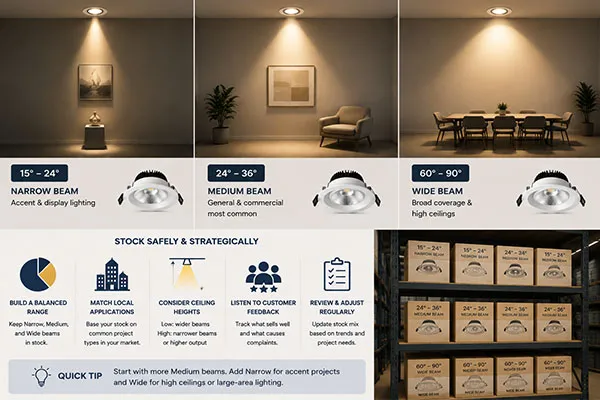
Stock planning should follow customer use cases
A wholesaler serving retail contractors may need more medium and narrow beam COB downlights because shops often need display accents. A distributor serving residential and small commercial channels may sell more medium or wider beams. A brand working with hotel and villa projects may need multiple options for different zones.
I often suggest that customers review their past orders and complaints. The best stock plan usually comes from real sales data, not only from factory catalogs.
Questions to ask include:
- Which projects buy COB downlights most often?
- Are customers mainly replacing old lights or building new projects?
- What ceiling heights are common in the market?
- Do customers ask for accent lighting or general lighting?
- Which beam angles caused complaints before?
- Which angle had the fastest repeat orders?
A practical stock mix concept
The exact mix depends on your market. Still, many distributors can think in terms of three product roles:
| Stock Role | Beam Type | Purpose |
|---|---|---|
| Core stock | Medium beam | Flexible for many commercial projects |
| Project stock | Narrow beam | Accent and display applications |
| Optional stock | Wide beam | Broader coverage and lower-ceiling needs |
This does not mean every distributor needs all angles in large quantities. Some customers prefer to keep a core beam angle in stock and order special angles by project. This approach can reduce inventory pressure.
Customization can reduce wrong bulk decisions
OEM and ODM supply is useful when a buyer wants a product range that matches their market. In our case, customers often ask for different lens angles, wattages, color temperatures, CRI levels, and housing finishes. For COB downlights, the optical choice is especially important because it directly affects the visible result.
However, I always prefer to confirm the application before producing a customized batch. A custom lens angle sounds simple, but a wrong custom angle can become a large inventory problem.
Use project feedback to improve future orders
After installation, feedback is very valuable. I encourage customers to send comments such as:
- “The beam is too narrow for this ceiling height.”
- “The product display looks good, but the walking area is dark.”
- “The light is comfortable, but the counter needs more intensity.”
- “The old fixture had wider spread, and the customer wants the same effect.”
- “The beam edge is too visible on the wall.”
This feedback helps me advise better on the next order. It also helps wholesalers build a smarter local range. In my experience, the customers who share installation feedback usually reduce mistakes faster than customers who only reorder by wattage and price.
Frequently Asked Questions
Is 36° the best beam angle for COB downlight?
No, 36° is not universally the best beam angle for COB downlight. It is often a practical medium option, but the right choice depends on mounting height, spacing, target area, and lighting task. It may work well in many commercial projects, but it should still be checked against site conditions.
Should I choose 24° or 60° for a COB downlight?
You should choose 24° when you need more focused accent lighting and the target area supports it. You should choose 60° when you need broader coverage and softer distribution. However, both choices can fail if ceiling height, fixture spacing, and lumen output are not suitable.
Does higher wattage mean I can use a wider beam angle?
Higher wattage may provide more light output, but it does not automatically make a wider beam suitable. A wider beam spreads light over a larger area, so target intensity may still feel weak. You should consider lumen output, beam angle, mounting height, spacing, and the required lighting effect together.
What beam angle should I stock as a wholesaler?
Many wholesalers start with a medium beam because it can suit many general commercial applications. However, your stock plan should depend on your customers. Retail display contractors may need narrow beams, while general building channels may need medium or wide options. Past sales and complaint feedback are the best guide.
Can a supplier customize the beam angle for COB downlights?
Yes, many manufacturers can offer different lens or reflector angles for COB downlights, depending on the product structure and order requirements. You should send mounting height, layout, application, target area, and desired effect before customization. This helps avoid producing a beam angle that does not fit the project.
Conclusion
Choosing beam angle for COB downlight is not about finding one “best” angle. It is about matching the optical distribution to the lighting task, mounting height, spacing, and target area. Narrow beams can support accent lighting, medium beams can fit many commercial uses, and wider beams can help with broader coverage. But every choice should be confirmed with project conditions. If you are selecting COB downlights for a project or planning stock for your market, send me your layout details and requirements. I can help you review practical beam angle options before ordering.
"Beam angle", https://en.wikipedia.org/wiki/Beam_angle. A lighting-standards source defines beam angle as the angular extent of a luminaire's beam based on its luminous intensity distribution, supporting the article's use of beam angle as a descriptor of light spread. Evidence role: definition; source type: institution. Supports: A lighting standards or photometry source should define beam angle as the angular spread of a luminaire's beam, commonly measured by intensity distribution criteria.. ↩
"Light-emitting diode", https://en.wikipedia.org/wiki/Light-emitting_diode. Technical literature on LED packages and luminaires describes chip-on-board LEDs as integrated LED arrays and notes that secondary optics such as lenses and reflectors are used to control beam distribution. Evidence role: mechanism; source type: research. Supports: A technical source should explain that COB LEDs mount multiple LED chips on a substrate and that LED luminaires commonly use lenses or reflectors to control distribution.. ↩
"Realization of the lumen | NIST", https://www.nist.gov/pml/sensor-science/optical-radiation/realization-lumen. Government and standards-based lighting references distinguish electrical power in watts from luminous flux in lumens and from distribution metrics such as beam angle, supporting the article's separation of these parameters. Evidence role: definition; source type: government. Supports: A government or standards source should define wattage as electrical power, lumens as luminous flux, and beam angle as a distribution measure.. ↩
"Uniformity vs. Light Distribution: Key Differences", https://www.luminatelightinggroup.com/post/uniformity-vs-light-distribution-key-differences. Lighting-design guidance treats mounting height as a key factor in luminaire distribution, illuminance, uniformity, and glare assessment, supporting the article's claim that beam selection must change with ceiling height. Evidence role: general_support; source type: institution. Supports: A lighting-design source should support that mounting height influences beam spread, illuminance, uniformity, and visual comfort considerations.. Scope note: Such guidance supports the design logic but does not prescribe one universal beam angle for every COB downlight installation. ↩
"Inverse Square Law for Light", http://hyperphysics.phy-astr.gsu.edu/hbase/vision/isql.html. Photometry references describe how a fixed beam angle produces a larger illuminated area as distance increases and how illuminance generally decreases with distance, consistent with beam-spread geometry and inverse-square behavior. Evidence role: mechanism; source type: education. Supports: An educational or lighting-design source should explain beam spread geometry and illuminance reduction with increased distance.. Scope note: The inverse-square relationship is an idealized model and may be modified in real rooms by luminaire optics, surface reflectance, and interreflections. ↩
"Calculation of the Unified Glare Rating based on luminance maps for ...", https://ui.adsabs.harvard.edu/abs/2015BuEnv..84...60S/abstract. Lighting standards and guidance on glare, including CIE and IES materials, identify luminaire distribution, source luminance, viewing position, and room conditions as factors in visual comfort, supporting the article's warning that wider distribution alone does not ensure comfort. Evidence role: expert_consensus; source type: institution. Supports: A CIE, IES, or similar source should explain that visual comfort depends on glare control as well as distribution.. Scope note: The source would support the general glare principle rather than test the specific downlight models discussed in the article. ↩
"LED Lighting in a Performing Arts Building at the University ...", https://www.pnnl.gov/main/publications/external/technical_reports/PNNL-23514.pdf. Lighting-design references describe accent lighting as directional illumination used to emphasize selected objects or features, and note that narrower distributions can concentrate light on smaller targets. Evidence role: general_support; source type: education. Supports: A lighting-design source should state that accent lighting uses directional or focused light to emphasize selected objects or areas.. Scope note: The source supports the design principle but not a specific beam-angle threshold for every project. ↩
"Choosing a Beam Angle for Your Ceiling Height", https://hi-hyperlite.com/blogs/comprehensive-guides/choose-high-bay-beam-angle-ceiling-height?srsltid=AfmBOop5MvLxVELMn6zl5irsH7PSEMudEj_tkI-9XCNIdyoTZ1tWzdgg. Photometric analysis shows that concentrating luminous flux into a smaller beam increases center-beam intensity, so broader or medium distributions can reduce the contrast that produces visible hot spots. Evidence role: mechanism; source type: research. Supports: A photometry source should support that narrower beams concentrate luminous intensity over a smaller solid angle, increasing center intensity and the likelihood of visible hot spots.. Scope note: The relationship is general; actual hot-spot visibility also depends on optics quality, spacing, mounting height, and surface reflectance. ↩
"Luminous flux", https://en.wikipedia.org/wiki/Luminous_flux. Photometry references define illuminance as luminous flux incident on a surface per unit area, supporting the article's point that distributing the same light over a wider area can reduce surface illuminance. Evidence role: definition; source type: encyclopedia. Supports: A photometry source should define illuminance as luminous flux incident per unit area, supporting why spreading the same output over more area lowers illuminance.. Scope note: This supports the physical basis of the claim, while perceived brightness can also be affected by adaptation, contrast, and surface reflectance. ↩
"Lighting Design Guidelines 2024", https://www.codot.gov/safety/traffic-safety/assets/documents/cdot-lighting-design-guideline.pdf. Lighting-design guidance on luminaire spacing and spacing criteria explains that fixture distribution and spacing determine beam overlap and illuminance uniformity on the target plane. Evidence role: mechanism; source type: institution. Supports: A lighting-design source should explain that luminaire spacing and distribution determine beam overlap and illuminance uniformity.. ↩
"“There's no 'standard spacing' in lighting design.” “One of ...", https://www.instagram.com/p/DXbNKg_E0Ry/. Lighting-layout texts describe poor illuminance uniformity as a result of mismatched luminaire spacing and distribution, supporting the article's claim that narrow beams placed too far apart can produce visible bright and dark zones. Evidence role: mechanism; source type: education. Supports: A lighting-design education source should show that insufficient overlap between luminaire beams can cause poor uniformity and visible bright/dark areas.. Scope note: The source would support the layout mechanism, while the exact visibility of patches depends on photometric files, ceiling height, finishes, and observer conditions. ↩
"Color rendering index", https://en.wikipedia.org/wiki/Color_rendering_index. Government lighting references define correlated color temperature, color rendering index, electrical power, and distribution-related measures as separate performance characteristics, supporting the article's distinction among these decisions. Evidence role: definition; source type: government. Supports: A government or standards source should define CCT, CRI, wattage, and beam distribution as separate metrics with different purposes.. ↩