Finding a reliable LED downlight manufacturer in China can feel simple at first, because many suppliers reply quickly with attractive prices. The problem starts when the sample, quotation, certificate, and mass production do not match. I suggest treating supplier selection as risk control, not only price comparison.
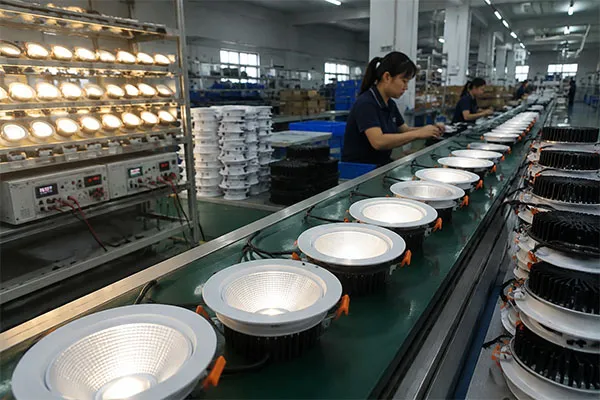
A reliable LED downlight manufacturer in China should control product configuration, sampling, mass production consistency, testing, delivery, and communication. Buyers should verify the LED chip, driver, housing, beam angle, CRI, certification documents, aging test process, packaging, lead time, and after-sales response before placing repeated or project orders.
From my manufacturer-side communication with overseas buyers, I have noticed one pattern. The best purchasing decisions usually start with detailed questions, not the lowest unit price. If you know what to verify before ordering, you can avoid many common supply-chain problems.
What Makes a Reliable LED Downlight Manufacturer in China?
Choosing a reliable LED downlight manufacturer in China becomes difficult when every supplier claims good quality, fast delivery, and competitive pricing. The risk is that these words mean little unless you connect them to real production controls. I prefer to define reliability through verifiable actions.
A reliable LED downlight supplier should provide clear specifications, consistent samples, controlled mass production, practical testing records, and responsive communication. Buyers should confirm whether the factory can keep the same driver, LED chip, housing, color temperature, beam angle, and packaging from sample approval to final shipment.
Reliability Is a Risk-Control Question
When I talk with importers, wholesalers, and project contractors, I often see that they are not only buying LED downlights. They are trying to avoid several hidden risks:
- Sample-to-mass-production mismatch
- Unclear configuration changes
- Unstable delivery dates
- Incomplete quotation details
- Weak warranty or after-sales communication
- Certificates that do not match the exact model
- Packaging that fails during transportation
- Inconsistent color temperature or beam angle
A reliable supplier reduces these risks before they become expensive problems.
What Buyers Should Verify First
I suggest buyers start with the product structure. LED downlights may look similar in photos, but the internal configuration can be very different.
| Item to Verify | Why It Matters | What to Ask the Supplier |
|---|---|---|
| LED chip | Affects brightness, color consistency, and lifespan expectations1 | Which chip brand or grade is used? |
| Driver | Affects flicker, stability, and warranty risk2 | Is the driver isolated or non-isolated? Is it replaceable? |
| Heat sink | Affects thermal control and long-term performance3 | What material and design are used? |
| CRI | Affects color rendering in retail, hotel, and residential projects4 | Is CRI 80, 90, or another value? |
| Beam angle | Affects lighting effect and spacing5 | Is the lens or reflector angle fixed or optional? |
| CCT | Affects project consistency | Can the supplier keep 3000K, 4000K, or 6000K consistent? |
| Warranty | Affects commercial risk | What is covered, and what conditions apply? |
Why “Factory” Claims Need Verification
Some suppliers say they are manufacturers, but buyers should still verify basic production capability. I do not think every trading company is bad. Some trading companies provide excellent service. However, if your order requires OEM/ODM work, repeated purchasing, custom packaging, or project continuity, direct manufacturing control may matter more.
You can ask for:
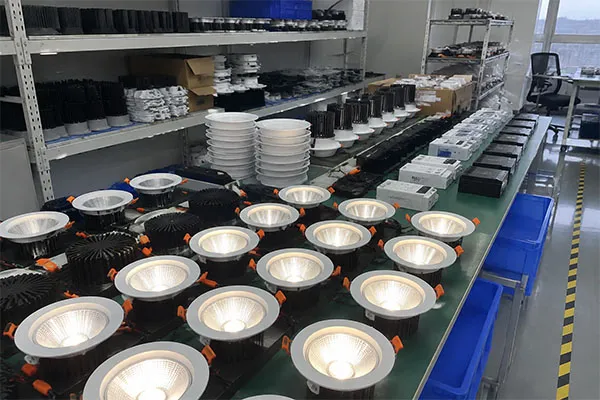
- Factory photos or videos related to LED downlight production
- Production workflow explanation
- Aging test process details
- Sample lead time and mass production lead time
- Quality inspection points
- Whether custom wattage, CCT, beam angle, CRI, or packaging is possible
A good LED downlight manufacturer in China should answer these questions clearly. The supplier does not need to sound perfect. In fact, I trust suppliers more when they explain limitations honestly. For example, if a housing size cannot support a higher wattage safely because of heat dissipation, that answer is more useful than a quick “yes, no problem.”
How Should You Compare Quotations from an LED Downlight Manufacturer in China?
Many buyers compare quotations line by line and choose the lowest number. I understand why this happens, because purchasing teams need cost control. The problem is that LED downlight prices are only meaningful when the configuration is identical or clearly explained.
You should compare quotations from an LED downlight manufacturer in China by checking the full specification behind the price. A useful quote should state wattage, lumen output, LED chip, driver, housing material, CRI, beam angle, CCT, warranty, certification, packaging, MOQ, lead time, and payment terms.
Low Price Is Not Always Bad, But It Must Be Explained
I do not believe that a lower price always means poor quality. China has a strong lighting supply chain6, and cost differences can come from many normal factors, such as:
- Larger production volume
- Mature mold design
- Efficient assembly process
- Local component sourcing
- Standardized packaging
- Lower overhead cost
- Different warranty positioning
However, cost differences can also hide risks. A cheaper quotation may use a lower-grade driver, thinner aluminum housing, lower lumen output, different LED chip, or shorter warranty coverage. That is why I always suggest comparing configuration to configuration, not price to price.
What a Complete Quotation Should Include
A serious quotation should not only say, “7W downlight, USD X.” That information is too limited for procurement decisions.
| Quotation Detail | Good Practice | Buyer Risk If Missing |
|---|---|---|
| Wattage | State rated power and tolerance | Actual power may differ |
| Luminous flux | Provide lumen range or test basis | Brightness may disappoint |
| LED chip | Mention brand, type, or grade | Supplier may change components |
| Driver | State driver type and key parameters | Flicker or failure risk may rise |
| Input voltage | Match target market requirement | Product may not suit local use |
| CRI | State CRI 80/90 or custom option | Lighting effect may not match project |
| Beam angle | State angle or lens option | Installation effect may change |
| CCT | State 2700K/3000K/4000K/etc. | Mixed color risk in project |
| Housing | State material and finish | Heat control and appearance may vary |
| Warranty | State years and conditions | After-sales disputes may occur |
| Certificates | State available documents | Compliance screening may fail |
| MOQ | State minimum order quantity | Budget planning may be wrong |
| Lead time | State sample and bulk schedule | Project delivery may be delayed |
Ask Whether the Specification Is Locked
One question I wish more buyers asked is:
“Will the mass production use the same LED chip, driver, housing, lens, CCT, CRI, and packaging as the approved sample?”
This question is simple, but it changes the conversation. It tells the supplier that you are not buying a vague product name. You are buying a controlled specification.
For OEM/ODM buyers, this matters even more. If you need custom color temperature, lens angle, surface finish, or private-label packaging, the quotation should include those items clearly. Otherwise, a supplier may quote a standard model first and add extra costs later.
Practical Quotation Comparison Method
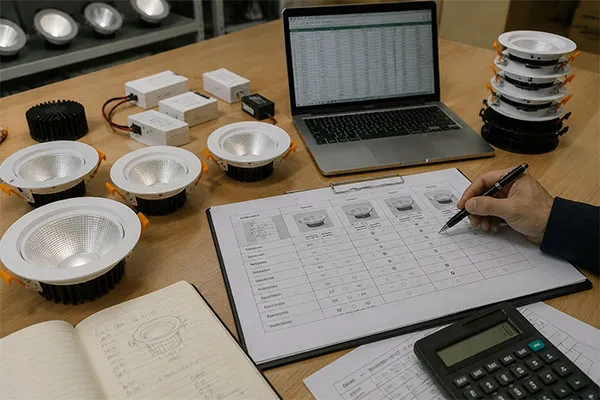
I recommend using a simple comparison sheet. It can include:
- Supplier name
- Model number
- Wattage
- Input voltage
- Lumen output
- CRI
- CCT
- Beam angle
- Driver type
- Housing material
- Certificate documents
- Warranty
- MOQ
- Sample cost
- Bulk price
- Lead time
- Packaging
- Notes on customization
This method makes hidden differences visible. It also helps you ask better follow-up questions. In my experience, serious suppliers usually welcome detailed comparison because it allows them to explain their cost structure instead of competing only on a bare unit price.
Why Should an LED Downlight Manufacturer in China Ask Questions Before Quoting?
Some buyers feel frustrated when a supplier asks many questions before sending a price. I understand that fast quotation matters, especially when a project deadline is close. However, if a supplier quotes too quickly without understanding the application, the price may not match your real need.
A professional LED downlight manufacturer in China should ask about application scenario, installation method, target market, CCT, beam angle, CRI, dimming, certification needs, packaging, order quantity, and delivery schedule. These questions help the supplier quote the correct configuration instead of a misleading low-price option.
Good Questions Protect the Buyer
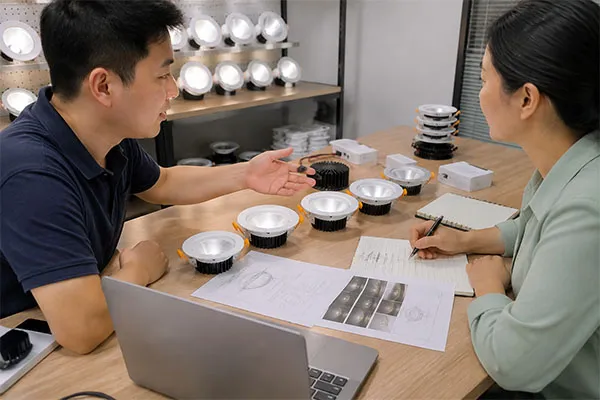
From my side as a manufacturer, I often need to clarify basic project details before quoting. This is not a delay tactic. It is a way to avoid wrong assumptions.
For example, a 10W recessed downlight for a residential ceiling is different from a downlight used in a hotel corridor, retail shop, office area, or humid indoor space. The buyer may need different CRI, beam angle, trim color, dimming type, or certification documents.
Questions a Reliable Supplier May Ask
A reliable supplier may ask:
- Where will the downlight be installed?
- Is it for residential, commercial, hotel, retail, or project use?
- What cut-out size is required?
- What input voltage is needed?
- Do you need dimmable or non-dimmable models?
- What color temperature do you prefer?
- Is CRI 80 acceptable, or do you need CRI 90?
- What beam angle is required?
- Do you need CE, RoHS, or other documents for screening?
- What is your expected warranty level?
- Do you need neutral packaging or custom packaging?
- What is the first order quantity and estimated repeat demand?
- What is the delivery deadline?
These questions help the supplier understand whether a standard product is suitable or whether a custom configuration is needed.
Why Application Details Change the Product
The same wattage can perform differently depending on design. A downlight is not just a lamp with a number printed on the box. It is a combination of thermal structure, optical design, electrical components, and installation conditions.
| Buyer Requirement | Possible Product Impact |
|---|---|
| Higher CRI | May reduce luminous efficiency or increase cost7 |
| Narrow beam angle | Needs suitable lens or reflector |
| Dimming function | Requires compatible driver8 |
| Small cut-out size | Limits heat dissipation space |
| Custom surface color | May affect MOQ and lead time |
| Branded packaging | Requires artwork approval and printing time |
| Higher warranty | Usually needs stronger configuration control |
Fast Response Still Matters
I do not suggest accepting slow or vague communication. A supplier can ask questions and still respond quickly. In our industry, fast quotation is useful, but only when the basic technical and commercial details are clear.
A practical approach is to send an inquiry template. You can include:
- Product type: recessed LED downlight
- Wattage range: 5W, 7W, 10W, 15W, etc.
- Cut-out size
- Input voltage
- CCT
- CRI
- Beam angle
- Dimming requirement
- Certificate requirement
- Quantity
- Packaging requirement
- Destination country
- Target delivery time
This helps the LED downlight manufacturer in China quote faster and more accurately. It also helps you identify suppliers who do not read details carefully. If a supplier ignores your key requirements and only sends a catalog, you may need to be cautious.
How Do Certificates, Samples, and Aging Tests Reduce Buyer Risk?
Certificates, samples, and tests are important, but they are often misunderstood. Some buyers treat certificates as a final guarantee. Some suppliers treat samples as a sales tool only. The risk appears when documents, approved samples, and mass production are not connected.
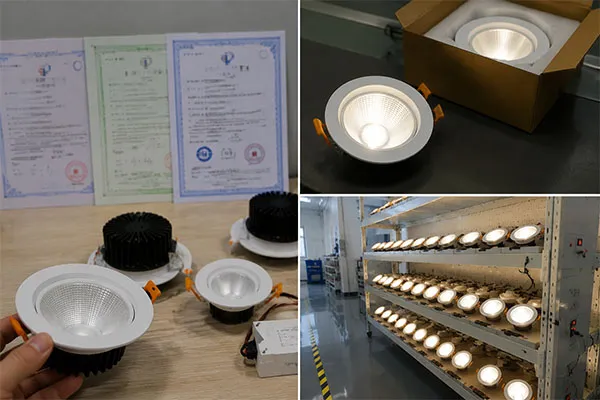
Certificates help with compliance screening, samples help verify actual product quality, and aging tests help identify early failures before shipment9. Buyers should verify whether documents match the specific model, whether samples are approved in writing, and whether mass production units follow the same specification and testing process.
Certificates Are Necessary, But Not Enough
CE, RoHS, and similar documents can be useful screening tools.10 In my business context, we often see overseas buyers ask for these documents before they continue discussions. That is reasonable. However, buyers should treat certificates as documents to verify, not as automatic proof that every shipment will be reliable11.
You should check:
- Does the certificate match the exact product category?
- Does the model number match the quoted product?
- Are the electrical parameters consistent?
- Is the document still valid?
- Is the issuing body acceptable for your market or customer?
- Does your project need additional local compliance review?
I recommend that buyers consult qualified compliance professionals for market-specific decisions. A supplier can provide documents, but the buyer or importer often needs to confirm local import and sales requirements.
Sample Approval Should Be Formal
A sample is not only a product you test once. It should become the reference point for production.
Before approving a sample, you can check:
-
Appearance
- Trim color
- Surface finish
- Housing shape
- Label position
- Packaging
-
Electrical parameters
- Wattage
- Input voltage
- Driver type
- Dimming compatibility if required
-
Lighting effect
- CCT
- CRI
- Beam angle
- Glare control
- Brightness impression
-
Mechanical fit
- Cut-out size
- Spring clips
- Installation depth
- Ceiling compatibility
-
Documents
- Specification sheet
- Certificate copies
- User instruction if needed
- Packaging label
After approval, I suggest confirming the locked specification by email or purchase order. This helps avoid disputes later.
Aging Tests Are Practical Production Checks
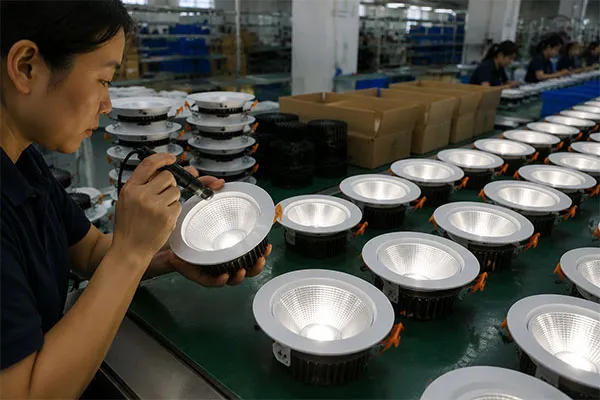
In LED lighting production, aging tests are common because they help detect early failures. In my manufacturer-side experience, buyers often ask whether products are aged before shipment. A practical process may include several hours of powered operation before packing.
For example, our business context includes 100% aging testing before shipment, normally around 4 to 8 hours, as part of our internal quality control. I mention this not as a universal standard, but as the type of process buyers can ask suppliers to verify.
You can ask suppliers:
- Is aging testing done for every unit or by sampling?
- How many hours are used?
- At what stage is aging performed?
- What happens if a unit fails during aging?
- Are inspection records available?
- Is final inspection done after aging?
Connect Documents, Samples, and Production
The strongest verification method is not one single document. It is the connection between documents, sample approval, production control, aging test, and shipment inspection.
A buyer can request:
- Approved sample photos
- Final specification sheet
- Pre-production confirmation
- Production photos or videos if appropriate
- Aging test confirmation
- Pre-shipment inspection report
- Carton marking confirmation
- Packing list and shipment details
This process may feel detailed, but it is much cheaper than solving problems after the goods arrive.
How Can You Verify Mass Production Consistency and Long-Term Cooperation?
Many supplier problems do not appear during the first conversation. They appear after the first sample, first order, or first repeat order. The risk is that a supplier performs well once but cannot maintain consistency over time.
You can verify mass production consistency by locking specifications, confirming key components, using approved samples, checking inspection procedures, reviewing aging-test practices, and arranging pre-shipment inspection when needed. For long-term cooperation, you should also evaluate communication speed, problem-solving attitude, customization ability, and delivery stability.
Sample Consistency Is the Center of Supplier Evaluation
I believe sample-to-production consistency is one of the most important topics when choosing a LED downlight manufacturer in China. A beautiful sample does not help if the bulk order changes the driver, LED chip, housing thickness, packaging, or CCT without approval.
Buyers should define what cannot change:
- LED chip
- Driver model or driver grade
- Housing material
- Lens or reflector
- CCT
- CRI
- Beam angle
- Surface finish
- Label content
- Packaging
- Warranty terms
If a component must change because of supply-chain reasons, the supplier should notify the buyer before production. The buyer should decide whether the change is acceptable.
Use a Pre-Shipment Inspection Checklist
A pre-shipment inspection does not need to be complicated for every order, but it should be concrete.12 You can inspect by yourself, ask a third-party inspection company, or agree with the supplier on internal inspection photos and records.
| Inspection Area | What to Check |
|---|---|
| Quantity | Carton count and unit count |
| Model | Model number matches purchase order |
| Appearance | No scratches, deformation, color mismatch |
| Electrical | Power-on test and basic function |
| CCT | Visual comparison or measured value if available |
| Packaging | Inner box, carton strength, labels |
| Accessories | Clips, screws, manuals, labels |
| Marking | Voltage, wattage, brand, certification marks if applicable |
| Aging | Confirmation of aging process |
| Documents | Invoice, packing list, certificate copies if needed |
Long-Term Cooperation Needs More Than a Good First Price
For importers, wholesalers, distributors, and local lighting brands, the real goal is often stable supply. A good first price is helpful, but repeated cooperation depends on more factors.
You should evaluate:
-
Communication discipline
- Does the supplier reply clearly?
- Does the supplier confirm details in writing?
- Does the supplier avoid vague promises?
-
Customization support
- Can the supplier handle CCT, wattage, beam angle, CRI, color finish, or packaging changes?
- Does the supplier explain MOQ and lead time for custom work?
-
Delivery control
- Does the supplier provide realistic lead times?
- Does the supplier warn early if there is a delay?
-
After-sales handling
- Does the supplier explain warranty terms?
- Does the supplier ask for photos, videos, batch numbers, and failure details?
- Does the supplier offer a practical solution process?
-
Order flexibility
- Can the supplier support small-batch trial orders?
- Can the supplier scale to repeat orders?
My Practical View from Supplier Communication
In my daily work, I see that the most successful buyer-supplier relationships are not built on one perfect conversation. They are built on clear written confirmation, realistic expectations, and repeated verification.
A buyer should not expect any supplier to remove all risk. Manufacturing always has variables, including component supply, production scheduling, packaging changes, and shipping conditions. However, a reliable supplier should make these variables visible and manageable.
If you are evaluating a LED downlight manufacturer in China, I recommend starting with a small but meaningful order after sample approval. This gives you a chance to test quotation accuracy, production consistency, packing quality, communication, and delivery performance before you place a large project order.
Frequently Asked Questions
What is the most important factor when choosing an LED downlight manufacturer in China?
The most important factor is consistency from sample to mass production. Buyers should verify whether the same LED chip, driver, housing, CCT, CRI, beam angle, and packaging will be used in bulk production. Price matters, but it should be compared only after specifications are clear.
Are CE and RoHS certificates enough to prove supplier reliability?
No. CE and RoHS documents are useful screening signals, but they are not complete proof of reliability. Buyers should verify whether certificates match the specific model and target market. They should also check samples, aging tests, QC process, packaging, and delivery capability.
How many hours should LED downlights be aging tested?
Aging test duration can vary by supplier, product type, and quality process. Many buyers ask whether every unit is powered for several hours before shipment. In my business context, 4 to 8 hours of aging testing is a practical process buyers can ask suppliers to confirm.
Should I choose the lowest quotation for LED downlights?
You should not choose only by the lowest quotation. A low price may be reasonable if the configuration, warranty, and production control are clear. However, it may also hide lower-grade components or missing requirements. Always compare wattage, lumen output, driver, chip, housing, CRI, beam angle, and lead time.
Is it better to buy from a factory or a trading company?
It depends on your needs. A trading company may provide strong service and product sourcing. A factory may offer better control for OEM/ODM customization, repeated orders, and specification consistency. Buyers should verify production capability, communication quality, sample control, and after-sales response in either case.
Conclusion
Finding a reliable LED downlight manufacturer in China is not about chasing the cheapest quotation. It is about verifying whether the supplier can control specifications, samples, mass production, testing, delivery, and long-term communication. I suggest buyers compare configurations carefully, confirm certificates properly, approve samples formally, and check aging-test and inspection processes before larger orders. If you are sourcing LED downlights for wholesale, distribution, projects, or OEM/ODM cooperation, contact us with your specification list, and I will help you review a practical quotation path.
"New Study Examines Lumen and Chromaticity Maintenance of LED ...", https://www.energy.gov/cmei/ssl/articles/new-study-examines-lumen-and-chromaticity-maintenance-led-packages-based-lm-80. A U.S. Department of Energy solid-state lighting source explains that LED package selection, binning, and lumen-maintenance behavior affect output and color consistency, supporting the link between LED chip choice and downlight performance; the source does not assess any specific supplier or model. Evidence role: mechanism; source type: government. Supports: LED package characteristics and binning influence light output, chromaticity consistency, and lumen-maintenance expectations.. Scope note: Contextual support for the mechanism, not direct proof of the performance of a particular downlight. ↩
"Flicker Research", https://www.energy.gov/cmei/ssl/flicker-research. A U.S. Department of Energy solid-state lighting publication describes LED flicker as related to driver and power-supply design, supporting the article’s statement that driver selection affects flicker and operational risk; it does not quantify warranty outcomes for individual manufacturers. Evidence role: mechanism; source type: government. Supports: LED drivers and power supplies influence flicker behavior, electrical stability, and reliability considerations in LED lighting systems.. Scope note: Supports the technical mechanism, while warranty risk remains an applied procurement inference. ↩
"Thermal Management of White LEDs", https://www1.eere.energy.gov/buildings/publications/pdfs/ssl/thermal_led_feb07_2.pdf. A U.S. Department of Energy solid-state lighting resource states that LED performance and lifetime are strongly influenced by thermal management, supporting the article’s emphasis on heat-sink design; the source does not validate any individual housing design. Evidence role: mechanism; source type: government. Supports: Thermal management and heat-sink design affect LED junction temperature, lumen maintenance, and long-term performance.. Scope note: Contextual technical support, not product-specific verification. ↩
"Color rendering of light sources | NIST", https://www.nist.gov/pml/sensor-science/optical-radiation/color-rendering-light-sources. A source from the International Commission on Illumination or a national standards body defines the color rendering index as a measure of how a light source renders colors, supporting the article’s statement that CRI affects color appearance in interior projects. Evidence role: definition; source type: institution. Supports: CRI is a metric describing how a light source renders object colors compared with a reference illuminant.. ↩
"Lighting Specification Guidance for Schools", https://www.energy.gov/sites/default/files/2024-12/lighting-spec-guidance-school_nov24.pdf. An educational lighting-design source explains that beam angle determines the spread of light and affects illuminance distribution, supporting the article’s statement that beam angle changes lighting effect and spacing; it does not provide a project-specific layout calculation. Evidence role: mechanism; source type: education. Supports: Beam angle influences light distribution, coverage area, and spacing decisions in lighting design.. Scope note: General lighting-design support, not a substitute for photometric planning for a specific room. ↩
"China Lamps and lighting fittings parts of plastics exports by country | 2024", https://wits.worldbank.org/trade/comtrade/en/country/CHN/year/2024/tradeflow/Exports/partner/ALL/product/940592. UN Comtrade or World Bank WITS trade statistics for lighting fixtures can document China’s large export volume in relevant lighting categories, providing contextual support for the statement that China has a strong lighting supply chain; export scale does not prove that any individual manufacturer is reliable. Evidence role: statistic; source type: institution. Supports: International trade data can show China’s scale in lighting-fixture exports, providing contextual support for the claim that China has a substantial lighting supply chain.. Scope note: Market-scale proxy evidence, not supplier-level quality evidence. ↩
"LED Basics", https://www.energy.gov/cmei/ssl/led-basics. A U.S. Department of Energy solid-state lighting report discusses tradeoffs between color quality metrics such as CRI and luminous efficacy, supporting the article’s note that higher CRI can affect efficiency or cost; the magnitude of the tradeoff depends on the LED technology and product design. Evidence role: mechanism; source type: government. Supports: Higher color-rendering requirements can involve tradeoffs with luminous efficacy and product cost, depending on LED design.. Scope note: Contextual support for a common tradeoff, not proof that every high-CRI downlight is less efficient or more expensive. ↩
"The Energy and Operational Impacts of Using 0-10V ...", https://www.energy.gov/cmei/ssl/articles/energy-and-operational-impacts-using-0-10v-control-led-streetlights. A U.S. Department of Energy solid-state lighting source explains that LED dimming depends on driver and control compatibility, supporting the article’s statement that dimmable downlights require compatible drivers; it does not evaluate a specific dimmer-driver combination. Evidence role: mechanism; source type: government. Supports: LED dimming performance depends on compatibility between the LED driver, dimmer, and control method.. Scope note: General compatibility support, not a compatibility certificate for any listed product. ↩
"Lifetime and Reliability", https://www1.eere.energy.gov/buildings/publications/pdfs/ssl/life-reliability_fact-sheet.pdf. Reliability-engineering literature describes burn-in testing as a method for exposing early-life failures in electronic products, supporting the article’s claim that powered aging tests can identify early failures before shipment; it does not establish an optimal burn-in duration for all LED downlights. Evidence role: mechanism; source type: paper. Supports: Burn-in or powered aging tests are used in electronics reliability practice to screen for early-life failures.. Scope note: Supports the reliability-screening principle, not a universal LED downlight test protocol. ↩
"European Union Reduction of Hazardous Substances RoHS and ...", https://www.waru.edu/artifact/european-union-reduction-hazardous-substances-rohs-and-waste-electrical-and-electronic. European Commission guidance describes CE marking and RoHS obligations as product-compliance mechanisms for relevant electrical and electronic goods, supporting the article’s use of these documents as compliance-screening tools; such documents do not independently establish production consistency or supplier reliability. Evidence role: general_support; source type: government. Supports: CE marking and RoHS documentation are compliance-related instruments for products placed on relevant markets.. Scope note: Supports compliance-screening relevance, not overall product quality. ↩
"CE marking", https://en.wikipedia.org/wiki/CE_marking. European Commission guidance characterizes CE marking as a declaration of conformity rather than a general quality mark, supporting the article’s warning that certificates are not automatic proof of shipment reliability; the source addresses regulatory meaning, not LED factory quality control specifically. Evidence role: expert_consensus; source type: government. Supports: CE marking and similar compliance documents indicate declared conformity with applicable requirements, not a guarantee of manufacturing consistency for every shipment.. Scope note: Regulatory-context support, not direct evidence about LED downlight shipment defects. ↩
"ISO 2859-1:2026(en), Sampling procedures for inspection by attributes", https://www.iso.org/obp/ui/#iso:std:iso:2859:-1:en. International inspection and sampling guidance, including ISO 2859-style inspection-by-attributes approaches, supports the article’s point that pre-shipment inspection should use concrete criteria; such guidance reduces but cannot eliminate the risk of undetected defects. Evidence role: general_support; source type: institution. Supports: Pre-shipment inspection commonly relies on defined inspection criteria, sampling plans, and documented checks.. Scope note: General inspection-method support, not a guarantee of defect-free shipments. ↩