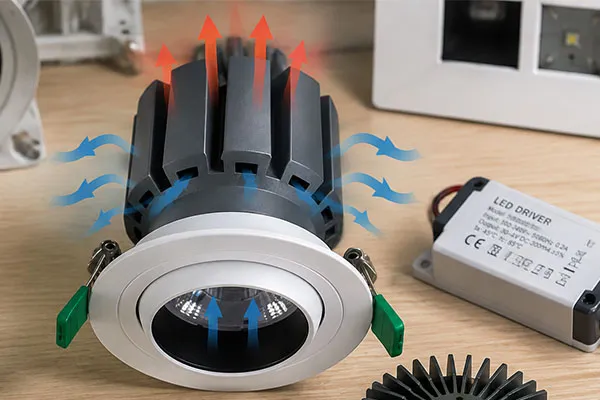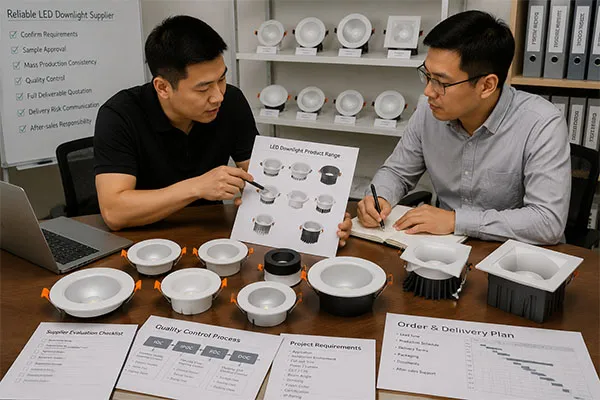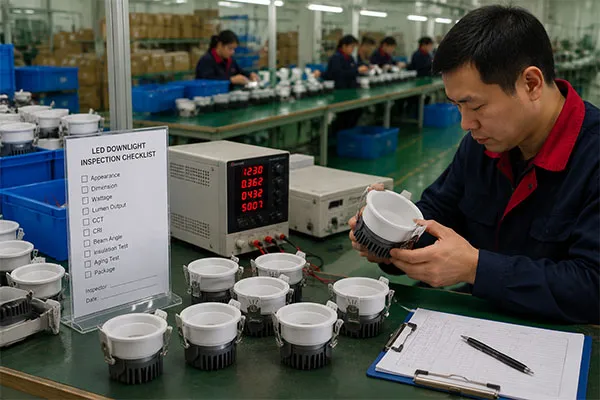

An LED downlight factory can be difficult to identify when many suppliers use similar photos, certificates, and product catalogs. That uncertainty can lead to sample-to-order differences, delayed delivery, and unclear responsibility when quality problems appear1. I recommend looking beyond labels and verifying how a supplier controls your exact downlight specification.
A real LED downlight factory is best identified by its ability to transparently show how a specific product moves from approved specifications to controlled mass production, inspection, aging tests, packaging, and shipment. Factory photos, licenses, low prices, and quick replies can be useful signals, but they do not prove reliable manufacturing accountability on their own.2
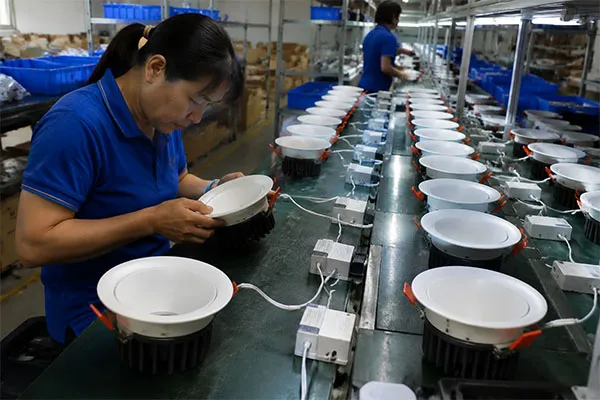
The practical question is not simply whether a supplier calls itself a factory or a trading company. The more useful question is: who is responsible for making sure your approved LED downlight sample becomes a consistent delivered order? In our daily work, that responsibility connects product engineering, assembly, quality control, aging, and shipping coordination.
What Evidence Should a Real LED Downlight Factory Provide?
Buyers often receive polished factory videos, workshop images, and copies of business registrations within minutes of asking. These materials can create confidence, but they can also distract from the real procurement risk: whether the supplier understands and controls the exact LED downlight model you plan to buy.
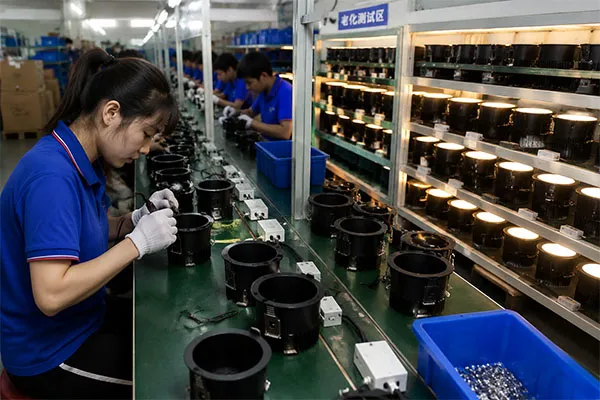
A credible LED downlight factory should provide product-specific operational evidence, including assembly steps, critical components, inspection points, aging-test arrangements, and packaging details for the model under discussion. The evidence should relate directly to your agreed wattage, CCT, driver, trim, beam angle, and other order requirements.
Ask for Evidence Related to the Exact Downlight Model
I suggest that buyers avoid asking only, “Are you a manufacturer?” Nearly every supplier will have a prepared answer. Instead, I would ask questions that require a supplier to explain the production process for the actual product quotation.
For example, buyers can ask:
- Which LED chips, driver, heat sink, diffuser, reflector, and trim are used for this model?
- What are the key assembly steps for this downlight?
- Where are the electrical and appearance checks performed?
- How is the product arranged for aging tests?
- How long is the aging test for this particular model?
- What packaging configuration is used for this wattage and trim size?
- Who confirms the final specifications before shipment?
These questions matter because a recessed LED downlight is not one fixed product. A 10W, 3000K, white-trim downlight with a dimmable driver may have different component choices and production controls than a 20W, 4000K, black-trim commercial downlight.
At our facility, I have seen how small specification changes can affect several steps at once. A different color temperature may require different LED component allocation. A different driver can affect wiring and electrical testing.3 A black surface finish may add another appearance inspection point. A change in cutout size can affect trim, housing, and carton labeling.
Generic Footage Is Not Enough
A workshop video may show machines, workers, and cartons. However, it may not prove that the supplier produces your requested downlight or controls that model consistently.
I would look for evidence with identifiable links to the order, such as:
- A video showing the requested downlight housing or trim style
- A production order or internal model number, with sensitive details hidden if needed
- Photos of the actual LED driver configuration
- Aging racks holding the same product series
- Inspection records that show relevant test items
- Packing photos showing the agreed labeling or carton arrangement
- A sample approval record that references the product specification
I treat factory videos as a starting point, not a final verification method. The useful part is whether the supplier can connect the video to the product I am purchasing.
A trading company may also coordinate real manufacturing effectively, particularly when it has strong product knowledge and clear supplier relationships. Therefore, I would not use these questions to exclude trading companies automatically. I would use them to identify where accountability sits if a problem occurs after the order is placed.
How Does an LED Downlight Factory Control Quality Across Production?
Quality problems rarely begin only at final inspection. A downlight can look acceptable after assembly while still containing inconsistent components, incorrect color temperature, unsuitable drivers, poor wiring connections, or cosmetic defects that become visible during installation. This is why I evaluate quality control as a chain rather than a single checkpoint.
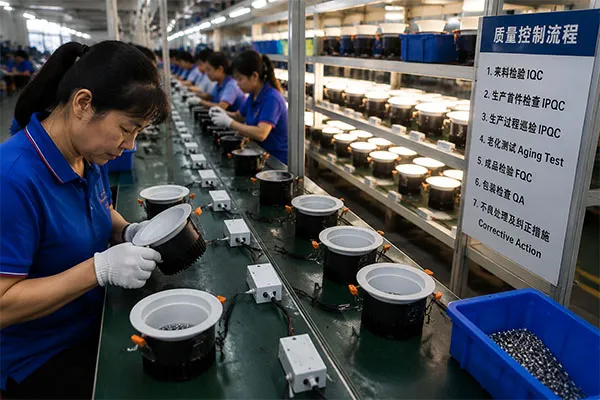
An LED downlight factory should be able to explain its quality-control chain from incoming materials through assembly, aging, finished-product inspection, and corrective action. Buyers should ask what is checked, when it is checked, which requirements apply, and what happens if a batch does not meet those requirements.
Review the Quality-Control Chain
In practical LED downlight production, quality control usually needs to cover several stages. The exact test methods depend on the product design, destination market, and buyer requirements, but the supplier should explain the logic of each stage.
| Production Stage | What Buyers Can Ask | Why It Matters |
|---|---|---|
| Incoming materials | How are LEDs, drivers, housings, diffusers, reflectors, and cables checked? | Critical components influence electrical performance, appearance, and reliability. |
| In-process assembly | Which checkpoints verify wiring, polarity, fit, and assembly quality? | Assembly errors are easier to correct before products reach final packing. |
| Aging test | How long are products aged, and how are failures recorded? | Aging can help identify early electrical or assembly failures.4 |
| Final inspection | Which visual, electrical, and functional checks are performed? | Final inspection helps confirm that the packed product matches the agreed requirement. |
| Packaging inspection | How are labels, accessories, inner boxes, and cartons checked? | Incorrect packaging can create installation, customs, or distribution problems. |
| Pre-shipment review | Is there a final quantity and packaging confirmation before loading? | This connects production completion to delivery coordination. |
In our own process, products are subjected to 100% aging tests before shipment, with aging periods generally ranging from 4 to 8 hours5. I view this as one operational control, not as a guarantee that no product will ever fail in the field. Buyers should still ask what the aging arrangement looks like and what criteria trigger a rejection or rework decision.
Ask What Happens When a Product Fails
A supplier’s response to failure can reveal more than a generic statement that it has “strict QC.” I would ask direct questions:
- What happens if a unit fails during aging?
- Is the failed unit isolated from accepted products?
- Is the cause checked before rework?
- Are repeated failures tracked by component batch or production date?
- Who decides whether a batch can proceed to packing?
- Can the supplier explain the corrective action in simple terms?
A capable supplier does not need to claim perfection. In fact, I generally find a clearer answer when a production team can explain how it handles defects, rechecks reworked units, and prevents mixed status products from entering cartons.
For project orders, buyers may also define additional acceptance requirements. These can include color-temperature tolerance, driver brand or performance requirements, dimming compatibility, IP rating requirements, trim color, lumen output, and carton markings. A supplier should confirm whether those requirements are part of its normal process or require a special inspection plan.
Can an LED Downlight Factory Turn an Approved Sample Into Stable Mass Production?
An approved sample is important, but it does not automatically mean mass production will match it.6 The biggest procurement risk often appears after sampling, when materials are purchased, production schedules change, packaging is prepared, and multiple specifications are handled at the same time.
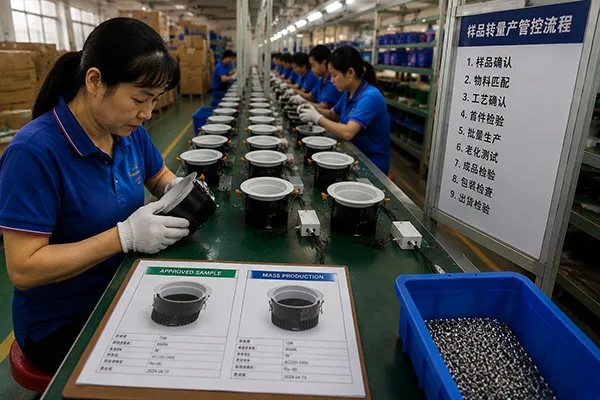
A reliable LED downlight factory should have a clear method for locking approved samples and specifications before mass production. Buyers should verify how product changes are documented, how components are matched to the approved sample, and how aging, packaging, and pre-shipment checks connect to the final order.
Build a Written Specification Lock
I recommend that buyers create a simple but complete product specification sheet before placing a purchase order. The document does not need to be complicated. It needs to remove uncertainty.
For LED downlights, the specification sheet can include:
- Product model number
- Wattage and input voltage
- Color temperature, such as 3000K, 4000K, or 6500K
- Lumen target and light-output requirement
- Beam angle or reflector configuration
- CRI requirement
- Driver type, dimming requirement, and driver brand if specified
- Housing material and heat-sink construction
- Trim shape, color, and surface finish
- Cutout size and overall product dimensions
- IP rating where applicable
- Packaging method and carton markings
- Required certificates or reports
- Approved sample photos and revision date
In our OEM and ODM work, I have found that small changes often deserve written confirmation. For example, a buyer may ask for a different trim color, a warmer CCT, a different lens angle, or a new carton design. These changes can seem simple, but they can affect material purchasing, production instructions, inspection criteria, and lead time.
Compare Sample Control With Production Control
Buyers should ask how the supplier links the approved sample to the production order. A useful supplier answer should cover more than “we will follow the sample.”
I would look for a process such as:
- The buyer approves a sample and written specifications.
- The supplier assigns a model number, revision, or internal production reference.
- The supplier confirms the bill of materials and critical components.
- The production team receives the approved requirements.
- Quality personnel inspect relevant points during production.
- The finished goods go through aging and final inspection.
- The packing team checks labels, accessories, and carton details.
- The shipment team confirms quantity and delivery readiness.
Raw-material purchase orders can be a supporting traceability signal. For example, a supplier may show that it ordered drivers or LED components for the requested model. However, I would not consider a purchase order standalone proof of manufacturing capability. It does not show how materials were assembled, inspected, aged, or packed.
Watch for Uncontrolled Substitutions
Component substitutions can create problems if they are not communicated. Some changes may be necessary because of supply availability, but a supplier should not treat a substitution as insignificant when it affects agreed performance or appearance.
Buyers should ask:
“If the original driver, LED component, reflector, or housing material is unavailable, what is your approval process before substitution?”
This question is especially important for OEM buyers, lighting brands, and project contractors. A controlled supplier should explain how it communicates material changes, whether it sends an updated sample if necessary, and how it records the approved revision.7
When Should Buyers Use Factory Visits and Third-Party Verification?
Remote verification can help buyers narrow down supplier options, but it has limits. A video call may show production activity, and documents may support initial screening, yet neither method replaces an independent review when an order carries major financial, project, or compliance risk8.
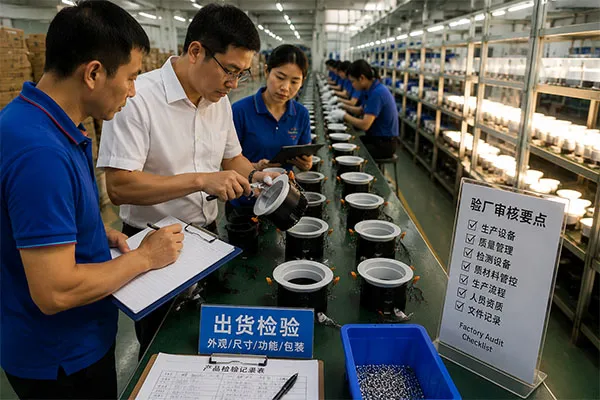
Buyers should consider factory visits, pre-shipment inspections, or qualified third-party verification when LED downlight orders involve high values, strict project specifications, new supplier relationships, regulated markets, or costly consequences from delivery failure. These measures reduce uncertainty, but they do not eliminate all quality or compliance risks.
Match the Verification Level to the Order Risk
I recommend matching verification efforts to the likely consequences of a mistake. A small trial order and a large commercial project should not always receive the same level of due diligence.
| Order Situation | Practical Verification Approach |
|---|---|
| Small first order | Review samples, specifications, product-specific process evidence, and communication quality. |
| Repeat order with stable specifications | Compare current specifications with previous approvals and request updated production and packing confirmation. |
| Large distributor order | Consider a factory visit, sample retention, batch inspection requirements, and pre-shipment inspection. |
| Project order with installation deadlines | Use detailed technical approvals, production scheduling confirmation, and independent pre-shipment checks where appropriate. |
| Regulated or compliance-sensitive market | Verify applicable certification documents, test reports, product markings, and professional compliance guidance. |
CE and RoHS documents can be relevant for market access and buyer compliance review.9 However, I recommend that buyers verify certificates, reports, product scope, validity, and destination-market requirements independently. A certificate copy alone should not be treated as proof that every delivered unit meets every applicable rule.10
Use a Pre-Shipment Inspection Checklist
For higher-risk LED downlight orders, buyers can arrange a pre-shipment inspection before the balance payment or before container loading. The inspection scope should be linked to the purchase order and approved sample.
A practical checklist may include:
- Quantity verification
- Product model and wattage confirmation
- CCT and trim color checks
- Appearance inspection for scratches, dents, and finish variation
- Basic functional and electrical checks
- Driver and label confirmation
- Packaging and carton-marking review
- Accessory quantity verification
- Random sample comparison with approved reference samples
- Review of aging-test records where available
I see independent inspection as a useful extra control, especially when a buyer cannot visit China personally. It should not be treated as a substitute for clear specifications or supplier communication. An inspection can identify certain issues in a defined sample size, but it cannot guarantee future field performance or cover every risk.11
Clarify Responsibility Before Payment
The most important commercial question is often not whether the supplier has a factory sign outside its building. It is whether the supplier clearly accepts responsibility for specifications, quality communication, production coordination, and corrective action.
Before payment, I recommend confirming:
- The final approved specification version
- The production lead time and delivery terms
- The inspection or acceptance method
- The process for reporting shortages or quality concerns
- The evidence required for a claim
- The responsible contact person after shipment
Clear agreements do not prevent every disagreement. However, they give both sides a practical reference if the delivered goods do not match the approved requirement.12
Frequently Asked Questions
Is a trading company always less reliable than an LED downlight factory?
No. A trading company can provide good service when it has strong product knowledge, reliable manufacturing partners, and clear accountability. I focus less on the company label and more on who controls the approved specification, production communication, quality checks, and after-sales responsibility.
Can factory photos prove that a supplier manufactures LED downlights?
No. Factory photos may support initial screening, but they do not prove that the supplier manufactures your exact downlight model or controls its quality. I recommend requesting model-specific assembly, inspection, aging, and packaging evidence linked to your quotation and sample.
What should I check before approving an LED downlight sample?
I recommend checking wattage, CCT, light output, beam angle, trim finish, cutout size, driver specification, dimming function if needed, packaging, and labels. Buyers should also confirm that the approved sample and written specifications will be used as the mass-production reference.
How long should LED downlights undergo aging tests?
Aging time depends on the product design and supplier process. At our facility, we generally conduct 100% aging tests for 4 to 8 hours before shipment. Buyers should ask about the actual arrangement, failure handling process, and inspection criteria for their specific model.
Should I use a third-party inspection for LED downlight orders?
A third-party inspection can be worthwhile for high-value orders, new suppliers, project-critical deliveries, or strict technical requirements. It can reduce risk by checking a defined sample before shipment, but it does not replace detailed specifications, sample approval, or professional compliance evaluation.
Conclusion
A real LED downlight factory is not defined only by a workshop image, business license, certificate, or quoted price. I believe the stronger indicator is transparent, product-specific control over assembly, component selection, inspection, aging, packaging, and shipment. Buyers should verify how an approved sample becomes a repeatable production order and who accepts responsibility if requirements are not met. If you are sourcing OEM or ODM LED downlights, contact us to discuss your specifications, sampling needs, aging-test expectations, and delivery requirements.
"8 Ways to Improve Your Supplier Selection Process", https://www.nist.gov/blogs/manufacturing-innovation-blog/8-ways-improve-your-supplier-selection-process. Research on supplier management indicates that supplier capability evaluation and ongoing quality controls are relevant to product conformity and delivery performance. Evidence role: general_support; source type: research. Supports: Supplier-selection and supplier-management practices are associated with product-quality consistency, delivery performance, and accountability in supply chains.. Scope note: The evidence is general supply-chain research and does not specifically measure LED downlight transactions. ↩
"SUSTAINABLE PROCUREMENT", https://thedocs.worldbank.org/en/doc/29b83caad985394cf9f75116df967ac7-0290012024/original/SUSTAINABLE-PROCUREMENT-CH3-16574.pdf. Supplier due-diligence guidance generally distinguishes preliminary documentation from verification of actual operational capability and control. Evidence role: general_support; source type: institution. Supports: Supplier due diligence commonly requires verification beyond self-provided documents and marketing materials.. Scope note: Such guidance provides a verification principle rather than proving that every supplier photograph, license, or quotation is unreliable. ↩
"Specifying Color-Tunable LED Luminaires", https://www.energy.gov/documents/aug2016ledwatchpdf. Electrical safety frameworks for LED luminaires treat the driver and its wiring arrangement as relevant elements of product safety and functional assessment. Evidence role: mechanism; source type: institution. Supports: LED drivers are electrical controlgear whose input, output, insulation, wiring, and compatibility characteristics affect luminaire safety and performance evaluation.. Scope note: The applicable tests depend on the driver design, luminaire construction, and destination-market standard. ↩
"Electrical, Electronic, and Electromechnical (EEE) Parts ...", https://llis.nasa.gov/lesson/814. Reliability literature describes burn-in and related screening as methods that can reveal a portion of early-life failures in electronic products before field use. Evidence role: mechanism; source type: research. Supports: Burn-in or screening procedures may expose some early-life defects in electronic assemblies before deployment.. Scope note: Burn-in effectiveness depends on test conditions and failure mechanisms and does not establish long-term field reliability. ↩
"Long-term Testing of LED Luminaires", https://www.pnnl.gov/main/publications/external/technical_reports/PNNL-23702.pdf. Batch-level aging-test records can document whether all units were screened and the duration and disposition criteria applied before shipment. Evidence role: case_reference; source type: other. Supports: Internal aging-test logs, production records, and inspection reports should document the stated test coverage and duration for each production batch.. Scope note: A generic external source cannot verify this facility-specific practice; verification requires contemporaneous records or an independent audit. ↩
"Q7A Good Manufacturing Practice Guidance for Active ...", https://www.fda.gov/regulatory-information/search-fda-guidance-documents/q7a-good-manufacturing-practice-guidance-active-pharmaceutical-ingredients. Quality-management principles distinguish approval of an initial sample from the continuing process controls needed to maintain conformity in serial production. Evidence role: general_support; source type: institution. Supports: Product conformity in serial production requires controlled processes and verification in addition to initial sample approval.. Scope note: The principle is cross-industry and does not assess the conformity performance of a particular downlight supplier. ↩
"Changes to Disposable Manufacturing Materials", https://www.fda.gov/media/160300/download. Quality-system guidance generally requires changes affecting product requirements, materials, or production processes to be evaluated, documented, and communicated under controlled procedures. Evidence role: expert_consensus; source type: institution. Supports: Formal quality systems commonly require controlled, documented evaluation of changes that may affect product requirements or conformity.. Scope note: The precise approval workflow and need for a replacement sample depend on contractual requirements and the significance of the change. ↩
"SUSTAINABLE PROCUREMENT", https://thedocs.worldbank.org/en/doc/29b83caad985394cf9f75116df967ac7-0290012024/original/SUSTAINABLE-PROCUREMENT-CH3-16574.pdf. Conformity-assessment and procurement guidance recognizes that the depth of verification should be proportionate to risk and may include independent inspection or audit. Evidence role: general_support; source type: institution. Supports: Risk-based assurance may require inspection, audit, or other independent verification beyond document review.. Scope note: Independent review also has sampling and scope limits and cannot eliminate all commercial, quality, or compliance risk. ↩
"CE marking - Internal Market, Industry, Entrepreneurship and ...", https://single-market-economy.ec.europa.eu/single-market/goods/ce-marking_en. European Union guidance explains that CE marking may be required for products covered by applicable harmonisation legislation, while RoHS restricts specified hazardous substances in covered electrical and electronic equipment. Evidence role: definition; source type: government. Supports: CE marking and RoHS requirements are relevant to certain electrical and electronic products placed on the EU market.. Scope note: Applicability depends on the product, intended market, and relevant legislation; a document alone does not demonstrate conformity of every unit. ↩
"Key considerations - casco - ISO", https://casco.iso.org/key-considerations.html. Conformity-assessment guidance distinguishes documentary certification from continuing manufacturer responsibility to ensure that products placed on the market conform to applicable requirements. Evidence role: general_support; source type: institution. Supports: Certificates and conformity documents have defined scopes and do not substitute for the manufacturer's continuing responsibility for product conformity.. Scope note: The legal effect of a certificate depends on its issuer, scope, applicable scheme, and the jurisdiction concerned. ↩
"6.2.2.2. Choosing a Sampling Plan with a given OC Curve", https://www.itl.nist.gov/div898/handbook/pmc/section2/pmc222.htm. Acceptance-sampling methods assess a lot through a defined sample and consequently provide statistical assurance rather than proof that every unit is defect-free or will perform reliably in service. Evidence role: mechanism; source type: government. Supports: Acceptance sampling estimates lot quality from a sample and therefore carries a risk of accepting nonconforming lots or rejecting conforming lots.. Scope note: The level of assurance depends on the sampling plan, inspection method, lot size, and the defects that the inspection can observe. ↩
"Know Your Incoterms", https://www.trade.gov/know-your-incoterms. International sales-law and trade guidance treat contractual descriptions and specifications as central references for assessing whether delivered goods conform to the parties' agreement. Evidence role: general_support; source type: institution. Supports: Written contractual specifications help determine whether delivered goods conform to the agreed terms and provide a basis for remedies or dispute handling.. Scope note: Available remedies and interpretation of the agreement depend on the governing law, contract terms, and evidence of nonconformity. ↩