

LED downlight solutions can become slow-moving inventory when buyers select products only by unit price or headline specifications. That approach can make a range difficult to position, quote, and repeat-order. I help customers build more sellable downlight assortments by aligning product choices with target spaces, customer expectations, price levels, and sales channels.
LED downlight solutions can support stronger sales performance when they are developed as a focused product range rather than isolated commodities. Brands, importers, and wholesalers should define their target customer, application, installation method, price band, and channel strategy first. They can then select coordinated specifications, packaging, and OEM/ODM details that make the range easier to explain, stock, quote, and reorder.
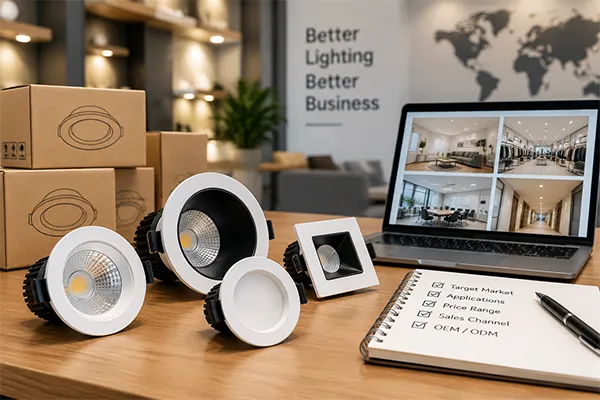
A good downlight range does not need every possible option. In my experience, it needs a clear reason to exist in the buyer’s catalog. The most useful discussions start with the market opportunity and only then move into wattage, lumen output, beam angle, color temperature, trim finish, and other technical details.
Why Should LED Downlight Solutions Start With the Sales Context?
A product can look competitive in a quotation but still fail to create repeat demand. When a range has no clear target space or customer profile, sales teams often struggle to explain why it is different. The solution is to define the commercial context before confirming the product specification.
LED downlight solutions should start with the sales context because the intended market determines which features, price points, installation formats, and packaging choices matter. A downlight for a value-focused wholesale channel may need a different assortment than one for a premium residential brand or a hospitality project supplier. Clear positioning helps buyers avoid mismatched stock and confusing product lines.
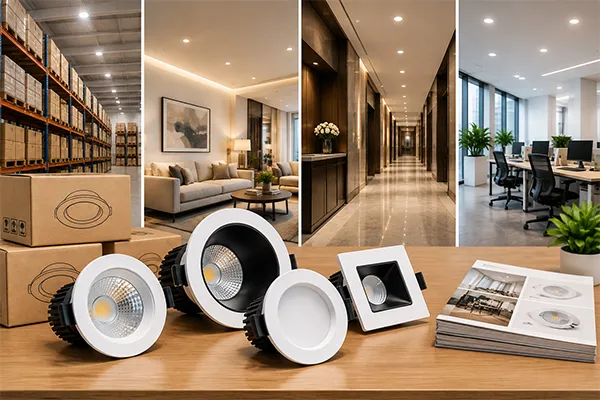
Start With the Questions That Shape a Sellable Range
When I discuss a new LED downlight inquiry with a brand, importer, or wholesaler, I usually do not begin by asking, “Which wattage do you need?” I first ask questions such as:
- Which market are you selling to?
- Who is your end customer?
- What space is the product intended for?
- Which price level must the range serve?
- Will the product be sold through distributors, electrical wholesalers, retail channels, project contractors, or online stores?
- Do installers influence the purchase decision?
- Will customers expect a basic standard product or a branded, differentiated solution?
These questions matter because the sales context shapes the product assortment.
For example, an importer serving electrical wholesalers may need a compact, easy-to-stock range with straightforward naming, standard color temperatures, and reliable carton information. A local lighting brand targeting residential renovations may place more value on trim colors, glare-control options, coordinated packaging, and a visual identity that supports showroom presentation.
I have seen customers arrive with a detailed technical request but no clear sales plan. In those conversations, I often find that several requested parameters overlap without creating a stronger market position. A broad range may appear attractive at first, but it can also increase inventory complexity, create quotation delays, and make it harder for sales staff to recommend the right SKU.1
Match the Product to the Buying Situation
A downlight is part of a buying situation, not simply a lighting component. A buyer may compare products based on:
| Buying situation | What the customer may prioritize | Assortment implication |
|---|---|---|
| Price-sensitive wholesale distribution | Consistent quality, simple ordering, competitive landed cost | Focused SKU count and standard finishes |
| Residential renovation | Appearance, color temperature, installation convenience | Clear trim choices and commonly requested variants |
| Hospitality or retail fit-out2 | Visual consistency, controlled ambience, project documentation | Coordinated specifications and sample confirmation |
| Local lighting brand | Differentiation, packaging, product identity | OEM/ODM branding, packaging, and finish options |
| Contractor-led purchasing | Availability, replacement consistency, easy selection | Repeatable models and stable specification control |
I do not treat these patterns as universal rules. Every market has its own commercial conditions, installation practices, and customer expectations. Still, this framework gives buyers a practical starting point.
A downlight assortment becomes easier to sell when each model has a defined customer, space, and price role.
At Upward Lighting, I have found that early clarification can prevent later changes during sampling or production. A buyer who defines the sales context early is often better placed to choose a manageable range and communicate it consistently to distributors, contractors, and end users.
How Can LED Downlight Solutions Create Clearer Product Positioning?
Many buyers assume that a larger specification list creates a more competitive catalog. However, too many overlapping options can make a range harder to understand and more expensive to manage3. The better approach is to build LED downlight solutions around recognizable customer needs.
LED downlight solutions create clearer positioning when each product variation supports a specific selling scenario. Instead of offering every wattage, beam angle, and trim finish, buyers can select a controlled combination of options for defined applications, such as entry-level residential upgrades, mid-range commercial interiors, or branded premium installations.
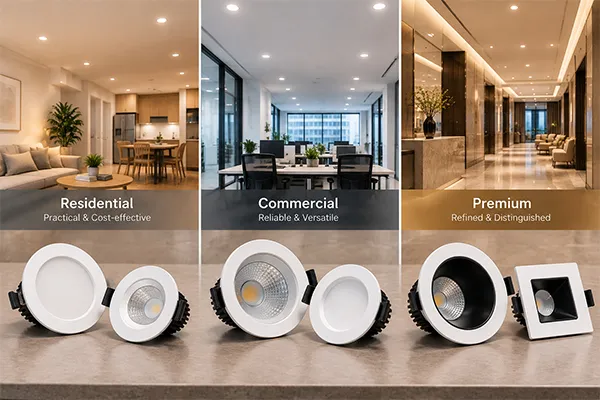
Build a Product Ladder Instead of an Unstructured Catalog
A practical downlight range often works better when it has a product ladder.4 This means that each family has a clear position, rather than competing with other models in the same catalog.
For example, a buyer may organize a range into three commercial levels:
-
Core range
This range supports regular wholesale or distribution demand. It may use the most commonly requested configurations for the target market. The goal is simple selection, reliable replenishment, and price discipline. -
Enhanced range
This range offers visible or functional differentiation. It may include selected finish colors, higher color-rendering options, additional beam angles, or more packaging customization. The goal is to create an upsell path without overwhelming the sales team. -
Project or brand-specific range
This range supports specific customer requests, design requirements, or OEM/ODM opportunities. It may be produced in smaller initial quantities for evaluation before a broader rollout. The goal is controlled differentiation, not unlimited complexity.
This structure helps salespeople explain the catalog. It also helps purchasing teams see which products are likely to require regular stock and which products should remain order-based.
Connect Every Specification to a Commercial Reason
Technical options matter, but I recommend connecting each option to a sales decision.
| Specification choice | Commercial question to ask | Potential role in the range |
|---|---|---|
| Wattage | Which room size and price level does this support? | Creates entry, mid, or higher-output tiers |
| Color temperature | What appearance do local customers expect? | Supports regional or application preferences |
| Beam angle | Is the customer lighting general areas, displays, or accents? | Helps sales teams recommend products by use case |
| CRI option | Does the target channel value color appearance as a selling point? | Supports differentiated or premium ranges |
| Surface finish | Does visual coordination influence the purchase? | Helps brands build a recognizable style |
| Cutout size | What installation formats are common in the target market? | Reduces installation mismatch risk |
| Dimming compatibility | Is dimming requested by the target user or project type? | Adds value only where the channel can sell it |
I have had quotation discussions where a customer initially requested many combinations: several wattages, multiple color temperatures, many trim finishes, and several beam angles. After reviewing the intended customers, the buyer sometimes chose a smaller starting range. That decision did not make the offer weaker. It made the range easier to sample, price, present, and order.
Avoid the “Everything for Everyone” Problem
A broad catalog can create hidden costs:
- More individual SKU codes5
- More artwork and packaging variations
- More forecast uncertainty
- More inventory tied up in low-volume models6
- More chances of specification confusion
- More time needed for quotations and sample confirmation
I recommend that buyers begin with the combinations that address the most recognizable sales opportunities. They can expand after gathering structured feedback from their channel partners and customers.
This approach does not guarantee higher sales. However, it can reduce the risk of building an assortment that is difficult to position or maintain.
Which OEM/ODM Details Make LED Downlight Solutions Easier to Sell?
Some buyers view OEM/ODM work as a logo, a custom carton, or a different trim color. Those details can matter, but commercial value often comes from coordinating the whole product presentation. The right OEM/ODM plan can help a buyer test differentiation before committing to a larger assortment.
OEM/ODM LED downlight solutions are easier to sell when product parameters, visual identity, packaging, labeling, and sample approval are coordinated around one market position. Buyers should use customization to make their range clearer and more consistent, rather than adding changes that do not support a defined customer need or channel strategy.
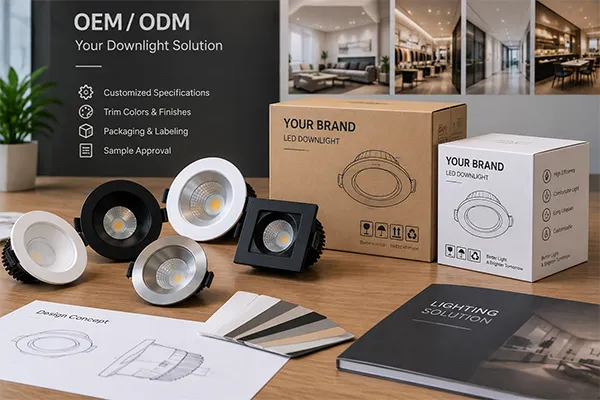
Look Beyond Cosmetic Customization
At Upward Lighting, we support OEM/ODM requests that can include color temperature, wattage, beam angle, CRI, and surface finish colors. We also discuss packaging and branding requirements with customers. However, I encourage buyers to assess customization through a commercial lens.
For example, a custom black or gold trim may make sense for a lighting brand with a coordinated interior product line. The same finish may create unnecessary stock risk for a wholesaler whose customers mainly request standard white models. The correct choice depends on whether the variation supports a repeatable sales story.
Useful OEM/ODM coordination may include:
- Consistent product naming across packaging, catalogs, and specification sheets
- Brand-aligned carton design for distributor shelves or showroom presentation
- Selected finish options that match the buyer’s product identity
- Defined color temperature options based on the target market
- Appropriate wattage and cutout combinations for the intended installation base
- Labeling requirements that support the buyer’s distribution process
- Small-batch samples for internal review or customer presentation before scaling
Use Sampling as a Commercial Test
I consider samples an important stage, but I do not consider a low sample cost proof that a range will work commercially. A sample can confirm physical appearance, basic configuration, packaging direction, and stakeholder acceptance.7 It cannot automatically prove that the product will earn repeat orders in a specific market.8
A stronger sampling process may include the following steps:
- Confirm the target customer and application.
- Approve key parameters in writing.
- Review the product appearance and finish.
- Check packaging, label information, and branding presentation.
- Gather feedback from relevant sales, technical, or channel stakeholders.
- Decide whether the range should be adjusted before a larger order.
In my experience, parameter confirmation is where many avoidable misunderstandings can be reduced. A customer may say they need “warm white,” for example, but the commercial team may also need to define whether that choice applies across the whole range or only to specific models. The same principle applies to trim colors, beam distribution, dimming needs, and packaging language.
Verify Documents for the Intended Market
Buyers should request and review relevant product documentation for their intended market and application.9 At Upward Lighting, our products hold certifications such as CE and RoHS.10 However, buyers should verify the current documents, product scope, destination-market requirements, and suitability for their own sales channel before placing an order.
For application-specific electrical, installation, safety, or compliance decisions, I recommend consulting qualified professionals and checking the applicable local requirements. A supplier can provide product information and documents, but the buyer remains responsible for confirming the fit for the intended market.
How Should Buyers Evaluate Suppliers of LED Downlight Solutions?
A low quotation can be attractive, especially in competitive wholesale markets. Yet the purchase price is only one part of the commercial decision. Buyers also need to evaluate whether a supplier can support stable specifications, responsive communication, sample control, and repeatable production.
Buyers should evaluate LED downlight solutions suppliers by examining communication quality, specification control, quality procedures, customization capability, quotation clarity, and long-term supply support. The best supplier fit is not always the lowest initial price.11 It is the supplier that can help the buyer maintain a consistent product range for the intended channel and customer base.
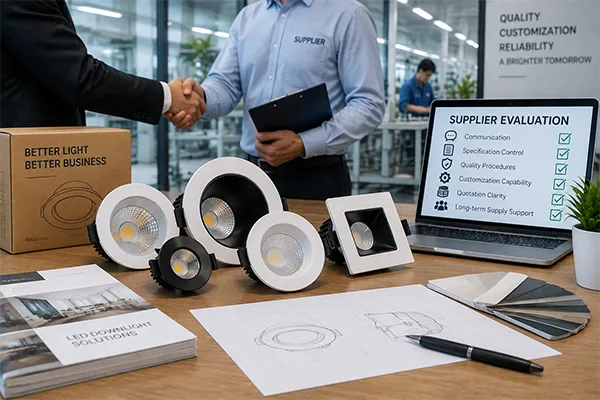
Assess the Supplier’s Process, Not Only the Product Photo
A product image and a low sample quotation provide limited information. I recommend that buyers ask how the supplier manages the process from inquiry through production.
At Upward Lighting, our team discusses customer requirements, prepares quotations, supports sampling, and confirms specifications before production. We also conduct a 100% aging test before shipment, with a stated test duration of 4 to 8 hours.12 Buyers should ask suppliers what their specific quality-control process includes, how it applies to the relevant model, and how records or inspection information can be reviewed where appropriate.
A practical supplier evaluation checklist includes:
| Evaluation area | Questions for the supplier |
|---|---|
| Requirement clarification | Do they ask about market, application, installation, and price positioning? |
| Quotation clarity | Are product parameters and commercial terms clearly stated? |
| Sample process | Can they support specification confirmation before volume production? |
| Quality control | What inspections or aging procedures do they perform? |
| Customization | Which OEM/ODM parameters can they realistically control? |
| Documentation | Can they provide relevant certification documents for buyer review? |
| Delivery planning | Can they explain lead time assumptions and supply-chain considerations? |
| Small-batch support | Can the supplier support a controlled product launch or market test? |
| Communication | Do responses address technical and commercial questions clearly? |
Look for Consistency in Requirement Discussions
I believe a good supplier should ask questions that may initially feel basic. When I ask, “Which market are you selling to?” or “What price level must the range serve?” I am trying to understand whether the requested model fits the buyer’s business plan.
A supplier that only agrees with every parameter request may not help identify conflicts. For instance, a highly customized model, premium packaging, and an aggressive target price may not align. A transparent discussion gives the buyer an opportunity to adjust priorities before investing in samples or inventory.
I also recommend comparing quotations on a like-for-like basis. Buyers should confirm:
- Model configuration
- Key performance parameters
- Finish and trim details
- Driver or dimming requirements, where relevant
- Packaging method
- Branding requirements
- Minimum order quantity
- Sample terms
- Delivery assumptions
- Documentation requested for review
Think About Repeatability
The strongest commercial question is often not, “Can this supplier make one good sample?” It is, “Can this supplier help us maintain a repeatable range?”
For a lighting brand, importer, or wholesaler, repeatability affects product training, catalog management, distributor confidence, customer expectations, and reorder planning. I have seen that buyers often value quick quotation turnaround and responsive communication because these factors help them respond to their own customers faster.
A supplier relationship should support a controlled product range over time. It should not force the buyer to restart the specification discussion with every order.
Frequently Asked Questions
What are LED downlight solutions?
LED downlight solutions are coordinated product offerings built for a specific market, customer segment, installation context, and sales channel. They can include selected product specifications, finishes, packaging, branding, and documentation. A solution is more than a single downlight because it supports a defined commercial purpose.
Should I offer many LED downlight models to increase sales?
Not necessarily. A larger selection can create more inventory complexity and make selling harder. I recommend starting with a focused range that covers clear customer scenarios. Buyers can add models after evaluating demand, feedback, reorder patterns, and the operational impact of additional SKUs.
What should I confirm before ordering LED downlight samples?
Buyers should confirm the intended market, target space, product parameters, finish, packaging direction, branding needs, and commercial price position. They should also clarify which stakeholders will review the sample and what acceptance criteria they will use before moving toward a larger order.
Can OEM/ODM customization help a lighting brand differentiate?
OEM/ODM customization can help a lighting brand create a more consistent identity when the changes support a real customer need. Useful options may include coordinated finishes, selected technical parameters, packaging, and labeling. Buyers should avoid customization that adds cost or stock complexity without strengthening their position.
How do I evaluate LED downlight quality for a new supplier?
Buyers should review the supplier’s specification process, sample control, production quality procedures, documentation, communication, and ability to maintain consistent configurations. They should verify any relevant certification documents and seek qualified technical or compliance advice when the application or destination market requires it.
Conclusion
LED downlight solutions can support a more effective product strategy when buyers treat them as a structured assortment, not as isolated low-cost items. I recommend starting with the target customer, space, channel, and price position. From there, buyers can select controlled specifications, meaningful OEM/ODM details, and supplier processes that support repeatable ordering. If you are building or refreshing a downlight range, I invite you to share your target market, application, and price level with Upward Lighting so we can discuss a suitable OEM/ODM approach.
"Search Growth Lab", https://growthlab.hks.harvard.edu/hwp_c_policyarea1/productspace/. Research on assortment breadth and choice finds that additional alternatives can increase decision complexity, while operations research links greater variety with added inventory and forecasting burdens; effects vary with category design and decision support. Evidence role: mechanism; source type: paper. Supports: Evidence that larger assortments may increase inventory-management burdens and can complicate choice or recommendation processes.. Scope note: The literature may not directly measure quotation delays or sales recommendations in the LED-lighting trade. ↩
"Analysis of factors affecting visual comfort in hotel lobby - PMC - NIH", https://pmc.ncbi.nlm.nih.gov/articles/PMC9851505/. Professional lighting-design guidance describes hospitality and retail lighting as application areas in which visual comfort, ambience, merchandise or interior presentation, and documented design criteria are commonly considered. Evidence role: general_support; source type: institution. Supports: Professional lighting-design guidance on visual comfort, ambience, consistency, and specification requirements in hospitality and retail environments.. Scope note: Such guidance establishes common design considerations, not a universal purchasing priority for every hospitality or retail project. ↩
"Managing Product Variety: Supply Chain Segementation for Food ...", https://scm.mit.edu/news-and-events/managing-product-variety-supply-chain-segementation-for-food-and-beverage-retailers/. Studies of product-variety management report that expanding and overlapping assortments can increase forecasting, inventory, and operational complexity, although the size of the effect depends on the firm, demand pattern, and supply chain. Evidence role: general_support; source type: paper. Supports: Research on product variety and operational complexity, including effects on inventory, forecasting, and supply-chain costs.. Scope note: This evidence addresses product-assortment complexity generally rather than LED downlights specifically. ↩
"Pricing strategies in business: master key techniques - Les Roches", https://lesroches.edu/blog/pricing-strategies-in-business/. Product-line management research describes tiered offerings as a way to distinguish value propositions and serve segments with different willingness to pay, provided that the tiers are clearly differentiated and economically viable. Evidence role: general_support; source type: research. Supports: Marketing and product-management evidence on tiered product lines that differentiate customer segments and value propositions.. Scope note: The evidence supports the general product-line strategy and does not demonstrate that every downlight range should use three tiers. ↩
"The impact of SKU and network complexity on inventory ...", https://dspace.mit.edu/entities/publication/ce32eddc-ed66-45a2-acc7-bed0ace31cf8. Supply-chain research and professional guidance identify SKU proliferation as a source of additional demand-planning, inventory-control, and replenishment complexity. Evidence role: mechanism; source type: research. Supports: Evidence that SKU proliferation is associated with greater planning, inventory-control, and replenishment complexity.. Scope note: The operational impact depends on volume, commonality of components, forecasting systems, and the distributor's inventory practices. ↩
"Working Capital Management, Corporate Performance, and ... - PMC", https://pmc.ncbi.nlm.nih.gov/articles/PMC4121159/. Inventory-management research shows that low-demand SKUs can require disproportionate safety-stock and carrying-cost attention, potentially tying up working capital when demand is fragmented across many items. Evidence role: mechanism; source type: paper. Supports: Research linking low-demand or long-tail SKUs with inventory carrying costs and working-capital exposure.. Scope note: The level of exposure depends on lead times, minimum order quantities, service targets, and the ability to replenish to order. ↩
"Prototyping for context: exploring stakeholder feedback based ...", https://pmc.ncbi.nlm.nih.gov/articles/PMC7451731/. Product-development literature describes prototypes and preproduction samples as tools for assessing physical attributes, communicating design intent, and obtaining stakeholder feedback before full-scale production. Evidence role: general_support; source type: paper. Supports: Product-development research on prototypes and samples as tools for evaluating physical attributes and collecting stakeholder feedback.. Scope note: A sample review cannot by itself establish manufacturing consistency, market demand, or regulatory conformity. ↩
"Navigating new product development: Uncovering factors and ...", https://pmc.ncbi.nlm.nih.gov/articles/PMC10788447/. New-product-development research distinguishes prototype evaluation from market validation: favorable sample feedback may inform design decisions but does not by itself establish future adoption or repeat purchasing. Evidence role: general_support; source type: paper. Supports: Evidence that prototype or concept evaluation differs from market validation and does not conclusively predict adoption or repeat purchase.. Scope note: The predictive value of testing can improve when it is combined with representative market research, pilots, and observed sales data. ↩
"Preparing technical documentation - Your Europe - European Union", https://europa.eu/youreurope/business/product-rules-compliance/general-product-compliance/preparing-technical-documentation/index_en.htm. Regulatory guidance for electrical products requires relevant economic operators to ensure that applicable conformity information and technical documentation are available and that products meet the requirements of the market in which they are placed. Evidence role: general_support; source type: government. Supports: Regulatory guidance that economic operators must ensure relevant technical documentation and conformity information are available for regulated electrical products.. Scope note: Exact documentation and responsibilities vary by jurisdiction, product category, and the party's legal role in the supply chain. ↩
"Ce Rohs Led Light", https://www.made-in-china.com/products-search/hot-china-products/Ce_Rohs_Led_Light.html. The manufacturer's current, model-specific conformity documentation should identify the covered product and substantiate the stated CE marking and RoHS compliance status. Evidence role: case_reference; source type: other. Supports: Current, model-specific CE conformity documentation and RoHS compliance records supplied by Upward Lighting.. Scope note: CE marking is a manufacturer declaration of conformity rather than an independent product certification, and documentation must be checked for the exact model and destination market. ↩
"Supply Chain Management - NIST", https://www.nist.gov/mep/supply-chain. Procurement guidance commonly assesses supplier value using total cost of ownership and non-price criteria such as quality, delivery performance, and supply risk, rather than relying solely on initial unit price. Evidence role: general_support; source type: government. Supports: Public-procurement or supply-management guidance that evaluates suppliers using total cost, quality, delivery, and risk factors in addition to purchase price.. Scope note: The appropriate weighting of price and non-price factors depends on the buyer's legal procurement framework, product risk, and commercial objectives. ↩
"Improved indoor lighting improved healthy aging at home - PMC", https://pmc.ncbi.nlm.nih.gov/articles/PMC6526775/. A documented quality-control procedure and corresponding batch records should verify whether each unit of the specified model underwent pre-shipment aging for the stated 4-to-8-hour period. Evidence role: case_reference; source type: other. Supports: Supplier quality-control procedures and batch records showing the scope and duration of pre-shipment aging tests for the relevant models.. Scope note: An aging-test record demonstrates that a stated procedure was performed; it does not alone establish long-term field reliability or compliance with every applicable performance standard. ↩