

Launching LED downlight products can look simple until the first samples, pricing discussions, and inventory commitments begin. A low quote or high specification may appear attractive, but the wrong product mix can create slow-moving stock, installation complaints, or replenishment problems. I recommend validating the application, sales channel, specification, and supplier plan before placing an order.
To launch LED downlight products successfully, buyers should match the product specification, target application, sales channel, compliance needs, packaging, and replenishment plan before committing to production. A successful launch is not defined by the lowest unit price or highest specification. It depends on whether the selected downlight fits customer demand, installation conditions, target price, and supplier capability.
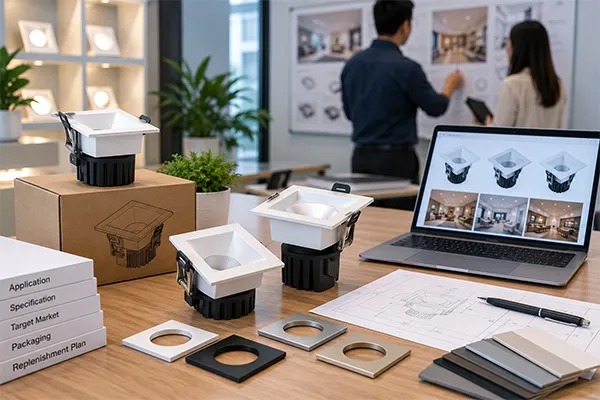
In supplier-side launch discussions, I often see buyers focus on the product first and the market route second. However, the commercial route usually determines the right SKU structure, packaging level, documentation, and order quantity. A clearer launch plan reduces avoidable changes after sampling and gives both buyer and supplier a more practical foundation.
How Should You Define the Market Before You Launch LED Downlight Products?
Many buyers start by requesting a catalogue, a price list, and a sample. That is understandable, but it can create confusion when the product is intended for several different customer groups. Without a defined market route, buyers may choose LED downlights that are too complex, too expensive, or unsuitable for the way they will be sold.
Before you launch LED downlight products, define who will buy them, where they will be installed, how they will be sold, and how quickly they may need replenishment. Retail, distribution, and project channels need different SKU ranges, packaging, installation support, documents, and stock plans.
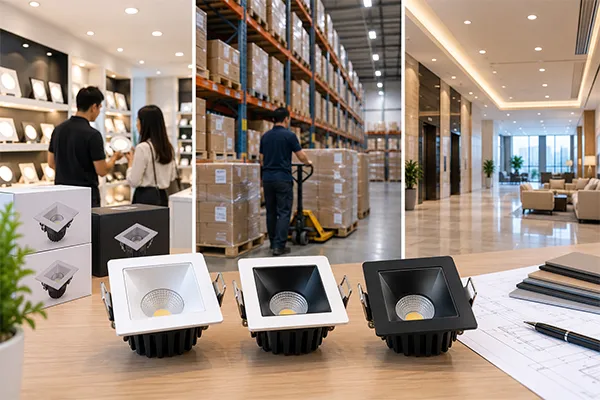
Retail, Distribution, and Project Sales Are Different
A local lighting brand selling through retail stores may need clear packaging, easy product comparison, consistent finish colors, and a manageable range. A distributor may prioritize stock availability, common wattages, and straightforward price tiers. A project buyer may need a product schedule, approval samples, installation details, and batch consistency.
I have found that a product can be technically suitable but commercially unsuitable. For example, a downlight with many optional specifications may be useful for a project, yet difficult for a wholesaler to stock because each variation creates another inventory line.
| Sales route | Typical priority | Common launch risk | Practical planning question |
|---|---|---|---|
| Retail or local brand | Packaging, appearance, simple choices | Too many similar SKUs | Can a customer understand the range quickly? |
| Wholesale or distribution | Stable availability, price positioning | Slow-moving variations | Which items will be replenished regularly? |
| Project supply | Approval, consistency, installation fit | Specification changes late in the process | Has the consultant or contractor approved the key parameters? |
| Electrical/building-material channel | Practical installation, product documentation | Returns caused by mismatched cut-out or driver needs | Are installation details clear for the trade customer? |
Questions to Answer Before Requesting a Quotation
Before I prepare a detailed quotation for a downlight launch, I encourage buyers to clarify the commercial basics. These answers help us recommend a realistic specification and avoid quoting a product that does not fit the intended channel.
A useful brief should include:
-
Target country or market region
The destination affects the documents, labeling, plug or wiring requirements, and buyer expectations. CE and RoHS documents may be relevant for market entry in certain situations1, but buyers should verify the applicable requirements for their product category, sales route, and destination market. -
Primary application
Is the product intended for homes, offices, hospitality spaces, corridors, shops, or general commercial areas? The installation height, ambient environment, visual task, and desired atmosphere affect the specification. -
Target customer and price band
A value-focused distributor and a premium lighting brand may need different housings, finishes, light quality expectations, and packaging standards. -
Expected SKU count
Buyers should decide whether they need a focused core range or a broader series. A launch with three well-defined models can be easier to control than a launch with fifteen loosely differentiated versions. -
Estimated first order and replenishment model
A small trial order may be appropriate when market demand is still uncertain. A repeat-stock model may justify a more stable production and packaging arrangement.
A practical point to confirm is this: “What decision will our customer make when they compare this downlight with another option?” That answer often reveals the most important product features.
When we help customers launch LED downlight products, we treat the quotation as the beginning of requirement definition, not simply a price document. This approach can make later sampling and production preparation more efficient.
Which LED Downlight Specifications Should You Confirm Before Sampling?
Buyers sometimes assume that higher wattage, higher lumen output, higher CRI, or more functions will automatically improve a product. In practice, every parameter affects cost, positioning, performance expectations, and inventory complexity. A specification only creates value when it supports the intended use and target price.
Before sampling LED downlights, buyers should confirm wattage, lumen output, CCT, CRI, beam angle, cut-out size, driver arrangement, finish, and installation conditions as one coordinated product definition. The best specification is the one that fits the application and commercial position, not necessarily the highest possible number.
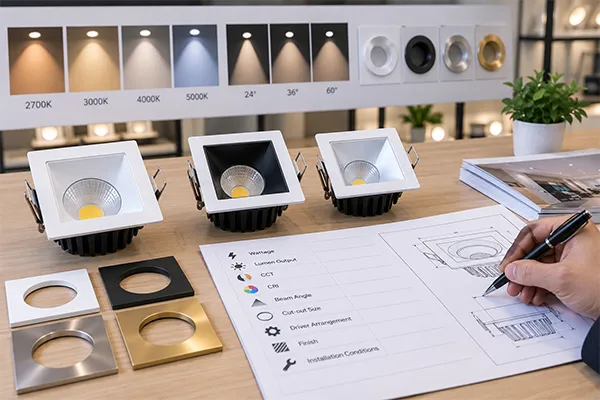
Build a Specification Around the Application
An LED downlight used in a residential corridor may need a different light distribution and price structure from a downlight used in a retail display area. Likewise, a deep anti-glare design may be more relevant in visual-comfort-sensitive spaces than in a basic utility installation.
The following table shows how buyers can connect common parameters to procurement decisions.
| Parameter | What it affects | Buyer consideration |
|---|---|---|
| Wattage | Power consumption, thermal design, price | Match it to the required light level and product category |
| Lumen output | Brightness expectation | Confirm the measurement basis and acceptable output range |
| CCT | Visual atmosphere and market preference | Select common choices such as 3000K, 4000K, or 6500K based on the target market |
| CRI | Color appearance | Consider the application; higher CRI may matter more where merchandise or interior finishes are emphasized2 |
| Beam angle | Light distribution | Match it to ceiling height, spacing, and the lighting purpose3 |
| Cut-out size | Installation compatibility | Confirm it early to reduce installation and return risks4 |
| Trim color and finish | Product appearance and brand fit | Approve a physical reference where appearance matters |
| Driver type | Reliability, dimming, wiring, replacement | Verify compatibility with the planned installation method |
| IP rating | Environmental suitability | Evaluate the real installation zone rather than selecting an unnecessarily high rating |
Avoid Creating Unnecessary SKU Complexity
A common challenge in LED downlight product launches is combining too many options into the first range. For example, a buyer may request three wattages, three CCTs, two beam angles, three trim colors, and two driver options. That can create 108 theoretical combinations5 before packaging variations are even considered.
Not every combination needs to become a stock item.
I usually suggest separating the range into:
- Core stock SKUs: The most likely repeat-order models.
- Project or made-to-order options: Variations for specific customer requirements.
- Future expansion options: Features that can be introduced after the first range receives market feedback.
This approach helps buyers protect working capital6. It also makes it easier for a supplier to prepare production materials, labels, packaging artwork, and quality references.
Confirm Expectations That Are Hard to Capture in a Datasheet
Technical datasheets are essential, but they cannot always describe visual expectations completely. Buyers should use samples to assess factors such as:
- Housing appearance and trim consistency
- Color tone between units
- Diffuser appearance
- Perceived glare
- Heat management design
- Spring clip operation
- Driver labeling and cable length
- Packaging condition after transport simulation or handling
In my experience, a short written approval record can be valuable. The record does not need to be complicated. It can list the approved sample code, color temperature, trim color, driver configuration, packaging version, and any agreed visual reference. This creates a clearer basis for production communication.
Why Is a Confirmed Sample Not Enough to Launch LED Downlight Products?
A confirmed sample is an important milestone, but it is not the same as a production-ready launch. Samples are often made under controlled attention, while production requires repeatable materials, documented checkpoints, packaging readiness, and clear communication7 between the buyer and supplier.
A confirmed LED downlight sample should be followed by production readiness checks. Buyers should lock down approved specifications, appearance expectations, quality checkpoints, packaging, labeling, lead time, documentation, and responsibility for changes before the first production order begins.
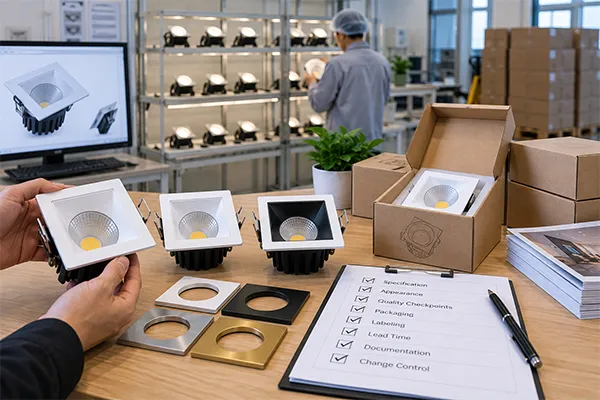
Turn Sample Approval Into a Production Reference
When buyers launch LED downlight products, the approved sample should become a reference point rather than a vague memory. This is especially important when the product includes custom branding, special trim colors, customized color temperatures, or project-specific packaging.
A production reference file may include:
- Approved product model number
- Product photo and sample identification
- Wattage, CCT, CRI, and beam-angle requirement
- Cut-out size and external dimensions
- Trim finish or approved color reference
- Driver input and output details
- Required labels and carton marks
- Packaging configuration
- Required documentation
- Inspection points and acceptance criteria
- Named communication contacts on both sides
This documentation helps reduce the risk of last-minute questions. It also supports internal handovers when a purchasing manager, product manager, or project coordinator is not available.
Quality Control Should Match the Product Risk
At Upward Lighting, we conduct a 100% aging test before shipment, typically lasting 4 to 8 hours, as part of our normal manufacturing process. However, I would not present this practice as a substitute for a buyer’s own quality plan or for application-specific evaluation. Buyers should still define the checks that matter for their product and market.
For a standard recessed LED downlight, practical checkpoints may include:
| Production stage | Example checkpoint | Why it matters |
|---|---|---|
| Incoming materials | Housing, LED source, driver, diffuser | Material changes can affect consistency |
| Assembly | Wiring, clip fitment, driver connection | Installation safety and handling depend on assembly quality |
| [Aging | Basic operation during aging period | Helps identify certain early failures](https://www.pcbcart.com/article/content/burn-in-testing-electronics-reliability.html)%%%FOOTNOTE_REF_8%%% |
| Final inspection | Appearance, labeling, operation, packaging | Supports shipment consistency |
| Pre-shipment review | Quantity, carton marks, documents | Reduces delivery and receiving errors |
Buyers should also clarify whether they need third-party inspection, their own inspection checklist, or supplier-provided inspection records. The right method depends on order size, product risk, destination, and commercial agreement.
Plan Change Control Before It Becomes Urgent
A practical issue in OEM/ODM work is change management. A buyer may change the artwork, color temperature, carton quantity, or driver requirement after the order is placed. These changes can affect material availability, lead time, cost, or production sequencing.
I recommend agreeing on a simple rule: no product, packaging, or document change should be treated as final until both parties confirm it in writing9.
This is not unnecessary administration. It is a basic safeguard for a launch where multiple teams may be involved. It helps protect the buyer’s brand and helps the supplier prepare consistently.
How Can You Control Cost and Inventory Risk When You Launch LED Downlight Products?
The lowest unit price can be tempting, especially when buyers need to establish a competitive market position. Yet a low purchase price can lose its advantage if stock does not sell, packaging is unsuitable, products cannot be replenished consistently, or after-sales issues consume time and margin.
To control risk when you launch LED downlight products, evaluate total business cost rather than unit price alone10. Compare product suitability, MOQ, lead time, packaging, compliance documentation, quality controls, replenishment capability, and after-sales exposure before choosing a supplier or order quantity.

Calculate the Cost Beyond the Invoice Price
Buyers should look at the full commercial picture. A slightly higher unit price may be reasonable if it supports a more suitable product, lower inventory risk, better packaging, or easier repeat ordering. Conversely, a lower-priced product may be appropriate when the channel demands a basic, high-volume specification and the buyer understands the trade-offs.
A useful total-cost review includes:
- Unit purchase price
- Tooling or customization cost, if applicable
- Packaging and branding cost
- Freight and import-related cost
- Inspection or testing cost
- Cost of holding inventory
- Risk of obsolete SKUs
- Expected replenishment lead time
- Possible return, replacement, or customer-service exposure
Use a Small-Batch Trial With a Clear Learning Plan
Small-batch orders can help buyers test a range before expanding it11. However, a trial should not simply mean “buy a small quantity and hope.” It should answer specific questions.
For example, a buyer may want to learn:
- Which wattage and CCT combinations receive the most interest?
- Do installers report any issues with cut-out size, spring clips, or driver placement?
- Does the packaging protect the product during local distribution?
- Are product labels clear for warehouse and sales teams?
- Does the target price leave enough margin after freight and local selling costs?
- Can the supplier provide a timely repeat order for the successful models?
In supplier-side launch discussions, I have seen buyers gain useful direction when they limit the first order to a focused assortment. A small trial can reveal whether the market needs a broader range, a different finish, or a more suitable price tier. It can also show whether a distributor needs faster replenishment than originally expected.
Evaluate Suppliers as Launch Partners
Supplier selection should include more than product photos and quotations. Buyers should ask how the supplier handles sampling, specification confirmation, production communication, packaging review, and document support.
For LED downlight procurement, I suggest asking suppliers:
- Can you provide a clear specification sheet for each model?
- Can you support OEM or ODM adjustments such as CCT, wattage, beam angle, CRI, and finish color?
- What is the normal process for sample approval and production confirmation?
- What aging, functional, and appearance checks are used?
- Can you support small-batch orders for a market trial?
- What is the expected lead time for samples, first production, and repeat orders?
- Which certification documents can you provide, and which market requirements must we independently verify?
- Who will be responsible for order updates and issue escalation?
At Upward Lighting, we support OEM/ODM discussions for LED downlights and other LED lighting products. We also work with small-batch requirements where practical. Still, every buyer should evaluate a supplier against their own application, destination market, technical requirements, and commercial risk tolerance.
Frequently Asked Questions
What is the first step to launch LED downlight products?
The first step is to define the target sales route and application. Buyers should identify whether the range is for retail, wholesale, distribution, or projects, then determine the target price, installation environment, expected order volume, and required product documentation.
How many LED downlight SKUs should I launch first?
A focused range is often easier to manage than a large range. Many buyers start with core wattages, common CCT options, and one or two trim finishes. The appropriate number depends on the sales channel, but every SKU should have a clear commercial reason.
Should I choose the highest CRI LED downlight available?
Not necessarily. Higher CRI can be valuable in applications where color appearance is important, such as retail or hospitality environments12. However, buyers should balance CRI with target price, lumen requirements, application needs, and the expectations of their intended customer group.
Are CE and RoHS documents enough for an LED downlight launch?
CE and RoHS documents may be relevant to market entry requirements in applicable markets, but they do not automatically cover every product, destination, installation, or customer requirement. Buyers should verify current regulatory, labeling, testing, and project-specific obligations with qualified professionals where needed.
Why should I place a small LED downlight trial order?
A small trial order can help buyers evaluate product-market fit before committing to larger inventory. It provides an opportunity to review installer feedback, packaging performance, customer response, price acceptance, and supplier communication under real commercial conditions.
Conclusion
To launch LED downlight products successfully, I believe buyers should start with the market need rather than a single specification or unit price. The strongest launch plan connects application requirements, channel strategy, product definition, sample approval, quality checkpoints, packaging, documentation, and replenishment planning. A focused small-batch trial can provide useful commercial feedback before a wider rollout. If you are preparing an LED downlight range, we at Upward Lighting can help you discuss OEM/ODM specifications, sampling, packaging, and practical production planning for your target market.
"RoHS Directive - Department of Toxic Substances Control", https://dtsc.ca.gov/universalwaste/rohs-directive/. European Commission guidance states that CE marking may be required for products covered by applicable EU harmonisation legislation, while the RoHS Directive restricts specified hazardous substances in in-scope electrical and electronic equipment. Evidence role: general_support; source type: government. Supports: The European Commission explains the circumstances in which CE marking and RoHS restrictions apply to electrical and electronic equipment placed on the EU market.. Scope note: Applicability must be assessed against the particular product, intended use, and destination market. ↩
"Light and Color", https://extension.okstate.edu/fact-sheets/light-and-color. International Commission on Illumination guidance explains that colour-rendering metrics characterize the extent to which a light source enables object colours to be perceived in comparison with a reference illuminant, making such metrics relevant where colour appearance is important. Evidence role: mechanism; source type: institution. Supports: CIE material should explain that color-rendering measures describe how a light source affects the perceived colors of illuminated objects relative to a reference illuminant.. Scope note: A high CRI alone does not determine all aspects of visual preference, color fidelity, or retail lighting performance. ↩
"LED Light Beam Angles", https://greencreative.com/lighting-academy/lighting-guide/led-light-beam-angles/. Lighting-design teaching materials describe illuminance distribution as a function of luminaire photometry and installation geometry, including mounting height and spacing; beam-angle selection therefore needs to be considered with the intended lighting task. Evidence role: mechanism; source type: education. Supports: Lighting-design references should describe how luminaire distribution and mounting geometry affect the area illuminated and resulting illuminance distribution.. Scope note: Final spacing and beam-angle choices require a project-specific photometric calculation and room geometry. ↩
"Dimensional Tolerances in Construction and for Surface ...", https://www.access-board.gov/research/building/dimensional-tolerances/. Construction quality-management literature identifies incomplete or incompatible product specifications and dimensions as contributors to installation errors and rework, supporting early verification of opening and fixture dimensions. Evidence role: general_support; source type: research. Supports: Research or construction-quality guidance should support the principle that incompatible dimensions and unclear specifications contribute to installation defects and rework.. Scope note: The evidence addresses dimensional coordination generally and does not quantify return rates for LED downlights specifically. ↩
"Managing Product Variety: Supply Chain Segementation ...", https://scm.mit.edu/news-and-events/managing-product-variety-supply-chain-segementation-for-food-and-beverage-retailers/. Operations-management research finds that greater product variety can increase supply-chain and inventory complexity because each additional variant requires separate forecasting, stocking, and coordination decisions. Evidence role: mechanism; source type: paper. Supports: Operations-management research should support that expanding product variety increases planning, inventory, and operational complexity.. Scope note: The numerical count of 108 follows directly from the stated option sets; research supports the operational consequence rather than that arithmetic. ↩
"[PDF] A comparison of inventory carrying cost in literature and in practice", https://dr.lib.iastate.edu/bitstreams/8d2b0874-381d-4752-b619-a8d340042d5d/download. Inventory-management research recognizes that inventory requires capital investment and carries holding and obsolescence risk; limiting speculative variants can therefore reduce working-capital exposure. Evidence role: mechanism; source type: research. Supports: Inventory-management evidence should support that stock ties up capital and that limiting uncertain inventory can reduce working-capital exposure.. Scope note: The financial benefit depends on demand forecasts, minimum order quantities, lead times, and the buyer's inventory policy. ↩
"Manufacturing", https://www.nist.gov/manufacturing. ISO 9001 quality-management guidance emphasizes controlled processes, documented information, and monitoring or verification as means of consistently providing conforming products, distinguishing a production system from an individually approved sample. Evidence role: expert_consensus; source type: institution. Supports: ISO quality-management principles should support the need for controlled production processes, documented information, and verification to achieve consistent product conformity.. Scope note: Conformity with a quality-management standard does not itself prove that any specific production batch will match a sample. ↩
"Burn-In Testing: Filtering Out Infant Mortality in Critical ...", https://www.pcbcart.com/article/content/burn-in-testing-electronics-reliability.html. Reliability engineering literature describes burn-in or aging as an operational screen intended to expose some early-life or latent failures before shipment. Evidence role: mechanism; source type: research. Supports: Reliability literature should explain that burn-in or aging screens are used to detect some early-life failures in electronic products.. Scope note: An aging test cannot demonstrate lifetime performance or detect every defect mechanism, and its effectiveness depends on the test conditions and duration. ↩
"11.4 Change Control Process – Project Management", https://pressbooks.ulib.csuohio.edu/project-management-navigating-the-complexity/chapter/11-4-change-control-process/. Project and quality-management frameworks describe change control as a documented process in which proposed changes are evaluated, authorized, and communicated before implementation. Evidence role: expert_consensus; source type: institution. Supports: Project and quality-management guidance should support formal evaluation, authorization, and documentation of changes before implementation.. Scope note: The appropriate approval workflow and contractual effect of written confirmation depend on the parties' agreement and governing law. ↩
"Implementing the OECD Recommendation on Public ...", https://www.oecd.org/en/publications/implementing-the-oecd-recommendation-on-public-procurement-in-oecd-and-partner-countries_02a46a58-en/full-report/implementation-of-the-oecd-recommendation-in-member-and-partner-countries_2305bb1b.html. Public-procurement guidance on total cost of ownership advises evaluating costs beyond the purchase price, including acquisition, logistics, operation, maintenance, and risk-related costs where applicable. Evidence role: general_support; source type: government. Supports: Procurement guidance should support evaluating acquisition decisions using costs beyond the initial purchase price, including operating, logistics, quality, and end-of-life costs where relevant.. Scope note: The relevant cost categories and their weighting differ by buyer, product, contract terms, and destination market. ↩
"The Importance Of Product-Market Fit (And How To Gauge It) - VivaTech", https://vivatech.com/news/product-market-fit-its-importance-definitions-and-examples. Research on staged experimentation and pilot implementation shows that limited-scale trials can generate information about demand, operational performance, and user response before a larger commitment is made. Evidence role: general_support; source type: research. Supports: Innovation and operations research should support using pilots or small-scale experiments to gather demand and process information before larger commitments.. Scope note: A small order may not represent full-scale demand, distribution conditions, or long-term product performance. ↩
"Color rendering index", https://en.wikipedia.org/wiki/Color_rendering_index. The International Commission on Illumination defines colour rendering as the effect of an illuminant on the colour appearance of objects compared with a reference illuminant, making it a relevant consideration in settings where merchandise, food, or finishes must be visually assessed. Evidence role: definition; source type: institution. Supports: An authoritative lighting source should define color rendering and explain its relevance when the appearance of illuminated objects matters.. Scope note: CRI is only one color-quality metric and does not by itself establish suitability for every retail or hospitality application. ↩