

LED downlight inventory can become difficult to control when distributors try to cover every wattage, colour temperature, cut-out size, and finish at once. The result is often missed sales on core products and too much cash tied up in slow-moving variants. I recommend a structured SKU strategy that protects availability for repeatable demand without treating every specification as a stock item.
Efficient LED downlight inventory management means separating repeatable, non-substitutable configurations from project-specific and custom variants, then replenishing each group differently. Buyers should commit stock to validated core SKUs, apply cautious rules to long-tail products, confirm specification compatibility before substitution, and coordinate production schedules with suppliers. This approach improves service reliability while reducing the risk of obsolete or unusable stock.

I have seen this challenge repeatedly in conversations with importers, wholesalers, and lighting brands. A buyer may ask for broad product coverage and fast delivery, but the same product range may include dozens of low-volume combinations. The key is not simply to stock less. The key is to stock the right LED downlights for the demand you can reasonably expect to repeat.
Why Should LED Downlight Inventory Start With SKU Architecture?
Poor LED downlight inventory planning often starts with a total-unit mindset. A business may count 10,000 pieces in stock and feel protected, yet still lack the 9W, 90 mm cut-out, 4000K configuration that contractors request every week. At the same time, it may hold hundreds of units that are difficult to sell again.
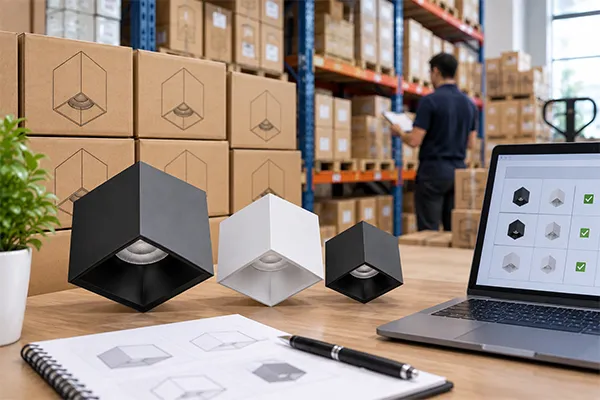
SKU architecture should come before total inventory quantity because LED downlight configurations are not equally reusable.1 Importers and distributors should classify products into core, repeatable SKUs; controlled long-tail SKUs; and order-driven custom products. Each category needs different forecasting, replenishment, and purchasing decisions.
Build Categories Based on Reusability
I usually encourage buyers to begin with a simple question: If this product does not sell to the original customer, can we sell it quickly to another customer?
That question is more useful than looking only at annual sales volume. A configuration may have sold well because of one hotel, office, or residential project. That does not automatically mean it deserves a permanent place in your warehouse.
A practical LED downlight SKU structure can include three groups:
| SKU category | Typical characteristics | Suggested inventory approach |
|---|---|---|
| [Core SKUs | Repeated demand, common market specifications, broad customer acceptance | Maintain planned stock and review replenishment regularly](https://dspace.mit.edu/server/api/core/bitstreams/20f38515-56d9-4263-936a-47a218bca9f1/content)%%%FOOTNOTE_REF_2%%% |
| Controlled SKUs | Moderate or irregular demand, limited customer base, potentially reusable | Buy cautiously and monitor demand patterns |
| Order-driven SKUs | Project-specific dimensions, special finishes, unusual CCTs, custom branding | Produce against confirmed orders where possible |
For example, an importer may find that a standard recessed LED downlight with a familiar cut-out size, white trim, 3000K or 4000K CCT, and a common wattage appears in many quotations. That SKU may deserve stock commitment if the buyer’s order history supports it.
However, a black-finish fitting with a narrow beam angle, a less common cut-out, special packaging, and an unusual colour temperature may be much harder to reuse. Even if the product is technically excellent, it can become trapped inventory if the original project changes.
Avoid “Catalogue Stock” Thinking
Many businesses keep products simply because they appear in a catalogue. I understand the reason. A wide range can help a distributor look capable. Yet a catalogue range and a warehouse range do not need to be identical.
At Upward Lighting, I have participated in many quotation and specification-confirmation discussions where a customer wanted to offer several options to its market. In these cases, I find it helpful to distinguish between:
- Products available from warehouse stock
- Products available on a planned production cycle
- Products available as OEM or project-specific orders
This distinction supports honest communication with customers. It also allows a distributor to present a broad product offering without taking equal inventory risk on every design.
Broad SKU coverage is valuable only when buyers can explain which products are stocked, which are replenished regularly, and which require production lead time.
Review SKU Categories Regularly
SKU architecture should not be permanent. A core SKU can lose relevance when a market changes, a contractor shifts preferences, or a new building standard affects demand. Similarly, a controlled SKU can become core when repeated demand appears across several customers.
I suggest reviewing categories using your own sales history, quotation activity, supplier lead times, and customer pipeline. I would not claim there is one universal turnover target or stock threshold. Each distributor has different delivery promises, cash-flow constraints, project exposure, and customer concentration.
Still, a disciplined review can reveal important warning signs:
- One customer creates most demand for a supposed “core” SKU.
- A product sells only after deep discounting.
- Stock remains unsold because a cut-out size does not match common ceilings.
- A custom finish has no repeat quotation activity.
- A replacement model has changed the required driver, trim, or installation method.
These signals help buyers protect capital before excess stock becomes a bigger commercial problem.
Which Specifications Make LED Downlight Inventory Non-Substitutable?
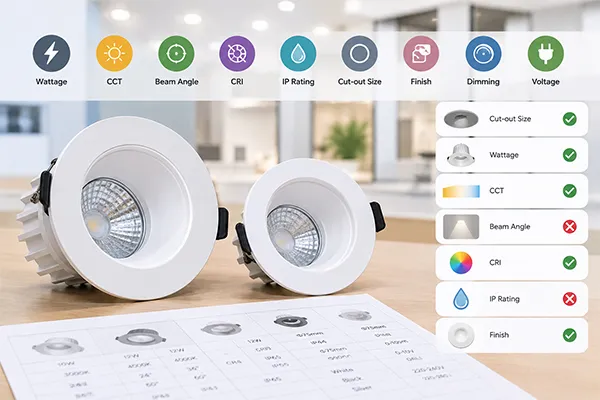
A common inventory mistake happens when a buyer assumes similar LED downlights can replace each other. In reality, LED downlight inventory is constrained by technical and installation details. A fitting with a similar appearance may still be unacceptable because its cut-out, wattage, beam angle, colour temperature, or driver arrangement differs from the required specification.
LED downlight specifications determine whether stock is genuinely usable. Wattage, colour temperature, cut-out size, beam angle, CRI, IP rating, trim finish, dimming method, and electrical requirements should be treated as inventory constraints rather than minor product attributes. Buyers should confirm compatibility before using one SKU as a substitute for another.
Cut-Out Size Is Often a Physical Constraint
The ceiling cut-out is one of the most important variables in recessed lighting procurement. If an installer has already cut a 90 mm opening, a 75 mm or 110 mm product may not be a practical substitute.3 Even where an adapter ring is possible, the appearance, fit, labour requirement, and approval process may change.
I have seen specification discussions become detailed very quickly once a project reaches installation. At quotation stage, a customer may say “9W downlight.” Later, the project team may need confirmation of:
- Exact cut-out diameter
- Outer trim diameter
- Fixture height above the ceiling
- Driver position and cable length
- Spring-clip arrangement
- Ceiling material and available installation space
That is why I do not view cut-out size as a minor SKU variation. It often creates a separate inventory commitment.
Wattage and Lumen Output Need Context
Wattage alone does not define performance.4 Two 9W LED downlights can produce different lumen output, use different LED chips or drivers, and deliver different optical results. Buyers should compare the full specification sheet rather than assuming that same-wattage products can replace one another.
Key items to verify include:
| Specification | Why it affects substitution |
|---|---|
| Wattage | Influences energy consumption and may be stated in project documents |
| Lumen output | Affects lighting level and perceived brightness |
| CCT | Changes visual atmosphere and may need to match installed fittings |
| [CRI | May be required for retail, hospitality, residential, or premium applications](https://www.energy.gov/cmei/femp/purchasing-energy-efficient-light-bulbs)%%%FOOTNOTE_REF_5%%% |
| Beam angle | Changes light distribution, spacing, and glare characteristics |
| Dimming compatibility | Affects control-system performance and installation acceptance |
| [IP rating | Determines suitability for bathrooms, soffits, and other exposed locations](https://pmc.ncbi.nlm.nih.gov/articles/PMC11012988/)%%%FOOTNOTE_REF_6%%% |
A 24-degree beam and a 60-degree beam can both use the same wattage, but they serve different lighting layouts.7 A narrow beam may create accent lighting, while a wide beam may support general illumination. Neither option is automatically interchangeable.
Colour Temperature and Finish Affect Customer Acceptance
Colour temperature is another area where buyers should be careful. A 3000K warm-white downlight may be preferred in hospitality or residential applications, while 4000K may be common in offices, retail, or utility areas. Local preferences vary by country, project type, and customer segment.
The same principle applies to surface finish. White, black, brushed metal, and custom-painted trims may appear to be cosmetic choices. Yet finish selection can determine whether a product matches the ceiling design, track system, or existing lighting range.
For this reason, I recommend that buyers create an internal specification matrix before they commit to stock. The matrix does not need to be complicated. It simply needs to show which combinations are truly reusable in your target market and which combinations should remain order-driven.
How Should Buyers Replenish LED Downlight Inventory Without Overbuying?
Fast past sales can create false confidence. A distributor may see strong movement for a downlight over several months and place a large replenishment order. Then a project ends, a customer changes its preferred cut-out, or a market shifts toward another CCT or trim style. The product that once moved quickly can become excess stock.
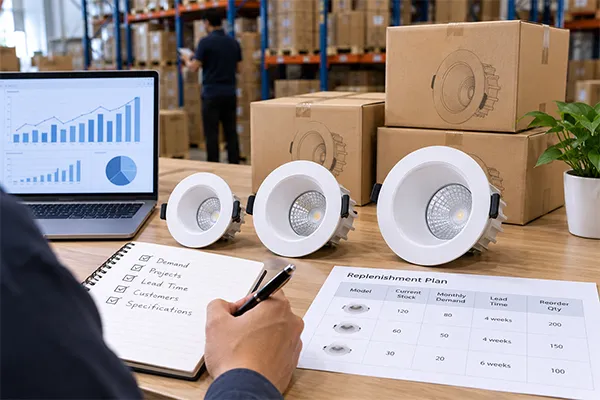
Buyers should replenish LED downlight inventory by combining historical demand with current quotations, confirmed projects, customer concentration, lead-time changes, and product-specification risk. Past sales are useful evidence, but they should not be the only reason to increase an order quantity.
Separate Repeat Demand From One-Off Project Demand
I recommend that buyers review the source of demand, not only the number of units sold. A SKU that sold 3,000 pieces across 40 customers may be less risky than a SKU that sold 3,000 pieces to one project contractor.8
A simple replenishment review can ask:
- How many customers purchased this SKU?
- How many orders were repeat orders rather than first-time purchases?
- Was demand related to a completed project?
- Are current quotations still requesting the same specification?
- Has any key customer indicated a design, price, or compliance change?
- Can this stock serve more than one sales channel?
This does not require perfect forecasting. It requires better questions before a purchase order is released.
Use Reorder Points as Internal Variables, Not Universal Rules
Many inventory guides suggest a formula such as:
Reorder point = expected demand during lead time + safety stock9
The formula can be helpful as a planning framework. However, I believe each variable must be validated against your own data. Demand can be seasonal. Shipping time can change. A factory production cycle can vary with material availability, order mix, and peak production periods. Safety stock should also reflect the commercial cost of a stockout versus the cost of holding potentially obsolete goods.
For LED downlights, I would add a specification-risk check before applying a reorder decision. A high-demand SKU with a very common configuration may justify stronger protection than a high-demand SKU tied to one customer’s custom requirements.
Watch for Signals That Demand Has Changed
A buyer should not wait for a warehouse report to identify risk. Sales and quotation activity often reveal changes earlier.
I would pay attention when:
- Customers begin requesting a different CCT or trim colour.
- Project quotations shift toward a new cut-out size.
- A competitor introduces a different visual style at a lower market price.
- A key customer requests lower wattage or higher efficacy.
- A control-system requirement changes from non-dimmable to dimmable.
- Sales teams stop quoting an SKU because it no longer fits current projects.
I remember a general pattern from replenishment conversations: the difficult products are often not the ones that never sold. The difficult products are the ones that sold very well once, encouraging a large reorder, but did not develop into repeatable market demand.
A disciplined buyer treats a large historical order as evidence to investigate, not as an automatic instruction to buy more.
Can Supplier Coordination Reduce LED Downlight Inventory Pressure?
Importers and distributors often need fast delivery, low MOQs, broad choice, and stable pricing. These goals can conflict. Supplier coordination can reduce pressure on LED downlight inventory, but it cannot remove the buyer’s responsibility to forecast demand and decide which products deserve local stock.
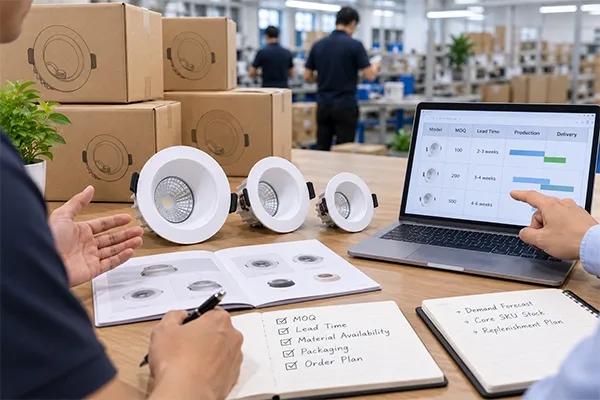
Supplier coordination can reduce inventory risk by improving visibility of MOQ, production lead time, material availability, packaging options, and order rhythm. However, responsive suppliers do not replace demand forecasting, specification control, or sensible safety stock for the SKUs that customers expect to receive quickly.
Discuss Production Reality Early
At Upward Lighting, I believe the best supplier conversations start before an urgent shortage occurs. Buyers should share their likely replenishment rhythm, core configurations, packaging requirements, and sales-channel priorities. In return, suppliers should provide realistic information about production cycles, MOQ expectations, material constraints, and confirmation procedures.
For LED downlights, buyers can ask suppliers questions such as:
- What is the normal production lead time for standard configurations?
- Does MOQ differ by housing colour, driver type, CCT, or packaging?
- Which components are shared across multiple models?
- Which specifications require custom materials or special assembly?
- Can the supplier support staged production or mixed-SKU planning?
- What product details must be confirmed before mass production?
- What inspection and aging-test process is used before shipment?
At our factory, each product undergoes a 100% aging test lasting approximately 4 to 8 hours before shipment. Buyers should still confirm the test scope, product specification, and documentation needed for their market. A quality-control process supports purchasing confidence, but it does not make an incorrectly forecast SKU easier to sell.
Use MOQ as a Commercial Planning Input
MOQ should not be treated only as a price negotiation issue. It also affects inventory exposure.10 A low MOQ can help a distributor test a new market or serve a niche customer without a large commitment. Yet small-batch purchasing can also create higher unit costs or more complex inbound logistics.
A balanced approach may include:
- Larger planned orders for validated core SKUs
- Smaller test orders for emerging configurations
- Order-driven production for project-specific combinations
- Consolidated purchasing when several SKUs share components
- Regular rolling forecasts shared with the supplier
OEM and ODM services can be valuable for local lighting brands that need specific wattage, beam angle, CRI, CCT, or surface finish. However, customization should increase planning discipline, not reduce it. The more specific the product becomes, the more carefully buyers should assess whether it can be sold beyond the original order.
Verify Compliance Documents for the Target Market
Certifications and declarations are also part of supplier selection. Upward Lighting products hold CE and RoHS certifications, but I always recommend that buyers verify the relevant documents, model coverage, test reports, labels, and market-entry requirements for the destination country and intended application.
A document may apply to a particular model, driver, or configuration.11 Buyers should not assume that one certificate covers every future customization automatically. When a project has specific regulatory, electrical, or installation requirements, qualified professional evaluation is appropriate.
Supplier responsiveness is most valuable when it supports a clear inventory plan. It cannot compensate for unclear specifications or demand that was never validated.
Frequently Asked Questions
What is the best way to classify LED downlight SKUs?
I recommend classifying SKUs by repeatability and substitution risk. Core SKUs have recurring demand across multiple customers. Controlled SKUs have irregular but potentially reusable demand. Order-driven SKUs include custom, project-specific, or difficult-to-resell configurations that should usually be purchased against confirmed requirements.
Can I substitute one LED downlight for another with the same wattage?
Not necessarily. The same wattage does not guarantee matching lumen output, cut-out size, beam angle, CCT, CRI, dimming compatibility, IP rating, or trim appearance. Buyers should verify the complete specification and installation requirements before approving any product substitution.
How does MOQ affect LED downlight inventory decisions?
MOQ affects how much capital a buyer commits to each configuration. A higher MOQ may work for validated core products, while a lower MOQ can support market testing or niche demand. Buyers should compare MOQ with expected repeat demand, lead time, freight cost, and product reusability.
Should distributors stock custom LED downlights?
Distributors should stock custom LED downlights only when they have evidence of repeatable demand or a clear secondary market. Products with special cut-outs, finishes, CCTs, packaging, or branding can be difficult to resell. Order-driven production is often a safer approach for highly specific variants.
Do supplier lead times eliminate the need for safety stock?
No. Reliable supplier lead times can reduce pressure, but they do not eliminate shipping delays, demand changes, urgent replacement needs, or forecast errors.12 Buyers should set their own safety-stock approach based on market expectations, order history, product risk, and actual supply conditions.
Conclusion
Efficient LED downlight inventory management is not about carrying the smallest possible quantity or listing every possible configuration. I believe it starts with clear SKU architecture, careful specification control, evidence-based replenishment, and realistic supplier coordination. Core configurations may deserve planned stock, while long-tail and custom variants often require more caution. If you are building a more reliable LED downlight range, we at Upward Lighting can support your evaluation with product specifications, OEM/ODM options, MOQ discussions, production planning, and quotation support for your target market.
"[PDF] Assessing Inventory Replenishment Strategy - DSpace@MIT", https://dspace.mit.edu/bitstreams/1478180f-62e4-4df4-9db5-bc3b95d1c36b/download. Inventory-management research describes SKU segmentation as a basis for assigning differentiated forecasting, service-level, and replenishment policies rather than managing all stocked items through a single aggregate quantity. Evidence role: general_support; source type: research. Supports: Inventory segmentation methods classify items by demand, value, variability, or operational importance so that replenishment policies can differ by SKU.. ↩
"[PDF] Internal Inventory Management, Analysis and ... - DSpace@MIT", https://dspace.mit.edu/server/api/core/bitstreams/20f38515-56d9-4263-936a-47a218bca9f1/content. Studies of ABC-XYZ inventory classification support using demand volume and variability to differentiate replenishment policies, with stable, frequently demanded items generally managed differently from intermittent-demand items. Evidence role: general_support; source type: paper. Supports: ABC-XYZ and related inventory-classification studies link sales volume and demand variability to differentiated stock-control policies.. Scope note: The classification frameworks do not determine which particular downlight specifications are core; that designation requires the distributor's own sales and market data. ↩
"IRSA Image Server - Cutouts - NASA/IPAC Infrared Science Archive", https://irsa.ipac.caltech.edu/ibe/cutouts.html. Luminaire-installation guidance treats the mounting opening and required clearances as specified installation parameters; consequently, a fitting designed for a different cut-out may require alteration or an approved adaptation rather than serving as a direct replacement. Evidence role: mechanism; source type: institution. Supports: Luminaire installation requirements include specified mounting openings and clearances that affect whether a recessed fitting can be installed in an existing ceiling opening.. Scope note: Practical interchangeability also depends on the ceiling construction, trim geometry, fire-rating requirements, and the manufacturer's installation instructions. ↩
"LED Basics - Department of Energy", https://www.energy.gov/cmei/ssl/led-basics. U.S. Department of Energy lighting guidance distinguishes electrical power (watts) from light output (lumens) and efficacy (lumens per watt), supporting the conclusion that equal wattage does not by itself establish equal lighting performance. Evidence role: mechanism; source type: government. Supports: LED lamp performance is assessed using measures including lumens, efficacy, color quality, and distribution, while wattage measures electrical power input.. ↩
"Purchasing Energy-Efficient Light Bulbs", https://www.energy.gov/cmei/femp/purchasing-energy-efficient-light-bulbs. U.S. Department of Energy lighting materials define the color rendering index as an indicator of how faithfully a light source renders colors relative to a reference source, making CRI relevant where color appearance is a design or specification concern. Evidence role: definition; source type: government. Supports: CRI is a measure used to describe how a light source renders object colors relative to a reference illuminant.. Scope note: CRI alone does not fully predict perceived color quality, and required thresholds vary by application, contract, and local practice. ↩
"Climatically Accelerated Material Processes Determining the Long ...", https://pmc.ncbi.nlm.nih.gov/articles/PMC11012988/. IEC 60529 defines IP codes for protection against ingress of solid objects and water, so the stated IP classification is a relevant installation parameter for luminaires used in locations with environmental exposure. Evidence role: definition; source type: institution. Supports: IEC 60529 defines IP codes as classifications for degrees of protection provided by enclosures against access, solid foreign objects, and water.. Scope note: An IP rating does not by itself establish compliance with all bathroom-zone, wiring, mounting, or local electrical-code requirements. ↩
"[PDF] New Energy-Saving Fiber Optic Lighting System Lights Up Public ...", https://www1.eere.energy.gov/office_eere/pdfs/energy_focus_sbir_case_study_2010.pdf. Lighting-design guidance explains that beam angle governs the spread and concentration of a luminaire's output, so luminaires with similar power ratings but substantially different beam angles can produce different distributions and spacing requirements. Evidence role: mechanism; source type: institution. Supports: Beam angle describes the angular spread of emitted light and influences illuminance distribution, aiming, and fixture spacing.. Scope note: The appropriate beam angle remains dependent on mounting height, target illuminance, room geometry, and the intended visual task. ↩
"Make Informed Decisions With Business Forecasting", https://online.radford.edu/degrees/business/mba/business-analytics/informed-decisions-business-forecasting/. Research on customer concentration and demand risk indicates that sales concentrated in a small number of buyers can be more exposed to changes in those buyers' purchasing decisions than demand diversified across customers. Evidence role: general_support; source type: paper. Supports: Research on demand forecasting and customer concentration identifies concentrated demand as a source of exposure when a major customer's purchasing pattern changes or ends.. Scope note: Customer count is only one risk indicator; contract terms, project pipelines, margins, and the ability to resell the item also affect the appropriate stock decision. ↩
"REORDER POINT FORMULA: Inventory Management Models", https://scm.ncsu.edu/scm-articles/article/reorder-point-formula-inventory-management-models-a-tutorial. Standard inventory-control teaching defines a reorder point as expected demand over replenishment lead time plus safety stock, with safety stock intended to buffer uncertainty in demand and/or lead time. Evidence role: definition; source type: education. Supports: The reorder-point model triggers replenishment when inventory falls to expected lead-time demand plus a safety-stock allowance.. Scope note: The formula requires reliable estimates and may need modification for seasonal, intermittent, constrained, or highly project-based demand. ↩
"Raw Material Minimum Order Quantity Optimization", https://dspace.mit.edu/entities/publication/e43f520c-9951-4e8d-b867-36c7afb5234c. Supply-chain research on minimum-order-quantity constraints shows that supplier-imposed order-size requirements can increase inventory holdings and associated carrying-risk exposure when they exceed a buyer's immediate demand. Evidence role: mechanism; source type: paper. Supports: Minimum order quantity constraints can force buyers to purchase more than unconstrained demand would require, increasing average inventory and associated holding or obsolescence exposure.. Scope note: The commercial effect of an MOQ depends on unit margin, freight consolidation, storage cost, lead time, and the item's expected resale demand. ↩
"Preparing technical documentation - Your Europe - European Union", https://europa.eu/youreurope/business/product-rules-compliance/general-product-compliance/preparing-technical-documentation/index_en.htm. European Commission guidance states that conformity assessment and technical documentation must support the compliance of the product placed on the market, so documentation should be checked for its applicable model and configuration. Evidence role: general_support; source type: government. Supports: EU conformity assessment requires manufacturers to assess the applicable product and maintain technical documentation and declarations supporting that product's compliance.. Scope note: The exact documentation and assessment route depend on the applicable legislation, product category, intended market, and whether a modification is legally significant. ↩
"[PDF] Understanding safety stock and mastering its equations - MIT", https://web.mit.edu/2.810/www/files/readings/King_SafetyStock.pdf. Inventory-control research characterizes safety stock as protection against uncertainty in demand and replenishment timing; therefore, dependable nominal lead times can reduce uncertainty without eliminating stockout risk from demand variation, disruption, or forecast error. Evidence role: mechanism; source type: research. Supports: Safety stock is used to protect service levels against uncertainty in demand, replenishment lead time, and forecast error.. Scope note: The appropriate safety-stock level depends on the desired service level, the cost of stockouts, forecast quality, and the item's obsolescence risk. ↩