LED downlight products can become slow-moving inventory when buyers choose them by wattage, lumen output, or the lowest quoted price alone. That approach can create installation mismatches, unclear compliance expectations, and difficult replenishment decisions. I recommend starting with the target market and selling scenario, then building a product range around real commercial needs.
I select market-focused LED downlight products by first defining where and how they will be sold, then matching the specification, price tier, local requirements, and supplier capability to that purpose. The best downlight is not a universal model; it is a reliable SKU that fits local customer expectations, installation practices, and the buyer’s commercial strategy.
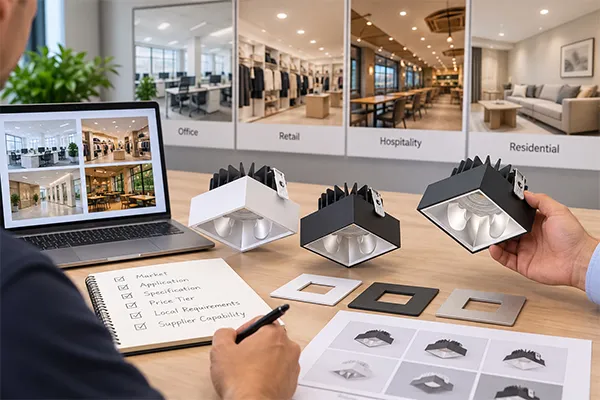
In my conversations with overseas importers, lighting brands, wholesalers, and contractors, I rarely begin by recommending a fixed model. I first ask what the buyer wants to achieve in their market. The answers usually reveal whether they need an entry-level retail item, a branded range, or a project-oriented configuration.
What Market Task Should LED Downlight Products Serve?
Many buyers begin with a specification request because it feels concrete: “Please quote 12W,” “I need 4000K,” or “Send your lowest price.” However, a specification without a market task can lead to the wrong product range, poor sell-through, and unnecessary after-sales pressure.
I recommend defining the selling scenario before selecting LED downlight products. A retail distributor may need a small, price-conscious range with familiar sizes, while a local brand may need differentiated finishes and packaging. A contractor or project buyer may prioritize consistent supply, installation compatibility, and document verification over the lowest unit price.
Start With the Channel, Not the Datasheet
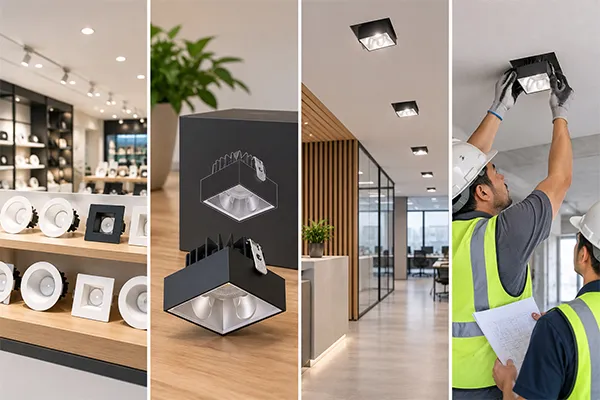
I have seen many inquiries where the first requested detail is wattage. Wattage matters, but it does not explain the commercial purpose of the product. Before I prepare a quotation, I normally try to understand the buyer’s channel and customer base.
For example, I may ask:
- Is the buyer supplying retail stores, wholesalers, contractors, or electrical channels?
- Is the product intended for a local lighting brand’s catalog?
- Will the buyer stock standard models or quote for individual projects?
- Does the buyer need a fast-moving, limited-SKU range or a broader premium offering?
- Will installers, homeowners, electricians, or architects influence the product choice?
- Does the buyer expect repeat orders for the same configuration?
These questions help me translate a general LED downlight request into a more useful product brief.
| Selling scenario | Typical commercial priority | Product-range consideration |
|---|---|---|
| Retail distribution | Clear price point, familiar appearance, easy stock rotation | Limited wattage and cutout options; practical packaging |
| Electrical or building-material channel | Installation compatibility and dependable availability | Common cutout sizes, stable driver configuration, repeatable specifications |
| Local lighting brand | Product differentiation and consistent brand presentation | Custom finish, CCT options, CRI positioning, packaging, labeling |
| Contractor or project supply | Delivery timing, specification control, documents | Approved sample, batch consistency, clear technical documentation |
| Importer or wholesaler | Landed cost, replenishment reliability, market fit | Balanced SKU range, carton planning, predictable lead times |
A buyer who serves small electrical shops may need a very different downlight range from a buyer supplying hospitality projects. I do not treat one as better than the other. I treat them as different commercial tasks.
Define the Target Price Tier
The intended price tier should also guide the configuration. Buyers can usually choose from different housing materials, driver solutions, LED source options, finish quality levels, dimming requirements, and packaging approaches. Each choice affects both the product’s perceived value and the procurement cost.
A low-price SKU may be appropriate for a highly competitive distribution market. Still, I encourage buyers to consider whether a lower initial price could create avoidable risk through unclear specifications, inconsistent batches, or limited differentiation. A mid-range or premium SKU may support stronger margins if the market recognizes the value of better appearance, higher CRI options, dimming capability, or more tailored packaging.
I do not view the “best” LED downlight as the highest-specification product. I view it as the product that fits the buyer’s market task and can be supplied consistently.
How Do I Turn Local Demand Into a LED Downlight Products Brief?
A vague request can make supplier comparison difficult. Buyers may receive quotes for products that look similar in photos but differ in cutout size, driver design, lumen output, trim material, or required documentation. A structured brief makes quotations more comparable and purchasing decisions more controlled.
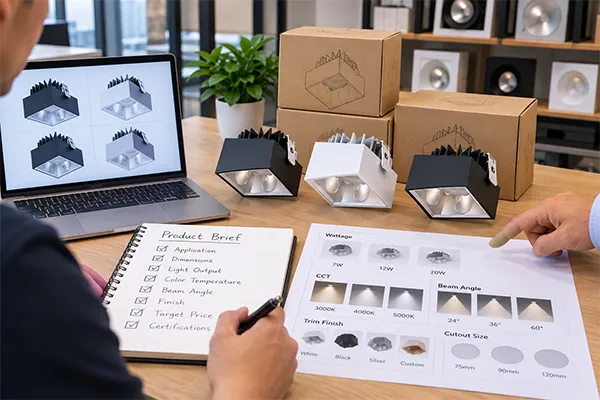
I turn local demand into a LED downlight products brief by documenting the intended application, preferred dimensions, light output range, color options, electrical requirements, visual finish, target price, and applicable market-entry documents. This brief gives both the buyer and supplier a common reference before samples and production are approved.
The Questions I Ask Before Recommending a Configuration
As a Zhongshan-based LED lighting manufacturer, I have discussed many overseas inquiries that begin with a simple request for a catalog or price list. I can provide those materials, but a short set of questions usually helps us narrow the options much faster.
I often ask for the following information:
-
Target country or region
This helps the buyer identify the local electrical, labeling, safety, environmental, and market-entry requirements that may apply. I recommend that buyers verify these requirements with qualified local professionals or relevant authorities. -
Selling channel and target customer
A downlight for a general wholesale market may not suit a premium residential brand or a contractor-led project. -
Installation type
Is the product for recessed ceilings, renovation work, new construction, commercial interiors, or residential spaces? The ceiling opening, ceiling depth, heat conditions, and installation method can all matter. -
Preferred cutout and outer diameter
Cutout mismatch is one of the most practical risks. An otherwise suitable product may be difficult to sell if it does not fit common local ceiling openings. -
Color temperature and visual preference
Buyers may request warm white, neutral white, cool white, or selectable CCT options. I do not assume one CCT is right for every market. Local preference should be checked through the buyer’s own sales experience and market research. -
Light quality and positioning
CRI, beam angle, glare control, trim design, and finish can influence the perceived quality of the product1. -
Target landed price and expected order volume
These points help establish a realistic configuration and packaging plan.
Build a Brief That Supports Comparable Quotations
I suggest that buyers use a table like the one below when comparing LED downlight products from multiple suppliers.
| Product brief item | Example decision | Why it matters |
|---|---|---|
| Product type | Recessed fixed LED downlight | Defines the basic product family |
| Intended channel | Electrical distribution | Guides price and SKU strategy |
| Cutout size | Buyer-defined local standard | Reduces installation mismatch risk |
| Wattage and lumen range | Market-specific target range | Supports price and lighting positioning |
| CCT | Fixed or selectable, based on demand | Affects inventory complexity and sales appeal |
| CRI | Standard or enhanced color rendering | Supports the intended quality tier |
| Beam angle | Based on ceiling height and use | Affects visual comfort and light distribution |
| Finish | White, black, silver, or custom | Supports local design preferences |
| Driver requirements | Non-dimmable or dimmable as required | Must align with the intended electrical system |
| Packaging and labeling | Brand, barcode, language, carton details | Supports retail and channel operations |
| Documentation | Buyer-verified market requirement | Helps manage regulatory and customer expectations |
At Upward Lighting, we can discuss OEM/ODM variables such as color temperature, wattage, beam angle, CRI, and surface finish color. However, I encourage buyers to approve the complete brief before production. A sample can be useful for checking appearance, dimensions, installation suitability, labeling, and the buyer’s own quality expectations.
Should Buyers Choose Higher Lumen Output for LED Downlight Products?
Higher brightness often sounds like an easy selling point. Yet more output is not always more suitable. Excessive brightness can create discomfort2, raise product cost, complicate energy positioning, or place the SKU in the wrong commercial tier for the intended customer.
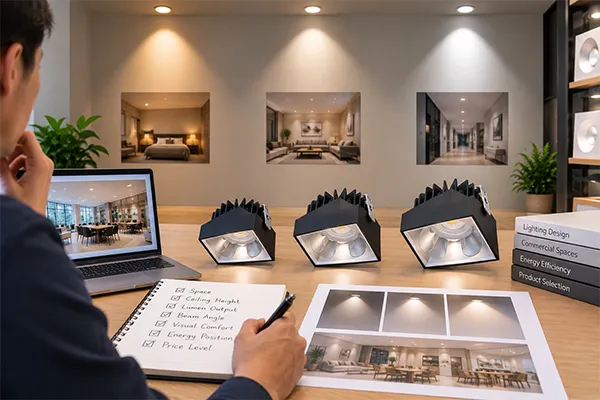
I treat higher lumen output in LED downlight products as a trade-off rather than an automatic upgrade. Buyers should match output to the space, ceiling height, beam angle, visual comfort expectations, target energy position, and price level. A balanced specification is often more commercially useful than simply choosing the highest available output.
Brightness Depends on the Installation Context
The same downlight may appear very different in a small residential room, a retail aisle, a hotel corridor, or a commercial office. The ceiling height, wall colors, room layout, spacing between fittings, and beam angle all influence the final impression3.
For this reason, I avoid telling buyers that one wattage or lumen level is universally best. A buyer should evaluate the intended installation and, where needed, consult a qualified lighting professional for application-specific planning.
The relationship between wattage and delivered light is also not a simple purchasing shortcut. Product design, LED source selection, driver performance, thermal management, optical design, and testing method can affect the final result4. Buyers should ask suppliers to clarify how performance figures are stated and compare like-for-like information.
Consider the Commercial Effect of Each Upgrade
A higher-output LED downlight may require changes in the LED configuration, driver capacity, heat management, and product price5. Those changes can be justified, but they should support a clear market reason.
I recommend considering the following trade-offs:
- Higher output vs. visual comfort: More light can be useful in some spaces but may feel harsh in others.
- Higher output vs. price positioning: Increased component cost may make the product less competitive in an entry-level channel.
- Higher output vs. energy messaging: Buyers may want a product range that supports their own energy-efficiency positioning.
- Narrow beam vs. wide beam: A narrow beam can create stronger accents, while a wider beam may suit general illumination6.
- Higher CRI vs. standard CRI: Better color rendering can support premium positioning, but it may affect cost and availability.
- Fixed CCT vs. selectable CCT: Selectable options may reduce SKU complexity for some buyers7, while fixed options may better match a specific market preference.
Use Samples as a Commercial Checkpoint
I consider sample approval an important procurement step, especially for OEM/ODM configurations. A sample does not replace formal professional evaluation where required, but it can help the buyer assess practical details before committing to a production order.
A buyer can review:
- Trim appearance and finish consistency
- Cutout and external dimensions
- Spring clip operation and installation handling
- Color temperature appearance
- Beam pattern and visual comfort
- Packaging presentation and labeling
- Brand marks, barcode placement, and carton information
- Compatibility with the intended selling range
At our factory, every product undergoes a 100% aging test lasting between 4 and 8 hours before shipment8 as part of our stated production process. Buyers should still define their own inspection standards, sample criteria, and any third-party verification requirements before ordering.
How Can Buyers Compare the Total Procurement Risk of LED Downlight Products?
A low unit price can look attractive on a quotation, especially when buyers compare several suppliers quickly9. However, the purchase price is only one part of the commercial decision. The wrong SKU, unclear documentation, delayed replenishment, or inconsistent product details can cost more than a small difference in initial pricing.
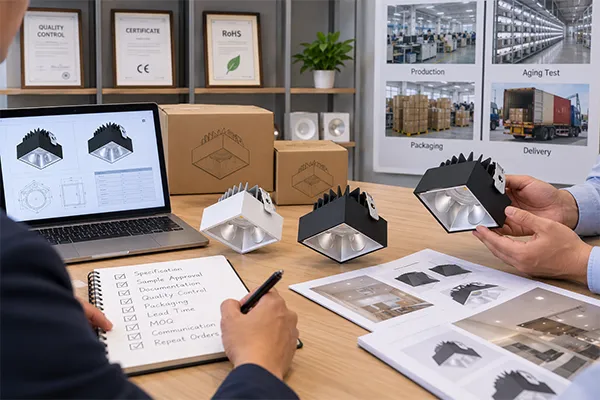
I compare LED downlight products through total procurement risk, not unit price alone. Buyers should assess specification consistency, sample approval, documentation, quality-control processes, packaging, lead time, communication speed, minimum order quantity, and the supplier’s ability to support repeat orders or customized configurations.
Look Beyond the Quoted Unit Price
When I prepare quotations, I know buyers need competitive numbers. Still, I also believe buyers should understand what is included in the quoted configuration. Two prices can differ because the products differ in ways that are not obvious in a product image.
For a meaningful comparison, buyers can ask each supplier to confirm:
- Housing and trim material
- Driver type and input requirements
- LED source and stated performance basis
- Cutout size and external dimensions
- Color temperature and CRI
- Dimming or non-dimming function
- Packaging specification
- Branding, labeling, and barcode options
- MOQ for standard and customized models
- Production lead time and replenishment capacity
- Warranty terms and after-sales process
- Available compliance-related documents
Use a Supplier Evaluation Matrix
A simple scoring matrix can help purchasing teams avoid over-weighting price.
| Evaluation area | Questions to ask | Why it affects procurement risk |
|---|---|---|
| Specification clarity | Does the quotation define all key parameters? | Reduces misunderstanding between sample and production |
| Sample control | Can the buyer approve a reference sample? | Creates a tangible standard for later comparison |
| Quality process | What inspection and aging procedures does the supplier describe? | Helps buyers evaluate process transparency |
| Documentation | Can the supplier provide relevant documents for buyer review? | Supports local compliance due diligence |
| Delivery reliability | What is the confirmed lead time and capacity plan? | Helps protect stock availability |
| Customization | Can the supplier support CCT, wattage, CRI, beam angle, or finish changes? | Supports local market differentiation |
| Communication | How quickly does the supplier clarify questions and revise quotations? | Reduces delays in product development |
| Reorder support | Can specifications remain stable for repeat orders? | Helps maintain range consistency |
Verify Certifications and Local Requirements
At Upward Lighting, our products hold certifications such as CE and RoHS. These documents can be relevant to certain market expectations and requirements. However, I do not advise buyers to assume that CE, RoHS, or any single document automatically satisfies every legal, safety, environmental, labeling, or market-entry requirement in every country10.
Each buyer should verify:
- Which requirements apply to the intended destination market
- Whether the specific product model and configuration are covered
- Whether labeling, plug, voltage, language, packaging, or importer obligations apply
- Whether a project consultant, local authority, testing body, or qualified compliance professional should review the documents
This approach is more careful than treating certification as a simple sales label. It protects the buyer, the supplier relationship, and the final customer.
Can OEM/ODM Options Help Build a Stronger Downlight Range?
Standard products can be suitable for many distribution needs, but they may not always help a buyer stand out in a crowded market. At the same time, excessive customization can create slow-moving inventory and complicated replenishment. The right approach is to customize the variables that matter commercially.
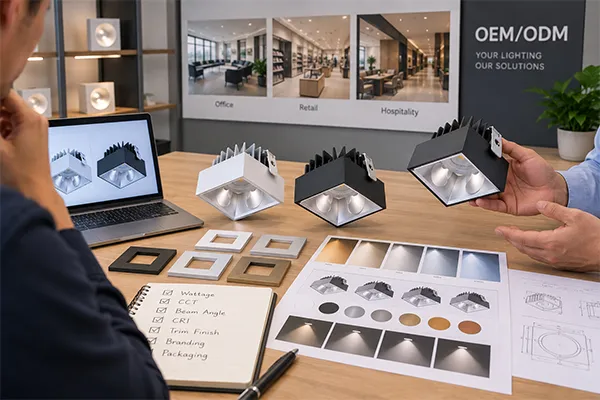
I use OEM/ODM options for LED downlight products when they support a clear market purpose, such as matching local color preferences, fitting a brand’s price position, meeting a practical installation need, or creating a recognizable product range. Buyers should avoid customization that adds cost without improving sales relevance or channel value.
Choose Customization That Solves a Market Need
In quotation discussions, I sometimes find that buyers initially request every possible variation: multiple wattages, many finishes, several CCT options, dimmable and non-dimmable drivers, and several packaging versions. That can be appropriate for a large brand program. For a new range, though, it may create unnecessary stock complexity.
I recommend prioritizing customization in this order:
-
Fit and installation compatibility
Cutout, dimensions, and mounting details should fit the intended application. -
Core light specification
Select the color temperature, wattage/lumen position, beam angle, and CRI appropriate to the selling scenario. -
Price-tier alignment
Choose components and features that support the target market position. -
Brand presentation
Add logo printing, packaging, labels, finish colors, or product naming when these improve channel recognition. -
Range expansion after validation
Add more variations once the initial SKUs show stable demand.
This staged approach can help importers and local brands keep their first order more manageable.
Keep a Controlled SKU Architecture
A strong downlight range does not need dozens of variations. In many cases, a controlled group of core SKUs is easier to quote, stock, train distributors on, and replenish.
For example, a buyer might organize the range around:
- A limited number of common cutout sizes
- Two or three practical wattage/output positions
- A defined CCT strategy
- One standard finish plus one differentiated finish
- A clear standard and premium product tier
- Consistent outer-carton and retail-packaging rules
I have found that clear SKU architecture makes future discussions more efficient. When a buyer returns for a repeat order, both sides can confirm the prior configuration, adjust only what is necessary, and reduce the risk of accidental specification changes.
Our team supports small-batch orders and personalized configuration discussions where practical. Still, I encourage buyers to confirm MOQ, lead time, customization costs, and sample requirements early. A customization idea is only commercially useful when it can be supplied repeatedly and priced appropriately.
Frequently Asked Questions
What is the first factor to consider when selecting LED downlight products?
I recommend starting with the target market and selling channel. Buyers should define whether the products are for retail, wholesale, electrical distribution, a local brand, or a project. This decision guides the right specification, packaging, price tier, documentation review, and inventory strategy.
Is a higher-wattage LED downlight always better?
No. A higher-wattage option may provide more light, but it can also affect visual comfort, energy positioning, product cost, and the intended price tier. Buyers should evaluate the installation environment and seek qualified lighting advice when an application requires detailed lighting planning.
How should I compare LED downlight supplier quotations?
I recommend comparing the full configuration rather than only the unit price. Check dimensions, cutout, driver, color temperature, CRI, beam angle, trim material, packaging, MOQ, lead time, customization capability, and available documentation. A detailed product brief makes supplier comparisons more reliable.
Do CE and RoHS documents guarantee market access?
No. CE and RoHS may be relevant documents, but they do not automatically satisfy every local requirement in every destination market. Buyers should verify the applicable requirements for the specific country, product model, labeling, electrical system, and intended sales channel with qualified local resources.
Can I customize LED downlights for my local brand?
Yes, buyers may be able to customize parameters such as wattage, color temperature, beam angle, CRI, surface finish, packaging, and branding. I recommend choosing only the options that support a clear commercial need, so the range remains practical to stock and reorder.
Conclusion
I believe that selecting LED downlight products is fundamentally a market decision before it becomes a specification decision. Buyers should define the channel, customer, installation context, price tier, and local requirements first. They can then build a focused brief covering dimensions, output, CCT, CRI, beam angle, finish, packaging, and supply expectations. At Upward Lighting, I work with importers, distributors, brands, and project buyers to discuss practical OEM/ODM configurations, samples, and repeat-order requirements. Contact us to develop a market-focused downlight range for your target customers.
"[PDF] LED Color Characteristics", https://www.energy.gov/sites/prod/files/2016/08/f33/led-color-characteristics-factsheet.pdf. Lighting-quality research identifies color rendering, glare, and light distribution as factors affecting visual appraisal and comfort in illuminated spaces. Evidence role: general_support; source type: research. Supports: Lighting research and professional guidance should support that color rendering, glare, light distribution, and appearance contribute to perceived lighting quality and visual comfort.. Scope note: Perceived quality also depends on the application, users, surrounding surfaces, and design expectations. ↩
"[PDF] Measuring Discomfort from Glare: Recommendations for Good ...", https://www.energy.gov/eere/ssl/articles/measuring-discomfort-glare-recommendations-good-practice. International lighting guidance describes discomfort glare as visual discomfort caused by inappropriate luminance levels or contrasts within the field of view. Evidence role: mechanism; source type: institution. Supports: Authoritative lighting guidance should explain that glare from excessive brightness or luminance contrast can impair visual comfort.. Scope note: Whether a particular downlight installation produces discomfort depends on its placement, optics, surroundings, and observer position. ↩
"[PDF] Understanding LM-79 Reports - Better Buildings Solution Center", https://betterbuildingssolutioncenter.energy.gov/sites/default/files/attachments/understanding_lm79_reports.pdf. Lighting-design references explain that room geometry, surface reflectance, luminaire distribution, and fixture spacing affect the resulting illuminance pattern and visual environment. Evidence role: mechanism; source type: education. Supports: Lighting-design materials should support that geometry, surface reflectance, luminaire distribution, and spacing influence illuminance and visual appearance.. Scope note: A final visual assessment requires application-specific photometric calculations or on-site evaluation. ↩
"Publications | NIST", https://www.nist.gov/publications/search_by_author/1149951?d%5Bmin%5D=&d%5Bmax%5D=&k=&n=&s=All&t=&page=1. LED-luminaire technical literature shows that electrical drivers, thermal conditions, optical design, and standardized measurement procedures affect reported and delivered photometric performance. Evidence role: mechanism; source type: government. Supports: Standards or technical research should support that LED luminaire output and performance are influenced by thermal conditions, drivers, optics, and measurement procedures.. Scope note: The magnitude of each factor varies by luminaire design and the applicable test method. ↩
"[PDF] Understanding Fixture Design Tools", https://www1.eere.energy.gov/buildings/publications/pdfs/ssl/bair_msslc-boston2012.pdf. LED-system engineering studies show that increasing electrical power and light output requires coordinated driver and thermal design to manage junction temperature and maintain performance. Evidence role: mechanism; source type: paper. Supports: Engineering literature should support that higher-power LED systems require appropriate driver and thermal design to maintain performance and reliability.. Scope note: The statement does not establish a uniform cost increase, which depends on design choices, production scale, and component markets. ↩
"[PDF] New Energy-Saving Fiber Optic Lighting System Lights Up Public ...", https://www1.eere.energy.gov/office_eere/pdfs/energy_focus_sbir_case_study_2010.pdf. Lighting-design guidance characterizes narrow beam distributions as useful for accent emphasis and wider distributions as suitable for illuminating larger general areas. Evidence role: general_support; source type: institution. Supports: Lighting-design guidance should distinguish narrow distributions for accenting from wider distributions for broader area illumination.. Scope note: Appropriate beam angle depends on mounting height, spacing, target size, and desired illuminance. ↩
"Understanding the Dynamics of Value-Driven Variety Management", https://sloanreview.mit.edu/article/understanding-the-dynamics-of-valuedriven-variety-management/. Inventory-management research finds that reducing the number of distinct product variants can lower assortment-management complexity while introducing configuration and demand-planning trade-offs. Evidence role: general_support; source type: research. Supports: Research on product variety and inventory management should support that consolidating variants can reduce assortment and stocking complexity.. Scope note: A selectable-CCT luminaire reduces SKU count only when its technical specification and customer acceptance allow it to substitute for fixed-CCT models. ↩
"[PDF] Stress Testing of Organic Light-Emitting Diode Panels and Luminaires", https://www.energy.gov/sites/prod/files/2018/05/f51/ssl_oled-stresstest_2018.pdf. Reliability literature describes burn-in and aging tests as methods used to screen for early-life failures in electronic assemblies, including LED lighting products. Evidence role: general_support; source type: paper. Supports: Reliability literature should support that burn-in or aging tests are used to screen early-life failures in electronic and LED products.. Scope note: General evidence on burn-in testing cannot verify this manufacturer's claimed 100% coverage or the stated 4-to-8-hour duration; verification requires batch records or independent audit evidence. ↩
"[PDF] Purchasing Policy Manual - Douglasville, GA", https://www.douglasvillega.gov/files/assets/city/v/1/finance/documents/purchasing-policy-_-final.pdf. Procurement guidance on total cost of ownership recommends evaluating costs and risks beyond the initial purchase price, including quality, delivery, operation, and supplier performance. Evidence role: expert_consensus; source type: institution. Supports: Procurement guidance should support evaluating life-cycle or total cost and supplier risk rather than relying only on initial purchase price.. Scope note: The relevant cost categories and their importance differ by product, contract terms, and buyer operations. ↩
"CE marking – obtaining the certificate, EU requirements - Your Europe", https://europa.eu/youreurope/business/product-rules-compliance/general-product-compliance/ce-marking/index_en.htm. European regulatory guidance defines CE marking and RoHS as compliance frameworks with specified scope; conformity with them does not remove the need to meet other applicable product and market-entry obligations. Evidence role: definition; source type: government. Supports: Official regulatory sources should establish the scope of CE marking and RoHS obligations and clarify that other product, labeling, importer, and destination-market requirements may also apply.. Scope note: The applicable obligations must be determined for the particular product, destination, economic operator, and date of placement on the market. ↩