
An LED downlight factory can look straightforward from the outside, yet buyers often face costly risks after production starts: unclear specifications, inconsistent batches, delayed approvals, or incomplete shipment documents. I believe the best way to assess a factory is to follow how it controls decisions from design confirmation through final release.
An LED downlight factory turns a buyer’s requested product into a repeatable production configuration through specification confirmation, material coordination, assembly, aging, inspection, packaging, and shipment release. A reliable supplier does not rely on final inspection alone. Instead, it manages quality, customization, documentation, and delivery risks at each connected stage.
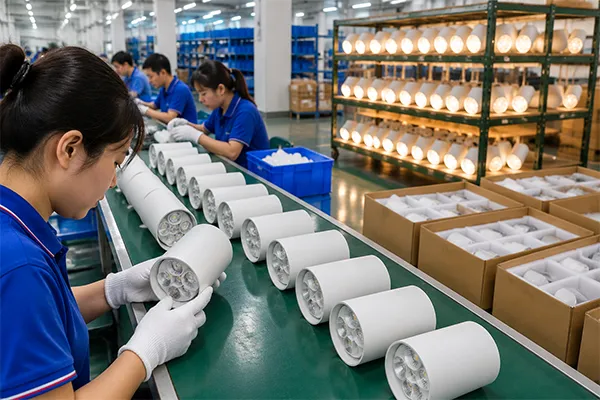
When I discuss factory capability with importers, lighting brands, and contractors, I try to move beyond the usual workshop tour. The important question is not simply whether a factory has assembly tables or aging racks. The question is whether its operating process reduces the commercial risks that matter to your order.
How Does an LED Downlight Factory Turn Requirements Into a Production-Ready Specification?
A vague request can create problems long before an LED downlight reaches an installation site. Buyers may ask for “warm white,” “high brightness,” or “a similar model at a lower price,” but these descriptions leave room for interpretation. I see specification confirmation as the first practical control point.
An LED downlight factory should translate buyer requirements into a written, production-ready specification covering key parameters such as wattage, CCT, beam angle, CRI, dimensions, trim finish, packaging, and destination-market documentation. This step helps both sides identify conflicts before materials are prepared and production is scheduled.
OEM and ODM Mean More Than a Logo
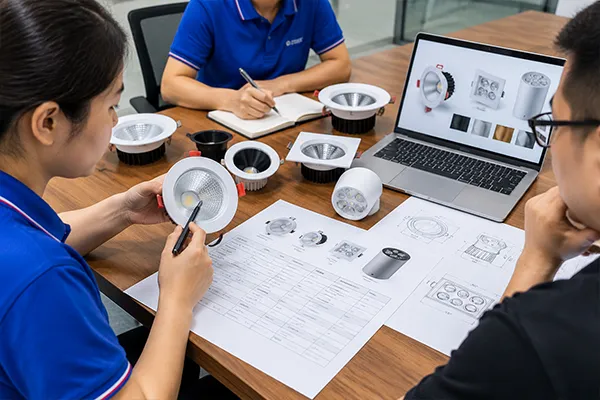
Many buyers use “OEM” to mean adding a logo to a standard product. Branding and packaging are important, but they are only part of the process. In our work at Upward Lighting, OEM/ODM discussions often involve translating a commercial request into details that production, purchasing, quality control, and packing teams can all follow.
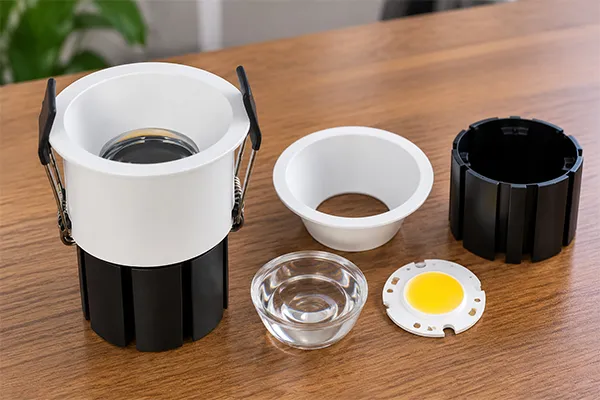
A downlight configuration may include:
- Wattage: Such as the required nominal power and any project-specific power range.
- Color temperature (CCT):1 For example, 3000K, 4000K, 6500K, or another confirmed requirement.
- Beam angle: A narrower beam and a wider beam can serve very different lighting layouts.2
- Color rendering index (CRI):3 Buyers may request a particular CRI level based on the intended environment.
- Body finish: White, black, silver, or another finish can affect the appearance of a finished space.
- Cutout size and external dimensions: These must match the ceiling plan and installation expectations.
- Input and market requirements: The destination market and electrical configuration should be confirmed before release.
- Packaging and labeling: Carton marks, manuals, barcodes, logo treatment, and inner-box presentation may require approval.
I have seen a buyer’s simple request develop into a practical specification after several short clarifications. In one anonymized case, the customer initially focused on a black finish and warm color temperature. During confirmation, the discussion expanded to beam angle, labeling, carton information, and the consistency needed across a product range. That is not unnecessary complexity. Those details help make the order manufacturable.
Why Similar-Looking Downlights Can Be Different
Two recessed LED downlights may appear almost identical in photos. They may even show the same stated wattage. However, appearance and a short specification line do not reveal how a supplier has coordinated the configuration, controlled incoming materials, managed assembly instructions, or checked the final product.
For procurement teams, I recommend asking process questions rather than making assumptions from product images:
| Buyer question | Why it matters commercially |
|---|---|
| Is the specification confirmed in writing before production? | It reduces disagreement about what should be produced. |
| Which parameters can be customized? | It clarifies whether the supplier can support your product positioning. |
| Is there a sample or approval process for customized orders? | It gives buyers a reference before larger production decisions. |
| How are packaging and labels confirmed? | It reduces avoidable import, warehouse, and channel issues. |
| What changes affect lead time or material planning? | It helps procurement teams schedule more realistically. |
A production-ready specification does not guarantee success in every application.4 A project team should still assess lighting calculations, installation conditions, controls, ceiling construction, and local requirements with qualified professionals. However, clear specifications give the factory and buyer a far better starting point.
What Should Buyers Evaluate Inside an LED Downlight Factory?
A factory visit can create confidence, but it can also be misleading if buyers focus only on what is visible. A clean production area, a busy line, or a large inventory of housings does not independently prove that a supplier can reproduce an approved downlight consistently. I encourage buyers to evaluate the factory as a control system.
When evaluating an LED downlight factory, buyers should examine how the supplier controls materials, assembly instructions, identification, inspection points, aging, packaging, and release decisions. The key issue is whether each stage connects to the confirmed specification and provides a traceable basis for shipment approval.
Material Coordination Starts Before Assembly
Production quality cannot be created solely at the end of the line.5 Once materials arrive, the factory needs to coordinate them with the approved product configuration. If a buyer has confirmed a particular color temperature, trim finish, beam angle, or labeling arrangement, material planning should align with those requirements.
I view this stage as a procurement-risk control. It helps reduce the risk of mixing configurations, preparing the wrong packaging, or discovering a mismatch after production has already started. Buyers do not need to demand confidential supplier information. Instead, they can ask how the factory distinguishes order configurations and how it prevents confusion among similar products.
Useful questions include:
- How does the team identify a customized order on the production floor?
- How are approved samples, drawings, or specification sheets shared internally?
- What happens if a buyer changes a parameter after materials have been planned?
- How does the factory separate different CCTs, finishes, or packaging versions?
- Who confirms that production can proceed after a specification revision?
Assembly Is a Repeatability Challenge
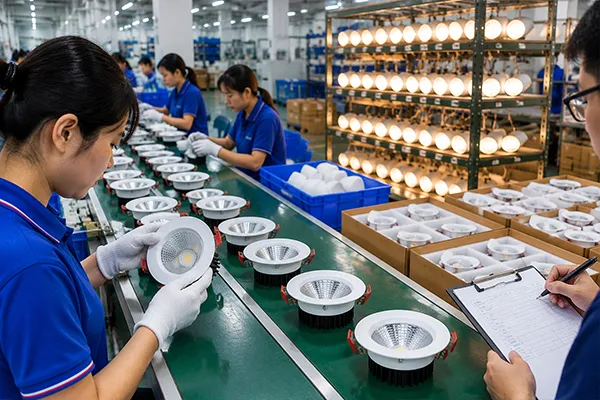
Assembly is not only about putting parts together. For a buyer, the real issue is repeatability across the batch. A product manager may approve one sample, but the commercial objective is to receive products that reflect the confirmed configuration throughout the shipment.6
At Upward Lighting, we coordinate production around confirmed product requirements and order details. Our team works through the path from assembly to inspection, aging, packing, and shipment. This does not mean that a factory process eliminates every possible issue. It means that the process should make deviations easier to identify before products are released.
A buyer should also consider the difference between a standard item and a customized item. Standard configurations may be easier to plan when materials are already available. A customized finish, special CCT, different CRI request, revised package, or new labeling requirement can add coordination steps. A responsible supplier should explain these dependencies rather than promise a timeline without reviewing the full requirement.
A credible factory discussion should connect customization choices to materials, approvals, production planning, inspection, and delivery timing.
A Factory Tour Should Produce Evidence, Not Just Impressions
I suggest that buyers document a factory evaluation with a simple risk map. This approach helps internal purchasing teams compare suppliers more objectively.
| Production area | What buyers should look for | Risk the review helps address |
|---|---|---|
| Specification control | Clear order details and revision handling | Producing an outdated or incomplete configuration |
| Material coordination | Separation of variants and order identification | Mixing CCTs, finishes, or packaging |
| Assembly | Consistent work flow and defined checks | Variation between units or batches |
| Aging area | Product identification and recorded release process | Releasing products without the planned aging step |
| Inspection | Checks connected to order requirements | Missing visible, functional, or labeling issues |
| Packaging | Approved cartons, labels, and protection | Warehouse damage or channel confusion |
| Shipment coordination | Document and carton-mark confirmation | Export and receiving delays |
Why Are Aging and Inspection Important in an LED Downlight Factory?
Buyers sometimes treat an aging rack as a simple visual sign of quality. The concern is understandable: nobody wants products packed immediately after assembly without any operational check. However, aging should be evaluated as one release gate within a broader process, not as standalone proof that every future installation will perform as expected.
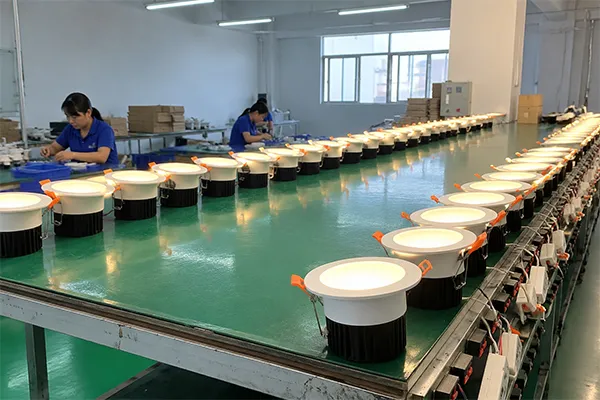
In our LED downlight factory process, every product undergoes a 100% aging test lasting between 4 and 8 hours before shipment. This aging stage supports product screening before release, but buyers should evaluate it alongside specification control, inspection, packaging, and project-specific suitability checks.
What 100% Aging Testing Means
At Upward Lighting, every product receives a 100% aging test for 4 to 8 hours prior to shipment. The exact duration depends on the product and order arrangement. This is a confirmed part of our pre-shipment workflow.
The purpose of aging is practical. It allows the team to operate products before packaging and to identify issues that may become visible during this controlled period. It also supports the broader objective of checking that the shipment is aligned with the planned release process.
Still, I think buyers should keep this claim in proportion. Aging does not prove that a product is suitable for every ceiling type, dimming system, climate, installation method, electrical environment, or local regulation. It does not replace project design, professional installation, or destination-specific compliance review.
Inspection Should Match the Order, Not Just the Product Category
Inspection is most useful when it follows the actual order specification. For example, if the buyer’s order includes a black trim, a specific CCT, branded packaging, and a defined carton mark, the release decision should consider more than whether the downlight powers on.
A practical inspection and release review can include:
- Appearance and finish consistency
- Product identification and configuration matching
- Operational checks following the factory’s process
- Packaging condition and quantity verification
- Carton label and shipping-mark confirmation
- Documentation review for the agreed destination and order
I advise buyers to define what they want inspected before the order is completed. An importer may prioritize packaging accuracy and barcode placement. A contractor may care more about cutout compatibility and configuration consistency. A lighting brand may focus on finish, visual presentation, and product labeling. Different priorities are valid, but they need to be communicated early.
Certification Documents Need Order-Specific Verification
Our products hold certifications such as CE and RoHS.7 These documents support market-entry requirements related to safety, environmental protection, and regulatory expectations in relevant markets. However, responsible procurement requires buyers to verify certification applicability for the specific model, configuration, destination, and sales channel.
This is especially important when an order includes customized parameters. A change in product configuration may affect what documentation should be reviewed.8 Buyers should ask for applicable documents and have qualified professionals assess regulatory suitability where necessary.
How Do Packaging and Shipment Release Protect the Buyer?
The most expensive problems are not always product failures. A shipment can become difficult to receive or sell if cartons carry incorrect marks, labels do not match the order, quantities are unclear, or export documentation is incomplete. Packaging and shipment coordination are therefore commercial controls, not final administrative tasks.
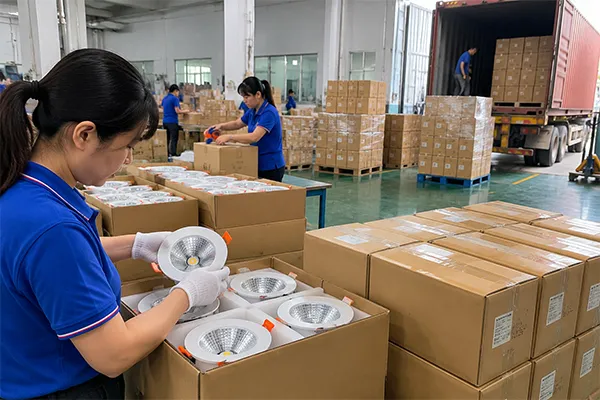
An LED downlight factory should treat packaging, documentation, carton marking, and shipping coordination as final release gates. These steps help confirm that the approved products are protected, identified, counted, and prepared for the buyer’s chosen transport and receiving process.
Packaging Protects Both Products and Product Positioning
Packaging has at least two functions. First, it protects the product during handling, loading, transport, storage, and local delivery.9 Second, it supports the buyer’s brand, channel requirements, and warehouse process.
For OEM lighting buyers, packaging may include:
- Custom outer-carton artwork
- Buyer logos or private-label information
- Product model identification
- Barcodes or SKU references
- Destination-specific caution labels
- Inner-box designs
- Installation instructions or product inserts
- Carton quantities and shipping marks
I have learned that packaging discussions should begin before the last days of production. A buyer may need artwork approval, language review, barcode confirmation, or carton-mark alignment with a forwarder’s instructions. These steps can affect timing, especially when a buyer is launching a new private-label LED downlight range.
Shipment Release Requires Cross-Team Coordination
A shipment is ready only when the product, packaging, quantities, and documentation are aligned with the agreed arrangement. The factory may coordinate with the buyer, freight forwarder, or logistics contact, but the buyer should provide clear instructions where needed.
Before shipment, I recommend using a release checklist like this:
| Release item | Buyer verification question |
|---|---|
| Product configuration | Does the shipment match the approved wattage, CCT, beam angle, CRI, finish, and dimensions? |
| Packaging | Does the artwork, labeling, and carton quantity match the purchase order? |
| Quantity | Are the packed quantities and carton counts clear? |
| Documentation | Have the agreed commercial and product documents been reviewed? |
| Certifications | Are applicable documents verified for the specific destination and model? |
| Shipment marks | Do carton marks match the consignee, project, or forwarder instructions? |
| Logistics timing | Is the pickup or loading arrangement confirmed with the relevant parties? |
Small-batch orders can require the same attention as larger orders. In fact, a small OEM trial order may need more careful coordination because it establishes the reference for future repeat orders. At Upward Lighting, we support small-batch orders and personalized customization, but we also encourage buyers to understand how each customization request affects confirmation and planning.
A clear release process does not guarantee that international shipping will be free from delays or external disruptions. Port conditions, customs procedures, route availability, weather, and local receiving arrangements remain outside a factory’s direct control.10 However, good shipment coordination reduces avoidable errors before goods leave the factory.
Frequently Asked Questions
What should I ask during an LED downlight factory visit?
I recommend asking how the factory controls specifications, identifies customized orders, coordinates materials, conducts aging, performs inspections, approves packaging, and releases shipments. You should also ask how the supplier handles revisions. A visual tour is useful, but process evidence is more valuable than appearance alone.
Does a 100% aging test guarantee LED downlight performance?
No. A 100% aging test helps screen products before shipment, and our products undergo aging for 4 to 8 hours. However, it does not guarantee performance in every installation, electrical environment, control system, climate, or market. Buyers should assess application suitability separately.
Can an OEM LED downlight supplier customize CCT, wattage, and finish?
Many suppliers can support such customization, but buyers should confirm the exact scope before ordering. At Upward Lighting, we can customize parameters including CCT, wattage, beam angle, CRI, and surface finish colors. Each requested configuration should be reviewed for manufacturability, lead time, and documentation needs.
Why do similar LED downlights have different prices?
Similar-looking downlights can differ in confirmed specifications, material coordination, quality-control processes, packaging requirements, customization scope, order volume, and shipment arrangements.11 Buyers should compare the complete order basis instead of comparing images, stated wattage, or unit prices alone.
Should buyers verify CE and RoHS documents for every order?
Buyers should verify that relevant certification documents apply to the ordered model, configuration, and destination market. CE and RoHS documentation can support market-entry review, but the buyer should obtain qualified professional advice for application-specific, legal, and local regulatory decisions.
Conclusion
An LED downlight factory should be evaluated as a connected control process, not as a collection of machines, racks, and finished products. I recommend that buyers begin with a precise specification, then review how the supplier manages materials, assembly, 100% aging, inspection, packaging, documents, and shipment release. At Upward Lighting, we help customers convert lighting requirements into workable OEM/ODM configurations and coordinate orders through export preparation. Contact our team to discuss your downlight specification, customization needs, or supplier-evaluation checklist.
"A correlated color temperature for illuminants", https://nvlpubs.nist.gov/nistpubs/jres/7/jresv7n4p659_A2b.pdf. Correlated color temperature (CCT), expressed in kelvin, characterizes the color appearance of a light source by comparison with a blackbody radiator or a related locus. Evidence role: definition; source type: government. Supports: CCT is a colorimetric measure, expressed in kelvin, used to characterize the perceived color appearance of light sources.. ↩
"Understanding LM-79 Reports", https://betterbuildingssolutioncenter.energy.gov/sites/default/files/attachments/understanding_lm79_reports.pdf. A luminaire’s beam angle describes the angular spread of its emitted light, so changes in beam angle alter the illuminated area and intensity distribution. Evidence role: mechanism; source type: education. Supports: Beam angle describes the angular spread of a luminaire's output and influences the area and intensity pattern illuminated.. Scope note: The appropriate beam angle also depends on mounting height, spacing, reflectances, target illuminance, and the overall lighting design. ↩
"Color rendering of light sources | NIST", https://www.nist.gov/pml/sensor-science/optical-radiation/color-rendering-light-sources. The color rendering index (CRI) is a standardized measure comparing the color rendering of a test light source with that of an appropriate reference illuminant. Evidence role: definition; source type: government. Supports: CRI is a standardized index intended to describe how faithfully a light source renders object colors relative to a reference illuminant.. Scope note: CRI does not by itself determine whether a lighting design is suitable for a particular visual task or environment. ↩
"Exterior Lighting Control Guidance", https://betterbuildingssolutioncenter.energy.gov/sites/default/files/attachments/exterior-lighting-control-guidance.pdf. Lighting guidance treats product selection as only one part of application performance, which also depends on layout, mounting conditions, controls, electrical compatibility, and installation practice. Evidence role: general_support; source type: institution. Supports: Luminaire performance in a project depends on system design, installation conditions, controls, and application requirements in addition to product specifications.. Scope note: This contextual guidance does not assess the suitability of any specific downlight model or installation. ↩
"Use of quality assurance systems in the fastener industry", https://nvlpubs.nist.gov/nistpubs/Legacy/IR/nistir6001.pdf. Quality-management guidance emphasizes controlling and improving processes throughout production, because final inspection can detect defects but cannot by itself build quality into a product. Evidence role: expert_consensus; source type: government. Supports: Modern quality-management practice emphasizes planned process controls and prevention rather than reliance on end-of-line inspection alone.. Scope note: The principle supports a process-based approach but does not demonstrate the effectiveness of a particular factory's controls. ↩
"What kinds of Lot Acceptance Sampling Plans (LASPs) are ...", https://www.itl.nist.gov/div898/handbook/pmc/section2/pmc22.htm. Acceptance-sampling methods use specified samples to make decisions about lots under defined assumptions; approval of an individual sample alone does not establish conformity of all subsequently produced units. Evidence role: mechanism; source type: government. Supports: A sample provides information about sampled units or a lot under defined methods, whereas ongoing process and lot controls are needed to address production consistency.. Scope note: The conclusion depends on the sampling plan, lot definition, and process controls used. ↩
"CE marking – obtaining the certificate, EU requirements", https://europa.eu/youreurope/business/product-rules-compliance/general-product-compliance/ce-marking/index_en.htm. For products within their scope, CE marking reflects the manufacturer’s declaration of conformity with applicable EU requirements, and the RoHS framework restricts specified hazardous substances in electrical and electronic equipment. Evidence role: definition; source type: government. Supports: CE marking indicates that a manufacturer declares conformity with applicable EU requirements, while RoHS restricts specified hazardous substances in electrical and electronic equipment.. Scope note: Applicability depends on the product, directives or regulations in force, technical documentation, and the market in which the product is placed. ↩
"CE marking – obtaining the certificate, EU requirements", https://europa.eu/youreurope/business/product-rules-compliance/general-product-compliance/ce-marking/index_en.htm. EU product-compliance guidance requires manufacturers to maintain technical documentation and ensure conformity with applicable requirements; changes to relevant product characteristics may therefore warrant renewed documentation and conformity review. Evidence role: general_support; source type: government. Supports: Manufacturers must maintain technical documentation and assess conformity against applicable requirements, which may need review when product characteristics are changed.. Scope note: Whether a particular change requires further testing, assessment, or documentation depends on the applicable legislation and the nature of the modification. ↩
"NIST.SP.800-171r3.pdf", https://nvlpubs.nist.gov/nistpubs/SpecialPublications/NIST.SP.800-171r3.pdf. Distribution packaging is designed to mitigate hazards encountered during handling, storage, and transport, including shock, vibration, compression, and environmental exposure. Evidence role: general_support; source type: research. Supports: Protective packaging is designed to reduce product damage from the mechanical and environmental hazards of distribution.. Scope note: Protection depends on package design, product fragility, handling practices, and the actual distribution environment. ↩
"Publication: Connecting to Compete 2010: Trade Logistics in ...", https://openknowledge.worldbank.org/entities/publication/5b468345-87e4-56fd-8107-fe913ee7f05c. International shipment timing can be affected by port congestion and operations, customs procedures, transport capacity and routing, weather events, and conditions at the receiving end of the supply chain. Evidence role: general_support; source type: institution. Supports: International cargo movements are affected by port operations, customs clearance, transport-network conditions, weather, and other external logistics factors.. Scope note: These factors do not establish that any particular shipment will be delayed or identify responsibility for a specific delay. ↩
"Quantifying packaging material complexity to improve ...", https://dspace.mit.edu/bitstreams/03944112-7c9f-4987-938d-c014d47e4c89/download. Manufacturing-cost research recognizes that product variety and complexity, quality-control requirements, batch size, packaging, and logistics can all affect the total cost of supplying a product. Evidence role: general_support; source type: research. Supports: Manufacturing costs can vary with product complexity, process and quality requirements, production volume, packaging, and logistics.. Scope note: This general cost framework cannot determine the price difference between particular downlight offers without supplier-specific cost and contract information. ↩