
The LED downlight assembly process can look simple from the outside, yet buyers often discover quality problems only after installation. A low unit price may hide inconsistent light output, loose connections, thermal issues, or early field failures. I recommend evaluating assembly as a controlled quality system, not merely a sequence of factory tasks.
The LED downlight assembly process includes material preparation, mechanical fitting, electrical and optical integration, inspection, and aging tests. For buyers, its real value is risk control: a well-managed process helps suppliers maintain consistent brightness, color temperature, appearance, safety-related assembly quality, and delivery reliability across production batches.
When I speak with importers, contractors, and lighting brands, they rarely need a factory tour. They need evidence that the supplier can repeat the same standard from one order to the next. The details below explain where procurement risks commonly appear and what buyers can ask suppliers to verify.
Why Should Buyers Review the LED Downlight Assembly Process?
Many buyers compare wattage, lumen output, and pricing first. Those figures matter, but they do not explain whether the product will remain consistent across a full shipment. This creates a problem when approved samples and delivered batches do not match. A structured assembly review gives buyers more useful questions to ask.
Buyers should review the LED downlight assembly process because it reveals how a supplier controls batch consistency and early-failure risks. Material checks, driver matching, wiring quality, heat management, optical fitting, final inspection, and aging tests all affect the delivered product—not only its specification sheet.
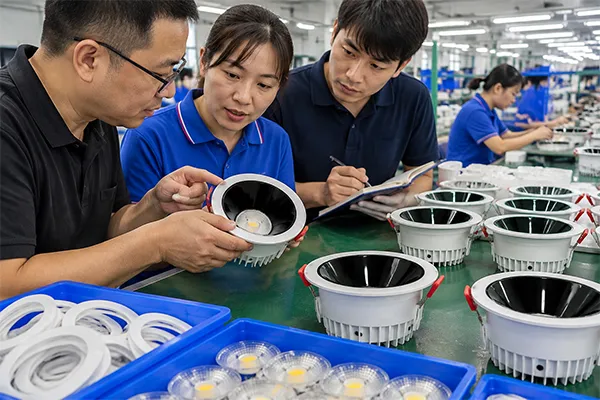
Assembly Is a Procurement Issue, Not Only a Production Issue
In our manufacturing discussions, I often see customers focus on a single product sample. A sample is important, but it is only one point in time. Procurement teams also need to consider whether the supplier can control materials, work instructions, and inspection methods when the order moves into volume production.
The LED downlight assembly process connects the product design to the shipment buyers ultimately receive. A small variation at one stage can affect the final installation experience. For example, a driver that is not properly matched to the LED module may create unstable operation1. A poorly seated optical component can affect beam appearance.2 An inconsistent surface finish can make fixtures look mismatched after they are installed in the same ceiling.
I suggest that buyers assess assembly controls against four commercial risks:
-
Inconsistent batches
The approved sample may differ from later deliveries in color temperature, trim color, driver configuration, or mechanical details. -
Premature field problems
Loose wiring, poor soldering, incorrect driver selection, or inadequate thermal contact may create avoidable after-sales work. -
Installation delays
Dimensional inconsistencies, damaged springs, incorrect cut-out information, or poor packaging can interrupt a contractor’s schedule. -
Unclear responsibility
If a supplier cannot describe its incoming inspection, assembly checks, and final inspection records, it may be difficult for a buyer to identify what was controlled.
I view a downlight as a system rather than a collection of parts. The LED source, driver, heat sink, optic, housing, springs, wiring, and packaging must work together.
What Buyers Can Request Before Ordering
A professional supplier evaluation does not need to become an audit of every workstation. However, buyers can request practical documents and samples that support a more informed decision.
| Buyer Question | Why It Matters | Evidence to Request |
|---|---|---|
| Which key components are used? | Helps confirm the approved configuration | Bill of materials, component photos, approved sample |
| How is the driver matched? | Affects electrical compatibility and operating stability | Driver specification, input/output details |
| How are production batches identified? | Supports traceability if an issue occurs | Batch label or production record example |
| What final checks are performed? | Shows how the supplier screens finished goods | Inspection checklist or quality-control record |
| Is aging performed before shipment? | Can help identify certain early issues | Aging-test process description and records |
| Which certifications apply? | Supports market-entry evaluation | Current certification documents for buyer verification |
Certifications such as CE and RoHS are documents that buyers should verify for the intended product and destination market.3 I do not recommend treating a logo on packaging as sufficient proof of regulatory suitability.4 Application requirements, installation conditions, and local regulations can differ.
How Does Material Preparation Affect LED Downlight Quality?
A downlight cannot become consistent if its input materials already vary. Buyers may face color differences, poor fit, or electrical mismatches when components are substituted without control. Material preparation is the first point where a supplier can reduce those risks before assembly begins.
Material preparation affects LED downlight quality by confirming that housings, LED modules, drivers, optics, wiring, springs, and accessories match the approved product configuration. Consistent incoming materials support repeatable assembly, while uncontrolled substitutions can create differences between samples, batches, and future orders.
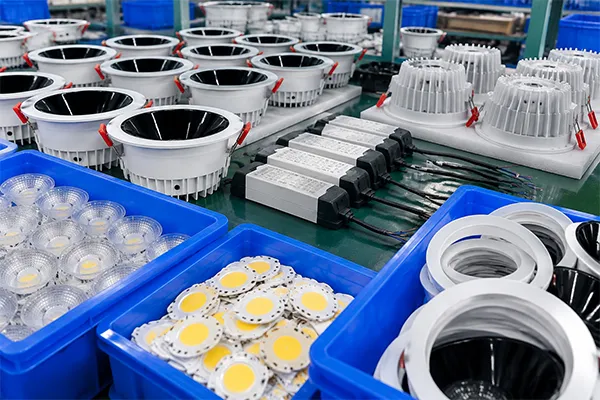
The Main Components Need to Be Evaluated Together
The LED downlight assembly process begins before a worker fits a driver or closes a housing. It begins when materials are selected, received, identified, and prepared for use. In our experience as a manufacturer, this handoff is important because every finished fixture depends on the compatibility of its individual components.
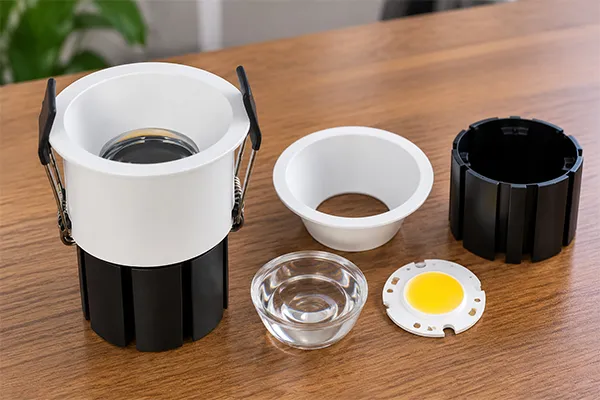
The core components often include:
- Housing and heat sink: These parts influence physical appearance, fit, and heat dissipation design.5
- LED module or light source: This affects luminous output, color temperature, color consistency, and optical performance.
- LED driver: This supplies the electrical conditions required by the LED system.
- Optical components: Reflectors, lenses, diffusers, and covers influence beam angle and visual comfort.
- Wiring and connectors: These affect assembly reliability and electrical connection quality.
- Springs, brackets, and trim parts: These affect installation convenience and finished appearance.
A buyer should not assume that a stated wattage alone confirms product equivalence. Two downlights with the same nominal wattage can use different drivers, thermal structures, LED arrangements, or optical designs.6 These choices may affect how the product performs in a particular project.
Customization Requires Clear Configuration Control
At Upward Lighting, we support OEM and ODM requests involving color temperature, wattage, beam angle, CRI, and surface finish colors. I have found that customization can be valuable for brands and project buyers, but it also requires a clear approved specification before production begins.
For customized procurement, I recommend documenting:
- Model number and product photo
- Wattage and input requirements
- Color temperature and CRI target
- Beam angle or optical configuration
- Trim and housing finish
- Cut-out and external dimensions
- Driver type and dimming requirement, if applicable
- Packaging, labeling, and destination-market requirements
This level of detail helps reduce misunderstandings. It also gives the buyer a clearer basis for sample approval, pre-shipment review, and future repeat orders.
Which Assembly Controls Matter Most in LED Downlights?
The central assembly risk is not simply whether parts fit together. The greater concern is whether electrical, thermal, optical, and mechanical elements are integrated consistently. If these controls are weak, a downlight may look acceptable at first but create installation or performance concerns later.
The most important LED downlight assembly controls are driver-to-LED matching, secure electrical connections, stable thermal contact, correct optical alignment, and reliable mechanical fitting. These controls help buyers evaluate whether a supplier is managing the product as an integrated lighting system rather than assembling parts at random.
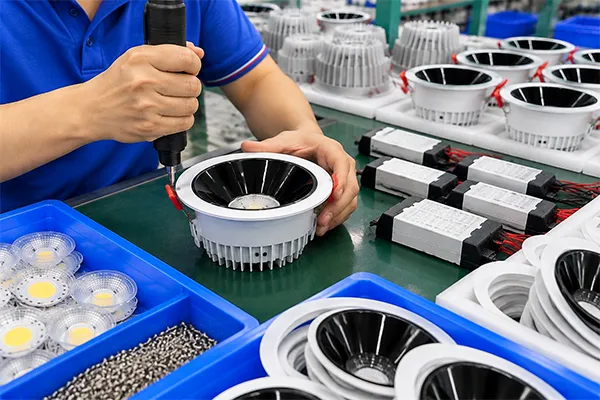
Electrical Integration: More Than Connecting Wires
The electrical stage is a key part of the LED downlight assembly process. The driver, LED module, wiring, and connectors must be assembled according to the approved configuration. A buyer should pay attention to this point because electrical mismatch can be difficult to see once the fixture is closed.
I recommend asking suppliers how they control:
- Driver model selection for each product version
- Input and output wiring identification
- Wire routing and connection security
- Connector compatibility, where connectors are used
- Driver placement within the fixture or external driver arrangement
- Product labeling and batch identification
For contractors, correct driver arrangement also affects installation planning. A fixture with an external driver may require different ceiling-space considerations than an integrated design. Project teams should review drawings and physical samples before finalizing a product for a specific ceiling system.
Thermal Integration: The Heat Sink Must Be Part of the Design
LED downlights generate heat during operation.7 For this reason, the LED module, thermal interface materials where applicable, heat sink, housing, and installation environment should be considered together.
I avoid making universal lifetime claims because operating conditions vary widely. Ceiling void temperature, ventilation, installation density, insulation contact, switching patterns, and driver design can all influence real-world results.8 However, buyers can still evaluate whether the supplier treats thermal design as a serious assembly consideration.
Useful questions include:
- Is the LED module fitted securely to the intended heat-dissipation structure?
- Does the product design provide a stable mechanical contact area?
- Has the supplier provided installation guidance for the specific model?
- Does the product’s intended application match the project environment?
- Are any restrictions stated for enclosed spaces, insulation contact, or ambient conditions?
Qualified technical evaluation is important for application-specific decisions. A supplier can provide product information, but the project engineer, contractor, or local electrical professional should determine suitability for the final installation.
Mechanical and Optical Assembly
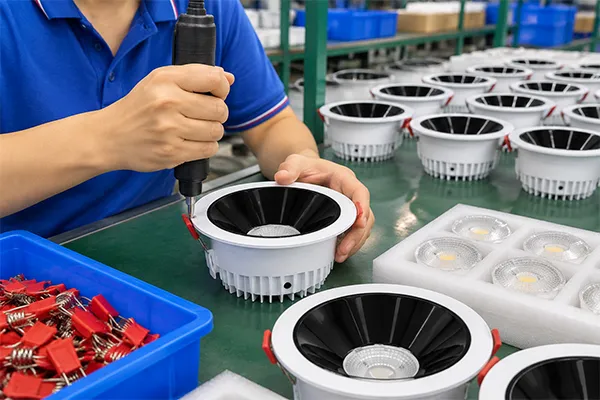
Mechanical fitting affects both installation and appearance. Springs must hold the fixture securely. Trim rings need to sit evenly. Housings should not show obvious damage or finish inconsistency. Optical components need to be positioned correctly so that the intended beam distribution is not visibly distorted.9
During supplier evaluation, I recommend that buyers inspect several pieces from a sample set rather than only one fixture. This simple step can reveal variation in:
- Spring tension and movement
- Trim alignment
- Paint or powder-coating appearance
- Lens, diffuser, or reflector seating
- Cable length and routing
- Overall fit between housing and trim
How Do Inspection and Aging Tests Support Batch Consistency?
A finished downlight may power on during a brief check and still require further screening before shipment. Buyers need more than a statement that products are “tested.” They need to understand what the supplier checks, when the checks occur, and what the testing can realistically demonstrate.
Inspection and aging tests support batch consistency by identifying visible defects, assembly errors, and certain early operational issues before shipment.10 They do not guarantee that a LED downlight will never fail11, but they form an important control point when combined with material checks, assembly controls, and final inspection.
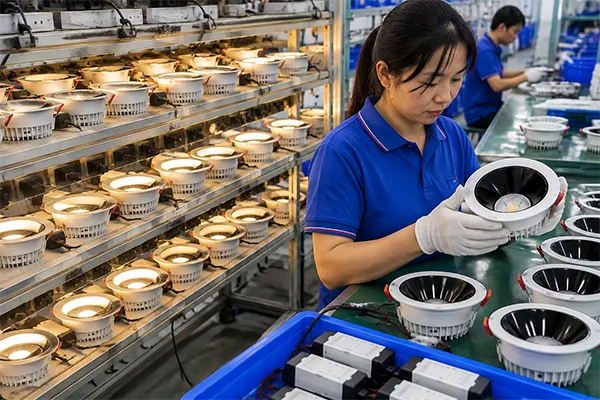
Final Inspection Connects Production to Delivery
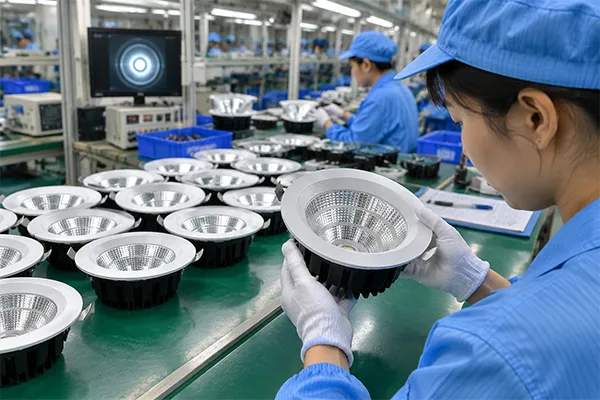
The final stage of the LED downlight assembly process should verify that the finished product matches the approved order requirements as closely as practical. At this point, inspectors can review appearance, assembly condition, labeling, packaging, and basic operation according to the supplier’s established procedures.
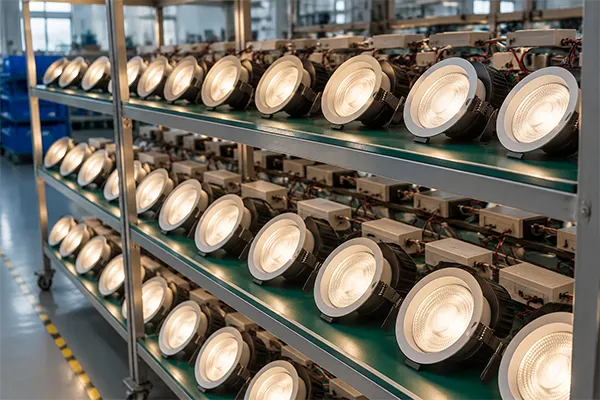
At Upward Lighting, our confirmed practice is to conduct a 100% aging test before shipment, with a test duration of 4 to 8 hours. The specific duration can depend on the product and production arrangement. This is part of our production-to-final-inspection handoff.
I want to be clear about the limit of this practice: an aging test can help screen for certain early failures or abnormalities before shipment, but it cannot prove that a product will never fail in the field. It also does not guarantee lifetime performance under every installation condition.
A credible supplier should explain aging as one part of a broader quality loop:
- Material preparation and component identification
- Assembly controls during production
- Functional or visual checks as required
- Aging before shipment
- Final inspection and packaging review
- Shipment documentation and customer communication
Batch Consistency Is the Buyer’s Main Concern
For distributors and brands, batch consistency has a direct commercial value. A shipment that varies in color tone, trim finish, driver arrangement, or packaging can create complaints even if each individual fixture turns on.12
I have heard this concern frequently in procurement conversations: “Will the next container match the first approved sample?” That is the right question. It shifts the focus away from one attractive prototype and toward the supplier’s ability to maintain controls over time.
Buyers can review consistency through practical methods:
| Review Method | What It Can Reveal |
|---|---|
| Compare multiple samples | Variation in finish, beam appearance, assembly, and fit |
| Request approved specifications | Whether the supplier has a clear reference configuration |
| Check carton and product labels | Traceability and model identification practices |
| Review inspection records | Whether final checks are documented |
| Discuss repeat-order controls | How the supplier manages approved configurations |
| Conduct pre-shipment inspection | Whether the order matches agreed requirements |
For significant projects or high-volume orders, I recommend independent pre-shipment inspection or a qualified third-party quality professional when appropriate. This gives buyers another layer of confidence before goods leave the factory.
What Should Buyers Ask a LED Downlight Supplier Before Ordering?
Supplier claims can sound similar across quotations. Buyers may hear “high quality,” “strict testing,” and “competitive price” from many sources. The challenge is turning those broad claims into specific, verifiable procurement questions that support a safer purchasing decision.
Before ordering, buyers should ask a LED downlight supplier about approved component configurations, assembly controls, inspection practices, aging-test procedures, traceability, customization details, lead times, and certification documents. Clear answers and supporting records are more useful than general quality promises.
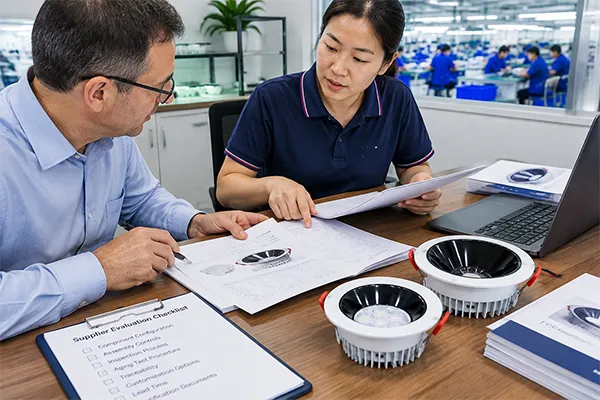
A Practical Supplier Evaluation Checklist
The best supplier questions are specific enough to compare across quotations. I recommend using the same checklist for each potential supplier so that purchasing teams can identify gaps more easily.
Product and configuration questions
- Can the supplier provide a detailed specification sheet?
- Are wattage, color temperature, CRI, beam angle, dimensions, and cut-out clearly stated?
- Which driver configuration is included?
- Can the supplier provide a physical sample for approval?
- How does the supplier record approved custom requirements?
Quality-control questions
- What incoming material checks are performed?
- What are the main assembly inspection points?
- Is final inspection completed before packing?
- Is aging conducted, and what is the stated duration?
- Can the supplier provide a relevant inspection record or process description?
- How are production batches identified?
Commercial questions
- What is the minimum order quantity?
- Can the supplier support small-batch orders?
- What is the quotation turnaround time?
- What lead time applies to the requested configuration?
- How are packaging, labels, and export documentation handled?
- What process applies if delivered goods differ from the approved specification?
At Upward Lighting, we serve contractors, importers, wholesalers, distributors, traders, local brands, and electrical or building-material channel partners. We focus on rapid quotation support, OEM/ODM options, small-batch support, and a structured supply-chain approach. However, I always encourage buyers to confirm the controls, documents, and product suitability relevant to their own order rather than relying on general statements.
Frequently Asked Questions
What is included in an LED downlight assembly process?
An LED downlight assembly process generally includes material preparation, housing and heat-sink assembly, LED and driver integration, wiring, optical fitting, mechanical fitting, inspection, aging, and packaging. The exact sequence varies by product design and factory controls, so buyers should ask suppliers for model-specific information.
Why is the LED driver important in a downlight?
The LED driver supplies the electrical conditions needed by the LED module. Proper driver matching affects system compatibility and stable operation. Buyers should review driver specifications, dimming requirements, installation arrangement, and the supplier’s approved configuration rather than comparing wattage alone.
Does a 100% aging test guarantee that LED downlights will not fail?
No. A 100% aging test can help identify certain early operational issues before shipment, but it cannot guarantee that a product will never fail in the field. Long-term results also depend on product design, installation conditions, operating environment, and other application-specific factors.
How can I check LED downlight batch consistency?
Buyers can compare multiple samples, approve detailed specifications, request product and carton labeling information, review inspection procedures, and conduct pre-shipment inspection where appropriate. These steps help assess consistency in appearance, color temperature, assembly details, and packaging across an order.
Should I verify CE and RoHS documents with a lighting supplier?
Yes. Buyers should request current certification documents and verify that they apply to the exact product and intended market. CE and RoHS requirements may involve product-specific and destination-specific considerations, so qualified regulatory or technical advice may be needed for complex projects.
Conclusion
The LED downlight assembly process matters because it influences far more than whether a fixture turns on during a sample review. It affects component matching, thermal and electrical integration, mechanical reliability, visual consistency, inspection results, and repeat-order confidence. I recommend that buyers evaluate suppliers through documented controls, approved configurations, and practical verification—not price alone. If you are sourcing LED downlights for a project, brand, or distribution program, contact Upward Lighting to discuss your required specifications, customization needs, sample evaluation, and quality-control expectations.
"(PDF) Multi-channel Constant Current LED Driver with ...", https://www.academia.edu/24964217/Multi_channel_Constant_Current_LED_Driver_with_Temperature_and_Voltage_Compensation. LED-driver technical literature describes how driver output limits, LED forward-voltage range, and control compatibility affect stable LED operation; the exact failure mode depends on the particular driver and module design. Evidence role: mechanism; source type: research. Supports: LED drivers must operate within specified output-voltage and output-current ranges, and incompatible LED loads or dimming arrangements can impair operation.. Scope note: This supports the electrical mechanism generally and does not establish that every mismatched driver will produce the same observable instability. ↩
"Understanding Beam Alignment in a Coherent Lidar System ...", https://ntrl.ntis.gov/NTRL/dashboard/searchResults/titleDetail/N150017033.xhtml. Research on LED secondary optics finds that the geometry and alignment of lenses or reflectors affect the resulting luminous-intensity distribution, so optical misalignment can change beam appearance. Evidence role: mechanism; source type: paper. Supports: Optical studies of LED luminaires show that reflector, lens, and diffuser geometry and positioning influence luminous-intensity distribution and beam shape.. Scope note: The magnitude and visibility of the effect vary with the optic type, tolerance, LED package, and luminaire geometry. ↩
"CE marking – obtaining the certificate, EU requirements", https://europa.eu/youreurope/business/product-rules-compliance/general-product-compliance/ce-marking/index_en.htm. European Commission guidance states that CE marking is applied only where relevant Union harmonisation legislation applies and must be supported by the required conformity assessment and technical documentation; RoHS obligations likewise depend on the product's scope under the directive. Evidence role: historical_context; source type: institution. Supports: EU guidance describes CE marking and RoHS compliance as obligations tied to applicable legislation, product conformity assessment, and supporting documentation.. Scope note: This is EU regulatory context and does not determine compliance in non-EU markets or confirm compliance of a specific supplier document. ↩
"CE marking – obtaining the certificate, EU requirements", https://europa.eu/youreurope/business/product-rules-compliance/general-product-compliance/ce-marking/index_en.htm. Official CE-marking guidance explains that the mark accompanies a manufacturer's conformity declaration and required assessment documentation; the symbol by itself does not provide the underlying evidence needed to evaluate product compliance. Evidence role: definition; source type: government. Supports: CE marking is a manufacturer's declaration of conformity under applicable rules and is associated with conformity assessment and documentation, rather than a standalone product-quality certificate.. Scope note: The applicable verification process depends on the jurisdiction, product category, and legislation involved. ↩
"Solid State Lighting LED Product Development and ...", https://www.energy.gov/documents/ledrtprdctmfg-reportoct2016pdf. Government technical guidance on LED systems explains that luminaire materials and heat-sink design form part of the thermal path that removes heat from LED components. Evidence role: mechanism; source type: government. Supports: LED thermal-management guidance explains that heat-sink and luminaire construction provide the path by which heat is conducted away from LEDs and electronics.. Scope note: This does not assess the thermal adequacy of any specific downlight housing or heat-sink design. ↩
"2019 Solid-State Lighting R&D Opportunities", https://www.energy.gov/sites/prod/files/2020/01/f70/ssl-rd-opportunities2-jan2020.pdf. LED lighting guidance distinguishes input power from the optical, electrical, and thermal design factors that together determine luminaire performance. Evidence role: general_support; source type: government. Supports: LED-luminaire performance is determined by interacting optical, electrical, and thermal design choices rather than input wattage alone.. Scope note: The source provides general design context and does not compare the construction of particular downlight models. ↩
"LED Basics", https://www.energy.gov/cmei/ssl/led-basics. U.S. Department of Energy LED guidance notes that LEDs generate heat during operation and require thermal management to maintain intended performance and reliability. Evidence role: mechanism; source type: government. Supports: LEDs convert only part of their electrical input into visible light, with the remainder becoming heat that must be managed.. Scope note: Heat generation alone does not indicate whether a particular installed downlight will exceed its allowable operating temperature. ↩
"LED Luminaire Reliability: Impact of Color Shift", https://www.energy.gov/sites/prod/files/2017/04/f34/lsrc_colorshift_apr2017.pdf. LED reliability research identifies junction and driver temperature as important factors in lumen maintenance and component life; enclosed or poorly ventilated installations can raise those temperatures. Evidence role: mechanism; source type: research. Supports: LED and driver temperatures, which are affected by ambient conditions and heat dissipation, are associated with changes in light output and component reliability.. Scope note: The listed installation factors do not have identical effects in every product, and suitability must be assessed against the manufacturer's installation instructions and applicable electrical rules. ↩
"LED-based light source for ultraviolet-visible absorption ...", https://ui.adsabs.harvard.edu/abs/2022SPIE11949E..09A/abstract. Studies of LED secondary optics show that optical position and geometry affect angular light distribution, supporting alignment checks where a specified beam pattern is required. Evidence role: mechanism; source type: paper. Supports: Changes in the placement of LED secondary optics can change angular intensity distribution and beam uniformity.. Scope note: Whether a deviation is visibly objectionable depends on the luminaire design, viewing conditions, and applicable photometric tolerances. ↩
"A Methodology for Testing", https://nvlpubs.nist.gov/nistpubs/Legacy/IR/nbsir76-1157.pdf. Reliability literature describes burn-in testing as a screening method intended to expose a portion of early-life electronic failures before products enter service. Evidence role: mechanism; source type: research. Supports: Burn-in or aging tests are used in electronics reliability practice to screen some early-life defects and failures before delivery.. Scope note: Screening effectiveness depends on test stress, duration, sample coverage, and defect mechanisms; it is not proof of lifetime reliability. ↩
"Burn-In - Integration and Test > Thermal Testing - S3VI - NASA", https://s3vi.ndc.nasa.gov/ssri-kb/topics/47/. Reliability engineering distinguishes early-life screening from a guarantee of failure-free service, because latent defects, wear-out mechanisms, and operating conditions can still cause later failures. Evidence role: expert_consensus; source type: research. Supports: Reliability screening can reduce the chance that some early defects reach users but cannot eliminate all later failures caused by latent defects, wear-out, or use conditions.. Scope note: The source addresses reliability principles generally rather than the measured field-failure rate of a particular downlight. ↩
"LED Color Characteristics", https://www.energy.gov/sites/prod/files/2016/08/f33/led-color-characteristics-factsheet.pdf. LED lighting guidance recognizes color consistency as a product-quality consideration because chromaticity differences among adjacent luminaires may be visually noticeable. Evidence role: general_support; source type: government. Supports: Color consistency is a recognized LED-lighting quality attribute, and chromaticity variation can be visible among nearby luminaires.. Scope note: This supports the likelihood of visible color-related dissatisfaction, not a quantified complaint rate for all types of shipment variation. ↩