LED downlight brand vs factory direct purchase is a common decision for buyers who need reliable products without creating avoidable procurement risk. A low quote can look attractive, while a familiar brand can feel safer, but both routes can create delays, quality disputes, or stock issues if the buyer does not define responsibilities clearly. I recommend evaluating who will own specifications, validation, inventory, communication, and after-sales support before comparing prices.
A branded LED downlight can simplify selection, documentation, local stock access, and warranty handling, while factory-direct purchasing can provide greater control over specifications, customization, and unit economics. Neither route automatically delivers better quality. The right choice depends on a buyer’s technical capability, order volume, destination-market requirements, inventory plan, and ability to manage product validation and supplier communication.
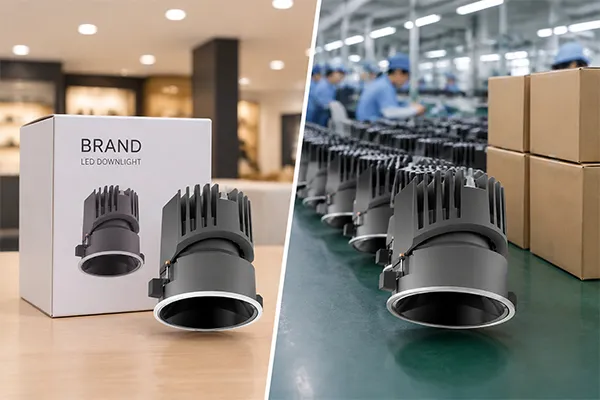
In my work with overseas RFQs, I often see buyers compare two downlights by wattage, cutout size, and color temperature alone. Those details matter, but they do not explain the complete product. The real comparison starts when we examine the driver, heat management, optical design, materials, quality controls, delivery model, and support responsibilities.
Is LED Downlight Brand vs Factory Direct Purchase Mainly a Price Decision?
Buyers often face pressure to lower product costs, especially in competitive distribution and project markets. This pressure can lead teams to treat branded and factory-direct downlights as simple price alternatives. That approach can create expensive mistakes when lower unit pricing shifts more work and risk to the buyer.
LED downlight brand vs factory direct purchase is not mainly a price decision. It is a total-cost and risk-allocation decision. A factory may offer more flexible pricing and customization, while a brand may provide pre-selected specifications, stock availability, local support, and warranty coordination. Buyers should compare the full cost of sourcing, validation, logistics, inventory, and after-sales service.
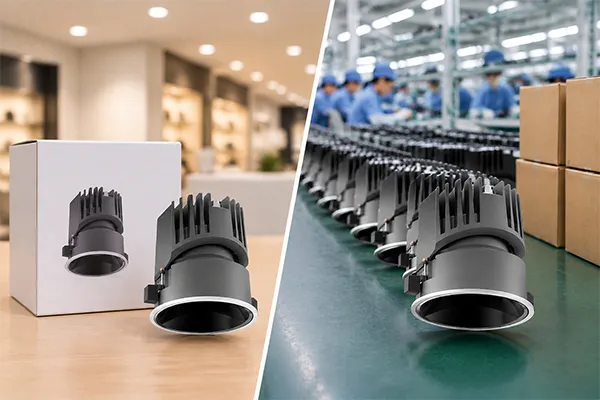
Unit Price Is Only One Cost Category
I encourage buyers to calculate the total procurement cost1, not just the ex-works or landed price per fixture. A product that costs less per unit can still cost more if it requires repeated sample rounds, technical clarification, rework, urgent air freight, or site replacement.
A typical procurement comparison includes:
- Product unit price
- Tooling or customization charges, where applicable
- Sample and approval costs
- Product testing or third-party inspection costs
- Packaging and labeling requirements
- Freight, duty, and local handling costs
- Inventory carrying costs
- Warranty reserve and replacement stock
- Internal engineering and purchasing time
- Project-delay exposure if products arrive late or fail inspection
For example, a contractor may choose a local brand because the distributor can release 500 units from stock within days. The contractor may pay more per downlight, but the project schedule may justify that premium. On the other hand, an importer ordering 10,000 units for a planned product range may benefit from factory-direct sourcing if the buyer has time to approve samples, manage specifications, and forecast inventory.
The Buyer’s Capability Changes the Economics
Factory-direct sourcing generally requires more buyer involvement. In our quotation process, I often need to clarify details that a brand may already have standardized:
| Procurement question | Why it matters |
|---|---|
| What is the required input voltage? | Driver selection varies by destination market and application. |
| What is the target wattage and lumen output? | Two 12W fixtures can have very different efficacy and output tolerance. |
| What is the ceiling cutout and trim diameter? | Installation compatibility depends on more than the outer diameter. |
| What CCT and CRI are required? | 3000K, 4000K, CRI 80, and CRI 90 affect component choice and pricing. |
| Is dimming required? | Triac, 0–10V, DALI, and non-dimmable drivers are not interchangeable2. |
| What is the installation environment? | Indoor, damp, insulated-ceiling, and commercial conditions require different evaluation. |
| What documents does the market require? | Buyers should verify destination-market and project requirements independently. |
I have seen RFQs that request “12W, 90 mm cutout, 4000K” without naming the dimming method, CRI, target lumen output, beam angle, finish, or driver requirement. That is not a complete product definition. It is only the start of a discussion.
A brand can reduce this workload because it may offer a fixed product family with established part numbers and documentation. However, buyers should still confirm whether the selected item meets their project requirements. A brand name does not remove the need for due diligence.
What Does a Lighting Brand Actually Add to LED Downlight Procurement?
A buyer may assume that a lighting brand simply adds margin between a factory and the final customer. This assumption can overlook real commercial value. At the same time, buyers should avoid assuming that every branded downlight has superior construction, performance, or compliance for a specific application.
A lighting brand can add value by curating product specifications, maintaining local stock, preparing documentation, coordinating warranty claims, and providing faster communication in the buyer’s market. However, buyers should verify the exact product specification, testing documents, warranty terms, and project suitability rather than relying on brand recognition alone.
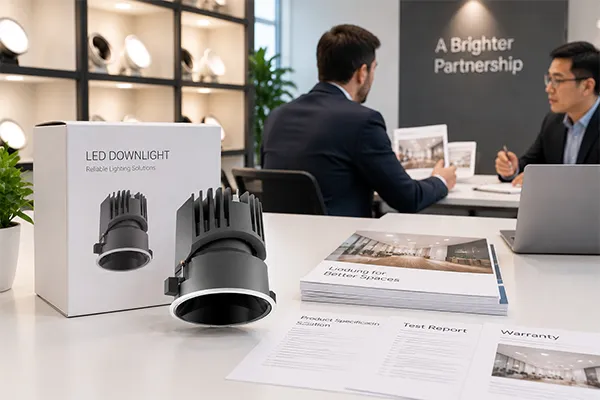
Common Advantages of Buying Through a Brand
A well-managed brand may create a more convenient buying experience, especially for contractors, small distributors, and projects with limited internal technical resources.
Potential benefits include:
-
Simplified product selection
The brand may have already created a practical range of cutouts, wattages, CCT options, and trim finishes. -
Local or regional inventory
Stock can reduce lead times for urgent project needs and replacement orders. -
Known documentation format
Product datasheets, installation instructions, photometric files, declarations, and warranty procedures may be easier to access. -
Local-language sales support
Buyers may find it easier to communicate with local teams about delivery, project substitutions, or product questions. -
After-sales coordination
A brand or distributor may manage return requests and replacements within the local market. -
More predictable product continuity
Some brands maintain defined product lines for longer periods, although buyers should still confirm continuity expectations.
Questions I Would Ask a Brand Supplier
Buyers should use the same discipline when buying branded fixtures as they use when buying directly from a factory. I would ask for a current datasheet, installation instruction, warranty policy, and batch traceability approach.
I would also ask:
- Is the product made for this exact market and voltage range?
- What driver type is installed?
- Is the model dimmable, and which dimming system is compatible?
- What are the stated lumen output, beam angle, CRI, and CCT tolerance?
- What is the expected lead time for repeat orders?
- Is the model stocked locally, made to order, or subject to minimum order quantities?
- What happens if a project needs replacement units after 12 or 24 months?
- Can the supplier provide relevant compliance documents for verification?
A CE or RoHS document may be relevant to many buyers, but it does not by itself confirm suitability for every country, building type, electrical installation, or project specification.3 I recommend that buyers verify requirements with qualified local professionals, project consultants, or compliance specialists before placing an order.
When a Brand Route May Be Practical
I see branded purchasing work especially well when a buyer needs:
- Small quantities with short lead times
- Local warranty support
- A familiar range for contractors or retail customers
- Simplified specification selection
- Fast replacement availability
- Reduced direct coordination with overseas production teams
This route can be useful, but the buyer should still compare actual product construction and service terms. A premium price should correspond to measurable value, not only a recognizable label.
When Does Factory-Direct LED Downlight Purchasing Make Sense?
Factory-direct buying can look straightforward: a buyer sends a product photo, receives a quote, approves a sample, and places an order. In practice, the process requires careful product definition and communication. Without those controls, buyers can receive a product that meets the basic description but not the intended project standard.
Factory-direct LED downlight purchasing makes sense when buyers have sufficient volume, time, and internal capability to define specifications, approve samples, verify documents, manage production communication, and plan inventory.4 It can support OEM/ODM programs and product differentiation, but it also places more validation and coordination responsibility on the buyer.

Factory Direct Is Best for Defined Programs
In my experience, factory-direct sourcing often suits importers, distributors, local lighting brands, wholesalers, and project supply companies that want more control over a repeatable product range.
At Upward Lighting, we work with buyers who need parameters adjusted for a particular market or customer segment. These parameters can include:
- Color temperature, such as 2700K, 3000K, 4000K, or 6500K
- Wattage and target output range
- Beam angle
- CRI level
- Surface finish colors
- Packaging design
- Private labels and product markings
- Certain driver or dimming configurations, subject to technical review
However, I make it clear that OEM/ODM is not simply putting a logo on a standard downlight. Every change can affect sourcing, production planning, sample confirmation, testing, lead time, cost, and minimum order quantity.
A Better Factory-Direct Evaluation Process
I recommend a structured sequence rather than placing an order based on catalog photos or a low quotation.
-
Create a specification sheet
Define cutout, outer diameter, wattage, CCT, CRI, beam angle, voltage, dimming method, IP rating, trim finish, target lumen output, and required documents. -
Request a detailed quotation
Ask the factory to state the driver configuration, LED source category, housing material, packaging, MOQ, lead time, sample charge, and payment terms. -
Approve samples against written criteria
Check fit, finish, light distribution, color appearance, dimming behavior where relevant, and installation practicality. -
Confirm the approved version
Use a controlled sample, signed specification sheet, approved artwork, and final product code. This step reduces ambiguity before mass production. -
Set inspection expectations
Buyers can arrange pre-shipment inspection, define acceptable quality levels, or request agreed quality records. -
Plan replacement and repeat-order needs
Buyers should ask about product continuity, component substitution controls, spare stock, and future lead times.
Aging Tests and Pre-Shipment Quality Control
At our factory, every product undergoes a 100% aging test of approximately 4 to 8 hours before shipment5 as part of our production quality-control process. This process helps us identify certain early failures before products leave the factory. However, I do not present an aging test as a universal guarantee of field performance, lifetime, or suitability for every installation.
Buyers should understand what a supplier’s QC process includes. Useful questions include:
- Is every unit powered during aging?
- How long is the aging period?
- Are input voltage, light output, and appearance checked?
- How are defects recorded and isolated?
- How does the supplier control approved components?
- Can the supplier provide batch identification or inspection records?
- What is the procedure if a buyer finds a recurring issue after delivery?
A factory’s answer to these questions often reveals more than a product photograph or a generic catalog claim.
How Should Buyers Compare LED Downlights Beyond Wattage and Cutout Size?
Many sourcing errors begin when buyers treat two downlights as comparable because both list the same wattage, cutout size, and color temperature. Those three points do not reveal driver quality, heat dissipation, light distribution, material selection, or expected consistency between batches.
Buyers should compare LED downlights using a complete technical and commercial specification. Important factors include driver configuration, thermal design, LED performance, optical control, CRI, color tolerance, housing materials, dimming compatibility, installation conditions, quality-control methods, documentation, and supplier support.
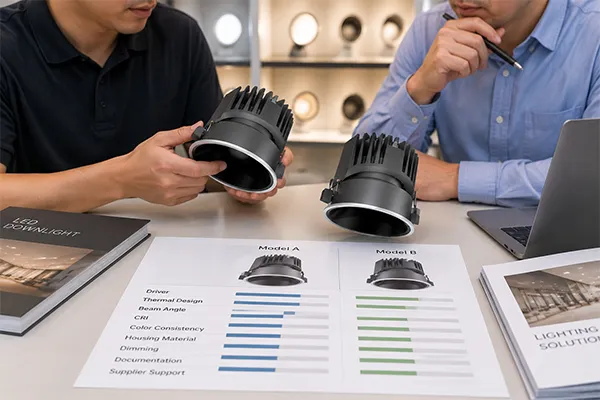
The Technical Details Behind Similar-Looking Products
Two recessed downlights may look nearly identical from the front. Their internal structures can differ substantially. I recommend buyers request clear specification data and, where appropriate, physical samples for comparison.
| Comparison area | What buyers should check | Why it affects procurement risk |
|---|---|---|
| Driver | Brand or configuration, dimming type, input range, protection features | The driver influences compatibility, stability, and serviceability. |
| Thermal design | Heat sink material, mass, airflow path, assembly method | Heat management affects component operating conditions.6 |
| LED source | LED package, target efficacy, CRI, color consistency | Light quality and batch consistency can vary. |
| Optical system | Reflector, lens, diffuser, beam angle, glare control | Beam distribution affects visual comfort and application suitability. |
| Housing | Aluminum, steel, plastic components, finish quality | Material selection affects durability and appearance. |
| Installation | Spring design, cutout tolerance, ceiling thickness | Poor fit can slow installation or damage ceilings. |
| Dimming | Triac, 0–10V, DALI, PWM, or non-dimmable | Incompatible dimming can cause flicker or limited control.7 |
| Quality control | Aging, functional checks, inspection records | QC processes reduce some shipment-level risks. |
Optical Performance Needs Context
A claimed lumen value does not tell the full story. Buyers should consider whether the product delivers appropriate light on the working plane, wall, shelf, corridor, or ceiling area. Beam angle and glare control can change the result significantly.8
For instance:
- A narrow beam may suit accent lighting but create uneven spacing in general illumination.
- A wide beam may support broader coverage but can produce lower intensity at a target point.
- A higher CRI may be valuable in retail, hospitality, and display environments where color appearance matters.9
- A specific CCT can influence how materials, finishes, and interior spaces appear.
I suggest that project buyers involve a qualified lighting designer, electrical consultant, or technical professional when an application has strict illumination, glare, emergency, safety, or regulatory requirements.
Do Not Ignore Tolerances and Batch Control
Buyers should ask not only for nominal specifications but also for tolerances and consistency controls. A product listed as 4000K may have acceptable variation within a stated color range.10 A 10W product may have a specified power tolerance. These details should be discussed for projects that require consistent appearance across many fixtures.
I have found that the best RFQs include a written target, sample reference, and acceptance criteria. This approach helps both the buyer and manufacturer identify gaps before production rather than after installation.
What Does OEM/ODM Change in LED Downlight Brand vs Factory Direct Purchase?
Customization can help importers and local lighting brands stand out in crowded markets. However, buyers sometimes underestimate the work behind a revised beam angle, finish color, driver, packaging design, or CRI requirement. A custom request can create commercial advantages, but it can also add time and validation responsibilities.
In LED downlight brand vs factory direct purchase decisions, OEM/ODM changes the balance of responsibility. Factory-direct programs can support customized wattage, CCT, CRI, beam angle, finish, and packaging, but each change may affect MOQ, samples, component availability, validation, production lead time, cost, and repeat-order planning.
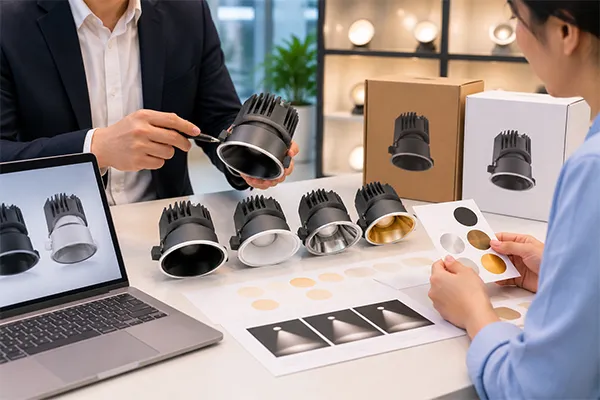
Customization Has Different Levels
Not every customization request carries the same level of risk or cost. I usually separate requests into practical categories.
| Customization type | Typical impact | Buyer consideration |
|---|---|---|
| Logo on packaging | Low to moderate | Artwork approval and packaging MOQ may apply. |
| Finish color change | Moderate | Color sample approval and coating consistency should be reviewed. |
| CCT adjustment | Moderate | Component selection and sample validation may be needed. |
| CRI upgrade | Moderate to high | Cost, efficacy, and availability may change. |
| Driver or dimming change | High | Compatibility testing and market requirements should be reviewed. |
| Beam-angle change | High | Optical tooling or different components may be required. |
| New housing or unique design | High | Tooling, engineering review, and a longer development cycle may apply. |
The Questions I Clarify Before Quoting
When a buyer requests a customized downlight, I need enough information to quote responsibly. A vague request can produce a vague result. I typically ask about the intended market, application, annual quantity, target retail or project price, required delivery date, and current sample reference.
I also clarify:
- Is the buyer requesting a custom fixture or a standard platform with modified packaging?
- Does the buyer need approval samples before the order?
- Does the buyer need third-party testing or specific documentation?
- Is there a required product label format?
- Does the buyer have a target carton quantity and pallet plan?
- Does the buyer expect the same configuration to be available for future orders?
- Who will approve the final golden sample?
I have learned that a detailed specification sheet protects both sides. It prevents a buyer from assuming that a standard product includes a custom feature, and it prevents a factory from building to an incomplete verbal description.
Customization Requires a Validation Plan
I advise buyers to budget time for sample review, especially when the product will carry their own brand. The buyer effectively becomes responsible for part of the product-definition process. That responsibility can be worthwhile because it creates a more differentiated range, but it should be planned rather than treated as a last-minute request.
A practical OEM/ODM plan includes:
- Product requirement document
- Artwork and label approval
- Sample approval record
- Packaging approval
- Agreed bill of key specifications
- Production lead time
- Pre-shipment inspection plan
- Warranty and replacement policy
- Repeat-order forecasting
For long-term programs, buyers should also discuss change-management procedures. If a component becomes unavailable, the buyer should know whether the factory will request approval before making a substitution. This conversation is important for maintaining product continuity and reducing unexpected differences between batches.
Frequently Asked Questions
Is factory-direct LED downlight purchasing always cheaper?
No. Factory-direct pricing can reduce some layers of distribution cost, particularly for larger planned orders. However, buyers may take on sample evaluation, engineering communication, inspection, freight coordination, inventory, and warranty responsibilities. The lowest unit price does not always produce the lowest total procurement cost.
Are branded LED downlights always higher quality?
No. A brand may offer useful value through product selection, local stock, documentation, and after-sales support. However, product quality depends on the exact model, technical configuration, manufacturing controls, and supplier management. Buyers should review specifications, samples, documents, and warranty terms for each product.
What should I include in an LED downlight RFQ?
I recommend including wattage, target lumen output, cutout size, trim size, CCT, CRI, beam angle, voltage, dimming type, IP rating, finish color, quantity, packaging needs, destination market, required documents, target delivery date, and sample requirements. A complete RFQ helps suppliers provide more comparable quotations.
Does a 100% aging test guarantee LED downlight lifetime?
No. A 100% aging test can help identify certain early functional failures before shipment. At Upward Lighting, we conduct a 4-to-8-hour aging test before shipment. However, field lifetime depends on installation conditions, electrical environment, thermal conditions, usage patterns, and product configuration.11
Does CE or RoHS documentation make a downlight suitable for every country?
No. CE and RoHS documentation may be relevant for particular market-entry and environmental requirements, but buyers should verify the current requirements for their destination market, project, installation type, and customer. I recommend consulting qualified local compliance or technical professionals when requirements are unclear.
Conclusion
The LED downlight brand vs factory direct purchase decision should focus on total procurement risk rather than a simple price comparison. Brands can offer convenience, stock access, documentation, and local after-sales support. Factory-direct sourcing can offer specification control, OEM/ODM flexibility, and stronger product differentiation for capable buyers. I recommend that every buyer compare complete technical specifications, approve samples, verify applicable documentation, define QC expectations, and plan for repeat orders. If you are developing a downlight range or evaluating an OEM/ODM program, we can help you clarify the specification and quotation process before you commit to production.
"Part 31 - Contract Cost Principles and Procedures | Acquisition.GOV", https://www.acquisition.gov/far/part-31. Procurement guidance defines total cost of ownership as a lifecycle measure that extends beyond purchase price to costs incurred in acquiring, operating, maintaining, and retiring an asset or supply arrangement. Evidence role: definition; source type: government. Supports: A procurement authority's definition of total cost of ownership and its inclusion of acquisition, operation, maintenance, and disposal or lifecycle costs.. Scope note: The precise cost categories and their relative importance depend on the buyer's contract, logistics model, and product category. ↩
"[PDF] LED Dimming: What you need to know - eere.energy.gov", https://www1.eere.energy.gov/buildings/publications/pdfs/ssl/dimming_webcast_12-10-2012.pdf. Lighting-control technical guidance distinguishes phase-cut, 0–10 V, and DALI control methods as different interfaces with specific driver and control compatibility requirements; a non-dimmable driver is not designed to provide dimming control. Evidence role: mechanism; source type: institution. Supports: Technical documentation describing the distinct operating interfaces and compatibility requirements of phase-cut, 0–10 V, and DALI lighting-control systems.. Scope note: Compatibility must still be verified for the particular luminaire, driver, dimmer, and installation wiring. ↩
"46 CFR Part 183 -- Electrical Installation - eCFR", https://www.ecfr.gov/current/title-46/chapter-I/subchapter-T/part-183. European Commission guidance explains that CE marking signifies a manufacturer's declaration of conformity with applicable EU requirements, while RoHS addresses restrictions on specified hazardous substances; neither function is a universal approval for all national installation rules or project specifications. Evidence role: definition; source type: government. Supports: Official explanations that CE marking concerns conformity with applicable EU requirements and that RoHS restricts specified hazardous substances, rather than certifying universal suitability for all jurisdictions or installations.. Scope note: The applicable legal requirements depend on the product, destination market, and installation context. ↩
"Achieving Excellence in Global Sourcing", https://sloanreview.mit.edu/article/achieving-excellence-in-global-sourcing/. Supply-chain research and supplier-development guidance describe direct sourcing as requiring buyer capability in supplier evaluation, specification control, quality assurance, logistics, and relationship management, with the feasibility of these activities influenced by purchasing scale and planning capacity. Evidence role: general_support; source type: research. Supports: Evidence that direct and global sourcing require buyer resources for supplier qualification, specification management, quality assurance, logistics, and continuity planning.. Scope note: Such guidance supports the general capability requirement but does not define a universal order-volume threshold for LED downlights. ↩
"Modeling early breakdown failures of gate oxide in SiC power ... - NIST", https://www.nist.gov/publications/modeling-early-breakdown-failures-gate-oxide-sic-power-mosfets. Reliability literature describes burn-in screening as a method for detecting some early-life failures, while emphasizing that a short screening interval is not, by itself, proof of a product's field lifetime or reliability in all operating environments. Evidence role: mechanism; source type: research. Supports: Reliability evidence that burn-in or environmental screening can expose some early-life defects while not serving as a direct demonstration of service life under field conditions.. Scope note: This evidence does not verify the factory's claimed 100% coverage, test duration, test conditions, or quality-control records. ↩
"[PDF] LED Luminaire Reliability: Impact of Color Shift - Department of Energy", https://www.energy.gov/sites/prod/files/2017/04/f34/lsrc_colorshift_apr2017.pdf. LED technical guidance identifies thermal management as important because elevated operating temperatures affect LED and driver operating conditions and can adversely affect light output maintenance and component reliability. Evidence role: mechanism; source type: government. Supports: Technical evidence that junction and component temperatures influence LED performance, lumen maintenance, and reliability-related behavior.. Scope note: Actual thermal performance depends on the complete luminaire design, ambient conditions, installation, and component ratings. ↩
"[PDF] LED Dimming: What you need to know - eere.energy.gov", https://www1.eere.energy.gov/buildings/publications/pdfs/ssl/dimming_webcast_12-10-2012.pdf. Lighting research on LED controls reports that mismatch between a dimmer and LED driver can result in flicker, unstable output, reduced dimming range, or other unsatisfactory control behavior. Evidence role: mechanism; source type: education. Supports: Lighting research explaining that dimmer-driver electrical incompatibility can produce flicker, unstable operation, limited dimming range, or failure to switch correctly.. Scope note: The occurrence and severity of these effects vary with the specific dimmer, driver, load, wiring, and operating conditions. ↩
"[PDF] Light extraction", https://www.energy.gov/documents/ssl-rd2020-kim-extractionpdf. Lighting-design guidance recognizes that a luminaire's photometric distribution, including beam spread and glare characteristics, influences the distribution of illuminance and the visual comfort experienced in an application. Evidence role: mechanism; source type: institution. Supports: Lighting-design guidance showing that luminaire distribution and glare characteristics influence illuminance patterns and visual comfort.. Scope note: Appropriate beam angle and glare limits depend on mounting geometry, spacing, task, surface reflectance, and the applicable lighting criteria. ↩
"Understanding LED Color-Tunable Products | Department of Energy", https://www.energy.gov/cmei/ssl/understanding-led-color-tunable-products. Color-science guidance defines color rendering as the effect of an illuminant on the color appearance of objects and supports considering rendering quality in settings where the appearance and discrimination of colors are important. Evidence role: general_support; source type: institution. Supports: Color-science guidance defining color rendering and explaining its relevance where observers need to judge the appearance of colored objects.. Scope note: CRI is only one color-quality metric and does not alone predict preference, gamut, fidelity for all colors, or the suitability of a lighting scheme. ↩
"[PDF] Color Maintenance of LEDs in Laboratory and Field Applications", https://betterbuildingssolutioncenter.energy.gov/sites/default/files/attachments/2013_gateway_color-maintenance.pdf. LED color-consistency guidance explains that a nominal correlated color temperature, such as 4000 K, can encompass chromaticity variation within a stated tolerance or bin, so products with the same nominal CCT need not have identical color appearance. Evidence role: definition; source type: institution. Supports: Standards or technical guidance explaining that nominal correlated color temperature is associated with chromaticity tolerances or bins rather than one identical color point for every LED product.. Scope note: The allowable tolerance must be specified by the applicable standard, manufacturer binning practice, or project acceptance criteria. ↩
"[PDF] LED Luminaire Reliability: Impact of Color Shift - Department of Energy", https://www.energy.gov/sites/prod/files/2017/04/f34/lsrc_colorshift_apr2017.pdf. LED reliability research and lifetime-testing guidance indicate that in-service performance is influenced by thermal conditions, electrical stresses, operating hours and switching patterns, driver and luminaire design, and the installed environment. Evidence role: mechanism; source type: research. Supports: Reliability research and lifetime-testing guidance showing that LED-system performance is affected by temperature, electrical stress, operating profile, driver design, and installation environment.. Scope note: Lifetime projections derived from controlled testing remain estimates and may not predict the performance of a specific installation. ↩