

LED downlight certification can become a costly procurement problem when buyers assume one document covers every country, project, and installation. That assumption can delay customs clearance, project approval, or product launch. I recommend a more controlled approach: match the product, documents, destination market, and installation scenario before production begins.
LED downlight certification is a market- and configuration-specific verification process, not a simple request for CE, RoHS, or “all certificates.” International buyers should first confirm the destination country, sales channel, application, and technical specification. Then, they should review whether the supplier’s test reports, declarations, labels, and product documents consistently match the exact LED downlight being ordered.
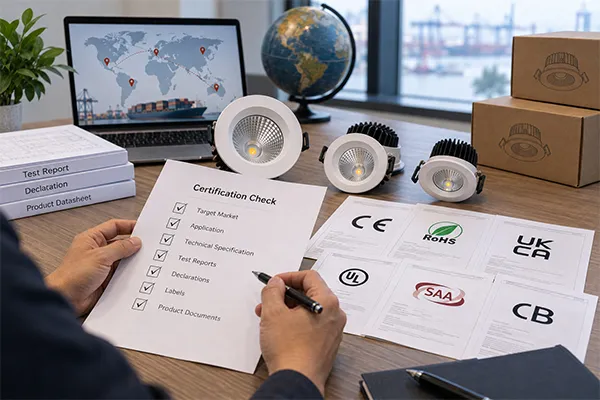
In my experience handling export inquiries for LED downlights, the strongest buyers do not begin with a generic document checklist. They begin with the intended market and product application. This makes discussions with suppliers faster, reduces avoidable document mismatches, and creates a clearer approval process before mass production.
Why Does LED Downlight Certification Depend on the Destination Market?
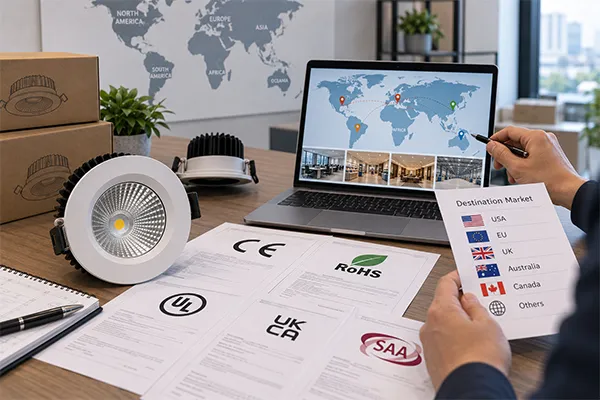
Buyers often face pressure to launch quickly, so they may request a standard document package without defining where or how the downlights will be sold. This creates uncertainty for both sides. I find that a destination-first LED downlight certification review gives buyers a more reliable basis for supplier selection and order approval.
LED downlight certification depends on the destination market because product safety, environmental, labeling, electrical, and project-document expectations can vary by country, channel, and installation type1. Buyers should confirm local obligations with qualified authorities, certification bodies, or compliance advisors, then ask suppliers for evidence relevant to the exact product configuration.
Start With the Buyer’s Real Sales Scenario
I recommend that buyers define four areas before requesting compliance documents:
-
Destination country or region
A product intended for one region may need different documentation or markings than the same product supplied elsewhere.2 I never treat a document commonly requested in one market as proof of suitability for every market. -
Sales channel
A wholesaler selling through electrical distributors may face different documentation expectations than a lighting brand supplying a tender project, retail channel, or online marketplace. -
Installation environment
An indoor residential recessed downlight, a commercial office fitting, and a downlight intended for humid or demanding environments may need different performance considerations. The ceiling construction, insulation arrangement, accessible location, and ambient temperature can also matter. -
Project requirements
Consultants, contractors, developers, and public-sector projects may request specific reports, declarations, photometric files, samples, factory records, or approved-submittal documents. These requests are often more detailed than a standard importer inquiry.
A Practical Pre-Request Questionnaire
Before I prepare a document review with a buyer, I would ask questions such as:
| Buyer question | Why it matters |
|---|---|
| Which country will receive and sell the product? | It helps frame the local compliance review. |
| Is the product for retail, distribution, a project, or an OEM brand? | Each channel may require different packaging and documentation. |
| Is the downlight recessed, surface-mounted, trimless, or adjustable? | Mounting construction can affect the product specification. |
| What input voltage and frequency are required? | Electrical configuration must match relevant documents and labels. |
| What wattage, CCT, CRI, beam angle, and driver are approved? | Changes may affect document-to-product consistency. |
| Is the installation in a normal indoor, damp, commercial, or specialized setting? | Application conditions can influence technical evaluation. |
A buyer does not need to become a regulatory specialist to ask these questions. However, the buyer should recognize that compliance evidence follows the product and market context. A responsible manufacturer can help organize documents and verify consistency with the agreed specification. The manufacturer should not replace the buyer’s local legal advisor, local authority, or qualified certification body.
I have seen document discussions become much smoother when the purchasing team sends a clear product brief. Even a one-page specification sheet with the destination, use case, voltage, mounting method, and requested branding can prevent confusion later.
Which LED Downlight Certification Documents Should Buyers Distinguish?
A common procurement risk appears when different document types are treated as interchangeable. A test report, a supplier declaration, a product certificate, and a factory-system document may all be useful, but they support different claims. I encourage buyers to ask what each document actually covers before relying on it.
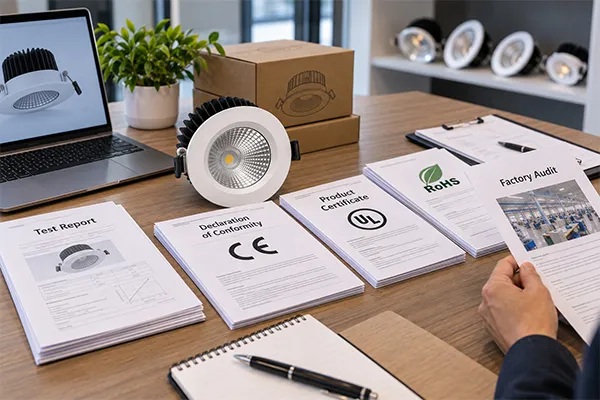
Buyers should distinguish LED downlight certification documents by purpose. Test reports provide recorded test results for a stated sample and standard; declarations state a party’s conformity claim; certificates may reflect a third-party assessment scope; environmental documents address substance-related claims; and factory documents describe management systems rather than product approval.
Test Reports
A test report generally records the results of testing performed on a specific submitted sample, under stated conditions and against identified standards or methods.3 I advise buyers to examine the report’s scope rather than only its front page.
Useful review points include:
- Report holder or applicant name
- Issuing laboratory or organization
- Report number and date
- Product model number and description
- Electrical ratings
- Test standards or methods cited
- Photographs and critical components, where shown
- Any limitations, remarks, or exclusions
A test report can be valuable evidence, but it is not automatically proof that every product variation from the supplier has the same tested status.4
Declarations of Conformity or Compliance
A declaration is generally a formal statement by the responsible party.5 Its value depends on whether the issuer, product identity, referenced requirements, and supporting evidence are appropriate for the buyer’s intended market. Buyers should verify local expectations before relying on a declaration for market entry or project acceptance.
Third-Party Certificates
A third-party certificate may indicate that an organization has assessed a product, factory, or system within a defined scope. However, I recommend checking the exact scope, validity period, listed models, and issuing body. A certificate title alone does not explain every relevant condition.
Environmental-Compliance Documents
Documents related to restricted substances are often requested by importers and brands.6 These can include declarations, material statements, or test evidence. Buyers should confirm what substances, thresholds, product parts, and applicable market expectations are covered. A broad environmental statement should not be assumed to apply to every component without review.
Factory-System Documents
Factory documents, such as quality-management system certificates, can help buyers evaluate process control. Still, these are not the same as LED downlight product certification. They do not prove that a specific wattage, driver, or product model meets a particular product requirement.7
I treat every document as evidence with a scope. I do not treat any one document as a universal passport for every sales market.
How Can Buyers Verify LED Downlight Certification Matches the Ordered Product?
A document may look complete but still fail to match the actual downlight ordered. This mismatch is often preventable. It can happen when a buyer changes wattage, color temperature, driver, finish, packaging, or mounting style after the initial document review but does not repeat the consistency check.
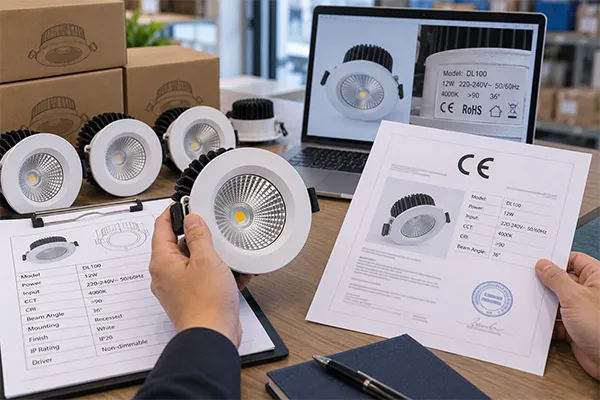
To verify LED downlight certification, buyers should compare the approved purchase specification with every key document field: model number, wattage, input voltage, driver, CCT, CRI, beam angle, mounting method, IP-related claims where relevant, labeling, and product photographs. Any variation should be reviewed before production or shipment.
Build a Document-to-Product Matching Sheet
I recommend using a simple matching sheet during product approval. This provides a shared record for the buyer, supplier, quality team, and project manager.
| Specification item | Purchase order requirement | Product label / artwork | Test report or document | Review status |
|---|---|---|---|---|
| Model number | DL-90-12W | DL-90-12W | DL-90-12W | Match |
| Wattage | 12W | 12W | Verify listed rating | Pending |
| Input voltage | 220–240V | 220–240V | Verify report scope | Pending |
| CCT | 3000K | 3000K | Check variation coverage | Pending |
| CRI | Ra 90 | Ra 90 | Check specification | Pending |
| Beam angle | 60° | Packaging claim | Check product sheet | Pending |
| Driver | Dimmable / non-dimmable | Label and carton | Verify component reference | Pending |
| Mounting | Recessed | Installation guide | Verify product description | Pending |
Configuration Changes Can Matter
At Upward Lighting, we support OEM/ODM adjustments such as color temperature, wattage, beam angle, CRI, and surface finish. These options help brands and projects create differentiated products. They also mean that the buyer should not assume one document automatically covers every customized version.
For example, these changes may require closer review:
- A different driver can change electrical characteristics, dimming behavior, markings, and component references.
- A different wattage can alter rated input, thermal behavior, lumen output, and label information.
- A different trim or housing can affect the model identity, mounting description, cut-out size, and installation instructions.
- A different CCT or CRI may affect product codes, packaging claims, photometric data, and approved samples.
- A different input voltage is especially important because electrical ratings must be consistent across the order, label, manuals, and supporting records.
Review the Physical Product Too
Paperwork should not be reviewed in isolation. I suggest that buyers request clear pre-production or pre-shipment photographs showing:
- Product front and rear
- Driver label
- Product label
- Carton label
- Installation accessories
- Instruction manual
- Packaging artwork
- Required marks, where locally confirmed as applicable
In our own pre-shipment process, every product undergoes a 100% aging test lasting 4 to 8 hours. This is a manufacturing quality-control measure intended to support stable output and identify early failures before shipment. I do not present aging-test records as a substitute for certification or regulatory approval. Instead, I see them as part of a broader buyer quality-control file.
How Should LED Downlight Certification Fit Into Supplier and Order Control?
Buyers sometimes review documents only during initial supplier screening. That approach can overlook changes made during sampling, quotation, order confirmation, and production. I believe LED downlight certification review should continue through the order-control process, especially when products are customized.
LED downlight certification should be managed as an order-control activity. Buyers should approve the final specification, required document list, labeling, and sample before mass production; then they should repeat a document-to-product check before shipment. This approach helps reduce discrepancies between the approved product and supplied paperwork.
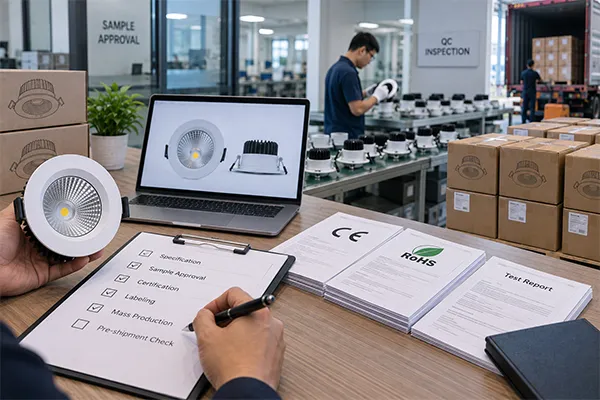
A Four-Stage Procurement Workflow
1. Supplier Pre-Qualification
During supplier selection, I suggest that buyers assess more than document availability. They should evaluate whether the supplier can explain each document, provide clear model references, respond quickly to technical questions, and support controlled customization.
Useful supplier questions include:
- Can the supplier identify the product models covered by each document?
- Can the supplier provide a current specification sheet and label artwork?
- Can the supplier explain which parameters are standard and which are customized?
- Can the supplier support small-batch orders without losing configuration control?
- Can the supplier provide samples that match the intended production version?
- Can the supplier provide production and aging-test records when agreed?
2. Sample and Specification Approval
I recommend that the buyer approve one controlled specification before production. This document should include the commercial and technical details that matter to the order.
A practical approved specification can cover:
- Product model and internal SKU
- Nominal wattage and electrical input
- CCT, CRI, beam angle, and lumen target
- Driver type and dimming requirement
- Cut-out size, dimensions, and mounting method
- Housing and trim finish
- Packaging and branding
- Required documents and language needs
- Inspection criteria and agreed sample reference
3. Production Monitoring
During production, the supplier should control changes. I consider a change-control process essential for OEM and project orders. If a component substitution, label revision, driver change, or packaging change is proposed, the buyer should receive notice before shipment.
At our factory, I would encourage a buyer to ask for confirmation that the agreed bill of materials, labels, and packaging are being followed. The exact monitoring level should reflect order size, project sensitivity, and buyer risk tolerance.
4. Pre-Shipment Document Check
Before balance payment or shipping release, I recommend a final review of:
- Commercial invoice and packing list
- Final product and carton photographs
- Product labels and installation instructions
- Agreed test reports, declarations, or certificates
- Inspection records, if included in the order
- Serial, batch, or traceability references where applicable
This is also the right time to confirm that documents name the correct supplier or responsible party where needed, and that the final shipping product has not drifted from the approved sample.
What Should Buyers Ask an LED Downlight Supplier Before Placing an Order?
A supplier may have a strong product range and still be unsuitable for a buyer’s specific compliance workflow. The goal is not to search for a supplier with the largest folder of documents. The goal is to choose a partner that can provide consistent information, controlled production, and responsive support.
Before placing an order, buyers should ask an LED downlight supplier about document scope, product traceability, customization control, sample matching, quality testing, labeling, and pre-shipment support. A capable supplier should explain what it can provide and identify where buyers need local professional confirmation.
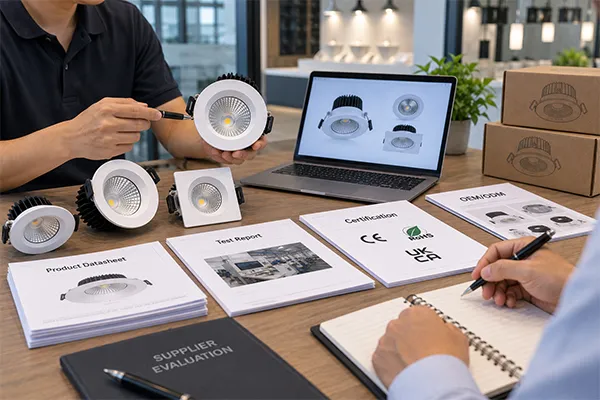
Questions I Would Encourage Buyers to Ask
| Question | What a useful supplier response should show |
|---|---|
| Which exact models and configurations do these documents reference? | Clear model mapping instead of vague assurances |
| Can you provide product photos and labels linked to the model? | Traceability between paperwork and physical goods |
| What changes can be made under OEM/ODM service? | Defined options for wattage, CCT, CRI, beam angle, and finish |
| How do you control changes after sample approval? | A documented communication and approval process |
| What testing do you perform before shipment? | Clear manufacturing QC activities, separated from certification claims |
| Can you support small-batch customized orders? | Realistic lead-time and MOQ information |
| Can you provide documentation before mass production begins? | A willingness to align requirements early |
Balance Price With Verification Capability
I understand why price remains a major procurement factor. Importers, distributors, and project contractors need competitive purchasing terms to protect margin. However, I have found that the lowest unit price can become less attractive when it creates document gaps, unclear labeling, repeated sample changes, or delayed project approval.
A better supplier comparison includes:
- Quotation transparency
- Product consistency
- Documentation responsiveness
- Customization capacity
- Quality-control process
- Delivery reliability
- Communication speed
- Ability to support the buyer’s approved specification
At Upward Lighting, we work with global buyers that need rapid quotations, flexible OEM/ODM options, and small-batch support. We can help buyers organize product specifications and check whether supplied documentation is consistent with the requested configuration. Buyers should still seek confirmation from qualified local experts for final legal, regulatory, or application-specific decisions.
Frequently Asked Questions
Is CE enough for LED downlight certification in every country?
No. I do not treat CE or any single document as universal proof for every country, sales channel, or project.8 Buyers should first identify the destination market and intended use, then confirm applicable obligations with local authorities, qualified certification bodies, or compliance advisors.
What is the difference between a test report and an LED downlight certificate?
A test report records testing performed on a stated sample under stated conditions. A certificate may reflect an assessment by a third party within a defined scope. Buyers should check the model number, product configuration, issuer, dates, and scope rather than assuming the documents provide identical evidence.
Can a changed LED driver affect LED downlight certification documents?
Yes, it can affect document-to-product consistency. A driver change may alter electrical ratings, dimming capability, component references, labeling, and product performance. I recommend that buyers review the revised driver details before approving production or accepting documents for the final order.
Should I request documents before or after placing an LED downlight order?
I recommend starting the review before placing the order, then confirming documents again before production and shipment. Early review helps define the correct configuration. Final review helps verify that the actual product, labels, packaging, and approved paperwork remain aligned.
Does a factory quality certificate prove that a downlight meets market requirements?
No. A factory-system certificate can provide useful information about management processes, but it does not automatically prove that a specific LED downlight meets every product or market requirement.9 Buyers should separately review product-specific evidence and obtain local confirmation where necessary.
Conclusion
LED downlight certification is most effective when buyers treat it as a controlled verification process rather than a generic paperwork request. I recommend starting with the destination, channel, installation scenario, and approved product specification. Then, buyers should distinguish document types, compare every document against the ordered configuration, and complete a final pre-shipment review. If you are sourcing customized LED downlights for distribution, branding, or projects, I invite you to share your target market and specification requirements with Upward Lighting so we can help prepare a clear, consistent supplier document package.
"CE marking", https://en.wikipedia.org/wiki/CE_marking. Official market-access guidance explains that electrical-product conformity, marking, and documentation duties arise from the legislation of the market where a product is placed, rather than from a single universal certificate. Evidence role: general_support; source type: government. Supports: Official guidance that product compliance, labeling, and conformity-assessment obligations are determined by applicable legislation and can differ among jurisdictions.. Scope note: The precise obligations for a particular downlight depend on the destination jurisdiction, product design, and intended use. ↩
"General Use Products: Certification and Testing | CPSC.gov", https://www.cpsc.gov/Business--Manufacturing/Testing-Certification/General-Use-Products-Certification-and-Testing. Government guidance on CE and comparable national marking regimes indicates that conformity markings are linked to specific legal markets and are not automatically transferable worldwide. Evidence role: general_support; source type: government. Supports: Official guidance showing that CE marking is tied to the EU/EEA legal framework and that other markets may use separate conformity regimes or marks.. Scope note: A destination market may accept some foreign test evidence, but acceptance and required markings must be verified under its own rules. ↩
"PROCEDURES AND GENERAL REQUIREMENTS", https://www.nist.gov/document/nist-handbook-150pdf-0. ISO/IEC 17025 laboratory-reporting guidance describes test reports as records of results for identified items tested by specified methods and under documented conditions. Evidence role: definition; source type: institution. Supports: ISO/IEC 17025-related guidance that laboratory reports identify the tested item, methods, conditions, and reported results.. Scope note: A report's exact content and legal significance depend on the laboratory's accreditation scope, the cited standard, and the applicable regulatory scheme. ↩
"42 CFR § 493.1291 - Standard: Test report. - Law.Cornell.Edu", https://www.law.cornell.edu/cfr/text/42/493.1291. Conformity-assessment guidance treats laboratory results as applicable to the identified sample and stated scope; whether they extend to variants depends on documented product-family or change-assessment rules. Evidence role: general_support; source type: institution. Supports: Conformity-assessment guidance stating that test results apply to the item or scope identified in the report and that extensions to variants require defined technical justification or assessment.. Scope note: Some certification schemes expressly cover families of models, so the report or certificate scope must be examined rather than inferred. ↩
"Signing an EU declaration of conformity - Your Europe", https://europa.eu/youreurope/business/product-rules-compliance/general-product-compliance/signing-declaration-conformity/index_en.htm. European Commission guidance defines the EU declaration of conformity as the document by which the manufacturer, or where applicable its authorized representative, declares that a product meets relevant Union requirements. Evidence role: definition; source type: government. Supports: Official EU guidance that an EU declaration of conformity is a document through which a manufacturer or authorized representative declares compliance with applicable requirements.. Scope note: The required issuer, wording, and legal effect of a declaration vary by jurisdiction and applicable product legislation. ↩
"European Union Reduction of Hazardous Substances RoHS and ...", https://www.waru.edu/artifact/european-union-reduction-hazardous-substances-rohs-and-waste-electrical-and-electronic. EU RoHS rules restrict specified hazardous substances in electrical and electronic equipment and require manufacturers to maintain technical documentation and issue an EU declaration of conformity where the directive applies. Evidence role: general_support; source type: government. Supports: Official RoHS information showing that electrical and electronic equipment may be subject to restricted-substance requirements and supporting technical documentation.. Scope note: RoHS applicability, exemptions, substance limits, and documentation obligations differ by product category and market. ↩
"ISO 9000 family", https://en.wikipedia.org/wiki/ISO_9000_family. ISO explains that ISO 9001 certification concerns an organization's quality-management system and does not certify individual products or establish their compliance with product-specific legal requirements. Evidence role: definition; source type: institution. Supports: ISO guidance distinguishing certification of an organization's quality-management system from certification or testing of individual products.. Scope note: A management system may support process consistency, but product conformity requires product-specific evidence under the relevant rules. ↩
"CE Marking", https://www.trade.gov/ce-marking. European Commission guidance states that CE marking applies to products covered by relevant EU harmonisation legislation when they are placed on the European Economic Area market; it is not a worldwide conformity mark. Evidence role: general_support; source type: government. Supports: European Commission guidance that CE marking is used for products covered by EU harmonisation legislation and placed on the EEA market.. Scope note: Individual non-EEA markets may recognize some European standards or test evidence, but such recognition does not itself make CE marking locally sufficient. ↩
"ISO 9001 explained", https://www.iso.org/home/insights-news/resources/iso-9001-explained.html. Standards and accreditation guidance distinguishes certification of a manufacturer's management system from product testing or certification, which must address the particular product and applicable requirements. Evidence role: expert_consensus; source type: institution. Supports: Standards-body guidance distinguishing quality-management-system certification from evidence that a particular product conforms to market-specific requirements.. Scope note: A factory-system certificate can be relevant to supplier assessment, but it is not by itself evidence of compliance for a particular model, configuration, or destination market. ↩