

LED downlight certification requirements in Europe can feel confusing when a supplier offers a CE mark, RoHS report, or test file without explaining how those documents apply to a specific product. The risk is not only delayed customs clearance or rejected project submittals. A documentation mismatch can also create avoidable responsibility for importers, local brands, and distributors.
European LED downlight compliance is not based on purchasing one universal certificate. Buyers should verify the destination country, the exact downlight SKU and configuration, their role in placing it on the market, and the documents that support applicable safety, environmental, and energy-related requirements. CE-related documentation, RoHS evidence, and ecodesign obligations are connected, but they are not interchangeable.
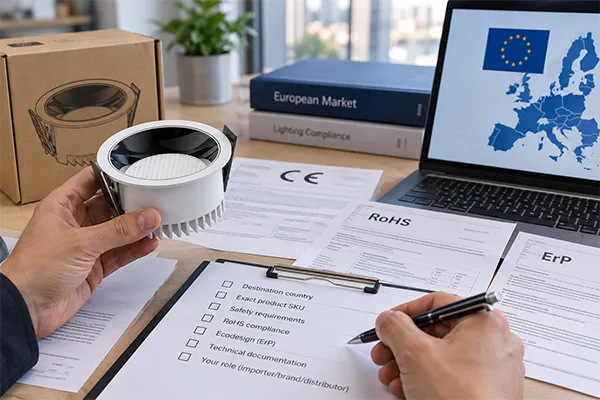
At Upward Lighting, we regularly prepare pre-shipment documentation and answer questions from European customers about LED downlight files. Our experience is practical rather than legal. We help customers organize product information, but we always recommend that buyers verify country-specific rules, current standards, language requirements, and project conditions with qualified compliance professionals.
What Do LED Downlight Certification Requirements in Europe Actually Mean?
Many buyers begin with a simple question: “Which certificate do I need?” That question is understandable, but it can lead to the wrong purchasing decision. A downlight may look identical to another model while using a different driver, wattage, dimming function, or light source arrangement.
LED downlight certification requirements in Europe refer to the set of legal, technical, labeling, and documentation obligations that may apply to a particular product in a particular market. In many cases, the buyer must review CE-related conformity documentation, RoHS substance compliance, and applicable energy-efficiency or ecodesign obligations separately.
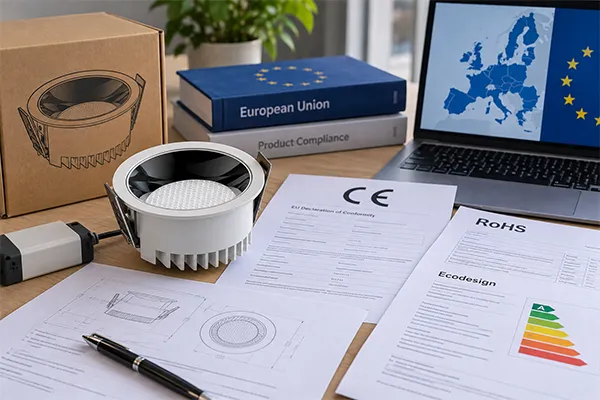
CE Is a Conformity Process, Not a Universal Product Certificate
One of the most important distinctions is the meaning of the CE mark. We often see buyers ask suppliers for a “CE certificate” as though CE were a single document issued by a universal authority for every lighting product.
In practice, CE marking generally involves a manufacturer’s conformity assessment process and a Declaration of Conformity (DoC) supported by relevant technical documentation. Depending on the product and applicable requirements, this documentation may include test reports, risk assessment records, component information, product specifications, labeling details, and manufacturing controls.
A buyer should not assume that:
- A CE logo on a product proves every requirement has been met.1
- A report for one downlight model automatically applies to all related models.
- A supplier’s CE-related paperwork removes the importer’s obligations.
- A document prepared for one market automatically satisfies every European country or project.
RoHS and Ecodesign Have Different Purposes
RoHS focuses on the restriction of certain hazardous substances in electrical and electronic equipment.2 Buyers commonly request RoHS reports, declarations, or material-related evidence as part of supplier approval.
Energy-efficiency and ecodesign requirements have a different purpose.3 Depending on the product category and market situation, buyers may need to consider energy performance, product information, light-source treatment, replaceability concepts, and other product-design obligations. The exact assessment can depend on whether a downlight contains an integrated LED light source, uses a replaceable lamp, or is supplied as a luminaire with specific control gear.
We recommend separating these questions during procurement:
| Compliance Question | Practical Buyer Check |
|---|---|
| Can the product be supported by CE-related conformity documentation? | Review the DoC, product identification, applicable documentation, and labeling. |
| Does the product have RoHS support? | Request a RoHS declaration and relevant material or test evidence where needed. |
| Are energy-related requirements relevant? | Confirm product type, light-source arrangement, destination market, and current obligations. |
| Is the file suitable for the sales country? | Check local language, importer information, labeling, and national requirements. |
This approach makes supplier discussions more useful. Instead of asking for “all certificates,” we encourage buyers to request a documentation package that matches the exact product they plan to place on the market.
Why Must the Exact LED Downlight Configuration Match the Documents?
A familiar problem occurs when a buyer approves a sample, then later asks for a different wattage, driver brand, trim finish, beam angle, or dimming option. These changes may be commercially reasonable, but they can affect whether existing test evidence and declarations remain applicable.
The exact LED downlight configuration must match the supporting documentation because changes to electrical components, thermal construction, optical parts, control functions, or rated values can alter the product being assessed.4 Buyers should verify that reports, declarations, labels, and technical specifications identify the final sellable SKU rather than only a similar sample.
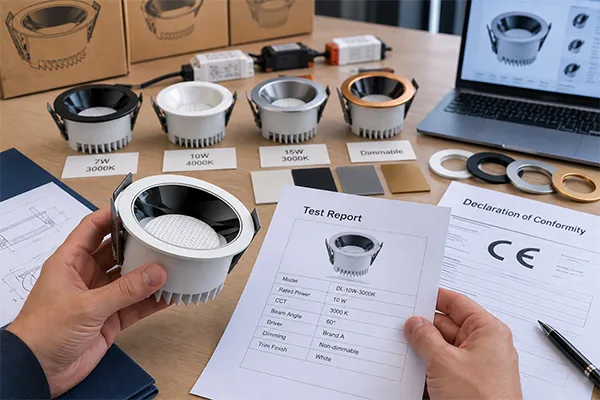
Small Product Changes Can Create Large Documentation Questions
In our manufacturing work, we know that an LED downlight is not defined only by its outer appearance. A recessed round downlight with the same housing can have different electrical and thermal behavior when its internal components change.
For example, the following changes should trigger a documentation review:
- Driver or power supply changes, including a new supplier, input range, output current, or dimming design.
- Wattage changes, such as moving from 9W to 12W or 18W.
- LED module changes, including LED brand, light-source structure, board design, or luminous output.
- Dimming changes, such as adding TRIAC, DALI, 0–10V, PWM, or smart-control functions.
- Construction changes, including heat sink design, insulation parts, cable type, terminal block, or ingress-protection structure.
- Installation changes, such as changes in cutout size, mounting method, insulation-cover suitability, or ceiling material conditions.
- Product identity changes, including model number, rated voltage, frequency, class designation, or labeling information.
Build a Product-to-Document Matrix
We encourage importers and lighting brands to maintain a simple product-document matrix. This is especially useful when one downlight platform has several wattages and trim options.
| Product Detail | Example | Buyer Verification Question |
|---|---|---|
| Model number | UL-DL-12W-RD | Does the model appear on the declaration and report? |
| Rated wattage | 12W | Does the file cover the listed electrical rating? |
| Driver | Non-dimmable external driver | Is this driver the same as the production version? |
| Dimming option | TRIAC dimmable | Does the dimming version have matching evidence? |
| CCT | 3000K / 4000K | Does the product information reflect the sold option? |
| Installation | Recessed ceiling mount | Does the manual cover this installation method? |
| Market label | EU importer details | Is the label suitable for the destination market? |
I have seen buyers avoid substantial project delays by asking for this matrix before confirming the purchase order. It creates a clear checkpoint between product development, quotation approval, production, and final shipment.
At Upward Lighting, we can support OEM and ODM projects with options such as color temperature, wattage, beam angle, CRI, and surface finish. However, customization also means the buyer should re-check whether the documentation package still matches the final agreed configuration. A customized version should never be treated as automatically identical to a standard catalog model.
Which Documents Should Buyers Request From an LED Downlight Supplier?
Buyers often receive a large folder of PDFs but still lack the documents needed for a practical compliance review. The goal is not to collect the highest number of files. The goal is to obtain relevant, traceable evidence that supports the specific downlight and sales model.
For LED downlight certification requirements in Europe, buyers should request a structured documentation package that links the exact SKU to a Declaration of Conformity, applicable test evidence, technical specifications, labeling details, instructions, and RoHS-related support. The required format and depth can vary by country, product type, and buyer role.
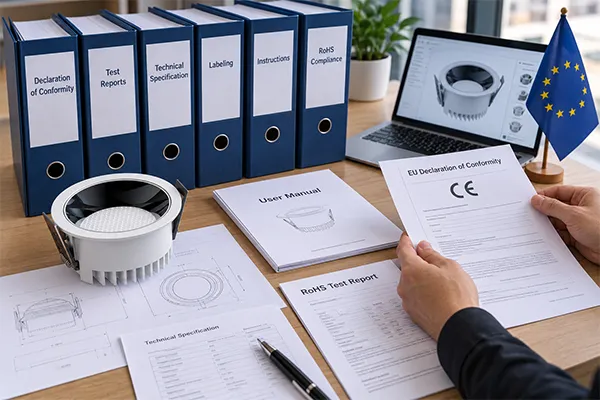
A Practical Supplier Documentation Checklist
We suggest that buyers begin with the following request list:
-
Product specification sheet
The sheet should identify the model number, wattage, input voltage, frequency, luminous flux, color temperature, beam angle, CRI, IP rating where applicable, dimensions, cutout size, and installation method. -
Declaration of Conformity
Buyers should check that the declaration identifies the responsible economic operator, product model or model family, date, and relevant conformity basis. Buyers should also confirm that the declaration is appropriate for the actual market-placement arrangement. -
Relevant test reports or test summaries
Reports should be reviewed for product identity, rated values, applicable configuration, report date, laboratory details, and any limitations. A report is not useful if it only covers a materially different product. -
RoHS declaration and supporting evidence
The appropriate level of evidence depends on the buyer’s risk assessment, product category, and supply-chain requirements. Some buyers also request declarations from key component suppliers. -
Product label artwork or label photographs
The label should be checked for model identity, electrical ratings, applicable markings, traceability information, and importer or responsible-party details where required. -
Installation instructions and safety information
Instructions should reflect the actual installation environment. For recessed downlights, this can be important where insulation, ceiling voids, ventilation, moisture, or fire-rated building systems are involved. -
Packaging artwork and carton markings
Packaging should match the agreed product identity and destination-market needs.
Verify Documents, Not Just File Names
A PDF labeled “CE Certificate” may still require careful review. We recommend that buyers inspect the contents rather than rely on the document title.
A strong compliance file is traceable. It connects the physical product, product label, purchase order, declaration, instructions, and evidence package.
For larger projects, buyers may also need additional documents requested by consultants, contractors, or local authorities. These can include photometric files, lumen-maintenance information, ingress-protection reports, thermal information, warranty terms, or factory quality-control records.
At Upward Lighting, every product undergoes a 100% aging test for 4 to 8 hours before shipment as part of our manufacturing quality-control process. This internal process can support buyer confidence in production consistency, but it is not a replacement for the compliance assessment and documentation required for market placement.
A supplier can provide valuable technical records, but documentation support does not automatically transfer legal responsibility away from the party that places the product on the market. This point matters most for importers, private-label brands, and companies selling a modified product under their own name.
Importers, local brands, and distributors should confirm their own market-placement responsibilities because manufacturer reports and declarations may support their process without eliminating their obligations5. A business that imports, relabels, modifies, or markets an LED downlight under its own brand may need to take additional steps to ensure compliant market entry.6
Understand Your Position in the Supply Chain
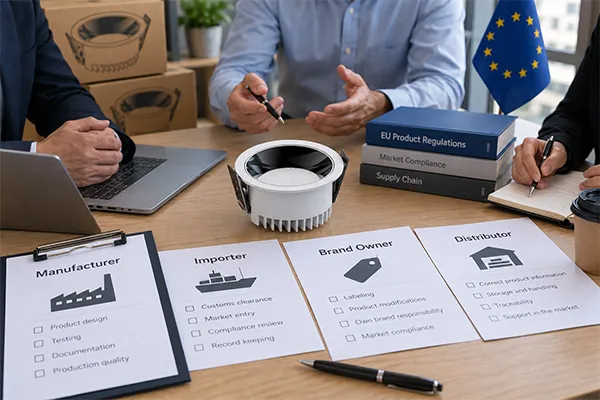
The correct compliance process can depend on who performs each role. Buyers should map their sales model before placing an order.
| Supply-Chain Role | Typical Procurement Question |
|---|---|
| Manufacturer | Can the factory provide traceable product evidence and production information? |
| Importer | Has the importer confirmed required checks before placing the product on the market? |
| Local brand owner | Does private labeling or product modification create additional responsibility? |
| Distributor | Has the distributor checked that required markings, documents, and instructions are present? |
| Project contractor | Does the specified downlight meet project, installation, and local tender requirements? |
Private Labeling Requires Extra Care
Many customers ask us to add their logo, packaging, model number, color box, or customized specifications. OEM and ODM support can be valuable for market differentiation, but it should also prompt a more careful documentation review.
A private-label buyer should consider:
- Whether the new brand and product identity are reflected consistently.
- Whether the label identifies the relevant responsible party where required.
- Whether the declaration and technical records still match the branded product.
- Whether translated instructions are needed for the intended sales countries.
- Whether any requested product modification affects test evidence.
- Whether project specifications impose additional requirements beyond general market-entry documentation.
For example, a distributor selling an unchanged product may have different responsibilities from a local brand that changes the driver, adds smart controls, or sells the product under a new model number. We do not provide legal opinions on those boundaries. However, we believe that clear role mapping should be part of supplier qualification.
Remember That Europe Is Not One Identical Market
Buyers also need to distinguish between the EU/EEA market framework and country-specific considerations. The United Kingdom, for example, has its own market-access framework and may require different marking or documentation treatment from EU countries.7 Individual countries may also have national language, packaging, registration, waste-management, installation, or project requirements.8
For that reason, we recommend confirming these points before production:
- Sales country or countries.
- Product configuration and final SKU list.
- Buyer role: importer, brand owner, distributor, contractor, or reseller.
- Required labels and language versions.
- Applicable project specifications.
- Document-review responsibility within the buyer’s organization.
- Any third-party laboratory, consultant, or certification-body review required by the project.
How Can Buyers Build a Lower-Risk European Downlight Procurement Process?
A rushed quotation process can create gaps later. Buyers may compare unit prices, approve a sample, and only request documentation after goods are ready to ship. That approach can be expensive when a report does not match the final driver or when the destination country needs different instructions.
A lower-risk process for LED downlight certification requirements in Europe starts before the order is placed. Buyers should confirm the market, product configuration, responsibility model, document requirements, and inspection points before approving mass production or shipment.
Use a Seven-Step Verification Sequence
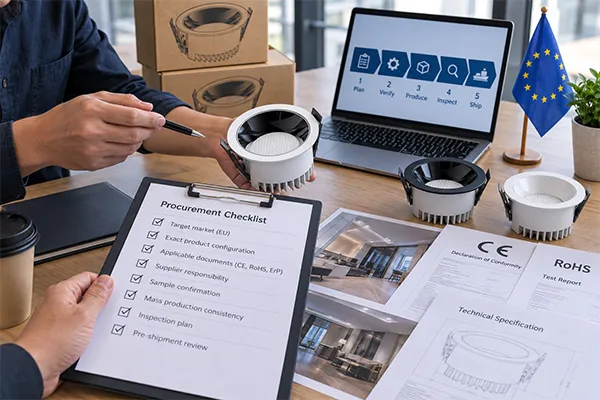
We recommend this practical sequence for importers, brands, wholesalers, and project buyers:
-
Confirm the destination market
Identify every country where the product will be sold, installed, or transferred. Do not assume that one file works for every destination. -
Freeze the product configuration
Confirm the exact SKU, wattage, driver, dimming function, CCT, beam angle, trim, cable, connector, installation method, and packaging. -
Identify applicable requirements
Ask internal compliance teams or qualified advisers to determine the relevant safety, environmental, and energy-related obligations for the actual product. -
Request matching evidence
Review the supplier’s declaration, reports, technical data, labels, and instructions. Check matching model names and rated values. -
Confirm labels and accompanying documents
Verify product markings, traceability information, importer details where applicable, instruction languages, and packaging needs. -
Approve a golden sample
Keep an approved reference sample, artwork set, bill of materials, and specification sheet. This helps prevent production drift. -
Perform pre-shipment checks
Confirm the final product, carton labels, accessories, driver version, instructions, and document package before balance payment or dispatch.
Add Quality-Control Evidence to the Commercial Review
Compliance documentation is only one part of supplier selection. Buyers should also evaluate whether the factory can produce consistent goods at the agreed quality level.
For LED downlights, we suggest reviewing:
- Incoming component control for LED chips, drivers, housings, optics, and cables.
- Aging-test procedures and records.
- Electrical and visual inspection methods.
- Production traceability by order, batch, or date code.
- Packaging inspection and accessory checks.
- Corrective-action handling for nonconforming products.
- Supplier responsiveness when technical questions arise.
Our team at Upward Lighting uses a 100% aging process before shipment, with aging periods typically lasting 4 to 8 hours. Buyers should still define their own acceptance criteria, inspection plan, and project-specific requirements. A factory process is helpful evidence, but each importer or brand should decide whether it is sufficient for its own risk profile.9
Frequently Asked Questions
Is CE a certificate for LED downlights?
CE is not best understood as a single universal certificate that automatically proves every aspect of compliance. For LED downlights, buyers should review the relevant Declaration of Conformity, supporting technical documentation, product labeling, and whether the evidence matches the exact product and destination market.
Do RoHS documents prove that an LED downlight is CE compliant?
No. RoHS-related evidence addresses restricted substances, while CE-related conformity documentation can involve broader product requirements. These areas may be connected in a compliance review, but a RoHS report or declaration alone does not prove that every applicable market-entry obligation has been met.10
Can one test report cover several LED downlight wattages?
Sometimes a report may cover a product family, but buyers should not assume this without reviewing the scope.11 A different wattage, driver, dimming function, light source, housing, or installation method can affect whether the report remains applicable to the final SKU.
Does a Chinese manufacturer’s document package remove the importer’s responsibility?
No. Manufacturer documentation can support the importer’s or brand owner’s assessment, but it does not automatically remove that party’s responsibilities when placing products on the market. Buyers should confirm their role, local obligations, and required records with qualified advisers.
Are EU requirements the same in the UK?
Buyers should not assume that EU and UK requirements are identical. The UK has its own market-access framework, and specific labeling, documentation, and marking requirements may differ. Importers should verify current rules for the exact sales territory before placing an order.
Conclusion
LED downlight certification requirements in Europe should be treated as a product-and-market verification process, not as a search for one universal certificate. We recommend that buyers confirm the destination country, final SKU configuration, market-placement role, applicable requirements, matching evidence, declaration, labels, and instructions before production approval. At Upward Lighting, we can support importers, brands, wholesalers, and project buyers with organized product information, OEM/ODM options, and pre-shipment quality-control documentation. Contact us to discuss your LED downlight specification and documentation request before your next European sourcing project.
"CE marking", https://en.wikipedia.org/wiki/CE_marking. The EU Blue Guide describes CE marking as a declaration by the manufacturer that a product conforms to applicable Union harmonisation legislation, with compliance to be substantiated through the required conformity-assessment and technical-documentation process. Evidence role: general_support; source type: institution. Supports: The meaning of CE marking and its relationship to the manufacturer’s declaration of compliance rather than to a universal product-approval certificate.. Scope note: This supports the general interpretation of CE marking; the applicable legislation and assessment route remain product-specific. ↩
"European Union Reduction of Hazardous Substances ...", https://www.waru.edu/artifact/european-union-reduction-hazardous-substances-rohs-and-waste-electrical-and-electronic. Directive 2011/65/EU restricts the use of specified hazardous substances in electrical and electronic equipment placed on the EU market, subject to its scope, exemptions, and related conditions. Evidence role: definition; source type: government. Supports: The scope and purpose of the EU RoHS Directive concerning restrictions on hazardous substances in electrical and electronic equipment.. ↩
"Factsheet - 32019R2020 | European Free Trade Association", https://www.efta.int/eea-lex/32019r2020. EU ecodesign rules establish product-specific environmental-performance and information requirements for energy-related products; for light sources and separate control gears, these requirements are set out in Commission Regulation (EU) 2019/2020. Evidence role: definition; source type: government. Supports: The EU ecodesign framework’s focus on environmental performance requirements for energy-related products, including light sources and separate control gears.. Scope note: Whether a particular downlight, integrated light source, or control gear is in scope depends on the regulation’s definitions and exemptions. ↩
"The Blue Guide on the implementation of the product rules ...", https://single-market-economy.ec.europa.eu/news/blue-guide-implementation-product-rules-2022-published-2022-06-29_en. The EU Blue Guide states that a product modified after it has been placed on the market may need to undergo a new conformity assessment when the modification is substantial and affects compliance with applicable requirements. Evidence role: mechanism; source type: institution. Supports: EU guidance that substantial product modifications may require a new conformity assessment and updated technical documentation.. Scope note: The guidance does not classify every driver, optical, thermal, or rating change; whether a particular change is substantial depends on the applicable legislation and its effect on compliance. ↩
"CE marking – obtaining the certificate, EU requirements", https://europa.eu/youreurope/business/product-rules-compliance/general-product-compliance/ce-marking/index_en.htm. Under the EU product-marketing framework, importers must ensure before placing products on the market that the manufacturer has carried out the appropriate conformity assessment, prepared the required technical documentation, and provided the required marking and accompanying information. Evidence role: expert_consensus; source type: institution. Supports: The general obligations of importers to ensure that manufacturers have completed applicable conformity-assessment procedures and prepared required documentation.. Scope note: Specific importer duties are established by the particular legislation applicable to the product category. ↩
"Importers: What do the MDR and IVDR actually demand? - Johner Institute", https://blog.johner-institute.com/regulatory-affairs/importers/. The EU Blue Guide explains that an importer or distributor is regarded as a manufacturer when it places a product on the market under its own name or trademark or modifies a product already placed on the market in a manner that may affect compliance with applicable requirements. Evidence role: general_support; source type: institution. Supports: EU guidance that an importer or distributor placing a product on the market under its own name or trademark, or modifying it in a way that may affect compliance, is considered a manufacturer.. Scope note: The consequences for a specific private-label or modified downlight depend on the applicable sectoral legislation and the nature of the modification. ↩
"Placing UKCA or CE marked products on the market in Great Britain", https://www.gov.uk/guidance/placing-ukca-or-ce-marked-products-on-the-market-in-great-britain. UK government guidance sets out a Great Britain product-marking framework, including UKCA requirements and circumstances in which CE marking continues to be accepted for specified product regulations. Evidence role: historical_context; source type: government. Supports: Current UK government guidance on product marking and documentation for goods placed on the market in Great Britain.. Scope note: Acceptance periods, sectoral rules, and the position in Northern Ireland can differ and should be checked against current UK guidance. ↩
"EU - Labeling/Marking Requirements - International Trade Administration", https://www.trade.gov/country-commercial-guides/eu-labelingmarking-requirements. EU product-market guidance recognises that Member States may require safety information and instructions in languages determined by national law, while WEEE rules require producer registration in each Member State where electrical and electronic equipment is placed on the market. Evidence role: general_support; source type: institution. Supports: The existence of national language requirements for product information and national producer-registration arrangements for waste electrical and electronic equipment.. Scope note: Packaging, installation, tender, and other national requirements vary by jurisdiction and product context; this evidence does not establish a single rule for all countries. ↩
"CE marking - Wikipedia", https://en.wikipedia.org/wiki/CE_marking. The EU Blue Guide distinguishes production controls used to maintain conformity from the wider conformity-assessment process, which includes demonstrating compliance with applicable requirements and preparing the required technical documentation and declaration. Evidence role: mechanism; source type: institution. Supports: That production controls form part of maintaining conformity where required, while CE compliance also depends on applicable conformity assessment, technical documentation, and declaration obligations.. Scope note: The type and depth of production control required depend on the applicable product legislation and conformity-assessment module. ↩
"RoHS", https://en.wikipedia.org/wiki/RoHS. The EU Blue Guide explains that where several Union harmonisation acts apply to a product, the manufacturer must ensure conformity with all applicable requirements and reflect the applicable legislation in the EU declaration of conformity. Evidence role: general_support; source type: institution. Supports: That products may be subject to multiple applicable Union harmonisation acts and that declarations of conformity address all applicable requirements.. Scope note: The set of applicable acts for a particular downlight depends on its design, intended use, and legal scope. ↩
"Luminaires V2.2 Final Specification", https://www.energystar.gov/sites/default/files/Luminaires%20V2.2%20Final%20Specification.pdf. EU conformity-assessment guidance requires technical documentation to permit assessment of a product’s conformity and to identify the product concerned; where evidence is applied to variants or representative products, the scope and technical basis must be established. Evidence role: general_support; source type: institution. Supports: The principle that conformity evidence must identify the product covered and that representative-product approaches require defined scope and technical justification.. Scope note: Whether a specific test report validly covers multiple wattages or variants is determined by the report, the applicable standard, and the certification or assessment scheme. ↩