

LED downlight certification requirements in North America can feel confusing when buyers see CE marks, RoHS declarations, UL references, test reports, and different labels on similar products. The risk is not only an incorrect import document. A mismatched downlight can delay project approval, prevent channel listing, or create installation concerns. We recommend verifying compliance at the exact SKU level before ordering.
North American LED downlight compliance requires buyers to confirm that the exact product configuration is evaluated for its intended market and use. A generic “UL certificate,” CE marking, RoHS declaration, or test report is not enough on its own. Buyers should check the destination country, model number, electrical rating, driver, housing or trim arrangement, product label, documentation scope, and intended installation application before purchase.
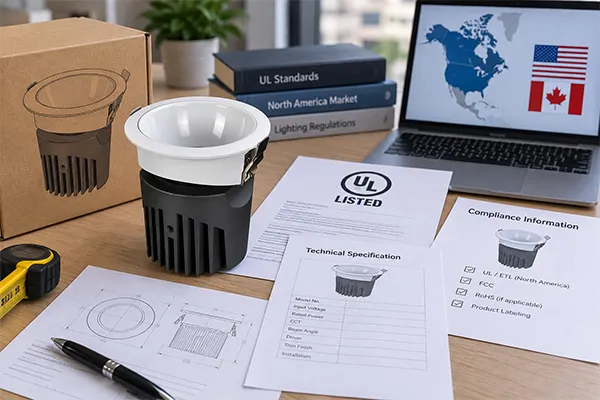
In our work with importers, contractors, and lighting brands, we have learned that the best compliance questions are asked before a quotation becomes a purchase order. A careful review can reduce avoidable surprises later, especially when a buyer needs customized wattage, color temperature, dimming, finishes, or mounting arrangements.
Why Do LED Downlight Certification Requirements in North America Need SKU-Level Verification?
Many buyers ask whether a supplier has “UL certification” for LED downlights. That question is understandable, but it is too broad for a purchasing decision. A supplier may hold relevant documentation for some models while the specific configuration being ordered differs in ways that affect the documented scope.
LED downlight certification requirements in North America should be verified against the exact sellable SKU, not only against a product family name or supplier statement. The buyer should match the model, wattage, input voltage, driver, trim, housing, wiring method, label, and intended application to the available certification documents and listing information.
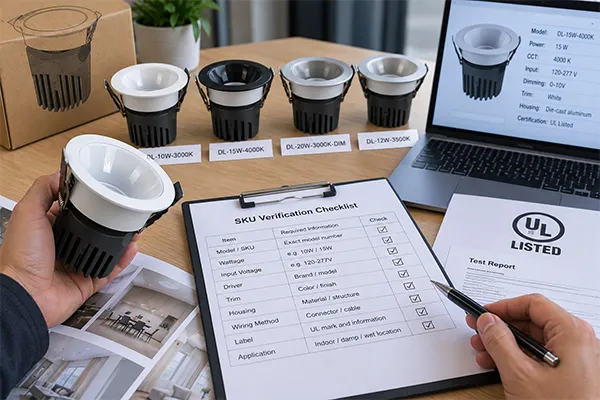
A product family is not always one compliance scope
A recessed LED downlight may look nearly identical across multiple configurations. However, a change in one component can alter electrical, thermal, mechanical, or installation characteristics.1 From a procurement perspective, visual similarity is not a reliable compliance method.2
When we review customer requirements, we encourage the buyer to begin with a controlled product description. This description should include the commercial SKU and every feature that matters to the intended sale or installation.
Key details commonly include:
- Model number and revision
- Nominal wattage and power range
- Input voltage and frequency
- Driver brand, model, and dimming method
- Color temperature and lumen package
- Beam angle and optical components
- Trim material, finish, and dimensions
- Housing type or canless construction
- Junction box design and wiring arrangement
- Wet, damp, or dry location claim, where applicable
- Intended country: United States, Canada, or both
- Private label name and product label artwork
I have seen buyers receive a report that mentions a similar product family but does not clearly identify the final ordered model. That situation does not automatically mean the product is unsuitable. It means the buyer needs a more detailed review before relying on the document for a listing, project submittal, or installation decision.
Ask for evidence that can be matched
A practical document review should connect the physical downlight to the paperwork. Buyers can request:
| Item to review | Why it matters |
|---|---|
| Product label artwork | It helps confirm ratings, model identification, and marking consistency. |
| Model list or listing scope | It shows whether the exact SKU appears within the relevant documentation. |
| Test report references | It supports comparison of the tested configuration with the ordered version. |
| Bill of materials or controlled specification | It helps identify driver, LED board, housing, and wiring differences. |
| Installation instructions | It clarifies the stated application and installation assumptions. |
| Factory change-control records | It helps buyers understand how configuration changes are managed. |
We do not present ourselves as a certification laboratory, code authority, or legal adviser. However, as a manufacturer, we can help customers organize model-specific information early. The final interpretation should be confirmed with the relevant certification body, local authority having jurisdiction, project specifier, or another qualified professional.
Are CE and RoHS Enough for LED Downlight Certification Requirements in North America?
CE and RoHS documentation may be important in certain markets and supply-chain discussions. However, buyers should not treat either document as automatic proof that a LED downlight is ready for sale, listing, project approval, or installation in the United States or Canada.3
CE and RoHS are not substitutes for verifying North American LED downlight certification requirements. CE marking addresses European Union conformity processes, while RoHS generally concerns restrictions on certain hazardous substances.4 North American buyers should evaluate the documents and marks expected for their specific country, product application, sales channel, and project requirements.
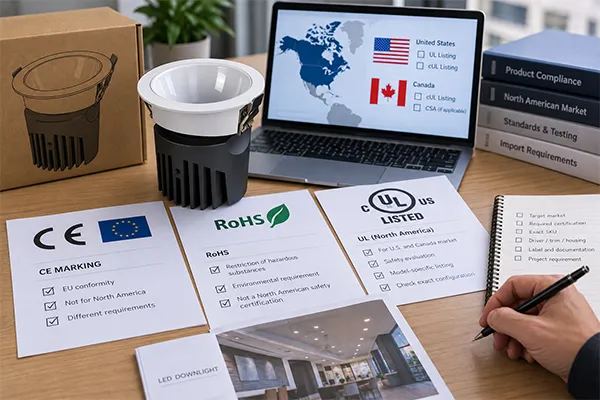
Different documents answer different questions
A recurring issue in international lighting procurement is that buyers receive a folder containing many documents but cannot determine what each document proves. More paperwork does not automatically create better market access.
For example, CE-related documentation may be relevant to a European market strategy. A RoHS declaration may support environmental-material requirements. A laboratory test report may show that a particular sample was tested under a stated standard and condition.5 These documents can all be useful, but each has a different purpose and scope.
The buyer should ask a simple question:
Does this document support the exact product, market, and intended use that I am purchasing for?
That question brings clarity to the review process.
The U.S. and Canada should be assessed separately
The United States and Canada have overlapping product-safety expectations in many lighting categories.6 Still, buyers should not assume that documentation for one country automatically transfers to the other.7 The target market needs to be identified before compliance evidence is evaluated.
For a North American sourcing project, we recommend documenting the destination in the product requirement sheet:
| Procurement question | U.S. purchase | Canadian purchase | Cross-border purchase |
|---|---|---|---|
| What country will receive the product? | Confirm U.S. market requirements | Confirm Canadian market requirements | Review each destination independently |
| Who will accept the product? | Distributor, inspector, project team, retailer | Distributor, inspector, project team, retailer | Identify acceptance requirements in both markets |
| What label is needed? | Verify with relevant parties | Verify with relevant parties | Do not assume one label covers all scenarios |
| What installation environment applies? | Confirm specification and local requirements | Confirm specification and local requirements | Compare project-specific requirements |
In our experience, the phrase “North America compliant” should trigger follow-up questions rather than end the discussion. It may be a useful commercial shorthand, but it is not a complete technical conclusion. Buyers need to know the relevant country, product marking, scope, and application.
How Can Buyers Check LED Downlight Certification Requirements in North America Before Ordering?
A buyer can reduce risk by turning compliance review into a formal pre-order process. This process should happen before tooling changes, private-label printing, mass production, or final container booking. It is easier to resolve document gaps before products are manufactured than after inventory reaches a warehouse.
To check LED downlight certification requirements in North America, buyers should create a model-specific compliance checklist, compare it with supplier documents, review proposed labels and installation instructions, and confirm any unresolved questions with the appropriate certification body, authority, project specifier, or qualified professional.
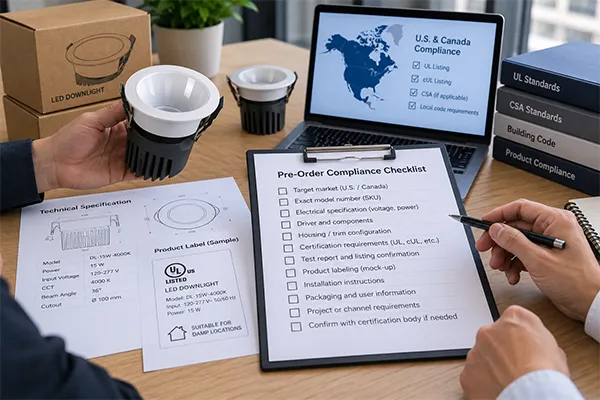
Use a controlled pre-order checklist
Our team often supports customers by gathering technical files, label samples, photographs, and product specifications. We find that a structured checklist is more reliable than a general email question such as, “Is this UL certified?”
A purchasing manager can use the following workflow.
-
Define the end market and application.
Confirm whether the products are intended for the United States, Canada, or both. Identify whether they are for residential retail, commercial channels, hospitality projects, public buildings, renovation work, or another defined application. -
Freeze the configuration for review.
Record wattage, voltage, CCT, driver, dimming function, trim, housing, cable, junction box, and installation type. A buyer should also document the desired label brand and packaging language. -
Request product-specific evidence.
Ask for the relevant model list, certificate or listing reference, report references, label artwork, installation manual, and technical data sheet. The documents should be readable and traceable to the product. -
Compare the documents with the quotation.
The commercial quotation should not describe a 12 W, 120 V downlight if the available documentation applies only to a different electrical arrangement. The buyer should identify discrepancies before approving the order. -
Review the production sample.
A pre-production sample should match the reviewed documents. The product label, driver marking, housing construction, wire specification, and installation hardware should be checked against the approved record. -
Keep the compliance file with the purchase order.
Buyers should retain approved documents, correspondence, sample photos, inspection reports, and revision records. These files can be valuable for channel questions, project submittals, and post-sale support.
Examine labels, not only certificates
The physical product label is often one of the most useful checkpoints.8 A label can help the buyer compare the actual product with the approved specification.
A typical review may include:
- Product model and brand
- Input voltage and frequency
- Wattage or rated electrical data
- Relevant marking information
- Manufacturing identification or traceability code
- Country-of-origin marking, if required for the buyer’s process
- Warnings and installation-related information
- Alignment with packaging and instruction manuals
At Upward Lighting, we perform a 100% aging test for 4 to 8 hours before shipment as part of our factory quality process. That production test is valuable for assessing basic operational consistency and identifying early failures. However, buyers should understand that factory aging is not a replacement for certification scope verification or application-specific approval.9
How Do OEM and ODM Changes Affect LED Downlight Certification Requirements in North America?
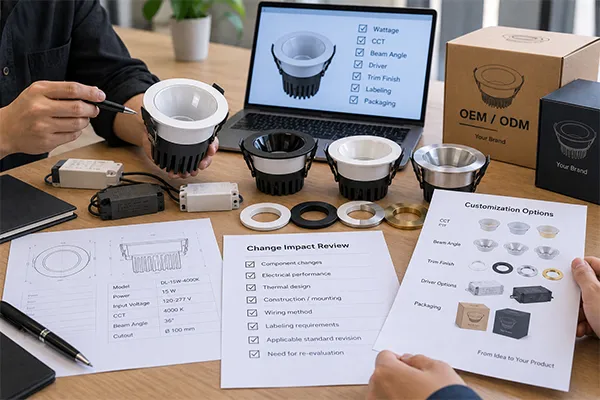
OEM and ODM flexibility can help lighting brands create differentiated product lines. Customers may request a different color temperature, wattage, beam angle, CRI, surface color, driver, or private-label package. These changes can be commercially valuable, but they also need controlled compliance review.
OEM or ODM changes can affect LED downlight certification requirements in North America when they alter electrical components, thermal performance, construction, mounting, wiring, labeling, or intended use.10 Buyers should not assume that an existing report or certification remains applicable until the specific revision and supporting documentation have been reviewed.
Some changes appear minor but may not be minor
A finish-color change may seem simple. In some cases, it may have limited relevance to a safety evaluation. However, a new housing material, deeper trim, alternative diffuser, revised driver, changed wire length, or different junction box can affect product construction or operating conditions.
The buyer should treat every requested change as a change-control question. The right question is not, “Can the factory make this?” The right question is, “What technical and document review is needed before we represent this version as covered?”
Here is a practical risk-screening approach:
| Proposed change | Example | Why review may be needed |
|---|---|---|
| Electrical change | 120 V to another input arrangement | Electrical ratings and components may differ |
| Driver change | New dimmable driver supplier | Driver performance and construction may change |
| Power change | 9 W to 15 W | Thermal output and electrical characteristics may differ |
| Mechanical change | New spring clip or housing | Mounting and installation configuration may change |
| Wiring change | Different cable or connector | Wiring method and component ratings may differ |
| Application change | Indoor to damp or wet location claim | Environmental exposure requirements may differ |
| Branding/label change | Private-label artwork | Required markings and model traceability must remain accurate |
Build compliance into the change-order process
We recommend that buyers add a compliance checkpoint to every engineering change request. This is particularly important for brands that place repeat orders over several years. A product can evolve gradually through component substitutions, packaging updates, and customer-driven modifications.
A controlled process can include:
- A unique revision number for each modified SKU
- Written identification of changed components
- Updated drawings and specifications
- Revised label artwork approval
- A document-scope review
- Confirmation of whether additional evaluation is needed
- Updated inspection criteria for production and pre-shipment checks
I have found that this process also protects the buyer’s sales team. When distributors or contractors ask whether a specific version is suitable for a project, the brand has a clearer technical record instead of relying on verbal assumptions.
What Risks Follow Incomplete LED Downlight Certification Requirements in North America?
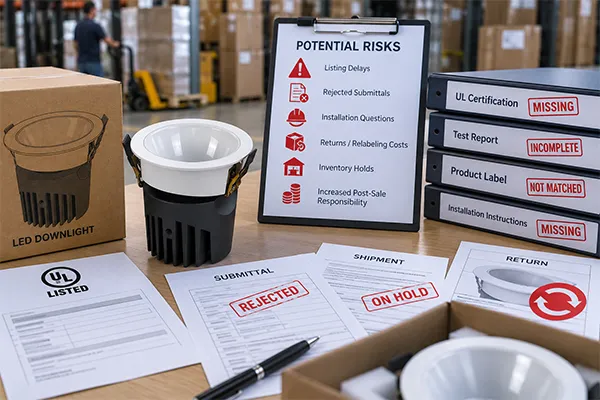
The compliance issue does not end when products leave the factory. An incomplete, unclear, or mismatched document package can affect channel onboarding, project approval, warehouse release, installation acceptance, customer confidence, and warranty handling.
Incomplete LED downlight certification requirements in North America can create commercial and operational risk beyond importation. Buyers may face listing delays, rejected submittals, installation questions, returns, relabeling costs, inventory holds, or increased post-sale responsibility when the product configuration and documentation do not clearly match.11
Compliance should be part of supplier selection
Price is important, but the lowest unit price can become expensive if a buyer cannot confidently use the product in its intended channel. Importers and distributors should include documentation quality in their supplier scorecard.
A practical supplier evaluation can assess:
- Technical response speed
- Document traceability
- Model and revision control
- Label accuracy
- Willingness to provide samples for verification
- Factory inspection capability
- Change-notification procedures
- Production consistency
- Packaging and instruction-manual control
- Ability to support small-batch customized orders without losing traceability
At Upward Lighting, we support OEM and ODM requests for parameters such as CCT, wattage, beam angle, CRI, and surface finishes. We also recognize that customization requires stronger communication, not weaker controls. A fast quotation is helpful, but a clear configuration record is more valuable when the customer needs to sell into a regulated or specification-driven channel.
Think beyond the initial purchase order
A buyer should consider what happens after the first shipment. Will the same driver remain available? Will the factory notify the buyer before a component substitution? Can the supplier identify the production batch if a channel partner reports a problem? Are the label and installation instructions consistent across reorder batches?
These questions matter because a lighting brand’s reputation is tied to the product in the field. A stable supplier relationship should include quality controls, document discipline, and open discussion of requested changes.
For application-specific decisions, buyers should still seek confirmation from the relevant certification organization, local authority, project engineer, specifier, or qualified professional. We can provide product information and manufacturing support, but final market-access and installation decisions belong with the appropriate experts.
Frequently Asked Questions
Is CE certification enough to sell LED downlights in the United States or Canada?
No. CE marking should not be treated as automatic proof that a LED downlight is ready for sale or installation in the United States or Canada. Buyers should verify the specific market, product configuration, required markings, documentation scope, sales-channel expectations, and project requirements with relevant qualified parties.
Can I rely on a generic UL certificate from a LED downlight supplier?
A generic claim is not enough for a purchasing decision. You should verify whether the exact SKU, electrical configuration, driver, trim or housing design, label, and intended application are included in the applicable scope. Ask for model-specific documents and compare them with the final quotation.
Are U.S. and Canadian LED downlight requirements the same?
They have areas of overlap, but buyers should not assume they are identical or automatically transferable. The target country should be identified before documents are reviewed. The relevant certification body, local authority, project specifier, or qualified professional can help confirm application-specific expectations.
Do OEM changes affect downlight compliance documentation?
They can. Changes to wattage, input voltage, driver, wiring, mounting method, housing, trim, application claim, or labeling may affect whether existing documentation applies. Buyers should submit the proposed change for review and avoid assuming that a similar-looking version remains covered.
What documents should I request before ordering LED downlights for North America?
Request the model-specific technical data sheet, product label artwork, installation instructions, applicable certificate or listing references, scope or model list, relevant report references, product photos, and a clear specification showing the final electrical and mechanical configuration. Keep approved records with the purchase order.
Conclusion
LED downlight certification requirements in North America should be treated as a model-specific procurement and quality-control process, not as a generic document request. Buyers need to confirm the destination country, exact SKU, electrical design, driver, label, installation arrangement, and intended use. CE, RoHS, and broad supplier claims may have value, but they do not replace careful North American compliance verification. If you are sourcing customized LED downlights, contact Upward Lighting to discuss your configuration, documentation needs, sample requirements, and pre-order quality-control process.
"Solid-state lighting metrology", https://www.nist.gov/programs-projects/solid-state-lighting-metrology. Luminaire safety standards evaluate construction, electrical protection, temperature rise, mechanical provisions, and installation conditions; a component substitution can therefore change characteristics relevant to the evaluated product. Evidence role: mechanism; source type: institution. Supports: That luminaire safety evaluation addresses construction, electrical insulation, temperature rise, mechanical provisions, and installation-related requirements, all of which can be affected by component changes.. Scope note: The safety significance of any particular substitution must be assessed for the specific design and applicable standard. ↩
"OSHA's Nationally Recognized Testing Laboratory (NRTL) Program", http://www.osha.gov/nationally-recognized-testing-laboratory-program. Product-safety listings are tied to identified models and evaluated constructions, so visual similarity alone is not evidence that two luminaires share the same certification scope. Evidence role: general_support; source type: government. Supports: That product certification and listing depend on an identified product and its evaluated construction rather than outward appearance.. Scope note: A product family may cover multiple variants when those variants are expressly included in the certifier's documented scope. ↩
"[PDF] Q:directScienceTechnologyAndMedicineOTPCA FilesComplianc", https://www.osha.gov/sites/default/files/publications/SHIB021610.pdf. CE marking is an EU conformity marking; its presence alone does not establish compliance with the separate electrical-safety, approval, or installation requirements that may apply in the United States or Canada. Evidence role: general_support; source type: government. Supports: That CE marking is an EU conformity marking and is not, by itself, the U.S. or Canadian evidence used to demonstrate compliance with applicable electrical-safety requirements.. Scope note: The precise acceptance requirement depends on the jurisdiction, product category, sales channel, and authority having jurisdiction. ↩
"CE marking", https://en.wikipedia.org/wiki/CE_marking. European Commission guidance distinguishes CE marking, which indicates conformity with applicable EU product requirements, from the RoHS framework, which restricts specified hazardous substances in electrical and electronic equipment. Evidence role: definition; source type: government. Supports: The European Commission's descriptions of CE marking as indicating conformity with applicable EU requirements and of RoHS as restricting specified hazardous substances in electrical and electronic equipment.. ↩
"Conformity Assessment Basics", https://www.nist.gov/standardsgov/conformity-assessment-basics. Conformity-assessment guidance distinguishes testing, which produces results for a tested item under specified conditions, from certification, which provides assurance that a product meets specified requirements within a defined certification system. Evidence role: definition; source type: institution. Supports: The distinction between testing a sample and third-party product certification or ongoing conformity assessment.. Scope note: The evidentiary value of a report depends on its scope, the sample identity, the test method, and whether the report forms part of a certification program. ↩
"Canadian Standards Association | Occupational Safety and Health ...", https://www.osha.gov/laws-regs/federalregister/1994-08-09. U.S.-Canadian standards harmonization and binational certification practices create substantial overlap in electrical-product safety evaluation, including for many luminaires. Evidence role: general_support; source type: institution. Supports: That many electrical-product safety standards are harmonized or coordinated for use in both the United States and Canada, including standards relevant to luminaires.. Scope note: Harmonization does not mean that every product marking, provincial or state requirement, installation rule, or market-acceptance decision is identical. ↩
"Types of products requiring NRTL approval - OSHA", http://www.osha.gov/nationally-recognized-testing-laboratory-program/products-requiring-approval. Electrical-equipment acceptance is jurisdiction-specific: U.S. workplace rules rely on appropriately approved equipment, while Canadian electrical authorities apply Canadian approval requirements and recognized certification marks. Evidence role: general_support; source type: government. Supports: That electrical equipment acceptance is governed by jurisdiction-specific rules and recognized certification arrangements in the United States and Canada.. Scope note: Whether a particular certification file or mark is accepted depends on the applicable jurisdiction and the product's exact certification scope. ↩
"UL 1598 - Standard for Luminaires", https://www.intertek.com/lighting/standards/ul-1598/. Luminaire safety standards require specified product markings, including identification and electrical ratings, so the product label is a relevant checkpoint for comparing the delivered item with its documentation. Evidence role: general_support; source type: institution. Supports: That luminaire marking requirements commonly include product identification and electrical rating information, making labels relevant to verification.. Scope note: Required label content varies with the applicable standard, product type, and intended installation. ↩
"Fire | NIST", https://www.nist.gov/fire. Factory operational testing can provide production-quality information, but it is distinct from third-party conformity assessment and does not by itself establish that a product is covered by a particular certification scope or approved for a particular installation. Evidence role: general_support; source type: institution. Supports: That manufacturer production testing is distinct from third-party product certification and does not itself establish conformance to a defined certification scope.. Scope note: The value of an aging test depends on its protocol, duration, sample coverage, recorded criteria, and manufacturing controls. ↩
"Follow-Up Services: Ongoing Onsite Certification Inspections", https://www.ul.com/resources/follow-up-services. Certification programs control changes to evaluated products because modifications to components, construction, ratings, markings, or use can affect whether the product remains within its certified configuration. Evidence role: mechanism; source type: institution. Supports: That changes to a certified product's components, construction, ratings, markings, or intended use may require review under the certification program.. Scope note: Whether a given OEM or ODM change requires retesting, documentation revision, or no action is determined by the certification body and the applicable certification file. ↩
"Recalls & Product Safety Warnings | CPSC.gov", https://www.cpsc.gov/Recalls. Electrical-safety enforcement and recall records show that improperly approved, nonconforming, or incorrectly marked electrical products can be subject to removal, correction, relabeling, or restrictions on sale and use. Evidence role: case_reference; source type: government. Supports: That regulators and electrical-safety authorities can restrict sale or use of improperly approved or marked electrical products and may require corrective action.. Scope note: The specific commercial outcomes for a downlight purchase depend on the defect, jurisdiction, contract terms, channel policies, and enforcement decision. ↩