

LED downlight compliance can become difficult when buyers assume that one test report or certificate will work across every Middle East market. That assumption can delay shipments, create project approval questions, or leave importers with products that need extra documentation. We recommend matching the destination, application, product configuration, and documentation before placing an order.
LED downlight compliance for Middle East markets requires buyers to verify the destination country, import route, sales channel, installation conditions, and exact product model before purchase. CE or RoHS documents may support a supplier’s technical file, but they do not automatically prove local market entry or project approval.1 We advise buyers to confirm current requirements with their importer, project stakeholder, local authority, or qualified certification partner.
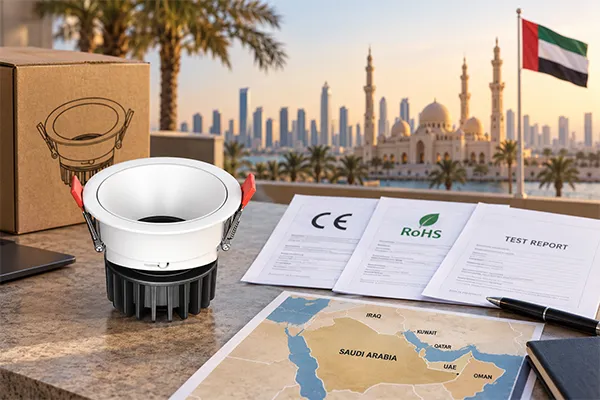
At Upward Lighting, we regularly receive questions from Middle East importers, contractors, and lighting brands about what documents can be prepared for a specific downlight. The most useful answer rarely starts with a universal checklist. Instead, we start by asking where the product will go, how it will be sold, and how it will be installed.
Why Does LED Downlight Compliance Depend on the Destination Market?
When procurement teams focus only on price, wattage, and appearance, compliance questions often arrive too late. This can create pressure close to shipment or project installation dates. We find that early destination-market planning gives buyers more control over product selection, documentation, labeling, and supplier communication.
LED downlight compliance depends on the destination market because each country, sales route, and project can have different requirements for product safety, energy performance, labeling, technical documents, registration, or local approval. Buyers should verify the current rules applicable to the exact destination and product rather than relying on another market’s documentation.
A Region Is Not One Regulatory Market
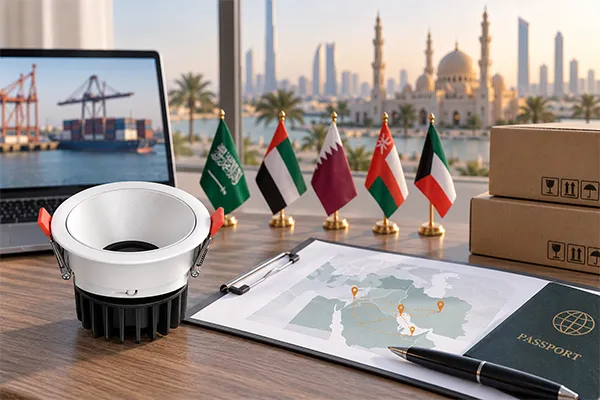
The Middle East is commercially connected, but it is not a single compliance jurisdiction.2 A downlight intended for a distributor’s retail range may face different questions than the same downlight supplied for a hotel, office, villa, retail store, or infrastructure-related project.
We have seen recurring customer conversations where a buyer initially asks, “Do you have CE?” Later, the discussion becomes more specific:
- Which country will receive the goods?
- Will the buyer import directly or buy through a local distributor?
- Is the item for retail sale, a contractor tender, or a private project?
- Does the project consultant require a particular document format?
- Does the importer need product labels in a specified format or language?
- Is the LED downlight recessed, surface-mounted, dimmable, emergency-compatible, or installed in a demanding environment?
These questions change the compliance conversation. A CE declaration or RoHS-related document may be useful supporting evidence, especially when it corresponds to the supplied product. However, it should not be treated as automatic authorization to sell in every market.
Verify Requirements Before Finalizing the Model
We encourage buyers to confirm country-specific requirements through current official sources, local import partners, project consultants, qualified laboratories, or certification specialists. Requirements can change, and local procedures may depend on the product category and import route.
A practical pre-purchase approach is to create a simple destination file:
| Item to Confirm | Why It Matters |
|---|---|
| Destination country | National requirements may differ |
| Importer of record | The importer may hold registration or declaration responsibilities3 |
| Sales channel | Retail, wholesale, and project supply can create different documentation needs |
| Installation type | Recessed, surface, indoor, wet-area, and exterior-adjacent applications may differ |
| Product configuration | Wattage, driver, dimming, CCT, housing, and cutout can affect document matching |
| Required labels | Market or customer label requirements may apply |
| Project approval route | Consultants, contractors, or owners may request additional evidence |
We do not present ourselves as a local approval authority or customs decision-maker. We provide product-related technical documentation and manufacturing support, while buyers should verify final market-entry and project requirements locally.
What Documents Support LED Downlight Compliance?
A missing or mismatched document can be more damaging than no document request at all. Buyers may receive papers for a family of products but later discover that the wattage, driver, label, or product code does not match the goods. We recommend reviewing the documentation chain before production begins.
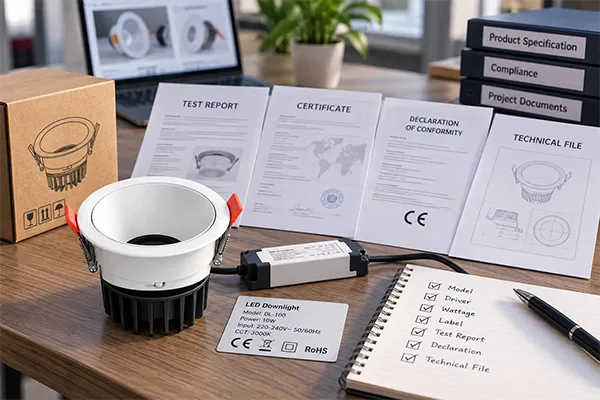
LED downlight compliance is supported by a consistent product-documentation chain. The tested model, product code, driver, wattage, electrical rating, construction, labels, reports, declarations, and technical file should correspond to the downlight actually supplied.4 Buyers should request documents for the confirmed configuration, not only a visually similar product.
The Product Must Match the Paperwork
In our manufacturing work, we see that LED downlights often look similar while having important internal differences. A 12W recessed downlight with a non-dimmable driver is not necessarily document-equivalent to a 15W version with a dimmable driver5, even if both units share the same housing shape.
For this reason, we advise buyers to lock the core specification before requesting final documentation.
Key variables include:
- Product model number
- Rated wattage and input voltage
- LED driver make, model, and electrical parameters
- Color temperature and luminous output
- Dimming method, if applicable
- Housing material and diffuser construction
- Cutout size and installation method
- Ingress protection rating6, where relevant
- Surface finish and branding label
- Packaging artwork and carton markings
At Upward Lighting, we can customize parameters such as color temperature, wattage, beam angle, CRI, and surface finish. These options are valuable for local brands and project buyers, but each change should be reviewed carefully because it can affect the product identification and documentation needed for the final order.
Documents Buyers Can Request From a Supplier
The exact document package should follow the buyer’s verified market and project needs. Still, a procurement team may ask a supplier to prepare or share the following product-related materials where available and appropriate:
- Product specification sheet with electrical, photometric, and mechanical details.
- Product drawings showing dimensions, cutout, installation method, and material details.
- Test reports relevant to the supplied configuration.
- Declarations of conformity or supplier declarations that identify the model and applicable basis.
- Component information, especially for the LED driver and key electrical parts.
- Product labels and packaging artwork for review before printing.
- Installation instructions and safety-related warnings.
- Quality-control records, such as aging-test procedures or inspection records.
- Photometric files or reports7, where project teams require lighting design support.
- Traceability information, including batch, date, or production references when agreed.
We conduct a 100% aging test before shipment, generally lasting four to eight hours, as part of our internal quality process. This is useful manufacturing quality-control evidence, but we do not describe it as a substitute for any local approval, registration, or application-specific testing requirement.
How Do Product Specifications Affect LED Downlight Compliance?
A downlight can be technically sound but still unsuitable for a buyer’s intended application if the specification was selected without installation conditions in mind. Heat, ceiling construction, dimming systems, operating hours, moisture exposure, and maintenance access can all create different questions. We recommend evaluating the use case before approving a model.
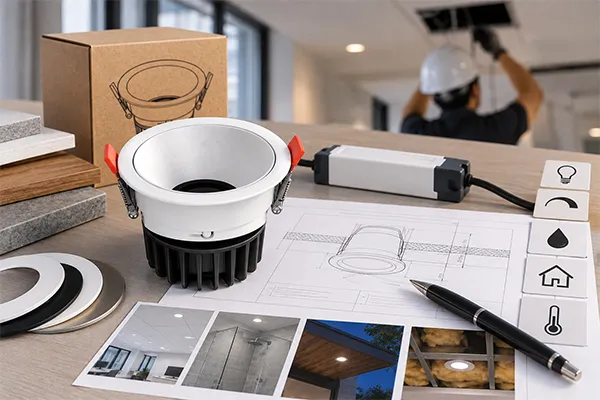
LED downlight compliance is affected by product specifications because wattage, driver type, installation method, housing construction, protection level, and intended environment influence the documents, labels, testing scope, and project questions associated with the product. Buyers should evaluate the exact configuration alongside the intended installation scenario.
Residential, Commercial, and Demanding Environments Are Different
We recommend separating products by real application instead of treating all downlights as interchangeable.
| Application Type | Typical Buyer Focus | Compliance and Documentation Questions |
|---|---|---|
| Residential retail | Appearance, price, easy installation, packaging | Product labels, installation instructions, electrical ratings, importer obligations |
| Commercial office or retail project | Consistent color, glare control, driver reliability, delivery schedule | Technical submittals, photometric data, drawings, consultant review, batch consistency |
| Hospitality project | Finish quality, dimming compatibility, visual comfort, replacement planning | Driver compatibility, CCT binning approach, spare quantities, project approval documents |
| Wet-area or demanding environment | Protection against environmental conditions, durability | Installation limitations, protection rating, housing and sealing details, application suitability |
| High-ceiling or long-hour operation | Thermal management, maintenance, operating cost | Driver quality, lumen maintenance information, thermal design, warranty terms |
For example, a small recessed LED downlight for a residential retail shelf may be selected mainly for its cutout size, CCT, and price point. A commercial project downlight may require more extensive technical submittals because the contractor, consultant, and owner need to review the proposed model before installation.
Driver Selection Deserves Special Attention
The driver is one of the most important components in a downlight. It affects input characteristics, dimming behavior, operating stability, maintenance planning, and technical document matching.8
We often ask buyers whether they need:
- Non-dimmable operation
- Phase-cut dimming
- 0–10V dimming
- DALI or other control compatibility9
- Flicker-related performance information
- Separate or integrated drivers
- Replaceable driver access for maintenance
- A specified driver brand or approved component list
A customer may ask us to change from a standard driver to a branded or dimmable driver after samples are approved. That can be a sensible commercial decision, but it should trigger a review of the technical file, product label, drawings, and any documents associated with the final configuration.
Installation Conditions Need Clear Communication
We advise buyers not to assume that an indoor recessed downlight is appropriate for every ceiling or environment. Installation conditions can include ceiling depth, insulation contact, ventilation, ambient temperature, moisture exposure, and access for future maintenance.10
Before ordering, the buyer should provide:
- Ceiling type and cutout requirements
- Expected operating hours per day
- Indoor or covered outdoor installation context
- Ambient temperature expectations
- Dimming or control-system details
- Need for emergency lighting integration
- Local project specifications and approved-material requirements
A qualified electrical engineer, lighting designer, or project consultant should evaluate application-specific suitability where the installation has technical, safety, or contractual complexity.11
How Can Buyers Build an LED Downlight Compliance Workflow Before RFQ?
Many buyer risks begin before a quotation is issued. If the RFQ only says “12W LED downlight, warm white,” suppliers may quote different drivers, housings, lumen levels, and document packages. This makes price comparisons misleading and creates avoidable changes later. We recommend using a structured RFQ process.
An effective LED downlight compliance workflow defines the destination country, import and sales route, application, installation conditions, exact product configuration, labeling needs, required documentation, and local approval responsibilities before production. This helps buyers compare suppliers on a like-for-like basis and identify gaps early.
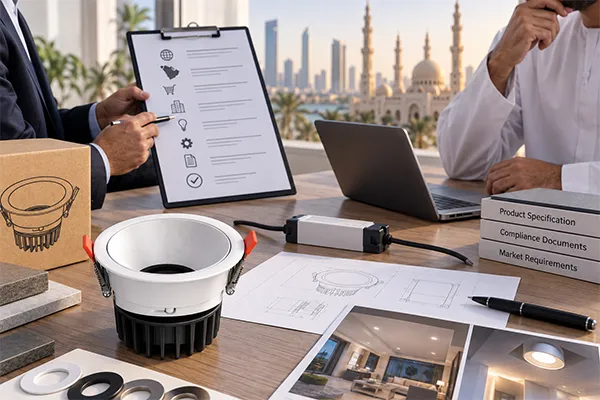
Step 1: Define the Commercial Route
The first step is to identify who will import, sell, and install the product. This influences who may need to manage country-specific registration, declarations, label review, project submittals, or customs documentation.
We suggest recording:
- Destination country and city, if project conditions matter
- Importer of record
- Sales route: retail, distribution, wholesale, contractor, or direct project
- Brand owner shown on the product and packaging
- Whether the order is for stock or a named project
- Required delivery date and partial-shipment needs
Step 2: Freeze the Technical Specification
A clear RFQ should include more than wattage. We recommend buyers specify the full configuration in a product schedule.
| RFQ Field | Example Detail to Define |
|---|---|
| Product type | Recessed LED downlight |
| Wattage | 9W, 12W, or 15W confirmed |
| Input | Required voltage and frequency range |
| CCT | 3000K, 4000K, or selectable CCT |
| CRI | Standard or high-CRI requirement |
| Beam angle | Narrow, medium, or wide beam |
| Driver | Non-dimmable, phase-cut, 0–10V, or other required type |
| Cutout | Exact ceiling cutout tolerance |
| Finish | White, black, silver, or customized finish |
| Label | Brand, model, electrical ratings, origin marking, other verified needs |
| Documentation | Product-specific reports, declarations, drawings, and instructions |
Step 3: Ask for Document-to-Product Mapping
This is one of the most valuable supplier-selection steps. Instead of asking only, “What certificates do you have?”, we recommend asking:
“Please map each document to the proposed model, wattage, driver, label, and product photo.”
A capable supplier should be able to explain whether the offered configuration matches the available documentation or whether additional work, testing, review, or confirmation is needed.
At Upward Lighting, we aim to respond quickly to RFQs and technical questions. We also support OEM/ODM projects and small-batch orders. However, we prefer transparent discussions when a customized configuration changes the documentation position. This is more useful than giving buyers a generic file that may not correspond to their final goods.
Step 4: Confirm Responsibilities in Writing
Before deposit payment or mass production, the buyer and supplier should confirm who handles each activity.
| Responsibility Area | Typical Party to Confirm |
|---|---|
| Product specification approval | Buyer and supplier |
| Label and packaging approval | Brand owner, buyer, and supplier |
| Local market-entry verification | Importer, local partner, or qualified certification provider |
| Project consultant approval | Contractor, consultant, project owner, or procurement team |
| Manufacturing inspection and aging test | Supplier |
| Import customs decision | Relevant customs authority and importer |
| Installation suitability | Qualified project professional or installer |
This division protects both sides from assumptions. A supplier can prepare accurate product data, production records, and agreed documents. The local importer or project party remains best placed to verify current local rules and approval pathways.
Frequently Asked Questions
Is CE documentation enough for LED downlight compliance in Middle East markets?
CE documentation may be relevant supporting evidence for a product’s technical file, but it should not be treated as proof of approval across all Middle East markets. We recommend that buyers verify current country-level, importer-level, and project-level requirements for the exact product configuration through appropriate local sources.
Do RoHS documents prove that an LED downlight can clear customs?
RoHS-related documentation addresses environmental substance considerations within its relevant scope.12 It does not by itself guarantee customs clearance, local registration, project approval, or permission to sell. The importer should confirm the destination market’s current requirements and make sure the documents match the supplied model.
What should I send a supplier before requesting a Middle East downlight quotation?
We recommend sending the destination country, application, installation environment, product specification, driver requirement, target quantity, sales route, branding needs, label requirements, and required documents. Buyers should also state whether the goods are for retail stock, distribution, or a named project with consultant approval.
Can a supplier provide documents for a customized LED downlight?
A supplier may be able to provide or prepare documents for a customized LED downlight, but the buyer should check whether the changed wattage, driver, CCT, housing, label, or other parameters affect document matching. We recommend confirming the final product configuration before finalizing technical files and packaging.
Who makes the final decision on local approval or customs entry?
The final decision normally rests with the relevant local authority, customs body, project stakeholder, or approval process in the destination market. We can support buyers with product-related documents and manufacturing information, but we recommend that importers and project parties obtain qualified local verification before shipment.
Conclusion
LED downlight compliance is best managed as a procurement and documentation process, not as a universal certificate checklist. We recommend that Middle East buyers confirm the destination country, sales route, installation conditions, final model, driver, labels, and document requirements before releasing an order. At Upward Lighting, we support importers, contractors, distributors, and lighting brands with OEM/ODM options, product data, responsive quotations, and quality-control documentation. Contact us with your project specification and destination details so we can help you build a clearer sourcing plan.
"CE marking", https://en.wikipedia.org/wiki/CE_marking. European Commission guidance describes CE marking as a declaration of conformity for applicable EU requirements, while RoHS addresses restrictions on specified hazardous substances; these frameworks do not themselves determine compliance with separate national import or project-approval procedures. Evidence role: general_support; source type: government. Supports: CE marking is an EU conformity-marking framework, while RoHS concerns restricted substances; neither document alone establishes compliance with a separate country's import or project procedures.. Scope note: The source explains the scope of EU frameworks and should be supplemented with the destination country's current rules for a specific shipment. ↩
"Saudi Arabia Testing, Inspection and Certification", https://www.trade.gov/saudi-arabia-testing-inspection-and-certification. Regional standardization initiatives may harmonize selected technical requirements, but national authorities retain distinct product-conformity, registration, enforcement, and import procedures across Middle East markets. Evidence role: general_support; source type: institution. Supports: GCC and Middle East states maintain country-level product-conformity and import processes, even where regional standards are harmonized or shared.. Scope note: The extent of harmonization and the applicable procedure vary by country and product category. ↩
"United Arab Emirates - Import Requirements and ...", https://www.trade.gov/country-commercial-guides/united-arab-emirates-import-requirements-and-documentation. Official product-conformity frameworks commonly assign importers duties to ensure that regulated products meet applicable requirements and that required technical documentation, declarations, or registrations are available. Evidence role: general_support; source type: government. Supports: Product-conformity systems commonly assign importers responsibilities for placing products on the market, maintaining documentation, registrations, or declarations.. Scope note: Specific importer obligations depend on the destination jurisdiction, product category, and route to market. ↩
"Conformity Assessment Basics", https://www.nist.gov/standardsgov/conformity-assessment-basics. Conformity-assessment guidance requires declarations and supporting technical documentation to identify the product concerned and to contain information sufficient to assess whether that product conforms to the applicable requirements. Evidence role: mechanism; source type: institution. Supports: Supplier declarations and technical documentation should identify the product and provide evidence enabling assessment of conformity for the product placed on the market.. Scope note: The precise documents and level of configuration detail required are set by the applicable regulation or project specification. ↩
"Long-term Testing of LED Luminaires", https://www.pnnl.gov/main/publications/external/technical_reports/PNNL-23702.pdf. Luminaire safety and performance assessment considers the declared electrical ratings and control gear; a change in wattage or driver function can therefore require review of whether existing test evidence remains applicable to the altered configuration. Evidence role: mechanism; source type: research. Supports: Electrical ratings and control gear are material characteristics of luminaires that can affect safety and performance assessment.. Scope note: Whether a particular variant can be covered by existing evidence depends on the governing standard, the documented product family, and the assessment body. ↩
"IP code - Simple English Wikipedia, the free encyclopedia", https://simple.wikipedia.org/wiki/IP_code. IEC 60529 defines the IP Code as a classification of enclosure protection against access to hazardous parts, ingress of solid foreign objects, and ingress of water. Evidence role: definition; source type: institution. Supports: The IP Code classifies the degree of protection provided by enclosures against access, solid foreign objects, and water.. Scope note: An IP rating addresses enclosure ingress under specified test conditions and does not alone establish suitability for every installation environment. ↩
"Rethinking the Photometric Data File Format - LED professional", https://www.led-professional.com/resources-1/articles/rethinking-the-photometric-data-file-format. IES photometric-data standards provide a structured means of reporting measured luminaire light-distribution data for use in lighting-calculation and design applications. Evidence role: definition; source type: institution. Supports: Standardized photometric data files communicate luminaire light-distribution and related measurement data for use in lighting calculations.. Scope note: A photometric file describes measured optical performance under stated conditions; it does not by itself demonstrate product safety, regulatory conformity, or installation suitability. ↩
"Technical Reports & Briefs", https://www.energy.gov/cmei/ssl/technical-reports-briefs. Technical guidance on LED systems explains that drivers regulate electrical power to LEDs and that driver characteristics influence input operation, dimming compatibility, and overall luminaire performance. Evidence role: mechanism; source type: government. Supports: LED drivers regulate power delivered to LEDs and their design influences input operation, dimming compatibility, and system performance.. Scope note: Driver effects vary with the specific driver, LED module, dimmer or control system, and installation conditions. ↩
"Digital Addressable Lighting Interface", https://en.wikipedia.org/wiki/Digital_Addressable_Lighting_Interface. The DALI lighting-control standard specifies a digital communication interface for lighting-control devices and control gear, supporting interoperable functions where devices implement the relevant parts of the standard. Evidence role: definition; source type: institution. Supports: DALI is a standardized digital interface used for communication between lighting-control devices and luminaires or control gear.. Scope note: A statement that a product is DALI-compatible should be verified against the relevant DALI version, device type, implemented features, and system configuration. ↩
"Recessed Lighting - Code Compliance Brief", https://basc.pnnl.gov/code-compliance/recessed-lighting-code-compliance-brief. Electrical-safety guidance for recessed luminaires identifies installation clearances, heat dissipation, insulation contact, environmental conditions, and accessible installation arrangements as factors relevant to safe use. Evidence role: general_support; source type: government. Supports: Recessed luminaire installation guidance addresses clearances, heat dissipation, insulation contact, environmental exposure, and accessibility as relevant safety considerations.. Scope note: Applicable installation rules and permitted conditions must be determined from the product instructions and the electrical code in force at the installation location. ↩
"Chapter 22 – Electrical Safety", http://www.osha.gov/shms/chapter-22. Electrical-safety standards and guidance distinguish qualified persons as individuals with the training and knowledge needed to assess electrical hazards and apply relevant installation requirements. Evidence role: expert_consensus; source type: institution. Supports: Electrical-safety practice recognizes the role of qualified persons in assessing and performing work involving electrical hazards and code requirements.. Scope note: Professional licensing, scope of practice, and mandatory review requirements are governed by local law, the project contract, and the applicable electrical code. ↩
"European Union Reduction of Hazardous Substances ...", https://www.waru.edu/artifact/european-union-reduction-hazardous-substances-rohs-and-waste-electrical-and-electronic. Directive 2011/65/EU restricts specified hazardous substances in electrical and electronic equipment within its defined scope, establishing an environmental-substance compliance framework rather than a general customs or market-authorization document. Evidence role: definition; source type: government. Supports: The EU RoHS Directive restricts the use of specified hazardous substances in electrical and electronic equipment within the directive's scope.. Scope note: The directive's scope, exemptions, substance limits, and legal effect are specific to EU law and may not match requirements in the destination market. ↩