An LED downlight factory China sourcing project can look simple until samples, quotations, and production specifications start to differ. A low price may hide material substitutions, inconsistent color, or incomplete compliance documents. I recommend treating supplier selection as a risk-control process that turns every approved requirement into a measurable production standard.
International buyers should evaluate an LED downlight factory in China by comparing defined specifications, component controls, quality procedures, compliance documents, and sample-to-production consistency—not unit price alone. Buyers should approve a documented sample, lock key materials and tolerances, run a pilot order when possible, and inspect finished goods before shipment.
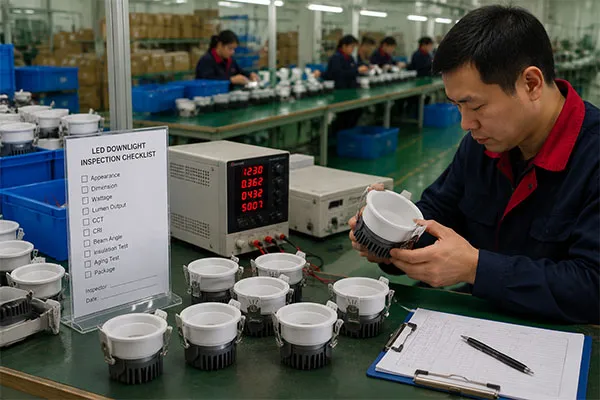
In my experience handling quotations, samples, production inspections, and batch corrections, most disputes begin before manufacturing starts1. The buyer and factory often assume that they understand the same specification. The sections below explain how importers, wholesalers, and distributors can remove that uncertainty.
How Should Buyers Compare Quotes from an LED Downlight Factory China Supplier?
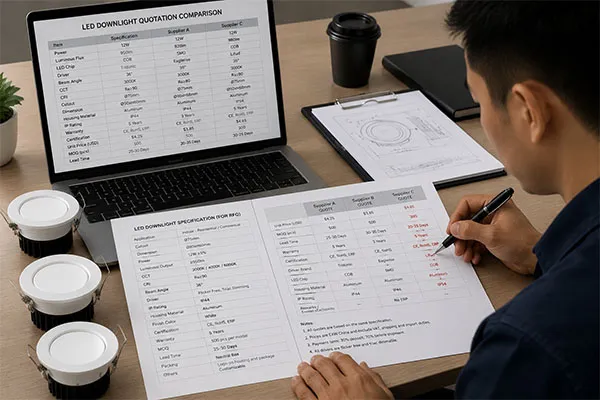
A quotation from an LED downlight factory China supplier may appear complete while leaving important variables undefined. Buyers can then compare prices that represent different drivers, housings, LED packages, installation conditions, or testing scopes. A structured request for quotation prevents this misleading comparison.
Buyers should compare LED downlight quotations only after defining the application, cutout, dimensions, wattage, luminous output, color characteristics, beam angle, driver requirements, target market, order quantity, packaging, warranty terms, and customization scope. Each supplier should quote against the same written specification and identify exclusions or alternative components.
Define the application before requesting a price
I often receive inquiries that ask for a “10 W downlight” or a “high-quality commercial downlight.” Those descriptions do not provide enough information for an accurate comparison. A 10 W recessed light for a hotel corridor may need a different beam, glare control, color quality, driver, and fire-safety assessment than a visually similar product for a retail shop2.
The buyer should first tell the factory where and how the product will be used:
- The buyer should identify whether the project is residential, retail, hospitality, office, or another application.
- The buyer should state whether the luminaire will be recessed, surface-mounted, adjustable, or fixed.
- The buyer should specify the ceiling type, available installation depth, and required cutout.
- The buyer should describe the ambient temperature and operating schedule.
- The buyer should identify any insulation, damp-location, fire-rating, or emergency-lighting requirements.
- The buyer should name the destination market and applicable project standards.
A qualified electrical or lighting professional should confirm application-specific requirements. A factory quotation cannot replace a project-level safety or regulatory assessment.
Use one quotation sheet for every supplier
I recommend sending one controlled RFQ document to each potential factory. The document should request both the offered value and the supporting evidence.
| Quotation item | Buyer should define | Supplier should confirm |
|---|---|---|
| Rated power | Target wattage and tolerance | Nominal value and production tolerance |
| Light output | Required initial lumens | Test basis and offered output |
| Color temperature | For example, 3000 K or 4000 K | Nominal CCT and allowable range |
| Color rendering | Minimum CRI requirement | Offered CRI and supporting data |
| Beam angle | Required distribution | Lens or reflector option |
| Cutout | Exact size or allowable range | Recommended installation opening |
| Driver | Dimming and electrical needs | Brand, model, power factor3, and output |
| Housing | Material and finish | Alloy, construction, and coating |
| Compliance | Destination-market requirements | Applicable model documents |
| Packaging | Retail or bulk requirements | Carton, label, and protection method |
| Order terms | Quantity and delivery schedule | MOQ, lead time, and price validity |
The buyer should also ask whether the quotation includes branded drivers, custom labels, photometric reports, special packaging, tooling, or inspection costs. These items can materially change the price.
I treat a vague quotation as an early warning. A detailed quotation does not prove quality, but it shows whether the supplier has understood the purchasing brief.
Why Can Similar LED Downlights Have Very Different Prices?
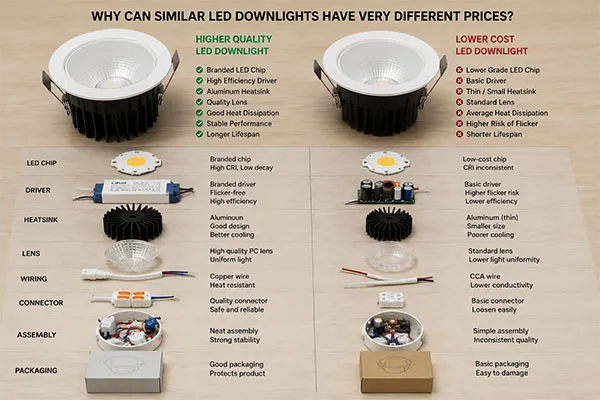
Two downlights can share the same visible diameter, rated wattage, color temperature, and claimed lumen output while using different internal components. Those differences can affect thermal behavior, color consistency, flicker, installation fit, and repeat-order stability. The lowest price therefore does not always represent the lowest total procurement cost.
Similar LED downlights can have different prices because factories may use different LED packages, drivers, heat sinks, lenses, surface finishes, connectors, wiring, assembly processes, test methods, and quality tolerances. Buyers should compare the complete construction and production controls rather than relying only on headline specifications or product photographs.
Internal components influence purchasing risk
A product photograph rarely shows the driver circuit, thermal interface, LED bin, connector quality, or housing thickness. However, these elements can affect how consistently the product performs in production.
Buyers should investigate at least five component groups:
- LED package: The buyer should ask for the manufacturer, series, color binning approach, and substitution policy.
- Driver: The buyer should confirm the model, input range, output conditions, dimming protocol, power factor target, and protection features.
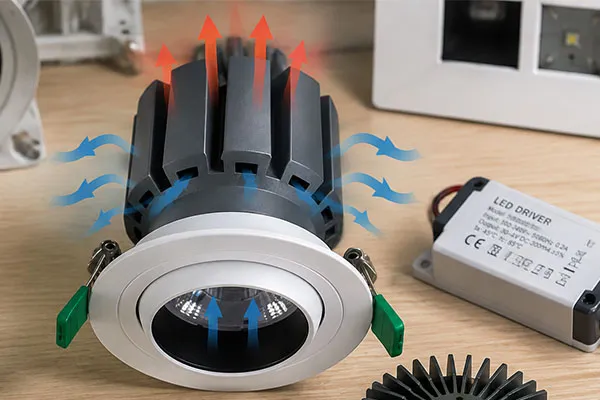
- Thermal structure: The buyer should review the housing material, heat-sink design, thermal interface, and assembly method.
- Optics: The buyer should confirm the lens or reflector material, beam distribution, glare-control design, and retention method.
- Mechanical parts: The buyer should check spring clips, connectors, wires, screws, coating, and cutout fit.
A brand name alone does not guarantee suitability. The selected component still needs to match the electrical, thermal, and commercial requirements of the finished downlight.
Tolerances matter as much as nominal specifications
A quotation may state 3000 K, but the buyer still needs to define the acceptable color range. A specification may state 900 lumens, but the buyer still needs to identify whether that figure is typical, minimum, or measured from a selected sample.
I recommend defining acceptance criteria for items such as:
- Input power
- Luminous flux
- Correlated color temperature4
- Color rendering index5
- Beam angle
- Power factor
- Visible flicker requirements
- Housing dimensions
- Cutout compatibility
- Surface color and appearance
- Label content
- Driver and LED identification
The acceptable values should reflect the project, market, measurement method, and available test equipment. Buyers should avoid copying arbitrary tolerances from another product.
Calculate the cost of inconsistency
A downlight that costs slightly less at the factory can become expensive if the buyer must sort mixed color temperatures, replace incompatible drivers, rework labels, or answer distributor complaints. Freight, customs processing, local labor, and damaged customer relationships can exceed the original price difference6.
In one anonymized inquiry pattern that I have seen repeatedly, a buyer approves a bright sample and then orders based on a short pro forma invoice. The mass-produced goods later use a different driver or LED bin because the original components were not locked. The issue is not necessarily deliberate deception. The issue often comes from an incomplete purchasing standard and an uncontrolled substitution process.
How Can an LED Downlight Factory China Supplier Reproduce an Approved Sample?
An approved sample creates confidence, but it does not automatically control mass production. The sample may have come from a previous batch, a development room, or available stock. If the buyer approves only its appearance, the factory may not know which internal materials and measured results must remain unchanged.
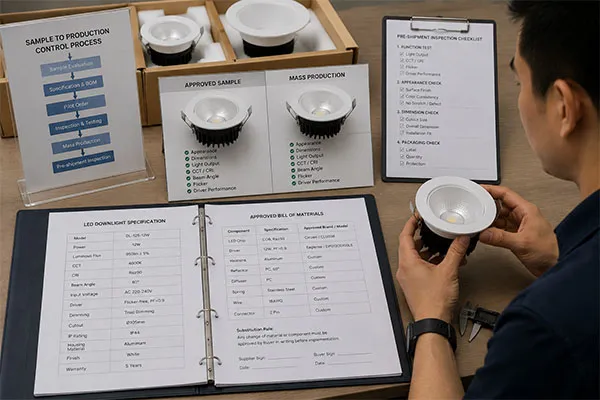
An LED downlight factory China supplier can reproduce an approved sample more reliably when the buyer and factory convert it into a signed specification, approved bill of materials, appearance standard, performance criteria, packaging instructions, and substitution rules. A pilot batch and pre-shipment inspection can then verify whether production matches those controls.
Create a golden sample and specification package
I use the term golden sample for a physically approved reference that connects the buyer’s expectations to the production documents. The buyer and supplier should label, date, photograph, and retain matching samples when practical.
However, the physical unit should not stand alone. The approval package should include:
- A model number and revision number
- A dimensional drawing
- A confirmed cutout and installation depth
- A controlled bill of materials
- An LED and driver specification
- A target photometric file or report, when required
- Electrical performance criteria
- A finish color or approved color reference
- Label artwork
- Packaging instructions
- Inspection criteria
- A list of prohibited or approval-required substitutions
The buyer should also define which document controls if the sample and written specification conflict. I prefer written, revision-controlled criteria because physical samples can age, become damaged, or be interpreted differently.
Control component substitutions
Factories sometimes need to change a component because a supplier discontinues it, extends its lead time, or increases its minimum order quantity. The procurement risk comes from making that substitution without evaluating its effect.
A sound change-control process should require the factory to provide:
- A description of the proposed change
- The reason for the change
- Old and new component specifications
- Samples or test results, where appropriate
- An assessment of dimensional and compliance effects
- Written buyer approval before production
A replacement driver may fit inside the housing but create different dimming behavior. A replacement LED package may produce the same nominal color temperature but show a different tint. A new lens may share the same stated beam angle while changing the distribution pattern.
Consider a pilot batch
I often recommend a pilot order when the model is new, customized, or commercially important. A pilot batch allows the buyer to evaluate production units rather than a small number of development samples.
The pilot batch should test the whole process:
- The factory should purchase the intended production materials.
- The production team should use the planned assembly instructions.
- The quality team should apply the agreed inspections.
- The packaging team should use the final labels and cartons.
- The buyer should review randomly selected finished units.
A pilot batch cannot remove every risk. It can reveal documentation gaps, assembly difficulties, packaging weaknesses, and unrealistic tolerances before a larger shipment increases the cost of correction.
What Quality Controls Should an LED Downlight Factory China Manufacturer Use?
Quality control should extend beyond a final visual check. Downlight consistency depends on incoming materials, assembly conditions, process inspections, testing methods, traceability, and corrective action. Buyers should examine the factory’s actual records and responsibilities instead of accepting a general promise that every product receives “strict QC.”
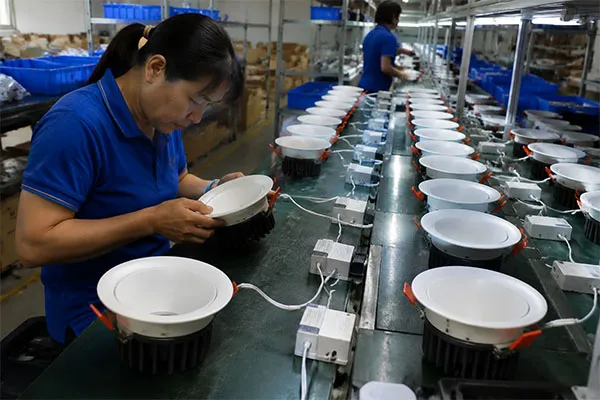
A buyer should expect an LED downlight factory China manufacturer to document incoming material checks, first-article approval, in-process inspections, electrical safety checks, performance sampling, aging procedures, final inspection, and nonconformance handling. The exact test scope and acceptance level should match the product, order, applicable standards, and buyer specification.
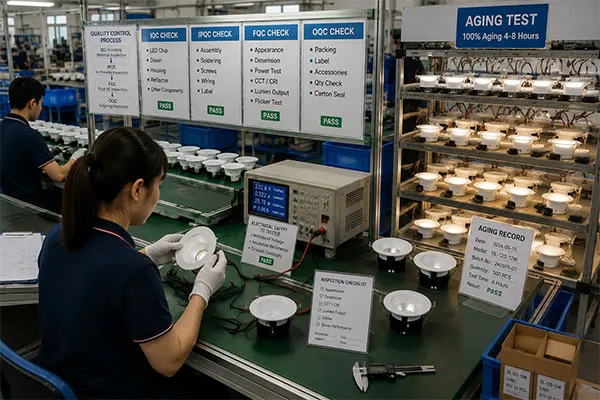
Review controls at each production stage
I recommend reviewing quality control as a connected system rather than a single inspection event.
| Production stage | Control to investigate | Evidence to request |
|---|---|---|
| Incoming materials | Identity, dimensions, appearance, and specifications | Inspection records and supplier documents |
| First article | Assembly and performance confirmation | Signed first-piece report |
| Assembly | Workmanship and process compliance | Work instructions and inspection logs |
| Electrical testing | Safety and functional checks | Test method and recorded results |
| Performance sampling | Power, light output, CCT, and related criteria | Sampling reports and equipment details |
| Aging | Early functional defect screening | Aging duration, conditions, and records |
| Final inspection | Quantity, appearance, function, labels, and packaging | Pre-shipment inspection report |
| Nonconformance | Segregation and corrective action | Defect report and disposition record |
At our Zhongshan operation7, we require 100% aging tests lasting 4–8 hours before shipment8 for our products. Buyers can investigate this type of practice by checking the aging area, work instructions, batch records, failure handling, and sampling traceability.
However, a 4–8-hour aging test does not prove the rated lifetime of a downlight. It can help identify some early functional failures under the stated test conditions. A lifetime claim requires suitable component data, thermal evaluation, test evidence, and a justified method. Buyers should ask the supplier to explain exactly what its aging process demonstrates.
Define the pre-shipment inspection
A pre-shipment inspection should use a written checklist. The buyer can conduct the inspection, appoint a third-party inspection company, or review the factory’s records, depending on order risk.
The checklist may cover:
- Purchase-order quantity and model identity
- Product dimensions and cutout
- Housing finish and cosmetic defects
- Spring-clip operation
- Connector and wire condition
- Functional operation
- Sampled electrical and photometric values
- Color consistency
- Driver and LED identity
- Labels, manuals, and carton markings
- Packaging protection
- Barcode readability
- Approved accessories
The buyer should define the sampling plan and defect classification before inspection. Critical, major, and minor defects should have clear meanings. A qualified inspection professional can help select an appropriate plan for the order and risk level.
Ask how the factory handles failures
A quality system becomes most visible when a defect occurs. I have found that buyers learn more from a corrective-action example than from a polished factory presentation.
The supplier should be able to explain:
- How its team contains affected inventory
- How its team traces materials and production batches
- How its team identifies the root cause
- How its team approves rework or replacement
- How its team prevents recurrence
- How its team verifies that the corrective action worked
The buyer should ask for an anonymized corrective-action report. The report can show whether the factory solves problems systematically or only replaces visible defective pieces.
How Should Buyers Verify Certifications and Customization Claims?
Certification logos and broad customization promises can create false confidence. A document may cover another model, a limited configuration, an outdated standard, or only part of the finished product. A customized driver, wattage, housing, or construction may also change the product’s compliance position.
Buyers should verify certification and customization claims by checking the legal entity, model numbers, product configuration, applicable standards, report dates, issuing or testing body, and destination-market requirements. Buyers should also confirm whether a proposed modification requires document updates, additional testing, or independent professional assessment before placing the order.
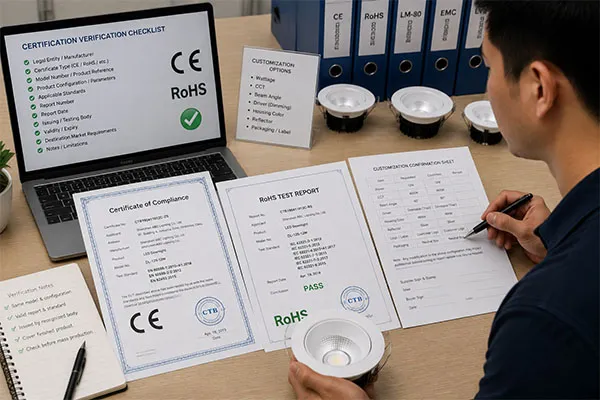
Check the scope of every document
Our products may be supplied with CE- and RoHS-related documentation where applicable, but buyers should not treat a logo or general statement as automatic market access. The importer should verify the documents for the exact model, configuration, and destination.
For an LED downlight, the buyer may need to request:
- A declaration of conformity, where applicable
- Relevant test reports
- A model list or product-family definition
- Component certificates or reports
- RoHS-related material or test documentation9
- Product and packaging labels
- User instructions
- Traceability information
- Photometric files or reports
- Driver documentation
The buyer should confirm the current legal and technical requirements with a qualified compliance professional. Requirements can differ among the European Union, United Kingdom, North America, the Middle East, Australia, and other markets. Project specifications may also exceed general market requirements.
If a report refers to standards such as IEC or EN 6059810, the buyer should confirm that the standard, edition, model, construction, and intended use are applicable. The buyer should not assume that one report covers every wattage or housing size.
Evaluate customization by impact
OEM and ODM customization can include color temperature, wattage, beam angle, housing dimensions, color rendering, surface finish, labels, and packaging. Each change has a different technical impact.
| Customization | Possible impact | Buyer verification |
|---|---|---|
| Color temperature | LED binning and visual consistency | Approved range and sample |
| Wattage | Driver loading and thermal conditions | Electrical and thermal review |
| Beam angle | Light distribution and glare | Photometric data or sample |
| CRI | Efficacy, color quality, and LED selection | Measured acceptance criteria |
| Housing dimensions | Fit and heat dissipation | Drawing and installation trial |
| Surface finish | Appearance and coating durability | Color reference and sample |
| Driver change | Dimming, flicker, safety, and compatibility | Driver specification and testing |
| Label or brand | Traceability and legal markings | Approved artwork and compliance review |
I ask buyers to separate cosmetic customization from performance or construction changes. A carton logo usually carries a different technical risk from a new wattage, driver, or heat-sink design.
Confirm timing and responsibility
Customization claims should include a development schedule. The factory should identify when it will provide drawings, prototypes, revised quotations, test samples, documents, and pilot-production units.
The buyer and factory should also agree on responsibility for:
- Tooling charges
- Sample charges
- Test and document costs
- Minimum order quantities
- Approval delays
- Failed development rounds
- Intellectual property and artwork
- Future component changes
- Ownership and storage of tooling
A clear development agreement protects both parties. It also prevents an attractive initial quotation from becoming a series of unplanned charges and schedule changes.
What Should Buyers Audit Before Choosing an LED Downlight Factory China Partner?
A factory audit should test whether the supplier can repeatedly manufacture the approved product. A clean showroom and several machines do not establish process control. Buyers should follow one downlight model from incoming materials through assembly, testing, finished-goods storage, document control, and complaint handling.
Before selecting an LED downlight factory China partner, buyers should audit the company’s legal identity, production capability, material controls, quality records, test equipment, change-management process, traceability, capacity, subcontracting, and corrective-action system. Buyers should verify important claims with records, product samples, and independent inspections where appropriate.
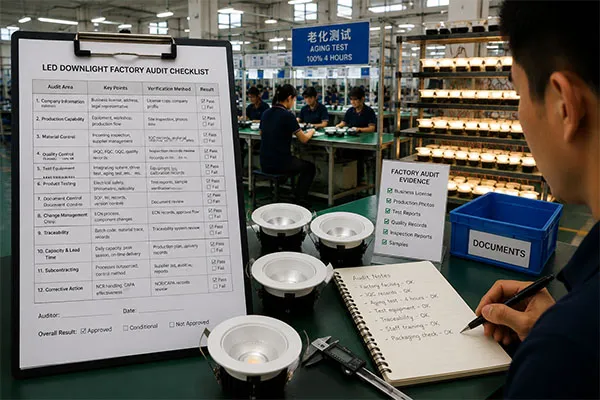
Follow a product through the factory
I prefer a process-based audit because it reveals how departments connect. The buyer can choose one current downlight model and ask the supplier to show:
- The approved drawing and specification
- The bill of materials
- Incoming inspection records
- Material storage and identification
- Assembly instructions
- First-article approval
- In-process checks
- Electrical and functional testing
- Aging records
- Final inspection
- Packaging approval
- Batch traceability
The records should refer to the same product revision. Conflicting model numbers or undated documents can signal weak document control.
Verify equipment and test methods
The existence of integrating spheres11, electrical testers, aging racks, or other equipment does not prove that the factory uses them correctly. The buyer should ask who operates each device, what the method requires, how often equipment is calibrated or checked, and where results are recorded.
The buyer should also distinguish between:
- Factory production checks, which support routine process control
- Internal comparative tests, which help monitor consistency
- Third-party laboratory reports, which may support defined compliance or performance claims
A factory should not present routine production equipment as equivalent to an accredited laboratory unless the evidence supports that statement.
Check commercial and supply-chain resilience
International buyers also need to evaluate delivery reliability. The buyer should discuss component lead times, backup suppliers, peak-season capacity, minimum order quantities, subcontracting, and material storage.
I recommend asking several practical questions:
- Which components have the longest procurement lead time?
- Which materials require buyer approval before substitution?
- Which processes take place outside the factory?
- How does the factory identify outsourced production?
- How does the factory separate different customer specifications?
- How does the factory manage small custom orders?
- How does the factory respond when a material supplier misses delivery?
These questions help buyers assess whether the factory’s promised lead time is based on actual capacity and material availability.
Frequently Asked Questions
What information should I send to an LED downlight factory in China?
You should send the application, installation method, cutout, dimensions, wattage, lumen target, CCT, CRI, beam angle, driver requirements, dimming method, input voltage, destination market, quantity, packaging, and compliance needs. You should also include drawings, reference samples, or project specifications when available.
Does an approved LED downlight sample guarantee mass-production quality?
No. An approved sample does not control production unless the buyer converts it into written specifications, material requirements, tolerances, packaging instructions, and substitution rules. A golden sample, pilot batch, production inspection, and pre-shipment inspection can reduce the risk of sample-to-production mismatch.
Is the lowest Chinese LED downlight quotation usually the best value?
No. The lowest quotation may use different components, tolerances, test scopes, packaging, or compliance assumptions. Buyers should compare like-for-like specifications and calculate the possible cost of sorting, rework, returns, delivery delays, and unstable repeat orders.
What does a 4–8-hour LED downlight aging test prove?
A 4–8-hour aging test can help a factory detect some early functional failures under the stated conditions. It does not prove the product’s rated lifetime. Buyers should review the test conditions, records, failure criteria, and corrective-action process instead of relying only on the stated duration.
How can I verify CE and RoHS claims for LED downlights?
You should request documents for the exact model and configuration. You should review model coverage, standards, dates, declarations, test reports, and responsible legal entities. You should also ask a qualified compliance professional to verify current destination-market requirements, especially after electrical or structural customization.
Conclusion
Choosing an LED downlight factory China supplier is a supplier-risk decision, not simply a unit-price comparison. Buyers should define the application, compare controlled specifications, document the approved sample, restrict material substitutions, inspect production, and verify compliance records for the exact model and market. I also recommend evaluating how the factory responds when a batch fails its criteria.
If you are sourcing standard or customized LED downlights, send us your specification, target market, expected quantity, and inspection requirements. Our Zhongshan team can review the project and prepare a documented OEM or ODM quotation for your evaluation.
"Identifying Gaps & Root Causes - UNC School of Medicine", https://www.med.unc.edu/ihqi/resources/root-cause-analysis/. Research on supplier quality management finds that specification ambiguity and incomplete requirements transfer are among the most frequent root causes of non-conformance in outsourced manufacturing, often exceeding process-capability failures (see, e.g., Foster, 'Managing Quality: Integrating the Supply Chain,' Pearson, 6th ed., 2016). Evidence role: general_support; source type: research. Supports: Supply-chain quality research identifies incomplete or ambiguous specifications as a leading root cause of buyer-supplier disputes in contract manufacturing. Scope note: General supply-chain quality literature supports the principle, but specific data on LED lighting procurement disputes is not widely published in academic sources. ↩
"IEC 60598-1 | Applus+ Keystone", https://keystonecompliance.com/iec-60598-1/. EN 12464-1:2021 specifies differing maintained illuminance levels, unified glare ratings (UGR), and color rendering requirements for corridors, hotel rooms, and retail sales areas, confirming that application context materially changes luminaire specification requirements. Evidence role: general_support; source type: institution. Supports: International lighting standards specify different photometric, glare, and safety requirements depending on the application environment (e.g., hospitality corridors vs. retail display areas). Scope note: The standard defines workplace lighting requirements; hospitality and residential applications may fall under different national or project-specific standards. ↩
"LED lamp", https://en.wikipedia.org/wiki/LED_lamp. IEC 61000-3-2 sets harmonic current emission limits for lighting equipment exceeding 25 W, effectively requiring high power factor in LED drivers; many energy-efficiency programs (e.g., ENERGY STAR, EU Ecodesign) set explicit power factor minimums of 0.7–0.9 depending on wattage class. Evidence role: general_support; source type: institution. Supports: Power factor requirements for LED drivers are governed by harmonic current limits in standards such as IEC 61000-3-2, with minimum thresholds often specified by energy regulations and utility programs. Scope note: Specific power factor thresholds vary by market, wattage category, and regulatory program; the article does not specify a destination market. ↩
"Correlated color temperature", https://en.wikipedia.org/wiki/Correlated_color_temperature. Correlated color temperature (CCT), as defined by CIE 15:2018 (Colorimetry), quantifies the perceived warmth or coolness of a light source by identifying the temperature of the Planckian radiator whose chromaticity most closely matches that of the source. Evidence role: definition; source type: encyclopedia. Supports: Correlated color temperature (CCT) is a standard metric describing the color appearance of light emitted by a source, measured in kelvins, and defined relative to a Planckian (blackbody) radiator. Scope note: CCT alone does not fully characterize color appearance; sources with the same CCT can differ noticeably in chromaticity (Duv) and spectral distribution. ↩
"Background and Guidance for Using the ANSI/IES TM-30 Method for ...", https://www.energy.gov/sites/default/files/2022-04/ssl-royer-leukos-tm-30-tutorial-2022.pdf. CIE 13.3-1995 defines the General Color Rendering Index (Ra) using eight test color samples; while widely used in LED procurement, CRI has acknowledged limitations in characterizing saturated-color rendering, leading to supplementary metrics such as IES TM-30-20. Evidence role: definition; source type: institution. Supports: The Color Rendering Index (CRI), as defined by CIE 13.3, rates a light source's ability to reproduce colors of illuminated objects compared to a reference illuminant. Scope note: CRI remains the most commonly specified metric in commercial lighting procurement despite its known shortcomings; alternative metrics have not yet achieved equivalent regulatory or commercial adoption in all markets. ↩
"Reducing the Costs of Poor Quality: A Manufacturing Case Study", https://scholarworks.waldenu.edu/cgi/viewcontent.cgi?article=6608&context=dissertations. Quality management literature consistently finds that external failure costs (warranty claims, returns, customer attrition) typically exceed internal failure and appraisal costs combined, supporting the principle that total procurement cost rather than unit price determines sourcing value (see Juran & Godfrey, Juran's Quality Handbook, 5th ed., 1999). Evidence role: general_support; source type: research. Supports: The total cost of quality failures—including rework, returns, freight, inspection, and reputational damage—frequently exceeds initial unit-price savings in international sourcing. Scope note: General quality-cost models are not specific to LED lighting procurement; actual ratios depend on product complexity, order volume, and market expectations. ↩
"LED lamp", https://en.wikipedia.org/wiki/LED_lamp. Guzhen, a township within Zhongshan, Guangdong Province, is widely recognized as China's 'lighting capital,' hosting thousands of lighting enterprises and accounting for a substantial share of domestic lighting production and exports. Evidence role: historical_context; source type: encyclopedia. Supports: Zhongshan, and its Guzhen township in particular, is one of China's largest lighting manufacturing clusters, producing a significant share of the country's lighting products. Scope note: Industry cluster size does not directly indicate the quality or capability of any individual factory within the region. ↩
"Physical models of infant mortality: implications for defects in biological ...", https://pmc.ncbi.nlm.nih.gov/articles/PMC7719151/. Reliability engineering literature describes burn-in testing as an established method for precipitating infant-mortality failures in electronic products, with durations typically ranging from hours to tens of hours depending on failure-mode characteristics (see, e.g., Kuo & Kuo, 'Facing the headaches of early failures,' IEEE Transactions on Reliability, 2003). Evidence role: mechanism; source type: research. Supports: Short-duration burn-in testing can identify early-life (infant mortality) failures in electronic assemblies, including LED luminaires, by stressing components under operational conditions. Scope note: The optimal burn-in duration is product-specific; a 4–8 hour window may not capture all early failure modes, and the cited literature addresses general electronics rather than LED downlights specifically. ↩
"China RoHS", https://en.wikipedia.org/wiki/China_RoHS. Directive 2011/65/EU of the European Parliament restricts the use of lead, mercury, cadmium, hexavalent chromium, and specified brominated flame retardants in electrical and electronic equipment placed on the EU market; lighting equipment (Category 5) falls within scope, requiring manufacturers to maintain technical documentation demonstrating compliance. Evidence role: definition; source type: government. Supports: EU Directive 2011/65/EU (RoHS) restricts the use of specified hazardous substances in electrical and electronic equipment, including luminaires, and requires compliance documentation. Scope note: RoHS requirements apply to the EU market; other jurisdictions (e.g., China RoHS, Turkey EEE) have analogous but not identical restrictions. ↩
"List of IEC standards", https://en.wikipedia.org/wiki/List_of_IEC_standards. IEC 60598-1 ('Luminaires – Part 1: General requirements and tests') establishes safety requirements for luminaire construction, electrical connections, thermal performance, and marking, while Part 2-2 addresses particular requirements for recessed luminaires, directly applicable to LED downlights. Evidence role: definition; source type: encyclopedia. Supports: IEC 60598-1 is the general safety standard for luminaires, and IEC 60598-2-2 provides particular requirements for recessed luminaires including LED downlights. Scope note: National implementations (e.g., EN 60598 in Europe, UL/CSA standards in North America) may include deviations; the IEC standard itself is not universally adopted without modification. ↩
"Integrating sphere", https://en.wikipedia.org/wiki/Integrating_sphere. IES LM-79-19 prescribes the use of integrating spheres (or goniophotometers) for measuring the total luminous flux, chromaticity, and electrical characteristics of solid-state lighting products under defined operating conditions. Evidence role: mechanism; source type: institution. Supports: Integrating spheres are optical instruments used to measure the total luminous flux, CCT, CRI, and spectral characteristics of LED luminaires, as described in IES LM-79. Scope note: Factory-floor integrating spheres used for production screening may differ in size, calibration rigor, and accuracy from those in accredited testing laboratories; LM-79 specifies laboratory conditions. ↩