
The LED downlight housing manufacturing process can create hidden project risks when buyers focus only on price, appearance, or a single approved sample. A housing that looks good at first may still vary in fit, finish, thermal behavior, or installation quality across larger orders.1 We recommend evaluating the full production and quality-control system instead.
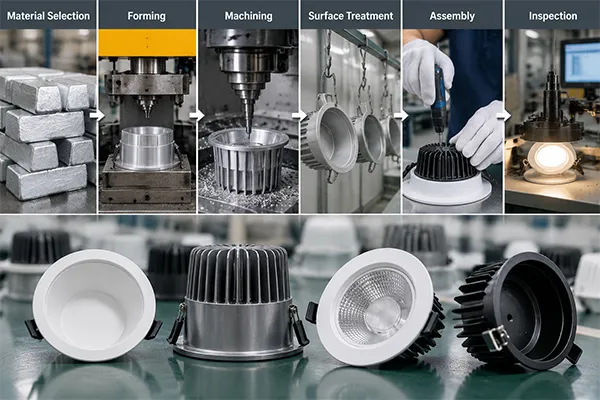
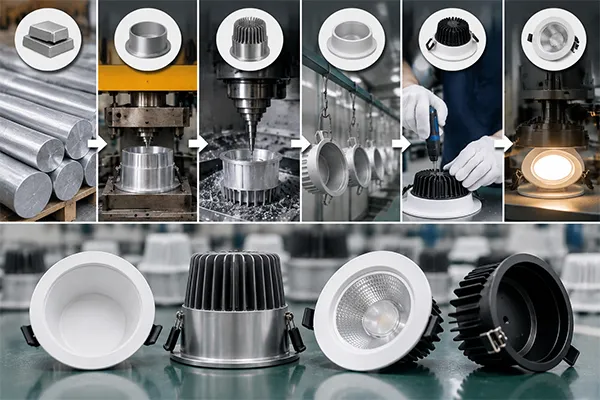
The LED downlight housing manufacturing process includes material selection, forming, machining, surface treatment, assembly interfaces, and batch inspection.2 No single method—such as die-casting, stamping, or spinning—is automatically best. Buyers should select a process that matches the downlight’s thermal design, installation environment, appearance target, order volume, quality expectations, and commercial budget.
When we discuss housing options with contractors, importers, and lighting brands, we often find that the real question is not “Which process is better?” The more useful question is: “Which housing process gives our project the right balance of consistency, performance, appearance, lead time, and cost?”
What Does the LED Downlight Housing Manufacturing Process Include?
The LED downlight housing manufacturing process may seem simple because the finished part is often just a metal frame, heat sink, trim, or back housing. However, small decisions made at each production stage can affect the fixture’s final fit, appearance, assembly stability, and consistency. Buyers can face expensive rework if those stages are not controlled together.
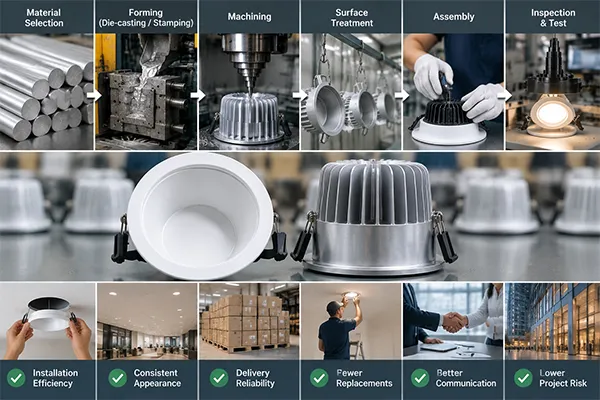
A complete LED downlight housing manufacturing process starts with the intended fixture design and continues through material selection, metal forming, secondary processing, finishing, assembly checks, and production inspection. Buyers should assess these stages as one connected quality system rather than judging the housing by its material label or visual appearance alone.
Material Selection Is Only the Starting Point
Many buyers ask for an “aluminum housing.” This requirement is understandable, but it is not sufficiently detailed for supplier evaluation. Aluminum can be used in different forms and processed in different ways. The final result depends on the fixture structure, the forming method, wall thickness, surface-treatment requirements, and the consistency of incoming material.
In our discussions with customers, we encourage them to define the housing requirement beyond a basic material name. For example, a purchasing team may need to clarify:
- The intended installation environment, such as indoor residential, retail, office, or sheltered outdoor use
- The required cutout size and ceiling compatibility
- The fixture’s target wattage and internal component layout
- The required trim appearance, including white, black, brushed, painted, or other finishes
- The expected quantity and whether a dedicated tool is commercially reasonable
- Whether the project needs standard products, OEM changes, or a fully customized structure
Forming, Interfaces, and Finishing Work Together
The housing process does not end when the metal part is formed. Secondary operations can be equally important. These may include trimming, drilling, threading, deburring, machining contact surfaces, fitting springs, attaching brackets, or preparing areas for LED modules and drivers.
A housing may look acceptable before assembly but create problems later if the interfaces are inconsistent. For example, variation in spring positions, mounting holes, or module contact surfaces may affect installation efficiency and product assembly.3 These risks can become more visible in a large project where installers handle hundreds or thousands of fixtures.
Surface treatment is also more than a cosmetic decision.4 Powder coating, painting, anodized-style finishes, or other treatments should be evaluated according to the specified product design and intended environment. Buyers should ask suppliers how they control color consistency, surface defects, scratches, edge coverage, and packaging protection during mass production.
We have seen that a well-defined drawing, approved finish reference, and agreed inspection points often provide more procurement value than a vague request for “high-quality aluminum.”
Is Die-Casting Always the Best LED Downlight Housing Manufacturing Process?
Die-cast aluminum is often treated as the premium answer for LED downlight housings. This assumption can lead buyers to pay for a process that does not match their design, order quantity, or application. At the same time, choosing a lower-cost process without understanding its limitations can introduce avoidable project risk.
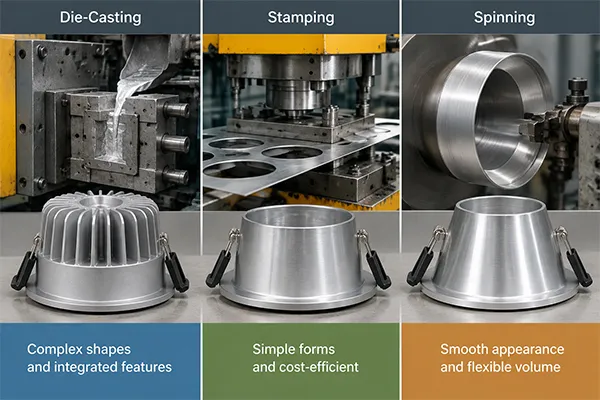
Die-casting is not always the best LED downlight housing manufacturing process.5 It can suit complex shapes and integrated structural features, but stamping or spinning may be more appropriate for simpler forms, lower tooling exposure, different appearance goals, or specific volume requirements. The appropriate process depends on the complete fixture design and verified product documentation.
Die-Casting: Complex Shapes With Tooling Considerations
Die-casting can be suitable when a downlight requires a more integrated body shape, detailed structural features, or a design that combines multiple functions into one housing.6 Depending on the design, a cast housing may incorporate elements such as ribs, mounting points, driver compartments, or shaped heat-management surfaces.
However, buyers should not use “die-cast” as a shortcut for quality. The outcome still depends on tooling condition, process control, trimming quality, surface preparation, dimensional consistency, and inspection. A complicated casting can also bring additional considerations for tooling investment, development time, weight, finishing requirements, and order-volume planning.
For a customized product, we recommend that buyers ask about the commercial and technical implications before approving the process:
- Is new tooling required for the requested design?
- What dimensions are critical for ceiling installation and component assembly?
- What sample approval process will be used before mass production?
- What cosmetic standard applies to visible trim surfaces?
- How will the supplier manage production changes after sample approval?
Stamping: Efficient for Suitable Sheet-Metal Designs
Stamping commonly suits housing parts made from sheet material, especially when the required geometry is relatively straightforward.7 It may be useful for trims, brackets, back covers, and certain reflector or housing forms. The process can support efficient repeat production when the part design, material thickness, and tooling approach are appropriate.
Yet stamped parts also need careful evaluation. Buyers should check edge quality, deformation control, hole positions, spring interfaces, coating coverage, and part rigidity in the finished fixture. A low-cost stamped housing is not automatically a poor choice. It can be commercially sensible when it meets the structural, visual, and installation needs of the downlight.
Spinning: A Consideration for Round Forms
Metal spinning may be considered for certain round or conical housing shapes.8 It can be relevant where the product design uses rotationally symmetrical forms and where the commercial situation does not justify a more complex tooling route.
The key point is not to rank these methods in isolation. We advise buyers to compare them against the specific product drawing, target price, finish requirement, project schedule, and expected annual demand.
| Process | Potential Fit | Buyer Evaluation Focus |
|---|---|---|
| Die-casting | Complex integrated shapes and detailed structures | Tooling, dimensions, finish preparation, repeatability |
| Stamping | Sheet-metal trims, covers, brackets, and simpler structures | Edge quality, rigidity, hole positions, coating |
| Spinning | Certain round or conical forms | Shape consistency, surface quality, dimensional control |
How Should Buyers Evaluate Material and Structural Consistency?
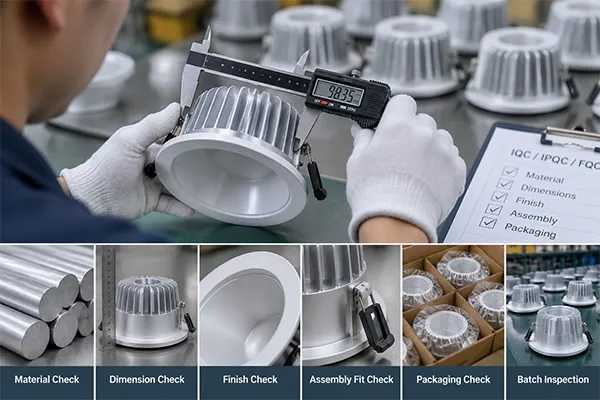
A polished sample can help buyers understand the look and basic installation of a downlight, but it does not prove that every future unit will match it.9 This gap between sample approval and mass-production consistency is one of the most important risks in downlight procurement.
Buyers should evaluate LED downlight housing consistency by reviewing material specifications, critical dimensions, finish standards, assembly fit, packaging protection, and batch inspection practices. An aluminum label or a visually attractive sample is useful, but it is not enough evidence of stable mass-production quality.
Move From “Good Sample” to “Controlled Specification”
We recommend turning sample discussions into measurable approval points. A supplier and buyer may interpret “nice finish” or “strong housing” differently. Clear specifications reduce the chance of later disagreement.
For a project downlight, buyers can request or confirm the following:
- Product drawings with key dimensions
- Cutout size and outer diameter tolerances where relevant
- Housing material description and construction details
- Finish color reference, such as an approved sample or color standard
- Surface acceptance criteria for visible areas
- Spring type, spring position, and installation interface details
- Assembly requirements for LED module, reflector, diffuser, driver, and wiring
- Packaging method to reduce scratches and deformation during transport
We find that these questions are especially valuable for OEM and ODM requests. A small change in trim depth, beam angle arrangement, driver location, or finish can affect multiple housing components. Without a controlled review process, the first sample may not represent the final mass-production configuration.
Inspect the Assembly, Not Just the Loose Housing
A housing should be assessed as part of the finished luminaire. The relevant question is whether the housing supports stable assembly and practical installation—not simply whether the individual metal piece looks clean.
Buyers should consider checking:
| Inspection Area | Why It Matters |
|---|---|
| Trim-to-ceiling fit | Influences visible appearance after installation |
| Spring operation | Affects installation speed and retention behavior |
| LED module interface | Can affect assembly alignment and thermal-contact design |
| Driver placement | Influences installation space and service access |
| Reflector or diffuser fit | Affects appearance, alignment, and light-control components |
| Coating appearance | Influences visual consistency across a project |
| Packaging protection | Helps reduce transit scratches and deformation |
At Upward Lighting, we conduct a 100% aging test for finished products before shipment, typically lasting 4 to 8 hours depending on the product requirement. However, buyers should understand that aging is only one part of product verification. Application-specific thermal performance, ingress protection, photometric results, material details, and compliance claims should be verified against the relevant product design and test documentation.
Ask How Batch Quality Is Followed Up
A qualified supplier should be able to explain how it handles production follow-up, not merely show a sample room. We encourage procurement teams to ask practical questions:
- Which dimensions are checked during production?
- How are visible finish defects identified and separated?
- How is the approved sample linked to the production order?
- What happens if an assembly-fit issue is found?
- How are customization changes recorded?
- Can the supplier provide pre-shipment photos, inspection records, or agreed quality documents?
These questions do not require buyers to become manufacturing engineers. They simply help buyers identify whether the supplier has a repeatable process for managing project requirements.
How Does the LED Downlight Housing Manufacturing Process Affect Project Risk?
The LED downlight housing manufacturing process affects more than the factory cost of a fixture. It can influence installation efficiency, site appearance, delivery reliability, replacement needs, and communication between the buyer, supplier, and installation team. If the housing process is poorly matched to the project, the cost impact may appear long after the purchase order is placed.
A suitable LED downlight housing manufacturing process reduces project risk by supporting consistent dimensions, stable assembly, controlled finishes, and predictable production planning. Buyers should assess housing decisions based on total project risk, including installation, rework, delivery, replacement, and long-term supplier coordination—not only unit price.
Common Procurement Risks Linked to Housing Quality
Housing-related problems do not always appear as obvious product failures. Sometimes they show up as extra work for installers, customer complaints about appearance, or delays caused by sorting and replacement.
Potential project risks include:
- Inconsistent cutout fit: Fixtures may sit unevenly or require extra adjustment during installation.
- Visible color variation: White, black, or metallic trims may look inconsistent when installed together.
- Poor component fit: Reflectors, diffusers, springs, or LED modules may not align consistently.
- Surface damage in transit: Inadequate protection can create scratches on visible trim surfaces.10
- Delayed mass production: Late design changes or unclear sample approval can affect the production schedule.
- Mismatch with the application: A housing structure may not suit the intended ceiling, installation depth, or environment.
These risks do not mean that a particular process is inherently unsuitable. Instead, they show why the LED downlight housing manufacturing process should be reviewed as part of supplier selection.
Evaluate the Supplier’s Communication Process
In our experience, a reliable supplier relationship depends on how quickly and clearly the factory can translate a requirement into a controlled product specification. This matters for standard downlights, but it matters even more for custom wattage, color temperature, beam angle, CRI, trim color, or structural adjustments.
A practical supplier evaluation may include the following stages:
- Requirement review: Confirm application, dimensions, installation conditions, finish, and target quantity.
- Technical proposal: Review drawings, available configurations, tooling implications, and quotation scope.
- Sample approval: Confirm visible appearance, fit, component configuration, and agreed changes.
- Mass-production confirmation: Freeze key specifications and packaging requirements.
- Production follow-up: Monitor critical quality points and communicate exceptions early.
- Pre-shipment review: Confirm agreed inspection and product documentation before dispatch.
We believe this approach gives procurement teams a stronger basis for decision-making than comparing only housing photos or broad marketing claims.
Balance Cost Against the Cost of Rework
A lower housing cost can be valuable when the product remains suitable for the project. However, a small unit-price saving may lose value if it creates site labor issues, replacement freight, delayed handover, or visual inconsistency across a completed installation.11
For this reason, we suggest that project buyers compare quotations using a broader set of criteria:
| Procurement Factor | Questions for Buyers |
|---|---|
| Unit price | Does the quoted construction match the approved specification? |
| Tooling cost | Is the investment justified by the expected volume and product life? |
| Lead time | Does the process fit the required project schedule? |
| Finish requirement | Is the finish standard clear and verifiable? |
| Quality control | What batch checks and records can the supplier provide? |
| Customization | Can the supplier manage requested changes without confusion? |
| Documentation | Can relevant CE, RoHS, and product-specific documents be provided for verification? |
Frequently Asked Questions
What is the most common material for LED downlight housings?
Aluminum and sheet metal are commonly used in LED downlight housings12, but the appropriate material and construction depend on the fixture design. Buyers should review the complete housing structure, finish, assembly interfaces, and supporting documents rather than relying only on a general material description.
Is die-cast aluminum better than stamped aluminum for downlights?
Die-cast aluminum is not universally better than stamped aluminum. Die-casting can suit complex integrated shapes, while stamping can suit simpler sheet-metal components and may offer different commercial advantages. Buyers should compare the process against the product design, required finish, order volume, and installation needs.
What should buyers inspect on a downlight housing sample?
Buyers should inspect dimensions, cutout compatibility, trim appearance, coating quality, spring operation, component fit, driver arrangement, and packaging. They should also confirm that the approved sample reflects the intended mass-production configuration, especially when the order includes OEM or ODM customization.
Can a good-looking downlight sample guarantee mass-production quality?
No. A good-looking sample is useful, but it does not guarantee material consistency, dimensional repeatability, finish control, assembly fit, or packaging quality across a full order. Buyers should ask about approved specifications, production inspection, and batch-quality follow-up procedures.
What documents should a downlight supplier provide?
The documents depend on the market and product application. Buyers may request product drawings, specifications, test records, and applicable compliance documents such as CE and RoHS documentation. Buyers should verify that all documents apply to the exact product configuration and target market.
Conclusion
The LED downlight housing manufacturing process is a procurement decision, not merely a factory detail. Die-casting, stamping, and spinning can each have a valid place when they match the fixture’s design, budget, order volume, appearance requirements, and installation environment. We encourage buyers to assess materials, dimensions, finishing, assembly fit, packaging, and batch controls as one connected system. If you are sourcing standard or customized LED downlights, we can help you review practical housing options, clarify specifications, and develop an OEM/ODM solution for your project.
"[PDF] End-to-End Quality Information Framework (QIF) Technology Survey", https://nvlpubs.nist.gov/nistpubs/ir/2016/NIST.IR.8127.pdf. Manufacturing-quality guidance recognizes that process variation can cause production units to differ from an approved sample; sampling and process controls are therefore used to assess ongoing conformity. Evidence role: general_support; source type: government. Supports: Manufacturing processes exhibit variation, and acceptance of a limited sample does not by itself establish conformity of an entire production population.. Scope note: This support is general to manufacturing quality assurance and does not measure variation in a particular downlight-housing order. ↩
"[PDF] Precision in machining: research challenges", https://nvlpubs.nist.gov/nistpubs/Legacy/IR/nistir5628.pdf. References on metalworking describe manufactured metal parts as proceeding through material preparation, forming, secondary processing, finishing, and quality inspection, with the exact sequence determined by the part design. Evidence role: general_support; source type: encyclopedia. Supports: Metal-component manufacture commonly combines material selection, forming, machining or other secondary operations, finishing, assembly-related processing, and inspection.. Scope note: The source would describe general metalworking rather than a mandatory process flow for every LED downlight housing. ↩
"[PDF] A Dimension and Tolerance Data Model for Concurrent Design and ...", https://tsapps.nist.gov/publication/get_pdf.cfm?pub_id=821122. Research on tolerance analysis and assembly variation shows that dimensional variation in mating features can alter fit and alignment, increasing adjustment or assembly difficulty when accumulated variation exceeds functional allowances. Evidence role: mechanism; source type: research. Supports: Variation in mating-feature locations and dimensions can reduce fit, interchangeability, and assembly efficiency.. Scope note: The cited principle does not quantify the impact of any specific spring, hole pattern, or downlight module interface. ↩
"[PDF] Coatings for corrosion protection - NIST Technical Series Publications", https://nvlpubs.nist.gov/nistpubs/Legacy/SP/nistspecialpublication1035.pdf. Materials-engineering references describe coatings and conversion treatments as affecting protective and functional properties—including corrosion resistance and surface durability—in addition to visual finish. Evidence role: mechanism; source type: government. Supports: Metal surface treatments and coatings can affect corrosion resistance, wear behavior, adhesion, and other functional properties in addition to appearance.. Scope note: The effect of a given treatment depends on the substrate, coating system, application quality, and service environment. ↩
"[PDF] A Computer-Based Economic Analysis for Manufacturing Process ...", https://digitalcommons.calpoly.edu/cgi/viewcontent.cgi?article=1027&context=it_fac. Manufacturing-process selection frameworks compare casting, sheet-metal forming, and related processes according to design requirements, production quantity, tolerance needs, and tooling economics; no single process is optimal for all parts. Evidence role: general_support; source type: education. Supports: Manufacturing-process selection is conditional on component geometry, material, required properties, production volume, tolerances, and tooling cost rather than on a universal ranking of processes.. Scope note: Such frameworks support the general selection principle and do not establish the best process for a specific downlight design. ↩
"die casting hpdc: Topics by Science.gov", https://www.science.gov/topicpages/d/die+casting+hpdc. Technical literature on die casting explains that the process can produce near-net-shape components with complex geometries and integrated features, although design must account for issues such as draft, wall thickness, filling, and porosity. Evidence role: mechanism; source type: research. Supports: High-pressure die casting can produce near-net-shape metal components with complex geometry and integrated features, subject to casting-design constraints.. Scope note: Capability depends on alloy, tooling, casting parameters, and part geometry; it does not guarantee quality or suitability for every housing. ↩
"[PDF] An Environmental and Cost Analysis of Stamping Sheet Metal Parts", https://dspace.mit.edu/bitstream/handle/1721.1/108603/Gutowski_An%20environmental%20and%20cost.pdf. Engineering references describe sheet-metal stamping as a die-based process for shaping sheet stock into repeatable parts, with feasible geometry governed by material formability, die design, and feature requirements. Evidence role: mechanism; source type: education. Supports: Sheet-metal stamping forms parts from sheet stock and is commonly applied to repeatable geometries using dedicated dies.. Scope note: The general description does not determine whether a particular downlight component meets stamping-design requirements. ↩
"Metal Spinning: Types, Applications, Advantages and More", https://usmetalspinning.com/metal-spinning-types-applications-advantages-and-more/. Descriptions of metal spinning identify it as a process in which sheet metal is formed over a rotating mandrel, making it particularly applicable to rotationally symmetric components such as conical and rounded shells. Evidence role: mechanism; source type: education. Supports: Metal spinning forms sheet metal over a mandrel and is principally suited to axisymmetric shapes, including cones and other round forms.. Scope note: Axisymmetry alone does not establish commercial suitability, because material, tolerances, finish, and production quantity also affect process choice. ↩
"What kinds of Lot Acceptance Sampling Plans (LASPs) are there?", https://www.itl.nist.gov/div898/handbook/pmc/section2/pmc22.htm. Statistical quality-control guidance notes that sampling inspection provides evidence about a population or lot at a stated level of uncertainty and does not demonstrate conformity of every individual production unit. Evidence role: general_support; source type: government. Supports: Inspection of a sample provides information about a lot or process but cannot prove that every uninspected unit conforms.. Scope note: This principle concerns inspection statistics generally and does not assess the actual controls used by a named supplier. ↩
"[PDF] Laser induced damage in optical materials", https://nvlpubs.nist.gov/nistpubs/Legacy/SP/nbsspecialpublication568.pdf. Packaging-test guidance identifies vibration, impact, and abrasion during distribution as hazards that protective packaging is designed to mitigate, including damage to finished product surfaces. Evidence role: mechanism; source type: institution. Supports: Packaging design is intended to limit handling and transport hazards, including abrasion, impact, and vibration that can damage finished surfaces.. Scope note: The general hazard description does not establish that scratches in a particular shipment were caused by packaging. ↩
"Maintenance versus replacement of medical equipment: a cost ...", https://pmc.ncbi.nlm.nih.gov/articles/PMC9373529/. Public-procurement and life-cycle-costing guidance treats acquisition price as only one component of total cost, which may also include installation, maintenance, replacement, logistics, and other downstream costs. Evidence role: general_support; source type: government. Supports: Procurement evaluation can account for life-cycle or total ownership costs beyond initial purchase price, including operation, maintenance, replacement, and risk-related costs.. Scope note: The framework supports broader cost evaluation but does not show that a lower-priced housing will necessarily generate higher project costs. ↩
"[PDF] 2019 Solid-State Lighting R&D Opportunities - Department of Energy", https://www.energy.gov/sites/prod/files/2020/01/f70/ssl-rd-opportunities2-jan2020.pdf. Lighting and thermal-management references describe aluminum and sheet-metal constructions as common material options for luminaire housings and related structural components. Evidence role: general_support; source type: government. Supports: LED luminaires commonly use metal housings, including aluminum and sheet-steel or other sheet-metal components, for structural and thermal-management functions.. Scope note: Material prevalence varies by luminaire type, region, performance target, and product price segment. ↩