An LED Downlight Manufacturer in China can look easy to find, but the real challenge is choosing one that can match your market, project, quality level, and delivery expectations. If buyers focus only on the lowest unit price, they may face unstable quality, weak documentation, or sample-to-bulk differences.1 I believe the safer path is structured supplier evaluation.
A reliable LED downlight manufacturer in China should be evaluated by application fit, lighting parameters, quality-control process, certification documents, OEM/ODM flexibility, and communication ability—not only by price.2 Global buyers should define the target market, installation needs, CCT, CRI, beam angle, finish, warranty expectations, and order stage before requesting a quotation.
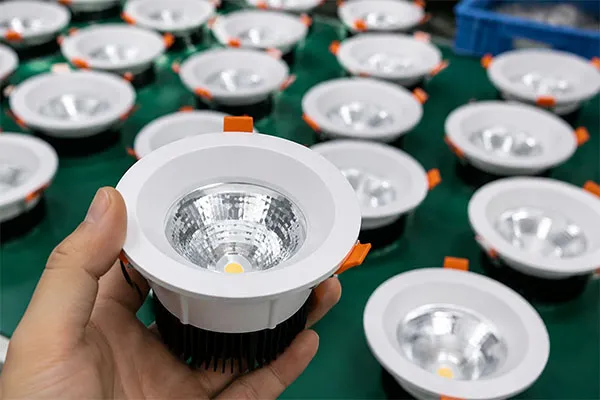
Many buyers ask me, “What is your lowest price for a 10W downlight?” I understand why. Price matters in wholesale and project supply. However, in real production, the better first question is whether the supplier can make the right downlight for the right application with repeatable quality.
How Should You Brief an LED Downlight Manufacturer in China Before Asking Price?
Many quotations fail before they begin because the buyer and supplier are not talking about the same product. A buyer may ask for a 10W downlight, while the supplier must guess the application, driver level, beam angle, trim finish, packing, and certification needs. This creates risk.
A good brief for an LED Downlight Manufacturer in China should include the application, target country, installation type, cut-out size, wattage range, lumen expectation, CCT, CRI, beam angle, finish color, certification documents, order stage, target price range, and warranty expectation. This helps the supplier quote the correct product level.
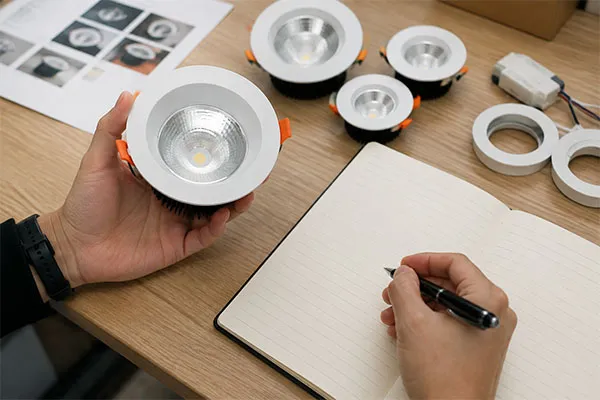
Start With the Application
I usually prefer when buyers tell me where the LED downlight will be used before they ask for the price. A hotel corridor, retail shop, apartment ceiling, office, villa, and supermarket do not always need the same product. The lighting effect, glare control, housing design, and driver expectation can be different.
For example:
- Residential projects may focus on warm CCT, smooth appearance, and stable basic performance.
- Retail spaces may need higher CRI, better beam control, and consistent color.
- Hotels may care about trim finish, low glare, dimming options, and long-term replacement consistency.
- Commercial offices may need efficient lumen output and comfortable light distribution.
When a buyer only says “10W downlight,” the supplier may quote a basic model. However, the buyer may actually need a higher-spec product. This gap often causes problems later.
Share the Target Market Early
The target market affects many decisions. A buyer who sells in Europe may ask for CE and RoHS documents.3 A buyer in the Middle East may care more about heat resistance, stable drivers, and project delivery timing. A buyer in Southeast Asia may need a cost-balanced product that still performs well in humid conditions.
I always recommend that buyers verify compliance requirements with local professionals, import agents, or testing bodies. Supplier documents such as CE and RoHS can support initial market-entry communication, but they should not be treated as automatic approval for every country or every project.
Include the Order Stage
The quotation also depends on whether the buyer is testing samples, preparing a tender, building a local brand, or placing repeat wholesale orders. I usually see four stages:
| Buyer Stage | What the Supplier Should Know | Main Risk |
|---|---|---|
| Sample testing | Technical parameters and sample quantity | Sample may not match final target |
| Tender preparation | Project specs, documents, lead time | Wrong document package |
| Trial order | Packaging, labeling, small-batch needs | Higher unit cost than bulk |
| Repeat order | Forecast, stable materials, delivery plan | Batch consistency |
A reliable LED downlight supplier should be able to support each stage differently. For example, a small trial order may need flexible packaging and fast communication. A repeat order may need stronger material control and stable production planning.
Give a Realistic Target Price Range
Some buyers worry that sharing a target price will make the supplier quote higher. I understand that concern. However, a realistic price range helps the supplier recommend the right product level. In LED lighting manufacturing, there are many ways to reduce cost, but not every cost reduction is safe.
Cost can change because of:
- LED chip selection
- Driver quality
- Housing material and weight
- Lens or reflector design
- Packaging strength
- Dimming function
- Certification support
- Warranty expectation
- Order quantity
A professional buyer does not need to reveal everything. However, a clear target range helps both sides avoid wasting time on products that are too cheap or too expensive for the market.
Why Are Same-Wattage LED Downlights Not Equal?
Same-wattage LED downlights can look similar on a product sheet, but they may perform very differently in the ceiling. If buyers compare only 7W, 10W, or 15W prices, they may miss the factors that affect brightness, comfort, heat, reliability, and customer complaints.
A 10W LED downlight is not defined only by wattage. Buyers should compare lumen output, beam angle, CRI, CCT, driver quality, heat dissipation, housing design, dimming compatibility, and sample-to-bulk consistency. These details decide whether the product works for the application and whether it remains stable after installation.
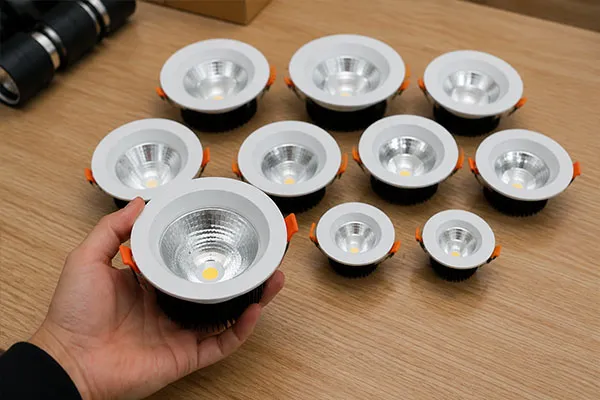
Lumen Output Matters More Than Wattage Alone
Wattage tells buyers how much power the downlight consumes. It does not directly tell them how bright the downlight appears.4 Two 10W LED downlights may have different lumen output because of LED efficiency, optical design, thermal performance, and driver efficiency.5
For example, one 10W model may produce around 800 lumens, while another may produce 950 lumens. The difference may be important in a commercial project. However, buyers should also check whether the lumen data comes from reliable testing and whether the supplier can keep the same material standard in bulk production.
Beam Angle Changes the Lighting Effect
A narrow beam angle creates stronger focus. A wider beam angle creates softer general lighting.6 A buyer who installs downlights in a hotel lobby may want a different beam angle from a buyer who installs them in a residential hallway.
Common beam angles may include:
- 15° to 24°: accent lighting or focused display areas
- 36° to 45°: balanced lighting for many commercial spaces
- 60° and above: wider general lighting
The same lumen output can feel different when the beam angle changes. This is why buyers should not compare downlights only by wattage and price.
CRI and CCT Affect the User Experience
CCT, or correlated color temperature, affects the mood of the space. Warm white is often used in homes and hotels. Neutral white is common in offices and shops. Cool white may be used where a brighter visual impression is needed.
CRI, or color rendering index, affects how accurately colors appear under the light. A retail store may need higher CRI to show product colors better. A basic storage area may not require the same level.
| Parameter | Buyer Decision | Common Options |
|---|---|---|
| CCT | Mood and visual comfort | 2700K, 3000K, 4000K, 5000K, 6500K |
| CRI | Color quality | CRI 80, CRI 90+ |
| Beam angle | Light spread | 24°, 36°, 60° |
| Finish | Interior design match | White, black, silver, custom color |
| Driver | Stability and function | Non-dim, triac dim, 0-10V, DALI depending on supplier capability |
Driver Quality Is a Major Reliability Factor
In production, the driver is one of the most important parts of an LED downlight. A low-cost driver may reduce the quotation, but it can increase flicker, failure risk, or dimming complaints.7 If the buyer needs dimming, the driver choice becomes even more important.
I often suggest that buyers ask:
- What driver brand or driver specification is used?
- Is the driver isolated or non-isolated?
- Is dimming required? If yes, what dimming system?
- What input voltage range is needed?
- Can the supplier keep the same driver in bulk production?
The last question is critical. A sample may perform well, but if the supplier changes materials during bulk production without approval, the buyer may face inconsistency. A reliable supplier should communicate material changes before production.
Heat Dissipation Supports Long-Term Stability
LED downlights operate inside ceilings, where heat management can be difficult. Housing design, aluminum quality, airflow, LED board layout, and driver position all affect thermal performance. Better heat dissipation usually supports better lumen maintenance and longer service life.8
Buyers do not need to become thermal engineers. However, they should ask practical questions:
- Does the housing feel too light for the claimed power?
- Is the heat sink design reasonable?
- Has the supplier tested the product during aging?
- Can the supplier explain how heat is managed?
- Does the sample become unusually hot during operation?
A good LED Downlight Manufacturer in China should be able to explain these points clearly and provide samples for evaluation before bulk orders.
How Should an LED Downlight Manufacturer in China Control Quality Before Shipment?
Quality problems are expensive after goods arrive overseas. A failed downlight is not only a product issue. It can create replacement costs, project delays, customer complaints, and brand damage. Buyers should evaluate quality control before placing the order, not after problems happen.
An LED Downlight Manufacturer in China should control quality through incoming material checks, production inspections, driver and lighting parameter checks, appearance inspection, packaging review, batch consistency control, and 100% pre-shipment aging tests. In our production practice, LED lights are typically aged for 4–8 hours before shipment.
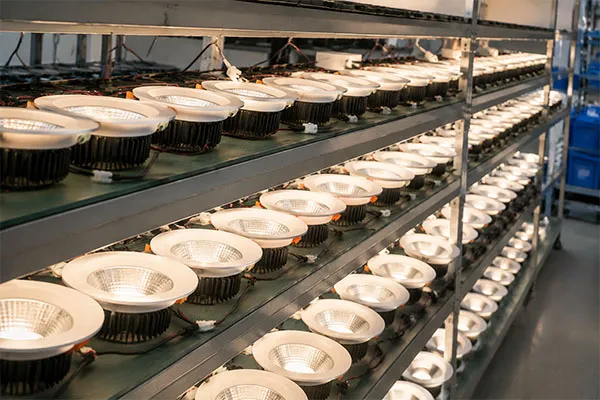
Make Aging Tests a Supplier Evaluation Point
In my manufacturing experience, aging tests are a basic but important step. They help identify early failures before products leave the factory.9 For LED downlights, a supplier should be able to explain whether every unit is aged or only a sample batch is tested.
In our factory context, products go through 100% aging tests, usually for 4 to 8 hours, before shipment. I do not present this as a magic guarantee. It is a practical control step that reduces the chance of early failure and helps confirm basic stability before packing.
Buyers can ask suppliers:
- Is every unit aged before shipment?
- How many hours is the aging test?
- Are products tested at normal input voltage?
- Are failed units recorded and repaired?
- Is there a final inspection after aging?
Check the Driver, LED, and Housing Together
Quality control should not focus on only one component. The LED chip, driver, PCB, housing, lens, trim, and wiring work together. A strong LED chip cannot save a weak driver. A good driver cannot fully compensate for poor heat dissipation.
A practical inspection plan may include:
- Electrical check: input voltage, power, current, and power factor when relevant
- Optical check: lumen output, CCT, CRI, and beam angle when required
- Thermal review: housing temperature and heat sink design
- Appearance inspection: scratches, paint defects, trim deformation, and color mismatch
- Assembly check: clips, screws, wiring, connectors, and lens position
- Packing check: carton strength, labels, barcodes, and private-label requirements
Sample-to-Bulk Consistency Is Critical
Many buyers approve a sample, but they do not define how the bulk order should match it. This creates room for misunderstanding. I recommend that buyers keep a signed reference sample, approved specification sheet, and material confirmation before mass production.
The buyer can request a simple confirmation table:
| Item | Sample Approved | Bulk Requirement |
|---|---|---|
| Power | 10W | Same as approved sample |
| CCT | 3000K | Within agreed tolerance |
| CRI | 80+ or 90+ | Same level as approved |
| Beam angle | 36° | Same lens or reflector |
| Housing color | Matte white | Same surface finish |
| Driver | Confirmed model | No change without approval |
| Packaging | Neutral or OEM | Match approved artwork |
This table does not replace a formal inspection standard, but it helps both sides communicate clearly.
Packaging Quality Also Matters
Some buyers focus only on the lamp itself. However, packaging affects arrival condition and resale quality. A downlight may pass production testing but arrive with damaged trims or crushed boxes if the packaging is weak.10
For importers, distributors, and local brands, packaging may also affect market perception. Private-label buyers should confirm:
- Inner box artwork
- Model number format
- Barcode requirements
- Installation manual language
- Carton marks
- Pallet requirements
- Drop-test expectations when needed
I have seen buyers spend a lot of time negotiating product price but very little time confirming packaging. That is risky. Good packaging is part of the final product experience.
What Certification Documents Should Buyers Verify With an LED Downlight Manufacturer in China?
Certification documents are important, but they are often misunderstood. Some buyers treat CE or RoHS as universal market approval. That is risky. Requirements vary by country, sales channel, product type, voltage, installation environment, and project owner.
Buyers should ask an LED Downlight Manufacturer in China for relevant certification documents, test reports, declarations, product labels, and model coverage details. CE and RoHS can support compliance communication, but buyers should verify whether the documents match the exact model and meet the target market’s requirements.
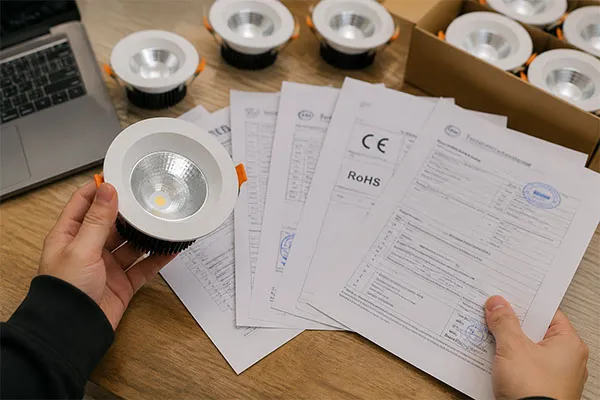
CE and RoHS Are Starting Points, Not the Whole Answer
Our company can provide CE and RoHS documents for relevant LED lighting products. These documents are useful for many buyer discussions, especially in initial sourcing and market-entry evaluation. However, I always believe buyers should verify the details instead of assuming that one document covers every product and every country.
Buyers should check:
- Does the certificate show the correct company name?
- Does the report cover the exact product model or product family?
- Is the input voltage correct?
- Are the standards listed relevant to the product?
- Is the document still valid or accepted by the buyer’s market?
- Does the local importer need additional testing or registration?
This verification protects both sides. It also helps avoid customs issues, project rejection, or sales-channel complaints.
Match Documents to the Real Product
A common problem in LED lighting sourcing is document mismatch. A supplier may have a certificate for one model, but the buyer is purchasing a different design. The buyer may not notice the mismatch until later.
A careful buyer should compare:
| Document Item | What to Check |
|---|---|
| Product photo | Does it match the quoted downlight? |
| Model number | Is it the same or clearly in the covered series? |
| Power range | Does it include the ordered wattage? |
| Voltage | Does it match the target market? |
| Standards | Are they relevant to the product category? |
| Manufacturer name | Is it the actual supplier or another company? |
If something is unclear, buyers should ask the supplier for explanation. A reliable supplier should answer directly and provide supporting files where available.
Ask About Labels and Manuals
Certification is not only about PDF documents. Product labels, carton marks, and manuals may also need to match the target market. A buyer who sells under a private label should confirm whether the supplier can print the correct information.
Typical label details may include:
- Brand name or buyer’s logo
- Model number
- Wattage
- Voltage
- CCT
- Safety marks when applicable
- Batch number
- Importer information when required
- Installation warning
I recommend that buyers prepare artwork and label requirements early. Last-minute label changes can delay shipment.
Use Professional Compliance Advice for Specific Markets
I can speak from the manufacturing and export communication side, but I do not pretend to replace a local compliance expert. Buyers should consult qualified professionals for country-specific requirements, especially when they sell through retail chains, public projects, or regulated channels.
This is especially important when the project has special requirements, such as:
- Fire-rated ceiling applications
- Dimming system compatibility
- Emergency lighting integration
- High humidity areas
- Public tender documentation
- Retail packaging rules
A responsible LED Downlight Manufacturer in China should support document preparation, but the buyer should verify final market acceptance.
Is a Small or Mid-Size LED Downlight Manufacturer in China the Right Fit for OEM/ODM?
Some buyers believe that only the largest factories are safe. Other buyers believe that smaller factories always offer better prices. Both views are too simple. Supplier size matters, but supplier fit matters more. Buyers should evaluate flexibility, process control, communication, and consistency together.
A small or mid-size LED Downlight Manufacturer in China can be a good OEM/ODM partner when it offers fast response, small-batch support, parameter customization, stable testing, and clear export communication. Buyers should still verify material control, production capacity, documentation support, and delivery consistency before scaling orders.
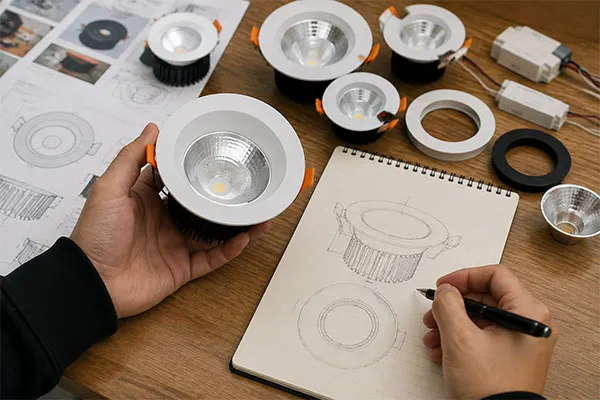
Why Mid-Size Manufacturers Can Be Practical
Our company is based in Zhongshan, China, and has manufactured LED lighting products since 2009. From my experience, many global buyers do not always need the largest factory. They need a supplier who can respond quickly, customize reasonably, and handle the order stage properly.
A mid-size manufacturer may be suitable for:
- Importers testing a new product line
- Wholesalers needing competitive pricing
- Local brands building private-label products
- Contractors needing project-specific parameters
- Distributors needing mixed SKUs and smaller batches
This does not mean every small or mid-size supplier is reliable. Buyers should still check the factory’s process, testing, communication, and production record.
OEM/ODM Customization Should Be Specific
OEM/ODM is a broad term. Buyers should define exactly what they need. For LED downlights, customization may include:
- CCT options: 2700K, 3000K, 4000K, 5000K, or 6500K
- Power options: adjusted wattage for project or market needs
- Beam angle: lens or reflector changes
- CRI: standard CRI or higher CRI options
- Housing finish: white, black, silver, or custom surface color
- Packaging: neutral box or private-label box
- Logo: product label, box, or instruction sheet
- Cut-out size: matched to local installation habits when tooling allows
Some customization is simple. Some customization requires new materials, new tooling, or longer lead time. Buyers should ask whether the change affects MOQ, delivery time, certification coverage, and unit cost.
Small-Batch Flexibility Has Value
Many buyers start with cautious quantities. I think this is reasonable. A trial order helps buyers test market response and inspect product quality before larger purchasing. A supplier who supports small batches can reduce the buyer’s inventory risk.
However, small-batch orders also have limits. Unit costs may be higher because of setup time, packaging printing, material purchasing, and production scheduling. Buyers should understand this instead of expecting trial-order pricing to match container-level pricing.
A balanced discussion should include:
| Order Type | Buyer Benefit | Supplier Concern |
|---|---|---|
| Sample order | Fast technical evaluation | Limited production efficiency |
| Small trial order | Lower inventory risk | Higher unit cost |
| Mixed SKU order | Market testing | More complex planning |
| Repeat bulk order | Better price and stability | Requires forecast and commitment |
Communication Speed Is Not a Small Detail
In export business, fast and clear communication can prevent many problems. A supplier may have good products, but if it responds slowly or avoids details, the buyer may lose time and confidence.
I suggest buyers observe how the supplier handles:
- Specification questions
- Drawing or cut-out confirmation
- Quotation revisions
- Sample arrangement
- Document requests
- Packaging details
- Production updates
- After-sales feedback
A reliable China LED downlight factory should not only quote quickly. It should also answer accurately and keep records clear.
How Can Buyers Compare Quotations From China LED Downlight Suppliers Fairly?
A low quotation may look attractive, but it may not represent the same product. Buyers often compare prices from several suppliers without confirming whether the parameters, materials, testing level, and packaging are equal. This creates a false comparison and increases sourcing risk.
Buyers should compare LED downlight quotations by matching specifications, driver level, lumen output, CRI, CCT, beam angle, housing material, warranty terms, certification documents, packaging, MOQ, lead time, and after-sales responsibility. A fair comparison requires the same product standard, not only the same wattage.
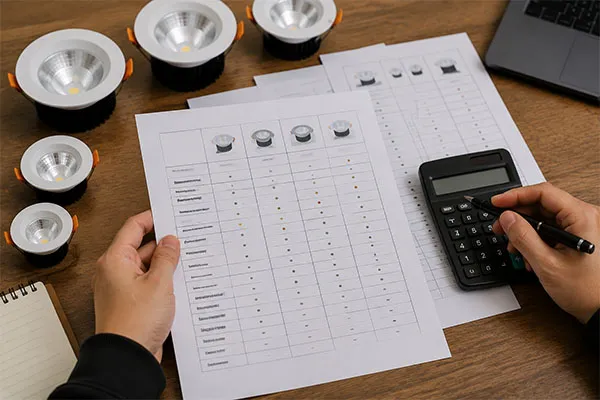
Build a Quotation Comparison Sheet
I recommend that buyers create a simple comparison sheet before choosing a supplier. This helps separate real cost advantage from hidden specification differences.
| Comparison Item | Supplier A | Supplier B | Supplier C |
|---|---|---|---|
| Wattage | 10W | 10W | 10W |
| Lumen output | Confirmed? | Confirmed? | Confirmed? |
| CCT | 3000K | 3000K | 3000K |
| CRI | 80+ | 80+ | 90+ |
| Beam angle | 36° | 60° | 36° |
| Driver type | Basic | Better | Dimmable |
| Housing | Aluminum | Aluminum | Aluminum |
| Aging test | Yes/No | Yes/No | Yes/No |
| Certification files | CE/RoHS? | CE/RoHS? | CE/RoHS? |
| Packaging | Neutral | OEM | OEM |
| MOQ | 500 pcs | 300 pcs | 1000 pcs |
| Lead time | 25 days | 20 days | 35 days |
This table may show why one supplier is cheaper. The cheaper quote may be acceptable for a basic wholesale market. It may not be acceptable for a hotel or retail project.
Separate Product Cost From Service Cost
A supplier’s quotation includes more than materials. It may also include engineering support, sample preparation, packaging design, document support, communication, and quality inspection. Buyers should decide what level of service they need.
For example, a project contractor may need:
- Fast technical confirmation
- Product photos and datasheets
- Installation guidance
- Packing list and shipping documents
- Stable delivery date
- Clear after-sales responsibility
A local lighting brand may need:
- OEM packaging
- Logo label
- Consistent appearance
- Long-term model availability
- Repeat-order material consistency
- Marketable product images
These needs may justify choosing a supplier that is not the cheapest.
Ask What Is Not Included
A quotation can look complete but still leave out important details. Buyers should ask what is excluded before confirming the order.
Common exclusions include:
- Special packaging
- Private-label printing
- Dimming driver upgrade
- Higher CRI option
- Special finish color
- Extra testing documents
- Pallet packing
- Spare parts
- Shipping cost
- Import duties and local taxes
Clear communication prevents disputes later. I prefer when buyers ask these questions early because it allows the supplier to quote honestly.
Evaluate After-Sales Responsibility
No factory should promise zero defects forever. LED lighting is still an electrical product, and installation conditions also affect performance. However, a responsible supplier should have a clear after-sales process.
Buyers should ask:
- What is the warranty period?
- What failure evidence is required?
- Will the supplier provide replacement parts or credit?
- How are batch problems handled?
- Who checks whether the issue is product-related or installation-related?
- How quickly does the supplier respond?
A serious LED Downlight Manufacturer in China should answer these questions before the buyer places a large order.
Frequently Asked Questions
What is the main advantage of buying from an LED downlight manufacturer in China?
The main advantage is access to broad product options, competitive manufacturing costs, OEM/ODM customization, and flexible order support. However, buyers should evaluate quality control, documentation, communication, and sample-to-bulk consistency before choosing a supplier.
How do I know if a 10W LED downlight quotation is fair?
You should compare lumen output, CRI, CCT, beam angle, driver quality, housing material, packaging, certification documents, aging test process, MOQ, and lead time. A fair comparison requires the same specification level, not only the same wattage.
Are CE and RoHS enough for importing LED downlights?
CE and RoHS can support compliance communication, but they are not universal approval for every market. Buyers should verify whether the documents match the exact model and meet local requirements. I recommend checking with local compliance professionals when needed.
Can LED downlights be customized for private-label orders?
Yes, many LED downlights can be customized for CCT, wattage, beam angle, CRI, finish color, labels, and packaging. Buyers should confirm MOQ, lead time, document coverage, and whether the customization affects cost or production schedule.
Why is aging testing important for LED downlights?
Aging testing helps identify early failures before shipment. In our production practice, products are typically aged for 4–8 hours, and 100% pre-shipment aging is used as a quality-control step. Buyers should verify each supplier’s actual testing process.
Conclusion
Choosing an LED Downlight Manufacturer in China should not start and end with the lowest price. Buyers should first define the application, target market, technical parameters, order stage, certification needs, and warranty expectations. Then they should evaluate quality control, aging tests, documentation, OEM/ODM flexibility, and communication. If you need LED downlights for wholesale, projects, or private-label supply, I can help review your requirements and prepare a practical quotation based on your market needs.
"Assessing the Best Supplier Selection Criteria in Supply Chain ... - PMC", https://pmc.ncbi.nlm.nih.gov/articles/PMC9102987/. Research on supplier-selection methods treats price as only one criterion among quality, delivery, service, and risk-related factors, supporting the article’s caution against lowest-price-only sourcing; the evidence is general procurement research rather than LED-downlight-specific proof. Evidence role: general_support; source type: paper. Supports: A scholarly source should support the idea that supplier selection normally involves multiple criteria beyond purchase price, including quality, delivery, and risk factors.. Scope note: Contextual support from supplier-selection literature, not a direct study of LED downlight imports from China. ↩
"Procedure for Purchasing and Supplier Evaluation", https://www.nist.gov/document/procedure-supplier-evaluation-20180101doc. Quality-management and procurement guidance describes supplier evaluation as a multi-criteria process involving capability, conformity, quality controls, and purchasing requirements, supporting the article’s broader supplier-assessment framework; it does not prescribe this exact checklist for LED downlight factories. Evidence role: expert_consensus; source type: institution. Supports: An institutional or standards-based source should support evaluating suppliers through documented purchasing controls, quality capability, and conformance requirements rather than price alone.. Scope note: Contextual support from general supplier-management standards or procurement guidance. ↩
"European Union Reduction of Hazardous Substances RoHS and ...", https://www.waru.edu/artifact/european-union-reduction-hazardous-substances-rohs-and-waste-electrical-and-electronic. European Commission guidance on CE marking and the RoHS Directive supports the relevance of CE and RoHS documentation for many electrical and electronic products placed on the EU market, including applicable lighting equipment; applicability still depends on the exact product and regulatory scope. Evidence role: general_support; source type: government. Supports: An official EU source should support that CE marking and RoHS compliance are relevant to many electrical and electronic products placed on the EU market, including lighting products where applicable.. Scope note: Regulatory applicability must be checked for the specific model, use case, and market channel. ↩
"Learn About Brightness", https://www.energystar.gov/products/learn-about-brightness. Energy-efficiency guidance distinguishes watts as a measure of electrical power use from lumens as a measure of light output, supporting the article’s warning that wattage alone does not indicate apparent brightness. Evidence role: definition; source type: government. Supports: A government or standards-based source should explain that watts describe energy use and lumens describe light output.. ↩
"Energy Efficiency of LEDs", https://www1.eere.energy.gov/buildings/publications/pdfs/ssl/led_energy_efficiency.pdf. Technical literature on LED luminaires describes system efficacy as the result of LED source performance, optical losses, driver efficiency, and thermal conditions, supporting the claim that equal-wattage downlights can have different lumen outputs. Evidence role: mechanism; source type: research. Supports: A lighting research or government technical source should support that total LED luminaire output depends on multiple system-level factors, not only rated power.. ↩
"Chapter 11 Table of Contents", https://www.intrans.iastate.edu/wp-content/uploads/sites/15/2018/09/Chapter_11-2014.pdf. Lighting-design references define beam angle as a measure of the spread of emitted light and explain that narrower beams concentrate illumination while wider beams distribute light over a larger area, supporting the article’s comparison of focused and general lighting effects. Evidence role: definition; source type: education. Supports: An educational lighting-design source should define beam angle and explain how narrower and wider beams affect light distribution.. ↩
"Flicker Research", https://www.energy.gov/cmei/ssl/flicker-research. Technical guidance on LED lighting systems identifies the driver as a key component affecting current regulation, flicker characteristics, dimming behavior, and system reliability, supporting the article’s warning about low-quality drivers. Evidence role: mechanism; source type: research. Supports: A technical source should support that LED drivers influence current regulation, flicker behavior, dimming compatibility, and reliability.. ↩
"Thermal Management of White LEDs", https://www1.eere.energy.gov/buildings/publications/pdfs/ssl/thermal_led_feb07_2.pdf. LED reliability literature links junction temperature and thermal management to lumen depreciation and lifetime, supporting the article’s statement that better heat dissipation generally improves lumen maintenance and service life. Evidence role: mechanism; source type: research. Supports: A technical or research source should show that elevated LED temperatures accelerate lumen depreciation or reduce lifetime, while thermal management supports lumen maintenance.. ↩
"Lifetime and Reliability", https://www1.eere.energy.gov/buildings/publications/pdfs/ssl/life-reliability_fact-sheet.pdf. Reliability-engineering literature describes burn-in testing as a screening method intended to expose early-life or infant-mortality failures before products are released, supporting the article’s description of aging tests as a pre-shipment control step. Evidence role: mechanism; source type: paper. Supports: A reliability-engineering source should support that burn-in or aging tests are used to screen products for early-life failures.. Scope note: Burn-in reduces some early-failure risk but does not guarantee long-term field reliability. ↩
"Load Securement and Packaging Methods to Reduce Risk of Damage ...", https://repository.rit.edu/cgi/viewcontent.cgi?article=1008&context=japr. Package-testing standards and guidance from transport-packaging institutions address distribution hazards such as shock, compression, and vibration, supporting the article’s claim that weak packaging can lead to damaged products despite successful factory testing. Evidence role: general_support; source type: institution. Supports: A packaging-testing institution or standard should support that packaging is designed and tested to protect products against distribution hazards such as drops, compression, and vibration.. ↩