

LED downlight market research often becomes difficult when importers compare dozens of similar-looking products with different prices, claims, and specifications. A low initial quote can create larger problems if the product does not fit local installation needs, buyer expectations, or compliance requirements. I recommend a structured research process that connects product selection with supplier verification.
LED downlight market research should begin with the intended customer, installation setting, target price position, and destination-market requirements. Importers should then compare complete product specifications, request relevant samples and documents, and assess whether a supplier can maintain quality, customization, communication, and delivery performance over repeat orders. The goal is not simply to find a cheap downlight, but to choose a repeatable product-and-supplier combination.
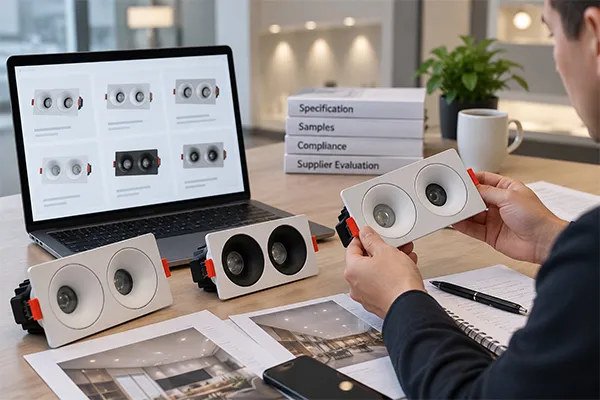
In our conversations with importers, distributors, project contractors, and private-label lighting brands, I often see the same issue: buyers start with wattage and unit price before defining what they need to sell or install. That approach can make product comparison fast, but it can also hide important commercial and technical differences.
Why Should LED Downlight Market Research Start With End Use?
Many importers begin LED downlight market research by sending a short request such as “10W downlight price?” This creates uncertainty because a 10W product can serve very different applications. Without an end-use definition, a supplier may quote a product that looks competitive but does not match the intended market position.
Importers should start LED downlight market research by defining who will buy or install the product, where it will be used, how it will be sold, and what performance level the channel expects. This information helps buyers choose suitable wattage, lumen output, cutout size, glare control, finish, packaging, compliance documents, and price level before comparing supplier quotations.
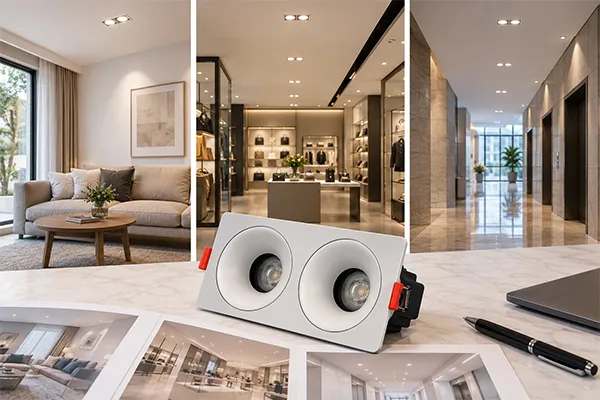
Define the Commercial Task Before the Product
A downlight is not only a lighting component. It is also a retail item, a contractor-installed item, a private-label product, or part of a larger building project. Each route creates different priorities.
For example, a wholesaler serving electrical installers may prioritize:
- Common installation sizes within its own channel
- Stable availability for repeat purchases
- Clear carton labeling and manageable packaging
- A practical balance between price and expected reliability
- Fast quotation and replacement-part communication
A project buyer may place more weight on:
- Required photometric or technical documentation
- Consistent appearance across a large installation
- Delivery scheduling
- Compatibility with ceiling conditions and cutout tolerances
- Specified CCT, beam angle, IP rating1, or CRI requirements
A private-label brand may focus on:
- Branding options
- Packaging design
- Product differentiation
- Sample approval procedures
- Longer-term batch consistency
I have seen inquiries where two buyers requested what appeared to be the same recessed LED downlight. One buyer needed an entry-level product for a price-sensitive retail channel. The other needed a higher-positioned item for a hospitality project. Their listed wattage was similar, but their actual requirements were not.
Questions to Answer Before Requesting Quotes
I suggest that buyers prepare a short product brief before beginning supplier outreach. It does not need to be complex. Even a one-page document can reduce confusion.
| Research question | Why it matters |
|---|---|
| Who is the final customer? | A contractor, retailer, homeowner, or project owner may evaluate value differently. |
| Where will the downlight be installed? | Ceiling type, moisture exposure, insulation conditions, and room use can affect product selection. |
| What is the target selling position? | Entry-level, mid-range, and premium ranges need different feature choices and quality expectations. |
| What quantity is expected for the first and repeat orders? | Order volume affects pricing, customization feasibility, and production planning. |
| Which destination market and channel apply? | Compliance requirements and documentation expectations must be checked case by case. |
| Is the product for a standard range or a branded range? | Branding, packaging, finishes, and labeling may need early planning. |
This early work makes LED downlight market research more useful because it turns a vague product search into a defined purchasing task. It also gives suppliers a clearer basis for quoting.
I encourage buyers to describe the application before asking for the lowest price. A better product brief usually produces a more useful quotation.
Qualified lighting professionals, installers, and local compliance advisers should review application-specific decisions where necessary. A supplier can provide product information, but the final suitability assessment should reflect the actual installation and market requirements.
Which LED Downlight Specifications Matter Beyond Wattage?
A common issue we see in inquiries is that buyers compare LED downlights using only wattage, cutout size, a product photo, and price. These details are useful starting points, but they are not enough for a reliable comparison. Similar headline specifications can represent different product designs and performance expectations.
The most useful LED downlight specifications include actual lumen output, efficacy, cutout and outer diameter, beam angle, CCT, CRI, driver arrangement, dimming requirements, IP rating where relevant, thermal design, material construction, and installation method. Buyers should compare these details as a complete product package rather than selecting only by wattage or appearance.
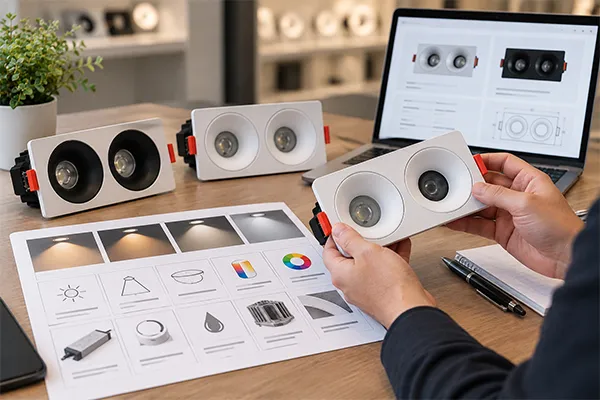
Compare Like With Like
A 10W downlight from one supplier may not be directly comparable with a 10W downlight from another supplier. The products may have different optical designs, light-source configurations, driver quality levels, heat-management approaches, materials, and intended service conditions.
During LED downlight market research, I recommend asking suppliers to provide a specification sheet that clearly states what is included. Buyers should also confirm whether the quoted product includes the driver, spring clips, cable, connector, and any required mounting accessories.
Here are core comparison points:
| Specification | What buyers should check | Why it affects procurement |
|---|---|---|
| Wattage | Rated input power and tolerance | Wattage alone does not show useful light output or product positioning. |
| Lumen output | Claimed lumens and test basis, if available | Buyers need to understand expected brightness for the intended use. |
| Efficacy2 | Lumens per watt | This can help compare energy performance when figures are measured on a comparable basis. |
| Cutout size | Required ceiling opening and tolerance | Incorrect cutout compatibility can create installation complaints. |
| Outer diameter | Visible trim size | This affects ceiling appearance and replacement compatibility. |
| Beam angle | Narrow, medium, or wide distribution | Beam angle influences spacing, brightness perception, and visual comfort.3 |
| CCT | Such as warm, neutral, or cool white | The suitable option depends on the market, project brief, and customer preference. |
| CRI | Color rendering target | Higher CRI may support certain applications4, but buyers should align it with their product position. |
| IP rating | Relevant protection level | Installation location and product construction must match. |
| Dimming | Driver and dimmer compatibility | “Dimmable” should be clarified against the planned dimming system.5 |
Product Photos Are Not Technical Evidence6
Product images are useful for evaluating appearance, trim finish, packaging style, and general design direction. However, they do not confirm construction details, dimensions, driver configuration, or batch consistency.
When a buyer asks us for a product similar to a photo, I usually recommend adding measurable requirements:
- Confirm the cutout size and visible diameter.
- Confirm the housing material and trim finish.
- State the requested CCT, CRI, beam angle, and wattage.
- Clarify whether an isolated driver, dimmable driver, or another driver configuration is required.
- Request drawings, product photos, and a sample before final approval.
- Confirm the intended ceiling and installation environment.
This process does not guarantee a product will suit every site. However, it reduces the risk of comparing products that only look similar in online listings.
Look at Installation Practicality
Installation suitability deserves more attention than it often receives. A recessed downlight must fit the actual ceiling opening and work with the available ceiling depth.7 The spring clip design, cable length, driver size, connector arrangement, and heat dissipation space may influence the installer’s experience.
For larger projects, buyers may also want to ask whether product dimensions and driver placement remain consistent between batches. Small changes can create unnecessary installation delays when contractors have already prepared cutouts or mounting plans.
How Can Importers Evaluate LED Downlight Suppliers for Repeat Orders?
Finding a product is only part of LED downlight market research. Importers also need to assess whether a supplier can support repeatable business. A competitive first quotation has limited value if later orders face unclear communication, inconsistent specifications, delayed lead times, or unresolved quality questions.8
Importers can evaluate LED downlight suppliers by reviewing quotation clarity, sample handling, product documentation, production controls, lead-time communication, customization capability, responsiveness, and support for expected order quantities. Buyers should seek evidence that a supplier can explain how the quoted product will be made, checked, packed, and delivered over time.
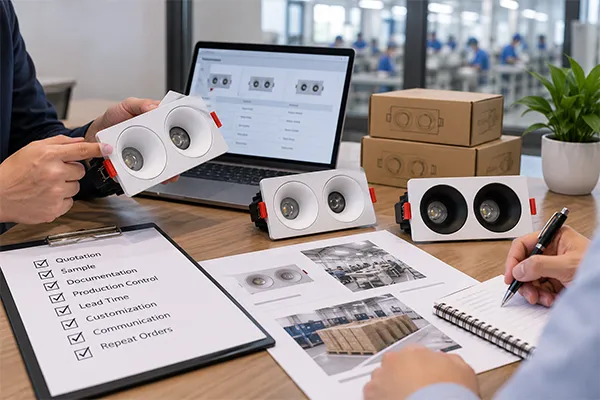
Review the Quality of the Quotation
A good quotation should do more than show a unit price. It should identify the specific product configuration being offered. If a quotation is vague, the buyer may later discover that the supplier and buyer understood the request differently.
I recommend checking whether the quotation includes:
- Product model or clear product description
- Wattage, CCT, CRI, beam angle, and cutout size
- Driver type and dimming option, if relevant
- Housing and trim finish
- Packaging information
- MOQ and pricing basis
- Sample cost and sample lead time
- Mass-production lead time
- Payment terms and trade terms
- Available customization options
- Stated documentation or certification availability
A clear quotation helps buyers compare suppliers fairly. It also creates a written reference point for sample approval and purchase-order preparation.
Use Samples as a Verification Step
Samples are not only for checking appearance. They allow buyers to review physical fit, light quality, packaging, labeling, finish consistency, and general workmanship. For project applications, qualified professionals may also need to evaluate the sample in the planned installation context.
At Upward Lighting, we understand that buyers often want to begin with small quantities or samples before committing to a wider range. This is particularly common for distributors testing a new product category or brands developing a private-label line.
A sample review can include:
- Measuring the cutout and outer diameter
- Checking trim color and surface finish
- Verifying labeling and packaging details
- Reviewing light output perception in a suitable environment
- Testing the intended dimming arrangement where applicable
- Checking driver markings and cable connections
- Comparing sample details against the approved quotation
Ask About Batch-Consistency Controls
No checklist can eliminate product, delivery, or after-sales risk. Still, buyers can reduce uncertainty by asking how a supplier manages repeat production.
Our own process includes a 100% aging test lasting approximately 4 to 8 hours before shipment, depending on the product and production arrangement. This is one production-control measure, not a universal guarantee of field performance. Buyers should ask suppliers what their testing procedures cover and how those procedures relate to the ordered product.
Useful supplier questions include:
- How are incoming materials checked?
- Are product parameters recorded for each order?
- What aging or functional testing is performed before shipment?
- How are CCT, wattage, driver, and finish changes controlled?
- How does the supplier handle nonconforming products?
- How are packing and labeling verified?
- What information is available if a buyer needs to trace an order later?
A supplier’s response should be specific and understandable. I believe buyers should be cautious when answers remain general, especially when the order involves a private label, project schedule, or a product with custom parameters.
How Should Compliance and OEM/ODM Fit Into LED Downlight Market Research?
Compliance and customization are often discussed late in the buying process. That timing can create rework because documentation, labeling, electrical configuration, packaging, or product design may need adjustment before a product can fit the target channel. I recommend including these topics at the start of LED downlight market research.
Importers should identify destination-market and channel requirements early, then ask suppliers which documents apply to the exact product configuration. Buyers should also define OEM/ODM changes—such as CCT, wattage, beam angle, CRI, finish, packaging, or branding—according to a clear market position, not simply because customization is available.
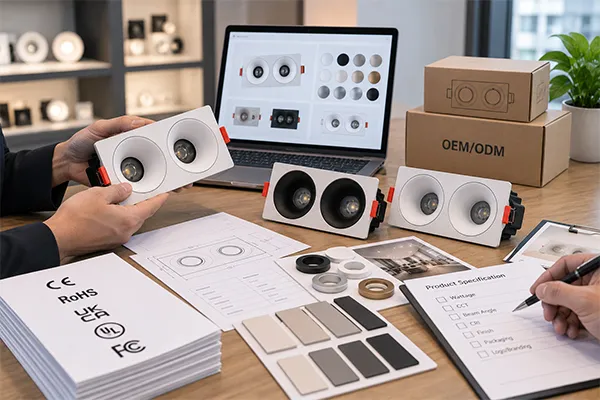
Verify Documents Against the Actual Market
Certification and compliance requirements can vary by destination, sales channel, project type, electrical installation, and buyer requirement. A document that is relevant in one context may not be sufficient in another.
For example, Upward Lighting products hold certifications such as CE and RoHS for applicable product and market-entry requirements. However, I would not advise an importer to assume that CE or RoHS automatically qualifies any product for every country, project, retailer, or channel9. Buyers should verify the documentation against their own destination-market obligations.
When reviewing documents, buyers should consider asking:
- Does the document identify the same product model or product family?
- Does the stated configuration match the proposed wattage, driver, and electrical specification?
- Is the document current and issued by an identifiable organization?
- Does the intended market require additional approval, registration, marking, testing, or local representation?
- Does a retailer, project consultant, or contractor impose additional documentation requirements?
- Does product labeling need to include specific information?
Local compliance professionals, testing bodies, and qualified advisers should be consulted where the application requires formal interpretation. Manufacturers can provide available documents, but buyers remain responsible for verifying what their market and channel require.
Use Customization to Support a Product Strategy
OEM/ODM capability can help importers create a stronger range, but customization should solve a commercial or technical need. It should not create unnecessary complexity.
At our factory in Zhongshan City, we can discuss options such as:
- Color temperature
- Wattage
- Beam angle
- CRI
- Surface finish color
- Packaging
- Branding and labeling, subject to project details
A distributor may choose a small set of CCT options to simplify inventory. A private-label brand may select a particular trim finish and packaging design to support a consistent identity. A project buyer may need a defined beam angle and CRI to align with a design brief.
Each change should be documented before production.10 Buyers should confirm whether the requested configuration affects MOQ, lead time, sample timing, pricing, documentation, or packaging.
Avoid Too Many SKUs Too Early
New importers sometimes create an overly broad product range before they understand demand in their channel. This can increase inventory pressure and make repeat ordering harder.11
A more controlled launch may include:
- A small number of core cutout sizes
- A focused selection of CCT options
- One or two finishes that fit the intended brand position
- Clear packaging for the target sales route
- Approved samples and documented specifications
- A review period before expanding the range
This approach supports more disciplined LED downlight market research because the buyer learns from actual sales feedback rather than trying to predict every possible variation at the beginning.
What Is a Practical LED Downlight Market Research Workflow?
The research process can feel fragmented when buyers collect online listings, catalogues, samples, documents, and quotations from multiple suppliers. A simple workflow helps importers compare evidence in the right order and avoid making a final decision based on one attractive feature.
A practical LED downlight market research workflow moves from end-use definition to specification comparison, supplier screening, sample approval, document verification, and controlled first-order planning. Each step should create a written record that makes later repeat orders easier to manage and compare.
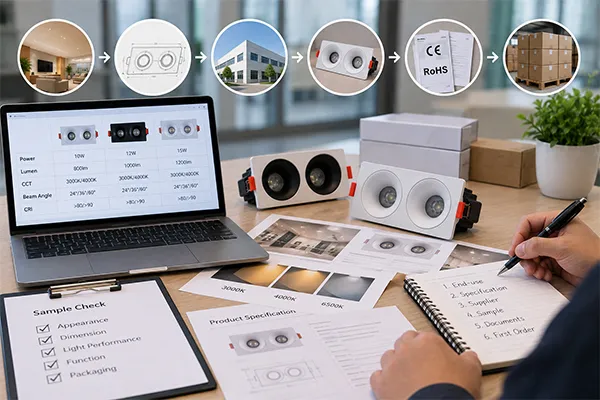
A Seven-Step Procurement Framework
I suggest the following framework for newer importers and buyers expanding an existing lighting range.
-
Define the target market and use case
Identify the customer type, installation setting, sales channel, intended price position, and expected first-order volume. -
Create a product specification brief
Include cutout, outer diameter, wattage, lumen expectation, CCT, CRI, beam angle, finish, driver requirements, packaging, and branding needs. -
Shortlist suppliers using comparable requests
Send the same core brief to each supplier. This makes quotation differences easier to understand. -
Review quotation completeness
Compare not only unit price but also configuration, MOQ, lead time, samples, packaging, customization, and commercial terms. -
Request and evaluate samples
Check physical dimensions, finish, labeling, installation practicality, and performance suitability for the intended use. -
Verify applicable documents
Confirm what the destination market and channel require. Review whether supplier documents relate to the proposed configuration. -
Place a controlled first order
Use an approved specification, packaging reference, labeling requirements, delivery terms, and agreed communication process.
Build a Comparison Sheet
A structured sheet can make supplier selection more objective. It also helps internal teams explain why one supplier was selected over another.
| Evaluation area | Supplier A | Supplier B | Supplier C |
|---|---|---|---|
| Product fit for intended use | |||
| Quotation clarity | |||
| Sample quality and consistency | |||
| Customization feasibility | |||
| Document availability | |||
| Lead-time communication | |||
| MOQ suitability | |||
| Packaging and branding support | |||
| Response speed | |||
| Repeat-order confidence |
A comparison sheet does not replace technical evaluation or compliance advice. However, it gives purchasing teams a more reliable decision record than an informal collection of emails and screenshots.
Frequently Asked Questions
What is the first step in LED downlight market research?
The first step is defining the end use. I recommend identifying the target customer, installation environment, destination market, channel, desired price position, and expected order quantity. This information gives suppliers a clearer basis for recommending a suitable recessed LED downlight configuration.
Is wattage enough to compare LED downlights?
No. Wattage is only one starting point. Buyers should also compare lumen output, cutout size, beam angle, CCT, CRI, driver type, dimming requirements, housing construction, finish, packaging, and installation suitability. Similar wattage ratings can represent different products and expected performance levels.
How can I verify an LED downlight supplier?
Importers can request a detailed quotation, product specification sheet, samples, production information, packaging details, and applicable documents. I also recommend reviewing communication quality, customization responses, MOQ flexibility, lead-time clarity, and how the supplier explains batch-consistency and quality-control procedures.
Do CE and RoHS documents allow me to sell LED downlights in every market?
No. CE and RoHS should not be treated as automatic approval for every destination, project, or sales channel. Requirements depend on the market and application. Buyers should verify documentation for the specific product configuration and seek qualified local compliance advice when needed.
Can OEM/ODM customization help a new lighting brand?
Yes, when customization supports a defined market position. Options such as CCT, wattage, beam angle, CRI, trim finish, packaging, and branding can help differentiate a range. However, buyers should confirm the effect on MOQ, pricing, samples, lead time, documentation, and inventory complexity.
Conclusion
Effective LED downlight market research is not a race to locate the lowest quoted wattage. I believe it is a structured process of defining the selling or installation task, comparing complete specifications, reviewing samples, verifying applicable documents, and assessing supplier capability for repeat orders. Importers can reduce avoidable risk by documenting requirements early and selecting product configurations that fit their real channel needs. If you are sourcing LED downlights for distribution, projects, or private-label development, our team at Upward Lighting can help you prepare a clearer product brief, quotation request, and OEM/ODM discussion.
"IP code - Wikipedia", https://en.wikipedia.org/wiki/IP_code. IEC 60529 defines the IP Code as a classification system for the protection provided by enclosures against access, ingress of solid foreign objects, and ingress of water. Evidence role: definition; source type: institution. Supports: That the IP Code in IEC 60529 classifies enclosure protection against access, solid foreign objects, and water.. Scope note: An IP classification addresses ingress protection only; it does not establish suitability for every environmental, electrical, or installation condition. ↩
"LED Basics - Department of Energy", https://www.energy.gov/cmei/ssl/led-basics. U.S. government lighting guidance defines luminous efficacy as the ratio of light output in lumens to input power in watts, commonly reported as lumens per watt. Evidence role: definition; source type: government. Supports: The definition of luminous efficacy as luminous flux divided by electrical power, commonly reported in lumens per watt.. Scope note: Comparisons remain meaningful only when products are measured under suitably comparable test conditions and reporting conventions. ↩
"[PDF] Understanding LM-79 Reports - Better Buildings Solution Center", https://betterbuildingssolutioncenter.energy.gov/sites/default/files/attachments/understanding_lm79_reports.pdf. Lighting-design guidance explains that a luminaire's beam spread and intensity distribution determine the area and pattern of illumination, making beam angle relevant to fixture spacing and visual conditions. Evidence role: mechanism; source type: institution. Supports: That beam spread and luminous-intensity distribution affect how light is distributed across a task plane and influence lighting layout.. Scope note: Visual comfort also depends on luminance, shielding, mounting geometry, room reflectances, and the specific installation. ↩
"Purchasing Energy-Efficient Light Bulbs", https://www.energy.gov/cmei/femp/purchasing-energy-efficient-light-bulbs. U.S. lighting guidance describes the color rendering index as an indicator of how naturally or faithfully a source renders colors relative to a reference source, which can matter in color-sensitive applications. Evidence role: definition; source type: government. Supports: That CRI is a measure used to describe how faithfully a light source renders object colors relative to a reference illuminant.. Scope note: CRI is not a complete predictor of perceived color quality and should be considered with other color-quality measures where relevant. ↩
"[PDF] LED Dimming: What you need to know - eere.energy.gov", https://www1.eere.energy.gov/buildings/publications/pdfs/ssl/dimming_webcast_12-10-2012.pdf. U.S. Department of Energy guidance notes that LED dimming performance can depend on compatibility between the LED product or driver and the selected dimmer or control system. Evidence role: general_support; source type: government. Supports: That LED dimming performance depends on compatibility among the LED lamp or driver, dimmer, and control method.. Scope note: Compatibility must be verified for the particular driver, dimmer model, load, and wiring arrangement in use. ↩
"Perform Due Diligence - International Trade Administration", https://www.trade.gov/perform-due-diligence. International trade due-diligence guidance emphasizes documented specifications, samples, and inspection or verification procedures when assessing suppliers and products, rather than relying solely on catalog imagery. Evidence role: general_support; source type: government. Supports: That import purchasing due diligence relies on specifications, samples, and inspection or verification rather than visual marketing material alone.. Scope note: Such guidance does not mean photographs have no value; they can still assist with preliminary assessment of visible appearance. ↩
"[PDF] ELECTRICAL INSTALLATION CONDITION REPORTING", https://www.electricalsafetyfirst.org.uk/media/mi1oqkur/best-practice-guide-4-issue-7-1.pdf. Electrical installation guidance requires luminaires to be installed in accordance with manufacturer instructions and with suitable consideration of the mounting location, clearances, and associated wiring arrangements. Evidence role: general_support; source type: government. Supports: That recessed luminaires need to be selected and installed with regard to the opening, clearance, and manufacturer installation instructions.. Scope note: Exact cutout, depth, and clearance requirements are product-specific and must be taken from the applicable luminaire instructions and local rules. ↩
"Supply Chain Management - NIST", https://www.nist.gov/mep/supply-chain. ISO 9001 quality-management guidance addresses the evaluation, selection, monitoring, and re-evaluation of external providers according to their ability to supply processes, products, and services that meet requirements. Evidence role: expert_consensus; source type: institution. Supports: That quality-management systems treat external-provider evaluation and ongoing monitoring as relevant to consistently meeting requirements.. Scope note: Conformance with a quality-management framework does not guarantee a supplier's future delivery, communication, or field-performance outcomes. ↩
"CE marking – obtaining the certificate, EU requirements - Your Europe", https://europa.eu/youreurope/business/product-rules-compliance/general-product-compliance/ce-marking/index_en.htm. European Commission guidance states that CE marking applies only to products covered by relevant EU harmonisation legislation, while RoHS sets separate restrictions for electrical and electronic equipment; these EU requirements do not themselves determine acceptance in all non-EU markets or private channels. Evidence role: general_support; source type: government. Supports: That CE marking applies to products covered by relevant EU harmonisation legislation and that RoHS is a separate EU restriction-of-hazardous-substances regime.. Scope note: The precise obligations depend on the product, destination, applicable legislation, and any additional contractual or project requirements. ↩
"Quality Management System Implementation - NIST", https://www.nist.gov/mep/successstories/2023/quality-management-system-implementation. ISO 9001 guidance requires planned changes affecting production and service provision to be reviewed and controlled, with documented information retained as appropriate to demonstrate conformity. Evidence role: expert_consensus; source type: institution. Supports: That quality-management practice includes controlling and documenting changes to production and service provision so that continuing conformity can be maintained.. Scope note: The standard does not prescribe a single documentation format or substitute for product-specific engineering validation. ↩
"AI in Omnichannel | Center for Transportation and Logistics - MIT CTL", https://ctl.mit.edu/ai-omnichannel. Supply-chain research on SKU proliferation finds that expanding assortment can increase forecasting and replenishment complexity and can raise inventory-management burdens when demand is uncertain. Evidence role: general_support; source type: research. Supports: That greater assortment and SKU proliferation can increase forecasting, replenishment, and inventory-management complexity.. Scope note: A broader assortment may still be commercially justified when additional variants generate sufficient demand or strategic value. ↩