
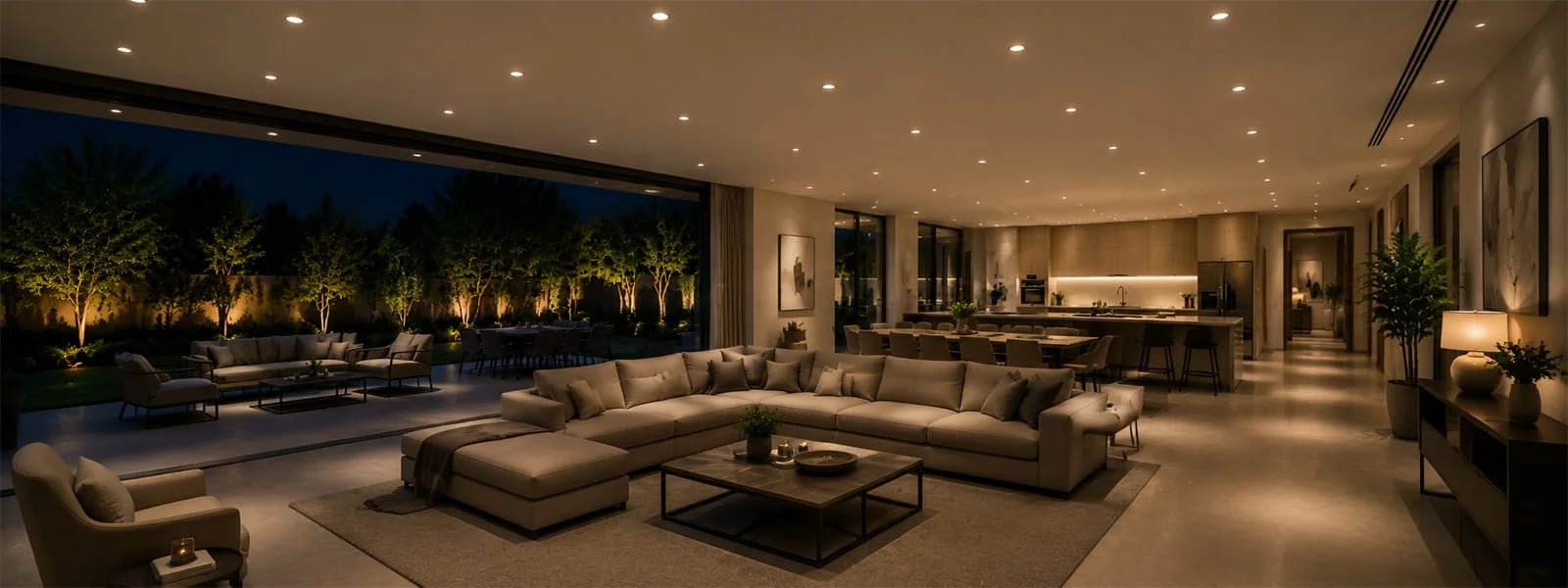
LED downlight safety standards can feel confusing for importers, contractors, and lighting brands because a product may carry a familiar logo while still being unsuitable for the intended market or installation1. That confusion can create approval delays, rework, and liability concerns. I recommend evaluating the exact product, documents, driver, and installation scenario together.
LED downlight safety standards are not proven by one logo, one test report, or one factory statement. Buyers should confirm that the exact downlight configuration—including its wattage, driver, input voltage, trim, body, and intended installation conditions—matches the target market’s requirements. Compliance documents, environmental declarations, third-party certification, and factory aging tests each serve different purposes and should be reviewed separately.
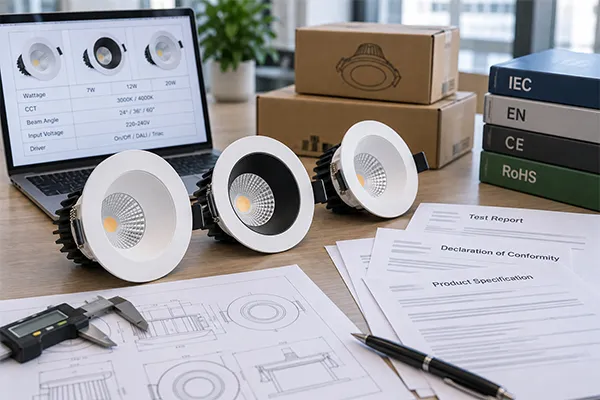
When I discuss compliance with customers, I often find that the first question is, “Do you have CE?” That is understandable, but it is rarely enough to make a purchasing decision. A safer procurement process starts with the market, the application, and the exact model that will be installed.
Why Do LED Downlight Safety Standards Start With the Installation Scenario?
Buyers sometimes select a downlight first and ask about safety documents later. That approach can cause problems when the selected driver, ceiling condition, or voltage arrangement does not fit the project. I believe the installation scenario should guide the review from the beginning.
LED downlight safety standards should be evaluated according to where and how the product will be installed. Buyers need to consider the destination market, electrical supply, ceiling material, thermal conditions, moisture exposure, wiring method, and whether the downlight uses an integrated or remote driver before accepting compliance documents.
A Downlight Is Part of an Electrical System
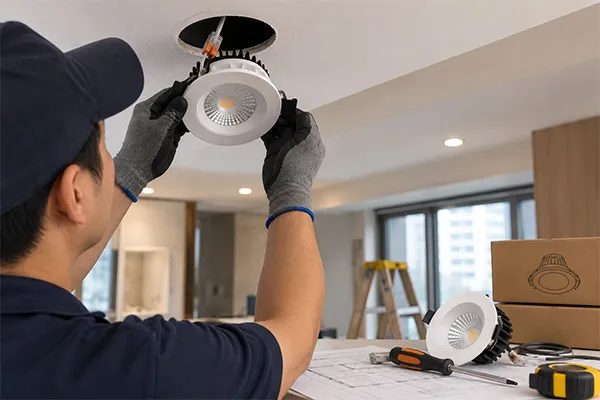
A recessed LED downlight may look like a simple finished product, but I view it as part of a wider installed electrical system. The fixture interacts with its driver, supply wiring, connectors, ceiling cavity, insulation materials, mounting method, and the skills of the installer.2
This matters because a suitable product for one project may not be suitable for another. For example, a downlight intended for a ventilated ceiling cavity may need a different thermal evaluation than one installed in a tightly enclosed space3. Likewise, a model with a remote driver creates different wiring and access considerations from an integrated-driver downlight.
Before I quote a project, I encourage buyers to define the following points:
- Destination market: The required market-access route can vary by location and product category.
- Installation type: Recessed, surface-mounted, retrofit, or new-build installation.
- Ceiling construction: Plasterboard, metal ceiling, wood, concrete, suspended ceiling, or other materials.
- Available cavity depth: The driver and heat dissipation space must fit the ceiling design.
- Ambient conditions: Indoor dry areas, humid locations, covered outdoor spaces, or other environments.
- Electrical system: Input voltage, frequency, wiring arrangement, dimming controls, and surge conditions.
- Maintenance access: Remote drivers may need to remain accessible for service or replacement.
- Application expectations: Residential, hospitality, retail, office, or commercial project use may involve different specification priorities.
I do not treat low voltage as an automatic safety conclusion. A low-voltage LED module still depends on the driver, output connections, insulation, heat management, and correct installation practice.4
Ask Better Questions Before Requesting Documents
Instead of asking only, “Do you have a certificate?” I recommend asking more specific procurement questions:
- Which exact downlight model is proposed?
- Which wattage and input voltage are required?
- Is the driver integrated or remote?
- Which dimming method, if any, will be used?
- Does the selected report or declaration identify the proposed configuration?
- What installation limits should the contractor follow?
- Does the target market require a particular approval route or local review?
At Upward Lighting, I have seen customers avoid unnecessary back-and-forth when they share an application brief early. A basic project description can help us check whether the proposed wattage, cutout, beam angle, color temperature, driver arrangement, and product documentation are aligned.
That process is not legal advice or a substitute for local certification guidance. However, it is a practical first step that helps purchasing teams avoid selecting a product based only on appearance, price, or a generic document title.
What Is the Difference Between CE, RoHS, Certifications, and Aging Tests?
Many buyers group all quality and compliance evidence into one category. That creates risk because different documents answer different questions. I regularly receive inquiries that treat RoHS as an electrical safety certificate or assume a factory aging test replaces third-party evaluation.
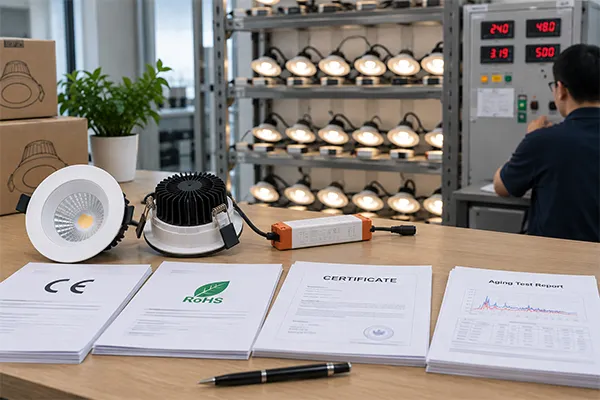
LED downlight safety standards involve several types of evidence, but each has a limited role. Compliance documentation may support market-access obligations, third-party certification may provide independent assessment within a defined scope, RoHS relates to restricted substances, and aging tests support factory quality control. None of these items alone proves universal approval or complete installation safety.
Documentation Has Different Purposes
I find it helpful to separate the evidence into four practical categories.
| Evidence Type | Main Purpose | What Buyers Should Verify | What It Does Not Automatically Prove |
|---|---|---|---|
| Compliance documentation | Supports a stated regulatory or market-access position | Exact model, responsible party, issue date, product description, applicable scope | Universal global acceptance |
| Third-party certificates or test reports | Provides independent assessment within a defined product scope | Laboratory identity, model coverage, configuration, validity, report scope | Suitability for every project or market |
| Environmental declarations | Addresses restricted substances or environmental requirements | Product coverage, supplier declaration details, current revision | Electrical safety or installation suitability |
| Factory aging tests | Screens products for early-life defects before shipment | Test duration, test process, sample coverage, records | Full compliance, laboratory certification, or field lifetime |
CE and RoHS Should Not Be Treated as the Same Claim
In our own documentation process, we keep CE-related documentation and RoHS-related documentation distinct because they address different topics. Customers sometimes ask whether RoHS means a downlight is “safe.” I explain that RoHS is generally associated with restrictions on certain substances.5 It should not be treated as proof that the fixture, driver, wiring arrangement, or installation is electrically safe.6
Similarly, a CE marking or CE-related declaration should not be treated as a universal passport for every country or every project7. Buyers should verify the target market’s current requirements through qualified local compliance professionals, import specialists, certification bodies, or legal advisers where necessary.
What Our Aging Test Does—and Does Not—Show
At Upward Lighting, we conduct a 100% pre-shipment aging test that typically lasts 4 to 8 hours. We use this process as a manufacturing quality-control measure. It helps us identify obvious early failures before goods leave the factory, such as instability in illumination, driver-related abnormalities, or assembly issues that appear during continuous operation.8
I consider this test valuable, especially for importers who want better shipment-level consistency. Still, I do not describe aging as a substitute for:
- Product certification
- Regulatory compliance evaluation
- Third-party laboratory testing
- Installation assessment
- Long-term lifetime validation
- Local market approval
A responsible supplier should explain these limits clearly. A buyer should value aging-test procedures, but should also ask for the documentation and technical review appropriate to the actual sales market and application.
How Can Buyers Confirm That Documents Match the Exact Downlight Model?
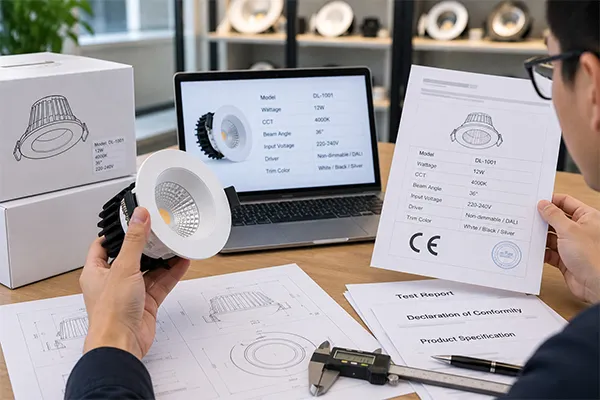
A certificate or report can look convincing while covering only part of the proposed product range. This issue becomes more important when buyers request customized wattage, color temperature, beam angle, trim color, or driver options. I recommend treating model-to-document consistency as a core supplier-selection task.
LED downlight safety standards can only support a purchasing decision when the documents cover the exact product configuration being ordered. Buyers should compare the model number, wattage, voltage, driver, housing, trim, and relevant variants against reports, declarations, labels, drawings, and purchase-order specifications before production begins.
Product Families Need Careful Review
A product family may include several visually similar downlights. However, small design changes can matter. A 7W unit and a 15W unit may use different drivers, heat sinks, LED boards, wiring layouts, or housing dimensions.9 A change from one input-voltage arrangement to another can also affect the relevant documentation scope.
I have found that the safest approach is not to assume that a family name covers every possible option. Instead, buyers should request a model-mapping review.
Compare These Items Line by Line
I recommend checking at least the following details:
| Item to Compare | Why It Matters |
|---|---|
| Model number or internal code | It connects the purchased item to the document set. |
| Wattage | Different wattages can have different thermal and driver characteristics. |
| Input voltage and frequency | Electrical supply compatibility must match the intended installation. |
| Driver brand and model | A driver change can materially alter the product configuration.10 |
| Integrated or remote driver | The installation method and wiring arrangement may differ. |
| Housing and trim construction | Material, dimensions, and mounting components can affect the product identity. |
| Cutout size and dimensions | These details help confirm that the physical item matches drawings and order requirements. |
| Dimming option | Dimmable and non-dimmable versions may not be identical configurations. |
| Color temperature and LED board variant | These may be commercial options, but buyers should confirm whether they affect the documented model scope. |
| Product label | The label should align with the purchase order and technical documentation. |
Build a Simple Document-Control File
For repeat procurement, I suggest that purchasing teams maintain a simple document-control file for each SKU. This does not need to be complicated. A spreadsheet or shared product folder can be enough when it includes:
- Approved product photo
- Product drawing
- SKU and model code
- Bill of key components, especially the driver
- Applicable reports and declarations
- Label artwork
- Packaging artwork
- Revision date
- Approved customization options
- Supplier contact and document owner
At our factory, we check document-to-model consistency when customers request specific versions. This is especially useful for OEM and ODM orders because customized surface finishes, wattage options, beam angles, and color temperatures can create multiple sellable variants under one customer brand.
I would still advise buyers to involve qualified compliance specialists when the target market requires detailed confirmation. Factory documentation checks are useful controls, but they are not a replacement for independent regulatory interpretation.
How Should Buyers Evaluate a Supplier’s LED Downlight Safety Standards Process?
A supplier can provide a folder of documents, but procurement quality depends on how that supplier controls production, revisions, components, and communication. I believe buyers should evaluate the supplier’s process, not only the files they send after an inquiry.
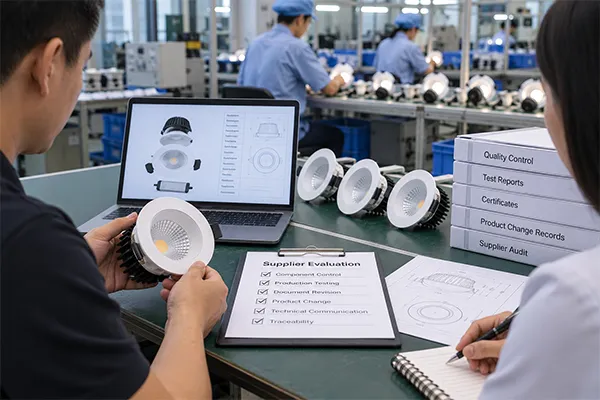
LED downlight safety standards are more credible when suppliers can explain how they control components, production testing, document revisions, and product changes. Buyers should look for clear model identification, responsive technical communication, traceable documentation, and realistic statements about what each test or certificate covers.
Look Beyond the Certificate Folder
During supplier evaluation, I recommend asking how the manufacturer manages changes. A downlight can change over time because of driver availability, LED component updates, housing revisions, packaging changes, or customer customization. These changes are not automatically negative. In fact, controlled improvement can be valuable. The key question is whether the supplier identifies and manages the change properly.
Useful supplier-evaluation questions include:
- How do you identify each downlight model and variant?
- How do you control driver substitutions?
- Can you provide current drawings and labels before production?
- What is your pre-shipment testing process?
- Do you perform aging tests on all units or selected samples?
- How do you handle non-conforming products?
- Who checks that sales documents match the ordered model?
- How do you manage OEM branding and custom specifications?
- Can you support small-batch orders without mixing variants?
- How quickly can you clarify document questions?
Review Manufacturing Quality Control Separately
At Upward Lighting, our 100% 4–8-hour aging process is one part of our shipment quality-control routine. For buyers, this can provide an additional layer of confidence that every unit has operated before dispatch. However, I encourage customers to ask about broader controls as well.
A practical quality-control review may include:
- Incoming component control for drivers, LED modules, housings, lenses, and connectors.
- In-process inspection during assembly.
- Electrical and functional checks before aging.
- Aging-test records for pre-shipment screening.
- Visual inspection for finish, trim condition, labeling, and packaging.
- Final quantity and carton checks before loading.
- Document review to confirm the shipping product matches the approved SKU.
Use Samples and Pre-Production Approval
For larger orders or custom projects, I recommend approving a sample before mass production. A sample lets buyers inspect practical details that documents alone may not show clearly11:
- Heat sink design
- Driver placement
- Spring clip construction
- Trim finish
- Cutout fit
- Glare control
- Cable length
- Connector style
- Product labeling
- Packaging protection
I have seen that a well-managed sample approval process reduces misunderstandings later. It also helps contractors, product managers, and technical leads confirm that the selected downlight fits the actual installation plan.
The goal is not to make procurement unnecessarily difficult. The goal is to make each decision traceable, realistic, and suitable for the intended application.
Frequently Asked Questions
Does CE mean an LED downlight can be sold everywhere?
No. CE-related documentation should not be treated as universal approval for every country or project. Buyers should confirm the target market’s current requirements, the applicable product scope, and importer responsibilities with qualified local compliance or certification specialists.
Is RoHS proof that an LED downlight is electrically safe?
No. RoHS-related documentation concerns restricted substances and environmental compliance matters. It does not by itself demonstrate electrical safety, driver suitability, thermal performance, installation compatibility, or approval for a specific market.
Does a 100% aging test replace product certification?
No. A 100% aging test is a factory quality-control process that can help identify early operational defects before shipment. It does not replace laboratory testing, certification, regulatory review, installation assessment, or confirmation of market access.
Can one certificate cover every downlight in a product family?
Not always. Similar-looking downlights may differ in wattage, driver, input voltage, housing, dimming function, or other technical details.12 Buyers should verify whether the exact purchased configuration is identified within the scope of the relevant document.
Are low-voltage LED downlights automatically safe?
No. Low-voltage operation does not remove risks related to the driver, electrical connections, wiring, heat dissipation, ceiling conditions, moisture exposure, and installation practice. A qualified installer should assess application-specific requirements.
Conclusion
LED downlight safety standards require more than checking for a familiar logo or requesting a general certificate. I recommend that buyers begin with the destination market and installation scenario, then verify that documents match the exact downlight configuration being purchased. CE-related documents, RoHS declarations, third-party reports, and aging tests each have different roles. At Upward Lighting, we support document-to-model checks, OEM/ODM customization, and 100% 4–8-hour pre-shipment aging tests to help buyers build a more controlled procurement process. Contact us to discuss your downlight specifications and documentation requirements.
"CE marking", https://en.wikipedia.org/wiki/CE_marking. European Commission guidance explains that CE marking signifies conformity with applicable EU requirements for the product concerned; it is not a general indication of acceptance in all markets or of suitability for every installation. Evidence role: general_support; source type: government. Supports: Official guidance that CE marking applies only where relevant EU requirements have been met and does not independently establish suitability under every jurisdictional or installation-specific requirement.. Scope note: The guidance addresses the EU conformity-marking framework and does not determine requirements in non-EU markets. ↩
"Recessed Lighting - Code Compliance Brief", https://basc.pnnl.gov/code-compliance/recessed-lighting-code-compliance-brief. Luminaire safety requirements evaluate the equipment together with specified mounting, wiring, temperature, and surrounding-material conditions, reflecting that recessed-luminaire safety is installation dependent. Evidence role: mechanism; source type: institution. Supports: Luminaire safety standards and installation guidance address wiring, mounting, temperature, enclosure conditions, and interaction with building materials.. Scope note: The precise requirements vary by the applicable national adoption of the standard and the luminaire's rated installation conditions. ↩
"How to Choose Bulbs for Enclosed Fixtures", https://blog.1000bulbs.com/home/how-to-choose-bulbs-for-enclosed-fixtures. Research on LED thermal management shows that restricted airflow and higher enclosure temperatures can raise luminaire component temperatures, making thermal performance dependent on the installation environment. Evidence role: mechanism; source type: research. Supports: Thermal performance of LED luminaires is affected by ambient temperature, airflow, and enclosure conditions because these factors alter heat dissipation and component temperature.. Scope note: Thermal findings are configuration-specific and do not establish the compliance status of any particular downlight. ↩
"EN IEC 61347-2-11:2024 - Safety Standard for Luminaire ...", https://standards.iteh.ai/catalog/standards/clc/14dd5ed7-e2e7-4ae3-ac83-c41e8368bd5b/en-iec-61347-2-11-2024?srsltid=AfmBOop6JWHoDp-hBZ5hSzdIYqp2M2Tlamy5aaJQJ6kA4dzf1kh0_Ac2. LED controlgear and luminaire safety requirements address insulation, connection integrity, abnormal conditions, and temperature control; low-voltage LED output alone does not address all electrical and installation hazards. Evidence role: mechanism; source type: institution. Supports: Safety requirements for LED controlgear and luminaires cover insulation, electrical connections, abnormal operation, and temperature even where the LED output is low voltage.. Scope note: The exact hazards and protective requirements depend on the driver design, output classification, and applicable standard. ↩
"European Union Reduction of Hazardous Substances ...", https://www.waru.edu/artifact/european-union-reduction-hazardous-substances-rohs-and-waste-electrical-and-electronic. Directive 2011/65/EU restricts specified hazardous substances in electrical and electronic equipment placed on the EU market, subject to defined scope provisions and exemptions. Evidence role: definition; source type: government. Supports: The EU RoHS Directive restricts the use of named hazardous substances in electrical and electronic equipment, subject to its scope and exemptions.. Scope note: RoHS obligations, exemptions, and enforcement details can change and must be checked for the relevant product and jurisdiction. ↩
"European Union Reduction of Hazardous Substances ...", https://www.waru.edu/artifact/european-union-reduction-hazardous-substances-rohs-and-waste-electrical-and-electronic. EU RoHS rules concern hazardous-substance restrictions in electrical and electronic equipment; they do not constitute an electrical-safety assessment of luminaire construction, controlgear, wiring, or installation. Evidence role: general_support; source type: government. Supports: RoHS concerns restrictions on hazardous substances, whereas electrical-safety requirements are established under separate product-safety legislation and standards.. Scope note: A product may be subject to multiple legal instruments, and the applicable electrical-safety route depends on its market and product classification. ↩
"EU - EU Legislation and CE Marking", https://www.trade.gov/country-commercial-guides/eu-eu-legislation-and-ce-marking. European Commission guidance states that CE marking is required only for products covered by relevant EU harmonisation legislation and is not a general quality or worldwide approval mark. Evidence role: definition; source type: government. Supports: CE marking is used for products covered by relevant EU harmonisation legislation and is not a worldwide approval mark.. Scope note: Some non-EU jurisdictions may recognize particular EU documentation in limited contexts, but recognition must be verified under local rules. ↩
"Physical models of infant mortality: implications for defects in ...", https://pmc.ncbi.nlm.nih.gov/articles/PMC7719151/. Reliability literature describes burn-in and screening as methods intended to reveal some early-life failures before field use by operating products under controlled conditions. Evidence role: mechanism; source type: paper. Supports: Reliability screening or burn-in can expose some early-life failures by operating components under defined conditions before deployment.. Scope note: Screening effectiveness depends on the test profile, duration, stress level, failure mechanisms, and production controls; it cannot demonstrate long-term field reliability by itself. ↩
"Impact of Thermal Dissipation on the Lighting Performance ...", https://pmc.ncbi.nlm.nih.gov/articles/PMC8776062/. LED-luminaire design research links operating power to driver selection, thermal-path design, and component temperatures, so wattage variants can require materially different electrical or thermal constructions. Evidence role: mechanism; source type: research. Supports: LED luminaire electrical and thermal design is related to input power, component ratings, heat dissipation, and driver selection.. Scope note: This general engineering relationship does not prove that any two particular models use different components. ↩
"Impact of Thermal Dissipation on the Lighting Performance ...", https://pmc.ncbi.nlm.nih.gov/articles/PMC8776062/. Studies of LED systems show that driver characteristics govern LED electrical operating conditions and can influence dimming behavior, temperature, efficiency, and reliability; a driver substitution can therefore change the luminaire configuration. Evidence role: mechanism; source type: paper. Supports: LED drivers determine output current or voltage and can affect LED electrical loading, temperature, dimming behavior, and system performance.. Scope note: Whether a specific substitution affects certification or conformity depends on the documented product design and the relevant assessment scope. ↩
"NIST Quality System", https://www.nist.gov/nist-quality-system. Quality-management guidance recognizes inspection and verification of products against specified requirements as controls that complement documentary review and can identify observable differences in construction, labeling, finish, or fit. Evidence role: general_support; source type: institution. Supports: Quality-assurance practice uses inspection and verification to determine whether delivered or pre-production products meet specified requirements.. Scope note: Sample inspection is not a substitute for statistically appropriate production controls, laboratory testing, or regulatory conformity assessment. ↩
"Conformity assessment — Vocabulary and general principles", https://www.iso.org/obp/ui/#iso:std:iso-iec:17000:en. Conformity-assessment practice relies on defined product identification and assessment scope; changes to relevant components, ratings, or functions may require review to determine whether existing evidence remains applicable. Evidence role: general_support; source type: institution. Supports: Conformity assessment and certification depend on defined product scope, identification, and control of relevant variations or modifications.. Scope note: The significance of a given variation is determined by the applicable scheme, standard, certification body, and product documentation. ↩