

LED downlight SKU planning can become difficult when distributors try to cover every cutout, wattage, color temperature, and price point at once. That approach often creates slow-moving stock, confusing quotations, and cash tied up in nearly identical products1. I recommend building a focused, replenishable range around the demand patterns your customers actually buy.
A practical LED downlight SKU planning strategy separates core stock, project-led models, and order-based customization. Distributors should prioritize installation type, cutout size, light output, CCT, and beam angle because these variables determine real buying compatibility2. Every additional SKU should meet a distinct customer need and justify its inventory, training, quotation, replenishment, and after-sales cost.
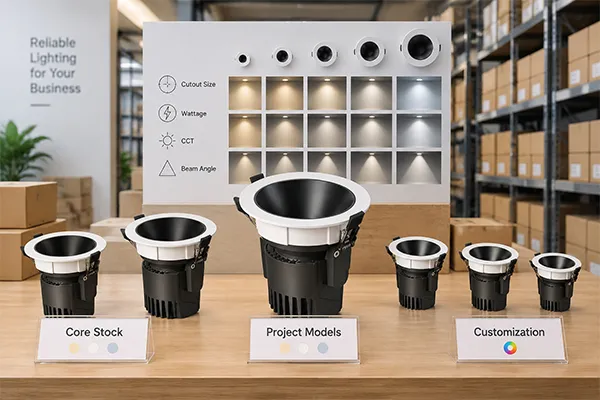
I have supported many distributor and importer discussions from the manufacturer side, and the same questions appear repeatedly: “Which cutout should we stock?” “Do we need three CCT options?” “Can we sell the same model to retail customers and project contractors?” The best answer is rarely “stock more.” It is usually “stock more deliberately.”
How Should Distributors Start LED Downlight SKU Planning?
New distributors often begin LED downlight SKU planning with a supplier price list. That process feels efficient, but it can lead to a range built around factory availability rather than local customer demand. The result is a catalogue with many options but little commercial focus.
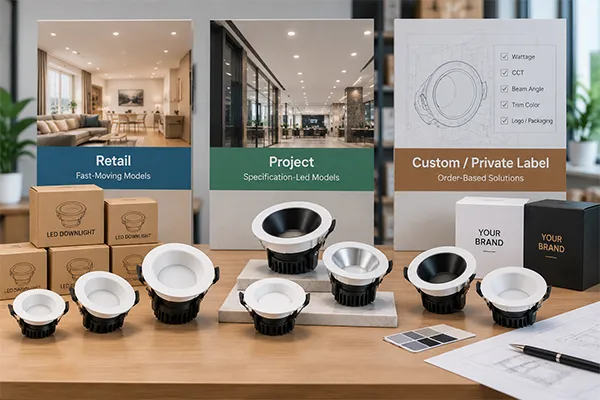
Distributors should start LED downlight SKU planning by identifying customer tasks and sales routes. A practical range normally separates fast-moving retail models, specification-led project models, and custom or private-label orders. This structure helps buyers cover common demand without treating every possible variation as standard inventory.
Start With the Customer’s Buying Job
I encourage distributors to ask what the customer is trying to accomplish, not simply which product they request first. A homeowner replacing an existing fitting has a different buying task from a contractor quoting a hotel corridor.3 Likewise, a local lighting brand creating its own product line has different needs from a building-material wholesaler.
Most downlight demand falls into three commercial groups:
| Route to market | Typical buyer need | Suitable SKU approach |
|---|---|---|
| Retail and counter sales | Easy replacement, familiar cutouts, clear price point, quick availability | Keep a narrow core range in stock |
| Contractor and project sales | Consistent specification, quantity availability, documented requirements | Stock selected project models or quote by project |
| Importer or private-label brand | Differentiated appearance, packaging, local requirements, repeat purchase program | Develop order-based OEM/ODM models |
| Electrical and building-material channels | Broad compatibility, reliable replenishment, sales support | Use core stock plus controlled extensions |
A distributor does not need to make every product available in every channel. In fact, I have seen ranges become harder to sell when counter staff must explain five nearly identical recessed downlights. The customer often wants a simple answer: “Will this fit my ceiling opening, and does it give the light I need?”
Map Existing Demand Before You Build Inventory
Before placing a first order, I recommend reviewing real sales evidence where possible. This may include:
- Previous sales invoices for lamps, panels, spotlights, and existing downlights
- Contractor requests and tender specifications
- Common ceiling cutout sizes in local renovation work
- Competitor shelf ranges and trade-counter offers
- Customer requests for warm white, neutral white, and cool white lighting
- Typical residential, retail, office, hospitality, and outdoor applications
- Local electrical standards and market-entry documentation requirements
For a new distributor, formal sales history may not exist. In that case, I would use a structured market interview. Speak with electricians, shop owners, contractors, and purchasing contacts. Ask which ceiling openings they encounter most often and which color temperatures customers ask for. Their answers are more useful than assuming the lowest-priced option will move fastest.
I have often seen quotation requests start with wattage alone. After a few questions, the real requirement becomes clear: the buyer needs a specific cutout, a certain trim color, or a light appearance that matches an existing installation.
Build Three Buckets Instead of One Large Catalogue
A useful planning model is to assign every candidate product to one of three buckets:
-
Core stock SKUs
These are replenishable models for repeated, high-probability demand. They should be easy for sales teams to explain and easy for customers to reorder. -
Project SKUs
These products suit contractor, commercial, or tender requirements. They may need deeper verification of photometric data, driver details, ingress protection, dimming compatibility, and market-specific documents. -
Order-based custom SKUs
These include special wattages, trim finishes, branded packaging, custom CCT, beam angles, and other OEM/ODM requests. They should not automatically become warehouse stock.
This separation protects working capital. It also protects service quality because your team can make clearer promises about availability, lead time, and technical documentation.
Which Specifications Matter Most in LED Downlight SKU Planning?
Distributors can easily create duplicate inventory when they plan only by wattage or price. Two 10 W downlights may serve very different needs if they use different cutouts, beam angles, trim designs, drivers, or color temperatures. Compatibility should guide the architecture.
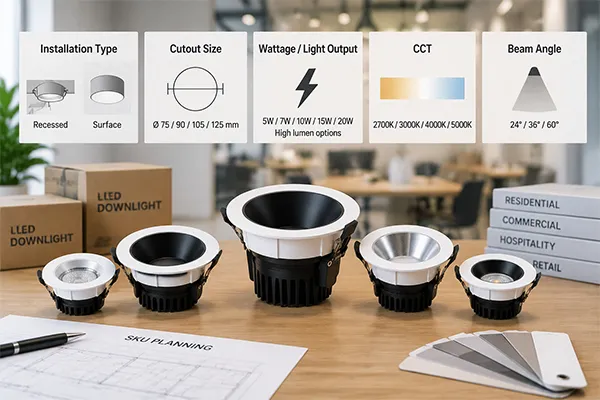
The most important variables in LED downlight SKU planning are installation type, cutout size, light output or wattage, CCT, and beam angle. These specifications shape whether a customer can install, use, reorder, and compare a product. Price should support positioning, but it should not be the only SKU-building variable.
1. Installation Type and Ceiling Compatibility
The first question should be how the downlight installs. Common categories include recessed, surface-mounted, trimless, adjustable, and integrated driver or remote driver designs. Each category has different installation implications.
For recessed models, the cutout size is frequently one of the strongest purchase drivers. An installer replacing an existing fitting may reject an otherwise attractive product if the ceiling hole is too small or too large. This issue can create returns, rework, and damaged customer confidence.
Your product labels, cartons, datasheets, and sales training should state:
- Cutout diameter
- Outer diameter
- Product height or recess depth
- Driver dimensions where relevant
- Recommended ceiling thickness, if provided by the product documentation
- Cable entry and connection details
- Installation environment limitations
I recommend treating cutout families as separate commercial platforms. A 75 mm cutout product and a 90 mm cutout product may look similar, but they solve different replacement problems. They should not be treated as interchangeable merely because their wattage is similar.
2. Light Output and Wattage
Wattage is familiar to buyers, but it does not independently describe delivered light.4 The buyer should evaluate lumen output, efficacy, beam angle, optical design, and application conditions alongside power consumption.
For SKU planning, wattage still matters because customers use it as a comparison shortcut. However, I recommend creating clear output bands rather than filling every possible wattage increment. For example, a range may need a compact low-output option, a general-purpose mid-output option, and a higher-output option for more demanding spaces. The exact bands depend on the market, ceiling height, local customer expectations, and product design.
When comparing suppliers, ask for product-specific documentation rather than relying on generic claims:
| Evaluation item | Why it matters for distributors | Document or evidence to request |
|---|---|---|
| Rated wattage | Supports positioning and electrical planning | Datasheet and product label |
| Lumen output | Helps compare useful light output | Photometric report or test data |
| Input voltage and frequency | Determines local compatibility | Datasheet and label |
| Power factor | May matter for commercial projects | Product-specific specification |
| Driver configuration | Affects installation and service planning | Driver datasheet and bill of materials confirmation |
| Dimming option | Must match controls and project requirements | Compatibility documentation |
3. CCT and Color Consistency
Color temperature often drives retail conversations. Customers may ask for warm white, neutral white, or cool white, but the preferred option differs by country, room type, and local design habits. A distributor should not assume that every market needs every CCT as stocked inventory.
Common approaches include:
- Fixed-CCT core models for markets with clear preferences
- Selectable-CCT models where the product design, local demand, and sales channel support them
- Project-specific CCT supply for hospitality, retail, office, or branded developments
- Special CCT orders when a repeat customer can support the volume and validation process
Color quality also matters in many applications.5 Buyers may request CRI information, especially for retail, hospitality, food displays, or premium residential projects. I advise distributors to request CRI claims in product documents and verify that the evidence applies to the actual model, CCT, and production configuration under consideration.
4. Beam Angle and Application Fit
Beam angle is often ignored in entry-level range planning, yet it can create a meaningful difference in visual results. A narrower beam may suit accent lighting, while a wider beam can support more general illumination.6 The correct option depends on mounting height, spacing, surface reflectance, target illumination, and the customer’s visual objective.
A simple commercial rule is useful: do not stock multiple beam angles unless your channel can explain and sell the difference. If your team mainly serves replacement retail demand, a broadly applicable beam may be more practical. If you sell to lighting designers, contractors, or commercial projects, beam-angle options may justify project-level planning.
For application-specific layouts, I recommend that distributors consult qualified lighting professionals or project engineers. A product datasheet alone does not replace a lighting calculation or site assessment.7
How Can Distributors Prevent Duplicate and Slow-Moving Downlight SKUs?
Every new downlight variation looks small on a quotation sheet. In reality, it creates operational work across purchasing, warehousing, sales training, sample management, packaging, quality control, and after-sales support. Without discipline, a range becomes expensive long before the warehouse appears full.
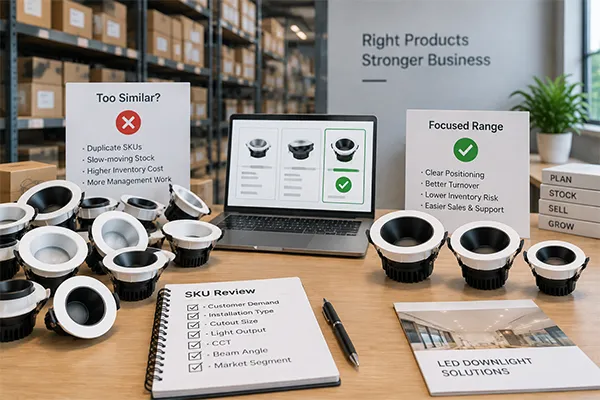
Distributors can prevent duplicate downlight inventory by assigning every SKU a distinct demand pattern, customer segment, or compatibility role. If two models solve the same installation and lighting need, the distributor should normally keep the stronger replenishment option rather than stock both.
Recognize the Hidden Cost of Each New SKU
I have seen a common pattern in which a distributor adds a second or third version “just in case.” One product has a silver trim, another has a white trim, another is 1 W higher, and another has a slightly different body shape. Each model may be reasonable on its own. Together, they may divide demand so much that none of them replenishes efficiently.
Every added SKU can create these commitments:8
- A new purchase forecast
- A separate minimum order quantity or production requirement
- Separate carton, label, barcode, and packaging decisions
- Separate product images and catalogue entries
- Sales-team explanation and customer-service training
- Samples for key accounts
- Different spare-part or replacement expectations
- More complex stock counts and replenishment planning
- Potential documentation checks for the applicable market
This does not mean that variation is always bad. It means the distributor should demand a commercial reason for every variation.
Use an SKU Admission Test
Before adding a product, I suggest using a simple internal approval test. The sales, purchasing, and technical teams should be able to answer these questions clearly:
- Which customer segment needs this SKU?
- Which existing product does it not overlap with?
- What installation, performance, aesthetic, or specification gap does it fill?
- How often do we expect to reorder it?
- Can our supplier maintain the configuration consistently?
- What documentation applies to this exact model and destination market?
- Who will sell it, and how will they explain it?
- What happens if the customer requests a replacement after several months?
If the team cannot answer these questions, the product may belong in a quote-only category rather than the standard stock list.
Track SKU Performance by More Than Revenue
Revenue alone can hide an inefficient product range.9 A SKU might sell occasionally but still consume disproportionate warehouse space, management attention, and purchasing complexity.
I recommend monitoring a small set of practical indicators:
| Metric | What it reveals | Useful action |
|---|---|---|
| Sales frequency | How regularly the SKU moves | Review low-frequency items |
| Gross margin | Whether the model supports the channel | Reprice, renegotiate, or rationalize |
| Stock cover | How long inventory may last | Reduce future purchase quantities |
| Reorder reliability | Whether supply is stable | Maintain backup planning or consolidate |
| Return or complaint rate | Possible fit, quality, or communication issues | Investigate documents, instructions, and samples |
| Quote-to-order conversion | Whether demand is real or speculative | Keep low-conversion variants quote-only |
| SKU overlap | Whether products compete internally | Remove duplicate models |
A regular quarterly review can be enough for many growing distributors. Larger importers may need monthly analysis. The key is to judge the range as a system, not as isolated product codes.
Avoid Price-Tier Duplication
A “good, better, best” structure can be useful when each tier has a clear reason to exist. However, price tiers should reflect meaningful differences that customers can understand and verify, such as design, driver configuration, warranty terms offered by the seller, optical options, installation features, or supplied documentation.
I would avoid creating three price tiers when the products appear identical to the customer and serve the same use case. That structure often causes internal competition and encourages sales teams to default to the cheapest item. A focused range gives staff more confidence and makes replenishment easier.
When Should OEM and ODM Be Added to LED Downlight SKU Planning?
Customization can help distributors meet local market needs, strengthen a private-label offer, or win repeat project business. However, OEM and ODM work adds commercial and operational conditions. It should be planned as a controlled extension, not as an instant answer to every request.
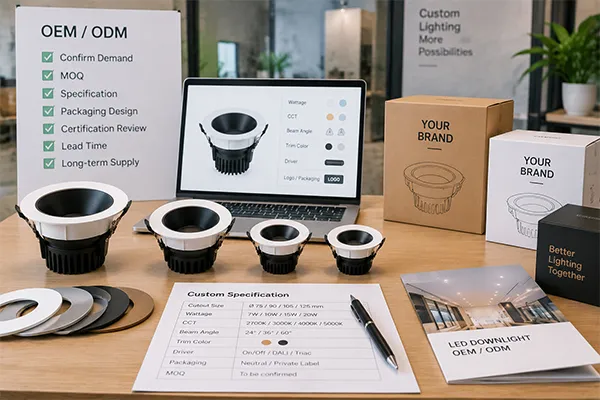
OEM and ODM should be added to LED downlight SKU planning when a distributor has verified demand that justifies MOQ, validation, packaging, certification review, lead time, and long-term supply commitments. Custom specifications can create value, but they should not become standard stock without evidence of repeatable demand.
Separate “Custom Request” From “Custom SKU”
A customer may ask for a different trim color, a branded carton, a special CCT, or a certain beam angle. That request is useful market feedback, but it does not automatically justify a permanent SKU.
At Upward Lighting, I have seen distributors use custom requests successfully when they have a defined customer program, a repeat-order forecast, or a market gap that the standard range does not cover. In those cases, customization can include parameters such as:
- Color temperature
- Wattage or output positioning
- Beam angle
- CRI requirement
- Surface finish color
- Product labeling
- Retail packaging
- Brand marks and carton artwork
However, each change must be reviewed against product design, component availability, minimum order quantity, sample approval, production timing, and applicable market requirements.
Plan the Customization Workflow
A disciplined OEM/ODM process reduces surprises. I recommend using a staged workflow:
-
Confirm the commercial use case
Identify the target customer, sales channel, estimated annual volume, and expected repeat order pattern. -
Define the requested configuration
Record cutout, dimensions, CCT, wattage, beam angle, trim finish, driver requirements, packaging, and branding details. -
Review feasibility with the supplier
Confirm whether the requested combination is an existing platform variation or requires further development. -
Request product-specific samples and documentation
Evaluate samples in the intended market and review available test reports, declarations, labels, and certification records as relevant. -
Agree on MOQ, lead time, quality standard, and packaging approval
These points should be documented before production. -
Validate the supply continuity plan
Confirm how future orders, component substitutions, artwork revisions, and replacement needs will be managed. -
Launch as a controlled SKU
Start with a measured inventory commitment unless demand is already contracted or well established.
At Upward Lighting, we conduct a 100% aging test before shipment, generally lasting 4 to 8 hours according to the product process. Buyers should still agree on the inspection standard, sampling approach, and documentation needed for their own project or market. An aging process is one quality-control step; it does not replace application-specific evaluation or independent verification10 where the project requires it.
Verify Compliance and Certification Documents
Buyers often ask whether CE or RoHS documentation is available11. These documents can be relevant for certain markets and product categories, but they should be reviewed carefully. A distributor should verify that the documentation corresponds to the exact product model, electrical configuration, destination market, and current regulatory requirements.
For custom products, the review becomes more important because changes may affect labels, components, or the final declared configuration. I recommend involving qualified compliance professionals, test laboratories, or local regulatory advisers when the application or market requires formal assessment.
A custom downlight is commercially successful only when the distributor can reorder it, document it, explain it, and support it after delivery—not simply when the first sample looks attractive.
Frequently Asked Questions
How many LED downlight SKUs should a distributor stock?
There is no universal SKU count. I recommend starting with the smallest range that covers your most common installation types, cutout sizes, output needs, and CCT preferences. Your sales route, market habits, customer base, and replenishment capability should determine the final number.
Should distributors stock multiple color temperatures for every downlight?
Distributors should stock multiple CCT options only when local demand supports them. A fixed-CCT core range can simplify inventory in markets with clear preferences. Selectable-CCT or special-order models may suit mixed demand, but buyers should review product-specific specifications and installation requirements.
Is wattage the best way to compare LED downlights?
Wattage is useful, but it is not enough. Buyers should also compare lumen output, cutout size, beam angle, dimensions, CCT, driver details, and applicable documentation. For project decisions, qualified lighting evaluation may be needed to confirm the actual application fit.
When should a downlight become a custom OEM or ODM SKU?
A product should become a custom SKU when there is verified repeat demand and the buyer accepts the MOQ, sample approval, lead time, packaging, documentation, and continuity requirements. One-off requests are often better handled as project quotations rather than standard inventory.
How can distributors reduce slow-moving downlight inventory?
Distributors can reduce slow-moving inventory by removing overlapping models, reviewing sales frequency, limiting speculative variations, and separating core stock from project and custom orders. Each SKU should have a distinct customer need, replenishment plan, and clear sales responsibility.
Conclusion
Effective LED downlight SKU planning is not about offering the longest catalogue. It is about building a clear range that customers can understand, sales teams can quote, and purchasing teams can replenish without unnecessary inventory risk. I recommend separating retail core models, project-led specifications, and OEM/ODM requests from the beginning. Focus on cutout compatibility, installation type, output, CCT, and beam angle before adding cosmetic or price-based variations. If you are planning or rationalizing a downlight range, we at Upward Lighting can help you review suitable product platforms, customization conditions, and quotation options for your target channel.
"How a Brand Reduced Slow-Moving Inventory", https://xorosoft.com/slow-moving-inventory-case-study/. Inventory-management research finds that expanding product assortments can increase forecasting complexity, safety-stock requirements, and capital committed to inventory, particularly where demand is fragmented across similar items. Evidence role: general_support; source type: research. Supports: Research on SKU proliferation and inventory management showing that greater assortment complexity can increase inventory, forecasting, and working-capital burdens.. Scope note: The size of the effect depends on demand variability, lead times, service targets, and the distributor's replenishment system. ↩
"[PDF] Application Summary Report 14: - LED Downlight Retrofit Units", https://www1.eere.energy.gov/buildings/publications/pdfs/ssl/caliper_14_summary.pdf. Lighting guidance identifies light output, correlated color temperature, beam distribution, and fixture mounting and dimensional constraints as material characteristics when selecting luminaires for an intended installation. Evidence role: general_support; source type: government. Supports: Authoritative lighting guidance describing lumens, correlated color temperature, beam distribution, physical installation dimensions, and mounting arrangement as relevant lighting-product selection characteristics.. Scope note: Compatibility with a particular ceiling opening, driver, control system, or local electrical installation must still be confirmed from the exact product documentation. ↩
"Purchasing Energy-Efficient Commercial and Industrial LED ...", https://www.energy.gov/cmei/femp/purchasing-energy-efficient-commercial-and-industrial-led-luminaires. Lighting guidance distinguishes residential and commercial applications because they commonly involve different visual tasks, operating schedules, installation constraints, and specification requirements. Evidence role: general_support; source type: research. Supports: Lighting research and guidance distinguishing residential and commercial applications by their design objectives, operational requirements, and specification practices.. Scope note: The distinction is contextual and does not establish that every homeowner or contractor follows the same purchasing process. ↩
"Purchasing Energy-Efficient Light Bulbs", https://www.energy.gov/cmei/femp/purchasing-energy-efficient-light-bulbs. Watts measure electrical power consumption, whereas lumens measure emitted visible light; therefore, products with similar wattage can provide different light output because their luminous efficacies differ. Evidence role: definition; source type: government. Supports: Government consumer and technical guidance distinguishing electrical power in watts from luminous output in lumens and explaining efficacy.. Scope note: Published lumen values should be assessed for the specific product and test conditions rather than inferred from wattage. ↩
"Purchasing Energy-Efficient Light Bulbs", https://www.energy.gov/cmei/femp/purchasing-energy-efficient-light-bulbs. Lighting research indicates that a light source's spectral properties and color-rendering performance affect the perceived appearance of objects and materials, which can be consequential in visually sensitive applications. Evidence role: mechanism; source type: research. Supports: Lighting research explaining that spectral characteristics and color rendering influence the perceived appearance of objects, materials, and food.. Scope note: CRI is an incomplete measure of color rendition, and the appropriate color-quality metric and target level depend on the application. ↩
"[PDF] CALiPER Application Summary Report 20: LED PAR38 Lamps", https://www1.eere.energy.gov/buildings/publications/pdfs/ssl/caliper_20_summary.pdf. Lighting-design guidance commonly uses narrow beam distributions to concentrate light on focal areas and wider distributions to illuminate larger areas more uniformly. Evidence role: general_support; source type: education. Supports: Lighting-design guidance relating narrower distributions to accenting and wider distributions to broader-area illumination.. Scope note: The resulting illumination depends additionally on mounting height, spacing, aiming, lumen output, and room-surface reflectance. ↩
"[PDF] Energy impact of human health and wellness lighting ...", https://www.energy.gov/eere/ssl/articles/energy-impact-human-health-and-wellness-lighting-recommendations-office-and. Professional lighting practice uses luminaire photometric data as an input to application-specific calculations and design analysis; a product datasheet by itself does not determine illuminance, uniformity, glare, or layout performance in a room. Evidence role: expert_consensus; source type: institution. Supports: Professional lighting guidance stating that luminaire photometry must be applied in calculations or design analysis to evaluate lighting performance in a specific space.. Scope note: The required level of analysis varies by project scale, regulatory obligations, and the consequences of inadequate lighting. ↩
"Excess and Obsolete Inventory: You're All Responsible for It!", https://scm.ncsu.edu/scm-articles/article/excess-and-obsolete-inventory-youre-all-responsible-for-it. Supply-chain research describes product proliferation as increasing the number of demand forecasts, replenishment decisions, inventory records, and operational processes that organizations must manage. Evidence role: mechanism; source type: research. Supports: Supply-chain research on how product variety and SKU proliferation increase planning, inventory-control, and operational complexity.. Scope note: Not every listed commitment applies equally to every distributor, because packaging, service, and training arrangements differ by business model. ↩
"Innovations in Inventory Management to Improve the ... - PMC", https://pmc.ncbi.nlm.nih.gov/articles/PMC12754351/. Inventory-performance analysis commonly considers sales together with gross margin, inventory turnover, stockholding cost, and service performance, because revenue does not by itself indicate the economic efficiency of a stocked item. Evidence role: general_support; source type: research. Supports: Inventory and retail-management research showing that sales revenue should be evaluated alongside margin, turnover, stockholding costs, and service measures.. Scope note: The most appropriate KPI set depends on the distributor's accounting practices, service commitments, and strategic assortment goals. ↩
"[PDF] A methodology for testing life-cycle performance of consumer products", https://nvlpubs.nist.gov/nistpubs/Legacy/IR/nbsir76-1157.pdf. Reliability screening such as burn-in can identify certain early-life failures, but product conformity and fitness for an intended application require evaluation against the relevant performance, safety, and installation requirements. Evidence role: general_support; source type: government. Supports: Technical sources explaining that reliability screening or burn-in is one element of quality assurance and does not substitute for broader performance, safety, or application testing.. Scope note: The appropriate test regime and the value of an aging test depend on the product design, failure mechanisms, applicable standards, and intended use. ↩
"CE marking – obtaining the certificate, EU requirements - Your Europe", https://europa.eu/youreurope/business/product-rules-compliance/general-product-compliance/ce-marking/index_en.htm. European Union guidance explains that, where applicable legislation requires it, CE marking is supported by conformity assessment, technical documentation, and an EU declaration of conformity; RoHS restricts specified hazardous substances in covered electrical and electronic equipment. Evidence role: definition; source type: government. Supports: European Union guidance on CE marking, declarations of conformity, technical documentation, and the RoHS restrictions applicable to covered electrical and electronic equipment.. Scope note: Applicability depends on the product, its intended use, the legislation in force, and the market in which it is placed. ↩