LED downlight solutions for healthcare facilities can become difficult to procure when one general-purpose specification is applied to every room. Reception zones, corridors, consultation rooms, patient rooms, and support areas all create different visual demands. We help project teams turn those room-by-room needs into clear, verifiable downlight product briefs.
LED downlight solutions for healthcare facilities should be selected by matching each room’s visual task, operating conditions, mounting constraints, and project requirements with a verified product specification. Buyers should review color temperature, CRI, wattage, lumen output, beam angle, finish, batch consistency, and delivery needs separately, while qualified lighting designers and local authorities confirm layout, glare, hygiene, and compliance decisions.
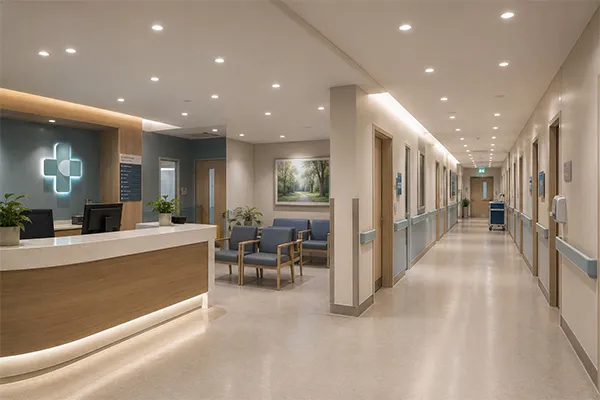
A healthcare project does not necessarily need one “medical-grade” downlight SKU. In our experience as an LED lighting manufacturer, the more useful approach is to create a practical room schedule, identify the questions behind each area, and ask suppliers to document what their products can genuinely provide.
Why Should LED Downlight Solutions for Healthcare Facilities Be Planned Room by Room?
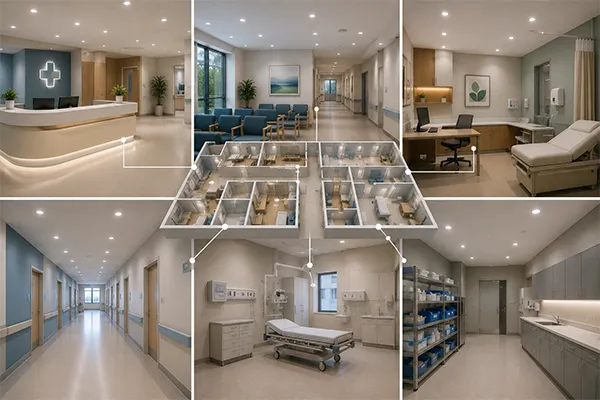
A single downlight specification may look easier to purchase, but it can create unnecessary compromises. A reception desk, a waiting room, a consultation space, and a back-of-house storage area do not support the same activities. If the brief ignores those differences, buyers may receive products that are difficult to apply consistently.
LED downlight solutions for healthcare facilities should be planned room by room because every space has different users, visual tasks, operating hours, ceiling conditions, and lighting-layout requirements1. A room-based brief helps project teams compare suitable downlight parameters without assuming that one color temperature, wattage, beam angle, or CRI suits the whole facility.
Different rooms create different procurement questions
We often see buyers begin with a simple request such as, “We need a 12W recessed downlight for a clinic.” That is a useful starting point, but it is not yet a complete procurement brief. Before we recommend product options or prepare an OEM/ODM quotation, we need to understand where the fitting will be used and what the project team expects from it.
For example, a front entrance may need a different visual impression from a staff utility area. A patient room may have different operating patterns from a busy corridor. A consultation room may require careful consideration of visual tasks and the broader lighting design. These are project questions rather than one universal product question.
A practical room schedule can include:
| Space type | Questions for the project team | Product details to request from supplier |
|---|---|---|
| Reception area | What visual impression and operating schedule are expected? | CCT, CRI, trim finish, output options, beam angle |
| Waiting area | How is the space arranged, and where are seating areas located? | Lumen package, diffuser type, beam distribution, batch consistency |
| Corridor | What are the ceiling height, mounting positions, and operating hours? | Wattage, beam angle, driver option, delivery volume |
| Consultation room | What tasks take place, and who approves the lighting design? | CRI options, color consistency, dimming compatibility if specified |
| Patient room | What is the local design brief and operating scenario? | Product finish, output range, control compatibility where required |
| Support space | Is durability, speed of installation, or cost efficiency a priority? | Standard SKU availability, lead time, packaging, spare quantities |
Avoid the “one SKU” mindset
A single SKU can still be appropriate in some projects. It can simplify inventory, installation, and maintenance. However, buyers should reach that decision after comparing the room requirements, not before.
We recommend that procurement teams separate:
- Product requirements that a manufacturer can confirm, such as wattage, CCT, CRI option, beam angle, cutout size, trim finish, input voltage, and test process.
- Lighting design requirements that should be reviewed by qualified lighting designers, facility teams, and relevant project consultants.
- Compliance and approval requirements that depend on local codes, contract documents, healthcare facility rules, and applicable authorities.
At Upward Lighting, we can support parameter discussions for LED downlights, including customized color temperature, wattage, beam angle, CRI, and surface finish. However, we do not treat these options as a substitute for project-level lighting calculations, glare evaluation, local code review, hygiene requirements, or infection-control requirements.
A clear room schedule does not replace professional design. It gives the design, procurement, and supplier teams a better shared language.
Which Downlight Parameters Matter Most in Healthcare Spaces?
Buyers often ask us for the “best” color temperature, highest CRI, or highest lumen output. Those questions are understandable, but no single number guarantees suitability. A higher specification can increase cost or change the visual result without necessarily improving the intended space.
The most relevant downlight parameters for healthcare facilities are color temperature, CRI, lumen output, wattage, beam angle, physical dimensions, finish, and driver compatibility. Each parameter should be evaluated together with the room function, ceiling condition, lighting layout, user needs, and final approval requirements rather than as a standalone buying rule.
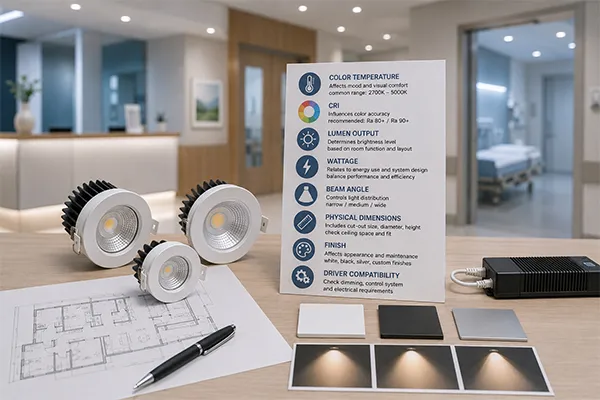
Color temperature and CRI require context
Color temperature affects the visual character of a space. However, a project should not select one CCT simply because it is commonly used in another building. The final selection may depend on the overall interior palette, daylight conditions, operating hours, visual tasks, and design intent.
Similarly, CRI is an important way to discuss color-rendering performance2, but a higher CRI is not automatically the correct answer for every area. Buyers should ask how the project intends to use the room and whether the lighting designer or consultant has stated a particular requirement.
When we prepare an inquiry, we encourage buyers to define:
- Requested CCT options, such as a fixed color temperature or a range for evaluation.
- Requested CRI level and whether that requirement appears in the project specification.
- Whether color consistency between fixtures and batches is important to the client.
- Whether samples should be reviewed under the intended project conditions.
- Who is responsible for approving the final visual result.
Lumen output, wattage, and beam angle work together
Lumen output describes the light output of a product, while wattage describes power consumption3. Beam angle affects how light is distributed from the fixture4. These values should not be selected in isolation.
For example, two downlights with the same wattage can have different optical designs, lumen packages, beam angles, drivers, and resulting application characteristics5. A higher-lumen product may not be appropriate if it creates an unsuitable visual balance in the proposed layout. Likewise, a narrow beam may serve a specific design purpose but may require different positioning from a wider beam.
We recommend that buyers ask suppliers for a consistent set of product documents:
| Parameter | Why buyers should ask | What needs separate project verification |
|---|---|---|
| Wattage | Supports energy and product comparison | Total connected load and project energy targets |
| Lumen output | Supports product comparison | Required illuminance and room calculation |
| Beam angle | Indicates optical distribution | Fixture spacing, aiming, and layout performance |
| CCT | Supports visual consistency discussions | Final design intent and room-specific suitability |
| CRI | Indicates color-rendering characteristic | Project requirement and intended visual task |
| Cutout and dimensions | Supports installation planning | Ceiling construction and site tolerances |
| IP rating | Indicates product ingress-protection classification | Required installation condition and local application rules |
We believe the best inquiry is not “What is your brightest downlight?” Instead, it is: “Here is the room type, ceiling height, requested product range, installation condition, target quantity, and party approving the design. Which documented options can you provide?”
Be careful with broad marketing claims
Terms such as “flicker-free,” “anti-glare,” or “antibacterial” can mean different things unless they are tied to defined test methods, product configurations, and project requirements6. Buyers should request clear documentation and should confirm whether a claim is relevant to their local project.
We do not present general product quality controls, CE documentation, RoHS documentation, or aging tests as proof of healthcare-specific performance. These documents and processes should be reviewed for the exact model, destination market, and project scope.
How Can Buyers Verify LED Downlight Solutions for Healthcare Facilities?
Healthcare procurement teams need more than a catalog page. They need a repeatable way to compare suppliers, confirm what is included in a quotation, and reduce the risk of inconsistent deliveries. The difficulty usually appears when product details are discussed verbally but not recorded in the final approved specification.
Buyers can verify LED downlight solutions for healthcare facilities by using a written product brief, requesting model-specific documents and samples, confirming customization limits, checking batch-consistency controls, and assigning final design and compliance approvals to qualified project parties. Supplier testing supports procurement confidence but does not replace project certification or authority approval7.
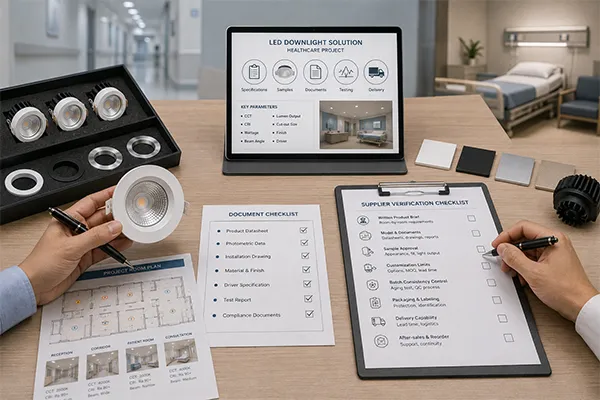
Start with a clear inquiry document
A good inquiry should help the supplier quote accurately and help the buyer compare quotations fairly. In our own quotation process, clear inputs reduce unnecessary back-and-forth and make it easier to identify whether a standard item or customized LED downlight is needed.
We suggest including the following information:
-
Project location and destination market
This helps identify the documentation and electrical requirements that may need review. -
Room schedule and quantities
Buyers should separate quantities by room type where practical. -
Product requirements
Include recessed or surface-mounted type, cutout size, trim color, CCT, CRI, wattage, beam angle, voltage, dimming requirement if applicable, and desired IP rating. -
Target delivery date and shipping terms
Procurement teams should identify phased delivery requirements early. -
Sample and approval process
State whether the project requires a physical sample, a finish sample, photometric documentation, or third-party review. -
Final approving party
Identify whether the lighting designer, consultant, contractor, facility team, brand owner, or local authority has final approval responsibility.
Review consistency, not only the first sample
One approved sample does not automatically prove that every future shipment will match it8. Buyers should discuss how the supplier controls incoming materials, LED selection, production processes, aging tests, and final inspection.
At Upward Lighting, every product undergoes a 100% aging test lasting between 4 and 8 hours before shipment. We use this process as part of our manufacturing quality-control approach. Buyers should still confirm their own acceptance criteria, including the exact model, order quantity, packaging requirements, and any third-party inspection process.
Useful supplier questions include:
- Can the supplier confirm the LED brand or component configuration for the quoted model?
- Can the supplier provide samples from the same proposed configuration?
- Can color temperature, CRI, wattage, beam angle, and trim finish be customized?
- What is the minimum order quantity for customized downlights?
- How are batch codes, carton labels, and product labels managed?
- What inspection records are available for the order?
- What happens if the project requires replacement quantities or later repeat orders?
- Can the supplier coordinate small-batch orders for a phased project?
Verify documents against the exact product
CE and RoHS documentation can be relevant for market access and environmental compliance requirements in certain markets9. However, buyers should verify that documents apply to the exact product model, electrical configuration, and destination market. They should also confirm whether additional local requirements apply.
We recommend that project teams avoid assuming that a general certificate, test report, or catalog statement covers every product variation. A customized wattage, driver, CCT, or housing option may require separate confirmation10.
What Should a Healthcare Downlight Approval Workflow Include?
Even a well-specified downlight can encounter problems when roles are unclear. Procurement may assume that design has approved the optical choice, while design may assume that the contractor has checked installation conditions. A simple workflow makes those responsibilities visible before a purchase order is issued.
A healthcare downlight approval workflow should define the room-by-room brief, product submittal, sample review, document verification, production approval, inspection expectations, delivery plan, and final responsibility for lighting design and local compliance. This process helps buyers manage LED downlight solutions for healthcare facilities without treating the supplier as the final project authority.
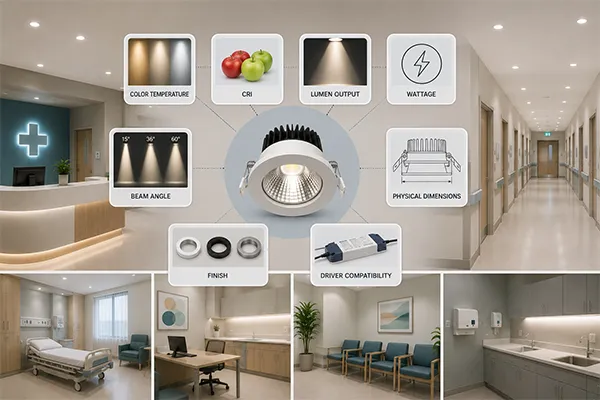
A practical seven-step workflow
We recommend a structured process for contractors, lighting brands, importers, and project managers.
1. Define the room function
The facility team and project designer should identify what occurs in each space. This stage should consider room use, user needs, operating schedules, ceiling conditions, maintenance access, and any project-specific hygiene requirements.
2. Create the product brief
The procurement team should translate the room schedule into product requirements. This brief may include CCT, CRI, wattage range, lumen range, beam angle, cutout, finish, driver type, dimming requirement, IP requirement, and target quantities.
3. Request supplier submittals
The supplier should provide a quotation, datasheet, product dimensions, available options, packaging information, lead time, and relevant model-specific documentation. If a project requires a customized product, the quotation should clearly state which parameters differ from the standard model.
4. Review samples and finishes
The project team should review samples where required. A sample should be assessed as part of the project approval process, not as a substitute for lighting calculations or local compliance review.
I have found that a simple written sample-approval record can prevent later disputes. The record should state the sample model, finish, CCT, wattage, driver, beam angle, date, and approving party.
5. Confirm final design and compliance responsibility
Qualified lighting designers, facility teams, consultants, and applicable local authorities should confirm glare control, illuminance calculations, fixture spacing, emergency-lighting coordination, local codes, hygiene requirements, and infection-control requirements where applicable11.
These topics depend on the facility, local rules, and project design. They should not be inferred from a downlight supplier’s general product description.
6. Approve production and inspection expectations
Before production begins, buyers should confirm the approved bill of materials, label details, carton markings, order tolerance, inspection process, aging-test expectation, and whether a third-party inspection is required.
7. Coordinate delivery and repeat-order needs
Healthcare projects may require staged delivery, replacement stock, or future expansion orders. Buyers should discuss lead times, packaging protection, shipment planning, and the availability of the approved configuration for repeat orders.
Keep an approval matrix
A simple approval matrix can improve accountability:
| Decision | Typical responsible party | Supplier role |
|---|---|---|
| Room lighting intent | Lighting designer and facility team | Provide product information |
| Illuminance and glare evaluation | Qualified lighting designer | Provide photometric data if available |
| Local code and authority review | Consultant, contractor, local authority | Provide requested documentation |
| Product configuration | Buyer, brand, contractor, project team | Confirm manufacturability |
| Production quality control | Manufacturer | Conduct agreed internal controls |
| Site installation | Electrical contractor | Provide installation instructions |
| Final acceptance | Project owner and authorized parties | Support documentation and after-sales communication |
This workflow is not complicated, but it protects all parties. It also helps suppliers provide faster and more accurate quotations because the request contains the details needed for a realistic production plan.
Frequently Asked Questions
Is there one best LED downlight specification for every healthcare facility?
No. Healthcare facilities contain spaces with different visual tasks, operating patterns, ceiling conditions, and user needs. Buyers should define requirements by room type rather than apply one CCT, CRI, wattage, lumen output, or beam angle to the entire facility.
Does higher CRI always mean a better healthcare downlight?
Not necessarily. Higher CRI may be relevant for certain visual requirements, but it can also affect cost, availability, and product configuration. The project team should confirm the required CRI with the lighting designer, facility team, and relevant project specification.
Do CE and RoHS documents make a downlight healthcare compliant?
No. CE and RoHS documents may be relevant to specific market-entry and environmental requirements, but they do not automatically demonstrate healthcare-specific suitability, infection-control compliance, local code compliance, or final project approval. Buyers should verify documents for the exact model and destination market.
Can a supplier customize LED downlights for healthcare projects?
Many manufacturers can customize selected parameters, including color temperature, wattage, CRI, beam angle, trim finish, and packaging. Buyers should confirm minimum order quantities, lead times, documentation requirements, sample approval, and whether the customized configuration can be repeated in later batches.
What should buyers ask before ordering downlights for a clinic or hospital project?
Buyers should provide a room schedule, requested parameters, quantity, ceiling details, delivery date, destination market, and sample requirements. They should also identify who will approve lighting design, glare evaluation, local compliance, hygiene requirements, and installation suitability.
Conclusion
The strongest LED downlight solutions for healthcare facilities begin with a room-by-room procurement brief rather than a universal product claim. Buyers should compare color temperature, CRI, wattage, lumen output, beam angle, finish, dimensions, and batch consistency in context. They should also keep design calculations, glare control, local codes, hygiene needs, and healthcare-specific approvals with qualified project parties. At Upward Lighting, we can help contractors, brands, importers, and distributors turn their downlight requirements into clear OEM/ODM product inquiries, samples, quotations, and production plans.
"Lighting the Patient Room of the Future: Evaluating ...", https://www.energy.gov/eere/ssl/articles/lighting-patient-room-future-evaluating-different-lighting-conditions-performing. Healthcare lighting guidance recognizes that clinical, patient, circulation, and support spaces have different activities and visual needs, so lighting criteria should be considered in relation to the specific space and task. Evidence role: general_support; source type: research. Supports: Healthcare lighting guidance and research connecting room functions, user activities, and visual tasks with different lighting-design considerations.. Scope note: Such guidance supports task-based planning but does not prescribe a particular downlight specification for every room. ↩
"NIST ICSD Web Site", https://icsd.nist.gov/. The general color rendering index (CRI) is a standardized measure intended to characterize how faithfully a light source renders the colors of specified test samples relative to a reference illuminant. Evidence role: definition; source type: institution. Supports: The technical meaning of the general color rendering index and its role in evaluating color-rendering properties of light sources.. Scope note: CRI is a general color-rendering metric and does not by itself establish performance for specialized clinical color-evaluation tasks. ↩
"StopRansomware Guide", https://www.cisa.gov/stopransomware/ransomware-guide. Lumen ratings express the quantity of visible light emitted by a source, while watts express electrical power consumed; the two measures therefore answer different product-comparison questions. Evidence role: definition; source type: government. Supports: The distinction between lumen output as a measure of luminous flux and wattage as electrical power input.. Scope note: Rated lumens and watts do not alone predict illuminance or visual comfort in an installed room. ↩
"Learn About LED Lighting", https://www.energystar.gov/products/learn-about-led-lighting. Beam angle describes the angular spread of a luminaire's beam, and changes in beam spread affect how light is distributed across the illuminated area. Evidence role: definition; source type: education. Supports: The relationship between beam angle and the angular spread or distribution of light from a luminaire.. Scope note: Beam angle alone cannot determine room performance because mounting height, spacing, photometry, surface reflectance, and aiming also affect the result. ↩
"How many lumens should be cultured in the conservative ...", https://pubmed.ncbi.nlm.nih.gov/20455693/. Luminaire wattage measures electrical input, whereas delivered light output and distribution depend on the LED system, driver, thermal conditions, and optics; products with the same wattage can therefore perform differently. Evidence role: mechanism; source type: research. Supports: That luminaire output and distribution depend on LED efficacy, driver and thermal performance, and optical design rather than input wattage alone.. Scope note: The principle explains why equal wattage is not equivalence, but model-specific photometric reports are needed to compare particular products. ↩
"Patent Cooperation Treaty", https://www.wipo.int/en/web/pct-system/texts/articles/atoc. Performance claims should be assessed against the applicable test method, tested configuration, and conditions of use; in particular, antimicrobial claims may be subject to specific evidentiary and regulatory requirements. Evidence role: general_support; source type: government. Supports: That product performance claims, especially antimicrobial claims, must be interpreted in light of the stated test method, conditions, and regulatory context.. Scope note: Requirements differ by jurisdiction and claim type, so this support does not validate or invalidate any particular product statement. ↩
"Conformity Bias - Ethics Unwrapped", https://ethicsunwrapped.utexas.edu/video/conformity-bias. Product test results can provide evidence for conformity assessment, but compliance and acceptance also depend on the applicable legal requirements, product documentation, installation conditions, and decisions of competent project or regulatory authorities. Evidence role: general_support; source type: government. Supports: That test reports are evidence within a conformity-assessment process but do not by themselves satisfy all legal, installation, or authority-approval obligations.. Scope note: The required approvals and the legal weight of a test report differ across jurisdictions and project types. ↩
"Quality", https://en.wikipedia.org/wiki/Quality. Acceptance sampling provides information about the quality of an inspected lot but does not guarantee that every unit, or units in later production lots, conforms to the approved sample. Evidence role: mechanism; source type: government. Supports: The statistical and quality-control principle that inspection of a sample provides evidence about, but does not guarantee conformance of, every item in a production lot or future lots.. Scope note: The degree of confidence depends on the sampling plan, lot definition, acceptance criteria, and the manufacturer's process controls. ↩
"State of Maryland eMaryland Marketplace Advantage (eMMA)", https://emma.maryland.gov/page.aspx/en/usr/login?ReturnUrl=%2Fpage.aspx%2Fen%2Fbuy%2Fhomepage. For products within their scope, EU CE-marking rules require conformity with applicable Union legislation before market placement, while the RoHS framework restricts specified hazardous substances in electrical and electronic equipment. Evidence role: historical_context; source type: government. Supports: The EU role of CE marking for applicable products and the purpose of the RoHS Directive's hazardous-substance restrictions for electrical and electronic equipment.. Scope note: Applicability depends on the product, its configuration, and the destination market; CE marking and RoHS compliance do not establish healthcare-specific suitability. ↩
"Climate Assessment, Science, and Research", https://lci.ca.gov/climate/icarp/climate-assessment/. Conformity documentation must correspond to the product placed on the market, and modifications that may affect compliance require manufacturers to assess whether further conformity evaluation or updated technical documentation is necessary. Evidence role: general_support; source type: government. Supports: That technical documentation and conformity assessment must cover the product placed on the market and may need review when a product is modified.. Scope note: Whether a particular change in wattage, driver, CCT, or housing requires retesting depends on the applicable legislation, standards, and technical effect of that change. ↩
"Qualified Facility Attestation", https://www.fda.gov/food/registration-food-facilities-and-other-submissions/qualified-facility-attestation. Healthcare-facility design guidance treats lighting, safety, building-system coordination, and infection-prevention provisions as project-level matters requiring application of relevant standards and review by responsible design and regulatory parties. Evidence role: expert_consensus; source type: institution. Supports: That healthcare-facility design is multidisciplinary and that lighting, safety systems, building requirements, and infection-prevention provisions are addressed through applicable project standards and responsible professional review.. Scope note: The precise responsible party and mandatory criteria vary by jurisdiction, facility type, and contract structure. ↩