

LED downlight standards can feel confusing when buyers receive certificates, test reports, and product specifications that appear complete but may not match the exact product they intend to import or sell. That gap can create avoidable delays, rework, and commercial risk. I recommend treating compliance as a documented verification process, not a single certificate check.
LED downlight standards for Australian markets should be evaluated through a verifiable compliance chain: the exact downlight model, driver, wattage, dimming option, installation method, labels, supporting documents, traceability, and the responsible local party’s current verification. A supplier certificate may support the review, but it does not automatically prove that the final sale configuration can be imported, installed, or sold in Australia.1
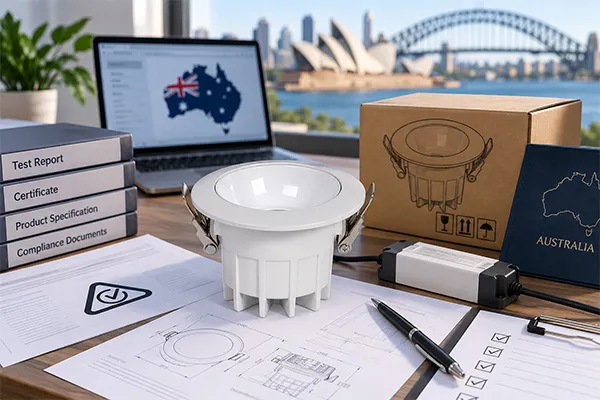
When I discuss products with Australian importers, lighting brands, and project buyers, I often see a familiar issue. The buyer has documents, but the documents have not yet been matched carefully to the final ordered configuration. The sections below explain how I would review that evidence before placing a production order.
Why Do LED Downlight Standards Require More Than One Certificate?
A buyer may ask whether a downlight “has a certificate” because that seems like the fastest route to approval. However, a document that relates to a product family, an earlier driver, or another wattage may create more questions than answers. The solution is to review the product-document connection before confirming the purchase order.
LED downlight standards involve more than electrical safety paperwork because buyers may also need to verify product identity, energy-related requirements, labeling, traceability, sale obligations, and installation conditions.2 The key question is whether each document applies to the exact final product configuration, not simply whether the supplier can provide a certificate.
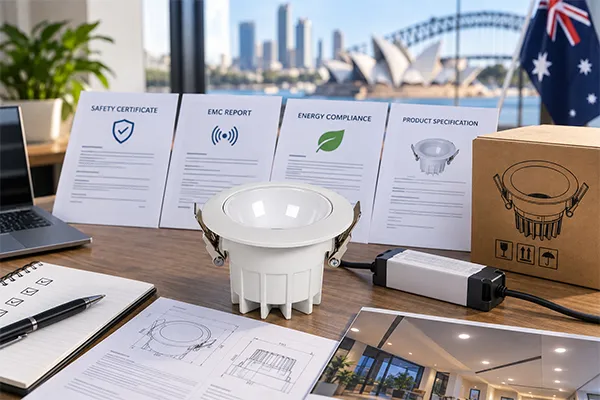
A Certificate Is Evidence, Not a Complete Compliance Decision
From a supplier-side perspective, I view certificates and test reports as supporting evidence. They can help a buyer understand how a product was assessed, which model was tested, and what product characteristics were included in the evaluation.
However, buyers should avoid treating a single document as a universal market-access pass.
For example, a factory may provide:
- A CE document
- A RoHS declaration
- A general laboratory test report
- A component-level driver report
- A report covering several related models
- A previous customer’s product documentation package
These documents may be useful during supplier qualification. Yet they may not prove that the exact downlight intended for Australia has the necessary evidence for the final sales and installation context.
I have seen buyers submit a report quickly, only to discover later that the report listed a different driver, different wattage, or different dimming method than the ordered product.
That is why I encourage buyers to shift their question from:
“Do you have a certificate?”
to:
“Can you show that the available evidence applies to this exact model and final configuration?”
What Should Buyers Match Against the Documents?
Before relying on a document, I recommend comparing every important product detail. This review should cover both the finished downlight and its critical internal components.
| Item to compare | Why it matters | Buyer action |
|---|---|---|
| Model number | Similar-looking products may use different constructions | Confirm the full model code appears on documents |
| Wattage | Wattage changes can affect thermal and electrical conditions | Match ordered wattage to report and label |
| Input voltage and frequency | Electrical input details must match intended market use | Verify the product specification and documentation |
| LED driver | Driver changes may affect performance and assessment relevance | Confirm driver brand, model, and dimming type |
| Dimming method | Different dimming systems may require separate review | Specify dimming requirements in the purchase order |
| Housing and heat sink | Mechanical and thermal designs affect product behavior | Check whether the final housing matches the evaluated unit |
| Installation method | Recessed, insulated, covered, or surface-mounted uses differ | Confirm the intended installation conditions |
| Cut-out size | Product dimensions affect site compatibility | Approve dimensional drawings and samples |
| Colour temperature and optics | These affect the final commercial specification | Match approved data sheets and production labels |
A buyer should also request that the supplier identify any product changes made after testing. In my experience, this is especially important when a product is customized for a project, private label program, or price-sensitive tender.
Why CE and RoHS Do Not Answer Every Australian Buyer Question
CE and RoHS documents can be relevant supplier documents, especially when a buyer is building a technical file or comparing manufacturers. They may indicate that the supplier has experience preparing product documentation for international trade.
Still, I would not present CE, RoHS, or a generic test report as sufficient proof of Australian market compliance.3 These documents may not address every requirement that applies to the final product, commercial route, labeling approach, local responsible party, or installation use.
A careful buyer should ask the responsible local party to verify current Australian requirements for the specific product and intended sales channel. That party may include the importer, local brand owner, compliance adviser, electrical professional, or another qualified representative with responsibility for the product’s local placement and use.
How Should Buyers Match LED Downlight Standards to the Final Product Configuration?
A product can look identical on the outside while using different internal parts.4 That is a major sourcing risk when buyers select a sample, request a customized version, and then assume all earlier documents remain applicable. The solution is configuration control from quotation through production shipment.
To evaluate LED downlight standards responsibly, buyers should confirm that the final model, LED driver, wattage, dimming system, housing, installation design, optical specification, and labeling match the evidence being relied upon. Any change may require review by the party responsible for verifying current local requirements.
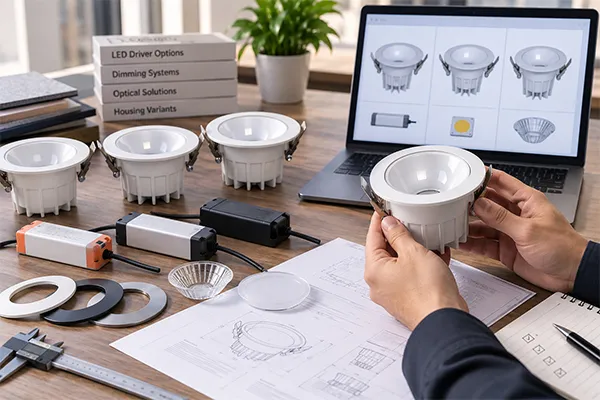
Configuration Changes Can Alter the Evidence Chain
At Upward Lighting, we provide OEM and ODM options because project and brand customers often require different colour temperatures, beam angles, wattages, CRI levels, finishes, and packaging. Customization creates commercial value, but it also creates a need for careful document control.
A change that seems small from a purchasing perspective may be significant from a technical documentation perspective.
Common changes that may require further review include:
-
Driver substitution
A buyer may request a lower-cost driver, a different dimming compatibility option, or a preferred driver brand. That change can affect electrical characteristics, reliability expectations, and the relevance of existing reports. -
Wattage adjustment
A 9 W version and a 12 W version may share a housing, but they can generate different heat levels and use different electrical components.5 -
Dimming option changes
Non-dimmable, phase-dimmable, DALI, 0–10 V, and smart-control versions may differ in driver design and system compatibility.6 -
Housing or heat-sink changes
A different trim, heat sink, enclosure, or installation structure can change thermal behavior and fitting conditions. -
Installation design changes
A recessed downlight intended for one installation arrangement may need separate consideration if the buyer changes the intended location or covering conditions.7 -
Private-label packaging and labels
The electrical rating label, importer details, product identity, batch code, and other markings should be reviewed before mass production.
Build a Product Identity Sheet Before You Approve Production
I recommend creating a simple product identity sheet for every purchase order. This document does not replace formal compliance review, but it helps prevent confusion between sales samples, catalog models, and final production units.
A useful identity sheet can include:
- Internal supplier model number
- Customer SKU or private-label model number
- Product photo and technical drawing
- Rated wattage
- Input details
- Driver manufacturer and driver model
- Dimming option
- LED type and LED quantity
- Colour temperature
- CRI
- Beam angle
- Cut-out size
- Housing material and finish
- Intended installation description
- Label artwork reference
- Carton marking reference
- Applicable document references
- Production batch or order number
This level of detail is helpful when multiple people are involved. A purchasing manager may negotiate cost, a product manager may approve appearance, and a technical lead may review documents. Without one controlled product identity record, these teams can unintentionally approve different versions of the same downlight.
Sample Approval Must Match Mass Production
I always encourage buyers to retain an approved reference sample. The sample should be identified clearly and linked to the purchase order specification.
For production consistency, buyers can request:
- Pre-production sample confirmation
- Label artwork approval
- Driver model confirmation
- Product photo before packing
- Batch number records
- Aging test records where available
- Final inspection photos or third-party inspection
- Random production samples from the finished batch
At our factory, each product undergoes a 100% aging test for approximately 4 to 8 hours before shipment.8 This process supports our internal quality-control approach and helps us identify early failures. However, buyers should understand that an aging test is not a substitute for their own compliance verification or application-specific technical assessment.
Which Documentation Should Support LED Downlight Standards Reviews?
Buyers may receive many files from a supplier, but more paperwork does not automatically mean better evidence. The problem is often document overload rather than document absence. A practical review should organize files by purpose and confirm their relationship to the final SKU.
For LED downlight standards reviews, buyers should request a structured documentation pack that connects the final product specification to relevant reports, declarations, labels, component information, and production traceability. The responsible local party should then confirm whether the evidence is current and suitable for the intended Australian market route.
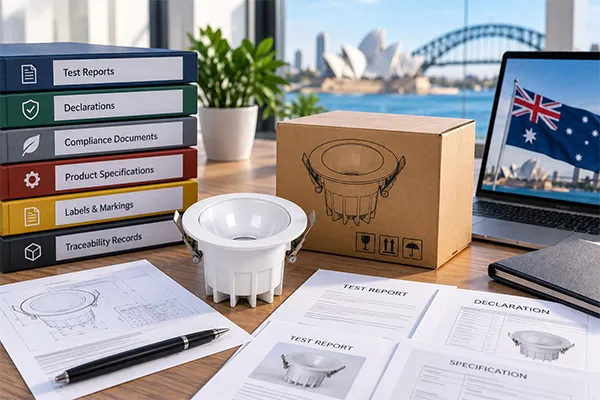
A Practical Supplier Documentation Pack
The exact documents needed may vary by product, customer role, and intended use. Still, a well-organized supplier package often makes local review easier.
I suggest requesting the following items where relevant:
| Document or record | What the buyer should check |
|---|---|
| Product specification sheet | Does it match final wattage, driver, dimensions, CCT, CRI, and beam angle? |
| Product drawing | Does it show the ordered physical design and cut-out dimensions? |
| Product label artwork | Does it match the final model and rating information? |
| Carton artwork | Does it identify the correct SKU, quantity, and batch information? |
| Test reports | Do model details and technical parameters match the final product? |
| Declarations | Are they product-specific and issued by the correct responsible entity? |
| Driver information | Does the driver model match the final production bill of materials? |
| Bill of materials summary | Are critical components controlled and identifiable? |
| Quality-control records | Do they show batch-level production checks? |
| Sample approval record | Does it connect the approved sample to the final order? |
Check Dates, Scope, and Model References
A document can be genuine and still be unsuitable for the product being ordered. Buyers should check the scope carefully.
I would ask these questions:
- Is the model number identical, or is it only similar?
- Does the report cover the exact wattage?
- Is the listed driver the same as the selected driver?
- Does the document include the required dimming version?
- Does the product photo or drawing resemble the final product?
- Is the document still current for the buyer’s local review process?
- Does the document identify a product family, and if so, what variants are actually included?
- Has the factory changed critical components since the document was issued?
A product-family document can be useful, but it should not automatically be assumed to cover every future variation.9 This point matters particularly when suppliers offer a broad range of wattages, cut-out sizes, trim colours, and driver options under one product series name.
Verify Labels Before Printing Thousands of Units
Label errors can create expensive rework. I have seen packaging discussions become urgent near the end of production because the customer approved the product body but did not finalize the label content.
Buyers should review:
- Product model identification
- Electrical ratings
- Brand name or private-label name
- Batch or date traceability
- Required warning or installation information where applicable
- Importer or responsible-party information where required
- Carton SKU and barcode information
- Consistency between label, carton, invoice, and document references
The local party with responsibility for placing the goods on the market should confirm what markings and information are needed. A manufacturer can prepare artwork based on customer instructions, but the manufacturer should not be expected to assume the importer’s final legal or registration responsibilities.
How Can Importers Control Quality and Traceability for LED Downlight Standards?
Even accurate documentation can lose value if the production goods differ from the approved sample. Buyers face risk when a supplier changes a driver, LED board, heat sink, or label without a controlled approval process. The answer is to connect quality control and traceability to the same configuration record used for compliance review.
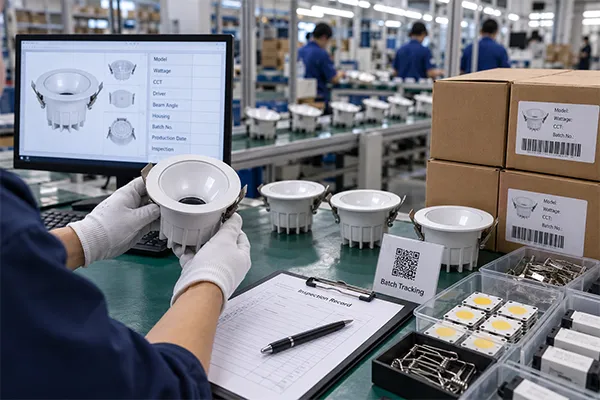
LED downlight standards are easier to verify when buyers can trace each shipment back to an approved configuration, production batch, component selection, label version, and inspection record. Strong traceability helps importers investigate field issues, compare samples with production goods, and control future repeat orders.10
What Good Traceability Looks Like
Traceability does not need to be overly complicated for every order. However, it should be practical enough to answer a basic question: Which exact product batch was shipped, and what was inside it?
For a downlight order, I would expect a traceability system to link:
- Purchase order number
- Customer SKU
- Factory model number
- Production date or batch reference
- Driver model
- LED board or LED source information
- Product label version
- Carton marking version
- Inspection record
- Aging-test record or internal production record
- Shipment invoice and packing list
This information becomes important if a distributor reports an issue months after delivery. The buyer can identify whether the issue relates to one batch, one component supplier, one dimming version, or a broader product range.
Use a Change-Control Process
A supplier should not replace a critical component without communication when the component affects the agreed specification.11 Buyers can reduce this risk by including a change-control clause in their purchase order or supplier quality agreement.
The clause can require the supplier to notify the buyer before changing:
- LED driver brand or model
- Rated wattage
- LED source
- Printed circuit board
- Heat sink or housing material
- Dimming design
- Lens, diffuser, reflector, or optical design
- Label content
- Packaging format
- Factory location, where relevant to the buyer’s quality plan
A reasonable process does not mean that every screw requires customer approval. Instead, it focuses on components and changes that may affect performance, safety evidence, installation suitability, or the buyer’s technical file.
Conduct Pre-Shipment Verification
Before shipment, buyers may use an internal inspector, a third-party inspection company, or a qualified local representative. The appropriate inspection depth depends on order value, product criticality, and the buyer’s own risk controls.
A practical pre-shipment inspection can include:
- Random quantity verification
- Visual appearance and finish inspection
- Dimensional checks, including cut-out size
- Wattage and input checks
- Driver and label model checks
- Dimming function checks, if applicable
- Colour consistency checks between samples
- Packaging drop or carton checks where relevant
- Verification that carton labels match the order
- Comparison with the approved reference sample
At Upward Lighting, I would provide production photos, specification confirmation, and agreed quality records as part of normal customer communication. For higher-risk projects, I would also recommend that buyers arrange independent inspection and qualified application-specific review before approving shipment.
What Is the Best Pre-Order Checklist for LED Downlight Standards?
A rushed order can leave key questions unresolved until goods are already on the water. That creates pressure for everyone: the importer, the factory, the distributor, and the project team. A structured pre-order checklist helps buyers identify gaps before deposits, labels, and production schedules are finalized.
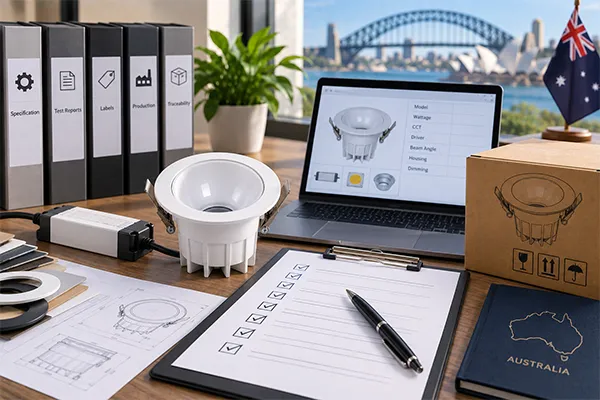
The best LED downlight standards checklist confirms the exact model, configuration, documents, labels, traceability plan, sample approval, production controls, and the responsible local party for current Australian verification. Buyers should complete these checks before approving mass production rather than after shipment.
Pre-Order Buyer Checklist
Use this checklist as a procurement control tool:
Product identity
- [ ] I have confirmed the factory model number.
- [ ] I have confirmed our internal SKU or private-label model number.
- [ ] I have approved product photos and dimensional drawings.
- [ ] I have confirmed wattage, CCT, CRI, beam angle, cut-out size, and finish.
- [ ] I have confirmed the intended installation method.
Critical configuration
- [ ] I have confirmed the LED driver brand and model.
- [ ] I have confirmed the dimming option.
- [ ] I have confirmed the housing and heat-sink design.
- [ ] I have documented any customized components.
- [ ] I have asked the supplier to notify us before critical changes.
Documents and labeling
- [ ] I have reviewed the document list against the exact model.
- [ ] I have checked that wattage and driver information are consistent.
- [ ] I have reviewed product label artwork.
- [ ] I have reviewed carton marking artwork.
- [ ] I have confirmed batch traceability requirements.
- [ ] I have asked the responsible local party to verify current Australian requirements.
Quality and shipment control
- [ ] I have approved a reference sample.
- [ ] I have defined acceptable quality limits.
- [ ] I have agreed on aging-test or quality-control records.
- [ ] I have planned pre-shipment inspection where appropriate.
- [ ] I have confirmed delivery timing, spare parts, and warranty handling.
Assign Responsibilities Clearly
One of the most useful steps is to assign each action to a named party. A factory may provide technical documents. A local importer may hold market responsibilities. A contractor may need to verify site conditions. An electrical professional may need to evaluate installation suitability.
| Task | Typical responsible party |
|---|---|
| Provide product specifications | Manufacturer |
| Confirm final ordered configuration | Buyer and manufacturer |
| Prepare private-label artwork | Buyer, with manufacturer support |
| Provide available product documents | Manufacturer |
| Verify current local requirements | Responsible local party |
| Confirm installation suitability | Qualified electrical or project professional |
| Approve production sample | Buyer |
| Conduct production quality checks | Manufacturer and/or third-party inspector |
| Maintain importer-side product records | Importer or local brand owner |
This division of responsibility supports clearer communication. It also avoids the risky assumption that a factory overseas can guarantee every local registration, installation, sales, or legal outcome.
Frequently Asked Questions
Are CE and RoHS documents enough for Australian LED downlight compliance?
No. CE, RoHS, and general test reports may be useful supplier documents, but they should not be treated as automatic proof that a downlight meets all current Australian market requirements. Buyers should verify whether documents apply to the exact final product and confirm requirements with the responsible local party.
What details should match between a downlight and its test documents?
Buyers should compare the model number, wattage, input details, driver model, dimming option, housing, installation design, dimensions, and label information. A document may not remain relevant if the final product uses different critical components or a changed configuration.
Can a product-family certificate cover every LED downlight variation?
Not automatically. A product-family document may cover defined variants, but buyers should verify which models, wattages, drivers, and configurations are included. Changes to dimming systems, housings, drivers, or installation designs may require further review by the responsible qualified party.
Why is batch traceability important for LED downlights?
Batch traceability helps buyers link shipped goods to production dates, component choices, inspections, labels, and approved specifications. If a field issue occurs, this information can help identify whether the problem is isolated to a specific production batch or component version.
Can a Chinese LED downlight manufacturer guarantee Australian compliance?
A manufacturer can provide product specifications, available reports, quality records, samples, and configuration information. However, the manufacturer should not guarantee the importer’s local registration, legal obligations, or installation outcome.12 Buyers should work with the responsible local party and qualified professionals for those decisions.
Conclusion
LED downlight standards for Australian markets should be approached as a complete evidence and control process, not a quick certificate request. I recommend that buyers verify the exact model, driver, wattage, dimming option, installation design, labels, documents, and batch traceability before production begins. CE, RoHS, and supplier reports can support due diligence, but the responsible local party should confirm current Australian requirements for the intended product and sales route. If you are sourcing customized LED downlights, contact Upward Lighting to request specifications, samples, OEM/ODM options, and a structured product-document review package.
"Equipment Safety in Australia and New Zealand – ERAC", https://www.erac.gov.au/equipment/equipment-safety-in-australia-and-new-zealand/. Australian electrical-equipment regulators explain that responsible suppliers must meet applicable equipment-safety and registration obligations before supplying regulated equipment; a supplier-held certificate is therefore contextual evidence rather than automatic authorization for every final sales configuration. Evidence role: general_support; source type: government. Supports: Australian electrical-equipment rules place obligations on responsible suppliers and use product-specific compliance arrangements rather than treating any supplier document as universal market-access proof.. Scope note: The precise obligations depend on the equipment classification, jurisdiction, and manner in which the product is supplied. ↩
"Lighting | energy.gov.au", https://www.energy.gov.au/business/equipment-guides/lighting. Australian government guidance identifies distinct electrical-safety and energy-efficiency regulatory pathways for relevant lighting equipment, supporting the need to assess product identity, markings, supply obligations, and intended installation separately. Evidence role: general_support; source type: government. Supports: Australian lighting products can be subject to separate electrical-safety, energy-efficiency, and supply-information requirements, while installation is governed in its own regulatory and standards context.. Scope note: Not every requirement applies to every downlight; applicability depends on product type, scope definitions, and the intended supply and installation context. ↩
"RoHS Directive - Environment - European Commission", https://environment.ec.europa.eu/topics/waste-and-recycling/rohs-directive_en. European Commission guidance describes CE marking and RoHS declarations as EU conformity instruments, while Australian electrical regulators prescribe their own responsible-supplier and compliance arrangements; consequently, those documents alone do not establish Australian compliance. Evidence role: general_support; source type: government. Supports: CE marking and RoHS declarations are mechanisms within the European regulatory framework, whereas Australian electrical-equipment supply obligations are administered under Australian and New Zealand arrangements.. Scope note: EU test evidence may still be relevant technical evidence if its scope and the applicable Australian requirements are reviewed. ↩
"[PDF] Solid State Lighting LED Product Development and Manufacturing ...", https://www.energy.gov/documents/ledrtprdctmfg-reportoct2016pdf. Research on LED lighting systems identifies the driver, LED source, and thermal-management design as material determinants of luminaire electrical and thermal performance, so externally similar products may not share the same technical characteristics. Evidence role: mechanism; source type: research. Supports: LED luminaire performance and reliability depend on internal elements such as drivers, LED modules, and thermal-management structures, which may not be apparent from external appearance.. Scope note: This supports the general engineering principle and does not establish that any specific visually similar downlights differ internally. ↩
"Purchasing Energy-Efficient Commercial and Industrial LED ...", https://www.energy.gov/cmei/femp/purchasing-energy-efficient-commercial-and-industrial-led-luminaires. LED thermal-management literature explains that electrical input power and component configuration affect heat dissipation and LED junction temperatures, supporting separate technical review where nominal wattage or internal electronics change. Evidence role: mechanism; source type: research. Supports: Higher electrical input and differing driver or LED configurations can alter heat generation and temperature conditions in LED luminaires.. Scope note: Actual temperature differences depend on efficacy, driver losses, housing geometry, ambient conditions, and installation conditions. ↩
"[PDF] LED Dimming: What you need to know - eere.energy.gov", https://www1.eere.energy.gov/buildings/publications/pdfs/ssl/dimming_webcast_12-10-2012.pdf. Lighting-industry technical guidance distinguishes phase-cut, 0–10 V, and digital control interfaces such as DALI, each of which has interface-specific driver and control compatibility considerations. Evidence role: mechanism; source type: institution. Supports: DALI, 0–10 V, phase-cut, and other dimming approaches use different control interfaces and can present different compatibility requirements for LED drivers and controls.. Scope note: Compatibility must be confirmed for the particular driver, dimmer or controller, wiring arrangement, and installation. ↩
"Lighting | energy.gov.au", https://www.energy.gov.au/business/equipment-guides/lighting. Australian electrical-safety guidance on recessed lighting addresses insulation and clearance considerations, supporting the need to assess a downlight in the installation conditions for which it is intended. Evidence role: general_support; source type: government. Supports: Recessed luminaires can have installation restrictions concerning insulation, clearances, and heat management, so the intended installation arrangement is relevant to safety assessment.. Scope note: The applicable requirements and permitted covering conditions depend on the luminaire’s classification, instructions, and the governing installation rules. ↩
"[PDF] A methodology for testing life-cycle performance of consumer products", https://nvlpubs.nist.gov/nistpubs/Legacy/IR/nbsir76-1157.pdf. Reliability literature describes burn-in testing as a method intended to screen some early-life failures, providing context for the stated aging-test practice. Evidence role: mechanism; source type: research. Supports: Burn-in or aging tests are used in reliability practice to expose some early-life failures under defined operating conditions.. Scope note: General burn-in research does not verify that this factory tests every unit, the stated duration, the test conditions, or the effectiveness of its specific procedure. ↩
"Testing and Labeling Pertaining to Product Certification", https://www.regulations.gov/document/CPSC-2010-0038-0062. Conformity-assessment guidance describes certification as applying to a defined product scope and requiring control of changes, supporting the conclusion that a family document should not be assumed to cover unlisted or subsequently modified variants. Evidence role: general_support; source type: institution. Supports: Product-conformity assessment is limited by the certified scope, defined variants, and change-control rules; modifications may require reassessment.. Scope note: Whether a particular variant is covered can only be determined from the document’s scope, applicable standard, and certification body or responsible assessor. ↩
"ISO 9001 - Clause 8.5.2 Identification & Traceability", https://msspassociation.org/training-courses/iso-standards-in-plain-english/iso-9001-clauses/iso-9001-clause-8-5-2-identification-traceability. Quality-management and product-safety guidance treats identification and traceability as tools for linking products to production records and for investigating nonconformities or conducting targeted corrective action. Evidence role: general_support; source type: institution. Supports: Product identification and traceability support investigation of nonconforming products, corrective actions, and targeted recalls or follow-up.. Scope note: Traceability improves investigation capability but does not itself prevent defects or prove that a product complies with all applicable requirements. ↩
"configuration control board (CCB) - Glossary - NIST CSRC", https://csrc.nist.gov/glossary/term/configuration_control_board. Quality-management guidance requires planned control of changes that may affect conformity to product requirements, supporting contractual notification and review of substitutions involving critical components. Evidence role: expert_consensus; source type: institution. Supports: Recognized quality-management systems require organizations to control changes to production and externally provided processes where changes can affect conformity to requirements.. Scope note: The appropriate approval threshold and contractual remedy are matters for the buyer, supplier, and applicable regulatory requirements. ↩
"Certification of Equipment – ERAC", https://www.erac.gov.au/equipment/certification-of-equipment/. Australian regulatory guidance assigns relevant product-supply and responsible-supplier duties to the local importing or supplying entity, supporting the distinction between manufacturer-provided technical evidence and the importer’s own local obligations. Evidence role: general_support; source type: government. Supports: Australian supply rules assign responsibilities to the entity that imports or supplies regulated goods, including responsible-supplier obligations where applicable.. Scope note: Responsibility allocation may vary by product category, contractual arrangement, state or territory, and the roles performed by each party. ↩