
LED downlight supplier vs manufacturer is a common question when buyers compare quotations, samples, and factory profiles. The problem is simple: website labels can look similar. The risk is bigger: wrong assumptions can lead to unstable quality, unclear responsibility, or delayed delivery. I believe the solution is to verify control, not just names.
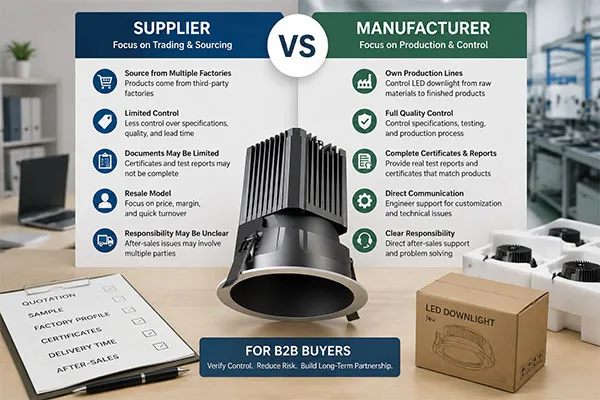
For B2B buyers, the real difference between an LED downlight supplier and a manufacturer is not the word on the website. It is whether the company can control product specifications, quality testing, certificates, delivery, and after-sales responsibility for your order. A supplier can be useful, but buyers should verify its actual role.
I work from the export side as a Zhongshan-based LED lighting manufacturer. Over the years, I have handled overseas inquiries, samples, OEM/ODM discussions, quotations, production checks, and shipments. So I look at this topic from a practical sourcing angle, not just a dictionary definition.
What Does LED Downlight Supplier vs Manufacturer Really Mean?
Many buyers start with a simple question: “Are you a supplier or a manufacturer?” That question is useful, but it is not complete. The problem is that both terms are used loosely in international trade, and this can create false confidence during procurement.
An LED downlight supplier is any company that can supply LED downlights to buyers, while a manufacturer has actual production capability.1 However, a supplier may be a factory, a trading company, or a company combining both roles. Buyers should verify what the company controls before making a sourcing decision.
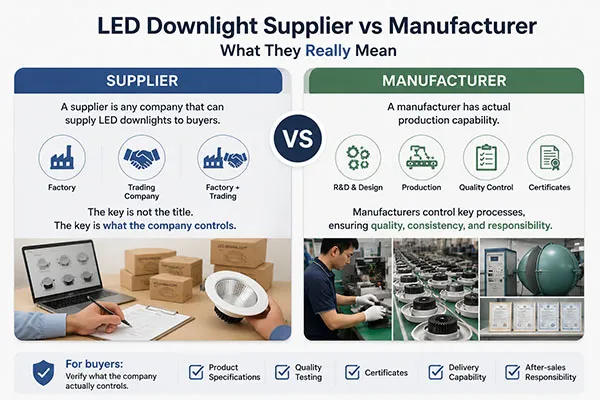
The word “supplier” is broad
In B2B purchasing, I often see buyers use “supplier” as a general term. It simply means a company that provides goods. A supplier may do many things:
- Produce LED downlights in its own factory
- Source LED downlights from partner factories
- Combine indoor and outdoor lighting products into one shipment
- Manage packaging, export documents, and communication
- Offer mixed product categories for importers or distributors
So, I do not treat “supplier” as a negative word. A capable supplier can save time, especially when the buyer needs a wide product range and small mixed quantities.
The word “manufacturer” refers to production capability
A manufacturer should have production capability. In LED downlights, that usually means it can control some or all of these areas:
- Product structure and housing selection
- LED chip and driver matching
- Assembly and wiring process
- Aging test before shipment
- Packaging and labeling
- Basic inspection before loading
However, “manufacturer” does not automatically mean reliable. A factory can still have weak quality control, poor communication, unstable materials, or slow delivery. I have seen buyers focus too much on “factory direct” and too little on the actual production system.
What buyers should really ask
The better question is not only, “Are you a manufacturer?” I suggest buyers ask:
- Which parts of the LED downlight do you produce or assemble yourself?
- Which components are outsourced, such as drivers, LEDs, lenses, or housings?
- Can you keep the same driver, CCT, CRI, beam angle, and housing for repeat orders?
- Do you perform 100% aging testing before shipment?
- Who handles after-sales issues if there is a defect claim?
In my own factory process, we conduct 100% aging testing before shipment, usually 4–8 hours, depending on the product and order requirement. I mention this as our process, not as a universal industry guarantee. Buyers should always confirm the exact inspection plan with each supplier.
The real purchasing issue is not the label. The real issue is control.
For B2B LED downlight buyers, this distinction matters because downlights are specification-sensitive products. A small change in driver quality, heat dissipation, CRI, or beam angle can affect installation results, customer satisfaction, and repeat business.
Why Does LED Downlight Supplier vs Manufacturer Matter for Price Comparison?
Many buyers compare prices first because budgets are real. The problem is that a low quote can hide different materials, different test standards, or different responsibility scopes. If you compare only unit price, you may not be comparing the same LED downlight at all.
LED downlight supplier vs manufacturer matters in price comparison because the quote reflects more than factory margin. LED downlight cost depends on the driver, housing material, heat dissipation, LED efficiency, CRI, beam angle, certificates, testing, packaging, and after-sales responsibility included in the offer.
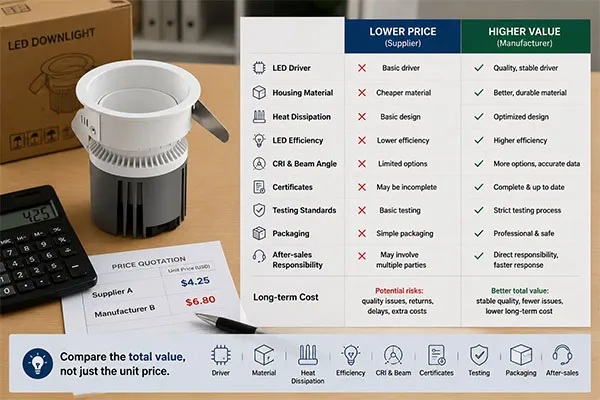
The lowest quote is not always the real factory price
I understand why buyers ask for the “best factory price.” In overseas trade, every importer, wholesaler, contractor, and distributor must protect margin. However, I have learned that the lowest quote is not always the most transparent quote.
For example, two 12W LED downlights may look the same in a spreadsheet. But they may differ in important ways:
| Cost Factor | Lower-Cost Option | Higher-Spec Option | Why It Matters |
|---|---|---|---|
| Driver | Basic non-isolated driver | Branded or better-protected driver | Affects stability and lifespan2 |
| Housing | Thin aluminum or plastic | Better aluminum heat sink | Affects heat dissipation3 |
| CRI | CRI 70–80 | CRI 80–90+ | Affects color quality4 |
| Lumen output | Lower efficiency | Higher lm/W | Affects lighting performance5 |
| Beam angle | Generic lens | Confirmed optical design | Affects installation effect6 |
| Testing | Random check only | 100% aging test | Reduces shipment risk7 |
| Packaging | Standard white box | Custom color box or reinforced carton | Affects channel sales and transport |
| Compliance | Unclear documents | CE/RoHS documents for relevant models | Affects market access and buyer verification8 |
Price depends on what is included
When I prepare quotations for overseas buyers, I try to clarify the specification first. A responsible quotation should answer questions like:
- What is the wattage and lumen output?
- What is the input voltage?
- What CCT is required: 3000K, 4000K, 6000K, or another option?
- What CRI is required?
- What beam angle is needed?
- Is the driver isolated or non-isolated?
- Is dimming required?
- What certificates or test documents should be provided?
- What packaging does the buyer need?
- What order quantity and delivery schedule are expected?
Without these details, price comparison becomes risky. One supplier may quote a low-cost version. Another manufacturer may quote a more stable version. A third supplier may include customized packaging, labels, or certification support. On paper, the numbers look different. In reality, the offers may not be equivalent.
Manufacturer pricing can be more transparent, but not always cheaper
A direct LED downlight manufacturer often has better visibility into material costs and production limitations. This can make the quotation more transparent. For example, if a buyer requests higher CRI, better driver protection, or a special beam angle, a manufacturer can usually explain the cost change more directly.
However, I do not present low price as the main advantage of working with a manufacturer. In many cases, the stronger advantages are:
- Specification control
- Sample-to-bulk consistency
- Faster technical confirmation
- Clearer quality responsibility
- Better support for repeat orders
A general supplier may sometimes offer a lower price because it sources from different factories or has ready stock. That can be practical for some buyers. The key is to compare the full scope, not only the price line.
My simple rule is this: if the price is much lower, I ask what changed. The answer is usually hidden in the driver, housing, testing, certification documents, packaging, or after-sales responsibility.
When Is a Manufacturer Better for OEM/ODM LED Downlights?
OEM/ODM buyers often need more than a standard product. The problem is that custom requirements create many chances for misunderstanding. A small error in CCT, trim color, cut-out size, label, or driver specification can affect the buyer’s brand and local channel sales.
A manufacturer is often better for OEM/ODM LED downlights when buyers need stable specifications, repeat production, custom packaging, private labels, adjusted wattage, different color temperatures, beam angle options, or sample-to-bulk consistency.9 Direct production control can reduce communication gaps during customization.
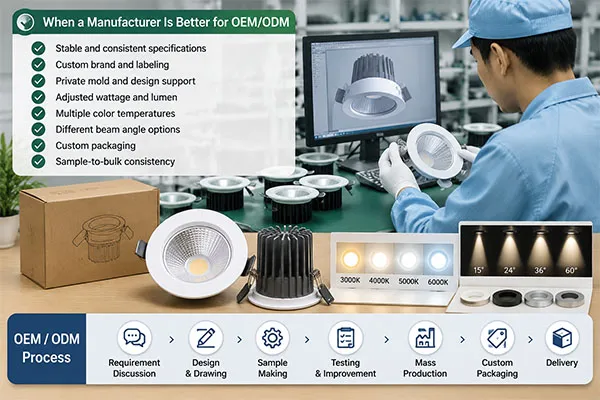
OEM/ODM requires technical confirmation
In our business, we provide OEM/ODM service for LED lighting products. For LED downlights, buyers often ask about:
- Color temperature: 2700K, 3000K, 4000K, 5000K, 6000K
- Power: common indoor wattages based on project needs
- Beam angle: narrow, medium, or wide options depending on lens design
- CRI: usually CRI 80 or higher for many commercial interiors
- Surface finish: white, black, silver, or customized trim color
- Packaging: neutral box, color box, or customer brand packaging
- Labels: brand label, wattage label, voltage label, model label
- Driver type: standard, isolated, dimmable, or market-specific options
A manufacturer can usually confirm these details with production, engineering, and purchasing teams faster. This matters when the buyer is preparing samples for a project tender, catalog update, or distributor launch.
Sample-to-bulk consistency is critical
One of the biggest risks in LED downlight sourcing is sample approval followed by bulk differences. The sample may look good, but the mass production order may use another driver, another LED batch, another housing thickness, or another diffuser.10
I always advise buyers to confirm the following before placing bulk orders:
- Keep the approved sample reference.
- Write key specifications in the proforma invoice or order contract.
- Confirm component brands or acceptable alternatives.
- Request pre-production photos when needed.
- Request aging test or inspection photos before shipment.
For repeat orders, this is even more important. Importers, wholesalers, and local lighting brands need stable product lines. If a downlight changes too often, the buyer may face complaints from installers or distributors.
Quality control is easier to trace
A manufacturer can often trace quality issues more directly because production records, materials, and inspection steps are closer to the source. In my own export work, I care about these checkpoints:
- Incoming material check
- Driver and LED matching
- Assembly process control
- Visual inspection
- Power and lighting test
- 100% aging test before shipment
- Final packing inspection
I do not claim that these steps replace professional laboratory testing. They do not. For application-specific decisions, buyers should consult qualified lighting engineers, certification bodies, or local compliance professionals where needed. But factory-level quality control still matters because it reduces avoidable defects before goods leave China.
When direct manufacturer communication helps
Direct communication with a manufacturer is useful when the buyer needs answers such as:
- Can this downlight fit a specific cut-out size?
- Can the lumen output be adjusted?
- Can the driver meet a specific voltage range?
- Can the product match CE or RoHS documentation requirements for a target market?
- Can the same model be supplied for repeat orders over time?
Certifications such as CE and RoHS should always be verified by product model, report scope, issuing body, and target market requirements. I can provide documents for relevant products where applicable, but buyers should review them carefully and confirm suitability with their own compliance team.
When Can a General Supplier Be Better Than a Manufacturer?
Some articles make direct manufacturing sound like the only smart choice. I do not agree. The problem is that real purchasing needs are different. A buyer may need many product types, low quantity, fast consolidation, or one shipment with several lighting categories.
A general supplier can be better than a manufacturer when the buyer needs small-volume mixed orders, many product categories, fast sourcing, shipment consolidation, or flexible purchasing support. A good supplier can reduce coordination work, especially for importers, traders, and distributors testing new markets.
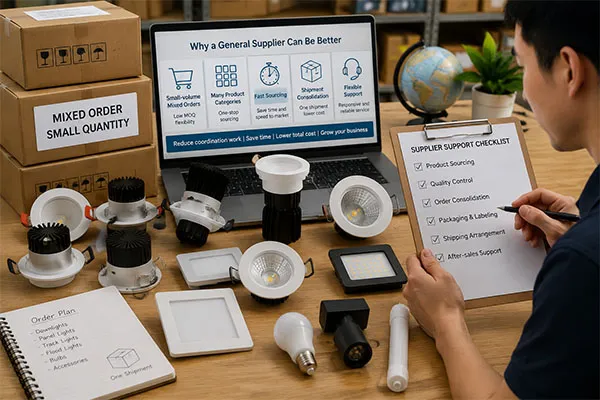
A supplier can simplify multi-category orders
Many overseas buyers do not buy only LED downlights. They may need:
- LED downlights
- LED flood lights
- LED wall lights
- LED street lights
- LED underground lights
- LED garden lights
- LED strip or linear lighting
- Accessories and packaging support
A single manufacturer may not produce every category. If the buyer wants one container or one LCL shipment with several product lines, a capable supplier can coordinate multiple sources.
This is especially useful for:
- Small distributors testing market demand
- Traders serving different customer requests
- Contractors with varied project lists
- Building-material channel buyers adding lighting SKUs
- Importers who want fewer communication points
Trading companies can add value
I do not attack traders or intermediaries because many of them provide real value. A strong trading company may have supplier networks, quality inspection experience, language skills, payment flexibility, and export documentation support.11
The key is transparency. A trader should be clear about what it controls and how it manages quality. A buyer should ask:
- Which factory produces the downlights?
- Can the trader provide product photos from production?
- Can it arrange inspection before shipment?
- Can it keep the same specification for repeat orders?
- Who handles warranty communication?
- Can it provide accurate certificates and model references?
If a trader can answer these questions clearly, it may be a practical partner.
A manufacturer may not fit every small order
Manufacturers often prefer stable production runs. Some factories have minimum order quantities, limited product categories, or longer lead times for special models. If a buyer needs 20 different SKUs in small quantities, a manufacturer may not be the most efficient choice.
Here is a simple comparison:
| Buying Scenario | Direct Manufacturer May Fit | General Supplier May Fit |
|---|---|---|
| Large repeat order of one downlight series | Yes | Sometimes |
| Private label downlight program | Yes | Sometimes |
| Small mixed order across many categories | Sometimes | Yes |
| Fast market testing | Sometimes | Yes |
| Custom driver, CRI, beam angle, packaging | Yes | Sometimes |
| One-stop procurement support | Sometimes | Yes |
| Strong technical traceability | Usually | Depends |
Choose based on sourcing risk, not labels
I think buyers should choose based on order type. If you need long-term LED downlight supply with stable specifications, a manufacturer may offer better control. If you need multi-category flexibility, a general supplier may be more practical.
The best partner is the company that can clearly explain:
- What it supplies
- What it controls
- What it outsources
- What it tests
- What documents it can provide
- What happens if a problem occurs
That is why the LED downlight supplier vs manufacturer decision should be connected to your procurement model, not just your preference for “factory direct.”
How Should Buyers Verify an LED Downlight Supplier vs Manufacturer Before Ordering?
Many sourcing problems happen before production starts. The problem is not always dishonesty. Often, the issue is unclear confirmation. If buyers do not verify specifications, documents, samples, and responsibility early, disputes become harder to solve later.
Buyers should verify an LED downlight supplier vs manufacturer by checking business role, production capability, product specifications, sample consistency, quality process, certificates, packaging details, delivery plan, and after-sales responsibility. The goal is to confirm control before placing bulk orders.
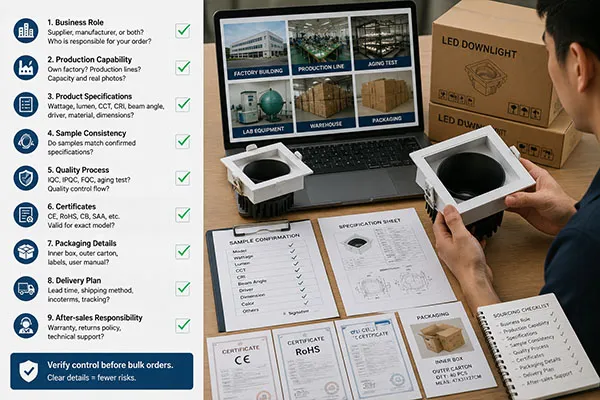
Use a practical verification checklist
I recommend buyers use a written checklist before confirming an LED downlight order. This helps both sides avoid assumptions.
| Verification Area | Questions to Ask | Why It Matters |
|---|---|---|
| Company role | Are you the producer, assembler, exporter, or sourcing supplier? | Clarifies responsibility |
| Product specs | What are wattage, lumen output, CCT, CRI, beam angle, voltage? | Prevents wrong comparison |
| Driver | What driver type is used? Is dimming required? | Affects stability and compatibility |
| Housing | What material and heat sink design are used? | Affects thermal performance |
| Samples | Will bulk production match the approved sample? | Reduces inconsistency |
| Testing | Is there 100% aging testing? How many hours? | Reduces early failure risk |
| Certificates | Are CE/RoHS documents available for this model? | Supports market compliance checks |
| Packaging | Neutral, OEM, color box, or reinforced carton? | Affects branding and transport |
| Delivery | What is the lead time after deposit and artwork approval? | Protects project schedule |
| Warranty | What is covered and how are claims handled? | Clarifies after-sales process |
Ask for documents, but verify scope
Certificates are important, but buyers should read them carefully. A document may apply to one model, one series, one driver, or one test standard. It may not automatically apply to every product on a website.
For CE, RoHS, or other compliance documents, I suggest buyers check:
- Product model number
- Applicant or manufacturer name
- Test standard
- Report date
- Issuing laboratory or certification body
- Product photos or technical descriptions
- Target market requirements
As a manufacturer, I can provide relevant documents for applicable products, but I always encourage buyers to verify them. I am not a certification body. Local importers should confirm compliance requirements with qualified professionals in their own market.
Confirm quality control before shipment
A good pre-shipment process should be clear. For LED downlights, buyers can request:
- Production photos
- Packing photos
- Label photos
- Aging test photos or videos
- Random inspection report
- Carton marking confirmation
- Final quantity and weight details
In our own workflow, LED lighting products must pass aging before shipment, usually 4–8 hours. This is part of our internal quality control approach. For large or critical orders, buyers may also appoint a third-party inspection company.
Evaluate communication speed and accuracy
Communication is part of supplier quality. I have seen buyers focus only on product price, then struggle because the supplier cannot confirm details quickly.
A good partner should respond clearly on:
- Technical questions
- Quotation details
- Sample timing
- Custom packaging
- Certificate availability
- Payment terms
- Delivery schedule
- After-sales process
Fast response alone is not enough. The response must be accurate. If a supplier answers every technical question vaguely, the buyer should slow down and verify more.
Start with samples when the order is important
For new LED downlight models, samples are often worth the cost. Samples allow buyers to check:
- Appearance
- Brightness
- CCT
- Beam effect
- Installation structure
- Driver type
- Packaging quality
- Label accuracy
If the sample is approved, buyers should keep a signed or clearly referenced sample standard. This makes bulk inspection much easier.
How Can Buyers Make the Final LED Downlight Supplier vs Manufacturer Decision?
The final decision can feel difficult because every option has trade-offs. The problem is that buyers sometimes choose based on one factor, such as price, title, or speed. That can create risk when the order enters production or reaches the local market.
Buyers should make the LED downlight supplier vs manufacturer decision by matching the partner type to the order goal. Manufacturers often fit OEM/ODM and repeat supply. General suppliers often fit mixed orders and flexible sourcing. In both cases, buyers should verify control, quality, documents, and responsibility.
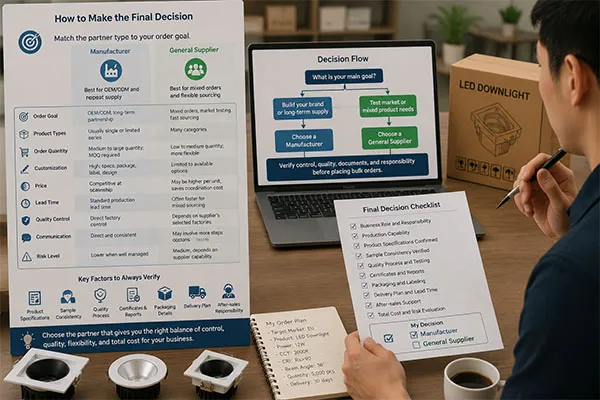
Match partner type to business model
Different buyers need different sourcing structures. I usually think about it this way:
| Buyer Type | Main Need | Better Fit |
|---|---|---|
| Importer building a stable downlight line | Repeat quality and price structure | Manufacturer |
| Wholesaler testing several lighting categories | Flexible SKUs and mixed shipment | General supplier |
| Lighting contractor | Project-specific specs and delivery | Manufacturer or strong supplier |
| Local lighting brand | OEM packaging and consistency | Manufacturer |
| Trader serving varied requests | Fast sourcing and broad product range | General supplier |
| Electrical/building-material channel buyer | Stable supply and packaging support | Depends on volume and SKU range |
Use a scoring system
A simple scorecard can make sourcing decisions more objective. Buyers can rate each potential partner from 1 to 5.
| Evaluation Factor | Weight | Notes |
|---|---|---|
| Specification clarity | High | Are product details complete? |
| Sample quality | High | Does the sample meet the buyer’s target? |
| Production control | High | Does the company control assembly and QC? |
| Certificate support | Medium/High | Are documents model-specific and verifiable? |
| Communication | High | Are answers fast and accurate? |
| Price transparency | Medium | Is the quote scope clear? |
| MOQ flexibility | Medium | Does it fit your order size? |
| Delivery reliability | High | Is the lead time realistic? |
| After-sales responsibility | High | Is the claim process clear? |
This kind of scorecard prevents emotional decisions. A buyer may find that a manufacturer wins for a long-term private label program, while a supplier wins for a small mixed container.
Think beyond the first order
The first order is important, but repeat supply is where many sourcing partnerships are tested. Buyers should ask:
- Will this model still be available in six months?
- Can the same CCT and CRI be maintained?
- Will the driver change without notice?
- Can packaging artwork be reused?
- Can the supplier support replacement parts or claim analysis?
- Can lead time remain stable during peak season?
A good LED downlight partner should help buyers reduce uncertainty. That is more valuable than a small price difference in many B2B situations.
My practical recommendation
If your order is focused on LED downlights, private label, custom specifications, or repeat supply, I would usually suggest talking directly with a manufacturer. If your order includes many categories and small quantities, I would also consider a capable general supplier.
The smartest approach is not ideological. It is practical. Ask who controls what. Ask what is tested. Ask what is documented. Ask who takes responsibility after shipment.
Frequently Asked Questions
Is an LED downlight supplier always a trading company?
No. An LED downlight supplier can be a manufacturer, trading company, exporter, or combined company. The word “supplier” only means the company can supply products. Buyers should verify production capability, quality control, certificates, and after-sales responsibility instead of relying on the label.
Is buying directly from an LED downlight manufacturer always cheaper?
Not always. A manufacturer may offer more transparent cost control, but the final price depends on driver quality, housing, CRI, efficiency, testing, certificates, packaging, MOQ, and service scope. The lowest quote may use different materials or include less responsibility.
What should I check before ordering OEM LED downlights?
You should confirm wattage, lumen output, CCT, CRI, beam angle, voltage, driver type, housing material, trim color, packaging, label design, certificates, sample approval, aging test process, delivery time, and warranty terms. Written confirmation reduces misunderstanding before bulk production.
Are CE and RoHS certificates enough for importing LED downlights?
CE and RoHS documents are important for many markets, but buyers should verify the model scope, test standards, issuing body, and local requirements. These documents do not replace professional compliance review. Importers should confirm market-specific rules with qualified local experts.
How long should LED downlights be tested before shipment?
Testing time depends on the supplier’s quality process and product type. In our own factory workflow, LED lighting products receive 100% aging testing before shipment, usually 4–8 hours. Buyers should confirm the exact test method and request inspection evidence when needed.
Conclusion
LED downlight supplier vs manufacturer is not just a definition debate. It is a sourcing risk question. A good partner should control specifications, quality, documents, delivery, and after-sales responsibility. Manufacturers often fit OEM/ODM and repeat orders, while general suppliers can be practical for mixed shipments. If you are evaluating LED downlights for import, wholesale, distribution, or projects, contact us with your specifications. I can help review options, prepare a clear quotation, and support sample confirmation.
"Supplier", https://en.wikipedia.org/wiki/Supplier. A neutral business reference defines a supplier as an entity that provides goods or services and a manufacturer as an entity engaged in making products, supporting the article’s distinction between supply role and production capability. Evidence role: definition; source type: encyclopedia. Supports: The source should support the general distinction between a supplier as a provider of goods and a manufacturer as an entity that makes products.. Scope note: The source would support the general terminology rather than LED-downlight-specific trade practice. ↩
"Lifetime and Reliability", https://www1.eere.energy.gov/buildings/publications/pdfs/ssl/life-reliability_fact-sheet.pdf. Research on LED luminaire reliability identifies driver electronics as a key contributor to system failures and lifetime limitations, supporting the claim that driver selection can affect product stability and service life. Evidence role: mechanism; source type: research. Supports: The source should explain that LED driver electronics are a significant reliability factor in LED luminaires.. Scope note: The evidence supports the mechanism at the luminaire-system level and may not quantify the effect for a specific downlight design. ↩
"Thermal Management of White LEDs", https://www1.eere.energy.gov/buildings/publications/pdfs/ssl/thermal_led_feb07_2.pdf. Thermal-management studies of LED luminaires show that heat-sink material, surface area, and housing design influence heat transfer and junction temperature, supporting the statement that housing design affects heat dissipation. Evidence role: mechanism; source type: paper. Supports: The source should support that heat-sink geometry and materials influence LED junction temperature and heat dissipation.. Scope note: The source would provide engineering support for the principle rather than evaluating the exact housings compared in the article. ↩
"Color rendering of light sources | NIST", https://www.nist.gov/pml/sensor-science/optical-radiation/color-rendering-light-sources. Authoritative lighting references define the color rendering index as a measure of how a light source renders object colors compared with a reference illuminant, supporting the use of CRI as an indicator of color quality. Evidence role: definition; source type: government. Supports: The source should define CRI and explain its relationship to how accurately a light source renders object colors.. Scope note: CRI is an imperfect color-quality metric and does not capture all aspects of visual preference or color fidelity. ↩
"LED Lighting Efficacy: Status and Directions", https://www.osti.gov/servlets/purl/1421610. Educational lighting references describe lumens as a measure of light output and luminous efficacy as lumens per watt, supporting the article’s treatment of lumen output and lm/W as lighting-performance factors. Evidence role: definition; source type: education. Supports: The source should explain lumens and luminous efficacy as standard measures of light output and energy efficiency.. Scope note: These metrics indicate output and efficiency but do not alone determine suitability for a specific installation. ↩
"Design and evaluation of an LED-based light fixture", https://www.lrc.rpi.edu/s/SPIE5187-43_Gu.pdf. Lighting-design references explain that beam angle or beam spread determines the distribution of luminous intensity and the illuminated area, supporting the claim that optical design affects installation results. Evidence role: mechanism; source type: education. Supports: The source should support that beam angle influences light distribution, illuminance pattern, and application suitability.. Scope note: The source would support the optical principle, while actual installation outcomes also depend on ceiling height, spacing, reflectances, and room geometry. ↩
"Prediction of lifetime by lumen degradation and color shift for LED ...", https://pubmed.ncbi.nlm.nih.gov/30874228/. Reliability literature describes burn-in or aging tests as a screening method intended to reveal early-life failures before products are shipped, supporting the article’s claim that aging tests can reduce shipment risk. Evidence role: mechanism; source type: paper. Supports: The source should support that burn-in or aging tests are used to screen early failures in electronic or LED products.. Scope note: The evidence supports the general reliability-screening rationale and does not prove that any specific 4–8 hour factory test will detect all defects. ↩
"European Union Reduction of Hazardous Substances RoHS and ...", https://www.waru.edu/artifact/european-union-reduction-hazardous-substances-rohs-and-waste-electrical-and-electronic. European Commission guidance explains that CE marking indicates conformity with applicable EU requirements and that RoHS restricts certain hazardous substances in electrical and electronic equipment, supporting the article’s statement that such documents matter for market access and verification. Evidence role: general_support; source type: government. Supports: The source should support that CE marking and RoHS obligations apply to relevant electrical and electronic products placed on the EU market.. Scope note: Applicability depends on the exact product, market, directives, and conformity-assessment scope. ↩
"Linking supply chain quality integration with mass ...", https://repository.ceibs.edu/en/publications/linking-supply-chain-quality-integration-with-mass-customization-/. Operations-management research links production control and close supplier integration with improved coordination of customized requirements and quality consistency, providing contextual support for preferring manufacturers in OEM/ODM programs requiring repeatable specifications. Evidence role: general_support; source type: paper. Supports: The source should support that closer production control and supplier integration can improve customization coordination and specification consistency.. Scope note: The source would support the supply-chain principle broadly rather than proving that every LED downlight manufacturer outperforms every general supplier. ↩
"Documentation and Records: Harmonized GMP Requirements", https://pmc.ncbi.nlm.nih.gov/articles/PMC3122044/. Quality-management guidance emphasizes control of specifications, approved samples, and production changes to prevent unintended variation between prototype approval and mass production, supporting the article’s concern about sample-to-bulk differences. Evidence role: general_support; source type: institution. Supports: The source should support the quality-management practice of controlling approved samples, specifications, and material changes during production.. Scope note: The source would support the quality-control principle and may not discuss LED downlights specifically. ↩
"Trade", https://www.worldbank.org/ext/en/topic/trade. Research on trade intermediaries describes their role in reducing transaction costs, matching buyers and suppliers, and supporting export-related coordination, providing contextual support for the article’s claim that capable trading companies can add procurement value. Evidence role: general_support; source type: research. Supports: The source should support that trade intermediaries can reduce transaction costs and coordinate export-related activities.. Scope note: The evidence supports the general economic role of intermediaries and does not verify the competence of any particular trading company. ↩