LED downlight vs track light comparison often becomes difficult when project teams focus only on wattage, lumens, or unit price. That approach can create glare, weak product highlighting, awkward installation, or costly changes after the ceiling is complete. I recommend starting with the lighting task, ceiling conditions, beam control, and future adjustment needs.
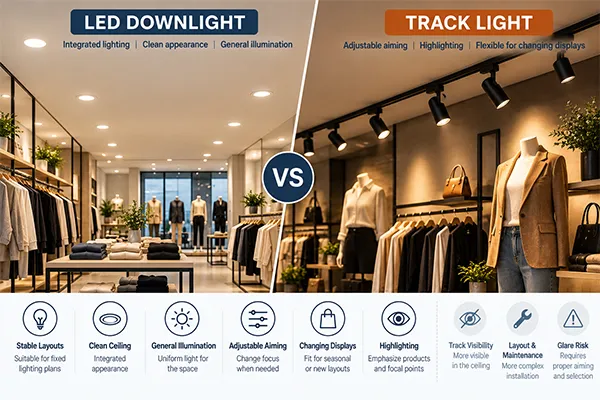
In an LED downlight vs track light comparison, downlights are often selected for integrated lighting layouts and a clean ceiling appearance, while track lights are often selected for directional lighting, accenting, and adjustable aiming. Neither option is automatically better. The correct choice depends on what must be illuminated, fixture spacing, beam angle, mounting position, glare control, color quality, installation constraints, and the flexibility required after handover.
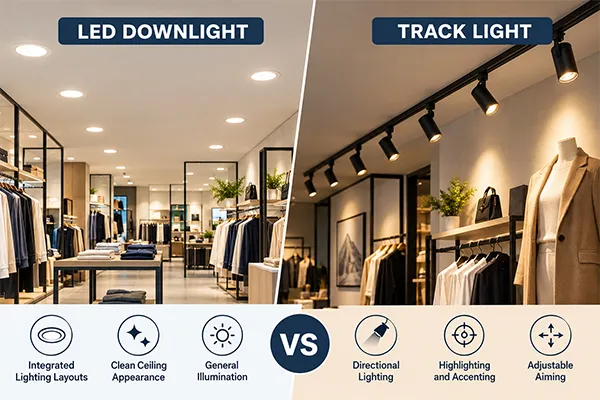
I regularly see contractors, importers, and lighting brands compare these products as if they are interchangeable because both may use similar wattage ranges. However, fixture performance depends on much more than electrical input. A structured LED downlight vs track light comparison helps buyers reduce specification risk before production, installation, and final project approval.
How Does the Lighting Task Shape an LED Downlight vs Track Light Comparison?
When I discuss fixture selection with a customer, the first challenge is usually not the product model. The challenge is identifying the actual lighting job. A space may need comfortable ambient light, strong vertical illumination, product emphasis, architectural drama, or a combination of several lighting layers.1
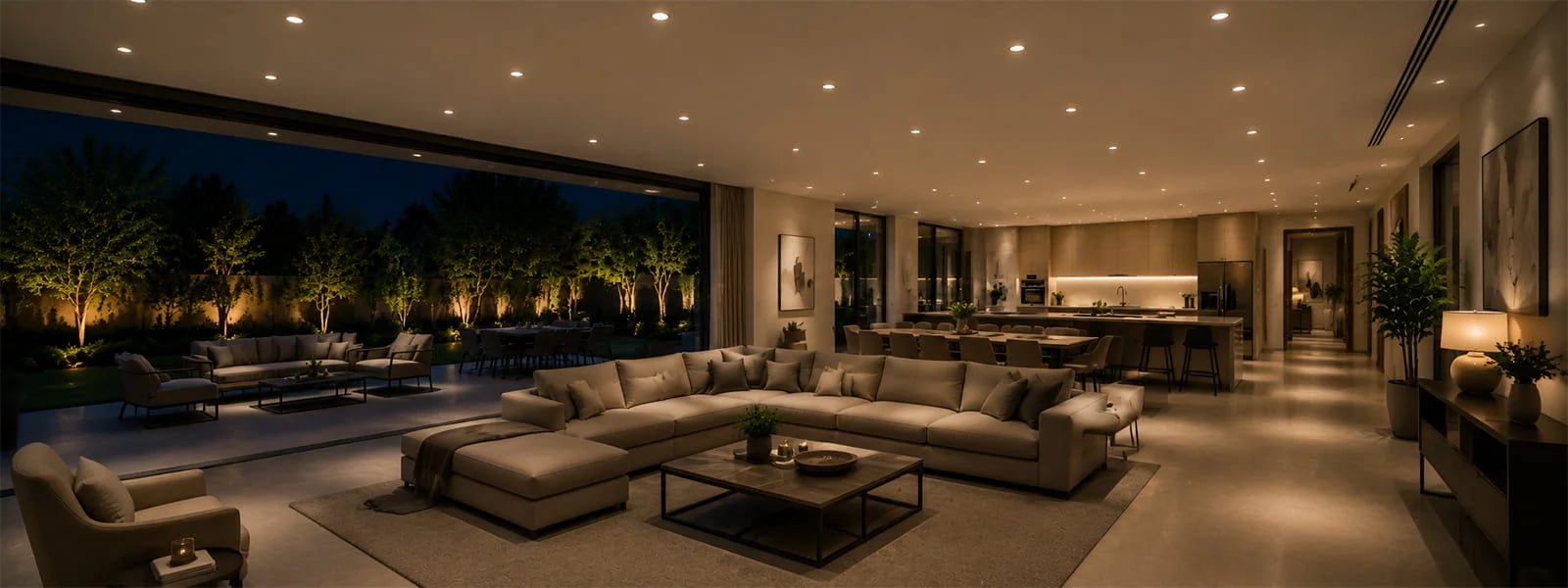
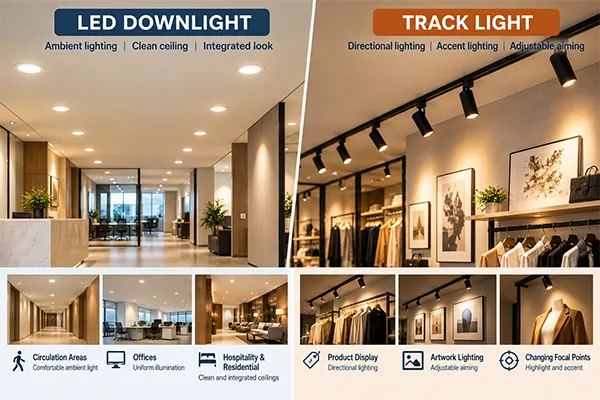
The lighting task should lead an LED downlight vs track light comparison. Downlights often support clean, integrated lighting across circulation areas, offices, hospitality spaces, and residential ceilings. Track lights are often more suitable where the project needs directional beams, adjustable aiming, product display lighting, artwork lighting, or changing focal points.2
Start With What the Fixture Must Illuminate
I ask customers a basic question before discussing wattage: What needs to be seen?
The answer may be very different from one project to another:
- A supermarket may need broad illumination for aisles, shelves, and checkout areas.
- A fashion store may need strong visual emphasis on mannequins, wall displays, and merchandise.
- A hotel corridor may need comfortable guidance lighting with a clean, unobtrusive ceiling.
- A gallery may need carefully controlled directional lighting for artwork.
- An office may need visual comfort, suitable color quality, and a layout that works with desks and circulation zones.
- A residential kitchen may need general lighting plus focused illumination over work surfaces.
Downlights can do more than provide basic general lighting. I have supported inquiries where recessed downlights were specified with narrower beam angles for architectural details, wall washing effects, or focused zones within a broader layout. However, these applications require project-specific verification of beam direction, mounting height, spacing, and visual comfort.
Track lights provide a different type of flexibility. Their heads can often be aimed after installation, which can help where displays, furniture, merchandise, or interior layouts may change. Yet that flexibility only has value if the project team expects to use it. A fixed retail layout may not require frequent adjustment. In that case, a carefully designed downlight layout may offer a cleaner appearance and a simpler ceiling plan.
I do not recommend selecting a fixture simply because it appears more commercial or more decorative. I recommend selecting it because its optical and installation characteristics support the intended task.
Consider Layered Lighting Rather Than One Fixture Type
Many successful commercial lighting schemes use both products. In these projects, the LED downlight vs track light comparison is not about choosing one category for the entire building. It is about assigning each fixture a suitable role.
| Lighting requirement | Downlight role | Track light role |
|---|---|---|
| General circulation lighting | Often suitable | Can be used, but may be visually excessive |
| Accent lighting | Suitable in defined fixed locations | Often suitable due to aiming flexibility |
| Retail product displays | Can support background lighting | Often useful for display emphasis |
| Hospitality ceilings | Often preferred for a clean integrated appearance | Useful for feature areas or artwork |
| Changing layouts | Less adjustable after installation | Often more adaptable |
| Wall displays and vertical surfaces | Requires careful placement and optics | Often easier to aim toward target surfaces |
I encourage buyers to map each zone before requesting a quotation. This approach gives us a better basis for discussing beam angle, wattage, color temperature, CRI, housing finish, mounting method, and required quantity.
Why Are Similar Wattage and Lumens Not Enough?
A common procurement problem begins when two fixtures appear similar on a quotation because they have the same wattage or a similar lumen figure. This can create unrealistic expectations. A 20 W downlight and a 20 W track light may consume similar power, but they can distribute light in very different ways.
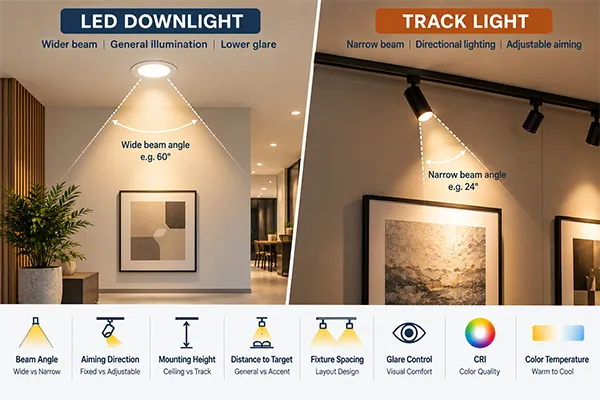
Similar wattage or lumen output does not make downlights and track lights interchangeable.3 In an LED downlight vs track light comparison, beam angle, aiming direction, mounting height, distance to the target, fixture spacing, glare control, CRI, and color temperature should all be evaluated before a product is specified.
Beam Angle Changes the Result
Beam angle is one of the most important factors that I discuss during specification confirmation. A fixture with a narrow beam concentrates light into a smaller area. A fixture with a wider beam spreads light over a larger area.4 Neither approach is universally correct.
For example:
- A narrow beam may help create emphasis on a product display, artwork, feature wall, or architectural detail.
- A medium beam may suit many retail and hospitality applications where the target area is defined but not extremely small.
- A wide beam may support broader ambient illumination, depending on ceiling height and layout.
- An overly narrow beam can create visible bright spots or uneven illumination.
- An overly wide beam can reduce emphasis and may cause light to spill into unwanted areas.
A track light can be aimed, but aiming does not remove the need to select an appropriate beam angle. If the optic is too narrow or too wide, later adjustment may not solve the visual issue. Likewise, a recessed downlight can provide focused illumination when the beam angle and location are selected carefully.
Mounting Height and Target Distance Matter
I also ask about ceiling height and the distance between the fixture and the illuminated surface. These dimensions influence how the beam reaches the target.5 A fixture that works well above a low retail ceiling may produce a very different effect in a lobby with a much higher ceiling.
Before a buyer compares products, I suggest confirming:
- Ceiling height: Measure the mounting height from the finished floor.
- Target position: Identify whether light is needed on the floor, a counter, a shelf, a wall, or a display.
- Target distance: Estimate the horizontal and vertical distance from fixture to target.
- Fixture spacing: Review whether fixtures are intended to overlap, create individual pools of light, or form a continuous lighting pattern.
- Viewing direction: Consider whether occupants will look directly toward the fixture or toward the illuminated object.
Color Quality Is a Specification Decision
CRI and color temperature also influence the result. A project that displays clothing, food, cosmetics, artwork, or premium finishes may need careful consideration of color rendering.6 A project team should not assume that all LED fixtures will present materials in the same way.
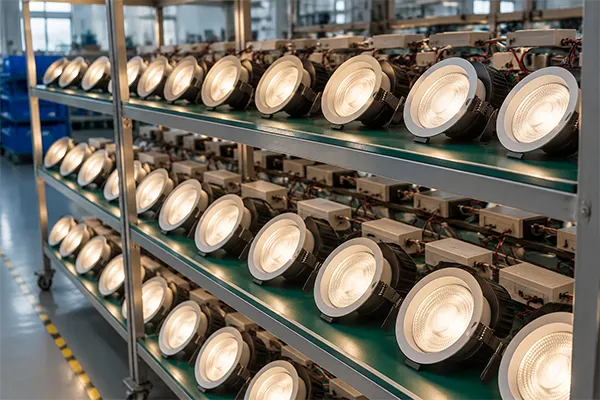
At Upward Lighting, we discuss options such as color temperature, CRI, wattage, beam angle, and surface finish during OEM/ODM specification conversations. However, I recommend that buyers define the intended application and verify the final specification documents, samples, and applicable certification requirements before placing an order.
What Installation Constraints Should Buyers Review?
A fixture may look suitable in a catalogue but become unsuitable once the team reviews the ceiling structure, wiring route, access conditions, and finished interior design. This is why I treat installation information as a key part of every LED downlight vs track light comparison.
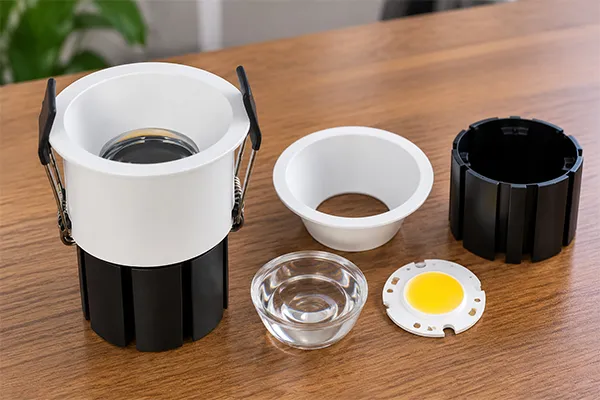
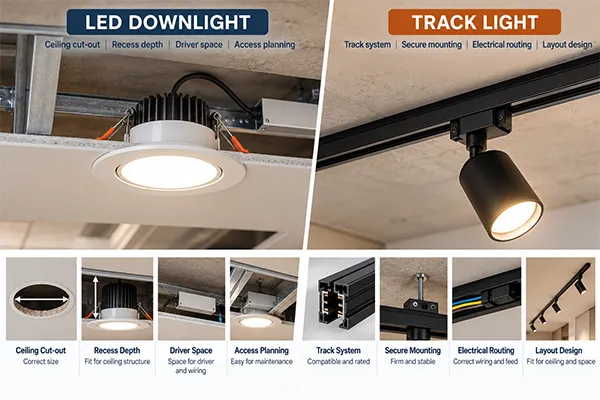
Downlights require suitable ceiling cut-out dimensions, recess depth, driver space, and access planning.7 Track lights require a compatible track system, secure mounting, electrical routing, and a layout that fits the ceiling design. Buyers should review these conditions before finalizing quantities or production specifications.
Downlight Installation Questions
Recessed downlights can create a streamlined visual effect because much of the fixture body is hidden within the ceiling. However, that appearance depends on suitable site conditions.
I typically ask about the following points:
- What is the ceiling type: gypsum board, metal ceiling, wood, concrete, or another material?
- What cut-out diameter is available?
- Is there enough recess depth above the finished ceiling?
- Is there sufficient clearance for the driver and wiring?
- Will insulation, HVAC ducts, fire systems, or other services interfere with the fixture?
- Does the project require trim, trimless, anti-glare, adjustable, or surface-mounted alternatives?
- Can maintenance personnel access the driver if replacement is needed?
A downlight should not be selected only by its outer diameter. The cut-out size, installation depth, driver arrangement, heat management design, and ceiling material should be reviewed together. For imported projects, buyers should also confirm that product dimensions and installation instructions match local contractor expectations.
Track Light Installation Questions
Track lighting has different constraints. The track itself becomes part of the visible ceiling design.8 Some projects welcome this industrial or contemporary appearance. Other projects prefer a minimal ceiling with fewer visible components.
Key track lighting questions include:
- Which track standard and wire configuration does the project require?
- Is the track single-phase, three-phase, or another specified system?
- How will the track be mounted: surface-mounted, suspended, recessed, or integrated into a ceiling detail?
- Where will the power feed be located?
- Are straight runs sufficient, or does the layout require L, T, X, or flexible connections?
- Will the track position allow suitable aiming without creating glare?
- Can the maintenance team safely access fixture heads and track connections?
Track lighting can be a useful option for flexible spaces, but it is not automatically the best commercial solution. A poorly positioned track can make a ceiling look crowded, create unwanted visual lines, or direct light toward occupants’ eyes.
Compare Installation Risk Before Ordering
| Evaluation point | LED downlight | LED track light |
|---|---|---|
| Ceiling appearance | Often more integrated | Track remains visible |
| Ceiling cut-out required | Usually yes for recessed types | Usually no cut-out for surface track |
| Adjustment after installation | Limited for fixed models | Often adjustable by head direction |
| Layout changes | May require new ceiling work | May allow fixture repositioning along track |
| Driver and wiring access | Depends on ceiling construction | Depends on track layout and power feed |
| Design coordination | Requires cut-out and service planning | Requires track route and ceiling coordination |
I recommend that contractors review shop drawings, ceiling reflected plans, fixture dimensions, and sample installation instructions before issuing a final purchase order. This process can reduce avoidable changes after materials arrive on site.
When Does Future Flexibility Justify Track Lighting?
Some buyers assume track lighting is the premium upgrade in every commercial project. I do not see it that way. Track lighting has valuable adjustment capability, but that capability should solve a real operational need rather than become an unnecessary cost or visual compromise.
Track lighting is often justified when displays, focal points, furniture, or merchandise may change and the project needs later aiming adjustments. In an LED downlight vs track light comparison, buyers should weigh that flexibility against track visibility, layout complexity, maintenance access, glare risk, and the long-term appearance of the space.
Identify Whether the Space Will Change
I often ask customers how stable the interior layout will be after opening. This question matters especially for retailers, showrooms, galleries, branded stores, and multi-purpose commercial spaces.
Track lighting may be worth evaluating when the project expects:
- Seasonal merchandising changes
- Rotating product displays
- New artwork or promotional zones
- Rearranged showroom layouts
- Frequent changes in focal displays
- Temporary installations or pop-up concepts
- A need to direct light toward different vertical surfaces
A track head can often be moved along the track or aimed toward a new target, depending on the selected system.9 This may provide useful operational flexibility. However, the project still needs a well-considered track layout. A flexible system cannot fully compensate for a track route that was installed too far from key display walls or too close to customer sightlines.
Evaluate Glare and Visual Comfort
Glare should be evaluated in both fixture categories. However, track lights can create a particular risk when heads are aimed toward common viewing directions. A bright visible light source can distract occupants, reduce visual comfort, or create an inconsistent visual impression.10
I recommend reviewing:
- The fixture’s shielding and optical design
- The likely viewing angle of customers, staff, and visitors
- The relationship between the fixture and reflective surfaces
- The height of the track and fixture heads
- Whether the beam will strike glossy floors, glass, screens, or mirrors
- Whether the project needs anti-glare accessories or alternative optics
Downlights can also create glare if they are poorly spaced, insufficiently shielded, or installed in unsuitable locations. The distinction is not that one product prevents glare and the other causes it. The issue is whether the selected optic, mounting position, and layout fit the actual environment.
Build a Product Range Around Applications
For importers, distributors, and local lighting brands, I suggest building a range that reflects common customer needs rather than treating one fixture family as a complete replacement for the other.
A balanced range may include:
| Product category | Potential use case | Customization points to review |
|---|---|---|
| Fixed recessed downlight | Offices, corridors, residential ceilings, hospitality areas | Wattage, CCT, CRI, cut-out, trim color |
| Adjustable downlight | Feature zones, wall emphasis, selected retail areas | Tilt angle, beam angle, glare control |
| Surface-mounted downlight | Concrete ceilings or limited recess depth | Housing finish, mounting size, driver arrangement |
| Track light | Retail, showrooms, galleries, display zones | Track compatibility, beam angle, CCT, CRI, finish |
| Track accessories | Adaptable track layouts | Connectors, power feeds, suspension parts |
At Upward Lighting, we can discuss OEM/ODM parameters such as color temperature, wattage, beam angle, CRI, and surface finish colors. I also recommend that buyers request clear product drawings, track compatibility details, samples where appropriate, and relevant certification documentation for verification in their intended market.
How Should Buyers Compare Downlight and Track Light Suppliers?
Even a well-designed LED downlight vs track light comparison can fail if the supplier cannot provide stable specifications, clear documentation, responsive communication, and consistent production control. Buyers should evaluate the product and the supplier together.
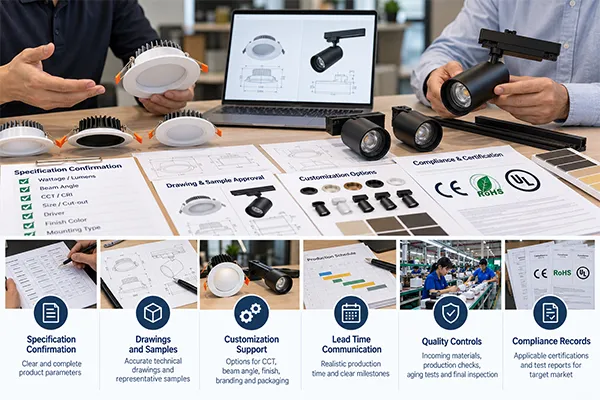
Buyers should compare suppliers by their ability to confirm specifications, provide accurate drawings and samples, support customization, communicate lead times, document quality controls, and provide applicable compliance records. Product certifications and performance claims should be verified against the target market and project requirements.11
Ask Practical Pre-Purchase Questions
I recommend that purchasing managers and project teams ask direct questions before approving a supplier:
- Can the supplier confirm cut-out size, outer diameter, height, beam angle, and driver details?
- Can the supplier support required color temperature, CRI, wattage, and finish options?
- Can the supplier provide product drawings and installation information?
- Can the supplier confirm compatibility between track heads and the selected track system?
- Can the supplier support small-batch orders for project trials or market testing?
- What aging test or quality-control process does the supplier describe?
- What is the quotation response time and expected production lead time?
- Which certification documents are available, and are they applicable to the target market?
- Can the supplier provide samples for qualified evaluation before bulk procurement?
- How will specification changes be documented before mass production?
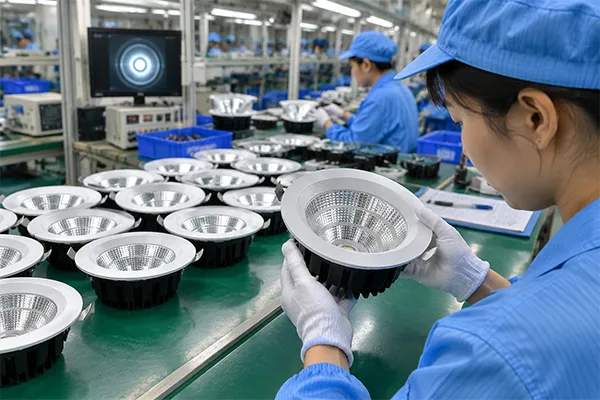
At Upward Lighting, we perform a stated 100% aging test before shipment, generally lasting 4 to 8 hours, as part of our production quality-control process. I would still encourage each buyer to define their own acceptance criteria and confirm what documentation, inspection process, or independent evaluation is required for the specific project.
Review Certifications Carefully
CE and RoHS documents may be relevant for certain markets and product categories, but buyers should not treat any certificate name as a complete procurement decision.12 Requirements can vary by market, project type, installation method, and customer contract.
I recommend that buyers verify:
- The document holder and manufacturer name
- Product model references
- The issuing organization and document validity
- Applicable standards and test scope
- Whether the document matches the final product configuration
- Whether the destination market has additional regulatory requirements
For application-specific decisions, qualified local professionals should review electrical, building, fire, and installation requirements. This is especially important for public buildings, hospitality projects, retail chains, and regulated commercial installations.
Frequently Asked Questions
Are LED downlights or track lights better for retail stores?
Track lights are often useful for retail stores that need directional lighting and adjustable product emphasis. Downlights can still be suitable for ambient lighting, circulation zones, fitting rooms, and fixed layouts. I recommend using the lighting task, ceiling design, display changes, and glare control requirements to determine the right mix.
Can downlights be used for accent lighting?
Yes, downlights can contribute to accent or focused lighting when the beam angle, fixture placement, ceiling height, and target position are appropriate. Adjustable downlights may offer additional aiming capability. However, the result requires project-specific verification and should not be assumed from wattage alone.
Does higher wattage mean a better track light or downlight?
No. Higher wattage does not automatically mean better lighting performance. Beam angle, optic design, mounting height, glare control, color rendering, color temperature, and target distance all influence the outcome. I recommend reviewing the full specification rather than comparing only wattage.
Should I choose track lights if the layout may change later?
Track lights may be a practical choice when displays, merchandise, or focal points will change and the project needs later aiming adjustments. However, buyers should also review track layout, visual appearance, access, compatibility, and potential glare before selecting a system.
What should I request from a downlight or track light supplier?
I recommend requesting product drawings, dimensions, cut-out details where relevant, photometric information when available, beam angle options, driver specifications, track compatibility information, sample availability, lead-time confirmation, quality-control details, and applicable certification documents for verification.
Conclusion
An effective LED downlight vs track light comparison begins with the lighting task rather than wattage, price, or appearance alone. Downlights can support clean integrated lighting and selected focused applications, while track lights can provide directional control and useful adjustment where layouts may change. I recommend reviewing beam angle, mounting height, spacing, glare, color quality, installation conditions, and supplier documentation before making a final decision. If you are sourcing customized LED downlights or track lights, contact Upward Lighting to discuss your project specifications, OEM/ODM requirements, and sample options.
"Lighting Design: Techniques to Transform Interior Spaces", https://marymount.edu/blog/lighting-design-techniques-to-transform-interior-spaces/. Architectural-lighting guidance distinguishes ambient, task, and accent lighting as separate functions that may be combined to provide general visibility, support activities, and emphasize objects or architectural features. Evidence role: definition; source type: institution. Supports: Definitions of ambient, task, accent, and related lighting layers used in architectural lighting design.. ↩
"Track lighting", https://en.wikipedia.org/wiki/Track_lighting. Track lighting consists of luminaires mounted to an electrified track, allowing fixtures to be positioned along the track and directed toward particular surfaces or objects. Evidence role: definition; source type: encyclopedia. Supports: That track-light fixtures are mounted on a track and can be positioned or aimed to direct light toward selected areas.. Scope note: This describes the system's physical capability; it does not establish that track lighting is the best choice for every retail or gallery project. ↩
"Understanding LM-79 Reports", https://betterbuildingssolutioncenter.energy.gov/sites/default/files/attachments/understanding_lm79_reports.pdf. Lighting guidance distinguishes total luminous flux from the distribution of that flux: fixtures with comparable lumen output can deliver different illuminance patterns because intensity distribution, beam geometry, and mounting conditions differ. Evidence role: mechanism; source type: government. Supports: That lumen output measures total emitted light, while light distribution and direction affect illuminance on a target.. Scope note: Photometric comparisons require the specific fixtures' distribution data and the intended installation geometry. ↩
"CALiPER Application Summary Report 20: LED PAR38 Lamps", https://www1.eere.energy.gov/buildings/publications/pdfs/ssl/caliper_20_summary.pdf. Beam angle characterizes the angular width of a luminaire's emitted beam; at a fixed mounting distance, a narrower beam generally produces a smaller beam spread than a wider beam. Evidence role: mechanism; source type: education. Supports: The relationship between beam angle, beam spread, and the illuminated area at a given distance.. Scope note: Actual beam shape and edge softness also depend on the optic and the photometric distribution, not beam angle alone. ↩
"This document, concerning Commercial Refrigerators, ...", https://www.energy.gov/sites/default/files/2023-09/cre-tp-fr.pdf?utm_medium=email&utm_source=govdelivery. For a point-like light source, illuminance decreases approximately with the square of the distance, so mounting height and fixture-to-target distance materially affect both light level and beam coverage. Evidence role: mechanism; source type: education. Supports: That illuminance from a source decreases with distance and that distance affects the area covered by a beam.. Scope note: Real luminaires are extended sources with directional optics, so project calculations should use the fixture's photometric data rather than the inverse-square law alone. ↩
"Color rendering of light sources", https://www.nist.gov/pml/sensor-science/optical-radiation/color-rendering-light-sources. Color-rendering metrics are used to characterize how faithfully a light source reveals object colors relative to a reference illuminant, making them relevant where visual evaluation of colored materials is important. Evidence role: definition; source type: government. Supports: That color-rendering measures describe how a light source affects the perceived color appearance of illuminated objects.. Scope note: A color-rendering metric does not by itself predict every aspect of preference or color appearance for a particular product or viewing environment. ↩
"1926.403 - General requirements.", http://www.osha.gov/laws-regs/regulations/standardnumber/1926/1926.403. Safety and installation guidance for recessed luminaires requires installers to follow the luminaire listing and manufacturer instructions concerning ceiling openings, clearances, wiring compartments, and contact with building materials. Evidence role: general_support; source type: institution. Supports: That recessed luminaires must be installed according to their listing and instructions, including required clearances and accommodation for associated electrical components.. Scope note: Specific cut-out, recess-depth, driver-space, and accessibility requirements vary by luminaire model, ceiling assembly, and local code. ↩
"Track lighting", https://en.wikipedia.org/wiki/Track_lighting. A track-lighting system uses an exposed or integrated electrified track that mechanically supports and powers attached luminaires, making the track a potential component of the ceiling's visual composition. Evidence role: definition; source type: encyclopedia. Supports: That track-light systems use a continuous electrified track to support and supply luminaires.. Scope note: The track may be recessed or otherwise integrated in some systems, so its visual prominence depends on the selected mounting method. ↩
"Configurable Seat Track Latching Mechanism Final Design ...", https://digitalcommons.calpoly.edu/context/mesp/article/1680/viewcontent/FDR_Final.pdf. Track-lighting systems commonly permit compatible luminaires to be placed at different positions on the track and aimed toward selected targets, enabling changes in directional illumination without relocating branch-circuit wiring. Evidence role: mechanism; source type: education. Supports: That track-mounted luminaires can commonly be relocated along a track and adjusted to direct light.. Scope note: Repositioning and aiming ranges depend on track standard, adapters, mechanical stops, wiring configuration, and the particular luminaire. ↩
"Measuring Discomfort from Glare: Recommendations for ...", https://www.energy.gov/eere/ssl/articles/measuring-discomfort-glare-recommendations-good-practice. Lighting research recognizes discomfort glare as visual discomfort caused by excessively bright sources or luminance contrasts within the field of view, particularly when source position and viewing direction are unfavorable. Evidence role: mechanism; source type: institution. Supports: That excessive luminance or poorly controlled bright sources can cause discomfort glare and impair visual comfort.. Scope note: Perceived glare depends on luminance, background adaptation, source size, viewing geometry, and individual sensitivity; it cannot be inferred from fixture type alone. ↩
"2-CE Marking | BETA - International Trade Administration", https://beta.trade.gov/article?id=CE-Marking. Conformity assessment for electrical products is tied to the applicable regulatory jurisdiction, product category, and relevant technical standards; purchasers should therefore evaluate documentation against the destination market and the installation's specified requirements. Evidence role: general_support; source type: institution. Supports: That product conformity requirements are determined by applicable jurisdictional regulations, standards, and intended use.. Scope note: This general compliance principle does not identify the complete legal or technical requirements for a particular country, building type, or luminaire. ↩
"CE marking – obtaining the certificate, EU requirements", https://europa.eu/youreurope/business/product-rules-compliance/general-product-compliance/ce-marking/index_en.htm. European Commission guidance explains that CE marking indicates conformity with applicable EU requirements for a product category, while the RoHS Directive restricts specified hazardous substances in electrical and electronic equipment; neither designation by itself addresses all project-specific installation, contractual, or non-EU market requirements. Evidence role: general_support; source type: government. Supports: The scope of CE marking and the RoHS Directive for electrical and electronic equipment placed on the EU market.. Scope note: The applicable directives, harmonized standards, and conformity-assessment obligations depend on the product and the market in which it is placed. ↩