LED downlight with lens vs reflector comparison can become confusing when buyers treat one optical design as automatically more premium, efficient, or comfortable than the other. That shortcut can create specification risk, disappointing beam patterns, or inconsistent product positioning. We recommend starting with the application, visual task, and verified optical data instead of relying on appearance alone.
A lens downlight and a reflector downlight can both be suitable choices, but they control light in different ways. The correct option depends on ceiling height, beam angle, target area, glare expectations, required illumination distribution, color quality, and the exact product’s optical configuration. Buyers should compare model-specific photometric data, specifications, and samples before selecting either design.
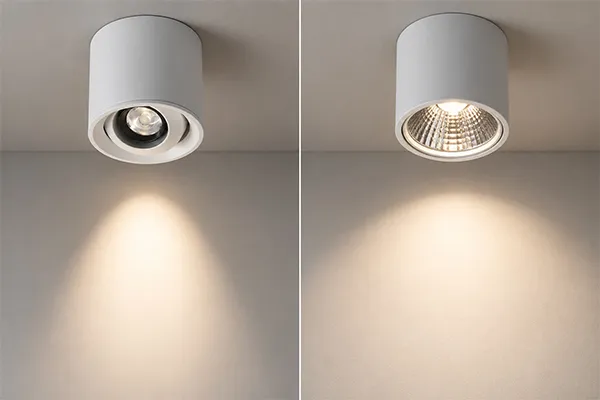
In our pre-sales discussions at Upward Lighting, customers often ask whether a lens version is “better” than a reflector version. We usually pause before answering. The better question is what the project needs the downlight to do: create general lighting, define merchandise, illuminate corridors, reduce visual distraction, or support a particular product-range position.
Why Is an LED Downlight with Lens vs Reflector Comparison Not a Quality Ranking?
A buyer may see a deep reflector, a clear lens, or a decorative trim and assume that one construction indicates a higher-quality fixture. This assumption can lead to the wrong product choice, especially when the lighting layout, mounting height, or task area has not yet been defined. We encourage buyers to compare optical purpose before product appearance.
An LED downlight with lens vs reflector comparison is an optical-design evaluation, not a universal high-end versus low-end ranking. A lens typically shapes and redirects light through a transparent or diffused optical component, while a reflector redirects light using a reflective surface.1 Either system may be appropriate when its beam distribution, shielding, materials, thermal design, and test data fit the application.
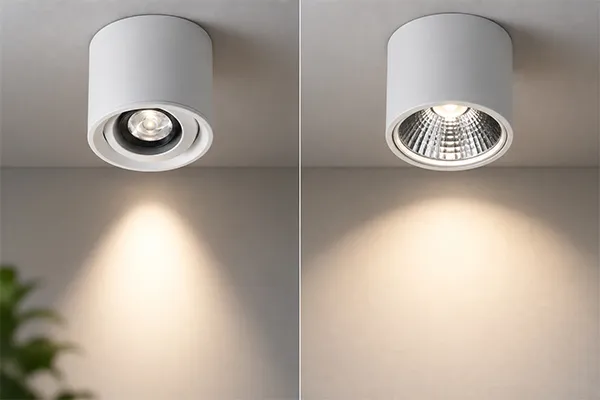
Lens and reflector systems solve different design questions
An LED downlight uses optics to manage the light emitted by its LED source. The fixture designer may use a lens, a reflector, or a combined optical arrangement. The visible front of the downlight does not tell the full story.2 A similar-looking luminaire can have a substantially different beam angle, cut-off characteristic, luminous intensity distribution, or source shielding arrangement.
A lens-based optical system commonly uses a molded optical component to redirect light. Depending on the lens material and geometry, the design may aim for a narrow beam, medium beam, wide beam, wall-washing distribution, or another controlled pattern. Some lens configurations may also include additional diffusers, reflectors, or baffles.
A reflector-based optical system commonly uses a shaped reflective cavity to direct light out of the fixture. Reflector finishes, depths, angles, coatings, and source placement can all influence the final result. A white, specular, faceted, black, or metallized reflector can serve different visual and optical objectives.
We do not recommend treating “lens” and “reflector” as fixed performance categories. The exact LED package, driver, reflector geometry, lens design, trim, and test conditions all matter.
What buyers should avoid assuming
We regularly clarify several assumptions during selection discussions:
- A lens does not automatically mean lower glare. Glare depends on the full optical and shielding design, mounting position, viewing angle, room brightness, and installation layout.3
- A reflector does not automatically mean a sharper beam. Beam control depends on the specific reflector geometry and LED source arrangement.
- A deeper trim does not automatically provide better visual comfort. Recess depth can contribute to shielding, but it is only one part of the design.4
- A premium exterior finish does not prove premium light distribution. Surface appearance and optical performance should be evaluated separately.
- A higher price does not substitute for photometric information. Buyers still need model-specific technical evidence.
A practical procurement view
For importers, distributors, and local lighting brands, the optical style can also affect how a product range is positioned. For example, a clean lens appearance may suit one product family’s design language, while a deep reflector may better match another range. However, marketing positioning should follow the product’s confirmed capability.
| Evaluation question | Lens-oriented design | Reflector-oriented design | What to verify |
|---|---|---|---|
| Beam shaping | May use lens geometry to redirect light | May use cavity geometry and reflective surfaces | Beam angle and photometric curve |
| Visual appearance | May look smooth, flat, or technical | May show a visible deep or decorative cavity | Trim, finish, and ceiling integration |
| Light-source shielding | Depends on lens, baffle, recess, and installation | Depends on reflector depth, source position, and trim | Viewing angles and glare-related documentation |
| Application fit | Depends on the exact distribution | Depends on the exact distribution | Mounting height, spacing, and target surface |
| Product selection risk | High if based only on appearance | High if based only on appearance | Samples and model-specific reports |
In our experience, the most reliable approach is simple: buyers should first identify the lighting objective, then compare confirmed optical information for shortlisted models.
How Should Buyers Choose Between Lens and Reflector Downlights for an Application?
Many downlight decisions start with wattage, cutout size, or a catalogue image because these details are easy to compare. However, those details alone do not reveal how the ceiling will look after installation. A mismatch can produce uneven brightness, insufficient accent definition, or an optical effect that does not support the project’s intended atmosphere.
Buyers should choose lens or reflector downlights by defining the illuminated task, ceiling height, beam spread, spacing, visual comfort requirements, and target surface. General lighting may require different beam coverage than retail accents, hospitality areas, corridors, or residential spaces. The correct optical direction comes from the complete lighting layout and verified characteristics of the selected model.
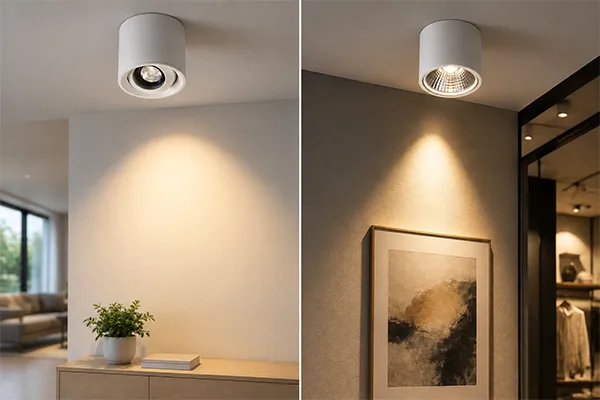
Start with the actual lighting task
When a customer asks our team to recommend a downlight configuration, we typically ask clarification questions before discussing a lens or reflector. These questions help reduce the risk of selecting an attractive fixture that does not serve the room.
We ask:
-
What is the primary purpose of the downlight?
Is it for ambient lighting, circulation lighting, task illumination, wall washing, display lighting, or a mixed purpose? -
What are the ceiling height and mounting conditions?
A fixture installed in a 2.7-meter ceiling faces a different optical challenge from one installed in a 5-meter commercial ceiling.5 -
What needs to be illuminated?
The target may be a floor area, shelf, countertop, vertical wall, artwork, corridor path, or open workspace. -
What beam spread does the layout require?
The project may need narrow, medium, or wide distribution. The lighting designer should also consider fixture spacing and overlap. -
How important is visual comfort?
Spaces such as hotels, offices, homes, and healthcare environments may have different expectations from retail display zones. -
What product position does the buyer need?
A local brand or distributor may require a consistent visual identity across a product family, but that identity should not override the optical requirement.
Match the optical decision to the environment
The following table is not a universal recommendation. It is a planning framework that buyers can use when discussing a specific model with a supplier or lighting professional.
| Application condition | Questions to ask | Optical information to compare |
|---|---|---|
| Low residential ceiling | Will the light source be visually exposed from common viewing positions? | Recess depth, shielding design, beam angle, sample appearance |
| Retail shelving or displays | Is accent definition more important than broad ambient coverage? | Center beam intensity, beam field angle, aiming needs, color consistency |
| Office or educational space | Does the layout need broad coverage and visual comfort for occupants? | Distribution pattern, spacing guidance, glare-related documentation where available |
| Hotel lobby or corridor | Does the design require atmosphere, wayfinding, or decorative integration? | Trim finish, beam pattern, CCT, dimming compatibility, installation mock-up |
| High-ceiling commercial area | Can the fixture deliver usable light to the intended plane? | Mounting height, photometric file, illuminance calculation, beam control |
| Distributor product range | Does the design fill a clear market segment without duplicate SKUs? | Product positioning, cutout sizes, optical options, certification documents |
Do not use simple specifications as optical shortcuts
We often see buyers compare two downlights using only four points: wattage, lumen output, cutout size, and exterior appearance. These are important procurement details, but they cannot predict final lighting performance by themselves.
For example:
- Wattage indicates electrical input, not the complete beam behavior in a room.
- Lumen output describes total luminous flux under stated test conditions, but it does not show where the light goes.
- Cutout size affects installation compatibility, not necessarily beam control.
- Housing appearance affects aesthetics and product positioning, but it does not confirm glare performance or distribution.
A more complete comparison should include:
- Beam angle and beam distribution
- Center beam intensity, where relevant6
- CCT options and color consistency approach
- CRI requirements for the application7
- Optical material and trim configuration
- Recess depth and shielding geometry
- Driver type, dimming method, and electrical compatibility
- Thermal design and stated ambient operating conditions
- Model-specific test information and photometric files, where available
I have found that a short upfront technical discussion often saves much more time than correcting a product choice after samples have already reached the installation stage.
What Technical Data Matters in an LED Downlight with Lens vs Reflector Comparison?
A product listing may describe a downlight as high efficiency, anti-glare, professional, architectural, or premium. Those terms can help explain a product category, but they should not replace evidence. Buyers need technical documents that relate to the exact model, optical option, LED configuration, and stated test conditions.
For an LED downlight with lens vs reflector comparison, the most useful evidence is model-specific optical and electrical documentation. Buyers should request the specification sheet, beam-angle options, photometric data when available, test conditions, certification documents, and samples. They should compare like for like, because changing a lens, reflector, CCT, wattage, or trim may change the final result.8
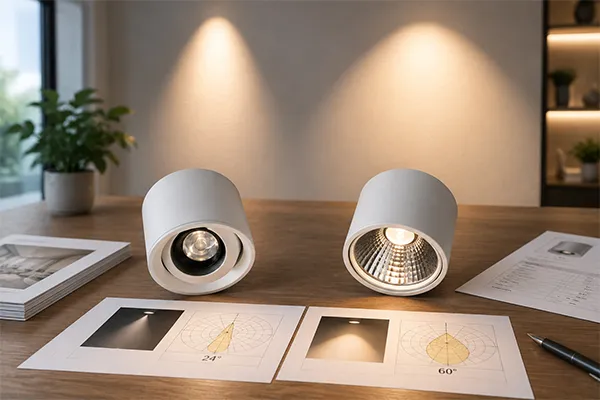
Essential documents for supplier evaluation
For project contractors, importers, and purchasing managers, document review should be part of supplier qualification. A supplier should be able to explain which document applies to which exact configuration.
We suggest requesting the following:
| Document or item | Why it matters | Buyer verification point |
|---|---|---|
| Product specification sheet | Confirms dimensions, input, wattage, CCT, CRI, IP rating, and options | Check the model number and revision date |
| Photometric file or optical report | Supports lighting calculations and beam-distribution review | Confirm the file matches the exact optical configuration |
| Beam-angle information | Helps match fixture spacing and target coverage | Ask whether the value is nominal and how it was measured |
| Lumen test information | Provides output data under stated conditions | Compare CCT, input power, temperature, and test method |
| Driver specification | Affects dimming, flicker-related performance, and compatibility | Verify dimming protocol and voltage range |
| Certification documents | Supports market-entry and compliance review | Verify validity, scope, issuing body, and model coverage |
| Physical sample | Allows installation, appearance, and basic functional evaluation | Test in the intended ceiling and room conditions |
At Upward Lighting, we can provide product specifications, available optical information, test reports, and samples for relevant models during pre-sales evaluation. We also offer OEM/ODM options such as CCT, wattage, beam angle, CRI, and surface finish adjustments where the model and project requirements support them. However, we always recommend confirming which documentation applies after customization, because an altered configuration may require separate review.
Compare like for like
A valid comparison requires consistent conditions. It is not useful to compare one 3000K narrow-beam lens model with a 4000K wide-beam reflector model and then declare that lenses or reflectors perform better.
Buyers should align these variables:
- Same or comparable CCT
- Same or comparable CRI
- Similar wattage range
- Similar beam-angle target
- Similar installation method
- Similar driver and dimming requirements
- Similar ambient temperature assumptions
- Similar test standards and reporting conditions
This approach is especially important for wholesalers and brands building a stable SKU range. Product claims should be connected to records that sales teams, technical teams, and channel partners can review.
Samples are a decision tool, not a formality
A sample does not replace a professional lighting calculation9, but it can reveal issues that a catalogue cannot show. Buyers may inspect trim appearance, perceived brightness, ceiling fit, dimming response, color impression, and basic beam behavior. A meaningful sample evaluation should use realistic mounting height, ceiling color, surface reflectance, and viewing positions.
For a larger project, we recommend that the project team involve a qualified lighting designer, electrical engineer, or other appropriate professional. Application-specific decisions should consider local regulations, wiring requirements, emergency-lighting obligations, maintenance access, and the full lighting layout.
How Can Buyers Reduce Procurement Risk Before Ordering Downlights?
Lighting procurement risk often appears after a buyer has already approved a quotation. A product may fit the cutout and meet the target price, yet still create problems if the beam is unsuitable, the documentation does not match the final SKU, or the supplier has not confirmed customization details. A structured review helps prevent these costly gaps.
Buyers can reduce risk by using a written LED downlight with lens vs reflector comparison checklist before approving production. The checklist should confirm the exact model, optical configuration, beam angle, CCT, CRI, driver, trim, certification scope, sample status, packaging, and inspection requirements. Clear records are more reliable than broad verbal claims.
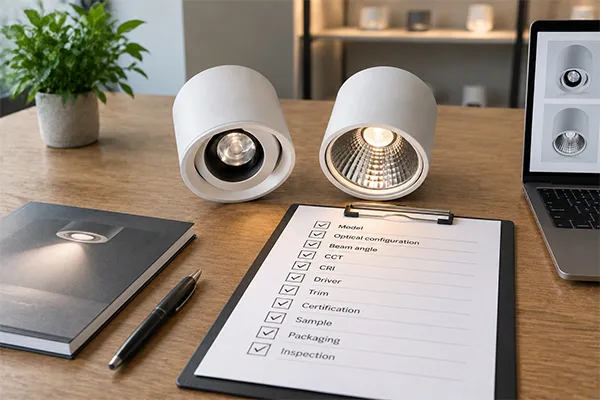
A practical pre-order checklist
We recommend documenting the selection in a simple comparison sheet. This is useful for contractors choosing project fixtures and for distributors building repeatable purchasing processes.
Optical and application checks
- Confirm the exact model number.
- Confirm whether the approved version uses a lens, reflector, or combined optical design.
- Confirm the specified beam angle.
- Confirm the target CCT and CRI.
- Review photometric information where available.
- Check whether the fixture supports the intended ceiling height and spacing plan.
- Evaluate a sample in conditions that reasonably represent the installation.
Quality and manufacturing checks
- Confirm the approved housing color, trim, and surface finish.
- Confirm driver brand or driver specification if it is project-critical.
- Confirm dimming requirements, such as TRIAC, 0–10V, DALI, or other specified protocols.
- Confirm the requested IP rating and installation environment.
- Ask how the supplier identifies and controls product revisions.
- Agree on inspection criteria before production.
At Upward Lighting, every product undergoes a 100% aging test for 4 to 8 hours before shipment as part of our stated production process. Buyers should still define their own acceptance criteria for the relevant order, including visual inspection points, functional testing, packaging requirements, and any third-party inspection arrangements.
Supplier questions that improve clarity
A capable supplier should answer focused questions clearly. We suggest asking:
- Which optical configuration is included in this quoted model?
- What beam-angle options are available for the same housing?
- Does the provided photometric information match the proposed CCT, wattage, and optic?
- What test conditions apply to the stated lumen output?
- Can the supplier provide a sample before mass production?
- Which CE, RoHS, or other documents apply to the exact model and target market?
- If customization is requested, which specifications will change and which documents need revalidation?
- What is the production lead time for standard and customized versions?
For market entry, buyers should verify certification documents independently with the relevant issuing body, regulatory adviser, testing organization, or local authority. CE and RoHS documentation may be relevant to certain market requirements, but applicability depends on the product, destination, and current regulatory obligations.10
Build decisions around records, not assumptions
A reliable procurement process connects the commercial quotation to technical records. This practice is particularly valuable for repeat orders, OEM projects, private-label product ranges, and tender-based work.
The lowest-risk downlight selection is usually not the one with the most attractive catalogue description. It is the one whose exact configuration, application fit, documentation, and sample evaluation are clearly understood.
Frequently Asked Questions
Is a lens downlight better than a reflector downlight?
No. A lens downlight is not inherently better than a reflector downlight. Each optical approach can suit different applications. Buyers should compare the specific model’s beam angle, distribution, shielding design, CCT, CRI, installation conditions, and available photometric information before deciding.
Do lens downlights always create less glare?
No. Glare depends on the full fixture design and installation environment, not only on the presence of a lens. Recess depth, trim design, source shielding, viewing angle, room brightness, ceiling height, and fixture spacing can all affect visual comfort.
Can I compare downlights by wattage and lumen output only?
No. Wattage and lumen output are useful specifications, but they do not show where light is distributed or how the fixture appears to occupants. Buyers should also compare beam angle, optical design, CCT, CRI, shielding features, driver specification, and model-specific test conditions.
What should I request from a downlight supplier before placing an order?
Buyers should request a specification sheet, beam-angle details, available photometric data, test conditions, certification documents, driver information, and a physical sample. The documents should match the exact model, including the selected lens or reflector, CCT, wattage, and trim configuration.
Can a supplier customize lens or reflector downlights for a local brand?
Many manufacturers can offer customization, but feasibility depends on the product platform and order requirements. At Upward Lighting, we can discuss OEM/ODM options such as CCT, wattage, beam angle, CRI, and surface finish. Buyers should confirm how changes affect specifications, samples, lead times, and documentation.
Conclusion
An LED downlight with lens vs reflector comparison should begin with the application, not with assumptions about quality or price. Lens and reflector designs can both support effective lighting when the selected model matches the ceiling height, target area, beam requirement, visual-comfort expectation, and product position. We recommend reviewing model-specific optical data, stated test conditions, certification documents, and samples before final approval. If you are sourcing LED downlights for a project or product range, contact Upward Lighting to discuss the relevant specifications and available customization options.
"[PDF] Digital Light Source Technology for Adaptive Lighting Systems", https://www.energy.gov/sites/default/files/2022-02/ssl-rd22_soer_advances-led.pdf. Lighting-optics references explain that lenses control rays by refraction through a transmissive material, while reflectors redirect rays by reflection from shaped surfaces. Evidence role: mechanism; source type: education. Supports: The distinct optical functions of refractive or transmissive lenses and reflective surfaces in controlling light direction.. ↩
"[PDF] Initial Performance and Reliability of Chromaticity Sensors Used for ...", https://www.energy.gov/sites/prod/files/2020/11/f80/ssl-rti-chromaticity-sensors-sep2020.pdf. Photometric guidance characterizes luminaires by measured luminous-intensity distributions, indicating that exterior appearance alone is not a sufficient indicator of beam performance. Evidence role: general_support; source type: research. Supports: That a luminaire's light distribution is characterized through photometric measurement and depends on its optical system.. Scope note: This supports the need for photometric evaluation but does not test any particular downlight design. ↩
"Influence of macular pigment on the sensitivity to discomfort glare ...", https://pmc.ncbi.nlm.nih.gov/articles/PMC10613614/. Visual-lighting research identifies source luminance, source position, background luminance, and viewing conditions as important contributors to discomfort glare; shielding geometry can modify these conditions. Evidence role: mechanism; source type: research. Supports: The roles of source luminance, position in the field of view, background luminance, and luminaire shielding in discomfort glare.. Scope note: The contribution of each factor varies with the luminaire, observer, and application. ↩
"An Energy Efficient Lighting Design Strategy to Enhance Visual ...", https://www.academia.edu/34098250/An_Energy_Efficient_Lighting_Design_Strategy_to_Enhance_Visual_Comfort_in_Offices_with_Windows. Luminaire-design guidance describes shielding angles and recessed source positions as means of limiting direct views of bright emitting surfaces, while glare assessment also requires consideration of luminance and viewing conditions. Evidence role: mechanism; source type: education. Supports: That shielding angle and recessed source position can reduce direct visibility of bright light-emitting surfaces.. Scope note: Recess depth by itself does not quantify glare performance for a specific fixture. ↩
"[PDF] Understanding LM-79 Reports - Better Buildings Solution Center", https://betterbuildingssolutioncenter.energy.gov/sites/default/files/attachments/understanding_lm79_reports.pdf. Lighting-design principles show that increasing the distance between a luminaire and the target changes illuminance and beam coverage, requiring corresponding consideration of beam angle, output, and fixture spacing. Evidence role: mechanism; source type: education. Supports: The relationship between source-to-target distance, illuminance, beam coverage, and lighting layout.. Scope note: Actual results also depend on luminaire distribution, aiming, room reflectances, and the target-plane geometry. ↩
"[PDF] Understanding LM-79 Reports - Better Buildings Solution Center", https://betterbuildingssolutioncenter.energy.gov/sites/default/files/attachments/understanding_lm79_reports.pdf. Photometric references define center-beam candlepower as luminous intensity measured on the axis of a directional beam, making it relevant when evaluating the concentration of accent or display lighting. Evidence role: definition; source type: institution. Supports: The meaning of center beam candlepower or center-beam intensity as the luminous intensity at the center of a directional beam.. Scope note: Center-beam intensity should be interpreted together with beam angle, aiming, mounting distance, and the intended illuminated surface. ↩
"Purchasing Energy-Efficient Light Bulbs", https://www.energy.gov/cmei/femp/purchasing-energy-efficient-light-bulbs. Color-rendering references describe the color rendering index (CRI) as a measure of how faithfully a light source renders test colors relative to a reference illuminant, a consideration whose importance varies by visual task and application. Evidence role: definition; source type: government. Supports: What the color rendering index measures and why color-rendering quality can matter for visual evaluation of illuminated objects.. Scope note: CRI is not a complete predictor of perceived color quality and may need to be supplemented by other color-fidelity or gamut measures. ↩
"[PDF] Initial Performance and Reliability of Chromaticity Sensors Used for ...", https://www.energy.gov/sites/prod/files/2020/11/f80/ssl-rti-chromaticity-sensors-sep2020.pdf. Luminaire photometric testing reports results for the tested configuration, so changes to optics, light-source characteristics, drive conditions, or physical construction can require separate confirmation of performance. Evidence role: general_support; source type: institution. Supports: That photometric results are tied to the tested luminaire configuration, including its optical system and operating characteristics.. Scope note: The magnitude of any change depends on the specific component alteration and should be verified by applicable testing or manufacturer data. ↩
"[PDF] The Impact of Circadian Lighting Design Strategies on Lighting and ...", https://www.energy.gov/sites/default/files/2023-01/ssl-2023_circadian-lighting-design-strategies-office-space.pdf. Lighting-design guidance uses luminaire photometric data, room geometry, and surface assumptions to calculate expected illuminance and distribution, functions that inspection of a single sample cannot fully provide. Evidence role: general_support; source type: institution. Supports: That lighting calculations use photometric data and geometry to estimate illuminance and distribution across a planned space.. Scope note: A sample remains useful for evaluating finish, installation, dimming behavior, and subjective visual impressions. ↩
"CE marking – obtaining the certificate, EU requirements - Your Europe", https://europa.eu/youreurope/business/product-rules-compliance/general-product-compliance/ce-marking/index_en.htm. European Commission guidance states that CE marking applies only to products covered by relevant EU harmonisation legislation, while the RoHS framework restricts specified hazardous substances in electrical and electronic equipment within its scope. Evidence role: historical_context; source type: government. Supports: The EU framework for CE marking and the scope-based restrictions on hazardous substances in electrical and electronic equipment under RoHS.. Scope note: This does not determine compliance for a particular model or destination; importers should verify current, product-specific legal obligations. ↩