LED downlights for airports and transportation facilities can create procurement risk when buyers select them only by price, wattage, or a generic certificate. A poor match may lead to glare, inconsistent batches, difficult maintenance, or documentation gaps. I recommend a zone-by-zone supplier evaluation process that confirms optical performance, environmental suitability, production consistency, and project-specific compliance requirements.
LED downlights for airports and transportation facilities should be selected by matching each facility zone’s visual task, operating environment, installation conditions, and maintenance plan with a supplier’s verifiable product and quality-control capability. Buyers should review photometric files, exact product configurations, certificates, production consistency, and technical support before approving a supplier or moving from samples to volume orders.
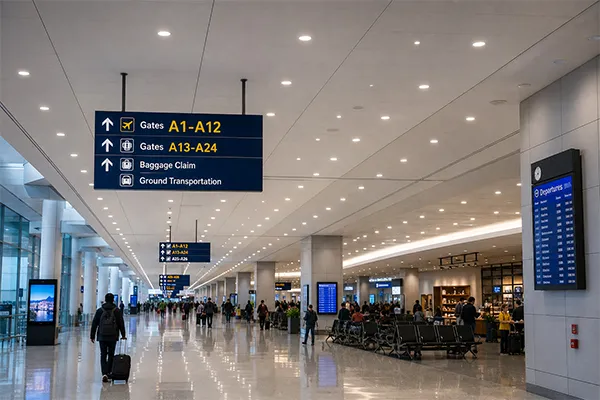
Airport terminals, metro stations, rail hubs, and passenger transfer facilities operate for long hours and serve large, changing crowds.1 That makes lighting procurement more than a catalog exercise. In my experience handling transport-facility inquiries, the strongest supplier discussions begin with practical questions about zones, access, documentation, replacement planning, and the final installed system.
Why Should LED Downlights for Airports and Transportation Facilities Be Selected by Zone?
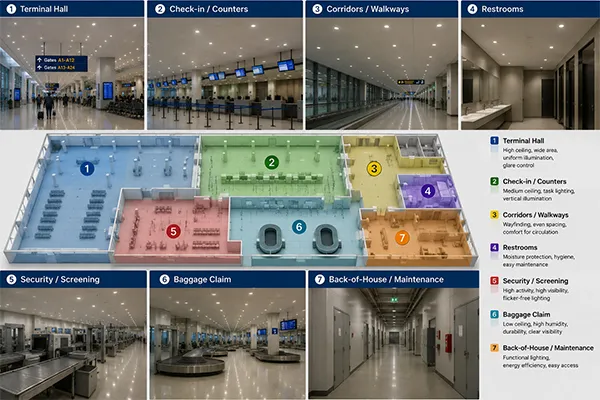
A transport facility may look like one large project, but each area creates different lighting risks. A downlight that appears acceptable in a low-ceiling restroom may cause glare or uneven illumination in an open terminal hall.2 Buyers can reduce specification mistakes by defining the zone before comparing products.
Buyers should select LED downlights for airports and transportation facilities by dividing the building into functional zones, then reviewing the visual task, ceiling condition, moisture exposure, operating hours, traffic level, and maintenance access in each zone. No single downlight model automatically suits every airport or transit-facility space.
Start with the passenger journey
I usually find that the best starting point is the passenger journey, not the product brochure. A traveler moves from drop-off areas to entrances, check-in halls, security zones, gates, restrooms, baggage claim areas, corridors, parking connections, and transport platforms. Each point has a different visual purpose.
For example, a terminal circulation area may need comfortable general illumination that supports orientation and reduces visual fatigue. A service counter may require clearer vertical visibility for staff and passengers. A restroom can introduce higher humidity and more frequent cleaning.3 A covered outdoor connection may face dust, condensation, wind-driven moisture, or major temperature changes.
Buyers should ask the lighting consultant, MEP team, contractor, or local authority to confirm applicable project requirements. I do not treat generic product information as a substitute for a project lighting calculation or local code review.
Build a zone schedule before requesting quotations
A simple zone schedule makes quotation comparisons more useful. Instead of asking for “airport downlights,” buyers can issue a clearer request with operating and installation details.
| Facility zone | Typical procurement questions | Downlight considerations to review |
|---|---|---|
| Terminal halls | What is the ceiling height? Is glare control important? | Beam angle, UGR-related design information, lumen package, mounting depth |
| Corridors and transfer passages | Are there long operating hours and repeated fixtures? | Uniformity support, driver reliability, replacement consistency |
| Restrooms and wash areas | Is humidity or cleaning exposure present? | IP rating, corrosion-resistant materials, sealed construction where required |
| Check-in and service areas | What tasks do staff and passengers perform? | CRI, beam distribution, vertical illumination contribution |
| Baggage and service corridors | Is the area back-of-house and maintenance-intensive? | Durability, access method, spare-parts planning |
| Semi-outdoor links | Is the area exposed to dust, moisture, or temperature swings? | Environmental protection level, thermal design, installation suitability |
Avoid the “one-model-for-all” assumption
A common cost-control goal is to reduce the number of SKUs. That can be sensible when it does not compromise the lighting design. However, I would not assume that one 12 W or 18 W recessed fitting can serve terminal halls, washrooms, covered walkways, and staff corridors equally well.
A buyer can still standardize intelligently by using a small approved family of LED downlights with controlled appearance, cutout sizes, color temperatures, and drivers. The final selection should remain tied to each zone’s needs.
I have seen transport-related inquiries become much clearer once the buyer separates “public hall lighting,” “wet-area lighting,” and “covered connection lighting” into different lines of the request. This change does not guarantee a final design result, but it gives suppliers a better basis for providing relevant documents and configurations.
How Do Optical Performance and Glare Affect LED Downlights for Airports and Transportation Facilities?
Bright lighting can still be uncomfortable lighting. Passengers, staff, security teams, and maintenance personnel may spend many hours under the same luminaires. If buyers focus only on lumen output, they may overlook beam control, glare, spacing, and ceiling reflectance.
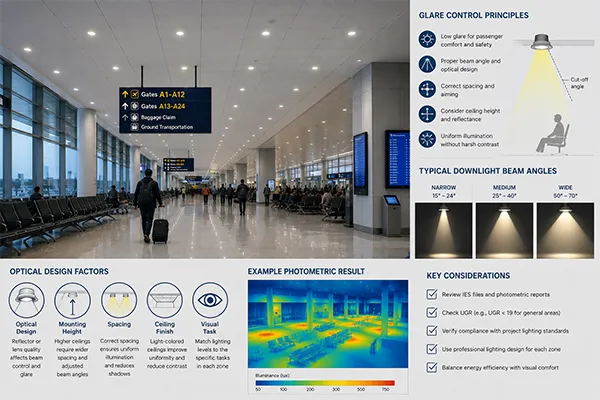
For LED downlights for airports and transportation facilities, buyers should evaluate lumens together with beam angle, diffuser or reflector design, mounting height, spacing, ceiling finish, and the visual task. Higher wattage does not automatically produce better comfort, safety, or lighting quality.4 Project-specific photometric calculations should be reviewed by qualified professionals.
Lumens are only one part of the optical picture
A product datasheet may state 1,200, 1,800, or 2,500 lumens. That figure is useful, but it does not tell the full story. The same light output can appear very different depending on reflector geometry, beam angle, diffuser transmission, mounting location, and surrounding surfaces.5
For transport facilities, procurement teams should request the optical information needed by the project lighting designer or consultant. This may include:
- IES or LDT photometric files, where required
- Beam angle and intensity distribution
- Luminaire dimensions and recessed depth
- Cutout size and trim style
- Correlated color temperature (CCT)
- Color rendering index (CRI)
- Driver data and dimming compatibility
- Flicker-related information when specified
- Declared lumen output and input power for the exact configuration
I would also ask whether the data applies to the exact selected version. A 10 W, 15 W, and 20 W family may use different LEDs, optics, heat sinks, or drivers. A document for one version should not be assumed to represent every version.
Glare control needs design review
Glare can make passengers less comfortable and can affect visual adaptation when people move between bright and dim zones.6 In a high-ceiling hall, a narrow beam may create visible bright spots. In a lower ceiling corridor, a wide beam with poor shielding may feel harsh when viewed at normal walking angles.
The project team should evaluate glare within the lighting layout, rather than relying on a single product description such as “anti-glare.” That phrase has no universal procurement meaning unless it is supported by defined optical information and assessed in the intended installation.7
A buyer can ask practical questions such as:
- What is the recessed depth of the light source?
- Does the model use a deep reflector, lens, diffuser, or baffle?
- Which beam-angle options are available?
- Can the supplier provide photometric files for the selected configuration?
- Has the consultant reviewed fixture spacing and mounting height?
- Are there visual comfort requirements in the tender documents?
Consider color quality and visual consistency
Color temperature and CRI affect perceived cleanliness, orientation, material appearance, and visual comfort.8 A warm white setting may suit some hospitality-adjacent spaces, while neutral white is common in functional public areas. The correct choice depends on the project concept, local requirements, other installed lighting, and the operator’s preferences.
For large facilities, I believe consistency matters as much as the initial choice. Buyers should define:
- Target CCT, such as 3000 K, 4000 K, or another specified option
- Permitted color tolerance or binning requirement, if stated in the project specification
- CRI requirement for each zone
- Whether emergency lighting, signage, and adjacent fixtures affect the overall color appearance
At Upward Lighting, we can discuss CCT, wattage, beam angle, CRI, and finish options for OEM/ODM requests. However, I would still ask the project consultant or lighting designer to confirm that the selected configuration supports the intended lighting design.
What Documents Should Buyers Verify for Airport LED Downlight Procurement?
Generic certificates can create false confidence. A document may apply to a different wattage, driver, factory, market, or product generation. Buyers need documents that match the exact downlight configuration and the destination market’s stated requirements.
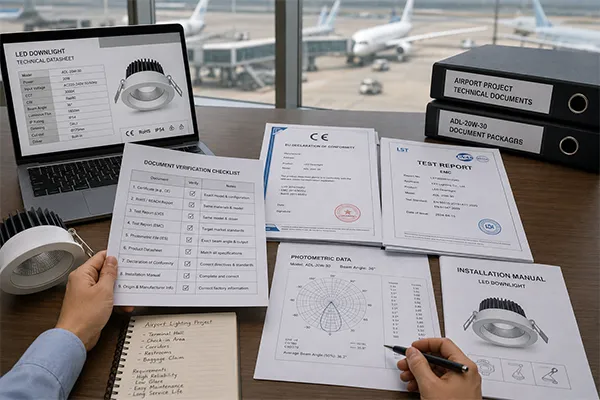
Buyers of LED downlights for airports and transportation facilities should verify that certificates, test reports, declarations, photometric files, and product datasheets apply to the exact model, wattage, driver, and target market. CE, RoHS, or any other individual document should be treated as evidence to review, not as an automatic approval for every project.9
Match documents to the purchase specification
In airport and transport-project inquiries, buyers often ask whether a supplier has CE or RoHS documentation. That is a reasonable first question, but it should not be the last question. The buyer should identify what the project actually requires and then ask for matching evidence.
For example, the project may require particular safety, EMC, ingress protection, photometric, material, or environmental documentation. Requirements can vary by country, authority, client standard, and contract terms. The project consultant, contractor, or local authority should confirm the applicable requirements.
A careful document review should compare:
| Item to verify | What buyers should check |
|---|---|
| Product model | Does the model number match the quotation and sample? |
| Wattage and driver | Does the report cover the selected power and driver option? |
| Electrical rating | Do voltage and frequency match the destination market? |
| IP rating | Does the stated protection level fit the proposed installation zone? |
| Photometric data | Does the file correspond to the selected optic and output? |
| Certification validity | Is the document current and issued for the relevant product? |
| Factory information | Does the listed manufacturer match the proposed supplier arrangement? |
| Revision control | Is the datasheet revision aligned with the current product configuration? |
Ask for a controlled submittal package
A strong supplier should be able to organize technical documents into a controlled package. This does not mean every supplier will hold every possible document for every market. It means the supplier should clearly state what it can provide, what applies to the selected model, and what must be confirmed before order release.
Before quoting a final project configuration, I would first clarify:
- Installation location and target market
- Required voltage and frequency
- Requested wattage and lumen target
- CCT, CRI, beam angle, and surface finish
- Dimming or control-system expectations
- IP or environmental requirements
- Required certificates and test reports
- Quantity, delivery schedule, and spare-unit expectations
At Upward Lighting, our products hold CE and RoHS documentation for relevant product and market-entry purposes. Buyers should still verify each document against their exact product configuration and project requirements. This approach protects both the buyer and supplier from assumptions made too early in the sourcing process.
Treat documentation as part of supplier quality control
Documentation quality also gives buyers insight into supplier discipline. If a supplier cannot maintain clear model numbers, revisions, product photos, and specification sheets, it may be harder to control sample-to-production alignment later.
I recommend keeping an approved technical file that includes the final quotation, approved sample record, datasheet, drawing, optical file, required reports, packaging details, and agreed marking requirements. The purchase order should refer to this file where practical.
How Can Buyers Control Batch Consistency, Installation, and Maintenance Risk?
A good approved sample is useful, but a public facility may need hundreds or thousands of units over several delivery stages. The major procurement question is whether the supplier can repeat the approved configuration and support future replacement needs.
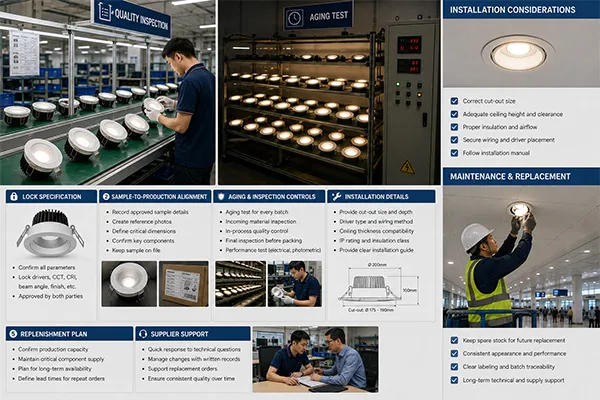
To reduce risk with LED downlights for airports and transportation facilities, buyers should lock the approved specification, document sample-to-production alignment, review aging and inspection controls, confirm installation details, and plan for replenishment. Suppliers should also explain how they handle technical questions, specification changes, and replacement orders over the facility’s operating life.
Move from sample approval to production control
A sample can look correct while mass production introduces changes in components, optics, drivers, finishes, or packaging.10 Some substitutions may be necessary due to supply constraints, but they should never be handled casually in a controlled project.
Buyers should ask the supplier to define how it manages:
- Approved model numbers and configuration codes
- LED source and driver identification
- Wattage, CCT, CRI, beam-angle, and finish control
- Cutout size and mechanical dimensions
- Labeling and carton markings
- Incoming component inspection
- Final visual and functional inspection
- Change notification and approval procedures
- Retained samples or production records, where available
At our factory, every product undergoes a 100% aging test of approximately 4 to 8 hours before shipment. This process is part of our internal quality-control approach and helps us identify early functional issues before packing. Buyers should still define any additional project-specific inspection, third-party inspection, burn-in requirement, or acceptance process in advance.
Confirm installation details before shipment
Installation problems can come from small mismatches.11 A downlight may have the correct wattage but the wrong cutout size, insufficient ceiling void depth, unsuitable spring clips, or an incompatible dimming driver. These issues are costly when discovered after delivery.
Before production, the buyer should confirm:
- Ceiling cutout diameter and permitted tolerance
- Ceiling thickness and mounting method
- Recessed depth and driver placement
- Access to the driver for future replacement
- Wiring method, connectors, and terminal requirements
- Dimming protocol, if applicable
- Environmental conditions around the ceiling void
- Installation instructions and marking language
A supplier can provide product-level installation guidance, but the contractor and project engineering team should verify installation suitability for the actual building condition.
Plan maintenance and replenishment early
Airports and transport hubs usually prioritize continuity. A facility operator may need replacement units years after the original order. That is why I encourage buyers to discuss replenishment before issuing the first purchase order.
Useful questions include:
- Can the supplier maintain the same trim appearance and cutout size?
- What is the expected lead time for repeat orders?
- Can the supplier identify the original configuration from a project code?
- What spare quantity should the buyer hold at handover?
- How are product changes communicated?
- Can compatible replacement options be proposed if a component becomes unavailable?
The lowest initial unit price can become expensive if replacement fixtures do not match the existing ceiling cutout, color appearance, or control system.12 I believe long-term consistency should be part of the supplier comparison from the first quotation.
For buyers managing phased projects, small-batch support can also matter. Our team supports small-batch orders and customized configurations where feasible, but I always recommend confirming production lead times, component availability, and specification control before making a phased delivery commitment.
Frequently Asked Questions
Are high-wattage LED downlights better for airport terminals?
No. Higher wattage may provide more light output, but it does not automatically improve visual comfort or suitability. Buyers should assess beam distribution, glare control, mounting height, spacing, ceiling reflectance, and lighting calculations. A qualified lighting designer or project consultant should review the final layout.
Can CE and RoHS certificates qualify LED downlights for every airport project?
No. CE and RoHS documents do not automatically qualify a downlight for every airport, rail, metro, or transportation project. Buyers should verify that each document applies to the exact product configuration, target market, and contract requirement, then confirm project-specific needs with relevant consultants or authorities.
What should buyers request from an LED downlight supplier before approval?
Buyers should request an exact datasheet, dimensional drawing, product photos, photometric files where needed, applicable certificates or reports, sample details, warranty terms, installation guidance, quality-control information, and a clear quotation. The documents should match the selected wattage, driver, CCT, beam angle, and finish.
How can buyers ensure an approved sample matches mass production?
Buyers should create a written specification lock that identifies the model, wattage, CCT, CRI, beam angle, driver, trim color, cutout size, labels, and packaging. They should also ask about component-change control, inspection procedures, aging tests, and notification requirements before production begins.
Should the same LED downlight be used in terminals, restrooms, and covered walkways?
Not automatically. These areas can differ in humidity, cleaning exposure, ceiling conditions, visual tasks, operating hours, and maintenance access. A standardized product family may be possible, but the project team should evaluate each zone and confirm environmental and optical suitability.
Conclusion
Selecting LED downlights for airports and transportation facilities is a risk-control task, not a search for the highest lumen figure or lowest quotation. I recommend that buyers begin with the zone, verify optical and environmental requirements, review documents against the exact configuration, and control the transition from approved sample to mass production. They should also plan installation access and long-term replacement needs early. If you are sourcing customized LED downlights for a transport-related project, contact Upward Lighting to discuss product configurations, documentation, sample requirements, and production consistency controls.
"Chapter 10. Terminal Operations, Services, and Equipment", https://www.faa.gov/air_traffic/publications/atpubs/foa_html/chap10_section_6.html. Transport-facility research describes airports and major transit stations as high-throughput public environments with variable passenger flows and extended operational demands, conditions that affect facility-service planning. Evidence role: general_support; source type: research. Supports: Evidence that major passenger transport facilities experience sustained operating periods and variable, high-volume passenger flows.. Scope note: Operating hours and traffic patterns vary substantially by facility, route network, and local operating model. ↩
"Discomfort glare perception of non-uniform light sources in ...", https://www.sciencedirect.com/science/article/abs/pii/S0272494414000292. Lighting-design guidance explains that glare and illuminance uniformity depend on the luminaire's distribution in combination with mounting geometry, surface conditions, and the visual task. Evidence role: mechanism; source type: institution. Supports: Lighting-design guidance explaining that room geometry, mounting conditions, surface reflectance, and luminaire distribution influence glare and illuminance uniformity.. Scope note: Such guidance supports the design principle; it does not establish the performance of any particular downlight in a specific terminal or restroom. ↩
"Environmental Cleaning Procedures | HAIs", https://www.cdc.gov/healthcare-associated-infections/hcp/cleaning-global/procedures.html. Electrical-installation and ingress-protection guidance identifies moisture-exposed sanitary areas as environments where equipment protection against water ingress must be assessed for the intended location. Evidence role: general_support; source type: institution. Supports: Guidance that wet or sanitary areas can expose electrical equipment to moisture and cleaning-related conditions requiring appropriate protection.. Scope note: The applicable protection level depends on the precise location, cleaning method, local code, and installation details. ↩
"Purchasing Energy-Efficient Light Fixtures (Luminaires)", https://www.energy.gov/cmei/femp/purchasing-energy-efficient-light-fixtures-luminaires. Lighting guidance distinguishes luminaire input power from lighting-quality outcomes, which also depend on light distribution, illuminance, glare control, and the application environment. Evidence role: mechanism; source type: government. Supports: Authoritative guidance that lighting quality and visual comfort depend on optical distribution, glare, illuminance, and application conditions rather than input power alone.. Scope note: The source provides a general lighting principle and does not determine the appropriate wattage for a particular project. ↩
"Table of Contents TABLE OF CONTENTS .. ...", https://www.in.gov/dot/div/contracts/standards/dm/2011/Part7/Ch78/Ch78.pdf. Lighting-science literature shows that installed illumination and perceived brightness are shaped by luminaire optical distribution, mounting geometry, and the reflectance of surrounding surfaces, not luminous flux alone. Evidence role: mechanism; source type: research. Supports: Research or technical guidance showing that luminaire optics, mounting geometry, and room reflectances affect luminance, illuminance distribution, and visual appearance.. Scope note: Photometric simulation or measurement is still needed to quantify performance in a particular space. ↩
"Influence of lighting on visual performance - PMC - NIH", https://pmc.ncbi.nlm.nih.gov/articles/PMC11627233/. Vision and lighting research recognizes glare as a factor affecting visual comfort and performance and describes visual adaptation as a response to changes in the luminance environment. Evidence role: mechanism; source type: research. Supports: Visual-science evidence that disability or discomfort glare affects visual conditions and that adaptation is influenced by luminance changes.. Scope note: The magnitude of these effects for passengers depends on the specific luminance levels, duration of exposure, and viewing conditions. ↩
"Unified Glare Rating (UGR) - LSI Lighting", https://lsicorp.com/lighting/resources/unified-glare-rating-ugr/. Lighting standards describe glare through defined assessment methods and metrics; a descriptive label such as “anti-glare” does not by itself specify a universally comparable glare-performance result. Evidence role: definition; source type: institution. Supports: Standards-based guidance defining measurable glare assessment methods, such as UGR, rather than treating descriptive product labels as complete performance specifications.. Scope note: The availability and applicability of a glare metric depend on the luminaire type and the project’s specified assessment method. ↩
"Effect of warm/cool white lights on visual perception and mood ...", https://pmc.ncbi.nlm.nih.gov/articles/PMC8481791/. Lighting research indicates that correlated color temperature and color-rendering characteristics can influence color appearance and occupants' appraisal of illuminated environments. Evidence role: general_support; source type: paper. Supports: Research on how correlated color temperature and color rendition affect color appearance, environmental appraisal, and visual comfort judgments.. Scope note: Perceptions of cleanliness, comfort, and orientation are context- and culture-dependent and cannot be inferred from CCT or CRI alone. ↩
"CE marking", https://en.wikipedia.org/wiki/CE_marking. European Commission guidance explains that CE marking indicates conformity with applicable EU requirements and that RoHS addresses restrictions on certain hazardous substances; these frameworks do not, by themselves, demonstrate compliance with all contract-specific or site-specific project criteria. Evidence role: definition; source type: government. Supports: Official explanation of CE marking as a manufacturer's declaration of conformity with applicable EU requirements and of RoHS as a specific substance-restriction regime.. Scope note: The relevant legal obligations depend on the product, destination market, and applicable legislation. ↩
"Quality Management System Implementation", https://www.nist.gov/mep/successstories/2023/quality-management-system-implementation. Quality-management guidance treats production and design changes as controlled processes because uncontrolled substitutions or process changes can affect conformity with an approved specification. Evidence role: mechanism; source type: institution. Supports: Quality-management principles requiring control of production changes and retention of information necessary to maintain product conformity.. Scope note: A quality-management framework does not prove that any individual supplier maintains sample-to-production consistency. ↩
"Chapter 6 - Lighting - California Energy Commission", https://www.energy.ca.gov/filebrowser/download/5128. Luminaire installation guidance requires compatibility checks for mounting dimensions, electrical connections, clearances, and the manufacturer's installation instructions before installation. Evidence role: general_support; source type: institution. Supports: Installation guidance requiring verification of mounting dimensions, wiring arrangements, clearances, and instructions for luminaires.. Scope note: Compliance with general installation guidance does not confirm suitability for a particular ceiling system or control arrangement. ↩
"LIFE CYCLE COST ANALYSIS GUIDELINES", https://dial.iowa.gov/media/7432/download?inline. Life-cycle-cost guidance evaluates building equipment using costs beyond initial acquisition, including operation, maintenance, repair, and replacement over the service period. Evidence role: general_support; source type: government. Supports: Lifecycle-cost guidance showing that acquisition cost is only one component of total ownership cost, alongside operation, maintenance, repair, and replacement.. Scope note: A lifecycle-cost framework does not establish that a particular lower-priced fixture will have higher total cost without project-specific cost and compatibility data. ↩