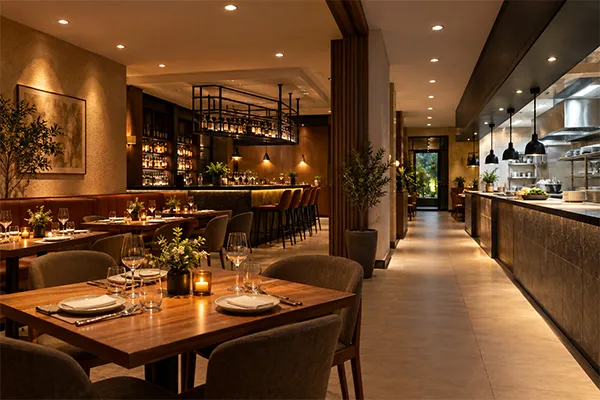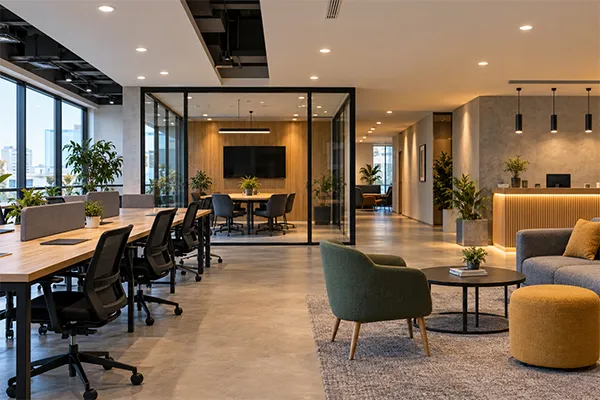
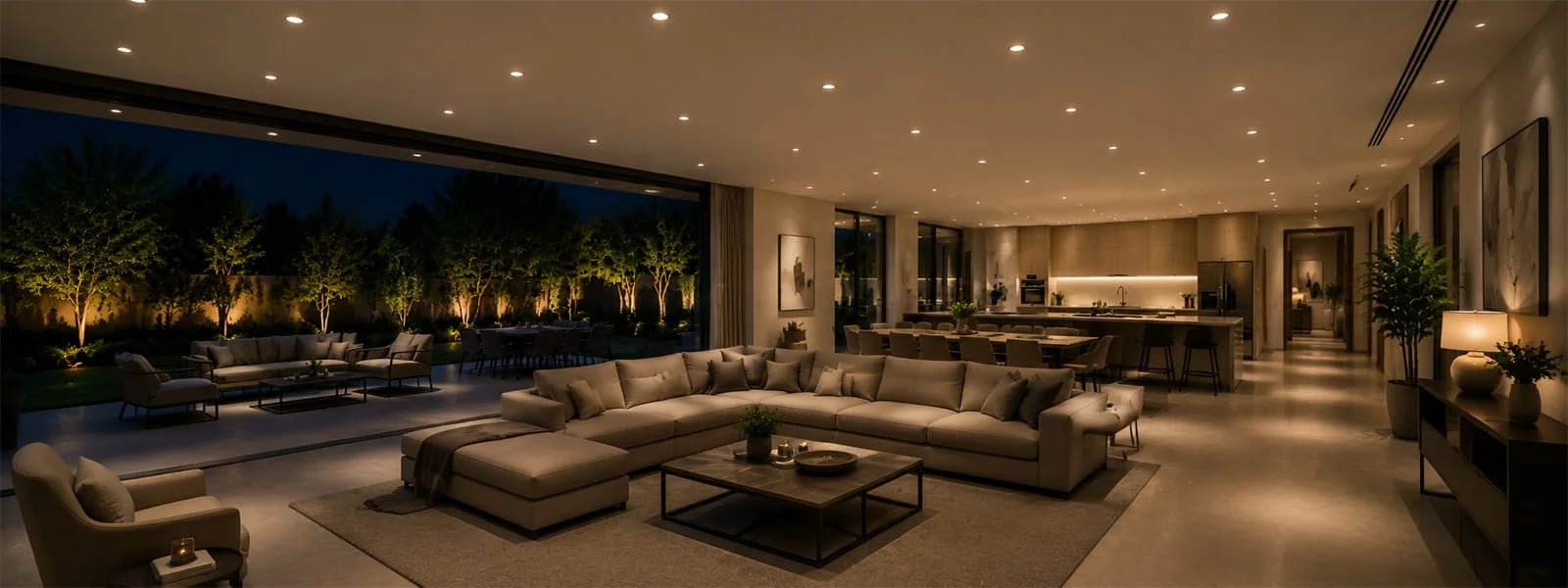
LED downlights for apartment developers can appear similar in a quotation, yet small differences in installation fit, light distribution, finish consistency, and supply continuity can create major project risk. A low unit price may look attractive at first, but rework, resident complaints, or unmatched replacement fittings can quickly make the original decision more expensive.
LED downlights for apartment developers should be selected against the requirements of each apartment space, the ceiling and installation conditions, expected visual effect, bulk-production consistency, and future maintenance needs. We recommend comparing model-specific drawings, samples, performance documents, quality-control procedures, delivery capability, and replenishment arrangements—not only wattage or unit cost.
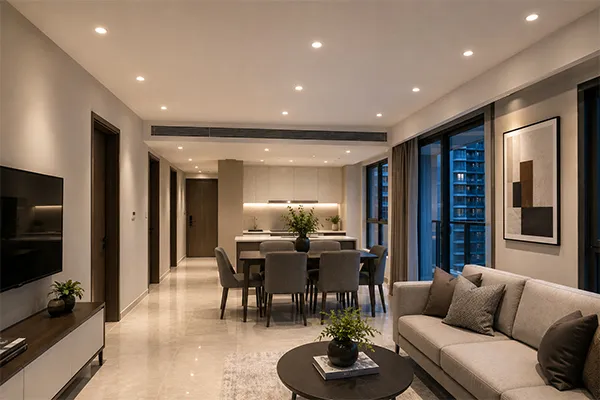
In project supply discussions, we often find that the difficult part is not choosing a downlight category. The difficult part is turning a broad apartment lighting requirement into a specification that contractors can install, residents can live with comfortably, and procurement teams can reorder confidently later.
How Should Apartment Developers Define the Role of LED Downlights?
Apartment lighting projects can start with a simple request such as “we need 8W downlights for all units.” That approach can create problems because identical wattage does not define the required light effect, installation method, or visual result1. We encourage buyers to begin with the room’s practical purpose2 before requesting quotations.
Apartment developers should define LED downlights by room function, ceiling construction, cut-out size, mounting depth, target brightness, glare control, beam angle, and desired appearance. A bedroom, corridor, kitchen, bathroom, lobby, and balcony may each require different priorities, even when the fixtures share a similar visual style.
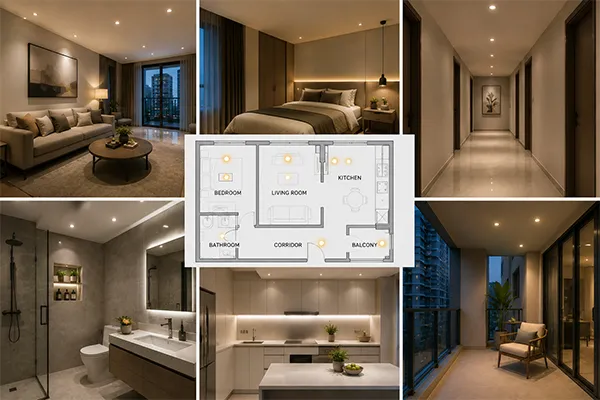
Start With the Space, Not the Wattage
Wattage is useful, but it is only one input. A 7W fixture from one supplier may not produce the same luminous output, beam pattern, or visual comfort as a 7W model from another supplier.3 The better starting point is: What must this space achieve?
For apartment developers and project managers, this often means clarifying the following points before a supplier comparison:
- Room type: Is the fitting for a living room, bedroom, kitchen, bathroom, hallway, stairwell, lobby, or covered outdoor area?
- Lighting role: Will the downlight provide ambient lighting, task lighting, accent lighting, or a combination?
- Ceiling type: Is the ceiling gypsum board, concrete, metal, suspended ceiling, or another construction?
- Available ceiling void: Is there sufficient depth for the recessed body, driver, wiring, and thermal clearance?
- Cut-out size: Can the installer work with a standard hole size, or is a specific cut-out required?
- Target effect: Does the project need a broad, soft distribution or more focused illumination?
- Finish: Should the trim be white, black, silver, brushed, matte, or customized to match the interior palette?
- Control requirements: Does the project need standard switching, dimming, sensor compatibility, emergency integration, or smart-control compatibility?
We have supported many quotation discussions where buyers initially compare only 5W, 7W, 9W, or 12W options. Once we review the ceiling drawings and room schedule, the requirement often becomes more specific. For example, a low-ceiling corridor may need a shallow recessed design and a wide beam angle, while a kitchen worktop area may need better task illumination and careful positioning.
A Simple Apartment Downlight Planning Matrix
| Apartment Area | Primary Lighting Need | Typical Procurement Questions |
|---|---|---|
| Living room | Comfortable ambient light | What beam angle supports the room layout? Should the color temperature create a warm residential feel? |
| Bedroom | Soft, low-glare comfort | Is the output suitable for resting areas? Is dimming required? |
| Kitchen | Functional task visibility | Is the fixture layout sufficient for counters and food-preparation areas? |
| Bathroom | Safe, practical illumination | What ingress-protection requirement applies to the installation zone?4 |
| Hallway | Even circulation lighting | Will the spacing and beam distribution avoid dark gaps? |
| Lobby or common area | Visual presentation and durability | Does the trim finish match other architectural elements? |
| Balcony or covered exterior | Environmental suitability | What protection level and mounting condition are required? |
The final lighting layout should be reviewed by qualified lighting, electrical, and project professionals for the specific application. As a manufacturer, we can provide product information, drawings, samples, and customization options, but the project team should confirm the final suitability for its local codes, installation conditions, and design intent.
Why Are Similar LED Downlights for Apartment Developers Not Always Equivalent?
A procurement team may receive several quotations for recessed LED downlights with the same wattage, color temperature, and nominal cut-out. The risk is assuming that those headline specifications mean the products are interchangeable. In reality, the physical, optical, and component details can differ in ways that matter after installation.
LED downlights for apartment developers are not equivalent simply because they share the same wattage or stated color temperature. Buyers should compare model-specific light output, beam distribution, trim appearance, driver configuration, cut-out tolerance, ceiling depth, thermal design, and documentation for the exact item quoted.
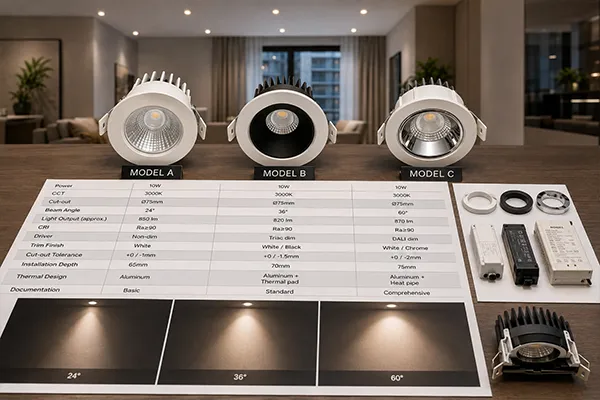
Compare the Installed Result, Not Only the Datasheet Headline
The installed result is what residents, building managers, and maintenance teams will see. A fixture can look acceptable in an isolated product photo but create uneven ceilings when installed in large quantities. This is why we recommend that apartment developers review the fixture as part of a system: ceiling, cut-out, wiring, room layout, paint color, adjacent fixtures, and viewing distance.
Key variables to compare include:
-
Actual light output
Buyers should request the stated lumen output for the exact model, wattage, color temperature, and optic. The relationship between watts and lumens is not fixed across all products.5 -
Beam angle and beam distribution
A wide-angle downlight may support more even ambient lighting in corridors or bedrooms. A narrower beam may create stronger pools of light and darker areas between fixtures.6 The best choice depends on spacing, ceiling height, and room function. -
Color temperature and color consistency
A warm white option may suit residential interiors, while a neutral option may be specified for utility areas. Buyers should also discuss how color consistency will be controlled between samples and bulk production. -
Color rendering index (CRI)
CRI can influence how finishes, furnishings, and skin tones appear.7 However, the required CRI should match the design objective and project budget rather than become a generic checkbox. -
Trim and housing appearance
White is not always the same white. Differences in paint texture, gloss level, trim thickness, reflector color, and bezel profile can become visible across a ceiling with dozens or hundreds of fittings. -
Cut-out and installation tolerance
A nominal 75 mm or 90 mm cut-out does not eliminate the need for a detailed drawing. The spring design, trim coverage, ceiling thickness range, driver size, and cable routing all affect installation.
Questions We Recommend Including in a Comparison Sheet
| Comparison Item | Why It Matters for Apartment Projects | Evidence to Request |
|---|---|---|
| Product model number | Prevents comparison of non-equivalent products | Quotation and model-specific datasheet |
| Cut-out size and tolerance | Reduces ceiling rework risk | Dimensioned installation drawing |
| Overall height and driver dimensions | Confirms ceiling-void compatibility | Product drawing and driver specification |
| Lumen output | Helps evaluate lighting quantity and effect | Model-specific technical data |
| Beam angle | Affects spacing and visual uniformity | Datasheet, photometric file where available |
| CCT and CRI | Supports interior visual requirements | Product specification and approved sample |
| Trim finish | Helps avoid visible variation | Finish sample or approved physical sample |
| IP rating, where relevant | Supports appropriate location selection | Product documentation for the exact model |
| Dimming or control compatibility | Avoids mismatch with project controls | Compatibility details and project testing plan |
We do not suggest that a lower-priced downlight is automatically poor quality. A lower price may reflect a simpler specification, different material selection, a larger order volume, limited customization, or a different service scope. The practical question is whether the quoted product meets the project’s documented requirements and whether its supplier can provide sufficient evidence for the decision.
How Can Apartment Developers Control Sample-to-Bulk Consistency?
An approved sample is important because it lets the project team inspect the look, dimensions, and basic operation of a proposed fixture. However, a sample alone does not define how bulk production will be checked. Without a clear approval and inspection process, teams may later face differences in finish, color temperature, labeling, packaging, or installation components.8
LED downlights for apartment developers require a documented bridge between the approved sample and bulk production. Buyers should record the exact model, finish, CCT, wattage, beam angle, cut-out, driver type, packaging, labels, and acceptable tolerances, then agree on how these details will be verified before shipment.
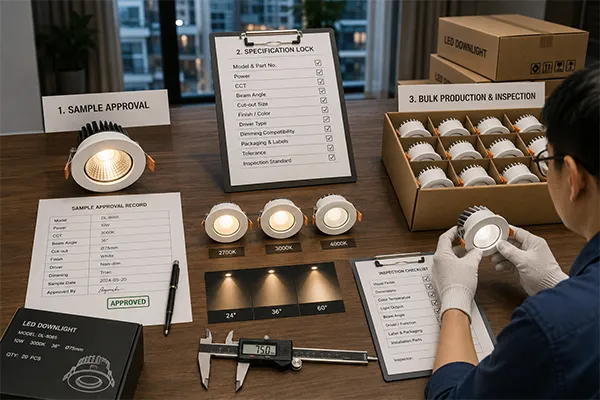
Build a Sample Approval Record
In our experience with project quotations and specification confirmation, buyers often need to clarify which features are critical before production begins. A visual sample may be approved by one person, while the purchasing order may list only “LED downlight, 9W, 3000K.” That is not always enough to protect the project from ambiguity.
A stronger approval record can include:
- Supplier name and full product model number
- Product photos from the front, side, rear, and installed position
- Rated wattage and input requirements
- Color temperature and CRI requirement
- Beam angle or optical configuration
- Cut-out diameter and ceiling thickness range
- Fixture diameter, height, and driver dimensions
- Trim color, surface texture, and gloss expectation
- Driver brand or approved driver configuration, if relevant
- Cable length, connector type, and spring clip design
- Carton markings, inner-box format, and project labeling requirements
- Required documents for the shipment
- Agreed inspection quantity or third-party inspection approach
Define What “Consistent” Means
Consistency is not a vague concept. For a large apartment development, it can mean that fixtures installed in the same visible area have a reasonably uniform appearance and that each carton contains the specified model and accessories.
At Upward Lighting, our stated process includes a 100% aging test of 4 to 8 hours before shipment. Buyers should treat this as a supplier quality-control procedure to review and verify for the applicable model and order, rather than as a universal guarantee of service life or project performance. A buyer may also request outgoing inspection records, product photographs, carton photographs, or an independent pre-shipment inspection according to the order’s risk level.
A sample proves what was presented for approval. A production-control plan helps confirm what will be delivered repeatedly.
Use Pre-Shipment Checks Proportionately
Not every order needs the same inspection depth. A small replenishment order may need confirmation of model, CCT, finish, and carton marking. A first-time high-volume apartment project may justify a more formal pre-shipment plan.
A practical inspection checklist may cover:
- Quantity and carton count
- Correct model and rated parameters
- External appearance and trim finish
- Cut-out and key dimensions
- Driver and wiring configuration
- Power-on checks from selected cartons
- Packaging protection and labels
- Required compliance documents
- Spare quantity, if agreed
- Shipment marks and destination information
CE and RoHS documents can be relevant market-access and environmental-compliance evidence for applicable markets.9 They should be checked for relevance to the exact product and destination requirements. They should not be treated as standalone proof of lighting quality, long-term reliability, or suitability for a particular apartment project.
What Should You Ask a Supplier of LED Downlights for Apartment Developers?
A supplier may provide an attractive quotation quickly, but the procurement decision should also consider whether that supplier can support specification confirmation, manufacturing control, shipment coordination, and later replacement needs. Apartment projects rarely end with the first container or first delivery. Changes, phased handovers, and maintenance requirements can create follow-up demand.
When sourcing LED downlights for apartment developers, buyers should assess supplier capability beyond price. Useful evidence includes model-specific datasheets and drawings, sample procedures, customization limits, quality-control steps, lead times, minimum order quantities, packaging details, compliance documentation, and a practical plan for replenishment or follow-up orders.
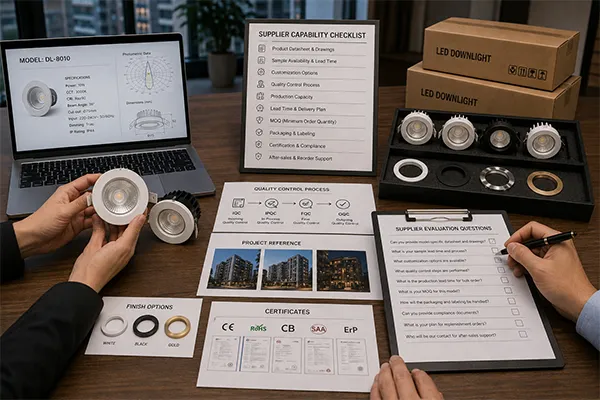
Review Evidence Before You Commit
In manufacturer-side project discussions, we often see buyers concentrate heavily on the initial quote and only later ask for dimensions, installation drawings, or replacement availability. We believe those questions should be addressed earlier, especially when a downlight will become part of a repeated apartment specification.
A supplier evaluation should include both product evidence and supply-chain evidence.
| Supplier Evaluation Area | Questions for Procurement Teams |
|---|---|
| Technical clarity | Does the supplier provide a model-specific datasheet, drawing, and installation detail? |
| Customization | Can the supplier adjust CCT, wattage, beam angle, CRI, finish, packaging, or labels where required? |
| Sampling process | How are samples identified and linked to the production order? |
| Quality process | What aging, visual inspection, functional checks, and outgoing-inspection procedures does the supplier use? |
| Production capacity | Can the supplier support the required quantity and delivery schedule? |
| Lead time | What is the lead time for samples, first production, and repeat orders? |
| MOQ flexibility | Can the supplier support pilot units, mock-up quantities, or small replenishment batches? |
| Documentation | Which test reports, declarations, and product documents are available for the target market? |
| Communication | Can the supplier respond quickly when drawings, labels, or specifications need confirmation? |
| Continuity | How will the supplier handle later orders if the project requires matching fixtures? |
Plan for Replenishment at the First Order Stage
Future replenishment is frequently overlooked. Yet apartments may be completed in phases, additional units may be added, or replacement fittings may be needed after handover. If the original model is discontinued or materially changed, the replacement may look different even if it fits the same cut-out.10
We recommend that buyers discuss these questions before placing a bulk order:
- Will the supplier retain the approved product specification and order record?
- Is the model a stable, ongoing product line or a project-specific configuration?
- What is the likely MOQ for follow-up orders?
- Can the supplier reproduce the approved trim finish and CCT specification?
- Are drivers, optics, or key components subject to change?
- How will the supplier communicate proposed substitutions?
- Can the buyer order a reasonable spare quantity with the initial shipment?
At Upward Lighting, we support OEM and ODM discussions for parameters such as color temperature, wattage, beam angle, CRI, and surface finish color. Our customers should still confirm that the selected configuration is appropriate for the specific project. Customization can improve fit, but it can also affect lead time, MOQ, approval requirements, and future replenishment planning.
How Can Procurement Teams Balance Price and Total Project Risk?
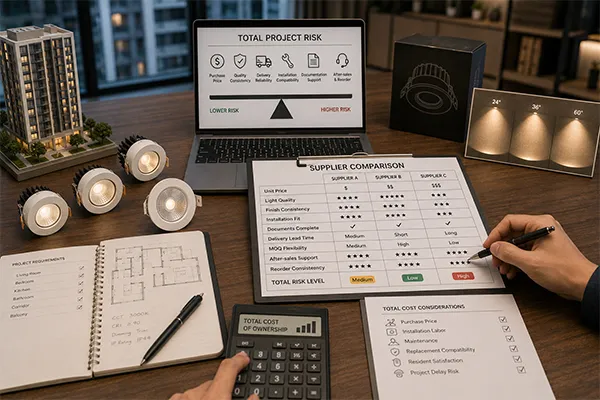
Procurement teams are expected to manage budgets, and unit price remains important. However, apartment downlight sourcing should consider the cost of uncertainty. A product that appears less expensive may still create added exposure if its dimensions are unclear, its finish varies, its documents are incomplete, or the supplier cannot support later matching orders.
The best-value LED downlights for apartment developers are not necessarily the lowest-priced option.11 Buyers should balance unit cost with installation compatibility, sample-to-bulk consistency, required documentation, delivery reliability, maintenance practicality, and the supplier’s ability to support future orders.
Use a Total-Risk Evaluation Method
A simple weighted scorecard can make supplier comparisons more disciplined. The weighting should vary by project. A luxury residential development may place more weight on finish consistency and visual comfort. A high-volume standard apartment program may prioritize repeatability, lead time, and cost control.
| Evaluation Factor | Example Weight | What to Review |
|---|---|---|
| Product and installation fit | 25% | Drawings, cut-out, ceiling depth, mounting method |
| Lighting specification fit | 20% | Lumen output, CCT, CRI, beam angle, application suitability |
| Appearance consistency | 15% | Approved samples, trim finish, batch-control process |
| Supplier quality controls | 15% | Aging process, outgoing inspection, traceability approach |
| Commercial terms | 15% | Price, MOQ, payment terms, quotation validity |
| Delivery and replenishment | 10% | Lead time, packaging, spare parts, follow-up order support |
The scores do not replace professional project review, but they force the procurement conversation beyond a single number. They also make internal approvals easier because the decision is supported by documented criteria.
Reduce Risk Before the Purchase Order
Before issuing a purchase order, we suggest that teams confirm the following:
- The quoted model matches the approved sample.
- The drawing matches the actual ceiling and cut-out condition.
- The selected CCT, finish, beam angle, and driver option are clearly stated.
- The quantity includes any agreed spare allowance.
- The supplier’s lead time is aligned with the construction schedule.
- The shipping marks, packaging, and documents are confirmed.
- The team understands the process for later replenishment.
I have seen project discussions become much smoother when these points are written into the order confirmation rather than handled through informal messages. Clear documentation does not remove every project risk, but it reduces avoidable misunderstandings between procurement, suppliers, contractors, and site teams.
Frequently Asked Questions
What is the most important factor when choosing apartment LED downlights?
The most important factor is whether the downlight meets the requirements of the specific space and installation. Buyers should confirm room function, ceiling construction, cut-out size, available depth, required lighting effect, appearance, and maintenance needs before comparing price or wattage.
Are higher-wattage downlights always better for apartments?
No. Higher wattage does not automatically create a better residential result. The correct choice depends on lumen output, beam distribution, fixture spacing, ceiling height, room use, and visual comfort. Buyers should review the model-specific technical information and lighting layout requirements.
How many sample downlights should an apartment project approve?
The number depends on project scale and risk. At minimum, buyers should approve the exact intended model and configuration. For larger projects, teams may also review samples for different finishes, CCTs, wattages, or installation conditions and document the approved specification clearly.
Should CE and RoHS certificates decide which downlight supplier to use?
CE and RoHS documentation can be important compliance evidence for relevant markets, but they should not be the only decision factor. Buyers should verify that documents apply to the exact product and also assess installation fit, lighting requirements, quality processes, delivery capability, and supplier support.
Should apartment developers buy spare LED downlights with the first order?
A spare quantity can help with installation damage, phased handover, and early replacement needs.12 The appropriate quantity depends on project size, maintenance strategy, storage capacity, and expected future availability. Buyers should discuss this with their supplier before the bulk order is finalized.
Conclusion
LED downlights for apartment developers should be assessed as part of a complete project-risk decision, not as a commodity defined by the lowest unit price. We recommend starting with room use and installation conditions, then comparing model-specific performance, dimensions, finish, sample approval controls, and supplier evidence. Finally, buyers should plan for inspection, delivery, and replenishment from the beginning. If you are sourcing apartment downlights, we can help you review drawings, confirm specifications, prepare samples, and discuss OEM/ODM options for your project requirements.
"Nitecore TM20K 20000 Lumens! Gear Review",
. U.S. Department of Energy guidance distinguishes a lamp or luminaire’s electrical power consumption in watts from its light output in lumens; optical distribution and installation design are additional factors affecting the illuminated result. Evidence role: mechanism; source type: government. Supports: That wattage measures electrical power input, whereas lumen output and light distribution describe different aspects of a luminaire's lighting performance.. Scope note: The source explains the general distinction and does not compare the specific downlight models discussed in this article. ↩"Fall Protection in Residential Construction - Overview", http://www.osha.gov/residential-fall-protection. Illuminating Engineering Society and U.S. Department of Energy educational materials describe lighting design in terms of ambient, task, and accent functions, with the activities and visual needs of a space informing the appropriate lighting approach. Evidence role: general_support; source type: institution. Supports: That lighting design commonly considers the activities performed in a space and distinguishes ambient, task, and accent lighting functions.. Scope note: Such guidance provides general design principles and does not substitute for an application-specific lighting calculation or code review. ↩
"Learn About LED Lighting", https://www.energystar.gov/products/learn-about-led-lighting. Lighting-performance guidance from U.S. public-sector research identifies luminous flux, efficacy, and photometric distribution as separate luminaire characteristics; therefore, equal rated wattage does not establish equal delivered light or beam pattern. Evidence role: mechanism; source type: government. Supports: That LED products with similar input power can differ in efficacy, delivered luminous flux, and photometric distribution.. Scope note: The guidance supports the technical principle, not the performance of any particular supplier’s 7 W product. ↩
"Bathroom IP Ratings - J Adams Lighting", https://jadamsandco.com/en-us/blogs/design-journal/bathroom-ip-ratings-guide. IEC 60529 defines IP codes for protection against access, solid foreign objects, and water, while national electrical-installation rules may apply zone-specific requirements to luminaires installed near baths or showers. Evidence role: definition; source type: institution. Supports: That IP classifications describe protection against solid objects and water ingress, and that bathroom electrical-installation requirements may prescribe equipment suitability by zone.. Scope note: The applicable bathroom zones and minimum IP ratings must be verified against the electrical code and regulatory guidance in the project jurisdiction. ↩
"Home - Careers Naval Nuclear Laboratory", https://navalnuclearlab.energy.gov/. U.S. Department of Energy lighting guidance defines efficacy as light output in lumens per watt; because efficacy varies by product and operating design, wattage cannot be converted to a single fixed lumen value. Evidence role: definition; source type: government. Supports: That lumens measure light output, watts measure power, and efficacy varies among products.. ↩
"Achieving Uniformity in Lighting Design Projects | Step-by- ...",
. Lighting-design guidance treats beam distribution, mounting height, and luminaire spacing as interacting variables that determine illuminance and uniformity; a more concentrated distribution can yield localized higher illuminance with lower levels between luminaires. Evidence role: mechanism; source type: institution. Supports: That beam distribution and fixture spacing affect illuminance patterns and uniformity on the illuminated plane.. Scope note: The resulting pattern depends on the specific photometry, spacing, mounting height, and room reflectances. ↩"Consejo Nacional de la Industria Maquiladora y ...", https://index.org.mx/. International Commission on Illumination materials explain that color rendering concerns the effect of a light source’s spectral power distribution on the perceived color appearance of objects relative to a reference illuminant. Evidence role: mechanism; source type: institution. Supports: That a light source's spectral properties and color-rendering performance affect the color appearance of illuminated objects.. Scope note: CRI is a general color-rendering metric and does not fully predict preference or fidelity for every material, color, or skin-tone evaluation. ↩
"Climate Finance Provided and Mobilised by Developed ...", https://www.oecd.org/en/publications/2026/05/climate-finance-provided-and-mobilised-by-developed-countries-in-2013-2024_532c847f.html. ISO 9001 quality-management principles include documented control of production and externally provided outputs, identification where traceability is required, and verification that outputs conform to specified requirements. Evidence role: general_support; source type: institution. Supports: That documented controls, identification, inspection, and traceability are established quality-management practices for ensuring conformity to specified requirements.. Scope note: Conformity procedures reduce the risk of variation but do not independently guarantee that every production unit will be defect-free. ↩
"LSC Restrictions and Other Funding Sources", https://www.lsc.gov/about-lsc/laws-regulations-and-guidance/lsc-restrictions-and-other-funding-sources. European Commission guidance states that CE marking is required only for product categories covered by relevant EU harmonisation legislation, while the RoHS Directive restricts specified hazardous substances in electrical and electronic equipment placed on the EU market. Evidence role: historical_context; source type: government. Supports: That CE marking may be required for products covered by applicable EU harmonisation legislation and that the EU RoHS framework restricts specified hazardous substances in electrical and electronic equipment.. Scope note: Document requirements depend on the exact product, applicable legislation, economic operator responsibilities, and destination market; CE and RoHS evidence does not establish product quality or project-specific suitability. ↩
"LUMINAIRE Definition & Meaning", https://www.merriam-webster.com/dictionary/luminaire. Lighting-maintenance guidance recognizes that replacement equipment may require review of physical fit together with electrical, photometric, and color characteristics, because dimensional compatibility alone does not establish equivalent illuminated appearance. Evidence role: general_support; source type: institution. Supports: That replacement luminaires should be evaluated for photometric, color, electrical, and physical compatibility rather than dimensions alone.. Scope note: The extent of any visible mismatch depends on the original and replacement products, installation geometry, adjacent luminaires, and viewing conditions. ↩
"Food Price Outlook | Economic Research Service", http://www.ers.usda.gov/data-products/food-price-outlook. OECD public-procurement guidance describes life-cycle costing as an approach that evaluates costs incurred over the life of a purchase, rather than relying exclusively on the initial acquisition price. Evidence role: expert_consensus; source type: institution. Supports: That procurement evaluations may consider life-cycle costs and quality-related factors in addition to initial purchase price.. Scope note: A life-cycle-cost framework does not show that any particular higher-priced downlight will provide better value without project-specific cost, performance, and risk evidence. ↩
"Facility", https://en.wikipedia.org/wiki/Facility. Asset-management and maintenance guidance treats spare-parts planning as a means of supporting timely replacement and reducing operational interruption when equipment requires repair or substitution. Evidence role: general_support; source type: institution. Supports: That spare-parts planning is a maintenance and asset-management practice used to reduce delays when components fail, are damaged, or require replacement.. Scope note: The appropriate spare quantity depends on failure risk, lead times, storage conditions, standardization, project phasing, and the owner’s maintenance strategy. ↩