LED downlights for art display applications can look like a simple specification decision, but many buyers start with the wrong question. I often hear requests for higher CRI, more wattage, or a narrow beam without a clear description of the artwork, the viewing distance, or the desired visual effect. The result can be flat lighting, glare, or missed focal points. A better process starts with the display objective.
LED downlights for art display applications can be suitable when the ceiling position, beam control, viewing direction, and display object align with the intended effect. I would not select them based on CRI or wattage alone. Buyers should first assess the artwork, mounting geometry, ambient light, glare risk, and whether an adjustable spotlight, track fixture, or wall washer would better serve the space.
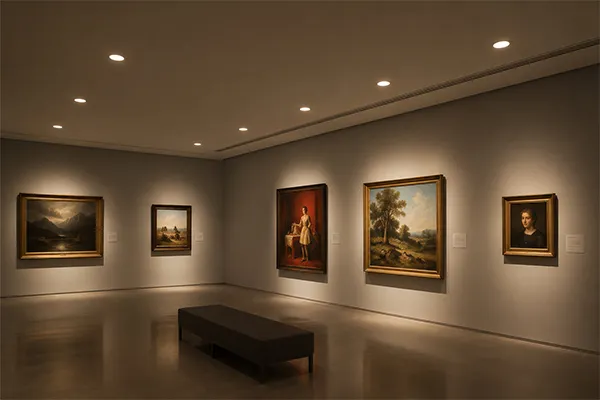
I work with contractors, lighting brands, distributors, and project teams that need to turn visual requirements into quotable lighting specifications. In pre-sales discussions, I find that the most successful requests begin with the object and the viewing experience—not only the product data sheet. That difference can help buyers avoid choosing a downlight for a task that requires another lighting method.
How Should LED Downlights for Art Display Applications Begin With the Viewing Task?
A buyer may know that a gallery, retail display, or exhibition area needs better lighting, but that does not automatically mean a recessed fixture is the best answer. If the team skips the visual brief, the lighting can emphasize the wrong surface, create reflections, or leave the artwork visually weak against its surroundings.
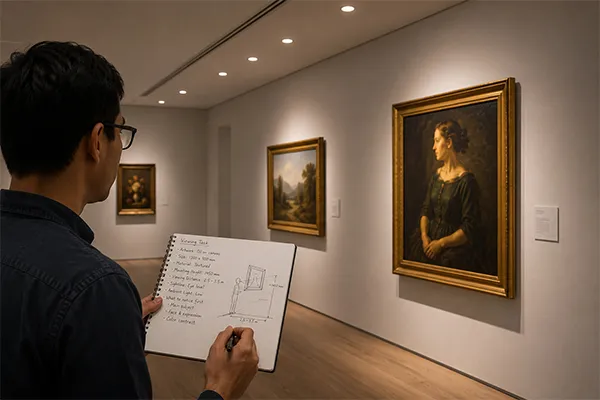
I recommend that buyers start LED downlights for art display applications by defining what is being displayed, what the viewer should notice first, and where the viewer will stand. Artwork material, texture, color, mounting height, sightline, and nearby ambient light should guide the specification before CRI, wattage, or beam angle are finalized.
Start With the Object, Not the Fixture
In early inquiries, customers often ask me, “Can you provide a high-CRI 12 W or 15 W downlight for artwork?” I understand why. CRI and wattage are familiar buying terms. However, neither question explains what the light must actually do.
I normally need to understand the display object first. A framed painting, textured sculpture, jewelry cabinet, fabric sample wall, retail product shelf, and graphic exhibition panel all respond differently to light.
For example:
- A textured canvas may benefit from controlled directional light that reveals surface depth.
- A glossy framed print may create unwanted reflections if the fixture sits in the wrong ceiling position.
- A sculpture may need more than one lighting direction to avoid harsh shadows.
- A vertical art wall may need a wall-washing or grazing approach rather than a standard downlight.
- A retail display may need stronger visual contrast between the feature product and the general background.
Ask What the Viewer Should Notice First
I encourage project teams to define the intended hierarchy. This means deciding which visual element should attract attention first and which elements should remain secondary.
A useful pre-quotation checklist includes:
-
What is the object?
Is it a painting, sculpture, display case, wall graphic, product display, or mixed-media installation? -
What are the object dimensions?
Width, height, depth, and mounting position affect beam spread and aiming needs. -
What is the surface finish?
Matte, glossy, metallic, reflective, textured, transparent, and dark finishes each create different lighting risks. -
Where will viewers stand?
The likely viewing direction helps identify glare and reflection concerns. -
What is the focal point?
Does the space need even illumination, a dramatic accent, or a layered lighting scene? -
What other light is present?
Daylight, decorative lighting, general downlights, and window reflections can change perceived color and contrast.
In my experience, a downlight can be technically compliant and still be visually unsuitable if its beam does not land where the project team wants the viewer’s attention to go.
I do not provide museum-grade conservation assessment, formal on-site lighting design certification, or laboratory spectral analysis. For high-value collections, sensitive materials, or conservation-led requirements, I recommend that buyers consult qualified lighting designers and conservation professionals before selecting fixtures.
Why Are High CRI and Higher Wattage Not Enough for LED Downlights for Art Display Applications?
High CRI and higher output are often treated as shortcuts for better display lighting. This approach can create problems. A fixture may render colors reasonably well on paper but still produce glare, spill light, poor contrast, or an uncomfortable visual impression in the installed space.
For LED downlights for art display applications, high CRI is a useful screening criterion but not a complete answer. Buyers should assess color temperature, beam distribution, glare control, dimming behavior, mounting position, ambient light, and the relationship between the illuminated object and its background.
CRI Helps, but It Does Not Describe Every Visual Outcome
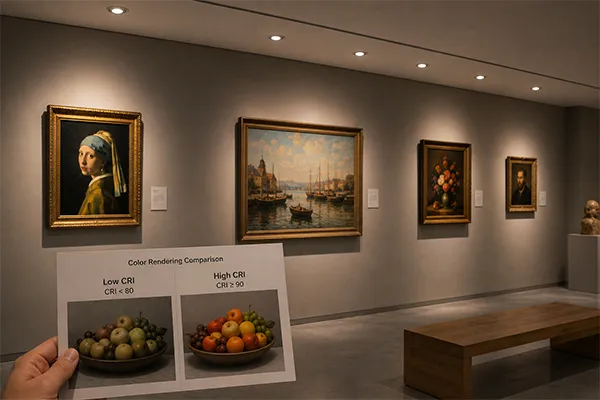
CRI, or Color Rendering Index, indicates how faithfully a light source renders a set of reference colors compared with a reference source.1 For many display projects, buyers may consider a higher CRI option, such as CRI 90 or above, when color appearance is important.
However, I would not present high CRI as a universal guarantee of good art lighting. A high-CRI downlight can still be the wrong choice if:
- The beam angle is too wide and makes the display look flat.
- The beam angle is too narrow and creates bright hotspots.
- The fixture is positioned where viewers see direct glare.
- The color temperature conflicts with the material or interior atmosphere.
- The surrounding ambient lighting overwhelms the intended accent.
- The object has glossy glazing that reflects the source into the viewer’s sightline.
Some buyers also ask about specific color fidelity metrics, such as R9, which is associated with strong red rendering.2 That information can be useful for certain materials, branding environments, textiles, or art colors. Still, I would connect any metric to the actual display objective instead of treating it as an automatic purchasing rule.
Color Temperature Changes the Perceived Atmosphere
Color temperature affects how viewers perceive the space and the object.3 Common options include 2700 K, 3000 K, 3500 K, 4000 K, and higher values. I usually see warmer tones considered for hospitality-like galleries, wood finishes, classic interiors, and some retail environments. Neutral-white options may suit modern exhibition spaces or commercial settings with brighter general lighting.
The right choice depends on the artwork, interior finishes, brand intent, and existing lighting. A 3000 K downlight may feel inviting in one space but may appear too warm in another. A 4000 K fixture may support a clean contemporary presentation but can feel visually cool if the room uses warm finishes.
| Factor | Why It Matters for Art Display | Buyer Question |
|---|---|---|
| CRI | Supports more natural color appearance | Does the project require CRI 80, 90, or another verified target? |
| CCT | Influences the mood and perceived color balance | Does the display need warm, neutral, or cooler white light? |
| Beam angle | Controls where the light lands | Does the fixture need a narrow accent, medium spread, or broad coverage? |
| Glare control | Affects viewer comfort and visibility | Will visitors see the bright source from normal viewing positions? |
| Dimming | Supports adjustment after installation | Does the project require scene setting or brightness tuning? |
| Ambient light | Changes contrast and perceived brightness | Is there daylight, general lighting, or reflective surrounding material? |
Wattage Is Not a Display Strategy
Wattage tells buyers about power consumption, but it does not independently describe how the display will look.4 Lumen output also matters, but lumens alone do not confirm that useful light reaches the intended object.5
A lower-wattage fixture with an appropriate beam and position may create a better accent effect than a higher-wattage fixture with excessive spill light. Conversely, a low-output downlight may be insufficient if the ceiling is high or if strong ambient light reduces contrast.
I prefer to discuss the complete relationship:
ceiling height + mounting location + beam angle + object size + ambient light + intended emphasis
This approach gives contractors and project managers more useful information than simply requesting “the brightest downlight available.”
When Do LED Downlights for Art Display Applications Work, and When Are Other Fixtures Better?
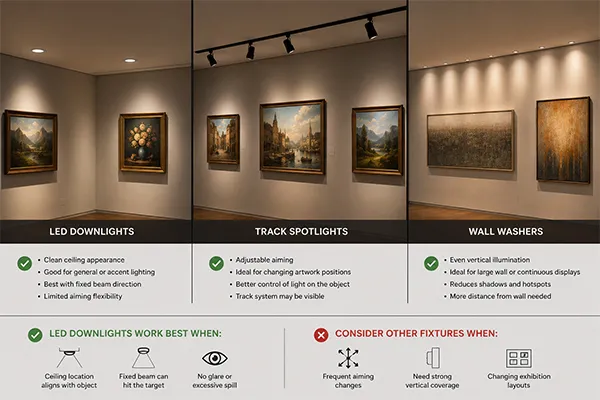
A recessed downlight can offer a clean ceiling appearance and may support selected accent or general display tasks. Still, a downlight has physical limits. If a project needs frequent aiming changes, strong vertical illumination, or full-wall coverage, another fixture type may provide more control.
LED downlights for art display applications work best when the ceiling location and fixed beam direction can deliver light to the intended object without glare or excessive spill. I would consider track spotlights, adjustable fixtures, or wall-washing solutions when aiming flexibility, vertical coverage, or changing exhibition layouts are essential.
Where Downlights Can Be a Practical Fit
I see downlights considered for display spaces where the design team wants a minimal ceiling appearance and the display layout is relatively stable. A fixed recessed fixture may be practical when the object location is known and the ceiling grid can support suitable placement.
Potential uses include:
- Controlled accent lighting for a fixed display object
- General lighting in small galleries or retail zones
- Supplementary illumination near selected display areas
- Hospitality or showroom spaces where a clean recessed ceiling is important
- Retail feature zones with consistent product placement
Some downlights offer adjustable or gimbal-style mechanisms. These can provide more aiming flexibility than fixed models. However, buyers should still confirm the available tilt angle, rotation range, ceiling cutout, trim appearance, glare performance, and access for adjustment.
Where a Downlight May Not Be the Best Tool
A standard downlight should not be assumed to replace every accent-lighting or wall-lighting task. I would be cautious when the application requires:
- Frequent exhibition changes: Track-mounted spotlights often allow easier repositioning.6
- Precise aiming: Adjustable spotlights may provide more focused directional control.
- Broad vertical wall coverage: Wall washers are often designed for more even vertical illumination.7
- Long display walls: A lighting layout may need dedicated wall-washing optics rather than a row of standard downlights.
- Large sculptures: Multiple lighting directions may be needed to manage shadow and form.
- Sensitive or high-value collections: A qualified specialist should assess preservation-related requirements.
Compare the Lighting Tools by Task
| Lighting Option | Typical Strength | Main Limitation | Suitable Decision Context |
|---|---|---|---|
| Fixed LED downlight | Clean appearance and simple ceiling integration | Limited aiming after installation | Stable layouts and controlled accent tasks |
| Adjustable LED downlight | More directional flexibility than fixed models | Adjustment range remains limited by ceiling location | Selected artwork or display zones |
| Track spotlight | Flexible aiming and easier adaptation | More visible ceiling hardware | Rotating exhibitions and changing retail displays |
| Wall washer | Better vertical wall coverage | May not create strong focused accents | Paintings, graphics, and large display walls |
| Linear lighting | Broad, even illumination options | Not always suitable for dramatic focal lighting | Shelves, cases, cabinets, and architectural display areas |
I have seen customers begin with a request for recessed fixtures because they want a clean interior style. After discussing the display wall and future layout changes, they sometimes decide to combine downlights with track lighting or wall-washing fixtures. That is not a failure of the downlight. It is a better match between the lighting tool and the visual task.
What Should Buyers Specify When Sourcing LED Downlights for Art Display Applications?
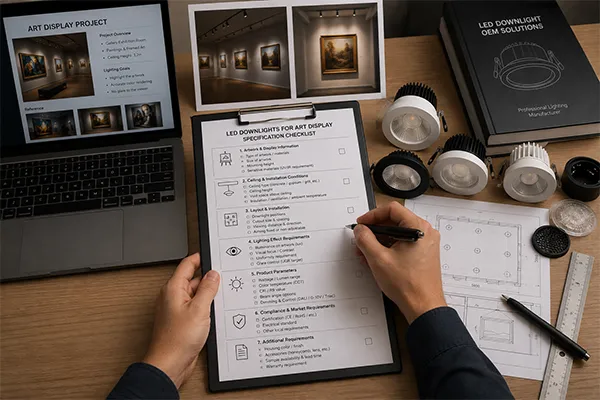
A vague request can slow down quotation, sampling, and technical review. Buyers can reduce risk by providing the display context along with the required product parameters. This helps manufacturers and ODM suppliers recommend a more relevant configuration instead of sending a generic catalog option.
When sourcing LED downlights for art display applications, I recommend that buyers provide artwork details, ceiling conditions, installation layout, desired visual effect, target color temperature, beam preference, control requirements, and market compliance needs. A complete brief supports more accurate quotations, samples, and supplier comparisons.
Build a Brief That Suppliers Can Quote
At Upward Lighting, I handle inquiries where buyers need OEM or ODM support for parameters such as color temperature, wattage, beam angle, CRI, and surface finish. I find that the best inquiries include both technical information and project context.
Buyers can prepare the following information before requesting a quote or sample:
| Information to Provide | Why It Helps |
|---|---|
| Application type | Helps distinguish gallery, museum, retail, hotel, showroom, or exhibition use |
| Artwork or display description | Supports discussion of beam control, color appearance, and glare risk |
| Ceiling height and ceiling type | Affects mounting, beam spread, cutout, and fixture selection |
| Proposed fixture positions | Helps assess whether light can reach the target area |
| Desired CCT and CRI | Supports LED source selection |
| Beam angle preference | Helps define spotlight, medium, or wider distribution |
| Dimming or control protocol | Confirms compatibility with drivers and project controls |
| Required quantity and sample plan | Supports production planning and evaluation |
| Target market | Helps identify documents buyers may need to verify for market entry |
| Branding or finish requirements | Supports OEM/ODM customization and packaging discussions |
Evaluate the Supplier, Not Only the Product
For B2B procurement, the fixture specification is only one part of the decision. I recommend that buyers compare suppliers on quality-control methods, responsiveness, documentation, delivery capability, and willingness to clarify technical boundaries.
At Upward Lighting, we conduct a 100% aging test of 4 to 8 hours before shipment as part of our production quality-control process. Buyers should still ask suppliers what their test process covers, how they handle incoming material control, and what records are available for the ordered model.
For projects requiring CE, RoHS, or other compliance documentation, I recommend that buyers verify the documents for the specific product configuration and target market. Certification needs can vary by destination, installation type, and project requirement.8 Product documentation should be reviewed as part of procurement due diligence rather than treated as a general marketing claim.
Use Samples for Visual Evaluation
A sample can help teams assess physical finish, installation compatibility, beam appearance, dimming behavior, and apparent color in the actual interior. However, I would not describe a sample review as a substitute for a professional lighting design or conservation assessment.
During sample review, buyers can check:
- Trim color and ceiling integration
- Beam spread on the intended display surface
- Visible glare from normal visitor positions
- Compatibility with dimmers or control systems
- Driver location and installation access
- Heat management considerations for the fixture location
- Consistency among multiple sample units
- Documentation and labeling for the target market
For sensitive art materials, UV exposure, blue-light risk, light dosage, fading concerns, and museum conservation standards, buyers should seek guidance from qualified conservation and lighting professionals.9 Manufacturing experience and product supply follow-up do not replace specialist preservation evaluation.
Frequently Asked Questions
Are LED downlights suitable for displaying paintings?
LED downlights can be suitable for some paintings when the ceiling position, beam angle, glare control, and viewing direction are appropriate. I would not assume they are the best choice for every painting wall. Adjustable spotlights or wall washers may offer better control for vertical surfaces or changing displays.
Is CRI 90 necessary for art display lighting?
CRI 90 may be considered when accurate color appearance is important, but it is not universally necessary or sufficient. I recommend evaluating CRI with color temperature, beam control, glare, ambient light, and the artwork’s material. A qualified specialist should assess sensitive or conservation-led applications.
What beam angle should I choose for art display downlights?
The right beam angle depends on ceiling height, distance to the object, artwork size, and desired emphasis. Narrow beams can create strong accents, while wider beams can cover larger areas. I recommend reviewing a lighting layout or sample installation before finalizing the beam angle for a project.
Can recessed downlights replace track lighting in a gallery?
Recessed downlights may replace track lighting in stable layouts with known display positions, but they do not offer the same flexibility for aiming and future changes. I would usually consider track lighting when exhibitions rotate, artworks move regularly, or precise directional control is important.
Should I use dimmable LED downlights for art display?
Dimming can be useful for adjusting brightness, balancing ambient light, and creating different scenes. However, it is not automatically required for every installation. Buyers should confirm the control method, dimming range, driver compatibility, and whether the project team will actually use the adjustment capability.
Conclusion
LED downlights for art display applications should be selected around the display objective rather than a single headline specification. I recommend that buyers begin with the artwork, viewer sightline, ceiling geometry, lighting hierarchy, and ambient conditions. High CRI, suitable color temperature, beam control, and dimming may all contribute, but none replaces the need to choose the right fixture type. If you are sourcing an OEM or ODM downlight for a gallery, retail display, or exhibition project, I invite you to share your layout, display details, and target specifications with Upward Lighting for a practical quotation and sample discussion.
"Color rendering index", https://en.wikipedia.org/wiki/Color_rendering_index. The CIE general colour rendering index evaluates the colour-rendering properties of a test illuminant by comparison with a reference illuminant using specified test-colour samples. Evidence role: definition; source type: institution. Supports: The definition of the general color rendering index and its comparison of test-source rendering with a reference illuminant.. ↩
"Color rendering index", https://en.wikipedia.org/wiki/Color_rendering_index. In the CIE colour-rendering method, R9 is a special colour-rendering index for a saturated red test-colour sample and is distinct from the general CRI value. Evidence role: definition; source type: institution. Supports: That R9 is a special color-rendering index concerning the rendering of a saturated red reference color.. ↩
"Effects of illuminance and correlated color temperature ... - PMC", https://pmc.ncbi.nlm.nih.gov/articles/PMC8275593/. Lighting research and CIE guidance describe correlated colour temperature as a property that can influence the perceived colour appearance and visual impression of an illuminated environment. Evidence role: general_support; source type: research. Supports: That correlated color temperature influences the perceived appearance of illuminated environments and objects.. Scope note: Perceived atmosphere also depends on illuminance, surrounding finishes, adaptation, and individual observers. ↩
"Purchasing Energy-Efficient Light Bulbs", https://www.energy.gov/cmei/femp/purchasing-energy-efficient-light-bulbs. Electrical watts measure input power, while lumens quantify luminous flux and illuminance quantifies light incident on a surface; therefore wattage alone does not specify the visual result at a display. Evidence role: definition; source type: government. Supports: That watts measure electrical power, whereas lumens and illuminance describe different aspects of light output and light arriving at a surface.. Scope note: Visual appearance further depends on distribution, aiming, surface properties, adaptation, and ambient lighting. ↩
"Candela - NIST", https://www.nist.gov/si-redefinition/candela. Photometric guidance distinguishes total luminous flux from target illuminance: the light reaching a surface depends on the luminaire’s intensity distribution, distance, orientation, and geometry. Evidence role: mechanism; source type: education. Supports: That illuminance at a target depends on luminous intensity distribution, distance, and geometry rather than total lumens alone.. ↩
"Purchasing Energy-Efficient Light Fixtures (Luminaires)", https://www.energy.gov/cmei/femp/purchasing-energy-efficient-light-fixtures-luminaires. Track-lighting systems are commonly used where luminaires must be repositioned or re-aimed, because compatible fixtures can be moved along the track without relocating recessed ceiling openings. Evidence role: general_support; source type: education. Supports: That track systems permit luminaires to be moved along the track and aimed at changing display locations.. Scope note: The available movement and aiming range depend on the particular track system and luminaire. ↩
"Vertical lighting: wallwashing for more orientation and ...", https://www.erco.com/en_us/designing-with-light/lighting-knowledge/lighting-design/wallwashing-7483/. Wall washing is a lighting approach intended to distribute light across a vertical surface with comparatively even illuminance, rather than concentrating it as a narrow accent beam. Evidence role: definition; source type: institution. Supports: That wall washing is a lighting technique intended to illuminate vertical surfaces with relative uniformity.. Scope note: Actual uniformity depends on luminaire optics, spacing, setback, ceiling height, and wall reflectance. ↩
"RoHS Directive - Department of Toxic Substances Control", https://dtsc.ca.gov/universalwaste/rohs-directive/. European Commission guidance states that CE marking applies only where relevant Union harmonisation legislation requires it, and manufacturers must assess conformity with the requirements applicable to the specific product before placing it on the EU market. Evidence role: general_support; source type: government. Supports: That product compliance obligations depend on the legislation applicable to the product and the market in which it is placed.. Scope note: This does not determine requirements in non-EU markets or replace review of the regulations and product configuration applicable to a particular project. ↩
"Light Duration Guidelines - National Museum of Asian Art", https://asia.si.edu/research/conservation-scientific-research/exhibitions-conservation/light-duration-guidelines/. Preventive-conservation guidance recognizes that light exposure, including visible and ultraviolet radiation, can cause cumulative fading and deterioration in light-sensitive museum materials; exposure decisions should account for material sensitivity and dose. Evidence role: expert_consensus; source type: government. Supports: That visible and ultraviolet radiation can cause light-induced fading or other deterioration in light-sensitive collection materials and that exposure management is part of preventive conservation.. Scope note: Risk varies substantially by material, spectral distribution, illuminance, duration, and collection-management objectives. ↩