LED downlights for banks and financial buildings can look simple on a quotation, yet the wrong specification can create glare, uneven appearance, customer discomfort, and avoidable maintenance work. Buyers may focus on wattage or unit price first. I recommend a zone-by-zone evaluation that connects light output, optics, color quality, controls, installation conditions, and supplier consistency.
LED downlights for banks and financial buildings should be selected by matching each product specification to the visual task, atmosphere, ceiling condition, and maintenance risk of each zone. Buyers should assess glare control, beam angle, CCT, CRI, dimming compatibility, driver quality, batch consistency, replacement availability, and supplier documentation—not only wattage, lumens, certifications, or purchase price.
I work with contractors, lighting brands, importers, and channel partners on commercial downlight inquiries. I do not act as a bank-lighting designer or project operator. However, I regularly see how an initial request for “20W, 4000K, lowest price” develops into a broader conversation about comfort, consistency, customization, and future replacement needs.
Why Do LED Downlights for Banks and Financial Buildings Need a Zone-by-Zone Plan?
A financial building needs more than a bright ceiling. When one downlight specification is used everywhere, buyers can face harsh customer-facing areas, weak task lighting, inconsistent visual appearance, and difficult maintenance decisions. The issue becomes more visible after installation, when changing fixtures can disrupt normal branch operations.
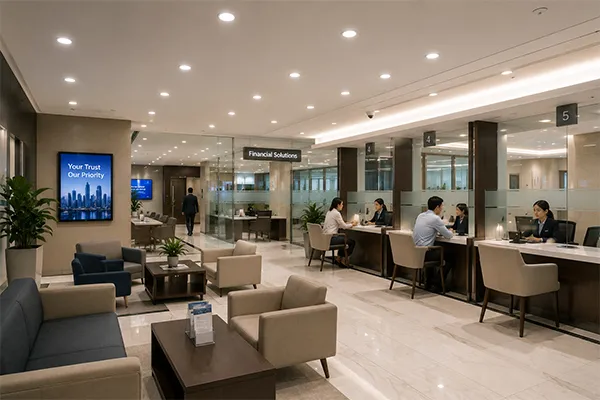
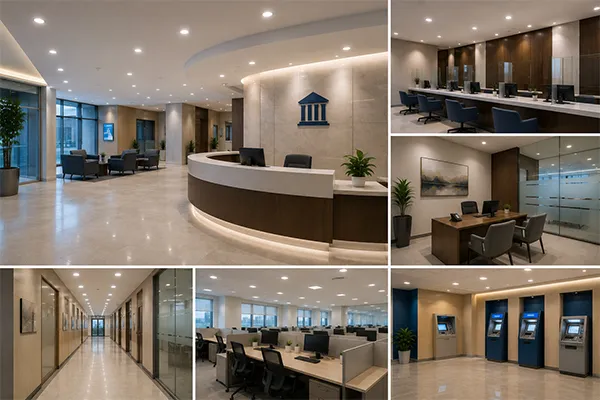
LED downlights for banks and financial buildings need a zone-by-zone plan because lobbies, counters, consultation rooms, corridors, offices, and self-service areas support different visual tasks1. A suitable downlight for a circulation area may not provide comfortable light at a service desk or create the right atmosphere in a private advisory room.
A Bright Lobby Is Not Automatically a Better Lobby
In many anonymous commercial inquiries, the first question I receive is about lumen output: “Can you provide a brighter model?” That request is understandable. A bank lobby needs clear visibility and a polished impression. Still, brightness alone does not define quality.
Excessive brightness can make surfaces look flat. Poorly controlled light can create uncomfortable glare on polished floors, glass partitions, digital screens, and glossy reception counters.2 A narrow beam angle can create obvious pools of light, while an overly wide distribution may reduce visual structure if it is not planned carefully.
A professional financial space often needs a balance between visibility and visual comfort. The final design should be verified through lighting calculations, site conditions, local regulations, and the project lighting designer’s requirements. From a procurement viewpoint, I encourage buyers to ask what each area needs before locking in a fixture specification.
| Financial building zone | Main lighting consideration | Procurement question to ask |
|---|---|---|
| Entrance and lobby | Comfortable general illumination and visual welcome | Is glare control appropriate for ceiling height and surface finishes? |
| Reception and teller counters | Facial visibility, document reading, screen comfort | Does the optical distribution support counter tasks without harsh reflections? |
| Consultation rooms | Calm atmosphere and accurate color appearance | Is the selected CCT and CRI suitable for finishes, documents, and face-to-face meetings? |
| Corridors | Safe navigation and visual continuity | Can output and beam angle avoid dark gaps or excessive brightness? |
| Self-service and ATM areas | Clear orientation and equipment visibility | Is the fitting compatible with the area’s operating hours and maintenance access? |
| Back offices | Desk-based work and screen use | Is dimming or control compatibility required by the lighting plan? |
Avoid the “One Product for Every Ceiling” Approach
A single SKU can simplify purchasing, packaging, and inventory. In some projects, it may be the right choice. Yet buyers should not assume that standardization means identical specifications in every room.
For example, a contractor may use one downlight family across a branch while selecting different wattages, beam angles, drivers, trim colors, or dimming versions. This approach can preserve a consistent visual style while allowing each zone to perform differently.
I often see buyers achieve better results when they standardize the platform, not necessarily every parameter. A common housing design, cutout size, trim finish, and product family can help with appearance and replacement planning. Different outputs or optics can then be selected according to the lighting designer’s schedule.
I have learned from quotation discussions that “same appearance” and “same specification” are not the same requirement. Buyers should define which elements must remain consistent and which elements can vary by zone.
Which LED Downlight Specifications Matter Most in Financial Spaces?
Product data sheets can contain many figures, but not every figure has equal value in every application. Buyers can become frustrated when specifications are reviewed separately from the installation environment. That can lead to a technically acceptable product that performs poorly in the finished space.
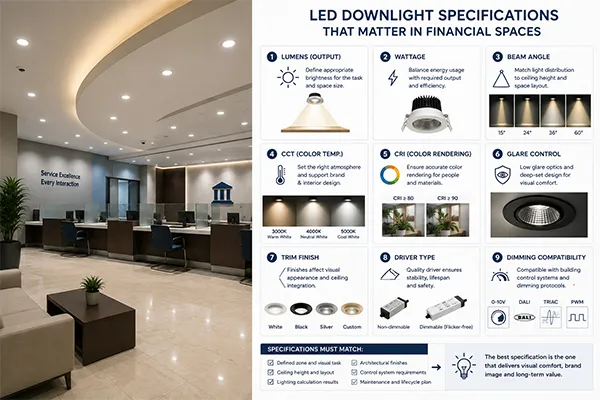
The most important LED downlight specifications for financial spaces are lumens, wattage, beam angle, CCT, CRI, glare-related optical design, trim finish, driver type, and dimming compatibility. Each specification matters only when it is connected to a defined zone, ceiling layout, visual task, and project lighting calculation.
Wattage and Lumens Should Be Read Together
Wattage shows power consumption. Lumens show the light output stated by the supplier.3 Neither figure alone tells a buyer whether a fixture is appropriate for a bank branch or financial office.
A higher-wattage downlight may produce more lumens, but its suitability depends on mounting height, fixture spacing, ceiling reflectance, beam distribution, diffuser design, and desired illuminance. The project lighting designer should calculate target illumination levels and verify the layout according to applicable codes and client requirements.
When I prepare a quotation, I encourage buyers to compare:
- Rated power and actual power tolerance
- Declared lumen output
- Luminous efficacy, expressed as lumens per watt
- Beam angle or photometric distribution
- Input voltage and driver configuration
- Thermal conditions of the intended installation
- Whether lumen data is measured under a stated test method
A lower-priced fixture with a higher claimed lumen figure is not automatically the stronger procurement choice. Buyers should request comparable data and samples where the project risk justifies it.
Beam Angle Affects Comfort and Uniformity
Beam angle is often underestimated in early sourcing conversations. Yet it strongly affects how light appears on the floor, walls, counters, and work surfaces.4
A narrower beam can create stronger accents and more defined light pools. A wider beam can support broader distribution. Neither choice is universally better. The right option depends on ceiling height, spacing, architectural materials, and the visual purpose of the area.
For LED downlights for banks and financial buildings, buyers should ask whether the selected optic supports:
- Uniform spacing between fittings.
- Controlled brightness in the viewer’s field of vision.
- Reduced reflection risk on glass, screens, and polished surfaces.
- Adequate visibility for customer interactions and document handling.
- A consistent ceiling appearance across adjacent rooms.
CCT, CRI, and Trim Finish Influence Perception
Color temperature, commonly stated in Kelvin, affects whether a space appears warmer or cooler.5 Color rendering index, or CRI, indicates how faithfully colors may appear under the light source.6 Trim finish affects the visible ceiling detail and can influence reflections.
I would not prescribe one CCT or CRI value for every financial building. A brand may prefer a particular atmosphere, while local project requirements may specify another range. However, buyers should ensure that color consistency is controlled across the order. A lobby with visibly different white tones between batches can look unprofessional even if each fixture works electrically.
For customer-facing areas, I recommend that buyers request confirmation of:
- Available CCT options and tolerance controls
- CRI version and supporting documentation
- Trim color samples, such as white, black, silver, or custom finishes
- Batch identification and carton labeling
- Whether customized parameters require a separate approved sample
How Can Buyers Reduce Glare and Comfort Complaints with LED Downlights for Banks and Financial Buildings?
Glare complaints can be difficult to solve after a ceiling is complete. A fixture may meet its basic electrical specification while still causing discomfort at reception desks, waiting areas, or workstations. Buyers need to consider the visible light source, ceiling position, and nearby reflective materials early.
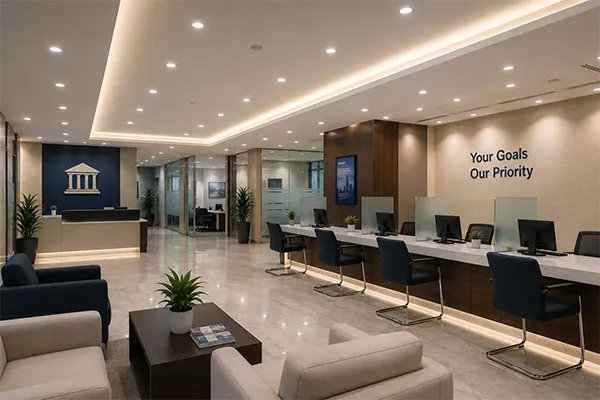
Buyers can reduce glare from LED downlights for banks and financial buildings by reviewing optical design, beam angle, diffuser or reflector construction, ceiling height, spacing, viewing direction, and surface reflectance. The final glare assessment should be completed by the responsible lighting designer using project-specific calculations and applicable standards.
Look Beyond the Lumen Figure
Two fixtures can state similar wattage and lumens but produce very different visual experiences. The difference may come from LED placement, reflector depth, lens design, diffuser material, and the brightness of the visible emitting surface.
A recessed, deep anti-glare design may help reduce direct views of the light source in some applications.7 A wider diffuser may offer a different visual effect. Buyers should not treat labels such as “anti-glare” as complete proof of performance. They should request product drawings, photometric information where available, physical samples, and professional evaluation against the project requirements.
Consider the Human Viewing Angle
Financial spaces often include seated customers, standing staff, digital displays, glass partitions, and computer monitors. These conditions create multiple viewing angles.
For example:
- A seated customer may look upward while waiting near the reception area.
- A teller may experience reflections from overhead light on a monitor.
- A consultant may need comfortable facial lighting during a private meeting.
- A visitor may notice bright reflections on stone, metal, or glass finishes.
These details explain why a ceiling plan cannot be assessed only from above. The responsible designer should consider the user’s eye level and sightlines. From my manufacturing and sourcing perspective, I can provide fixture dimensions, cutout details, available optics, and sample units. I cannot replace an on-site lighting assessment or lighting simulation.
Sample Verification Is a Practical Procurement Step
A sample is not a substitute for full project design, but it can reduce uncertainty.8 Buyers can install or inspect samples under representative conditions before releasing a major purchase order.
A useful sample review may include:
| Review item | Why it matters |
|---|---|
| Physical dimensions and cutout size | Confirms ceiling compatibility |
| Trim appearance | Checks visual match with ceiling and interior finishes |
| CCT consistency | Helps prevent unexpected warm/cool differences |
| Light distribution | Provides an initial impression of beam spread and brightness |
| Driver and connector arrangement | Supports installation planning |
| Dimming behavior, if required | Identifies compatibility issues early |
| Packaging and labeling | Helps with receiving, storage, and traceability |
I have seen projects benefit when the buyer approves a clear reference sample and records the agreed parameters before mass production begins.
What Should Contractors Check When Comparing LED Downlight Suppliers?
A low unit price can be attractive during tendering, but the purchase price is only one part of project cost. In commercial installations, inconsistent batches, late delivery, unavailable replacements, unclear customization, or driver failures can create costs that are much higher than the original saving9.
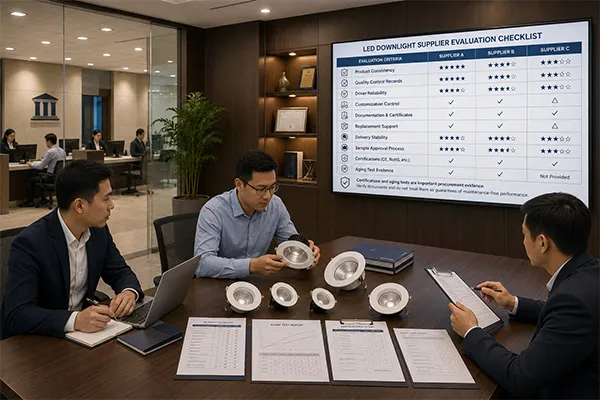
Contractors should compare LED downlight suppliers based on product consistency, quality-control records, driver reliability, customization control, documentation, replacement support, delivery stability, and sample approval processes. Certifications and aging tests are useful procurement evidence, but buyers should verify documents and should not treat them as guarantees of maintenance-free performance.
Review Manufacturing Controls and Documentation
At Upward Lighting, we manufacture LED lighting products in Zhongshan, China, and we support OEM and ODM requirements for commercial buyers. Our available customization can include color temperature, wattage, beam angle, CRI, and surface finish colors, depending on the product platform and order requirements.
Before shipment, we conduct a 100% aging test, typically lasting 4 to 8 hours, as part of our quality-control process. This process can help identify certain early electrical or assembly issues before shipment. Still, I would not describe an aging test as proof that a fixture will never fail in service. Long-term performance also depends on operating conditions, installation quality, voltage stability, thermal environment, control compatibility, and maintenance practices.10
Buyers should request and verify relevant documents for their destination market and project requirement. Our products may be supplied with certifications such as CE and RoHS, but the buyer should confirm that the documents apply to the exact product model, market, and regulatory requirement.
Ask Questions That Reveal Supply Risk
A productive supplier evaluation goes beyond “What is your best price?” I suggest asking questions such as:
- Can the supplier maintain the same LED source, driver specification, and trim finish across future orders?
- What is the process for approving OEM or ODM changes?
- Does the supplier provide a pre-production sample for customized orders?
- How are production batches identified and tracked?
- Can the supplier support small-batch replenishment orders?
- What packaging is used to protect trim finishes and drivers during transit?
- What lead time applies to standard products versus customized products?
- How will the supplier handle a replacement request if the original model changes?
Build a Replacement Strategy Before Installation
Bank branches and financial buildings can have limited tolerance for ceiling work during operating hours. Replacing a failed downlight may involve access restrictions, customer disruption, and coordination with facilities teams. Therefore, replacement planning should begin before the first shipment.
I recommend that buyers retain:
- Approved samples
- Product data sheets and installation instructions
- Final bills of materials
- Driver information
- Batch records where available
- A small quantity of spare fixtures
- Written confirmation of customized parameters
- Photos of labels and carton markings
This documentation makes future sourcing clearer, especially when the original purchasing contact or project manager is no longer involved.
How Should Buyers Manage Customization and Delivery for Bank Lighting Projects?
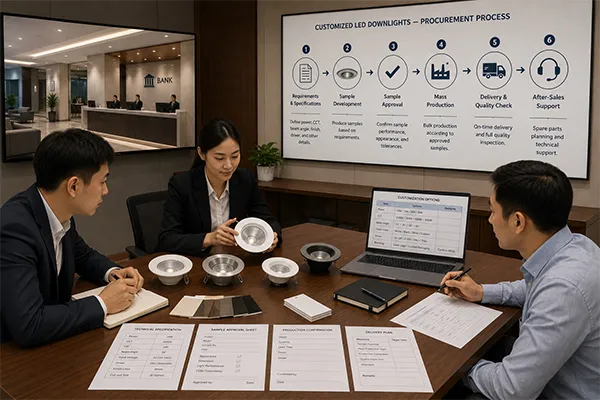
Customization can help a lighting product fit a project, but uncontrolled customization can increase procurement risk. A special trim color, CCT, beam angle, or driver option may be necessary. However, every change should be documented, sampled, and approved before volume production begins.
Buyers should manage customized LED downlights for banks and financial buildings through written specifications, approved samples, clear tolerances, production confirmation, realistic lead times, and spare-part planning. A supplier’s ability to quote quickly is valuable, but buyers should still allow enough time for technical review and sample verification.
Turn a General Request Into a Controlled Specification
Many inquiries start with a short message such as “Need recessed LED downlight for bank project.” I usually need more information before I can provide a meaningful quotation. The buyer does not need to solve every lighting-design issue alone, but the purchasing specification should be detailed enough to avoid assumptions.
A useful request for quotation can include:
- Product type and installation method
- Required cutout size and ceiling depth
- Target wattage range or lighting schedule reference
- CCT and CRI requirement
- Beam angle or optical requirement
- Trim color and finish
- Dimming or control protocol, if applicable
- Input voltage and market destination
- Quantity by SKU
- Required certifications or project documents
- Target delivery date
- Sample approval requirement
- Spare quantity requirement
Separate Standard Items From Project-Specific Items
This distinction can improve both price control and delivery reliability. Standard items may have shorter lead times and simpler replenishment. Project-specific items may require material confirmation, sample production, and more careful production scheduling.
| Item type | Typical procurement advantage | Main control point |
|---|---|---|
| Standard downlight model | Faster quotation and potentially shorter production cycle | Confirm exact version and document revision |
| Standard product with selected CCT | Retains platform consistency while allowing basic choice | Approve CCT sample and labeling |
| Customized beam angle or trim color | Better fit with design intent | Confirm sample, finish reference, and MOQ |
| Customized driver or dimming version | Supports project control requirements | Verify compatibility with the full control system |
| Private-label packaging | Supports brand presentation | Approve artwork, carton details, and packing method |
I have found that a clear approval process prevents the most common issue in customized orders: both parties believe they agreed on the same product, but their written specifications do not match.
Frequently Asked Questions
What is the best wattage for LED downlights in a bank?
There is no universal best wattage for a bank. Wattage should be selected with lumen output, beam angle, ceiling height, spacing, task requirements, and lighting calculations. The responsible lighting designer should verify target illumination levels and local code requirements for each zone.
Should banks use warm white or neutral white LED downlights?
The suitable color temperature depends on the brand environment, interior finishes, task needs, and project lighting design. Buyers should avoid choosing CCT from a catalog image alone. I recommend reviewing samples under representative finishes and documenting the approved CCT for batch consistency.
Are CE and RoHS documents enough when selecting a downlight supplier?
CE and RoHS documents can be important for relevant markets11, but they are not the only supplier-evaluation criteria. Buyers should verify that documents apply to the exact model and destination. They should also review samples, quality procedures, driver details, delivery capability, and replacement support.
Why is beam angle important for bank downlights?
Beam angle affects the spread and appearance of light. It can influence uniformity, reflections, contrast, and visual comfort at counters, waiting areas, offices, and corridors. The right beam angle depends on the ceiling plan and should be evaluated with project-specific lighting calculations.
Should a bank project keep spare LED downlights?
Yes. A reasonable spare quantity can reduce future maintenance disruption, especially when customized CCT, trim colors, drivers, or optical configurations are involved. Buyers should keep approved samples, product records, and final specifications so replacement orders remain consistent.
Conclusion
Selecting LED downlights for banks and financial buildings requires more than comparing wattage, lumens, and unit price. I recommend that buyers assess each functional zone, then connect product parameters to visual comfort, task suitability, ceiling conditions, controls, maintenance access, and replacement planning. Samples, documentation, batch consistency, and verified certifications all support stronger procurement decisions. If you are sourcing commercial LED downlights with OEM or ODM requirements, I invite you to send us your drawings, specifications, quantities, and target market so we can prepare a practical quotation and sample plan.
"Lighting Design: Techniques to Transform Interior Spaces", https://marymount.edu/blog/lighting-design-techniques-to-transform-interior-spaces/. Indoor-workplace lighting guidance evaluates illuminance, glare, and other lighting criteria in relation to the visual task and its surrounding area, supporting zone-specific assessment rather than a uniform specification throughout a building. Evidence role: general_support; source type: institution. Supports: Indoor lighting guidance distinguishes task areas and surrounding areas because visual tasks and user needs affect lighting criteria.. Scope note: General workplace standards do not prescribe a single lighting layout for every bank or financial-building zone. ↩
"Lighting and Reflections - Video Displays, Work, and Vision", https://www.ncbi.nlm.nih.gov/books/NBK216496/. Workplace lighting guidance recognizes that direct glare and reflected images from luminaires or bright surfaces can reduce visual comfort and interfere with display-screen tasks. Evidence role: mechanism; source type: government. Supports: Glare and reflected images can impair visual comfort and display-screen viewing when luminaires or bright surfaces are positioned poorly.. Scope note: The extent of glare in a particular lobby or counter area depends on luminaire placement, viewing direction, surface properties, and daylight conditions. ↩
"Lumen (unit)", https://en.wikipedia.org/wiki/Lumen_(unit). The lumen is the unit of luminous flux, or perceived light output, while the watt is the SI unit of power; consequently, wattage alone does not specify a lamp's light output. Evidence role: definition; source type: government. Supports: A lumen is the SI-derived unit used for luminous flux, whereas a watt is the unit of electrical power.. ↩
"Light Fixture Beam Angles – What are they and Why Should I Care?", https://www.ledlightexpert.com/light-fixture-beam-angle?srsltid=AfmBOoqvO2F9yUd4nF0qFm6QZaLKCRUiQYzc6dHTG4lCtussylkxex3r. Luminaire beam spread is part of its photometric distribution and affects the area over which light is delivered, influencing surface illuminance patterns and spacing requirements. Evidence role: mechanism; source type: education. Supports: Luminaire beam spread and photometric distribution affect where light falls and the resulting illuminance pattern on surfaces.. Scope note: Beam angle alone cannot predict uniformity or comfort because mounting height, spacing, reflectances, and the full intensity distribution also matter. ↩
"A Standard for Lighting Color Preference?", https://www.nist.gov/news-events/news/2017/03/standard-lighting-color-preference. Correlated color temperature (CCT), expressed in kelvins, characterizes the apparent color of white light; lower-CCT sources are generally described as warmer and higher-CCT sources as cooler. Evidence role: definition; source type: government. Supports: Correlated color temperature is measured in kelvins and describes the apparent warm-to-cool character of white light.. Scope note: Perceived warmth also depends on surrounding colors, illuminance, adaptation, and the source's spectral power distribution. ↩
"Color rendering of light sources", https://www.nist.gov/pml/sensor-science/optical-radiation/color-rendering-light-sources. The general color rendering index (CRI) is a standardized metric for comparing how a source renders a set of test colors relative to a reference illuminant, so it provides an indication rather than a complete prediction of color appearance. Evidence role: definition; source type: institution. Supports: CRI is a measure intended to characterize color-rendering properties relative to a reference illuminant.. Scope note: CRI does not fully characterize all color-preference, saturation, or spectrum-specific effects relevant to a finished interior. ↩
"What to measure and report in studies of discomfort from ...", https://www.energy.gov/eere/ssl/articles/what-measure-and-report-studies-discomfort-glare-pedestrian-applications. Lighting research and glare guidance identify the luminance and visibility of emitting surfaces, including luminaire shielding geometry, as factors that influence direct discomfort glare. Evidence role: mechanism; source type: research. Supports: Shielding geometry and the visibility of high-luminance emitting areas influence direct glare from luminaires.. Scope note: A deep-recessed form does not by itself establish glare performance; photometry, observer position, room geometry, and luminance distribution must also be assessed. ↩
"Contractor Quality Control Plans Contractor Guidelines and ...", https://highways.dot.gov/media/44311. Construction quality-assurance practice commonly uses samples and mock-ups to verify materials, finishes, and installation characteristics before full-scale work, supporting their use as an early risk-control measure. Evidence role: general_support; source type: government. Supports: Construction quality-control processes use submittals, samples, and mock-ups to verify specified characteristics before broader installation.. Scope note: A product sample or small mock-up cannot substitute for project-wide photometric calculations, commissioning, or evaluation under every operating condition. ↩
"Take Five: Life Cycle Costs for Acquisition - Department of Energy", https://www.energy.gov/cmei/femp/articles/take-five-life-cycle-costs-acquisition. Life-cycle-cost analysis evaluates alternatives using costs incurred over their service lives, including acquisition, operation, maintenance, and replacement rather than initial purchase price alone. Evidence role: general_support; source type: government. Supports: Life-cycle-cost analysis considers costs beyond acquisition, including operation, maintenance, replacement, and downtime-related factors where applicable.. Scope note: Whether later costs exceed an initial saving depends on the specific failure rate, labor cost, operating schedule, warranty terms, and availability of replacement products. ↩
"Solid-state lighting metrology", https://www.nist.gov/programs-projects/solid-state-lighting-metrology. LED lighting performance and reliability are system-level outcomes influenced by thermal management, driver and electrical conditions, operating environment, and compatibility with associated controls. Evidence role: mechanism; source type: government. Supports: LED-system reliability and lumen maintenance are affected by temperature, electrical drivers, operating conditions, and system-level integration.. Scope note: The relative contribution of each factor varies by luminaire design, installation, duty cycle, and electrical environment. ↩
"CE marking", https://en.wikipedia.org/wiki/CE_marking. European Commission guidance explains that CE marking applies to products covered by relevant EU harmonization legislation, while the RoHS framework restricts specified hazardous substances in applicable electrical and electronic equipment. Evidence role: historical_context; source type: government. Supports: EU rules establish CE-marking obligations for products covered by relevant harmonized legislation and restrict specified hazardous substances in applicable electrical and electronic equipment.. Scope note: Documentation requirements and conformity obligations depend on the exact product, applicable directives or regulations, importer role, and destination market. ↩