LED downlights for beauty salons and spas must do more than make a room look bright. Poor color rendering, glare, uneven beam control, or an unsuitable color temperature can affect how clients perceive skin, makeup, and the overall atmosphere. We recommend selecting a verifiable lighting specification package for each service zone rather than choosing one “best” downlight for the entire venue.
The best LED downlights for beauty salons and spas combine appropriate color temperature, high-quality color rendering, controlled brightness, low glare, and reliable batch consistency for each area’s task. Reception, consultation, treatment, makeup, and relaxation zones may need different priorities. Buyers should compare suppliers using documented specifications, approved samples, dimming compatibility, certifications, and production-quality controls—not CRI or wattage alone.
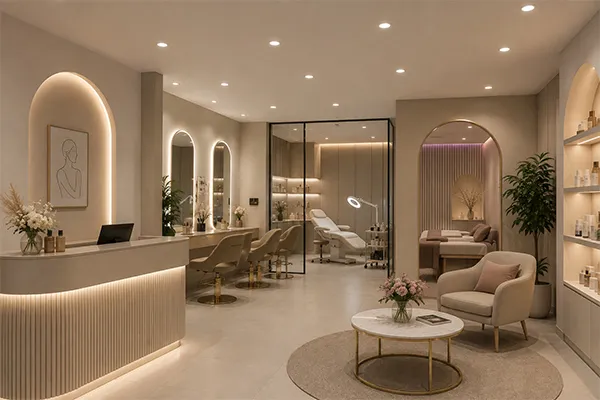
When we discuss quotations with contractors, importers, and local lighting brands, we often hear one request: “Can we use one downlight specification across the whole salon?” That approach may simplify purchasing, but it can create visual compromises. A more practical approach is to define what each space must help clients and staff see, feel, and do.
Why Should LED Downlights for Beauty Salons and Spas Be Chosen by Zone?
A salon or spa has many activities under one roof, yet buyers sometimes select lighting as though every room performs the same function. This can lead to reception areas that feel clinical, treatment rooms that feel dim, or makeup areas where color judgment becomes difficult. We recommend starting with the purpose of each zone.
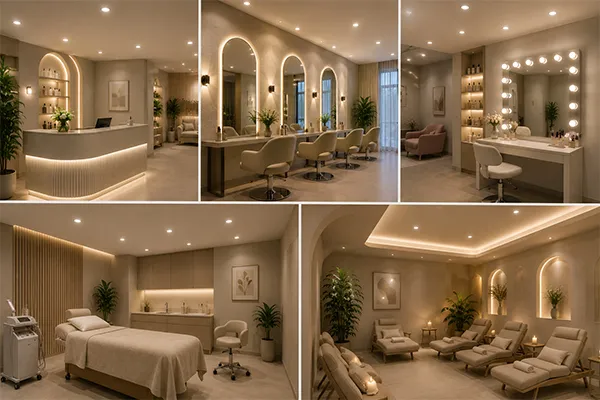
LED downlights for beauty salons and spas should be selected by zone because reception, consultation, makeup, treatment, and relaxation spaces have different visual and emotional requirements1. A zone-based brief helps buyers balance color appearance, visual comfort, beam spread, dimming needs, and practical procurement requirements without treating one specification as a universal solution.
Start With the Service Task
In our experience discussing project requirements, the strongest buyer briefs do not begin with wattage. They begin with a question such as: What should people be able to see and experience in this area?
For example, a receptionist may need clear facial visibility and a welcoming atmosphere. A makeup artist may need more dependable color evaluation around the face. A spa treatment room may prioritize calmness, gentle brightness, and controlled glare. These are different needs, even if the project uses a coordinated interior design style.
| Salon or spa zone | Main lighting purpose | Downlight priorities to evaluate | Common acceptance risk |
|---|---|---|---|
| Reception | Welcome guests and support basic transactions | Comfortable color temperature, moderate brightness, glare control, finish appearance | Space feels harsh or uninviting |
| Consultation area | Discuss treatments and assess appearance | Balanced color quality, facial visibility, low glare | Skin appearance looks inconsistent |
| Makeup station | Support detailed color-sensitive work | High CRI, suitable CCT, beam control, good vertical illumination planning | Makeup shades appear different from expected |
| Treatment room | Support staff while maintaining comfort | Dimming capability, low glare, appropriate output, cleanable design | Clients feel exposed or uncomfortable |
| Relaxation area | Create a calm, restorative setting | Warm or adjustable CCT strategy, low luminance, dimming | Excessive brightness disrupts the atmosphere |
| Corridor or retail display | Support movement and product viewing | Beam angle, uniformity, accent options, energy use | Dark spots, glare, or poor product presentation |
Avoid “One Specification Everywhere” Thinking
A single downlight model can sometimes work across several areas. However, this should be a deliberate product-family decision, not an assumption. Buyers may use the same housing style, trim color, cutout size, and supplier across the venue while varying:
- Color temperature
- Wattage or lumen package
- Beam angle
- Anti-glare structure
- Dimming driver
- Trim finish
- CRI level
- IP rating where the location requires it
This approach can preserve a consistent ceiling appearance while responding to different service tasks.
I have seen many quotation inquiries where the buyer initially asks for “3000K, CRI 90, one wattage.” That is a useful starting point, but it is not yet a complete specification. We usually encourage project teams to separate public areas, beauty-service areas, and relaxation areas before finalizing the product request.
A downlight is not selected only for its datasheet. It is selected for the visual task, the ceiling environment, the control strategy, and the buyer’s ability to receive consistent product batches.
A qualified lighting designer or technical team should still confirm the final luminaire layout, illuminance targets, control design, and on-site visual performance. Product selection supports that process, but it does not replace it.
Does High CRI Guarantee Natural Skin Tones and Makeup Colors?
High CRI is often one of the first requirements in a beauty lighting inquiry. That focus is understandable because color-sensitive services need better color quality than many general commercial spaces. Still, CRI alone cannot guarantee that skin tones, foundation shades, hair color, or treatment results will look natural in every salon environment.
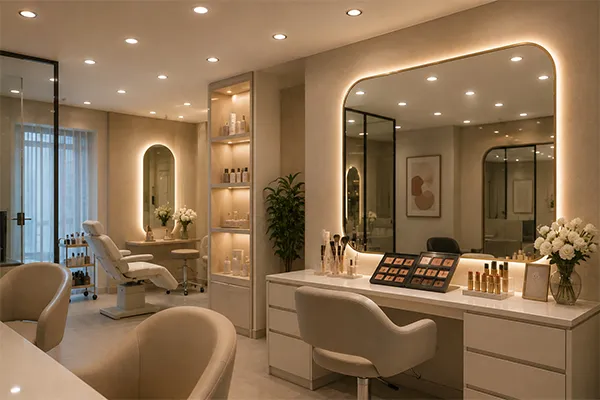
A high CRI downlight can support improved color rendering for beauty work, but it does not guarantee natural-looking skin tones or accurate makeup colors by itself. Buyers should also assess color temperature, spectrum-related data where available, light direction, glare, surrounding finishes, and the full lighting plan through samples and project-specific evaluation.
What CRI Tells Buyers—and What It Does Not
CRI, or Color Rendering Index, is a commonly used measure of how a light source renders colors compared with a reference source.2 For beauty applications, buyers frequently request CRI 90 or above because this is generally a more demanding requirement than standard commercial lighting.
However, CRI is an average metric.3 A product with a high Ra value may still render some colors differently than another high-CRI product. This matters when staff assess subtle skin undertones, lipstick shades, foundation, nail colors, or hair treatments.
A procurement team should treat CRI as one important screening criterion, not the final proof of visual suitability.
Ask for More Meaningful Color Information
When beauty lighting quality is important, buyers can ask suppliers for available documentation beyond a simple “CRI >90” statement. Depending on the product and market, useful information may include:
- Ra / general CRI value
- R9 value, which is often reviewed because it relates to saturated red rendering
- Color temperature and tolerance
- Photometric files, such as IES or LDT files when available
- Sample units from the intended production configuration
- Driver and dimming information
- Bin consistency or color-consistency approach, where documented by the supplier
These documents do not remove the need for a physical review. They simply help buyers compare quotations on more than marketing language.
Color Temperature Changes the Perception of a Space
Color temperature has a major influence on mood and perceived color.4 A warmer option, such as 2700K or 3000K, may support a softer, more relaxed feeling. A neutral range, such as 3500K or 4000K, may be preferred in some consultation, retail, or detail-oriented work areas. The appropriate choice depends on the service concept, interior finishes, target client experience, and design intent.
For example, beige walls, warm timber, gold trims, white cabinetry, mirrors, and dark ceiling finishes can all change how the lighting feels. A color temperature that looks comfortable in a sample board may feel very different after installation.
We recommend that buyers avoid assuming that one CCT is always “best” for skin. Instead, they should review samples with the actual or representative finishes, mirrors, furnishings, and service conditions. The project’s lighting professional should verify the final decision where color-critical work is involved.
How Do Brightness, Beam Angle, and Glare Affect Spa Comfort?
More lumen output does not automatically create better salon lighting. In fact, excessive brightness or poorly controlled light can create reflected glare in mirrors, discomfort for reclining clients, and visual fatigue for staff. The goal is not maximum output; the goal is useful, comfortable illumination where people need it.
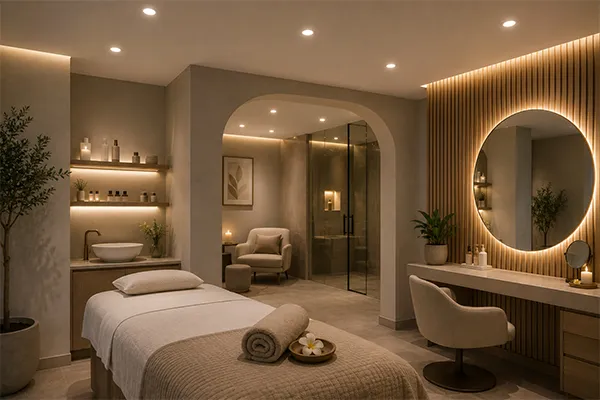
Brightness, beam angle, and glare control affect whether salon and spa downlights provide useful light without creating discomfort. Buyers should evaluate lumen output in relation to ceiling height, layout, finishes, task needs, and dimming strategy. Narrow beams, wide beams, and anti-glare designs should be chosen for the intended zone rather than by wattage alone.
Why Wattage Is Not a Complete Buying Metric
Wattage describes power consumption.5 It does not fully describe delivered light, beam control, visual comfort, or performance in a finished room. Two downlights with the same wattage can differ in:
- Lumen output
- Optical efficiency
- Beam angle
- Recess depth
- UGR-related glare performance6, where tested
- Driver quality
- Dimming behavior
- Color consistency
- Thermal management
- Installation method
For procurement teams, lumen output is usually more useful than wattage as a comparison point. Even then, lumen output must be viewed with the beam angle and layout. A narrow-beam downlight can create a concentrated pool of light, while a wide-beam model spreads light over a larger area.
Select Beam Control for the Visual Task
Beam angle influences how light reaches the working plane, face, wall, floor, or treatment bed.7 A very broad beam can support general ambient illumination. A narrower beam may be used for accents or controlled emphasis. Neither option is automatically better.
| Downlight characteristic | Potential benefit | Potential risk if poorly matched |
|---|---|---|
| Wide beam angle | Broader coverage and softer ambient effect | Insufficient emphasis or spill onto reflective surfaces |
| Narrow beam angle | More focused distribution and visual emphasis | Bright pools, harsh contrast, and visible glare |
| Deep recessed anti-glare design | Can reduce direct view of the light source | May reduce perceived brightness if layout is not adjusted |
| Higher lumen package | Supports demanding task areas | Can feel uncomfortable or create mirror reflections |
| Dimmable driver | Allows adaptation between service conditions | Compatibility issues if control systems are not verified |
Glare Is Both a Comfort and Acceptance Issue
Spa clients may spend time lying down, looking upward, or facing mirrors. In these situations, direct view of a bright LED source can be distracting8. Staff may also experience glare when working around reflective countertops, product packaging, glossy tiles, mirrors, or metallic finishes.
For this reason, buyers should consider downlights with appropriate optical control, recessed light-source positioning, honeycomb accessories where suitable, or anti-glare structures. The correct choice depends on the ceiling design and viewing angles.
I always suggest that buyers ask for product photos showing the illuminated aperture and recessed depth, not only a front-facing catalogue image. A trim can look elegant when switched off but behave differently when energized.
Final installation decisions should be validated through lighting calculations, mock-ups, or on-site review by qualified professionals. This is especially important where treatment beds, mirrors, glossy surfaces, or sensitive client comfort requirements are involved.
What Should Buyers Include in a Downlight Supplier Brief?
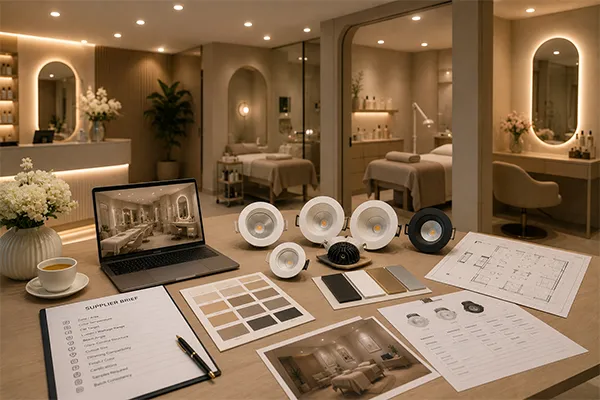
A clear supplier brief helps contractors, distributors, and local lighting brands compare like-for-like quotations. Without it, one supplier may quote a shallow standard downlight while another quotes a deep anti-glare model with a different driver, lumen package, and color tolerance. The prices may look comparable, but the products may not be equivalent.
A beauty salon downlight supplier brief should define the required zone, color temperature, CRI target, lumen or wattage range, beam angle, glare-control structure, cutout size, dimming compatibility, finish, certifications, samples, and batch-consistency expectations. Each requirement should connect to a service task, installation condition, or project acceptance risk.
Build a Comparable Procurement Specification
We recommend that buyers prepare a schedule that separates essential requirements from preferred options. This helps suppliers provide accurate quotations and reduces ambiguity during sample approval.
| Brief item | Why it matters for a beauty project | What buyers should clarify |
|---|---|---|
| Application zone | Links product selection to actual task | Reception, makeup, treatment, retail, corridor, or relaxation |
| Color temperature | Influences ambience and color perception | Fixed CCT, selectable CCT, or project-specific range |
| CRI target | Supports color-sensitive evaluation | Minimum Ra and whether R9 data is requested |
| Lumen or wattage range | Helps match output to the space | Ceiling height, desired brightness, and design basis |
| Beam angle | Shapes light distribution | General ambient, focused task, wall emphasis, or display |
| Glare-control design | Supports visual comfort | Deep recess, baffle, honeycomb, or other optical option |
| Cutout and dimensions | Prevents installation problems | Existing ceiling cutout, trim size, ceiling depth |
| Dimming compatibility | Supports scene adjustment | TRIAC, 0–10V, DALI, or another verified control method |
| Finish color | Maintains interior coordination | White, black, gold, custom RAL, or other finish |
| Certifications | Supports market-entry review | Required documents for the intended destination market |
| Sample approval | Reduces specification ambiguity | Sample quantity, evaluation criteria, approval record |
| Batch consistency | Supports repeat orders and maintenance | CCT, finish, driver, labeling, and packaging consistency |
Verify Supplier Claims With Documents and Samples
At Upward Lighting, we work with OEM and ODM requirements that can include color temperature, wattage, beam angle, CRI, and surface-finish customization. However, customization should always be captured in a written specification and approved sample process. A verbal request such as “warm white, anti-glare, high CRI” leaves too much room for interpretation.
Buyers should request and review:
- Product datasheets with model number, electrical data, dimensions, cutout, and optical information.
- Certification documents relevant to the destination market, such as CE and RoHS where applicable9. Buyers should verify document validity, scope, and market applicability independently.
- Sample units that match the requested production configuration.
- Dimming compatibility information for the selected driver and control system.
- Photometric documentation where it is needed for the project design process.
- Approved finish samples, especially for black, gold, metallic, or custom-color trims.
- Packaging, labeling, and batch-identification requirements for distribution projects.
Consider Supply Reliability Separately From Lighting Design
Product reliability supports delivery and maintenance planning, but it does not prove that a downlight will create the ideal beauty-lighting effect. These are separate evaluation areas.
Our products undergo a 100% aging test before shipment, typically lasting 4 to 8 hours. This type of production control can help buyers assess manufacturing process discipline and reduce certain shipment-related risks. Still, the buyer should define the required acceptance criteria, review samples, and confirm that the selected configuration matches the project specification.
For repeat projects, stable production also matters. Contractors and distributors may need consistent cutout dimensions, trim appearance, CCT, driver behavior, and packaging. A supplier that can support small-batch orders and customization may be useful for phased projects, but buyers should still agree on lead time, sample approval, change-control procedures, and replacement-stock planning.
Can One LED Downlight Range Support Both Salon and Spa Areas?
Many buyers want a streamlined product range because fewer SKUs can simplify purchasing, stock management, and installation. That is a reasonable commercial goal. The challenge is to simplify the range without forcing every zone into the same optical and color specification.
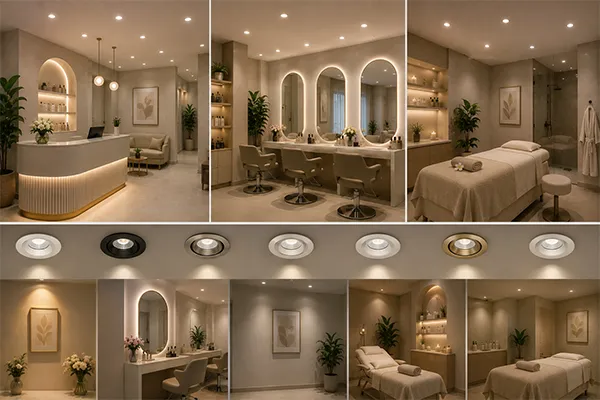
One LED downlight range can support both salon and spa areas when it offers coordinated options for color temperature, lumen output, beam angle, glare control, dimming, and trim finish. Buyers should standardize the platform where possible while allowing selected variants for zones with different visual tasks and comfort requirements.
Standardize the Platform, Not Every Performance Detail
A product family can provide visual consistency across a venue. For example, the project may standardize on a similar trim shape, cutout size, housing finish, and driver architecture. Then the buyer can specify different outputs or optics according to the area.
This can provide several procurement advantages:
- Fewer installation variables for contractors
- More consistent ceiling appearance
- Easier spare-parts planning
- More efficient supplier communication
- Better opportunities for consolidated ordering
- A clearer path for OEM branding or packaging requirements
However, standardization must not eliminate the choices that protect user comfort. A relaxing spa zone may require a different output or dimming approach than a makeup station. A retail shelf may require different beam control than a corridor.
Use a Sample Matrix Before Confirming a Range
For commercial beauty projects, a sample matrix can be more useful than approving one single product sample. Buyers may request a small set of configurations, such as:
- One warm-CCT, low-glare option for relaxation-focused areas
- One neutral-CCT, high-CRI option for consultation or beauty-service areas
- One higher-output option for selected task-related spaces
- One coordinated trim finish for public-facing ceilings
- One dimmable driver option tested with the intended control method
This does not mean every project needs multiple downlight models. It means the buyer should verify whether a proposed standard range genuinely covers the project’s needs.
From a manufacturing perspective, we can translate these requirements into configurable parameters before mass production. Still, final approval should be based on a documented sample review and project-specific technical validation. A lighting designer or qualified project team should confirm layout, control scenes, and visual performance after installation.
Frequently Asked Questions
What CRI should LED downlights have for beauty salons?
Many beauty projects consider CRI 90 or above for color-sensitive areas such as makeup and consultation spaces. However, CRI alone does not guarantee natural skin-tone appearance. Buyers should also evaluate color temperature, available R9 data, light direction, glare control, finishes, and approved samples.
Is 3000K or 4000K better for a beauty salon?
Neither color temperature is universally better. A 3000K option may support a warmer and more relaxing atmosphere, while 4000K may suit some detailed task or consultation environments. The right choice depends on the zone, interior finishes, service concept, and lighting designer’s project-specific evaluation.
Are anti-glare downlights important in spa treatment rooms?
Anti-glare downlights can be important in treatment rooms because clients may recline and look toward the ceiling. Recessed light sources, controlled optics, and dimming options may improve comfort. Buyers should review samples and have the final layout assessed by a qualified lighting professional.
Can I use the same downlight cutout size throughout a salon and spa?
Yes, a common cutout size can simplify installation and maintenance. However, buyers can still use different lumen packages, beam angles, CCTs, or glare-control options within the same product family. This approach may balance ceiling consistency with zone-specific lighting needs.
What should I verify before ordering salon downlights in bulk?
Buyers should verify the approved sample, model number, dimensions, cutout, color temperature, CRI target, beam angle, driver and dimming compatibility, finish, certifications, packaging, lead time, and batch-consistency requirements. Certification documents should be reviewed for validity and suitability for the target market.10
Conclusion
The right LED downlights for beauty salons and spas are not defined by the highest CRI, brightest output, or one color temperature throughout the venue. Buyers should match each downlight specification to the zone’s service task, client comfort expectations, and installation conditions. A clear supplier brief, documented samples, verified certifications, and stable production controls can reduce procurement risk. At Upward Lighting, we help contractors, brands, importers, and distributors configure OEM/ODM downlight options for commercial beauty projects—contact us to discuss your required specifications and sample plan.
"Accentuate the Positive - Illuminating Engineering Society %", https://ies.org/lda/accentuate-the-positive/. Lighting-design guidance treats the visual task, occupants, room use, and desired visual environment as relevant inputs to interior-lighting design rather than prescribing one luminaire specification for all spaces. Evidence role: general_support; source type: research. Supports: Lighting guidance that relates lighting quantity, distribution, color appearance, and visual comfort to the activity and occupants in a space.. Scope note: This supports the general zone-based design principle, not a specific lighting schedule for every salon or spa. ↩
"Color rendering index", https://en.wikipedia.org/wiki/Color_rendering_index. The International Commission on Illumination defines the general colour rendering index as a measure based on the colour appearance of specified test samples under a test illuminant relative to an appropriate reference illuminant. Evidence role: definition; source type: institution. Supports: The definition of the general colour rendering index and its comparison of a test source with a reference illuminant.. ↩
"Color rendering index", https://en.wikipedia.org/wiki/Color_rendering_index. Colour-rendering research explains that the general CRI (Ra) is an average score across designated test-color samples, so sources with similar Ra values can differ in their rendering of individual colors. Evidence role: mechanism; source type: paper. Supports: That general CRI is calculated from multiple color samples and can obscure differences in the rendering of particular hues.. Scope note: The statement does not establish that any particular high-CRI downlight will render a given cosmetic shade inaccurately. ↩
"Effect of warm/cool white lights on visual perception and mood ...", https://pmc.ncbi.nlm.nih.gov/articles/PMC8481791/. Studies of indoor lighting report that correlated color temperature can alter perceived color appearance and subjective appraisals of an illuminated environment. Evidence role: general_support; source type: paper. Supports: Research on how correlated color temperature affects perceived brightness, color appearance, and subjective evaluations of indoor environments.. Scope note: Mood and preference effects vary with illuminance, room finishes, culture, task, and individual response; they do not make one color temperature universally appropriate. ↩
"Purchasing Energy-Efficient Light Bulbs", https://www.energy.gov/cmei/femp/purchasing-energy-efficient-light-bulbs. U.S. energy-efficiency guidance distinguishes watts, which measure electrical power use, from lumens, which measure a lamp’s visible light output. Evidence role: definition; source type: government. Supports: That watts measure electrical power, whereas lumens measure the quantity of visible light emitted.. Scope note: Lumen output alone still does not predict illuminance, glare, or visual comfort in a completed room. ↩
"Perception of discomfort glare in relation to the CIE Unified ...", https://www.sciencedirect.com/science/article/pii/S2950362026000019. The CIE Unified Glare Rating is an index used to estimate discomfort glare for an observer in a specified indoor lighting installation. Evidence role: definition; source type: institution. Supports: The purpose and calculation context of the Unified Glare Rating in indoor lighting.. Scope note: UGR is installation-dependent; a catalogue value may be based on stated room assumptions and is not a universal property of a luminaire. ↩
"[PDF] Digital Light Source Technology for Adaptive Lighting Systems", https://www.energy.gov/sites/default/files/2022-02/ssl-rd22_soer_advances-led.pdf. Lighting-engineering guidance explains that a luminaire’s intensity distribution and beam angle determine how its emitted light is distributed across surfaces and task areas. Evidence role: mechanism; source type: education. Supports: That a luminaire’s photometric distribution and beam angle influence the spatial distribution of illuminance.. Scope note: Actual light levels also depend on mounting height, spacing, aiming, surface reflectance, and contributions from other luminaires. ↩
"What to measure and report in studies of discomfort from ...", https://www.energy.gov/eere/ssl/articles/what-measure-and-report-studies-discomfort-glare-pedestrian-applications. CIE glare guidance identifies discomfort glare as a sensation of visual discomfort associated with luminaires or other bright areas within the observer’s field of view. Evidence role: mechanism; source type: institution. Supports: The association between bright sources in the field of view and discomfort glare.. Scope note: Whether a particular installed downlight is unacceptable depends on its luminance, position, viewing direction, adaptation level, and the complete lighting installation. ↩
"CE marking – obtaining the certificate, EU requirements - Your Europe", https://europa.eu/youreurope/business/product-rules-compliance/general-product-compliance/ce-marking/index_en.htm. European Commission guidance explains that CE marking indicates conformity with applicable EU harmonisation legislation, while the RoHS Directive restricts specified hazardous substances in electrical and electronic equipment within its scope. Evidence role: historical_context; source type: government. Supports: The EU regulatory functions of CE marking and the Restriction of Hazardous Substances Directive.. Scope note: Applicability depends on the product, destination market, and relevant legislation; these requirements are not interchangeable certifications and do not by themselves establish product quality. ↩
"CE marking – obtaining the certificate, EU requirements - Your Europe", https://europa.eu/youreurope/business/product-rules-compliance/general-product-compliance/ce-marking/index_en.htm. Official product-compliance guidance requires economic operators to identify the legislation applicable to a product and to prepare, retain, or verify the corresponding technical and conformity documentation before placing it on the relevant market. Evidence role: general_support; source type: government. Supports: That manufacturers and importers must identify applicable product legislation and maintain appropriate conformity documentation for the market concerned.. Scope note: The precise documentation, responsible party, and enforcement regime vary by jurisdiction and product category. ↩