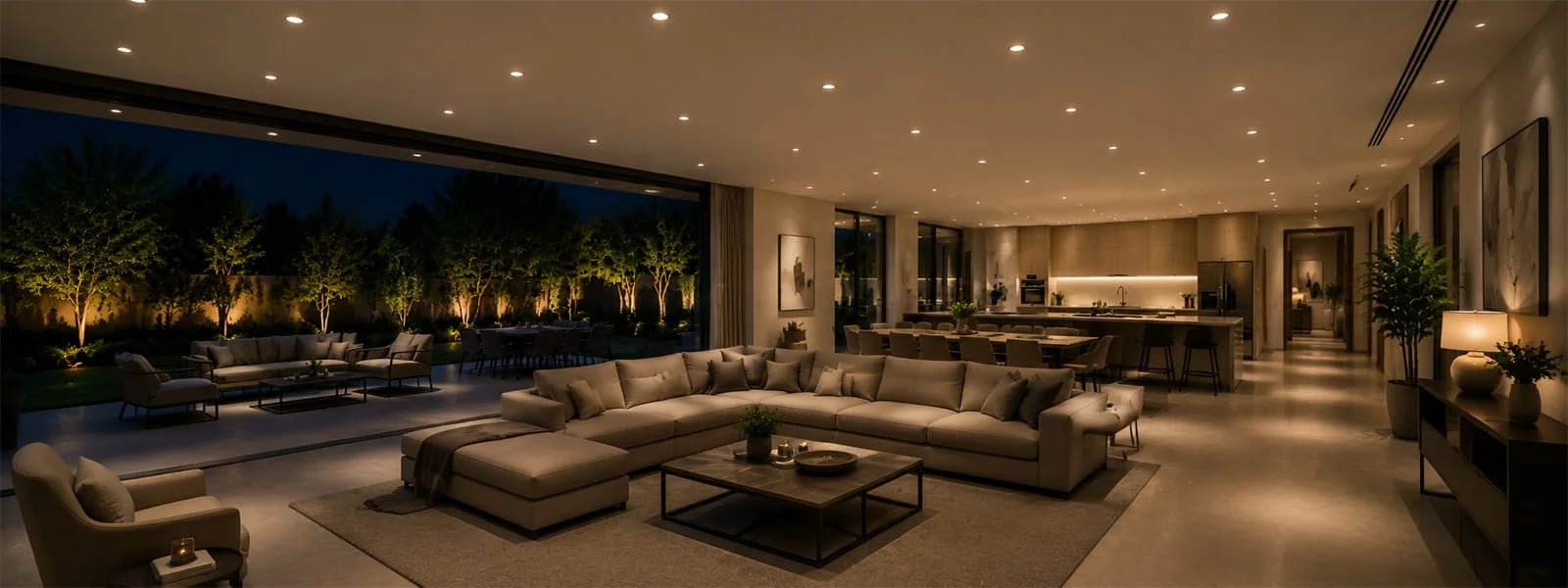
LED downlights for energy saving projects can look simple to specify, yet selecting by wattage or unit price alone often creates problems later. A fixture that uses less power but leaves a workspace under-lit, causes glare, or does not fit the ceiling can turn a planned upgrade into costly rework. We recommend starting with the lighting task, site constraints, and operating conditions.
LED downlights for energy saving projects should be selected by matching usable light output, beam control, visual comfort, installation compatibility, and operating hours to the actual space. Lower wattage can reduce consumption, but it only delivers practical value when the downlight still meets the project’s lighting needs and can be installed reliably without major modification.
In our project selection and quotation discussions, customers often ask us which wattage will save the most energy. That is a reasonable starting point, but it is not the final question. The better question is: what is the lowest practical energy use that still provides appropriate illumination, comfort, and installation reliability?
Why Should LED Downlights for Energy Saving Projects Start With the Lighting Task?
A project can reduce fixture wattage on paper and still fail in practice. If staff cannot see clearly, merchandise looks dull, or corridors feel unsafe, the project team may need to add fixtures or replace them again. That risk can quickly reduce the value of an energy-saving upgrade.
For LED downlights for energy saving projects, the lighting task should determine the specification. Buyers should first identify what people do in the space, how much light is needed, how high the ceiling is, and whether visual comfort matters. Wattage should be evaluated after these requirements are clear.
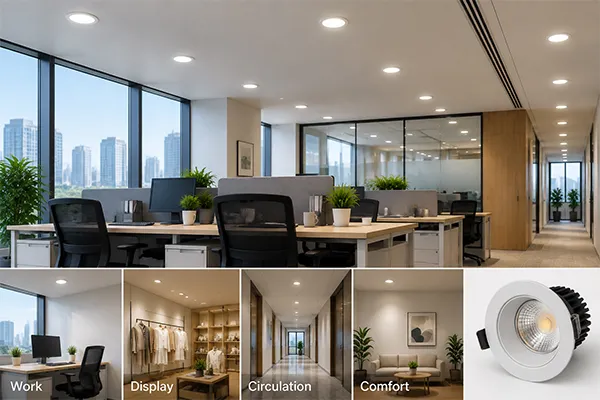
Start With the Purpose of Each Area
Different rooms need different lighting outcomes. A low-wattage recessed downlight may be suitable for a hotel corridor, but the same product may not provide enough useful illumination for a reception desk, retail display, classroom, or medical waiting area.
We encourage buyers to classify the application before requesting a quotation. Useful categories include:
- General circulation areas: corridors, lobbies, stair landings, and entrances
- Work areas: offices, meeting rooms, counters, classrooms, and service desks
- Retail areas: shelves, displays, fitting rooms, and cashier points
- Hospitality spaces: hotel rooms, restaurants, lounges, and public zones
- Residential common areas: apartment corridors, clubhouses, and elevators
- Wet or demanding environments: bathrooms, covered exterior areas, kitchens, and utility spaces
The task affects more than the target light level. It also affects preferred color temperature, color rendering, beam angle, glare control, dimming needs, and fixture finish.
For example, a narrow beam may create useful emphasis on a retail feature wall, but it can create bright spots and dark gaps when used for general lighting in an office. A wide beam can support more even coverage, but it may require careful spacing to avoid excess overlap and wasted light.
In our quotation conversations, we often find that a customer’s “wattage requirement” is actually a shorthand for a different concern: insufficient brightness, high electricity use, glare complaints, or an old fixture that no longer fits the project image.
Evaluate Useful Light, Not Only Rated Power
Wattage measures electrical input.1 It does not independently tell a buyer how much light reaches the intended surface. Lumen output indicates the amount of light produced, while luminous efficacy compares lumen output with power consumption in lumens per watt.2
Both values matter, but neither should be read in isolation.
A high-efficacy LED downlight can be attractive, but the project still needs to consider:
- Where the light goes through the beam angle and optical design.
- How much light reaches the task area from the mounting height.
- How evenly fixtures cover the room based on spacing and layout.
- Whether occupants find the lighting comfortable during normal use.
- Whether the specified output is appropriate after installation, not merely in a catalogue comparison.
Lighting calculations and final acceptance should be carried out by qualified project professionals where required. As a manufacturer, we can help buyers compare product parameters and available configurations, but we do not replace on-site electrical assessment or lighting design.
How Do Lumen Output, Beam Angle, and Glare Affect Energy Performance?
Many buyers compare LED downlights using a simple table of wattage and lumens. This can help during early supplier screening, but it does not show whether the fixture will perform well in a real ceiling layout. Beam distribution and glare control influence whether light becomes useful or wasteful.3
Lumen output, beam angle, mounting height, and glare control determine how effectively an LED downlight serves a space. A project can use an efficient fixture and still waste energy if its beam is poorly matched to the room, produces uncomfortable glare, or requires extra fittings to correct uneven lighting.
Beam Angle Changes the Result on Site
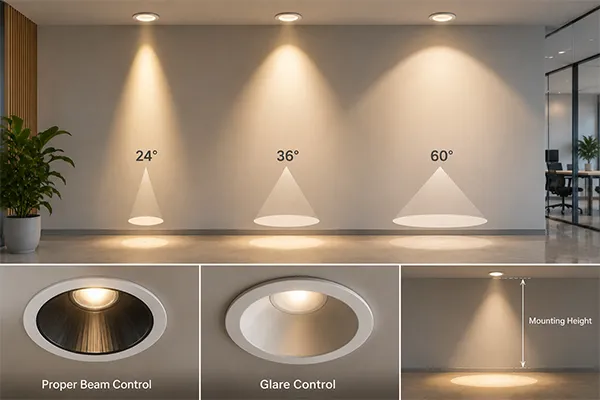
Beam angle describes how broadly a downlight distributes light.4 It is one of the most important parameters to discuss when a project wants to replace existing recessed fixtures.
A narrower beam concentrates light into a smaller area. A wider beam spreads light over a broader area. Neither option is automatically better.
| Project condition | Potential beam direction | Buyer question |
|---|---|---|
| High ceiling or focused display | Narrow to medium beam | Does the fixture deliver useful light at the target surface? |
| Standard office or corridor | Medium to wide beam | Will the spacing provide even coverage? |
| Hospitality lounge or feature zone | Medium beam with controlled optics | Can the lighting create atmosphere without harsh brightness? |
| Low ceiling residential area | Wide beam, subject to layout | Will the beam create glare or excessive overlap? |
| Retail shelving or vertical emphasis | Directional or selected beam angle | Does the product illuminate merchandise rather than only the floor? |
A 60-degree beam and a 90-degree beam with similar lumen output can produce very different visual outcomes.5 Therefore, the buyer should avoid assuming that two products are interchangeable solely because they have the same wattage, cutout size, or nominal lumen figure.
Glare Can Undermine a “Successful” Upgrade
Glare is often treated as an afterthought, especially when project teams are under pressure to reduce energy use. However, glare complaints can trigger replacement costs, additional diffusers, altered layouts, or operational dissatisfaction.
Glare may be more likely when:
- The fixture has a bright visible light source.
- The ceiling is low relative to the output level.
- The beam is too narrow for the mounting location.
- The fixture is installed near computer screens or reflective surfaces.
- The space requires occupants to look upward frequently.
- The optical design does not provide enough shielding or visual comfort.
For offices, schools, retail environments, and hospitality interiors, buyers may need to evaluate recessed depth, reflector design, diffuser style, and anti-glare construction. A deeper recessed light source can sometimes improve visual comfort6, although the final effect depends on the specific product and site.
We recommend that contractors request samples or review product data before committing to a large quantity. A sample review does not replace formal lighting design or site acceptance, but it can reveal obvious concerns about appearance, beam behavior, trim quality, and perceived brightness.
What Retrofit Checks Are Essential Before Ordering LED Downlights for Energy Saving Projects?
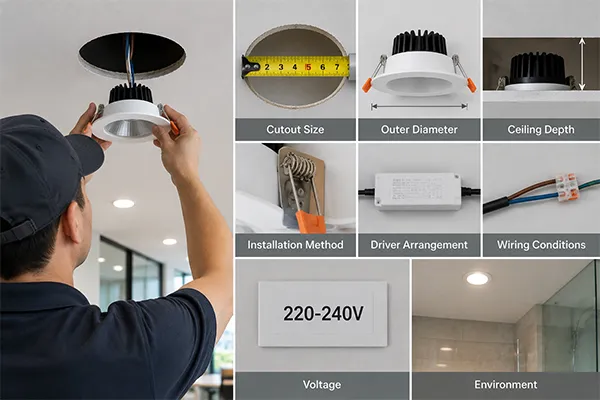
A downlight can have suitable optical performance and still be unsuitable for a retrofit. Existing ceiling cutouts, recess depth, driver placement, wiring conditions, and mounting systems often determine whether an installation can proceed efficiently.7 Ignoring these details can lead to delayed delivery, ceiling damage, or labor-intensive modifications.
Before ordering LED downlights for energy saving projects, buyers should verify cutout dimensions, outer diameter, ceiling depth, installation method, driver arrangement, voltage, wiring conditions, and environmental requirements. Physical and electrical compatibility should be confirmed before price comparisons become the main decision factor.
Confirm Physical Compatibility First
The following measurements are especially important in recessed downlight replacement projects:
| Item to verify | Why it matters | Common risk if missed |
|---|---|---|
| Ceiling cutout size | Determines whether the fixture fits the existing opening | Fixture is too small, too large, or needs ceiling modification |
| Outer trim diameter | Covers the cutout and affects ceiling appearance | Old marks, stains, or oversized holes remain visible |
| Ceiling recess depth | Confirms room for heat management and driver placement | Fixture or driver cannot fit above ceiling |
| Ceiling material | Affects spring clips and installation method | Weak holding force or ceiling damage |
| Fixture height | Helps assess clearance above the ceiling | Clash with ducts, insulation, or structure |
| Driver dimensions | Determines whether remote driver placement is possible | No accessible space for installation or maintenance |
In practical retrofit work, a product’s trim diameter can be almost as important as the cutout. An existing ceiling may have discoloration or repair marks around the old fixture. A new LED downlight with a larger trim may cover those marks, while a smaller trim may create extra finishing work.
Check Electrical and Environmental Conditions
The electrical review should cover input voltage, driver type, dimming requirements, wiring access, and site conditions. The buyer should also identify whether the downlights will operate for long daily hours or in areas with heat, moisture, dust, or limited ventilation.8
Key questions include:
- Is the project using the same mains voltage as the proposed product?
- Does the existing system require dimming compatibility?
- Is the driver integrated or external?
- Can the driver be accessed for future maintenance?
- Does the ceiling void have enough ventilation?
- Does the application need a particular ingress protection rating?9
- Are emergency lighting, control systems, sensors, or smart controls involved?
- Are there local compliance documents that the project team must review?
At Upward Lighting, we can customize parameters such as wattage, color temperature, beam angle, CRI, and surface finish for suitable OEM/ODM projects. However, buyers should provide the installation details early. Customization cannot solve a missing ceiling void, incompatible wiring arrangement, or unverified local project requirement after production has started.
Our products may hold documents such as CE and RoHS for relevant market requirements, but buyers should always verify the applicable certification documents, product scope, and local regulatory obligations for their project.
What Should Contractors Include in an LED Downlight Quotation Request?
An incomplete request can produce a fast quotation but an unreliable product recommendation. If a supplier only receives “10W downlight, 3,000 pieces,” the supplier has limited information to assess fit. Better project information supports more accurate product comparison and fewer changes after samples arrive.
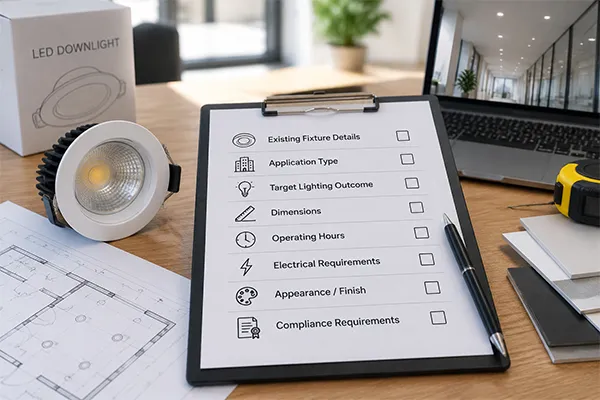
A useful LED downlight quotation request should include existing fixture details, application type, target lighting outcome, dimensions, operating hours, electrical requirements, and appearance or compliance needs. This information helps suppliers suggest options that are practical for the project rather than simply low in wattage or price.
A Practical Pre-Quotation Checklist
We suggest that contractors and purchasing teams prepare the following information before contacting LED downlight suppliers:
-
Photos of the existing fixture
Include front, side, ceiling opening, driver, label, and installation condition where possible. -
Existing product specifications
Record wattage, cutout size, outer diameter, height, input voltage, color temperature, and quantity. -
Target application
State whether the project is for an office, hotel, retail store, corridor, residence, school, or another space. -
Current lighting issue
Describe whether the project is addressing high energy consumption, insufficient light, glare, poor appearance, frequent failures, or a combination of concerns. -
Mounting and ceiling details
Provide cutout dimensions, ceiling thickness, available recess depth, and ceiling material. -
Operating schedule
Estimate daily and weekly operating hours. This helps project teams assess the importance of driver quality, thermal conditions, controls, and maintenance access. -
Lighting preferences
Include preferred color temperature, CRI, beam angle, trim color, anti-glare preference, and dimming requirements. -
Compliance and project requirements
Identify requested documents, destination market, labeling needs, packaging needs, and any project-specific standards that must be reviewed. -
Commercial requirements
Share target quantity, sampling needs, delivery schedule, destination port, and whether small-batch ordering or ongoing supply is required.
Compare Total Procurement Risk, Not Just Unit Price
A lower unit price can be meaningful, but it should be considered alongside the potential cost of incorrect specification. For energy-saving upgrades, the total procurement decision may include:
- Product consistency across batches
- Aging and quality-control processes
- Driver and component specifications
- Lead time and quotation responsiveness
- Sample availability
- Customization capability
- Packaging protection
- Documentation support
- Replacement and maintenance considerations
At Upward Lighting, we conduct a 100% aging test for products before shipment, typically lasting 4 to 8 hours according to the product process. Buyers should still define their own inspection criteria, sampling requirements, and project acceptance procedures. A manufacturer’s internal quality process is helpful, but it does not remove the buyer’s need to verify the product against the agreed specification.
Frequently Asked Questions
Are lower-wattage LED downlights always better for energy-saving projects?
No. Lower wattage reduces electrical input, but it may not meet the required lighting task. If a lower-wattage downlight causes dark areas, glare from added fixtures, or later replacement work, the project may lose value.10 Buyers should compare usable light, beam distribution, comfort, and installation suitability.
How do I choose the right lumen output for a retrofit downlight?
Buyers should consider the room use, mounting height, fixture spacing, surface reflectance, current lighting issue, and required lighting level. A qualified lighting professional can assess application-specific requirements. Suppliers can help compare available lumen packages, but catalogue output alone does not confirm site performance.
Why does beam angle matter in LED downlight replacement projects?
Beam angle determines how concentrated or widely distributed the light will be. A beam that is too narrow can create bright spots and dark gaps. A beam that is too wide may reduce useful brightness at the task area or create overlap. The correct choice depends on ceiling height and layout.
What dimensions should I send to an LED downlight supplier?
You should send the ceiling cutout diameter, fixture outer diameter, recessed height, available ceiling depth, ceiling thickness, and driver space where applicable. Photos with a measuring tape are useful. These details help the supplier assess whether the proposed downlight can fit the existing installation.
Can a supplier calculate my exact energy savings and payback period?
A supplier can help provide product power data, but exact energy savings and payback depend on operating hours, electricity tariffs, existing fixture performance, controls, installation cost, maintenance needs, and project conditions.11 The project team should verify calculations using site-specific data and qualified professional input where needed.
Conclusion
The best LED downlights for energy saving projects are not automatically the lowest-wattage products or the lowest-priced quotations. We believe a successful selection starts with the lighting task, then reviews lumen output, beam angle, glare, mounting conditions, driver compatibility, operating hours, and documentation requirements. This approach helps contractors reduce the risk of under-lighting, installation delays, and expensive rework. If you are preparing a downlight retrofit or energy-saving upgrade, we welcome your drawings, photos, and project requirements for a practical OEM/ODM quotation discussion.
"Purchasing Energy-Efficient Light Bulbs", https://www.energy.gov/cmei/femp/purchasing-energy-efficient-light-bulbs. The U.S. Department of Energy distinguishes watts, a measure of electrical power, from lumens, a measure used to describe light output. Evidence role: definition; source type: government. Supports: That watts describe electrical power consumption, whereas lumens describe the quantity of visible light emitted.. ↩
"[PDF] Optical metrology for LEDs and solid state lighting", https://tsapps.nist.gov/publication/get_pdf.cfm?pub_id=840989. National lighting and energy references define luminous efficacy as light output in lumens relative to electrical power input in watts. Evidence role: definition; source type: government. Supports: The definitions of lumen output and luminous efficacy, including expression of efficacy in lumens per watt.. ↩
"[PDF] Chapter 5: Lighting, HVAC, and Plumbing - eere.energy.gov", https://www1.eere.energy.gov/buildings/publications/pdfs/commercial_initiative/sustainable_guide_ch5.pdf. Lighting-design research recognizes that luminaire distribution and glare affect visual comfort and the effectiveness with which installed light serves a task. Evidence role: mechanism; source type: research. Supports: That luminaire distribution and glare influence task visibility, visual comfort, and lighting-design effectiveness.. Scope note: The source may establish the lighting-performance mechanism without quantifying energy savings for every downlight retrofit. ↩
"[PDF] CALiPER Application Summary Report 20: LED PAR38 Lamps", https://www1.eere.energy.gov/buildings/publications/pdfs/ssl/caliper_20_summary.pdf. Illuminating engineering references use beam angle to describe the angular spread of a directional luminaire's light distribution. Evidence role: definition; source type: institution. Supports: The photometric meaning of beam angle as the angular spread of a directional luminaire's emitted light.. ↩
"(PDF) Lighting Principles - Academia.edu", https://www.academia.edu/16061357/Lighting_Principles. Photometric guidance shows that, for a given luminous flux, a narrower distribution concentrates light over a smaller area while a wider distribution spreads it over a larger area. Evidence role: mechanism; source type: education. Supports: That changing a directional luminaire's beam angle changes the spatial distribution and intensity of illumination even when total luminous flux is similar.. Scope note: Actual visual outcomes also depend on mounting height, spacing, surface reflectance, and the luminaire's full intensity distribution. ↩
"4.401 Lecture 10 Visual Comfort", https://ocw.mit.edu/courses/4-401-environmental-technologies-in-buildings-fall-2018/7d0075e4cfca2a38a0cf86a634ca4205_MIT4_401F18_lec10.pdf. Research on luminaire glare indicates that shielding geometry and source recession can reduce direct exposure to high luminance and thereby influence visual comfort. Evidence role: mechanism; source type: paper. Supports: That luminaire shielding geometry and source recession can influence direct glare and visual comfort.. Scope note: The effect is conditional on luminaire optics, viewing direction, mounting position, luminance, and the surrounding environment. ↩
"[PDF] Premium Efficiency Motor Selection And Application Guide", https://www.energy.gov/sites/prod/files/2014/04/f15/amo_motors_handbook_web.pdf. Public energy-efficiency guidance for recessed-lighting upgrades emphasizes verifying fixture compatibility, available clearance, and electrical installation conditions before retrofit work. Evidence role: general_support; source type: government. Supports: That recessed-lighting retrofits require assessment of physical clearances, electrical connections, and installation conditions.. Scope note: Local codes and the requirements of a particular fixture may impose additional conditions beyond general retrofit guidance. ↩
"LED Luminaire Reliability: Impact of Color Shift", https://www.energy.gov/sites/prod/files/2017/04/f34/lsrc_colorshift_apr2017.pdf. LED reliability literature identifies thermal management and environmental operating conditions as factors that can affect LED and driver performance over time. Evidence role: mechanism; source type: research. Supports: That thermal conditions and environmental exposure can affect LED-system performance and reliability.. Scope note: The magnitude of the effect depends on the specific product design, enclosure, driver, duty cycle, and environmental severity. ↩
"[PDF] A Page Vault", https://ptacts.uspto.gov/ptacts/public-informations/petitions/1550654/download-documents?artifactId=hXP7b50n-I5C52zjA3To9BsZTQehaHM-Bq0JBhDWTwTZQroktRllVVY. IEC 60529 establishes IP codes for classifying the protection provided by electrical enclosures against access, ingress of solid foreign objects, and water. Evidence role: definition; source type: institution. Supports: That IP codes classify enclosure protection against access, solid foreign objects, and water as specified in IEC 60529.. Scope note: An IP rating addresses specified ingress conditions and does not by itself demonstrate suitability for every chemical, thermal, mechanical, or installation exposure. ↩
"Purchasing Energy-Efficient Exterior Lighting", https://www.energy.gov/cmei/femp/purchasing-energy-efficient-exterior-lighting. Lighting retrofit evaluation frameworks emphasize balancing energy use with required lighting quality and life-cycle costs rather than selecting equipment solely by rated power. Evidence role: general_support; source type: research. Supports: That retrofit decisions should consider lighting quality and life-cycle costs in addition to initial energy consumption or equipment price.. Scope note: This supports the decision principle; whether a particular project loses value depends on its design, installation costs, and operational outcomes. ↩
"View PDF | Better Buildings & Better Plants Initiative", https://betterbuildingssolutioncenter.energy.gov/node/3698/pdf. Government lighting-retrofit guidance calculates savings and payback from site-specific baseline use, operating hours, electricity prices, control strategies, installation costs, and maintenance assumptions. Evidence role: mechanism; source type: government. Supports: That lighting-retrofit energy and economic evaluations require assumptions about baseline energy use, operating hours, electricity costs, controls, installation costs, and maintenance.. Scope note: A calculation based on these inputs remains an estimate and should be updated with measured site conditions and applicable local tariffs. ↩