LED downlights for fitness centers and gyms can look simple to specify until the project reaches installation. A uniform high-output plan may create glare on mirrors, uncomfortable brightness above cardio equipment, poor access for maintenance, or fixtures that do not fit the ceiling. We recommend a zone-based evaluation before selecting wattage or appearance.
LED downlights for fitness centers and gyms should be selected according to each area’s activity, viewing angles, ceiling construction, and maintenance needs. Reception desks, weight rooms, cardio spaces, studios, changing rooms, and corridors need different combinations of output, glare control, colour temperature, CRI, beam angle, and installation method. A qualified local lighting professional should verify final calculations, code compliance, and installation details.
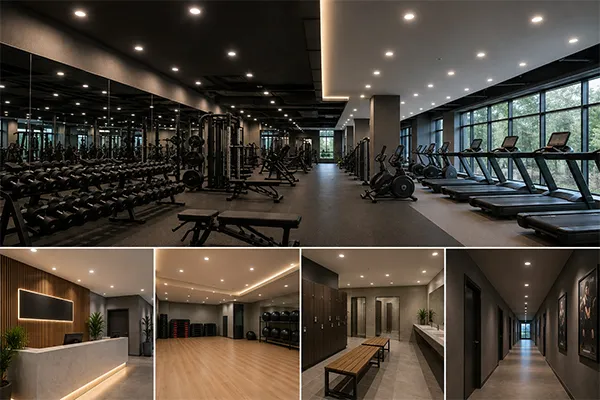
At Upward Lighting, we often receive early enquiries that begin with a simple question: “What wattage downlight should we use for our gym?” In our experience, the better starting point is a short discussion about the floor plan, ceiling conditions, equipment layout, and the atmosphere the operator wants to create. Those details help prevent expensive revisions later.
Why Should LED Downlights for Fitness Centers and Gyms Be Planned by Zone?
A gym contains several activities under one roof, but each activity creates different visual demands. If a project team applies one downlight type and one spacing pattern everywhere, users may experience inconsistent comfort, harsh reflections, and spaces that feel either overly clinical or too dim for their purpose.
Gym lighting should be planned zone by zone because reception, strength training, cardio, group exercise, changing areas, and circulation routes require different light levels, viewing conditions, and visual moods. A layered plan can use LED downlights as one component while adapting beam control, output, colour quality, and placement to each zone.
Start With Activities, Not a Watts-Per-Square-Metre Figure
We do not recommend choosing gym downlights from a universal watts-per-square-metre target. Wattage describes electrical input, but it does not independently explain delivered illuminance, beam distribution, glare, surface reflectance, ceiling height, or the effect of daylight.1
A 15 W LED downlight from one supplier may have a different lumen output, optical system, driver performance, and thermal design than a 15 W model from another supplier. More importantly, the same product can perform very differently in a 2.8-metre changing room and a 6-metre open training floor.
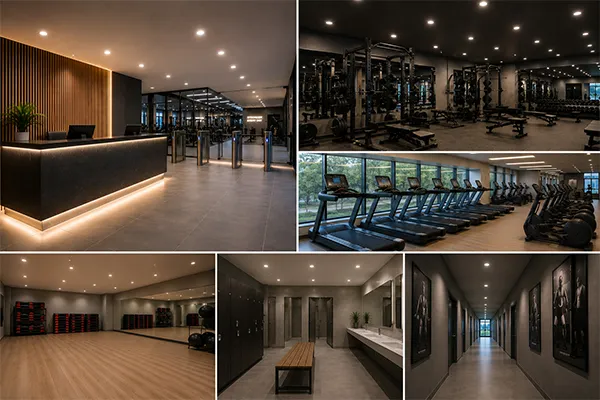
When we support a fitness-project quotation, we normally ask customers to identify the functional zones first:
| Gym zone | Main visual task | Common lighting concern | Downlight evaluation focus |
|---|---|---|---|
| Reception and retail | Greeting visitors, payments, product display | Flat or unwelcoming atmosphere | Good colour rendering, comfortable brightness, visual consistency |
| Free-weight area | Equipment use, movement, posture checks | Mirror reflections and glare | Controlled optics, careful positioning, robust fixture selection |
| Cardio area | Reading machine screens, sustained upward viewing | Direct glare from overhead fixtures | Lower-glare distribution, spacing, reduced reflections on displays |
| Group studio | Instructor visibility, changing activity modes | Inflexible mood or uneven coverage | Dimming compatibility, adaptable CCT where required, zoning |
| Changing rooms | Grooming, lockers, circulation | Poor face lighting and shadows | Balanced vertical illumination, suitable IP rating where needed |
| Corridors and entrances | Safe movement and orientation | Dark transitions or excessive brightness | Uniformity, wayfinding, durability |
| Bathrooms and wet-adjacent areas | Grooming and safe movement | Moisture exposure | Appropriate ingress protection and verified installation suitability |
For example, a customer once asked us to use the same recessed downlight across the lobby, treadmill zone, locker area, and yoga studio because it simplified purchasing. We understood the commercial reason. However, we encouraged the team to review whether the selected beam angle would create bright spots above treadmills and whether the colour temperature suited a calmer studio environment. The final project could still use a coordinated fixture family, but it did not need one identical specification in every location.
Consider Sightlines and Reflective Surfaces
Gyms have more reflective materials than many people expect. Mirrors, polished flooring, chrome equipment, glossy screens, glass partitions, and painted ceilings can all influence perceived brightness.2
The light that reaches the floor is only part of the result. Users also see the light source itself when they look upward during stretching, when they use seated equipment, or when they face a mirrored wall. A plan with adequate measured illuminance may still feel uncomfortable if the fixture placement creates visible bright reflections.
We suggest that project teams review:
- Mirror locations and sizes
- Cardio machine screen orientation
- Ceiling height and colour
- Floor finish reflectance
- Areas where users lie down, stretch, or look upward
- Equipment zones that may be rearranged after opening
- Natural daylight from glazing or skylights
This approach does not replace a lighting calculation. It gives the lighting designer, electrical contractor, and procurement team better inputs before they finalize the design.
We treat a gym as a collection of visual environments, not as one large room with a single wattage target.
How Do Glare and Brightness Affect Gym Downlight Selection?
Many gym owners want a bright, energetic interior, which is understandable. However, excessive brightness or poorly controlled light can create discomfort, reduce screen visibility, and make mirrors feel visually harsh. Higher output does not automatically create better lighting conditions.
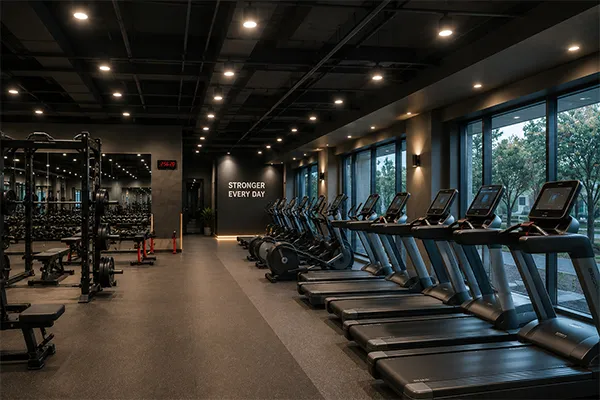
Glare control is essential when selecting LED downlights for fitness centers and gyms because users often look upward, toward mirrors, or at electronic displays.3 Buyers should evaluate fixture optics, beam angle, mounting height, spacing, shielding, and placement relative to equipment rather than simply increasing lumen output.
Why More Lumens Are Not Always Better
A brighter fixture can be useful in some areas, especially where ceiling height is greater or where equipment requires strong general illumination. Yet a high-lumen downlight with a wide, exposed source may be uncomfortable at a lower mounting height.
Glare can be direct or reflected:
- Direct glare occurs when a user sees an intensely bright source within their field of view.
- Reflected glare appears when mirrors, screens, glossy floors, or equipment surfaces reflect the source.
- Contrast glare happens when a bright fixture sits beside a relatively dark ceiling or wall surface.
- Disability glare can reduce a person’s ability to see detail, even when the space appears adequately lit.
A cardio area is a useful example. Users may spend 30 to 60 minutes facing forward and occasionally looking upward. If downlights are placed directly above or in front of machines without considering their viewing direction, a high-output source can become distracting. Similarly, a mirror wall can multiply the perceived number of bright points in the room.
Evaluate the Optical System, Not Just the Product Photograph
During product selection, buyers should ask for more than a catalogue image and nominal wattage. They should request technical documents that help the project team understand the light distribution and construction.
Useful information includes:
- Lumen output at the stated wattage and CCT
- Beam angle or photometric distribution
- Unified Glare Rating (UGR) information4, where available and applicable
- Cut-off angle, reflector style, or deep anti-glare construction
- Driver specification and dimming options
- Colour consistency information, such as SDCM or MacAdam-step data where supplied
- Installation cut-out, external dimensions, and clearance requirements
- Thermal conditions and rated ambient operating range
At Upward Lighting, we can discuss options such as wattage, beam angle, colour temperature, CRI, and finish colour during the quotation stage. However, we always encourage customers to have qualified local professionals assess the final layout, glare performance, emergency-lighting requirements, circuit design, and local electrical rules.
Use Placement to Support Comfort
Fixture placement matters as much as fixture selection. A suitable downlight can still cause discomfort if it is installed in the wrong location.
Project teams can consider these practical questions:
- Is the fixture directly above a treadmill, bench, or mat area?
- Does the fixture appear in a large mirror when a member faces the equipment?
- Will the beam create scalloping or isolated pools of light on dark walls?
- Are there exposed ceiling services that affect the visual pattern?
- Does the spacing work with ceiling grids, air-conditioning diffusers, sprinklers, speakers, and signage?
- Is dimming needed for group classes, cleaning, or closing procedures?
A visual mock-up can be valuable for larger projects. Even a small sample installation can reveal issues that a specification sheet cannot show.
Which Downlight Specifications Work Together in a Gym?
Buyers sometimes treat colour temperature, CRI, beam angle, wattage, and spacing as separate choices. In practice, these variables influence one another. A change in beam angle can alter the required spacing. A different CCT can affect the perceived brightness and atmosphere. A higher CRI option may change efficacy or cost.
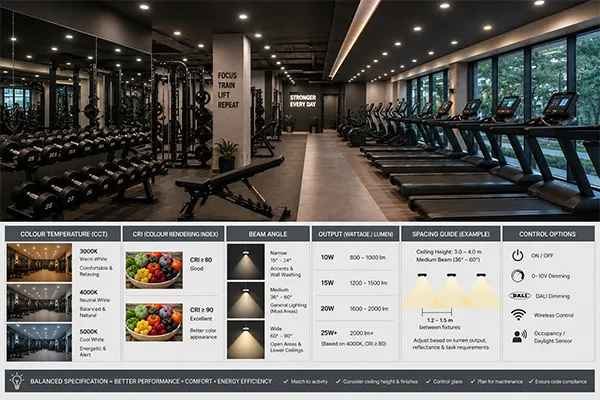
The best gym downlight specification is a balanced combination of output, beam angle, colour temperature, CRI, spacing, and control method. Each parameter should be reviewed alongside ceiling height, interior finishes, activity type, and the desired visual character of the fitness space.
Colour Temperature: Match the Intended Atmosphere
Colour temperature is commonly stated in Kelvin (K).5 It affects how warm or cool the white light appears, but it does not determine quality by itself.
Many commercial projects consider options such as:
| Colour temperature | Typical appearance | Potential fitness-project use |
|---|---|---|
| 3000K | Warm white | Boutique reception, relaxation zones, premium changing areas |
| 4000K | Neutral white | General fitness areas, circulation, functional spaces |
| 5000K and above | Cool white | Some task-focused or high-activity spaces, subject to design intent |
We do not suggest that one CCT suits every gym. A boutique studio may want a warmer reception experience and neutral task lighting elsewhere. A performance-focused training facility may prefer a more neutral or cooler visual environment. The interior finishes, brand identity, local preferences, and daylight conditions all matter.
Some projects also require tunable-white or scene-control systems. These systems can support different class formats, but they add procurement, commissioning, control compatibility, and maintenance considerations. Buyers should evaluate the full system rather than considering the fixture alone.
CRI Supports Colour Recognition
The Colour Rendering Index (CRI) indicates how faithfully colours may appear under a light source compared with a reference source.6 For gym applications, good colour rendering can support brand presentation, wayfinding, retail display, cleaning inspection, and a more natural appearance of finishes and skin tones.
Many buyers consider CRI 80 as a baseline for general commercial use, while CRI 90 may be evaluated for areas where visual presentation is more important. The appropriate choice depends on the project brief and budget. A higher CRI should not be specified automatically without confirming the performance data, lead time, and price implications.
Beam Angle and Spacing Are Linked
Beam angle affects how light spreads from the ceiling to the working plane.7 A narrower beam can create stronger visual emphasis or reach farther from a high ceiling. A wider beam can support more even general illumination at lower mounting heights. Neither is universally better.
The final spacing depends on factors such as:
- Mounting height
- Fixture lumen output
- Beam angle and photometric distribution
- Ceiling and wall reflectance
- Target illuminance and uniformity
- Furniture and equipment positions
- Daylight contribution
- Local lighting standards and professional calculations
For this reason, we ask customers for reflected ceiling plans, mounting heights, room dimensions, and photos when available. These details help us recommend suitable product options. They do not replace a formal photometric design by a qualified lighting professional.
Dimming and Driver Choices Need Early Discussion
Gyms may operate early in the morning and late at night. Some spaces also need different scenes for classes, cleaning, maintenance, or events. If the project requires dimming, buyers should confirm compatibility between the selected driver, dimming protocol, control system, and local installation practice.8
Common options may include:
- Non-dimmable drivers
- 0–10V dimming
- DALI dimming
- Phase-cut dimming, depending on regional compatibility
- Sensor-based controls in suitable support areas
A low initial fixture price can become less attractive if drivers, controls, and commissioning requirements are not reviewed at the start.
Should We Use Recessed or Surface-Mounted LED Downlights in a Gym?
Recessed downlights can provide a clean ceiling appearance, while surface-mounted downlights can help where ceiling voids are shallow or inaccessible. The right method depends on the building structure, ceiling depth, maintenance access, visual design, and retrofit limitations.
Recessed and surface-mounted LED downlights for fitness centers and gyms both have practical advantages. Recessed models may suit ceilings with sufficient void depth and planned access, while surface-mounted models can simplify installation in exposed, concrete, shallow, or retrofit ceilings.9 The final decision should follow a site review by qualified professionals.
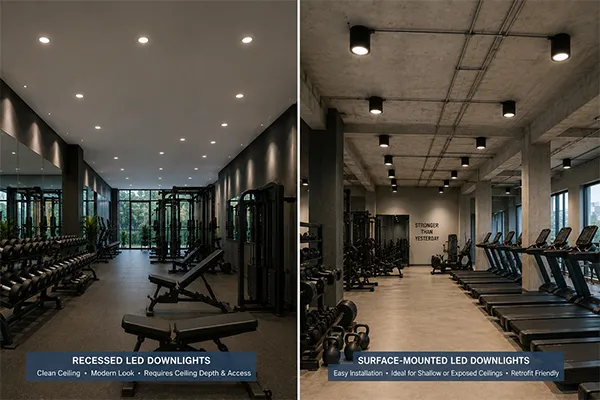
Recessed Downlights: Clean Appearance, More Ceiling Dependencies
Recessed downlights are often selected because they create a tidy and integrated appearance. They can work well in reception areas, corridors, studios, changing rooms, and suspended ceilings where the ceiling system has been planned around the lighting layout.
However, the product must fit the actual ceiling construction. Before procurement, we recommend confirming:
- Ceiling cut-out size
- Ceiling-board thickness
- Available void depth
- Driver location and clearance
- Heat dissipation conditions
- Presence of ducts, pipes, sprinklers, and cable trays
- Access for future replacement
- Fire-rated ceiling requirements where applicable10
- Insulation or acoustic material around the fixture
In one project conversation, a contractor liked the appearance of a deep recessed anti-glare downlight. The ceiling void later proved much shallower than expected because of air-conditioning services. A surface-mounted alternative could have avoided a late redesign. This is why we prefer to receive ceiling sections or site photos before we recommend a specific housing depth.
Surface-Mounted Downlights: Flexible for Constraints and Retrofits
Surface-mounted downlights can be useful in spaces with exposed concrete slabs, limited ceiling voids, or renovation constraints. They can also support an industrial design language when the finish, size, and placement are coordinated with other ceiling services.
Their potential advantages include:
- No large recessed cut-out in the ceiling
- Easier adaptation to some shallow-ceiling conditions
- Clearer access for replacement in certain installations
- Suitability for exposed-ceiling or retrofit projects
- Visual flexibility through housing shape and finish options
Yet surface-mounted fixtures are not automatically easier in every project. They remain visible, so alignment and spacing need careful planning. Their housing depth may also affect headroom or visual clutter in lower ceilings. They must be securely fixed to a suitable structure, and the electrical connection method must meet local requirements.
Compare the Installation Options Before Ordering
| Evaluation factor | Recessed downlight | Surface-mounted downlight |
|---|---|---|
| Visual effect | Flush, integrated ceiling look | Visible architectural element |
| Ceiling void | Usually requires sufficient depth | Often suits shallow or solid ceilings better |
| Retrofit suitability | Depends on cut-out and access | Often flexible, but mounting surface matters |
| Maintenance | Requires planned driver and ceiling access | May offer more direct fixture access |
| Coordination needs | High coordination with services above ceiling | High coordination with exposed services and alignment |
| Main risk | Product does not fit ceiling construction | Visual clutter or unsuitable mounting structure |
At Upward Lighting, we can provide dimensions, cut-out information, installation drawings, and product samples for evaluation. We can also discuss finish colours and customized parameters for projects that need a consistent visual identity. The contractor and local electrical professionals should still confirm structural fixing, wiring, environmental suitability, and compliance before installation.
How Can Buyers Evaluate a Gym Downlight Supplier Before Ordering?
A gym lighting project can fail because of late delivery, inconsistent colour appearance, missing technical information, or a product that differs from the approved sample. Supplier evaluation should therefore cover manufacturing controls, communication, documentation, customization capability, and after-sales responsiveness.
Buyers should evaluate gym downlight suppliers by reviewing product samples, technical documents, ageing procedures, production consistency, lead times, customization limits, and communication quality. A reliable supplier should provide clear information for professional review rather than making unsupported claims about performance or compliance.
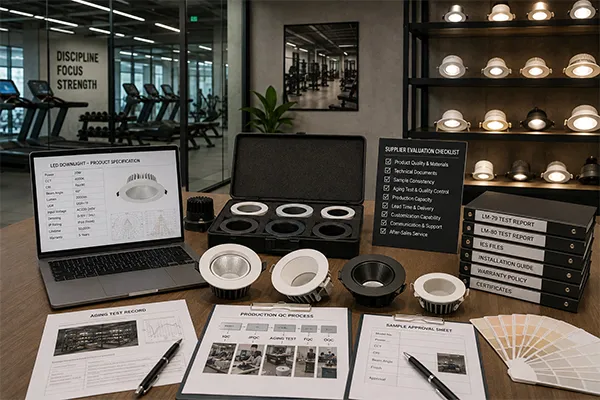
Questions We Recommend Asking Before a Purchase Order
Procurement teams can use the following checklist when comparing suppliers:
- Can the supplier provide a sample that matches the quoted specification?
- Are wattage, lumen output, CCT, CRI, beam angle, dimensions, and IP rating clearly stated?
- Can the supplier provide photometric data or supporting technical documents where required?
- What driver brand or driver performance specification is included?
- What is the colour consistency control process between production batches?
- What ageing or burn-in process is used before shipment?
- What are the standard lead times and the realistic lead times for customized orders?
- Can the supplier support small-batch trial orders before a wider rollout?
- Which certificates are available, and do they apply to the exact model and target market?
- What packaging, spare-part, and replacement process is available?
Our Manufacturing and Communication Approach
At Upward Lighting, we manufacture LED lighting products in Zhongshan City, China, and we have supported customers since 2009 across project, wholesale, brand, and distribution channels. We provide OEM and ODM support for parameters such as CCT, wattage, beam angle, CRI, and surface finish colour.
Before shipment, our products undergo a 100% ageing test of approximately 4 to 8 hours. This process is part of our internal quality-control approach and is intended to identify early operating issues before dispatch. Buyers should still evaluate samples and review the relevant product documentation for their own project conditions.
We can provide products with CE and RoHS documentation for applicable models and markets. However, we always advise buyers to verify certificates, test reports, marking requirements, and market-entry rules for the exact product, destination country, and installation context. Certification documents should be checked by the importer, project owner, and qualified local professionals rather than assumed from a general supplier statement.
For fitness projects, early communication reduces risk. We can respond more effectively when a customer shares:
- Floor plans and reflected ceiling plans
- Ceiling heights and ceiling sections
- Room-by-room usage descriptions
- Photos of renovation conditions
- Required finish colours and branding details
- Target delivery dates
- Required quantity by model
- Local voltage, dimming, and certification requirements
This information helps us provide a more relevant quotation and reduces the chance that a suitable-looking product becomes an unsuitable installation choice.
Frequently Asked Questions
What colour temperature is best for gym LED downlights?
Many gyms evaluate 4000K as a neutral option for general activity areas, while 3000K may suit more relaxed or premium spaces. However, the best colour temperature depends on branding, finishes, daylight, activity type, and user expectations. We do not recommend one CCT for every zone.
Are brighter LED downlights better for a fitness center?
No. Higher output can improve illumination in some conditions, but it can also increase glare, mirror reflections, and discomfort. Buyers should evaluate lumens, optics, mounting height, beam angle, fixture spacing, and user sightlines together. A qualified lighting professional should verify the final lighting design.
Should gym owners choose recessed or surface-mounted downlights?
The decision depends on ceiling depth, structure, maintenance access, design intent, and retrofit conditions. Recessed downlights can create a clean appearance when there is sufficient ceiling void. Surface-mounted models can be practical for shallow, exposed, or concrete ceilings. Neither option is universally superior.
What CRI should LED downlights have in a gym?
Many commercial projects consider CRI 80 suitable for general lighting, while CRI 90 may be considered where colour appearance and presentation matter more.11 The choice should account for budget, project objectives, supplier data, and product availability. Buyers should compare the actual specification, not only the label.
What information should I send a downlight supplier for a gym project?
We recommend sharing floor plans, ceiling heights, ceiling construction details, room functions, photos, required quantities, target CCT and CRI, dimming needs, voltage, destination market, and project timeline. This information helps suppliers recommend product options that are more appropriate for the installation conditions.
Conclusion
Choosing LED downlights for fitness centers and gyms requires more than selecting a wattage and placing fixtures in a grid. We recommend evaluating every zone by activity, sightline, glare risk, ceiling condition, maintenance access, and desired atmosphere. Colour temperature, CRI, beam angle, output, spacing, and installation method should work together as one system. At Upward Lighting, we can support your early-stage product selection, samples, customized specifications, and project quotation. Send us your gym floor plan and ceiling details to begin a practical downlight evaluation.
"[PDF] LED Lighting in a Performing Arts Building at the University of Florida", https://betterbuildingssolutioncenter.energy.gov/sites/default/files/attachments/2014_gateway_universityflorida.pdf. Lighting guidance distinguishes electrical power (watts) from light output and illuminance, which are also affected by optical distribution and the characteristics of the illuminated space. Evidence role: mechanism; source type: government. Supports: That watts measure electrical power, whereas lumens, illuminance, distribution, and the installed environment determine perceived and delivered lighting performance.. Scope note: The source may explain general lighting principles rather than evaluate this specific gym installation. ↩
"(PDF) Quantifying the effects of interior surface reflectance on indoor ...", https://www.academia.edu/145255711/Quantifying_the_effects_of_interior_surface_reflectance_on_indoor_lighting. Interior-lighting research identifies surface reflectance and specular reflections as factors that alter luminance distribution and can affect visual comfort. Evidence role: mechanism; source type: education. Supports: That surface reflectance and specular reflections influence luminance patterns, perceived brightness, and visual comfort in interior lighting.. Scope note: General findings about reflective surfaces do not quantify the effect of each listed gym material. ↩
"[PDF] Measuring Discomfort from Glare: Recommendations for Good ...", https://www.energy.gov/eere/ssl/articles/measuring-discomfort-glare-recommendations-good-practice. Lighting and workplace-ergonomics guidance recognizes direct and reflected glare as sources of visual discomfort and reduced visibility for tasks involving screens and reflective surfaces. Evidence role: general_support; source type: government. Supports: That direct and reflected glare can cause visual discomfort and interfere with viewing tasks, including display-based tasks.. Scope note: The evidence is generally applicable to occupied interiors and may not be specific to fitness facilities. ↩
"[PDF] Glare and Diffuse Sources", https://www.energy.gov/sites/prod/files/2021/02/f82/ssl-rd21-schwade-glare.pdf. The Unified Glare Rating is a standardized glare metric used in interior-lighting practice to estimate discomfort glare from luminaires within an observer's field of view. Evidence role: definition; source type: institution. Supports: That Unified Glare Rating is a standardized method used to assess discomfort glare in interior lighting conditions.. Scope note: A UGR value depends on the specified installation geometry, room surfaces, observer position, and calculation assumptions. ↩
"A correlated color temperature for illuminants", https://nvlpubs.nist.gov/nistpubs/jres/7/jresv7n4p659_A2b.pdf. Colour temperature, commonly expressed in kelvin, characterizes the chromatic appearance of a light source rather than its illuminance or colour-rendering performance. Evidence role: definition; source type: government. Supports: That colour temperature or correlated colour temperature is expressed on a kelvin scale and describes the chromatic appearance of white light.. ↩
"Text-Alternative Version: Understanding and Applying TM-30-15", https://www.energy.gov/cmei/ssl/text-alternative-version-understanding-and-applying-tm-30-15. The Colour Rendering Index compares how a test light source renders specified colour samples relative to an appropriate reference illuminant. Evidence role: definition; source type: institution. Supports: That CRI is an established metric comparing the colour rendering of a test light source with a reference illuminant.. Scope note: CRI does not fully describe every aspect of colour preference, saturation, or the visual quality of a particular interior. ↩
"[PDF] LED Technology for Improved Application Efficacy", https://www.energy.gov/sites/prod/files/2020/02/f71/ssl-rd2020-soer-efficacy_0.pdf. Luminaire photometry shows that beam spread affects the distribution of luminous intensity and therefore the illuminated area and illuminance pattern at the working plane. Evidence role: mechanism; source type: education. Supports: That beam spread and luminaire photometric distribution influence the area illuminated and resulting illuminance pattern at a working plane.. Scope note: Actual spacing and uniformity also depend on mounting height, lumen output, room reflectance, and the full photometric distribution. ↩
"[PDF] Specifying LED in a World of Continuous Change", https://www.energy.gov/sites/prod/files/2014/11/f19/miller-hershman-yorgey-willcock_specifying_detroit2014.pdf. LED-control guidance notes that dimming performance depends on compatibility among the LED driver, control interface or protocol, control device, and installed electrical system. Evidence role: mechanism; source type: research. Supports: That LED dimming systems require compatible luminaires or drivers, controls, and protocols to achieve intended dimming operation.. Scope note: Compatibility must still be verified for the exact products, wiring arrangement, and local electrical requirements. ↩
"(PDF) Lighting basics interior design - Academia.edu", https://www.academia.edu/7012552/Lighting_basics_interior_design. Luminaire-installation guidance distinguishes recessed fittings, which require adequate enclosure and clearance conditions, from surface-mounted fittings, which require an appropriate mounting substrate and electrical connection arrangement. Evidence role: general_support; source type: government. Supports: That recessed luminaires require appropriate ceiling-space and clearance conditions, while surface-mounted luminaires require suitable mounting and electrical provisions.. Scope note: Specific requirements vary by luminaire listing, ceiling assembly, fire protection, jurisdiction, and manufacturer instructions. ↩
"Recessed Lighting - Code Compliance Brief", https://basc.pnnl.gov/code-compliance/recessed-lighting-code-compliance-brief. Building-fire-safety guidance treats penetrations in fire-resistance-rated ceiling assemblies as conditions that must preserve the required fire performance through compliant tested or approved details. Evidence role: general_support; source type: government. Supports: That penetrations and recessed luminaires in fire-resistance-rated ceiling assemblies must be addressed in accordance with applicable tested assemblies and building-code requirements.. Scope note: The applicable solution depends on the local code, the ceiling assembly, the fixture's listing, and the approved installation detail. ↩
"LED Basics | Department of Energy", https://www.energy.gov/cmei/ssl/led-basics. General lighting guidance commonly treats CRI around 80 as suitable for many ordinary applications, while higher colour-rendering performance may be specified when accurate or appealing colour appearance is a project priority. Evidence role: general_support; source type: government. Supports: That CRI near 80 is widely used for general lighting and that higher colour-rendering performance can be relevant where colour appearance is especially important.. Scope note: These benchmarks are design conventions rather than universal requirements and do not establish an appropriate CRI for every gym zone. ↩