

LED downlights for government buildings can create unexpected procurement risks when buyers focus only on wattage, lumen output, certificates, and unit price. A fitting that appears suitable on paper may fail approval, not fit the ceiling opening, conflict with controls, or become difficult to replace later. A disciplined specification and supplier-verification process reduces these risks before installation begins.
LED downlights for government buildings should be selected as project-critical components, not interchangeable commodities. Buyers should verify physical fit, electrical configuration, optical performance, control compatibility, tender documentation, certification relevance, batch consistency, and future replacement availability. The lowest-priced option may create higher lifecycle costs if it causes installation changes, approval delays, maintenance problems, or inconsistent later supply.
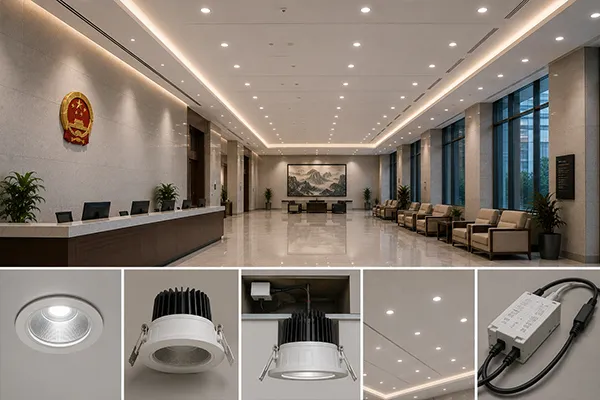
Government facilities often operate for many years and serve diverse users, including staff, visitors, maintenance teams, and the public. That makes lighting procurement more than a simple product comparison. In my experience supporting export and OEM/ODM lighting supply, the best purchasing questions are usually the ones asked before samples are approved and production starts.
Why Are LED Downlights for Government Buildings Not Automatically Interchangeable?
Many procurement teams see two recessed fittings with the same wattage, cut-out size, and nominal lumen output and assume that they can be substituted. That assumption can create problems during installation or handover. Small differences in trim shape, driver design, beam distribution, and mounting method can affect both approval and long-term maintenance.
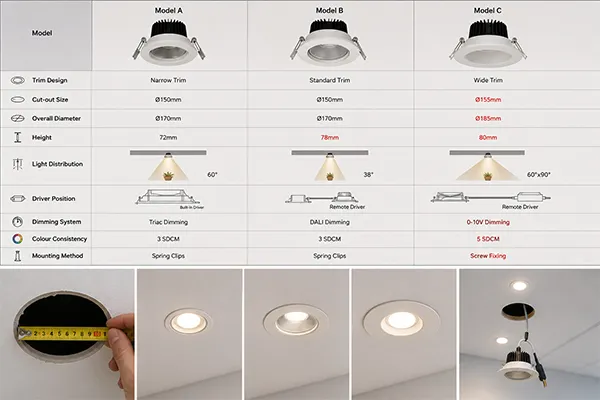
LED downlights for government buildings are not automatically interchangeable because physical dimensions, electrical components, light distribution, dimming systems, colour consistency, and installation details may differ between models1. Buyers should compare the complete approved specification rather than relying on only wattage, lumen figures, or a catalogue image.
Physical Compatibility Goes Beyond Cut-Out Diameter
A ceiling cut-out is important, but it is only one part of installation compatibility. Two downlights may both state a 90 mm cut-out, yet their trim diameters, spring positions, heat-sink depth, or driver placement can be different2.
For example, a replacement downlight may fit into the opening but leave a visible ceiling mark because its trim is narrower than the previous fitting. Another unit may have a deeper rear body that conflicts with ductwork, cable trays, insulation, or ceiling framing.
I have seen project inquiries where the first question was simply, “Can you match 90 mm?” In practice, I would ask for more information before confirming a suitable model:
- Ceiling cut-out diameter and tolerance
- Finished ceiling thickness
- Available ceiling void depth
- Trim outer diameter
- Required fitting height
- Driver location and dimensions
- Spring-clamp design
- Access conditions for maintenance
- Insulation or thermal-cover conditions where applicable
A procurement schedule should capture these details. Product drawings, installation instructions, and approved samples should all refer to the same product code and revision.
Electrical and Control Compatibility Must Be Confirmed
A downlight can have the correct appearance but still be electrically unsuitable. Driver configuration affects how the fitting connects, dims, and performs under real site conditions.
Common driver options include:
| Driver Type | Typical Use | Buyer Verification Point |
|---|---|---|
| Non-dimmable | Basic switched circuits | Confirm voltage, frequency, and switching arrangement |
| Triac/phase-cut dimmable | Retrofit or simple dimming systems | Confirm compatibility with the specified dimmer model |
| 0–10V dimmable | Commercial control systems | Confirm control wiring, dimming range, and driver behaviour |
| DALI/DALI-2 compatible | Building management and advanced control projects | Confirm tender requirements, addressing process, and system compatibility |
| Emergency-compatible arrangements | Areas requiring emergency lighting coordination | Confirm the project’s approved emergency lighting design and local requirements |
The words “dimmable” or “DALI” alone do not confirm full system compatibility3. Buyers should ask for driver data, wiring diagrams, compatible-control information where available, and sample testing within the intended control system.
Optical Performance Is Not Just a Lumen Number
Two 12 W LED downlights can both claim 1,000 lumens while producing very different results on the ceiling and working plane. Beam angle, diffuser design, reflector geometry, colour temperature, colour rendering index, and LED binning all influence the visual result4.
For government-building applications, the lighting designer or qualified technical reviewer should define the required illumination, uniformity, glare control, colour quality, and control strategy for each space5. These requirements can vary significantly between corridors, reception areas, meeting rooms, public counters, washrooms, archive rooms, and circulation spaces.
Buyers should avoid treating a generic beam angle or glare claim as universal proof of suitability. The relevant project standard, room geometry, installation height, surface reflectance, and qualified lighting-design review should determine whether a selected product is appropriate.
A matching wattage and cut-out size do not prove that two downlights deliver the same installation result.
What Documentation Should LED Downlights for Government Buildings Include?
Tender teams often face a documentation gap after selecting a product. The fitting may look correct and the price may be accepted, but the technical file may not match the tender language, the target market, or the exact product configuration. That can slow approval and make later substitutions harder to control.
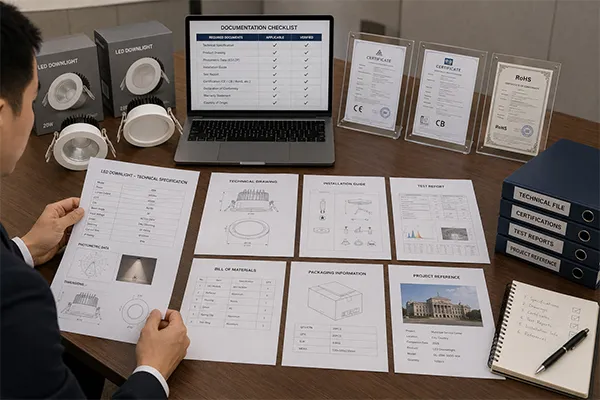
LED downlights for government buildings should be supported by a controlled documentation package that connects the approved product to its drawings, specifications, certification evidence, installation information, test records, and commercial reference. Certificates are important evidence, but buyers must verify that they apply to the target market and tender requirement.
Treat Certifications as Evidence, Not a Final Approval
CE, RoHS, and similar documents may be relevant for market access and environmental requirements, but they do not automatically prove that a fitting meets every government tender condition, local rule, installation requirement, or specified standard version6.
A buyer should verify several points:
-
Does the document identify the exact product model?
A certificate or report that covers a product family may require careful review to confirm that the selected wattage, driver, and configuration are included7. -
Does the document correspond to the destination market?
Market-entry requirements vary. A document suitable for one region may not satisfy another project’s requirements. -
Does the tender specify a standard edition or test method?
The tender may request a particular standard, report format, or document validity period. -
Does the supplied configuration match the approved configuration?
Changing from a non-dimmable driver to a DALI driver, changing wattage, or revising the housing may affect which documents apply. -
Has a qualified project reviewer confirmed the requirement?
Electrical consultants, authorities having jurisdiction, and project design teams should confirm application-specific compliance decisions.
At Upward Lighting, we can provide available product documentation for review, including documents related to our CE and RoHS product offerings. However, I would always recommend that buyers compare every document against the actual tender, destination-market requirements, and project specification before approval.
Build a Product Documentation Matrix
A simple matrix helps procurement teams identify missing information before placing an order.
| Document or Record | Why It Matters | Procurement Check |
|---|---|---|
| Product datasheet | Confirms headline specifications | Check model, wattage, CCT, CRI, IP rating, beam angle, and dimensions |
| Dimension drawing | Supports ceiling and void-space checks | Verify cut-out, trim size, height, driver dimensions, and tolerances |
| Installation instruction | Supports contractor installation | Check wiring, mounting, access, and environmental limitations |
| Photometric information | Supports lighting-design review | Confirm the file and configuration match the selected fitting |
| Driver specification | Supports electrical and controls review | Check input, output, dimming protocol, surge information, and wiring |
| Certification evidence | Supports market and tender evaluation | Verify scope, date, model reference, and applicable standard/version |
| Sample approval record | Controls production expectations | Record the exact approved product and finish |
| Batch or production traceability record | Supports later issue investigation | Agree on label, lot, or order reference method |
Control the Version, Not Only the File Name
A PDF file called “Downlight Datasheet Final” is not enough. Buyers should use a revision number, issue date, product code, and approval record. This discipline becomes especially important when a project includes several colour temperatures, wattages, finishes, or driver options.
For example, a 15 W, 4000 K, 60-degree, DALI version should not be casually treated as equivalent to a 15 W, 3000 K, 90-degree, phase-cut dimmable version8. They may share a housing, but they remain different technical configurations.
A controlled approval schedule should state:
- Supplier product code
- Project reference code
- Approved wattage and input voltage
- CCT and permitted chromaticity tolerance if specified
- CRI requirement
- Beam angle or optical configuration
- Driver type and dimming protocol
- Finish colour and trim style
- Required labels and packaging
- Required documents and revision numbers
This approach gives contractors, procurement teams, and future maintenance staff a clearer reference point.
How Should Buyers Control Custom LED Downlights for Government Buildings?
Customization can help a project meet its visual, electrical, or maintenance requirements. However, uncontrolled customization can create confusion. A request for a different colour temperature or finish may seem simple, but it can affect samples, documents, lead times, production planning, replacement stock, and final-site consistency.
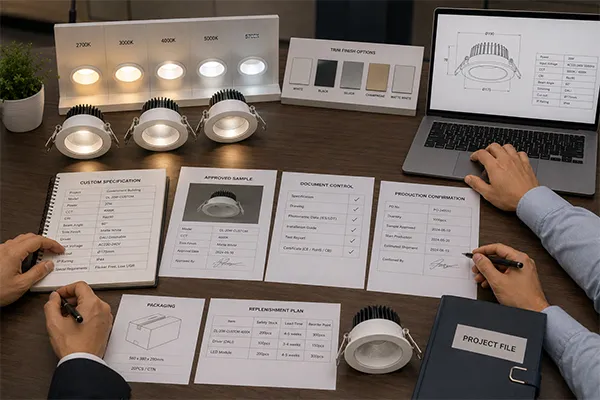
Custom LED downlights for government buildings should be managed through a written specification, approved sample process, document control, production confirmation, and replenishment plan. Buyers should lock all custom variables before mass production instead of relying on verbal descriptions or informal messages.
Define Every Variable That Can Affect the Delivered Product
At Upward Lighting, we support OEM/ODM requirements such as colour temperature, wattage, beam angle, CRI, surface finish, and packaging. In my experience, these options are most useful when the buyer converts them into a controlled requirement rather than a broad request.
A custom downlight specification may include:
- Colour temperature: 2700 K, 3000 K, 4000 K, 5000 K, or a project-defined value
- Colour rendering: Standard CRI or higher CRI requirement
- Wattage: Fixed wattage or approved selectable-wattage arrangement
- Beam angle: Narrow, medium, wide, or a defined optical distribution
- Trim finish: White, black, brushed finish, or custom RAL-related project finish where feasible
- Driver: Non-dimmable, phase-cut, 0–10V, DALI, or another specified control arrangement
- Branding: Product label, carton artwork, instruction leaflet, or local-brand packaging
- Emergency or control integration: Only where reviewed and specified for the project
A sample should represent the intended production configuration as closely as practical. If the final project version includes a custom driver, special trim finish, or specific packaging, the sample approval process should identify whether those elements are included in the sample.
Use a Controlled Sample-to-Production Process
A structured process reduces misunderstandings:
-
Confirm the written specification.
The buyer and supplier should agree on the exact product configuration and required documentation. -
Review drawings and technical data.
The contractor or consultant should confirm dimensions, installation conditions, and electrical requirements. -
Approve a sample.
The project team should inspect appearance, fit, output, dimming behaviour, and other relevant characteristics in the intended application. -
Issue a sample approval record.
The record should identify the sample code, date, revision, and any conditions of approval. -
Confirm mass-production details.
The supplier should confirm quantities, production lead time, packaging, labels, inspection requirements, and shipment schedule. -
Retain a reference sample where practical.
A retained sample can help resolve future questions about finish, trim geometry, or configuration.
I would not recommend approving a custom product based only on a chat message such as “same as sample, but 4000 K and DALI.” That phrase may leave unanswered questions about driver dimensions, labels, test documentation, dimming performance, and production revision.
Plan Replenishment Before the First Order Ships
Government buildings may require maintenance replacements years after the original project. If the project uses custom LED downlights, the buyer should plan for later supply at the beginning.
A replenishment plan can include:
| Replenishment Factor | Questions to Ask |
|---|---|
| Product code stability | Will the approved code remain identifiable for future orders? |
| Critical components | Can the driver, LED source, trim, and diffuser be matched later? |
| Minimum order quantity | What quantity is practical for later maintenance orders? |
| Spare stock | Should the project hold an agreed percentage of spare fittings? |
| Documentation archive | Who will retain approved drawings, samples, and order records? |
| Change notification | How will material product changes be communicated and reviewed? |
No manufacturer can responsibly promise that every component will remain unchanged indefinitely. Technology, component availability, and regulations can change9. However, a supplier should clearly explain how product records are maintained and how later-order requirements will be reviewed.
How Does Supplier Reliability Reduce Government Building Project Risk?
A low initial unit price can look attractive during tender comparison, but procurement cost is only one part of project risk. Delayed clarifications, inconsistent batches, unclear product files, and inability to support replacement orders can create costs that are not visible in a quotation.
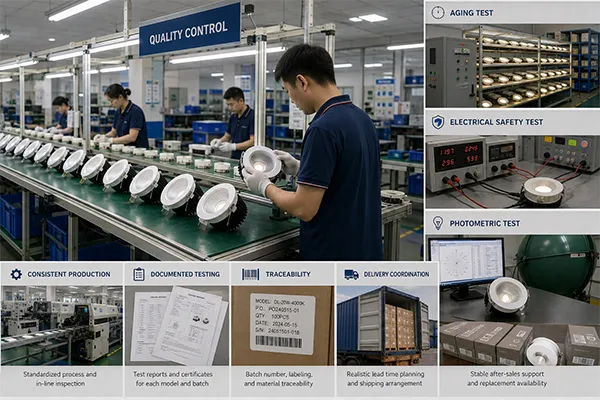
Supplier reliability for LED downlights for government buildings depends on consistent production controls, responsive technical clarification, documented testing, traceability, realistic delivery coordination, and support for future orders. Buyers should assess these capabilities alongside product price and specifications.
Evaluate the Supplier’s Process, Not Only the Product Sample
A sample can demonstrate a product concept, but it does not fully demonstrate production consistency10. Buyers should ask how the supplier manages incoming materials, assembly, testing, inspection, packing, and shipment records.
At Upward Lighting, each product undergoes a 100% aging test for approximately 4 to 8 hours before shipment as part of our standard quality-control process. This process can help identify early failures before products leave the factory11. However, buyers should still define any additional tender-specific testing, inspection, reporting, or third-party verification requirements in advance.
A supplier assessment should consider:
- How quickly technical questions receive a clear response
- Whether the supplier provides consistent product codes and drawings
- Whether samples, quotations, and production orders are linked clearly
- Whether the supplier can explain its aging and inspection process
- Whether packaging protects the selected trim and driver configuration
- Whether the supplier has a method for order or batch traceability
- Whether the supplier can support small-batch replenishment where needed
- Whether lead times are realistic and communicated early
Look for Traceability That Supports Investigation
If a problem appears after installation, the project team needs to identify what was supplied, when it was produced, and whether the issue affects a single fitting, a batch, or an installation method.
Useful traceability practices may include:
- Product labels with model and electrical data
- Carton labels with order reference or production information
- Packing lists linked to purchase orders
- Inspection records where agreed
- Production batch or lot references
- Retained approved samples
- Change-control communication for material revisions
Traceability is not only useful for defect investigation. It also supports replacement planning.12 A maintenance team can provide a clear product reference instead of relying on a photograph taken from below the ceiling.
Compare Total Risk, Not Just Unit Price
A practical procurement comparison can score suppliers across several factors:
| Evaluation Area | Example Consideration |
|---|---|
| Product fit | Does the fitting match cut-out, depth, trim, and installation conditions? |
| Technical suitability | Does the driver and optical configuration match the approved design? |
| Documentation | Are drawings, datasheets, installation instructions, and evidence complete? |
| Quality process | Is aging, inspection, and production control explained clearly? |
| Delivery reliability | Are lead times, packaging, and shipment arrangements realistic? |
| Customization control | Can the supplier lock and reproduce the approved configuration? |
| Future support | Can the supplier review later replacement requirements? |
| Commercial value | Does the quotation offer value after project risks are considered? |
I believe this evaluation is particularly useful for public-sector and tender-led work because an avoidable substitution or approval delay can affect many parties: the contractor, consultant, purchasing team, facility operator, and end users.
Frequently Asked Questions
What cut-out information should buyers request for LED downlights?
Buyers should request more than the nominal cut-out diameter. They should verify cut-out tolerance, trim outer diameter, ceiling thickness, fitting height, driver dimensions, spring-clamp position, and available ceiling void depth. These details help prevent clashes with ceiling structures, services, insulation, and existing finish marks.
Are CE and RoHS certificates enough for a government building lighting tender?
No. CE and RoHS documents may be relevant evidence, but they do not automatically confirm compliance with every tender, local code, destination-market rule, or project requirement. Buyers should verify document scope, product configuration, applicable standards, standard versions, and any project-specific approval requirements.
Can two LED downlights with the same wattage be used as substitutes?
Not necessarily. Two fittings with the same wattage can differ in beam angle, driver type, dimming compatibility, trim geometry, cut-out tolerance, colour consistency, installation depth, and documentation. A qualified project reviewer should assess any proposed substitution against the approved specification.
How many spare LED downlights should a government building project keep?
The correct spare quantity depends on project size, maintenance strategy, custom configuration, expected access difficulty, and future supply risk. Buyers should agree on a spare-stock plan during procurement and retain approved product records. The project consultant or facility manager should confirm the final maintenance requirement.
What should be approved before custom downlight production begins?
Buyers should approve the product code, wattage, CCT, CRI, beam angle, driver type, trim finish, dimensions, labels, packaging, drawings, documentation revision, and sample record. The supplier and buyer should also confirm quantity, lead time, inspection requirements, and a plan for future replacement orders.
Conclusion
Selecting LED downlights for government buildings requires more than comparing price, watts, and lumens. Buyers should verify the complete physical, electrical, optical, documentation, and supply-chain fit of each approved fitting. They should also treat certificates as evidence to review against the actual tender and local project requirements. At Upward Lighting, we support contractors, importers, local lighting brands, and channel partners with specification confirmation, OEM/ODM coordination, product documentation, aging-tested production, and replacement-order discussion. Contact us to review your downlight specification before sample approval or mass procurement.
"Lighting Research Center", https://www.lrc.rpi.edu/. Luminaire standards and technical guidance distinguish mechanical, electrical, photometric, and control-related characteristics, so products with similar headline ratings may not be technically equivalent. Evidence role: general_support; source type: institution. Supports: Luminaire selection and specification involve mechanical dimensions, electrical characteristics, photometric distribution, control equipment, and other product-specific attributes.. Scope note: The source supports the general distinction among luminaire characteristics; it does not compare the particular downlight models discussed in the article. ↩
"How to Measure Recessed Light Fixtures for Replacements", https://www.ledlightexpert.com/how-to-measure-recessed-lights?srsltid=AfmBOorsZZVuza3bo1lO7UUGDkRCzxk_KtR7QILG3ss0xpvbruvLGuAO. Recessed-luminaire installation guidance identifies cut-out dimensions, trim coverage, mounting arrangement, fixture depth, and clearance for equipment as separate compatibility considerations. Evidence role: mechanism; source type: education. Supports: Recessed-luminaire installation requires checking cut-out, trim, mounting, fixture depth, and clearance for associated equipment.. Scope note: Dimensional requirements remain product- and ceiling-system-specific and must be verified against the selected luminaire's drawings. ↩
"DALI-2 versus DALI version-1", https://www.dali-alliance.org/dali2/comparison.html. Lighting-control guidance explains that dimming interoperability depends on the specific driver, control device, wiring, and configuration; a generic dimming designation alone does not establish system performance. Evidence role: mechanism; source type: institution. Supports: Dimming performance depends on the interaction between control devices, LED drivers, wiring, and system configuration.. Scope note: Formal protocol conformance can demonstrate defined interoperability requirements, but site-specific commissioning and compatibility testing may still be necessary. ↩
"LED Color Characteristics", https://www.energy.gov/sites/prod/files/2016/08/f33/led-color-characteristics-factsheet.pdf. Lighting research and CIE technical guidance describe light distribution, optical control, colour rendering, correlated colour temperature, and chromaticity consistency as factors affecting visual lighting quality. Evidence role: mechanism; source type: research. Supports: Light distribution, glare-related optics, correlated colour temperature, colour rendering, and chromaticity variation affect perceived lighting conditions.. Scope note: The relative importance of each factor depends on room geometry, finishes, task requirements, and the selected luminaire. ↩
"(PDF) BSI Standards Publication Light and lighting", https://www.academia.edu/43043934/BSI_Standards_Publication_Light_and_lighting_Lighting_of_work_places. Recognized interior-lighting standards specify that illuminance, uniformity, glare limitation, colour quality, and other criteria are selected in relation to the visual tasks and spaces being served. Evidence role: expert_consensus; source type: institution. Supports: Interior-lighting standards establish design criteria including maintained illuminance, uniformity, glare limitation, colour rendering, and the needs of particular tasks or spaces.. Scope note: Applicable standards, target values, and regulatory status vary by jurisdiction and project type. ↩
"CE marking - Wikipedia", https://en.wikipedia.org/wiki/CE_marking. European Commission guidance states that CE marking indicates conformity with applicable EU harmonisation requirements, while RoHS addresses hazardous-substance restrictions; neither instrument independently establishes compliance with all procurement specifications, installation rules, or non-EU requirements. Evidence role: definition; source type: government. Supports: CE marking concerns conformity with applicable EU harmonisation legislation, while RoHS restricts specified hazardous substances in covered electrical and electronic equipment.. Scope note: The precise legal effect depends on the product, applicable legislation, destination market, and contract or tender terms. ↩
"Medical X-Ray Imaging Devices Conformance with IEC ...", https://www.fda.gov/media/99466/download. Conformity-assessment guidance treats certificates and test reports as evidence for the products, variants, and conditions identified in their scope, requiring verification that the supplied configuration is included. Evidence role: general_support; source type: institution. Supports: Conformity-assessment evidence is valid only within its identified product scope, including documented models, variants, and conditions.. Scope note: Whether a driver, wattage, housing, or other change falls within a given report's scope must be determined from the report and applicable certification rules. ↩
"ENERGY STAR® Program Requirements for Luminaires", https://www.energystar.gov/sites/default/files/asset/document/Luminaires%20V2%200%20Final_0.pdf. Technical lighting and control standards treat correlated colour temperature, photometric distribution, and control interface as distinct specified parameters; matching power alone therefore does not establish equivalence. Evidence role: general_support; source type: institution. Supports: Colour temperature, photometric distribution, and control interface are distinct luminaire and control-gear parameters that affect intended use and interoperability.. Scope note: A formal substitution decision also requires review of the project specification, installation conditions, and applicable codes. ↩
"Purchasing Energy-Efficient Commercial and Industrial ...", https://www.energy.gov/cmei/femp/purchasing-energy-efficient-commercial-and-industrial-led-luminaires. Government lighting-policy materials document that lighting technologies and regulatory requirements evolve over time, conditions that can affect the availability and configuration of replacement products. Evidence role: historical_context; source type: government. Supports: Lighting products are affected by evolving technology and regulatory requirements, which can alter available components and compliant product designs over time.. Scope note: Such sources provide market and regulatory context rather than proof that a particular manufacturer's component will be discontinued. ↩
"NIST Quality System", https://www.nist.gov/nist-quality-system. Quality-management guidance explains that product conformity across production depends on controlled processes, monitoring, and verification; inspection of an individual sample alone cannot establish ongoing production consistency. Evidence role: mechanism; source type: government. Supports: Consistent production quality requires controlled processes, monitoring, and verification rather than reliance on a single inspected unit.. Scope note: The appropriate controls and acceptance criteria depend on product risk, contract requirements, and the supplier's manufacturing process. ↩
"Towards Understanding Early Failures Behavior during Device Burn-In", https://www.nist.gov/publications/towards-understanding-early-failures-behavior-during-device-burn-broadband-rf. Reliability guidance describes burn-in and screening as methods for detecting some early-life or latent electronic failures before deployment. Evidence role: mechanism; source type: government. Supports: Burn-in and environmental-stress screening are used to detect some early-life or latent defects in electronic equipment before field use.. Scope note: Aging or burn-in screening does not prove lifetime reliability, and its effectiveness depends on the test profile, duration, failure mechanisms, and quality of the manufacturing process. ↩
"ISO 9001 Clause 8.5.2 Identification & Traceability", https://www.qualityze.com/blogs/iso-9001-clause-8-5-2-identification-traceability. Quality- and asset-management guidance recognizes identification and traceability records as tools for investigating nonconformities and maintaining reliable information for maintenance and replacement decisions. Evidence role: general_support; source type: institution. Supports: Identification and traceability records support investigation of nonconformities and maintenance decisions by linking installed items to their specifications and supply history.. Scope note: Traceability records assist identification and investigation but do not by themselves ensure that an identical replacement remains available. ↩