
LED downlights for hospitals and clinics can become a procurement risk when one standard commercial fixture is applied across every room1. A downlight that appears bright enough on paper may still create glare, uneven coverage, maintenance difficulties, or an unsuitable visual atmosphere. We recommend matching each fixture to the space, task, installation conditions, and project requirements.
LED downlights for hospitals and clinics should be selected by evaluating the function of each space rather than choosing the brightest, highest-CRI, or lowest-cost option. Buyers should assess visual tasks, glare control, beam angle, uniformity, color quality, installation compatibility, maintenance access, and future replacement plans. Final specifications must also be verified against lighting drawings, tender documents, local codes, and project-specific requirements.
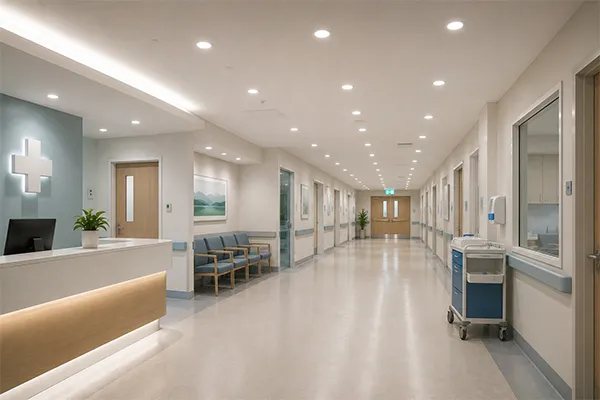
In our discussions with contractors, importers, and project teams, we often hear the same questions: “Is a standard commercial downlight bright enough?” “Will high CRI solve the problem?” “Can we use one model for every room?” These are understandable questions, but responsible selection starts with a more detailed review.
How Should LED Downlights for Hospitals and Clinics Be Matched to Each Space?
A hospital or clinic has many spaces with different activities, visual priorities, and user expectations. When buyers use one downlight configuration everywhere, they may simplify the initial quotation but create issues during installation, inspection, and daily operation. A room-by-room approach can reduce this risk.
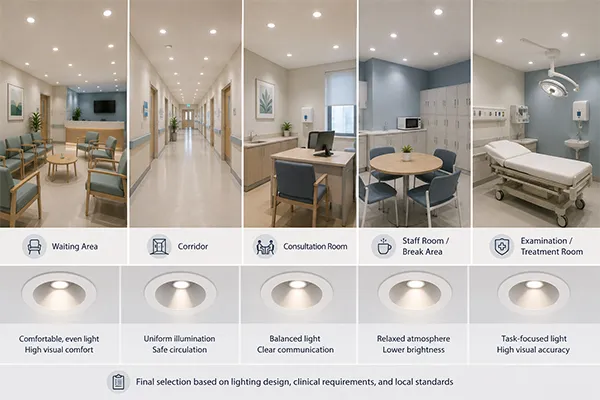
LED downlights for hospitals and clinics should be matched to the room’s function and visual task. Waiting areas, corridors, consultation rooms, staff spaces, and examination or treatment-related rooms may require different output, beam distribution, glare control, and color characteristics2. The project’s lighting design and local requirements should determine the final configuration.
Start With the Space, Not the Product Catalog
We believe the first supplier question should not be, “Which wattage do you need?” Instead, we ask what the room is used for, who uses it, and what visual task takes place there.
For example, a reception or waiting space may need a welcoming, comfortable appearance with controlled glare. A corridor may prioritize even illumination and dependable operation over a long daily schedule. A consultation room may need lighting that supports communication and routine visual assessment. Examination or treatment-related areas may have more demanding task and project requirements that must be reviewed by qualified professionals.
During one anonymized consultation, a customer asked us whether a single recessed downlight could cover a clinic reception, corridor, consultation room, and staff room. We explained that one product family may sometimes support multiple areas, but one identical configuration should not be assumed to suit all of them.
A Practical Space-Planning Framework
Buyers can use this early-stage framework before requesting a quotation:
| Space type | Main selection concern | Downlight factors to evaluate |
|---|---|---|
| Reception and waiting area | Comfort, first impression, visual ease | Glare control, beam spread, color temperature, fixture appearance |
| Corridors and circulation routes | Uniform coverage and reliability | Beam angle, spacing, lumen distribution, maintenance access |
| Consultation rooms | Communication and routine visual tasks | Uniformity, color quality, glare limitation, dimming compatibility if specified |
| Staff rooms and offices | General work comfort | Output, visual comfort, installation depth, energy use |
| Examination or treatment-related spaces | Application-specific task requirements | Project lighting design, local requirements, color quality, glare, cleaning and maintenance needs |
This table is not a substitute for a lighting design, tender specification, or local compliance review. It is a procurement checklist that helps a buyer avoid treating every healthcare room as a generic commercial space.
Consider the Consequences of a Mismatch
An under-specified downlight may lead to dark zones, poor visual comfort, or the need for extra fixtures after the ceiling work is complete. An over-specified fixture may increase product cost, driver cost, heat management considerations, and procurement complexity without delivering a meaningful benefit in a low-demand area.
The goal is not to choose the lowest specification. The goal is to choose a defensible specification that aligns with the relevant space, drawings, and approved project requirements.
Why Are Lumen Output, Color Temperature, and CRI Not Enough for Healthcare Downlights?
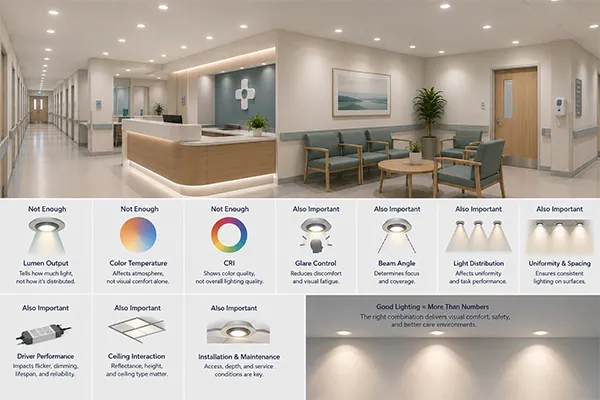
Many buyers begin with lumen output, correlated color temperature, and CRI because these figures are easy to compare in a quotation. However, these values do not explain how light will be distributed in the room or how comfortable the fixture may feel when installed. A broader evaluation is necessary.
For LED downlights for hospitals and clinics, lumen output, color temperature, and CRI are important but incomplete selection criteria. Buyers should also review glare control, beam angle, light distribution, spacing, uniformity, driver performance, and the interaction between the fixture and ceiling layout. A suitable specification depends on the intended space and approved project requirements.
Brightness on a Datasheet Is Not the Same as Useful Light
A fixture’s total lumen output describes the amount of light produced, but it does not fully describe where the light goes.3 Two downlights with similar lumen figures can create very different results because of optic design, beam angle, mounting height, ceiling reflectance, fixture spacing, and room geometry4.
A narrow beam may create bright pools and darker areas between fixtures.5 A wider beam may support more even general lighting but may require careful spacing to avoid insufficient task illumination. The correct distribution should be evaluated against the room layout and lighting plan.
We often see quotation requests that ask only for “12W,” “15W,” or “20W” downlights. Wattage can help with product comparison, but it is not a complete performance requirement. LED efficacy, optical losses, driver characteristics, and beam distribution all affect the final result.
Glare Can Affect Perceived Quality
Glare control is especially relevant in spaces where people may be seated, waiting, lying down, walking along corridors, or looking upward from a bed or examination position.6 A very bright visible light source may feel uncomfortable even if the room meets a target illuminance level on paper.
Buyers should ask suppliers for relevant information about:
- Diffuser type and visible light source appearance
- Reflector or anti-glare design
- Recessed depth of the light source
- Beam angle and distribution curve
- Unified Glare Rating (UGR)7 information, where it is specified and applicable
- Recommended mounting conditions from the manufacturer
A lower-glare design may be appropriate for some areas, but the product must still provide the required light distribution. This is why glare cannot be evaluated separately from output and layout.
CRI Supports Color Distinction, but It Does Not Solve Everything
CRI describes how naturally colors may appear under a light source compared with a reference source.8 Higher CRI may be useful where color distinction is important, but it does not automatically guarantee suitability for every healthcare environment.
A high-CRI fixture can still have poor glare control, unsuitable beam spread, inconsistent binning between batches, or an installation issue. It may also add cost where a project does not require that level of color rendering. Conversely, some spaces may require more demanding color-quality performance based on the project documentation or local requirements.
We recommend that buyers treat CRI as one decision point within a full lighting specification, not as a shortcut for healthcare suitability.
How Can Buyers Avoid Over-Specifying or Under-Specifying LED Downlights for Hospitals and Clinics?
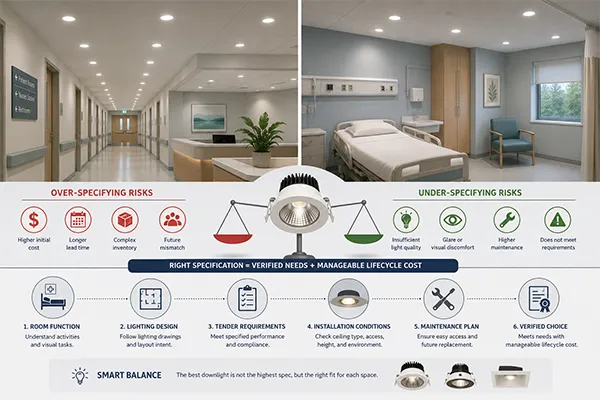
Buyers may assume that a higher wattage, higher CRI, premium driver, or more expensive optic is always the safer choice. In some areas, stronger performance requirements may be justified. However, an unnecessarily high specification can complicate budget control, lead time planning, and future replacement consistency.
Buyers can avoid over-specifying or under-specifying LED downlights for hospitals and clinics by comparing each proposed fixture against the room function, lighting drawings, tender requirements, installation conditions, and maintenance plan. The best choice is not automatically the highest specification; it is the configuration that meets verified project needs with manageable lifecycle cost.
Use a Requirement Matrix Before Comparing Prices
A structured requirement matrix helps project teams compare offers fairly. It also reduces the risk that suppliers quote technically different products under the same general description.
| Evaluation category | Questions for the buyer | Procurement consequence |
|---|---|---|
| Space function | What activity happens in this room? | Prevents one-size-fits-all selection |
| Lighting performance | What distribution, output, and visual comfort are required? | Supports better fixture and optic comparison |
| Installation | What are the ceiling cutout, depth, and wiring conditions? | Reduces site rework and compatibility problems |
| Control system | Is dimming, emergency integration, or a specific driver required? | Avoids mismatched drivers and controls |
| Product consistency | Will the same model be needed for later phases? | Supports replacement and batch consistency |
| Documentation | What reports, certifications, and declarations are required? | Helps buyers verify market and project requirements |
At Upward Lighting, we can customize parameters such as wattage, color temperature, beam angle, CRI, and surface finish for OEM/ODM requirements. However, customization should follow an approved specification, not replace it. A custom product that is not aligned with the drawings or local requirements may still create project risk.
Look Beyond Unit Price
The lowest unit price may not represent the lowest project cost.9 A cheaper product can become expensive if it causes incorrect cutouts, driver incompatibility, color inconsistency, replacement delays, or extra labor during installation.
Buyers should consider total procurement value, including:
- Product consistency: Can the supplier control key parameters across batches?
- Quotation clarity: Are wattage, lumen output, CCT, CRI, beam angle, cutout size, and driver details clearly stated?
- Lead-time reliability: Can the supplier support the required delivery schedule?
- Small-batch support: Can the supplier provide a practical quantity for mock-ups, phased work, or replacements?
- After-sales continuity: Can the supplier identify and reproduce the approved configuration later?
We have seen customers benefit from separating their request into several configurations rather than forcing every room into one SKU. This does not always mean a large increase in complexity. In many cases, a controlled range of two or three configurations can better balance performance, price, and installation management.
Verify Documentation Rather Than Assuming Compliance
CE and RoHS documents can be relevant to product and market-entry requirements10, but buyers should verify the documents, their applicability, and any additional requirements for the destination market and healthcare project. Standard documentation does not prove full compliance for every hospital application, installation method, or jurisdiction.11
A qualified local professional should review application-specific requirements, including electrical installation rules, emergency lighting interfaces, fire-related ceiling requirements, and any healthcare-specific obligations.
What Maintenance and Installation Issues Matter for Healthcare Downlights?
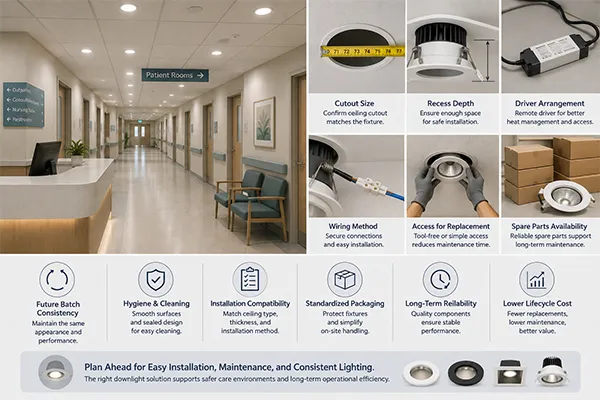
Maintenance planning often receives less attention than lumen output during early procurement. Yet replacement access, cutout compatibility, driver location, cleaning needs, and future batch matching can affect the facility long after the initial installation. These practical details should be reviewed before an order is finalized.
LED downlights for hospitals and clinics should be evaluated for installation compatibility and long-term maintenance from the start. Buyers should confirm ceiling cutout size, recess depth, driver arrangement, wiring method, access for replacement, spare-part availability, and future product consistency. These factors can reduce rework and help maintain a consistent appearance across the facility.
Confirm Physical Compatibility Before Ordering
A fixture may meet the requested electrical specification but still fail to fit the ceiling conditions. Recessed downlights require careful review of physical dimensions, including the cutout, trim diameter, recessed height, driver size, spring mechanism, and clearance around the fixture.
Before placing a production order, buyers should confirm:
- Ceiling cutout diameter and tolerance
- Available void depth above the ceiling
- Ceiling material and thickness
- Driver placement and access method
- Wiring connection method
- Required ingress protection rating, where applicable
- Compatibility with insulation, ceiling systems, or other site constraints
- Whether the trim finish matches the interior design intent
We recommend approving samples before volume production whenever the project schedule allows. A sample review can reveal practical issues that a datasheet does not show, such as spring tension, trim appearance, driver location, and the perceived glare of the installed fixture.
Plan for Replacement Consistency
Healthcare facilities may be maintained over many years. A replacement fixture that has a slightly different color temperature, trim color, beam angle, or cutout size can create visible inconsistency.12 This concern is particularly important in long corridors, waiting areas, and repeated ceiling layouts.
Our manufacturing process includes a 100% aging test of 4 to 8 hours before shipment, intended to support product quality control and confirm that lumen maintenance performance meets applicable industry expectations. However, buyers should still define their own project acceptance requirements and verify the relevant product documentation.
For future continuity, buyers should retain:
- Approved sample records
- Product model numbers and complete parameter sheets
- Driver specifications
- CCT and CRI requirements
- Beam angle and trim finish details
- Order quantities and batch references
- Supplier contact and replacement procedures
Think About Supplier Capability as Part of Maintenance Planning
A supplier’s ability to respond quickly, quote accurately, support small quantities, and maintain configuration records can matter during later project phases. At Upward Lighting, we support OEM/ODM requests and small-batch orders, which may help customers managing phased procurement or replacement needs. Still, availability and replacement specifications should be confirmed at the time of each order because supply conditions and component availability can change.
Frequently Asked Questions
Can one LED downlight model be used throughout a hospital or clinic?
One downlight family may be used across several areas, but one identical configuration should not automatically be used everywhere. Waiting spaces, corridors, consultation rooms, and treatment-related areas can have different visual tasks and comfort needs. Buyers should verify the final selection against project drawings and requirements.
Is a high-CRI downlight always better for hospitals and clinics?
High CRI may be appropriate where color distinction is important, but it is not the only factor that matters. Buyers should also evaluate glare, beam distribution, uniformity, output, installation conditions, and the room’s function. Project documents and qualified review should guide the final CRI requirement.
What color temperature should healthcare downlights use?
There is no universal color temperature for every hospital or clinic space. The appropriate choice depends on the intended atmosphere, visual task, interior design, project lighting plan, and local requirements. Buyers should avoid applying one CCT across the entire facility without reviewing each area.
What should buyers check before ordering recessed hospital downlights?
Buyers should confirm cutout size, ceiling depth, beam angle, wattage, lumen output, CCT, CRI, glare-control design, driver type, control compatibility, finish, documentation, and replacement plan. They should also review samples and verify requirements with the project team and qualified local professionals.
Do CE and RoHS certificates prove a downlight is suitable for every healthcare project?
No. CE and RoHS documentation may support certain regulatory and market-entry requirements, but buyers must verify the documents and determine whether additional local, electrical, building, or project-specific requirements apply. Standard certification documents do not replace application-specific compliance assessment.
Conclusion
LED downlights for hospitals and clinics should be selected as part of a practical, room-by-room procurement strategy. Buyers should look beyond wattage, lumens, color temperature, and CRI to consider glare control, beam distribution, installation compatibility, maintenance access, and replacement consistency. We recommend reviewing drawings, tender documents, and local requirements before final approval. If you are sourcing healthcare downlights for a project, contact Upward Lighting for a clear quotation, sample discussion, and OEM/ODM configuration review based on your required specifications.
"Barriers and facilitators of workplace visual comfort from the perspective ...", https://pmc.ncbi.nlm.nih.gov/articles/PMC12474977/. Healthcare-lighting guidance recognizes that lighting criteria should be related to the activity, visual task, and users of individual spaces rather than applied uniformly across an entire facility. Evidence role: general_support; source type: institution. Supports: Healthcare lighting guidance that distinguishes lighting needs by clinical activity, room type, visual task, and occupant comfort.. Scope note: Such guidance supports a room-by-room design approach but does not by itself establish the suitability of any particular downlight model. ↩
"Optimization of LED Lighting for Clinical Settings - PMC", https://pmc.ncbi.nlm.nih.gov/articles/PMC6732584/. Lighting standards and professional guidance commonly assign different illuminance, glare, colour-rendering, and distribution considerations to healthcare spaces according to their function and visual tasks. Evidence role: expert_consensus; source type: institution. Supports: International lighting recommendations or standards that specify different lighting parameters for healthcare room types.. Scope note: Applicable values and compliance obligations depend on the governing national standard, project brief, and jurisdiction. ↩
"Luminous Flux", http://hyperphysics.phy-astr.gsu.edu/hbase/vision/lumpow.html. Luminous flux measures the total visible light emitted by a source, whereas photometric intensity distribution describes how that light is directed through space. Evidence role: definition; source type: education. Supports: Photometric definitions of luminous flux and luminous-intensity distribution.. ↩
"(PDF) Methods for calculating illumination", https://www.academia.edu/36659932/Methods_for_calculating_illumination. Indoor lighting calculations incorporate luminaire photometry, mounting height, room geometry, surface reflectance, and luminaire spacing because these variables affect illuminance distribution and uniformity. Evidence role: mechanism; source type: education. Supports: Lighting-design principles showing how luminaire photometry, mounting geometry, surface reflectance, and spacing influence calculated illuminance and uniformity.. Scope note: The relative influence of each variable must be calculated for the actual room and luminaire rather than inferred from a general rule. ↩
"Beam Angle: Understanding Light Spread & Focus", https://lightideas.com/beam-angle/?srsltid=AfmBOopxS7PpReMZe8mFNov-Y8_Gu2jasI6LeQolFKNHtdhvVcYh7TuT. Luminaire beam distribution and spacing are key determinants of illuminance uniformity; narrow distributions can create localized peaks and reduced illuminance between luminaires when the layout is not designed accordingly. Evidence role: mechanism; source type: research. Supports: Research or technical lighting guidance relating beam spread and luminaire spacing to illuminance uniformity.. Scope note: This effect is conditional on the luminaire photometry, mounting height, spacing, and room reflectances. ↩
"Patient room lighting influences on sleep, appraisal and ...", https://pubmed.ncbi.nlm.nih.gov/27862514/. Studies of healthcare lighting identify visual comfort and glare as relevant environmental considerations for patients and staff, particularly where occupants have direct views of ceiling-mounted light sources. Evidence role: general_support; source type: paper. Supports: Evidence that glare and direct views of luminaires can affect visual comfort in healthcare environments, including patient areas.. Scope note: Evidence on comfort does not define a universal glare limit or prescribe a specific downlight construction for every healthcare space. ↩
"Discomfort Caused by Glare from Luminaires with a Non- ...", https://cie.co.at/publications/discomfort-caused-glare-luminaires-non-uniform-source-luminance. The Unified Glare Rating is an internationally used index for estimating discomfort glare from indoor lighting installations under defined observer and viewing conditions. Evidence role: definition; source type: institution. Supports: The definition and intended use of Unified Glare Rating as an index for discomfort glare in interior lighting.. Scope note: A UGR value is installation-dependent and cannot be inferred reliably from a luminaire alone without the relevant room and layout assumptions. ↩
"A Standard for Lighting Color Preference?", https://www.nist.gov/news-events/news/2017/03/standard-lighting-color-preference. The general colour-rendering index characterizes how faithfully a test light source renders specified colour samples relative to an appropriate reference illuminant. Evidence role: definition; source type: government. Supports: The technical definition of the general colour-rendering index and its comparison with a reference illuminant.. Scope note: CRI is not a complete measure of all aspects of colour quality, such as gamut preference or spectral suitability for a particular clinical task. ↩
"Life Cycle Cost (LCC) | www.waru.edu", https://www.waru.edu/acquipedia-article/life-cycle-cost-lcc. Whole-life-cost approaches assess acquisition alongside installation, operation, maintenance, replacement, and end-of-life costs, so the lowest initial price may not be the lowest-cost option over an asset's service life. Evidence role: general_support; source type: government. Supports: Public-procurement guidance explaining that whole-life cost includes costs beyond initial purchase price.. Scope note: A lifecycle-cost comparison requires project-specific assumptions about service life, labor, energy, failure rates, and replacement availability. ↩
"European Union Reduction of Hazardous Substances ...", https://www.waru.edu/artifact/european-union-reduction-hazardous-substances-rohs-and-waste-electrical-and-electronic. In the European Union, CE marking indicates that a product is declared to meet applicable harmonised requirements, while RoHS restricts specified hazardous substances in electrical and electronic equipment within its scope. Evidence role: historical_context; source type: government. Supports: The regulatory scope of CE marking and the EU RoHS restriction of hazardous substances in electrical and electronic equipment.. Scope note: The precise directives, conformity-assessment route, and documentation required depend on the product, intended market, and applicable legislation. ↩
"Nationally Recognized Testing Laboratories; Supplier's ...", https://www.federalregister.gov/documents/2008/10/20/E8-24826/nationally-recognized-testing-laboratories-suppliers-declaration-of-conformity. Product conformity documentation addresses the legal requirements within its stated scope and does not remove the need to satisfy applicable national installation, building, electrical, and sector-specific requirements. Evidence role: general_support; source type: government. Supports: Official guidance indicating that product conformity documentation must be considered alongside applicable national, installation, and sector-specific rules.. Scope note: The additional requirements vary by jurisdiction, project type, and the responsibilities assigned to designers, installers, and facility operators. ↩
"LED Color Characteristics", https://www.energy.gov/sites/prod/files/2016/08/f33/led-color-characteristics-factsheet.pdf. Lighting research shows that differences in chromaticity can be visually perceptible, while luminaire dimensions and optical characteristics affect whether replacement products maintain a consistent appearance and fit within an existing installation. Evidence role: general_support; source type: research. Supports: Evidence that differences in chromaticity and luminaire characteristics can be perceptible and that dimensional compatibility affects replacement work.. Scope note: The visibility and practical significance of a difference depend on viewing conditions, adjacent luminaires, ceiling design, and the tolerances of the installed system. ↩