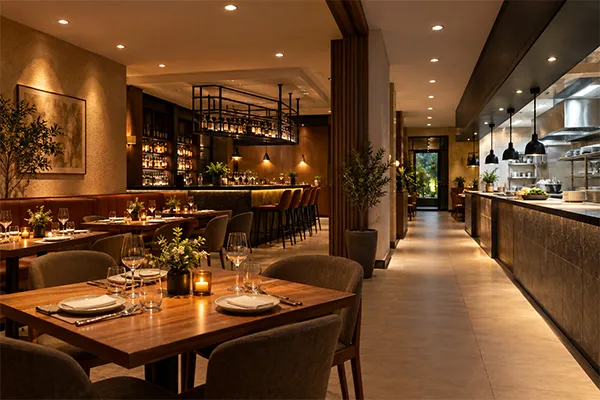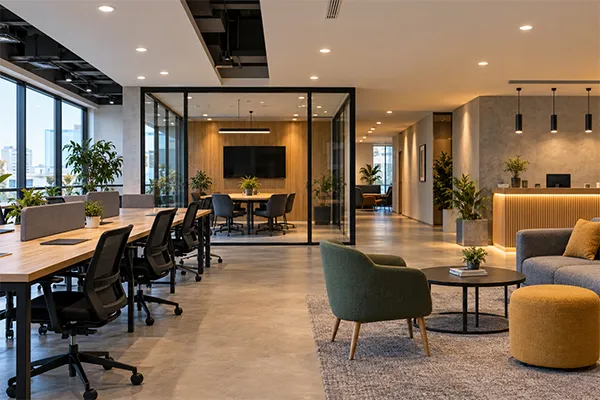
LED downlights for industrial offices can create avoidable problems when buyers select them only by wattage, color temperature, or price. Glare at desks, unsuitable cutout sizes, uneven light, and difficult driver access can all lead to rework. We recommend starting with workplace tasks, ceiling conditions, existing lighting, and maintenance requirements before requesting a quotation.
The right LED downlights for industrial offices are selected through a task-and-installation review, not a single product specification. Buyers should assess what employees do in each area, ceiling height and cutout details, available ambient light, glare risk, maintenance access, compliance documents, and supplier reliability. A qualified lighting designer should verify final illuminance calculations and fixture layouts for the specific project.
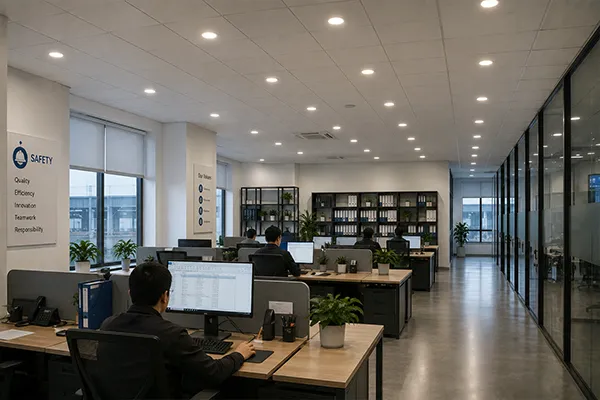
In our conversations with contractors, importers, and project teams, we often see quotation requests that list only a wattage, cutout size, and quantity. Those details matter, but they do not tell the full story. A better procurement process helps teams reduce installation conflicts, employee complaints, and inconsistent future supply.
Why Should LED Downlights for Industrial Offices Start With Workplace Tasks?
Industrial-office buyers often face pressure to choose fixtures quickly. That pressure can lead to a simple but risky question: “Which wattage should we use?” If the team does not first consider the work performed below the fitting, it may install lighting that looks acceptable but feels uncomfortable during a full workday.
Buyers should start LED downlight selection by identifying the activities in each office zone, such as computer work, document review, technical drawing, meetings, circulation, or reception. These tasks affect the needed light distribution, glare control, color consistency, and lighting layout.1 Ceiling conditions and existing daylight must then be reviewed before a final product is specified.
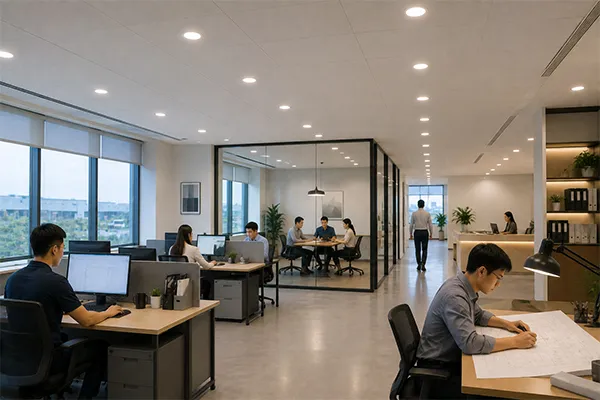
Map the Office Before Comparing Products
An industrial office is rarely one uniform space. It may include open-plan workstations near a production area, enclosed engineering rooms, logistics offices, meeting rooms, corridors, and reception desks. Each zone can have different visual needs and different sources of ambient light.
We recommend that buyers prepare a simple workplace map before they ask for pricing. This does not replace a professional lighting plan. However, it gives suppliers and designers a clearer foundation for evaluating suitable options.
A useful initial map should identify:
- Primary work activities: screen-based work, paperwork, inspection records, engineering drawings, or customer-facing tasks.
- Desk and workstation locations: especially where people will sit directly below or near downlights.
- Ceiling height and construction: suspended ceiling, gypsum board, exposed structure, concrete slab, or metal ceiling.
- Daylight conditions: windows, skylights, roller shutters, and areas with strong sunlight variation.
- Existing fixtures: linear office lights, panels, track lights, emergency lights, or older fluorescent fittings.
- Obstructions: ducts, cable trays, sprinklers, air-conditioning outlets, beams, and access panels.
- Operational schedules: one shift, two shifts, overnight administration, or intermittent use.
Consider Visual Comfort, Not Only Brightness
More light is not always better light.2 A downlight with a concentrated beam may produce strong brightness directly below the fixture while leaving adjacent work surfaces less evenly lit. A poorly positioned fixture may also reflect on monitors or create uncomfortable contrast around desk areas.3
For this reason, we encourage procurement teams to discuss the workstation layout with the project lighting designer or electrical consultant. A fixture that performs well in a corridor may not be appropriate above a computer workstation. The same nominal lumen output can create very different visual results when beam angle, diffuser design, mounting height, spacing, and surface reflectance change.
In our product discussions, we have learned that a buyer’s most useful first question is often not “How many watts?” but “What work is happening under this light?”
A competent lighting design process should verify target illuminance, uniformity, glare considerations, and fixture spacing. We can support product data and customization discussions, but we do not treat a product quotation as a substitute for a site survey or application-specific calculation.
Which Specifications Matter Beyond Wattage and Lumen Output?
A buyer may compare LED downlights by wattage, lumen output, cutout size, and unit price because these specifications are easy to list. The risk is that these values can make two products appear comparable even when their optical behavior, thermal design, drivers, and installation suitability differ significantly.
Wattage, lumens, and cutout size are important procurement inputs, but they do not determine whether a downlight will suit an industrial office. Buyers should also compare beam angle, glare-control design, driver configuration, heat management, color consistency, ceiling compatibility, and the proposed layout. Final lighting performance should be validated through professional calculations and, where appropriate, samples or mock-ups.
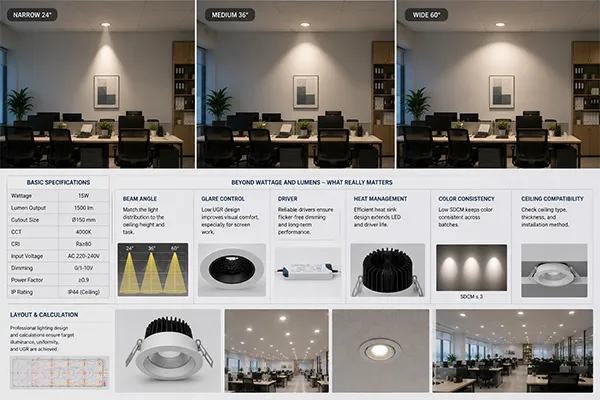
Understand the Relationship Between Watts and Lumens
Wattage describes electrical power consumption. Lumen output describes the amount of visible light emitted by the fixture.4 Neither figure alone tells buyers how that light will reach desks, walls, corridors, or shared work areas.5
For example, a higher-lumen fitting with a narrow beam can create intense pools of light. A lower-lumen fitting with a wider distribution can sometimes support a more even appearance in the intended layout. This does not make one approach universally better. It means that buyers must connect the photometric behavior to the actual installation.
Review Optical and Installation Variables
When we receive industrial-office inquiries, we suggest that buyers compare the following points alongside basic wattage and lumens:
| Evaluation item | Why it matters in an industrial office | Questions for the supplier or designer |
|---|---|---|
| Beam angle | Affects spread, spacing, and light concentration | Is the beam suitable for the ceiling height and workstation arrangement? |
| Glare-control design | Can influence visual comfort around screens and desks | What optical design, reflector, lens, or diffuser is used? |
| UGR information6 | Supports a glare evaluation when provided for a defined application | Is the UGR value based on a relevant room calculation and installation condition? |
| Cutout size | Determines whether the fitting fits the prepared ceiling opening | What is the required cutout tolerance and ceiling thickness range? |
| Fixture depth | Can create conflicts with services above the ceiling | How much clearance is required above the ceiling? |
| Driver type and location | Influences maintenance access and installation method | Is the driver remote or integrated, and can it be replaced safely? |
| CRI | Affects color appearance and some visual tasks | Does the task require a particular CRI level or color-rendering consistency? |
| Dimming compatibility | May be needed for controls or daylight response | Which dimming protocol and control components are compatible? |
Avoid Assuming Equivalent Performance
Not all downlights with the same diameter or declared wattage have equivalent glare control, beam behavior, driver quality, or thermal management. Buyers should ask for current specification sheets, photometric files where available, installation instructions, and sample evaluation options.
At Upward Lighting, we can discuss customization of wattage, color temperature, beam angle, CRI, and surface finish color for relevant OEM/ODM projects. Still, we advise buyers not to select a configuration only because it is available. The selected combination should fit the project’s ceiling, layout, task areas, and maintenance plan.
How Should Buyers Coordinate Color Temperature and CRI?
Color temperature is often treated as a matter of personal preference. One stakeholder may prefer a cooler appearance, while another may want a warmer atmosphere. This can create inconsistent decisions across meeting rooms, administrative offices, reception areas, and connected production-support spaces.
For industrial offices, color temperature should be coordinated as a project-wide visual and operational decision. Buyers should consider existing fixtures, daylight conditions, work atmosphere, brand expectations, and the need for consistency between spaces. CRI should be selected according to visual-task needs and project requirements rather than used as a stand-alone quality claim.
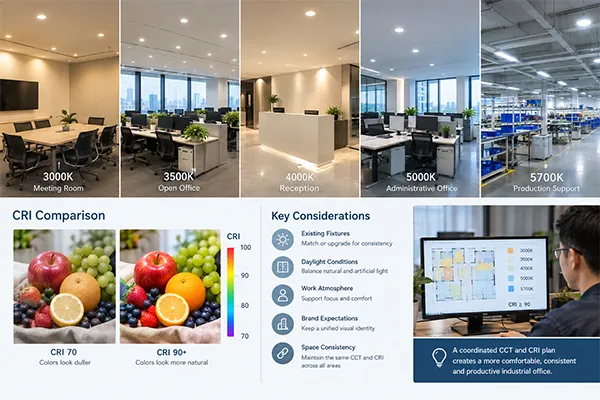
Coordinate CCT Across Connected Spaces
Color temperature, commonly expressed in Kelvin (K), affects the perceived appearance of light.7 However, a color temperature number does not automatically define comfort, productivity, or lighting quality in every setting.
A project team should first inspect what already exists. If an industrial office uses linear luminaires in one area and recessed downlights in another, the team should determine whether the new fixtures need to visually coordinate with the established system. Mixed color appearance can make a recently upgraded office look incomplete, even if each individual fixture meets its published specification.8
We usually see buyers discuss common options such as warm white, neutral white, and cool white. The most appropriate choice depends on the project context, including:
- The appearance of existing lighting products.
- The amount and color of daylight entering the office.
- Wall, ceiling, desk, and flooring finishes.
- The desired atmosphere in customer-facing versus technical areas.
- The need for consistent replacement products in future phases.
- Regional project standards or end-customer preferences.
Use CRI in Context
CRI, or Color Rendering Index, indicates how faithfully a light source renders colors compared with a reference source under the measurement method.9 A higher CRI can be useful for some applications, but procurement teams should connect it to actual needs.
For many general office decisions, buyers should ask: Do employees need to distinguish color-coded documents, samples, wiring labels, safety markings, finishes, or printed materials? Does the project specification state a minimum CRI? Is there a requirement for color consistency between batches or adjacent fixture types?
We recommend documenting these requirements in the purchase specification. A vague instruction such as “good color” creates room for misunderstanding. A clearer request may state the required CCT, acceptable tolerance if specified by the project, CRI requirement, and sample-approval process.
I have seen projects become delayed because stakeholders approved lighting from a catalog image rather than reviewing a physical sample under the intended room conditions. A sample does not replace a lighting calculation, but it can help teams assess visible color coordination and finish quality.
What Should a Pre-Quotation Checklist for LED Downlights for Industrial Offices Include?
Many quotation delays are not caused by price negotiation. They happen because the first inquiry omits critical information: ceiling opening size, ceiling depth, dimming needs, target quantity, required documents, or delivery date. Incomplete inputs increase the chance of receiving a technically unsuitable offer.
A strong pre-quotation checklist for LED downlights for industrial offices should cover task areas, ceiling details, existing lighting, electrical requirements, maintenance access, certification documents, quantities, delivery timing, and samples. Buyers should ask a project lighting designer to verify final calculations, spacing, and compliance requirements for the installation location.
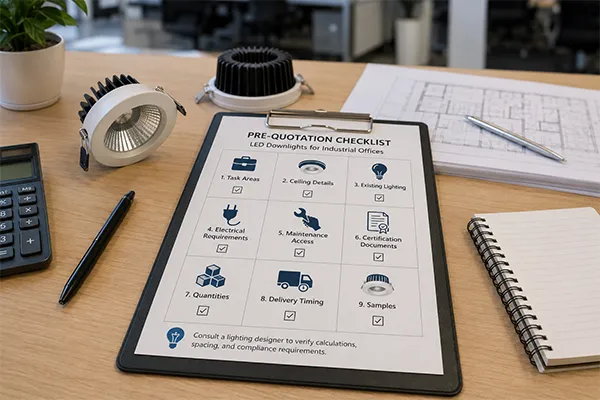
Practical Information to Send With an Inquiry
We encourage buyers to include the following information in their first request. Even partial information can help us identify follow-up questions early.
-
Project type and location
State whether the space is an industrial-office renovation, warehouse administration area, engineering office, reception zone, or new build. The destination market can also affect documentation requirements. -
Room dimensions and ceiling information
Provide room length, width, ceiling height, ceiling material, cutout diameter, maximum fixture depth, and photos of above-ceiling conditions where possible. -
Task and workstation layout
Identify desks, computer stations, meeting tables, filing areas, counters, and other work zones. Include a reflected ceiling plan or basic layout when available. -
Existing and auxiliary lighting
Explain whether downlights will operate with linear office lighting, daylight, wall lights, emergency lighting, or other fixture types. -
Requested product parameters
Include preferred wattage range, color temperature, CRI, beam angle, finish color, dimming requirement, IP rating if relevant, and any required control system. -
Compliance documentation
State which documents the project requires. Buyers should verify the applicability and validity of CE, RoHS, or other requested documents for their particular market and product configuration. -
Quantity and purchasing plan
Clarify sample quantity, trial order quantity, total project quantity, phased delivery needs, and future replenishment expectations. -
Delivery timing and packaging needs
Provide the required delivery date, destination, labeling expectations, carton requirements, and whether the order is for import, distribution, or direct project installation.
Evaluate Maintenance Before Installation
Maintenance is easy to overlook during the quotation stage because the fixture has not yet been installed. Yet inaccessible drivers, crowded ceiling voids, or unclear replacement procedures can increase long-term operational disruption.10
Buyers should confirm:
- Whether the driver is integrated or external.
- How the fixture is removed from the ceiling.
- Whether the driver can be accessed without damaging the ceiling.
- Whether future replacement units can match the cutout and visible finish.
- Whether the supplier can maintain a stable specification for repeat orders.
- Whether spare units should be ordered with the original project batch.
At Upward Lighting, every product undergoes a 100% aging test of approximately 4 to 8 hours before shipment as part of our shipment quality-control process. This test can help identify certain early issues before dispatch. However, we are careful not to present this process as a guarantee of field lifetime, site performance, or compliance in every installation. Actual service life depends on installation quality, thermal conditions, operating hours, electrical environment, maintenance, and application-specific factors.11
Build Supplier Evaluation Into the Specification
For contractors, importers, and distributors, procurement risk also extends beyond the first shipment. A low initial price may become expensive if specifications change without notice, replacement stock is unavailable, or technical questions receive slow responses.
We suggest evaluating suppliers using both product and process criteria:
| Supplier evaluation area | What buyers should verify |
|---|---|
| Product documentation | Current data sheets, installation instructions, test reports, and requested certification documents |
| Quality-control process | Incoming checks, production controls, aging procedures, final inspection practices, and traceability approach |
| Customization capability | Ability to confirm and document requested wattage, CCT, beam angle, CRI, finish, labeling, or packaging |
| Sample handling | Sample lead time, approval process, and how approved samples connect to production orders |
| Delivery reliability | Quotation validity, production lead time, packing method, and communication process |
| Repeat-order support | Specification consistency, spare-part policy, and ability to support phased projects |
We work with buyers who need small-batch orders, OEM/ODM adjustments, rapid quotations, and longer-term supply coordination. However, we believe the strongest supplier relationship begins with complete project information and clear written specifications.
Frequently Asked Questions
What wattage is best for LED downlights in industrial offices?
No single wattage is best for every industrial office. Wattage should be reviewed after the team understands room dimensions, ceiling height, workstation tasks, existing light, beam angle, and layout. A qualified lighting designer should verify final fixture quantities and illuminance calculations for the specific project.
Are higher-lumen downlights always better for office work?
Higher lumen output is not always better. A high-output downlight may create glare, bright spots, or uneven illumination if its beam pattern and spacing do not suit the room. Buyers should compare lumens with optical distribution, mounting height, glare-control features, and the planned position of desks and monitors.
Which color temperature should an industrial office use?
The appropriate color temperature depends on the existing lighting system, daylight, interior finishes, workplace atmosphere, and project standards. Buyers should coordinate color temperature across connected spaces rather than select it only by personal preference. A physical sample can help confirm visual consistency before full production.
What should buyers check before ordering recessed LED downlights?
Buyers should confirm cutout size, ceiling thickness, fixture depth, driver access, electrical requirements, beam angle, dimming compatibility, required documents, quantity, delivery timing, and sample needs. They should also provide room layouts and task information so that a lighting professional can verify the final design.
Does a factory aging test guarantee downlight lifetime?
No. A factory aging test is a quality-control procedure that may identify certain early product issues before shipment.12 It does not guarantee field lifetime, installation quality, local regulatory compliance, or lighting performance. Actual results depend on site conditions, operating patterns, electrical supply, heat management, and maintenance.
Conclusion
Selecting LED downlights for industrial offices requires more than matching watts, lumens, and cutout sizes. We recommend that buyers begin with workplace tasks, ceiling constraints, existing lighting, glare risk, maintenance access, and clear procurement documentation. Color temperature and CRI should support a coordinated project plan, while final layouts should be checked by a qualified lighting designer. If your team needs OEM/ODM options, samples, or a quotation based on complete project details, we at Upward Lighting can help review practical product parameters and supply requirements.
"Should We Re-think Regulations and Standards for Lighting at ... - PMC", https://pmc.ncbi.nlm.nih.gov/articles/PMC8155670/. Workplace-lighting guidance identifies visual task requirements as a basis for selecting illuminance, glare limitation, colour rendering, and light distribution in indoor work areas. Evidence role: general_support; source type: institution. Supports: Lighting guidance for workplaces relates lighting design criteria, including illuminance, glare limitation, colour rendering, and distribution, to the visual tasks performed.. Scope note: Specific design values and methods depend on the applicable local standard and the individual room. ↩
"[PDF] Measuring Discomfort from Glare: Recommendations for Good ...", https://www.energy.gov/eere/ssl/articles/measuring-discomfort-glare-recommendations-good-practice. Lighting guidance recognizes that adequate illumination alone does not ensure visual comfort, because glare, luminance contrast, and light distribution also affect occupants’ visual conditions. Evidence role: general_support; source type: government. Supports: Authoritative lighting guidance explains that visual comfort depends on lighting distribution and glare control as well as the quantity of light.. Scope note: The relationship between illumination level and comfort varies with the task, room geometry, reflectances, and occupants. ↩
"eTools : Computer Workstations - Workstation Environment - OSHA", http://www.osha.gov/etools/computer-workstations/workstation-environment. Display-screen workstation guidance notes that luminaires and other bright sources can produce reflections or glare on monitors, making screen work less comfortable and potentially reducing visual performance. Evidence role: mechanism; source type: government. Supports: Display-screen workstation guidance identifies reflections and glare from luminaires or windows as sources of visual discomfort and recommends controlling their position relative to screens.. Scope note: Whether a particular downlight produces objectionable reflections must be assessed for the actual screen orientation, luminaire photometry, and room conditions. ↩
"[PDF] Optical metrology for LEDs and solid state lighting", https://tsapps.nist.gov/publication/get_pdf.cfm?pub_id=840989. A watt measures power, whereas a lumen measures luminous flux—the quantity used to express visible light output. Evidence role: definition; source type: government. Supports: A watt is a unit of power and a lumen is a unit of luminous flux, used to express the visible-light output of a source.. Scope note: Fixture-level lumen declarations may be measured under specified test conditions and do not alone predict illumination at a work surface. ↩
"[PDF] CALiPER Application Summary Report 18: LED Recessed ...", https://www1.eere.energy.gov/buildings/publications/pdfs/ssl/caliper_18_summary.pdf. Photometric principles show that work-plane illuminance is determined by the luminaire’s intensity distribution and installation geometry, in addition to its total luminous flux. Evidence role: mechanism; source type: research. Supports: Illuminance at a surface depends on luminaire intensity distribution, distance, orientation, geometry, and reflectance, rather than fixture lumens alone.. Scope note: A complete prediction of desk, wall, or corridor illumination requires a room-specific calculation using the relevant photometric data. ↩
"Calculation and Presentation of the Standard CIE UGR ...", https://www.academia.edu/9504476/Calculation_and_Presentation_of_the_Standard_CIE_UGR_Table_for_Indoor_Lighting_Luminaires. The CIE Unified Glare Rating method evaluates discomfort glare for a defined interior lighting arrangement by considering the luminaires, observer position, and surrounding luminance conditions. Evidence role: definition; source type: institution. Supports: The Unified Glare Rating is a CIE discomfort-glare calculation method for indoor lighting that incorporates the observer position, luminaires, and room luminance conditions.. Scope note: A published UGR figure is not a universal product property; its relevance depends on the calculation assumptions and the proposed installation. ↩
"Candela - NIST", https://www.nist.gov/si-redefinition/candela. Correlated colour temperature (CCT), reported in kelvin, is a descriptor of a light source’s apparent warm-to-cool white colour appearance. Evidence role: definition; source type: government. Supports: Correlated colour temperature, expressed in kelvin, describes the apparent colour of white light relative to a blackbody radiator.. Scope note: CCT does not by itself characterize colour rendering, chromaticity tolerance, visual comfort, or lighting quality. ↩
"[PDF] LED Color Characteristics", https://www.energy.gov/sites/prod/files/2016/08/f33/led-color-characteristics-factsheet.pdf. LED-lighting guidance recognizes that chromaticity variation among luminaires can produce noticeable differences in white-light appearance within an installed space. Evidence role: general_support; source type: government. Supports: LED lighting guidance discusses colour consistency and chromaticity variation between products or batches as factors that can create visibly different colour appearance.. Scope note: The visibility and acceptability of variation depend on chromaticity difference, adjacent placement, adaptation, room finishes, and observer sensitivity. ↩
"Purchasing Energy-Efficient Light Bulbs", https://www.energy.gov/cmei/femp/purchasing-energy-efficient-light-bulbs. The general Colour Rendering Index (CRI) is a standardized measure comparing the colour rendering of specified test samples under a test source with their rendering under a reference illuminant. Evidence role: definition; source type: institution. Supports: The CIE general colour rendering index quantifies the average colour-rendering fidelity of test colour samples compared with an appropriate reference illuminant.. Scope note: CRI has recognized limitations and may not fully represent colour discrimination or appearance for every material, light source, or application. ↩
"Purchasing Energy-Efficient Exterior Lighting", https://www.energy.gov/cmei/femp/purchasing-energy-efficient-exterior-lighting. Lighting maintenance guidance identifies physical access to luminaires and serviceable components as an important determinant of maintenance effort and disruption during repair or replacement. Evidence role: general_support; source type: institution. Supports: Lighting-maintenance guidance treats access to luminaires and replaceable components as a factor affecting maintenance time, cost, and service continuity.. Scope note: The operational effect depends on ceiling construction, access equipment, spare-part availability, labour arrangements, and the failure mode. ↩
"[PDF] DOE Solid-State Lighting CALiPER Program 2009 Roundtable", https://www1.eere.energy.gov/buildings/publications/pdfs/ssl/2009_caliper_roundtableproceedings.pdf. Research on LED lighting systems indicates that field reliability and useful life are affected by thermal conditions, electrical stresses, operating profiles, component design, and the installation environment. Evidence role: mechanism; source type: research. Supports: LED-system reliability research identifies temperature, electrical stress, operating conditions, driver components, and installation environment as factors affecting field performance and lifetime.. Scope note: Such evidence establishes general reliability mechanisms; it cannot predict the service life of a particular downlight installation without product-specific testing and site data. ↩
"[PDF] A methodology for testing life-cycle performance of consumer products", https://nvlpubs.nist.gov/nistpubs/Legacy/IR/nbsir76-1157.pdf. Reliability literature describes burn-in or aging as a screening process that can expose some early-life failures before deployment, rather than as proof that all units will meet a specified field lifetime. Evidence role: mechanism; source type: paper. Supports: Reliability literature describes burn-in as an environmental or operational screening process intended to detect a portion of early-life defects before field use.. Scope note: The screening value depends on the test duration, stress conditions, failure mechanisms, sample coverage, and manufacturing process. ↩