LED downlights for luxury residential projects can disappoint when teams select them only by wattage, lumen output, or a premium-looking trim. A beautiful interior can feel harsh, flat, uneven, or poorly coordinated if the lighting does not match each room’s purpose. I recommend a room-by-room specification method that connects visual comfort, atmosphere, installation conditions, and supply consistency.
Luxury residential downlights should be configured around how each room is used, what materials need to look like, and what ceiling conditions allow. High CRI, a sleek trim, or higher output can support a premium result, but no single feature guarantees it. Contractors should combine lighting-design input with supplier-side checks on samples, dimensions, finishes, drivers, testing, and delivery consistency.
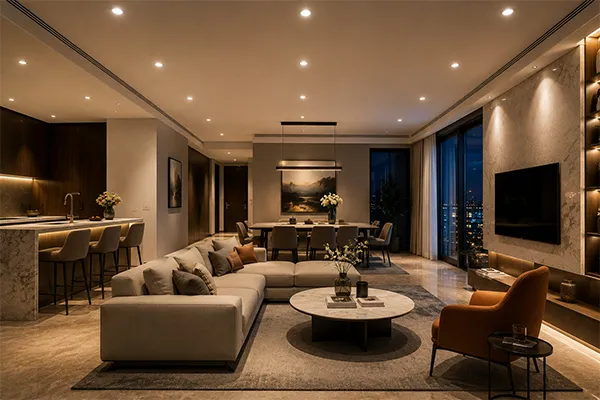
In my conversations with contractors, purchasers, and local lighting brands, the strongest projects usually begin with better questions rather than a longer specification sheet. The goal is not to find one “luxury” downlight. The goal is to build a practical downlight package that supports the interior designer’s intent and can be ordered, installed, and replenished with confidence.
What Makes LED Downlights for Luxury Residential Projects Feel Premium?
A luxury project can lose its intended atmosphere when downlights create visible glare, overly bright spots, or poor color appearance on expensive finishes1. These issues often appear late, after ceilings are closed and fixtures are installed. I encourage teams to define the required visual experience before comparing product specifications.
LED downlights for luxury residential projects feel premium when they create useful light with controlled brightness, believable material color, and a deliberate visual hierarchy. The best result comes from balancing beam distribution, light level, color temperature, CRI, trim appearance, mounting depth, and placement—not from choosing the highest number in one category.
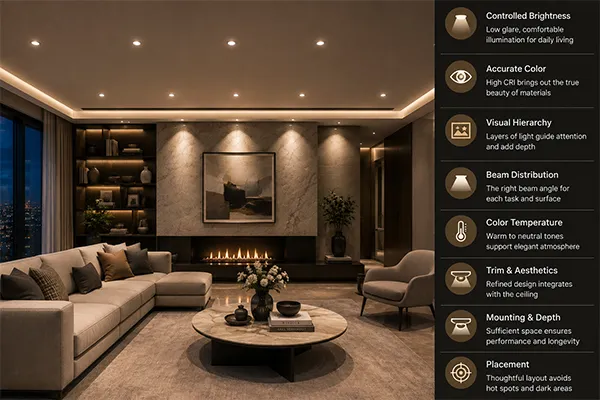
Luxury Is a Lighting Outcome, Not a Single Product Grade
I have seen project teams ask for “the highest CRI,” “the brightest option,” or “the thinnest trim” as if one choice can solve the whole project. Those features may be important, but they answer different questions.
For example:
- A high CRI LED downlight may help timber, stone, artwork, fabrics, and skin tones appear more natural.
- A narrow trim or trimless detail may support a clean ceiling aesthetic.
- A higher lumen output may help where there is limited fixture quantity or a demanding visual task.
- A narrow beam angle may add contrast to artwork, a wall texture, or a display feature.
- A wide beam angle may create softer ambient coverage in open areas.
However, a high-output downlight can feel uncomfortable in a low ceiling. A high-CRI fixture can still produce an unattractive result if the color temperature conflicts with finishes. A minimalist trim can look refined in a sample board but become difficult to coordinate with ceiling thickness, cut-out tolerances, or maintenance access.
I treat luxury lighting as a combination of visual comfort, material presentation, installation detail, and reliability—not as a label attached to one fixture.
Questions We Ask Before Suggesting a Downlight Combination
At Upward Lighting, our role is to translate purchasing and project requirements into manufacturable product options. We can discuss parameters such as color temperature, wattage, beam angle, CRI, and finish colors. Still, I do not present supplier-side input as a replacement for a lighting designer’s calculations or site review.
Before we suggest LED downlights, I would ask:
- What is the room’s primary use? Is it for relaxing, circulation, grooming, dressing, cooking, reading, or displaying finishes?
- What atmosphere does the designer want? Calm, dramatic, gallery-like, bright, intimate, or hospitality-inspired?
- What are the ceiling constraints? Confirm ceiling depth, cut-out size, insulation conditions, access space, and trim detail.
- What surface materials are present? Stone, wood, polished metal, dark paint, marble, textured plaster, and artwork react differently to light.
- Where will fixtures sit relative to walls and furniture? Placement affects scalloping, shadows, reflected glare, and perceived brightness.2
- What needs customization? A project may need a special finish, a specific CCT, a revised wattage, or a selected beam angle.
- What is the approval process? A physical sample and mock-up review can reveal issues that a data sheet cannot.
These questions help buyers avoid the common mistake of treating every ceiling point as identical.
How Should You Specify LED Downlights for Luxury Residential Rooms?
A single downlight specification may simplify procurement, but it can make a high-end home feel repetitive and poorly balanced. Bedrooms, bathrooms, corridors, wardrobes, and feature zones have different visual demands. I recommend standardizing where possible without forcing every room into the same lighting behavior.
LED downlights for luxury residential rooms should be grouped by room function and spatial condition. Teams should vary beam angle, output, color temperature, trim, cut-out, and placement where needed, while limiting the number of SKUs enough to keep procurement, installation, and future replenishment manageable.
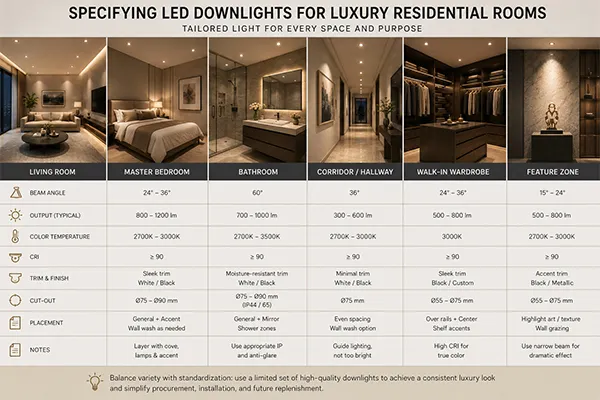
Living Rooms and Feature Areas
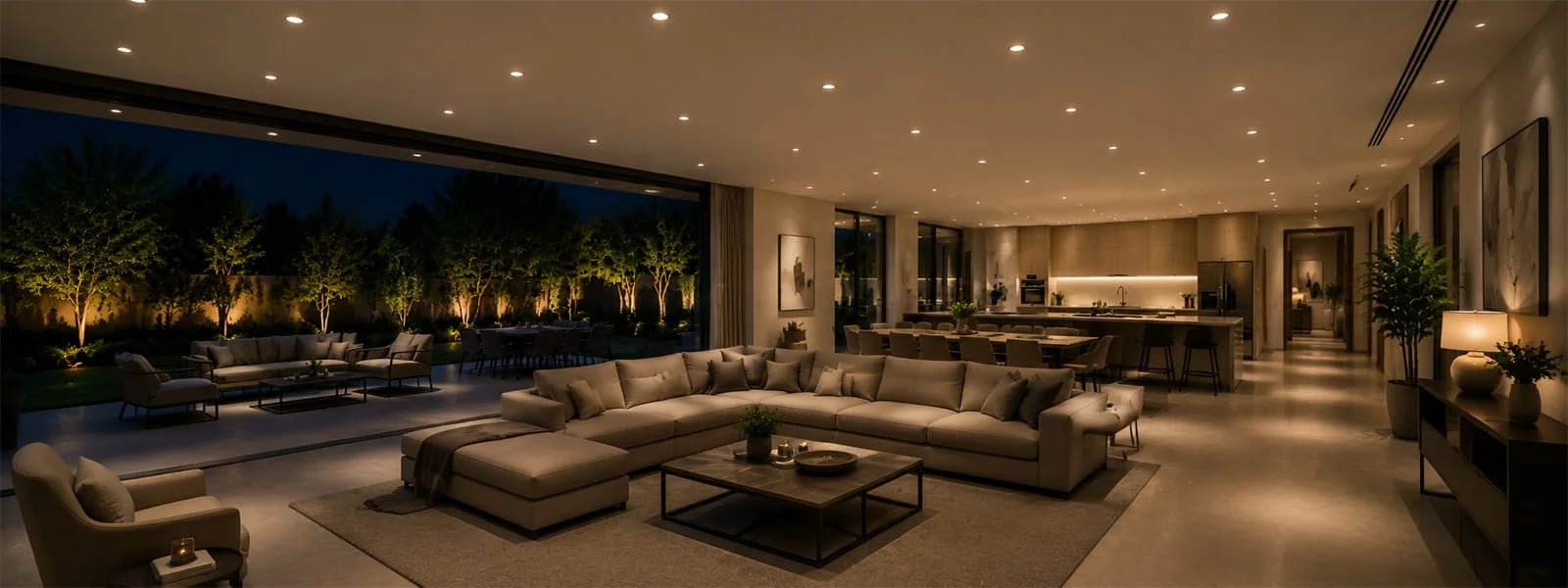
Living rooms often need layers of light rather than uniform brightness. LED downlights can provide ambient illumination, but they should not compete with decorative pendants, wall lights, concealed linear lighting, or feature lighting.
For a living area, I would review:
- Ceiling height and furniture layout
- Artwork, wall textures, and decorative joinery
- Seating positions that may face the fixture
- The location of televisions and reflective surfaces
- Whether dimming is planned
- The desired contrast between general lighting and focal points
A wide-beam downlight may work for soft ambient coverage, while a narrower beam may be more appropriate for a feature wall or artwork. The final choice depends on spacing, mounting height, and the lighting layout. A lighting designer should verify these details through calculations and on-site evaluation.
Bedrooms and Corridors
Bedrooms require a different mindset. Residents usually need enough light for movement, dressing, and cleaning, but they also need a calm environment. Excessive brightness directly above a bed can make the space feel less restful.3
Corridors are often treated as simple transit zones, but they strongly affect the perceived quality of a residence. Poor spacing can create alternating bright and dark patches. Excessive output can make a corridor feel clinical. A coordinated downlight layout can instead create an even, welcoming path while maintaining the interior rhythm.
Bathrooms and Wardrobes
Bathrooms and wardrobes are task-oriented spaces. People need to see faces, clothing colors, grooming details, and storage contents. Yet strong overhead light alone can create unflattering shadows4.
For these areas, teams should consider a combination of downlights and lighting near mirrors or inside wardrobes. The downlight package should support the overall scheme, not carry every task by itself.
| Room or Zone | Main Visual Need | Downlight Considerations | Common Risk |
|---|---|---|---|
| Living room | Relaxation and visual hierarchy | Beam control, dimming, finish coordination | Flat, over-lit ceiling |
| Corridor | Safe, comfortable circulation | Spacing, beam overlap, ceiling rhythm | Bright-dark striping |
| Bedroom | Calm atmosphere and basic tasks | Controlled output, glare awareness | Harsh light near bed |
| Bathroom | Grooming and cleaning | CRI, task-light coordination, moisture suitability | Face shadows or excessive contrast |
| Wardrobe | Clothing selection | Color appearance, shelf shadows, compact installation | Inaccurate color perception |
| Feature wall | Texture and emphasis | Beam angle, aiming, distance from wall | Unwanted scallops or glare |
I always recommend that teams use this table as a starting point, not as a universal design prescription. The final LED downlight layout should be reviewed by a qualified lighting professional for the actual site conditions.
Which Downlight Specifications Matter Most in a Luxury Home?
Specification sheets can make comparison seem easy, but they can also distract teams from the real application. Buyers may compare wattage, lumens, CRI, and cut-out dimensions without asking how those figures work together in the completed interior. I focus on the relationship between specifications and room experience.
The most important LED downlight specifications for luxury homes are the ones that match the room’s task, ceiling condition, surface finishes, and desired ambience. Buyers should assess output, beam angle, color temperature, CRI, glare-control design, trim style, cut-out size, driver compatibility, and dimming requirements as an integrated package.
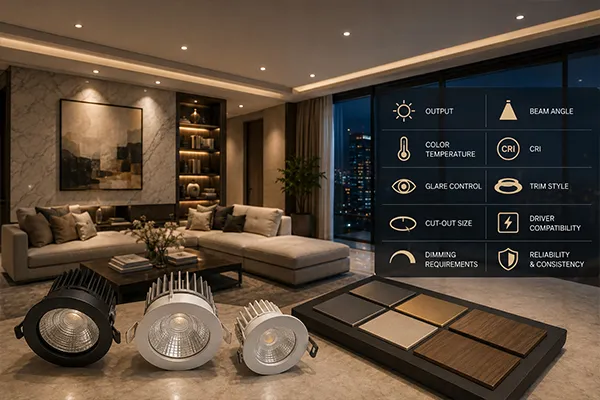
Output and Wattage Are Not the Same Decision
Wattage indicates electrical consumption, while lumens indicate the light output claimed by the product.5 Neither figure independently tells a buyer whether the room will feel comfortable.
A higher-wattage LED downlight may be useful in a high ceiling or task-focused zone. However, it may create unwanted brightness in a compact bedroom, hallway, or low-ceiling lounge. Fixture spacing, reflectance of walls and floors, beam angle, dimming range, and other luminaires all influence the outcome.
Beam Angle Shapes the Space
Beam angle affects how light spreads from the downlight.6 A narrower beam concentrates light and can create stronger contrast. A wider beam distributes light across a larger area and may support more even ambient illumination.
Neither is automatically better.
| Specification | What It Influences | Buyer Review Question |
|---|---|---|
| Beam angle | Spread, contrast, wall effect | Is the light intended for ambient, task, or accent use? |
| CCT | Perceived warmth or coolness | Does it suit the selected stone, timber, paint, and fabrics? |
| CRI | Color appearance | Are accurate material and skin-tone rendering priorities? |
| Lumen output | Brightness potential | Does the layout and ceiling height justify this output? |
| Cut-out | Installation compatibility | Does it match the approved ceiling and contractor opening? |
| Trim finish | Ceiling integration | Does it coordinate with joinery, metalwork, and ceiling color? |
| Driver and dimming | Control performance | Has compatibility been checked with the planned control system? |
CRI, Color Temperature, and Finish Coordination
High CRI can be valuable in luxury residences because materials are often a major part of the design story. Marble veining, warm timber, textured fabrics, decorative paint, and curated artwork may all benefit from thoughtful color rendering.
Still, I avoid saying that high CRI alone creates a luxurious result. The selected color temperature must also work with the room palette and intended mood.7 A finish sample should be reviewed under proposed lighting where possible.
The same principle applies to trim finishes. White, black, brushed metallic, and custom-painted trims can all work well. The correct choice depends on whether the project wants the fixture to disappear, create a graphic ceiling rhythm, or coordinate with other metal elements.
How Can Buyers Evaluate LED Downlight Suppliers for Luxury Projects?
A luxury specification is only useful if the supplier can manufacture it consistently, communicate clearly, and support the project timeline. Buyers face risk when approved samples differ from production units, delivery dates change without notice, or a future replenishment order cannot match the original batch.
Buyers of LED downlights for luxury residential projects should evaluate suppliers beyond price and product appearance. They should review sample control, customization capability, driver selection, thermal design information, aging-test procedures, batch consistency, documentation, packaging, delivery coordination, and replenishment support before placing a project order.
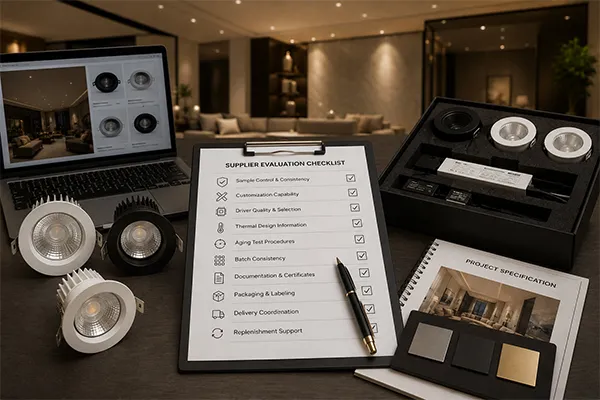
Separate Manufacturing Controls From On-Site Results
Manufacturing controls matter, but they do not prove that an installed project will meet every lighting expectation. A factory can verify product assembly and run production checks, while the completed visual outcome still depends on lighting design, wiring, dimming compatibility, installation quality, ceiling construction, and site conditions.8
At Upward Lighting, we conduct a 100% aging test for 4 to 8 hours before shipment as part of our production process. We also support OEM/ODM adjustments for parameters including CCT, wattage, beam angle, CRI, and surface finish. These controls can help purchasers evaluate product preparation and production discipline. They should not be interpreted as proof of long-term site performance or a substitute for a post-installation inspection.
A Practical Supplier Review Checklist
Before confirming a luxury residential downlight order, I recommend asking suppliers for clear answers to the following:
- Can the supplier provide approved physical samples before mass production?
- Can the supplier confirm the cut-out, trim diameter, fixture depth, and driver dimensions?
- What are the available CCT, CRI, beam-angle, wattage, and finish options?
- Is the selected driver compatible with the project’s planned dimming or control system?
- How does the supplier manage production batch consistency?
- What aging-test or quality-control process is used before shipment?
- Can the supplier support a small pilot order or mock-up quantity?
- What packaging method is used to protect trims and finishes?
- What is the lead time for samples, production, and replacement quantities?
- Can the supplier provide applicable certification documents for verification?
Our products may be supplied with documents such as CE and RoHS certifications where applicable. Buyers should always verify the current documents, product scope, destination-market requirements, and project-specific compliance obligations with qualified parties.
Why Replenishment Planning Matters
Luxury residences often require replacement units after handover, during phased installation, or when project scope changes. A buyer should ask early whether the original finish, color temperature, beam angle, and driver configuration can be reproduced later.
I have found that early SKU discipline helps. A project does not need one model for every room, but it should avoid unnecessary variations. The best procurement strategy usually balances room-specific performance with a manageable set of approved downlight configurations.
What Should Be Approved Before Ordering Luxury Residential Downlights?
Project teams often discover problems after production begins because the approved information was incomplete. A product photo, a price quotation, and a basic wattage selection do not fully define a luxury downlight package. I recommend creating a clear approval record before issuing the purchase order.
Before ordering LED downlights for a luxury residential project, buyers should approve the physical sample, key dimensions, cut-out, finish, color temperature, beam angle, wattage, driver arrangement, dimming compatibility, packaging, quantities, delivery schedule, and documentation requirements. This reduces avoidable confusion between design intent, factory production, and site installation.
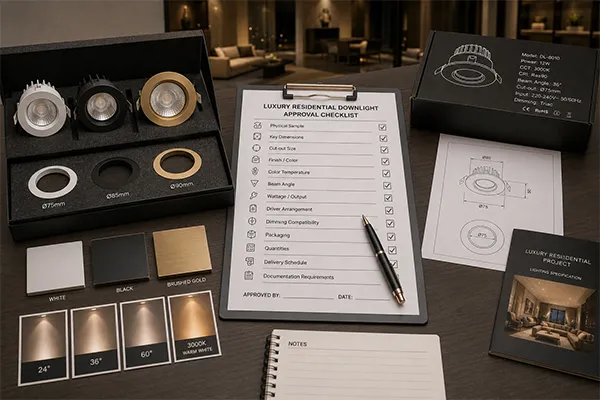
Build a Sample Approval Record
A practical approval record can include photos, signed samples, drawings, and written specifications. This process helps purchasing managers, site teams, designers, and suppliers work from the same reference.
I suggest documenting:
- Product identification: model code, trim type, finish, dimensions, and cut-out.
- Lighting configuration: CCT, CRI target, beam angle, wattage, and driver type.
- Control details: dimming method, compatibility requirements, and any approved control equipment.
- Installation information: ceiling depth, access requirements, wiring arrangement, and location notes.
- Visual references: approved sample photographs beside key ceiling and interior finishes.
- Commercial details: quantity by SKU, spare-unit allowance, packaging, labeling, lead time, and delivery destination.
- Quality and compliance documents: requested reports, certifications, and inspection requirements.
A simple approval matrix can reduce late-stage arguments about whether a production item matches the sample.
Use Mock-Ups for High-Risk Areas
A mock-up is especially useful where the project includes:
- Dark ceilings or highly reflective stone
- Very low or very high ceiling heights
- Trimless installation details
- Bespoke metallic finishes
- Artwork walls or textured surfaces
- Multiple dimming scenes
- Tight coordination with air grilles, sprinklers, speakers, and linear lighting
A mock-up will not eliminate all site risks, but it can expose problems early.9 It can show whether the beam effect feels too sharp, whether the trim is visually dominant, or whether the finish clashes with nearby materials.
Frequently Asked Questions
What CRI should LED downlights have for a luxury residence?
Many luxury-residential teams consider high CRI important where finishes, artwork, fabrics, and skin tones need careful presentation. However, the appropriate CRI depends on the application and budget. Buyers should review CRI together with color temperature, beam angle, dimming, and sample performance.
Should every room use the same color temperature?
No. A project may choose a consistent color-temperature strategy, but every room does not automatically need the same setting. Living rooms, bedrooms, bathrooms, wardrobes, and feature zones can have different visual needs. A lighting designer should review the overall scene and material palette.
Are trimless LED downlights always better for luxury interiors?
Trimless LED downlights can support a minimalist ceiling appearance, but they require careful coordination with ceiling construction, finishing quality, access, and maintenance planning. A visible trim can also look premium when its color, size, and finish suit the interior design.
Does a factory aging test guarantee long-term project performance?
No. A factory aging test is a production-quality control step, not a guarantee of installed performance or service life.10 Long-term results also depend on thermal conditions, wiring, drivers, controls, installation quality, operating hours, and maintenance practices.11
What should I ask a downlight manufacturer before requesting a quotation?
I recommend sharing room use, ceiling drawings, cut-out requirements, preferred CCT, CRI, beam angle, wattage range, trim finish, quantities, target delivery date, dimming requirements, and destination market. This information helps a supplier prepare a more relevant quotation and sample proposal.
Conclusion
LED downlights for luxury residential projects should support the way people live in each space, not simply meet a generic “premium” specification. I recommend evaluating room function, visual comfort, material appearance, beam distribution, installation constraints, and supply reliability together. Physical samples, mock-ups, clear approval records, and qualified lighting-design review can reduce costly surprises. If you are sourcing a customized residential downlight package, we at Upward Lighting can help you review manufacturable options, prepare OEM/ODM samples, and coordinate a practical delivery plan.
"IES Playground – Just another IES WordPress site.", https://playground.ies.org/. Lighting guidance identifies glare, uneven luminance distribution, and color-rendering characteristics as factors that influence visual comfort and the perceived appearance of interior surfaces. Evidence role: mechanism; source type: institution. Supports: That glare, luminance distribution, and color-rendering properties affect visual comfort and the appearance of illuminated surfaces.. Scope note: This supports the general lighting mechanism rather than proving the visual outcome of any particular residential project. ↩
"Text-Alternative Version: Glare in LED Outdoor Lighting", https://www.energy.gov/cmei/ssl/text-alternative-version-glare-led-outdoor-lighting. Lighting-design guidance explains that luminaire location and spacing, together with surface reflectance and viewing geometry, affect shadow formation, wall-washing patterns, reflected glare, and perceived brightness. Evidence role: mechanism; source type: education. Supports: That luminaire spacing, mounting position, surface reflectance, and viewing direction influence wall brightness patterns, shadows, and reflected glare.. Scope note: The resulting effect depends on the luminaire photometry, room geometry, finishes, and observer position. ↩
"Eurac Research - Eurac Research", https://www.eurac.edu/en. Research on indoor and nocturnal light exposure indicates that unsuitable bedroom lighting can affect sleep-related physiology and perceived comfort, supporting the use of controlled lighting in rest spaces. Evidence role: general_support; source type: research. Supports: That exposure to inappropriate or excessive light in bedroom settings can affect comfort and sleep-related outcomes.. Scope note: Studies of light exposure and sleep do not directly establish that a downlight above every bed will make a particular bedroom feel less restful. ↩
"Sexual grooming", https://en.wikipedia.org/wiki/Sexual_grooming. Lighting guidance for grooming areas notes that overhead-dominant illumination can cast facial shadows, whereas lighting near the mirror can improve frontal and vertical illumination. Evidence role: mechanism; source type: education. Supports: That overhead-dominant lighting may leave the face insufficiently illuminated from the front and can produce shadows relevant to grooming tasks.. Scope note: Appropriate fixture placement and illuminance depend on mirror size, user position, luminaire distribution, and local electrical requirements. ↩
"How many lumens should be cultured in the conservative ...", https://pubmed.ncbi.nlm.nih.gov/20455693/. U.S. energy-efficiency guidance distinguishes watts, which measure electrical power use, from lumens, which measure a lamp's light output. Evidence role: definition; source type: government. Supports: That watts express electrical power and lumens express the quantity of visible light emitted as luminous flux.. Scope note: Rated lumens and watts do not by themselves determine illumination, glare, or comfort in an installed room. ↩
"Home - Careers Naval Nuclear Laboratory", https://navalnuclearlab.energy.gov/. Lighting terminology defines beam angle as an angular measure of a luminaire's light distribution, making it relevant to the area over which its output is distributed. Evidence role: definition; source type: institution. Supports: That beam angle is used to describe the angular spread of a luminaire's emitted light and is relevant to light distribution.. Scope note: Beam angle does not alone describe the complete photometric distribution, spacing performance, or visual effect of a fixture. ↩
"Home - Careers Naval Nuclear Laboratory", https://navalnuclearlab.energy.gov/. Lighting guidance defines correlated color temperature as a descriptor of the apparent warm or cool character of white light, a property relevant to the visual character of an interior. Evidence role: definition; source type: government. Supports: That correlated color temperature characterizes the apparent warm-to-cool appearance of white light.. Scope note: Perceived mood and coordination with a palette are context-dependent and also depend on illuminance, color rendering, daylight, and surface colors. ↩
"Foreign-Produced Direct Product Rule Additions, and ...", https://www.federalregister.gov/documents/2024/12/05/2024-28270/foreign-produced-direct-product-rule-additions-and-refinements-to-controls-for-advanced-computing. Lighting-system guidance recognizes that installed performance depends not only on equipment specifications but also on design, installation, controls compatibility, and commissioning. Evidence role: general_support; source type: government. Supports: That installed lighting performance depends on design, installation, controls integration, and commissioning in addition to product characteristics.. Scope note: This does not assess the quality-control practices or installed performance of any named manufacturer. ↩
"Online University, Tuition-Free, Accredited Degrees ...", https://www.uopeople.edu/. Lighting-design practice uses representative mock-ups to assess fixture integration, light distribution, glare, controls, and interactions with architectural finishes before final installation. Evidence role: general_support; source type: institution. Supports: That full-scale or representative lighting mock-ups are used to evaluate fixture appearance, distribution, glare, controls, and material interactions before final implementation.. Scope note: A mock-up may not replicate all room geometries, daylight conditions, operating modes, or installation variables found across the completed project. ↩
"NIST ICSD Web Site", https://icsd.nist.gov/. LED reliability literature distinguishes production burn-in and accelerated testing from demonstrated field service life, because operating temperature, electrical conditions, and system design affect long-term performance. Evidence role: mechanism; source type: research. Supports: That burn-in and accelerated tests can screen for early failures or characterize reliability but are not equivalent to a guarantee of field life under all operating conditions.. Scope note: The relevance of any test depends on its duration, stress conditions, failure criteria, and the actual use environment. ↩
"Bureau of Land Management: Home", https://www.blm.gov/d8-home. Technical guidance on LED systems identifies thermal conditions, driver and electrical performance, and operating environment as important determinants of lumen maintenance and system reliability. Evidence role: mechanism; source type: government. Supports: That LED and LED-luminaire performance and lifetime are affected by thermal management, drivers, electrical conditions, and operating environment.. Scope note: Installation workmanship, maintenance, and control compatibility may require separate project-specific verification beyond component-level reliability guidance. ↩