LED downlights for museums and galleries can become a weak point in a project when contractors select them from a standard specification sheet without defining their actual lighting role. A high-CRI label alone does not solve glare, vertical illumination, conservation concerns, or coordination with track lights. We recommend starting with the lighting task, then building an RFQ-ready configuration around it.
LED downlights for museums and galleries should primarily be selected according to their defined role in the overall lighting scheme, such as ambient lighting, circulation lighting, or limited vertical illumination. Contractors should confirm where track spotlights, wall washers, and specialist exhibit luminaires are needed instead. CRI, color temperature, beam angle, glare control, dimming, and installation constraints should follow that role rather than lead the decision.
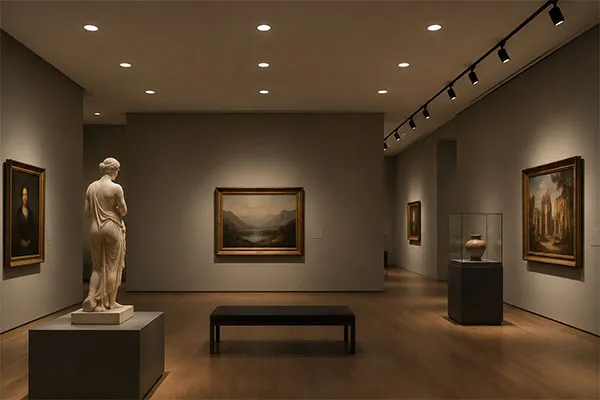
Museum and gallery projects often look simple on a reflected ceiling plan, but the lighting brief can hide many unanswered questions. We have discussed exhibition-lighting requirements with contractors, lighting brands, and distribution customers, and we know that a vague phrase such as “museum-grade downlight” is not yet a quotable specification. The right questions help turn a broad concept into a more controlled purchasing decision.
What Role Should LED Downlights for Museums and Galleries Play?
A contractor may receive a request for recessed lighting throughout a gallery and assume that one downlight model can handle every area. That assumption can create uneven walls, weak artwork emphasis, glare complaints, or expensive late-stage substitutions. The first step is to define exactly what each luminaire is expected to illuminate.
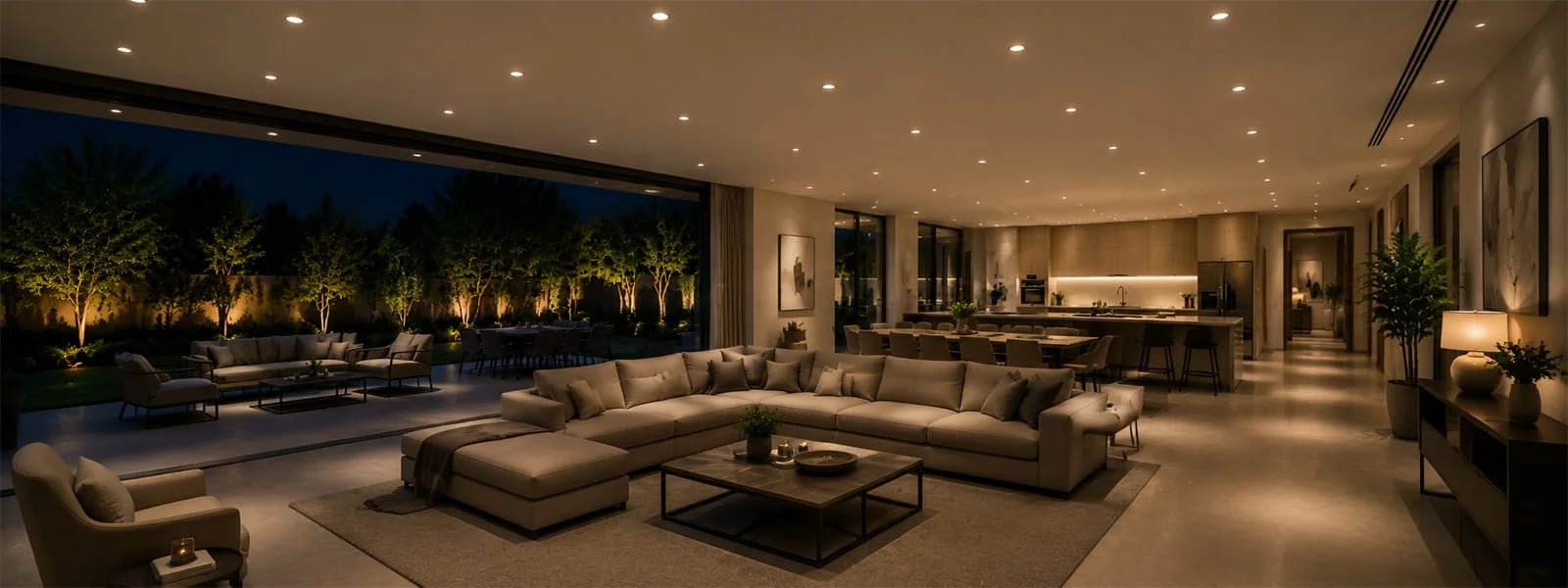
LED downlights for museums and galleries are usually most appropriate for ambient, circulation, and selected general lighting tasks. They may support some vertical illumination when the optical design and mounting layout are suitable, but they do not automatically replace track spotlights for accent lighting or wall washers for uniform wall illumination1.
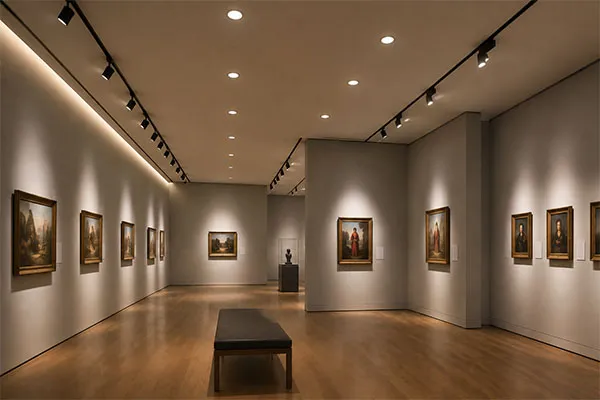
Start With the Lighting Task, Not the Product Name
When we receive an enquiry, we would first ask the contractor or lighting buyer to divide the space into lighting tasks. This approach avoids asking one recessed downlight to perform several conflicting jobs.
A museum can include many functional zones:
- Main exhibition rooms
- Temporary exhibition rooms
- Gallery circulation paths
- Entrance and reception areas
- Educational spaces
- Retail corners
- Storage-adjacent areas
- Restrooms and back-of-house corridors
Each zone may require a different visual effect and control strategy. A circulation route may need calm, comfortable ambient light. A display wall may need a controlled vertical lighting approach. A sculpture, object case, or featured painting may need adjustable accent lighting from a track-mounted spotlight rather than a fixed recessed source.
| Lighting task | Typical luminaire approach | Questions contractors should confirm |
|---|---|---|
| Ambient lighting | Recessed downlights, indirect lighting, or a combined approach | What is the ceiling height? Is a calm, even atmosphere required? |
| Accent lighting | Track spotlights or adjustable recessed accent luminaires | Which exhibits need emphasis? Will exhibit layouts change? |
| Vertical wall illumination | Wall washers, asymmetric luminaires, or designed downlight layouts | Is the wall a display surface? Is uniformity important? |
| Circulation lighting | Downlights with controlled glare | Where do visitors look while walking? Are there low ceilings? |
| Display case lighting | Specialist integrated or remote lighting solutions | What does the case supplier and conservation team require? |
Why Downlights Should Not Be Treated as Universal Exhibit Lights
Downlights are fixed in the ceiling. This fixed position can make them efficient for general illumination, but it can also limit their flexibility. Galleries often change artwork, partition walls, object locations, and viewing routes. Track lighting can be more adaptable because the direction and aiming of spotlights can change as the exhibition changes.2
We have seen early RFQs that simply state “recessed LED downlights, high CRI.” We would clarify whether the requested downlights are intended to light the floor, the walls, or the exhibits. That one question often changes the recommended beam angle, recessed depth, quantity, dimming method, and even the preferred luminaire category.
A downlight specification should describe a lighting task. It should not rely only on a marketing term such as “gallery light” or “museum-grade.”
Contractors should also coordinate the downlight plan with the locations of track rails, wall washers, air-conditioning grilles, sprinklers, access panels, and ceiling joints. A good luminaire can still create a poor result if the ceiling layout places it in the wrong relationship to the display wall or visitor path.
Is High CRI Enough for LED Downlights for Museums and Galleries?
High CRI is often the first requirement buyers mention, especially when artwork, textiles, printed materials, and colored finishes are involved. However, high CRI alone can create false confidence. A high-quality lighting scheme depends on how multiple parameters work together, not on one index printed on a catalogue page.
High CRI is an important starting point for LED downlights for museums and galleries, but it is not a complete suitability test. Contractors should also consider color temperature, spectral characteristics where relevant, beam distribution, dimming behavior, glare control, exhibit sensitivity, and the museum’s intended visual presentation.
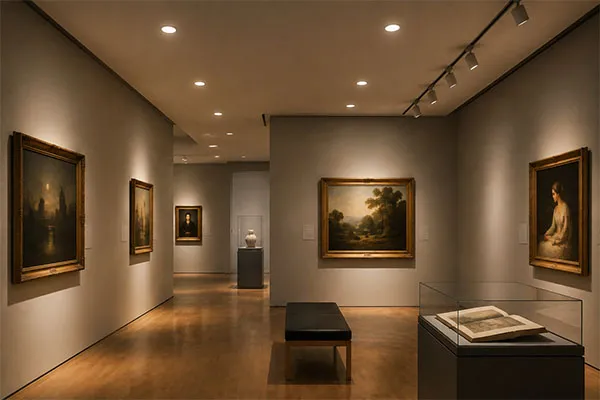
CRI Should Be Interpreted in Context
CRI, or Color Rendering Index, indicates how faithfully a light source renders colors compared with a reference source under a defined method.3 In practical procurement, buyers commonly request CRI 80, CRI 90, or higher. For exhibition spaces, a CRI 90 target may be appropriate in many briefs, but the museum, lighting consultant, or project designer should define the actual requirement.
We would not advise a contractor to assume that “the highest CRI available” is always the best purchasing decision. Higher CRI can influence product availability, lead time, efficacy, and pricing.4 More importantly, it does not answer how the artwork should appear under the complete lighting scheme.
A complete discussion should include:
- Color temperature: Warm, neutral, or cooler light changes the perceived mood of materials and finishes.
- Consistency: Contractors should ask about color consistency expectations across luminaires and replacement batches.
- Beam quality: A good CRI value cannot correct an unsuitable beam angle or uneven distribution.
- Dimming performance: Exhibition spaces may need scene setting, event modes, cleaning modes, or reduced-light operation.
- Visual hierarchy: The lighting should help visitors understand what deserves attention first.
Ask About the Curatorial Intent
A gallery may aim for a warm and intimate presentation. Another venue may want a clean, contemporary neutral appearance. The same painting, sculpture, or architectural finish can look different under different color temperatures and beam distributions.
In our supplier-side discussions, we would ask questions such as:
- What CCT does the lighting consultant specify: 2700K, 3000K, 3500K, 4000K, or another value?
- Is the downlight lighting the visitor circulation area, a wall, or an exhibit zone?
- Will track spotlights provide the primary artwork emphasis?
- Does the project require dimming, and which protocol is planned?
- Are there sample boards, mock-up requirements, or approval procedures defined by the project team?
The museum’s conservation team or qualified lighting advisor should validate any application-specific requirements related to sensitive works. We can help translate confirmed requirements into a downlight configuration, but we should not treat a general CRI claim as conservation approval or as proof of museum suitability.
How Can Contractors Control Glare in Museum and Gallery Downlights?
Glare is one of the most common causes of dissatisfaction in exhibition lighting. Visitors may see bright apertures when looking toward displays, reflective floors, framed artwork, glass cases, or polished surfaces. A low-glare product description is useful, but it does not guarantee comfortable conditions in every ceiling and viewing arrangement.
Glare control for LED downlights for museums and galleries depends on the luminaire’s shielding design and on the installed environment.5 Contractors should assess recessed depth, trim finish, beam angle, ceiling height, mounting position, aiming relationships, reflectance, and visitor sightlines before finalizing a low-glare downlight selection.
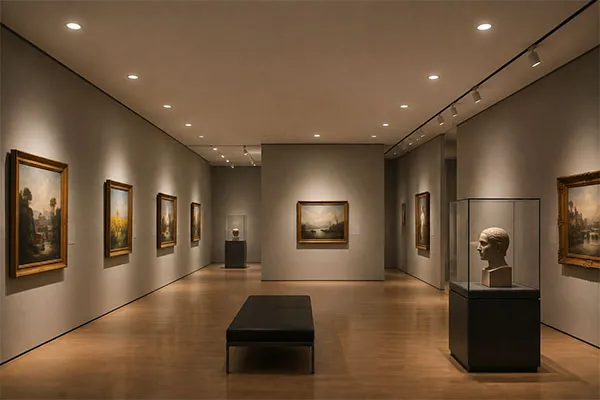
Product Design Is Only One Part of Glare Control
A deep-recessed light source, dark inner reflector, honeycomb louver, anti-glare trim, or carefully designed optic may help reduce visible brightness at common viewing angles. However, these features must be considered with the full installation geometry.
For example, a downlight may appear comfortable in a product sample board but become visually intrusive when it is mounted near a display wall. It may also create reflected glare on glass-framed artwork if its location is not coordinated with the viewing angle.
We would normally clarify the following project conditions:
| Glare-control factor | Why it matters | RFQ information to request |
|---|---|---|
| Recess depth | A deeper light source may reduce direct view of the LED | Maximum ceiling void and preferred trim style |
| Beam angle | A wide beam can create broad brightness; a narrow beam can create harsh contrast | Required distribution and lighting task |
| Ceiling height | Mounting height affects brightness, spacing, and viewing angles | Finished ceiling height by room |
| Mounting location | Placement can affect wall reflections and viewer comfort | Ceiling plan and display-wall positions |
| Surface reflectance | White ceilings, glossy floors, and glass affect perceived brightness | Main finish schedule where available |
| Control system | Dimming can support different operating scenes | Dimming protocol and control interface |
Avoid “Low Glare” as a Standalone Procurement Requirement
A phrase such as “UGR < 19” may appear in commercial lighting specifications, but contractors should not use it as a universal shortcut for exhibition comfort. UGR calculations depend on room geometry, reflectance, observer position, luminaire photometry, and layout assumptions.6 A value stated in a catalogue may not describe the final gallery arrangement.
We recommend asking for relevant photometric documentation where available and reviewing it with the lighting designer. The project team should assess the final arrangement, especially in areas with glass, reflective finishes, low ceilings, and frequent visitor viewing toward the ceiling.
I have found that glare conversations become much more productive when contractors share a simple reflected ceiling plan and section drawing. Even a basic drawing helps us see whether a recessed downlight is being asked to illuminate a circulation route, a wall, or an object zone. That clarity makes it easier to discuss trim style, beam selection, and the need for separate accent luminaires.
Do Low-UV and Low-IR Claims Protect Museum Exhibits?
Buyers often request low-UV or low-IR LED lighting when a project contains artwork, photographs, paper, fabrics, or other potentially sensitive materials. These are understandable questions. Still, a product-level statement about UV or infrared should not be treated as a complete exhibit-protection strategy.
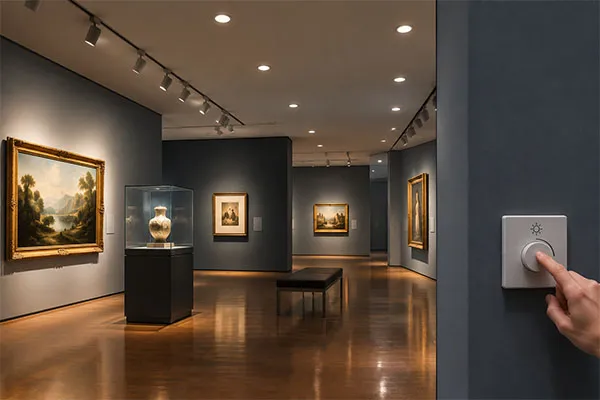
Low-UV and low-IR messaging for LED downlights for museums and galleries can be relevant to source selection, but it does not by itself protect exhibits. The museum’s conservation team or qualified lighting advisor should confirm requirements for illuminance, cumulative exposure, operating hours, controls, exhibit sensitivity, and any project-specific verification process.
Conservation Is a System-Level Consideration
The protection of museum objects involves more than the type of light source.7 Light exposure can depend on the amount of light reaching an object, the duration of exposure, the object’s sensitivity, daylight contribution, display rotation, lighting scenes, and operational controls.8
Therefore, a contractor should be cautious when a supplier’s catalogue uses broad claims such as “safe for artwork” or “conservation lighting.” Those phrases may not define the project’s actual conservation requirements. The museum or its appointed advisors should provide the relevant criteria.
A responsible lighting specification discussion can include:
- Which exhibit categories will be present?
- Which areas contain sensitive materials?
- Does the museum require different scenes for open hours, events, cleaning, or maintenance?
- Will daylight enter the exhibition area?
- Does the control system support scheduled dimming or switching?
- Who is responsible for confirming application-specific conservation requirements?
- Does the tender require particular documents, declarations, or test reports?
Controls Can Be as Important as the Luminaire
Dimming and controls can help the project team manage lighting scenes.9 Depending on the project design, buyers may request phase-cut dimming, 0–10V, DALI, or another control compatibility requirement. The chosen method should be confirmed early because the LED driver, control system, wiring arrangement, and commissioning process must align.10
At our factory, we can discuss configurable elements such as CCT, power, beam angle, CRI target, housing finish, and compatible dimming options for suitable downlight models. However, we would need a confirmed technical brief before quoting a configuration. We would also recommend that buyers verify any requested CE, RoHS, or other compliance documents for the exact product version and destination market.
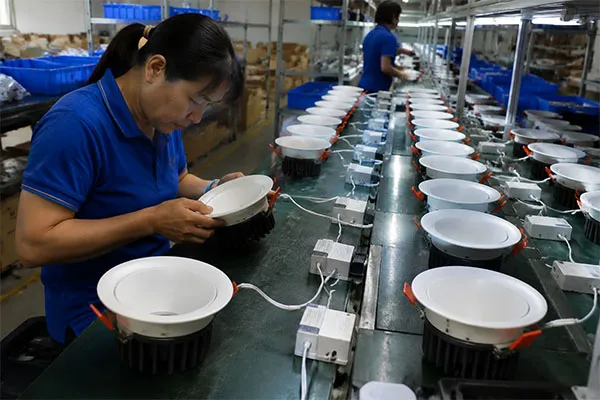
Our production process includes 100% aging tests before shipment, typically for 4 to 8 hours depending on the product process. This manufacturing quality-control step supports shipment consistency, but it should not be confused with a museum conservation assessment, an onsite lighting validation, or an application-specific approval.
How Do You Create an RFQ for LED Downlights for Museums and Galleries?
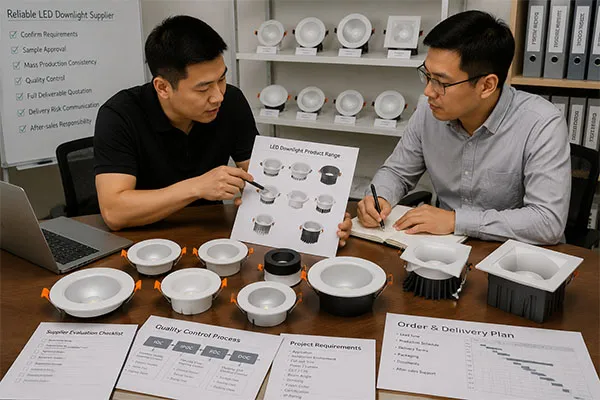
A vague enquiry makes it difficult to compare suppliers fairly. It can also lead to quotations that look similar on price but use different optics, drivers, CRI levels, trim constructions, and control compatibility. A structured RFQ reduces these hidden differences before procurement begins.
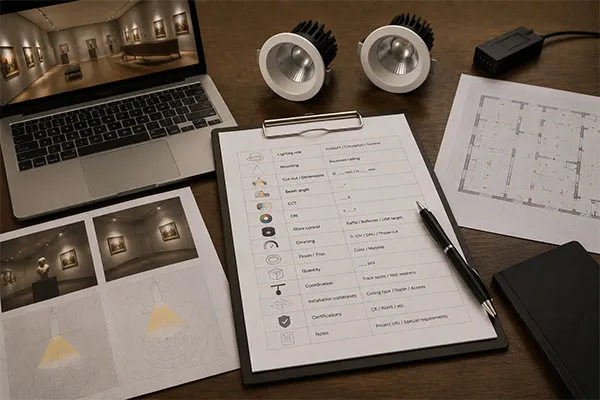
An RFQ for LED downlights for museums and galleries should define the lighting task, required distribution, CCT, CRI target, glare-control approach, dimming compatibility, installation constraints, quantity, and coordination with track spots or wall washers. Contractors should ask suppliers to quote against the same documented configuration.
Build the Specification in a Logical Sequence
We recommend that contractors create the RFQ in the same order that the lighting decision is made. First define the task. Then define the optical and installation requirements. Finally, request documentation, samples, commercial terms, and production details.
A practical RFQ checklist can include the following:
-
Project area and lighting role
- Ambient lighting, circulation, selected wall illumination, or another defined task
- Whether track spotlights or wall washers are included elsewhere in the scheme
-
Optical requirements
- Required beam angle or distribution
- CCT requirement
- CRI target
- Any color-consistency requirement specified by the project team
-
Glare-control requirements
- Deep recessed, dark reflector, honeycomb louver, or trim preference
- Ceiling height and mounting location
- Sightline concerns near walls, cases, or reflective surfaces
-
Electrical and control requirements
- Input voltage and regional requirements
- Dimming type, such as DALI, 0–10V, or phase-cut
- Emergency lighting coordination if required by the building design
-
Mechanical requirements
- Ceiling cutout
- Maximum fixture height above the ceiling
- Trim diameter and housing color
- IP requirement where relevant
- Access and maintenance constraints
-
Commercial and supplier requirements
- Quantity by model
- Sample requirement
- Required documents for the destination market
- Requested delivery date
- Packaging, labeling, and OEM branding requirements
Compare Quotations Beyond Unit Price
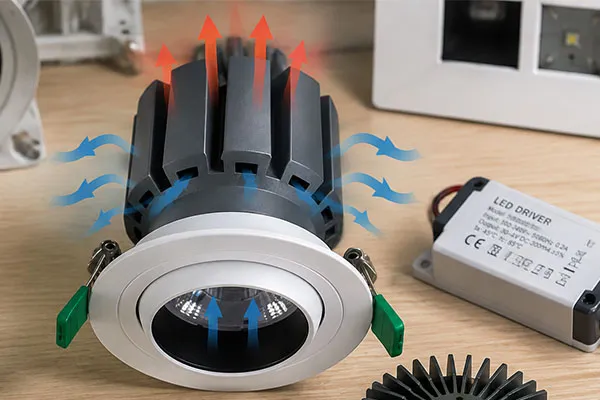
For procurement teams, the lowest unit price does not always represent the lowest project risk. Two downlights with the same nominal wattage may have different optics, drivers, thermal designs, trims, dimming compatibility, and production controls.11
| Comparison point | Why buyers should compare it |
|---|---|
| Exact LED configuration | CCT and CRI targets can affect performance and cost |
| Beam angle and optic | The optical distribution influences the lighting result |
| Driver and dimming method | Compatibility affects commissioning and future maintenance |
| Cutout and housing dimensions | Ceiling coordination can prevent installation delays |
| Trim and reflector finish | Finish influences appearance and perceived glare |
| Documentation | Buyers should verify documents for the quoted model and target market |
| Aging and inspection process | Quality-control procedures support consistent outgoing production |
| MOQ and lead time | These factors affect project scheduling and spare-parts planning |
As a China-based LED lighting manufacturer, we can support OEM and ODM discussions for suitable downlight configurations. We can work with contractors, importers, brands, and channel customers that need changes in CCT, power, beam angle, CRI target, surface color, and other practical parameters. Still, the museum or lighting consultant should validate the final application-specific lighting design before the order is released.
Frequently Asked Questions
Are LED downlights suitable for museum exhibition rooms?
LED downlights can be suitable for ambient lighting, circulation areas, and some defined general-lighting tasks in exhibition rooms. They do not automatically replace track spotlights for adjustable accent lighting or wall washers for uniform vertical illumination. Contractors should confirm each luminaire’s role within the full lighting scheme.
What CRI should contractors request for museum and gallery downlights?
Many exhibition briefs request CRI 90 or above12, but the required CRI target should come from the project lighting design and visual objectives. CRI should be evaluated alongside CCT, beam distribution, dimming, glare control, and the museum’s requirements for particular exhibit areas.
Can low-UV LED downlights prevent artwork damage?
Low-UV claims should not be treated as a complete protection solution. Exhibit protection also depends on illuminance, cumulative exposure, operating hours, daylight, controls, and material sensitivity. The museum’s conservation team or a qualified lighting advisor should confirm the relevant project requirements.
What information should be included in a gallery downlight RFQ?
A strong RFQ should include the lighting task, beam angle, CCT, CRI target, glare-control preference, ceiling height, cutout size, housing dimensions, dimming protocol, quantity, finish color, delivery requirements, and documentation required for the destination market.
Should museum downlights be dimmable?
Dimmable downlights can support scene setting, changing exhibitions, events, and operational flexibility. However, the project team should define the control protocol early, such as DALI, 0–10V, or phase-cut dimming. The driver, wiring, and commissioning plan must be compatible with that choice.
Conclusion
LED downlights for museums and galleries should be selected as part of a coordinated lighting system, not as a standalone “high-CRI” product decision. Contractors should first define the lighting task, then confirm where accent spotlights and wall washers are necessary. They should also assess glare, controls, ceiling constraints, and conservation-related requirements with the museum team and qualified advisors. If you need help converting an exhibition-lighting brief into a clear downlight RFQ, we can help you review configurable specifications and prepare a practical quotation basis.
"Mission Accomplished", https://ies.org/lda/mission-accomplished-2/. Lighting-design guidance distinguishes directional accent lighting from uniform vertical wall illumination and general ambient lighting; the appropriate luminaire depends on the intended visual task and photometric distribution. Evidence role: general_support; source type: institution. Supports: Guidance distinguishing accent lighting, general lighting, and vertical wall illumination, including the use of directional and wall-washing luminaires.. Scope note: This supports the functional distinction in principle; final luminaire selection still depends on the specific gallery geometry and photometric design. ↩
"(PDF) LIGHTING FOR MUSEUMS AND GALLERIES", https://www.academia.edu/29720166/LIGHTING_FOR_MUSEUMS_AND_GALLERIES. Museum-lighting guidance describes track-mounted luminaires as adaptable because their positions and aiming can be adjusted to accommodate changing displays. Evidence role: general_support; source type: education. Supports: Track lighting systems permit luminaires to be repositioned and aimed as display arrangements change.. Scope note: Adaptability varies with the installed track layout, electrical capacity, fixture type, and exhibition-planning constraints. ↩
"Color rendering index", https://en.wikipedia.org/wiki/Color_rendering_index. The general color-rendering index is a standardized measure that compares a test light source’s rendering of specified color samples with their appearance under an appropriate reference illuminant. Evidence role: definition; source type: institution. Supports: The definition and standardized basis of the general color-rendering index.. Scope note: CRI summarizes rendering for a prescribed sample set and does not by itself characterize every aspect of perceived color quality. ↩
"LED Basics", https://www.energy.gov/cmei/ssl/led-basics. Technical literature on LED spectral design reports that improving color-rendering performance can reduce luminous efficacy, because the spectrum must be modified to render a broader range of colors more faithfully. Evidence role: mechanism; source type: government. Supports: Higher color-rendering performance in LEDs can involve a trade-off with luminous efficacy.. Scope note: This evidence supports the efficacy trade-off; effects on availability, lead time, and price depend on individual products and market conditions. ↩
"Understanding UGR (Unified Glare Rating)", https://www.innerscene.com/SpecHelp/CircadianSky/ugr. Glare evaluation methods account for luminaire luminance and geometry together with observer position, background conditions, room dimensions, and surface reflectances, rather than treating glare as a product-only property. Evidence role: mechanism; source type: institution. Supports: Discomfort glare depends on source luminance and size as well as observer position, background luminance, room geometry, and surface reflectance.. Scope note: A general glare model does not replace calculations or visual assessment for the final gallery layout. ↩
"Algorithm of HDR image preparation for discomfort glare ...", https://www.academia.edu/88349606/Algorithm_of_HDR_image_preparation_for_discomfort_glare_assessment. The Unified Glare Rating method calculates discomfort glare for a specified observer and installation using luminaire photometry, spatial arrangement, room geometry, background luminance, and surface reflectances. Evidence role: definition; source type: institution. Supports: The parameters used in the Unified Glare Rating method and why its result is specific to a defined installation.. Scope note: A UGR result is conditional on its calculation assumptions and may not represent all viewing positions or a changed gallery arrangement. ↩
"Determination of the Annual Light Exposure Received by Two ...", https://repository.si.edu/bitstreams/c9cdf50c-340a-4757-baca-c301859d0afa/download. Museum-conservation guidance treats light damage as a function of an object's sensitivity and its cumulative exposure, including illuminance and duration, rather than as a property determined only by lamp technology. Evidence role: expert_consensus; source type: government. Supports: Museum-conservation guidance that light damage risk depends on cumulative exposure and material sensitivity in addition to the characteristics of the source.. Scope note: Conservation limits and management strategies must be tailored to the specific collection materials and display conditions. ↩
"Conservation and lighting - Museums Galleries Scotland", https://www.museumsgalleriesscotland.org.uk/advice-article/conservation-and-lighting/. Preventive-conservation guidance identifies illuminance, exposure duration, daylight contribution, material sensitivity, and exposure-management measures such as lighting controls or display rotation as relevant to light-damage risk. Evidence role: mechanism; source type: institution. Supports: Cumulative light exposure and collection-management measures, including daylight control and display rotation, are relevant to managing light-sensitive objects.. Scope note: The relative importance of these factors and any target exposure limits vary by object material, condition, and institutional policy. ↩
"Maximizing Energy Savings with New Technologies in ...", https://www.energy.gov/sites/prod/files/2015/11/f27/fupwg_fall2015_matour.pdf. Lighting-control guidance recognizes dimming and programmable controls as tools for adjusting lighting to operational needs and avoiding unnecessary illumination. Evidence role: general_support; source type: government. Supports: Dimming and lighting controls enable scene management and can reduce lighting operation when full output is unnecessary.. Scope note: Controls only deliver the intended operational or conservation benefits when they are properly specified, commissioned, and used. ↩
"The Energy and Operational Impacts of Using 0-10V ...", https://www.energy.gov/documents/ssl-impacts-010v-led-streetlightsdec2023pdf. LED lighting-control guidance notes that reliable dimming requires compatible drivers and control devices, appropriate wiring and control topology, and commissioning of the installed system. Evidence role: mechanism; source type: research. Supports: LED dimming performance depends on interoperability between drivers, controls, wiring, and commissioning.. Scope note: Specific compatibility requirements differ among phase-cut, 0–10 V, DALI, and other control architectures. ↩
"REA Refrigerated Display Case LED Lighting Performance ...", https://www.energy.gov/sites/prod/files/2014/04/f14/rea_refrig_display_spec.pdf. LED-lighting evaluation guidance recommends assessing photometric performance, efficacy, thermal management, driver characteristics, and control compatibility rather than using input wattage alone as a proxy for luminaire equivalence. Evidence role: general_support; source type: government. Supports: LED luminaire evaluation requires photometric, electrical, thermal, and control information beyond input wattage.. Scope note: The relative importance of each comparison criterion depends on the project’s lighting task, installation conditions, and maintenance strategy. ↩
"(PDF) LIGHTING FOR MUSEUMS AND GALLERIES", https://www.academia.edu/29720166/LIGHTING_FOR_MUSEUMS_AND_GALLERIES. Representative exhibition-lighting specifications often call for high color-rendering performance, including CRI values around 90, where faithful presentation of artworks and finishes is an objective. Evidence role: general_support; source type: education. Supports: Representative museum or exhibition-lighting guidance that specifies or commonly uses high color-rendering requirements such as CRI 90.. Scope note: A CRI 90 target is not a universal museum requirement and should be set within the project's visual, conservation, and photometric criteria. ↩