LED downlights for schools and universities can become a procurement risk when buyers compare only wattage, color temperature, brightness, or unit price. A classroom, library, laboratory, corridor, and lecture hall all place different demands on visual comfort and maintenance. We recommend starting with each space’s task, project specification, and supplier consistency before selecting a downlight model.
LED downlights for schools and universities should be specified by application, visual-comfort requirements, installation conditions, and verified project documentation—not by price or nominal wattage alone. Buyers should define the required beam angle, color temperature, CRI, output, finish, control compatibility, and compliance documents, then compare suppliers on their ability to deliver that specification consistently.
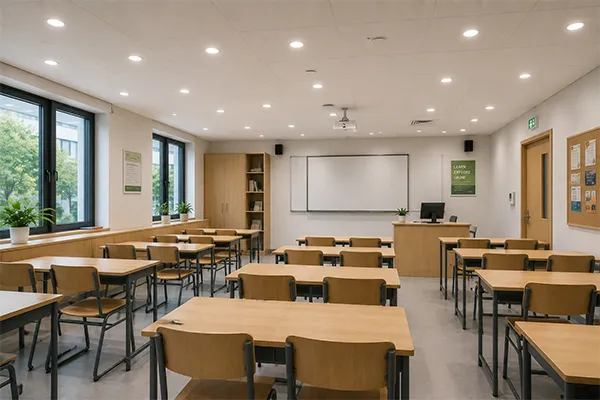
School projects often look straightforward from a product-list perspective. In practice, they involve many users, multiple room types, changing layouts, and strict acceptance expectations. I have seen procurement teams save time by separating the lighting brief into practical space-by-space requirements before requesting quotations.
Why Do LED Downlights for Schools and Universities Need Space-by-Space Planning?
LED downlights for schools and universities are often grouped under one broad “education lighting” category. That shortcut can create problems. A product that appears suitable in a corridor may not support the same visual task, glare limits, or installation arrangement required in a classroom or specialist teaching room.
Buyers should treat each school or university area as a separate lighting application. Classrooms, lecture halls, libraries, laboratories, art rooms, corridors, toilets, reception areas, and storage rooms require different combinations of light distribution, color quality, maintenance access, and visual comfort.1
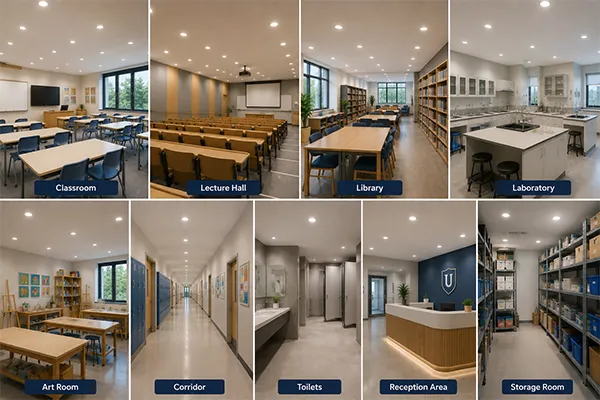
Classrooms and lecture halls
Classrooms need lighting that supports reading, writing, teaching boards, digital displays, and face-to-face interaction. The correct downlight arrangement depends on ceiling height, desk layout, daylight contribution, projection equipment, and the local project standard.
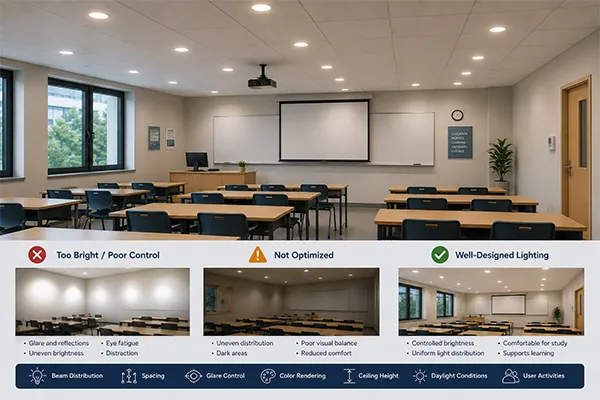
A brighter fitting is not automatically a better fitting. Poor spacing or an unsuitable beam angle can create bright spots on desks and darker zones between fittings.2 It can also cause reflected glare on whiteboards, screens, polished desks, or tablet devices.3
For lecture halls, the challenge can become more complex. The front teaching zone, audience seating, aisle circulation, and presentation screen may need different lighting scenes or separate controls.4 A downlight specification should therefore be reviewed as part of the complete lighting layout, not as an isolated product choice.
Libraries and study areas
Libraries combine quiet reading, computer use, shelving, circulation, and sometimes collaborative workspaces. These areas can benefit from careful consideration of uniformity, visual comfort, and color rendering.
In my experience supporting project discussions, buyers often focus first on lumens per fixture. That is understandable, but the useful question is whether the proposed layout supports the actual study environment. Downlight placement can affect how users perceive shelving, reading tables, signage, and computer screens.
Specialist rooms and service spaces
Labs, art rooms, workshops, food-service areas, and healthcare-related teaching spaces may introduce additional requirements. These may include higher color-rendering expectations, cleanability, impact resistance, ingress protection, emergency-lighting coordination, or restrictions related to chemicals and equipment.5
Service areas also matter. Corridors, stairwells, washrooms, reception zones, staff rooms, and storage rooms may have lower task demands than classrooms, but they still need appropriate safety, maintenance, and installation decisions.
| Space type | Procurement focus | Questions for the project team |
|---|---|---|
| Classroom | Desk-task visibility, glare, board and screen interaction | What is the ceiling height? Where are boards and displays located? |
| Lecture hall | Zoning, audience comfort, presentation use | Are dimming or scene controls required? |
| Library | Reading comfort, screen use, shelf visibility | Is the space quiet study, group study, or mixed use? |
| Laboratory | Color quality, durability, safety conditions | Are there chemical, cleanliness, or equipment constraints? |
| Corridor | Wayfinding, consistency, maintenance | What are the operating hours and emergency-lighting requirements? |
| Washroom or service room | Moisture conditions, cleaning, access | Is a specific IP rating or trim material required? |
A responsible procurement process should ask the design consultant or qualified engineer to confirm the final lighting calculations, glare criteria, emergency provisions, and local compliance requirements. We can help configure products and provide product information, but we do not replace project-specific design or compliance approval.
Are Brighter LED Downlights for Schools and Universities Always Better?
A bright-looking downlight can create visual discomfort when its beam is poorly controlled or when the installation layout is unsuitable. This matters in learning spaces, where users may read, write, view screens, or look toward teaching walls for extended periods. High initial output alone does not define lighting quality.
No, brighter LED downlights for schools and universities are not always better. Buyers should assess output together with beam distribution, spacing, glare control, color rendering, ceiling height, surface reflectance, daylight conditions, and the way students and staff use the room.
Light distribution affects the room, not just the fitting
Two downlights with similar nominal wattage can perform very differently once installed. Their optics, beam angle, mounting depth, diffuser design, luminous intensity distribution, and thermal management can all affect the result.6
For example, a narrow beam may produce stronger pools of light and more contrast between illuminated and unilluminated areas. A wider beam may provide broader coverage but may not suit every ceiling height or spacing pattern. Neither option is universally correct.
Buyers should request photometric files and use them in project calculations where required.7 Common documents may include:
- IES or LDT photometric files
- Product datasheets with lumen output and electrical information
- Dimensional drawings and cutout details
- Installation instructions
- Driver and control-system details
- Material and finish information
- Test reports or declarations relevant to the project market
A qualified lighting designer or engineer can then assess whether the product supports the project’s required illuminance, uniformity, glare, emergency, and energy-code criteria.
Color temperature is a project decision
Color temperature is often discussed as if there is one correct setting for every education project. We do not recommend that approach. A warmer or cooler appearance can influence how a space feels, but the appropriate selection depends on the room purpose, existing finishes, daylight, institutional preferences, visual tasks, and the project brief.
For school and university procurement, we can configure color temperature where the product platform supports it. However, the buyer should first confirm whether the project documents call for a specific value or a defined range. The same principle applies to tunable or multi-CCT product options: flexibility is useful only when it aligns with the control strategy, maintenance plan, and specified application.
CRI and display conditions deserve attention
Color Rendering Index (CRI) can be relevant in art studios, design classrooms, laboratories, food areas, and spaces where accurate visual distinction matters.8 Yet CRI should not be treated as a standalone quality label. Buyers should consider the task, the materials being viewed, and the project requirements.
A useful specification question is not “What is the highest CRI available?” It is “What color-rendering performance does this room require, and can the supplier provide it consistently across the order?”
At Upward Lighting, we can discuss configurable CRI options, beam angles, wattages, and finishes for eligible OEM/ODM projects. We recommend that buyers validate final choices against the project specification and qualified technical input.
How Can Buyers Turn a School Lighting Brief Into an LED Downlight Specification?
Many quotation problems begin with an incomplete inquiry. A request for “20W classroom downlights” may leave too much open to interpretation. It can lead suppliers to quote products with different lumen packages, optics, drivers, cutout sizes, finishes, and documentation levels, making price comparisons unreliable.
For LED downlights for schools and universities, buyers should create a written specification brief that identifies the room type, installation constraints, required output range, color temperature, CRI, beam angle, finish, driver requirements, control compatibility, and required project documents before comparing quotations.
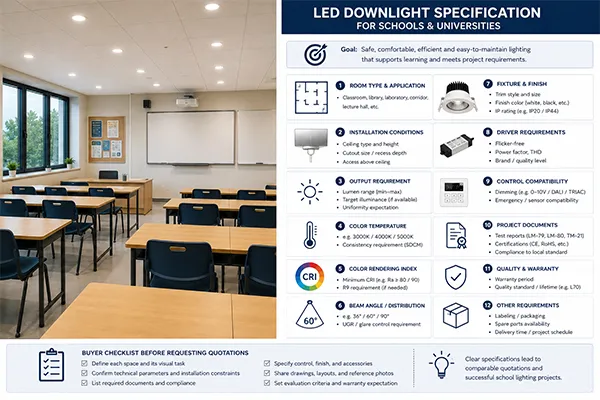
Start with the room and installation details
A useful procurement brief does not need to be complicated, but it should reduce ambiguity. I usually suggest that project buyers gather the available drawings, reflected ceiling plans, room schedules, and product schedule before approaching suppliers.
The following checklist provides a practical starting point:
-
Application and room type
Identify whether the fitting is for classrooms, libraries, labs, corridors, washrooms, offices, or another area. -
Ceiling and installation conditions
Confirm ceiling type, thickness, available void depth, cutout size, insulation conditions, access limitations, and whether the fitting must be recessed, surface-mounted, or otherwise integrated. -
Electrical requirements
Confirm input voltage, frequency, driver type, dimming protocol, control system, emergency-lighting coordination, and local wiring requirements. -
Optical requirements
Record required color temperature, CRI, beam angle, lumen package, glare-related criteria where specified, and any photometric documentation requested by the design team. -
Physical appearance
Specify trim diameter, body size, bezel style, reflector type, and finish color. A white trim may suit one ceiling design, while black, silver, or custom finishes may be required elsewhere. -
Project documentation
State which certificates, declarations, reports, drawings, samples, and inspection records must be submitted.
Compare quotations on an equal basis
The lowest unit price can become expensive if it represents a different product configuration from the one required.9 For fair comparison, buyers should build a quote-comparison sheet.
| Comparison point | Why it matters |
|---|---|
| Wattage and stated lumen output | Helps distinguish nominally similar products |
| Beam angle and photometric file availability | Affects layout calculations and visual distribution |
| CCT and CRI | Connects the fitting to the intended visual task |
| Cutout and product dimensions | Reduces ceiling rework risk |
| Driver and dimming option | Affects compatibility with controls |
| Housing and trim finish | Supports design consistency and durability expectations |
| Sample lead time | Helps the team inspect fit, finish, and function |
| Production lead time | Supports construction sequencing |
| Documentation scope | Supports submittals and buyer due diligence |
| Quality-control process | Helps evaluate supply consistency |
We support OEM/ODM adjustment of color temperature, wattage, beam angle, CRI, and finish colors on suitable product programs. We also support small-batch orders and project samples where feasible. These options can help contractors and brands respond to changing specifications, but each customization should be confirmed in writing, including sample approval, tolerance expectations, quantity, and delivery timing.
How Does Supplier Reliability Reduce Risk for LED Downlights for Schools and Universities?
A school project can face disruptions when samples differ from mass production, documents arrive late, cutout dimensions change, or the supplier cannot support replacement quantities.10 Product selection is important, but supplier coordination is also part of procurement risk control.
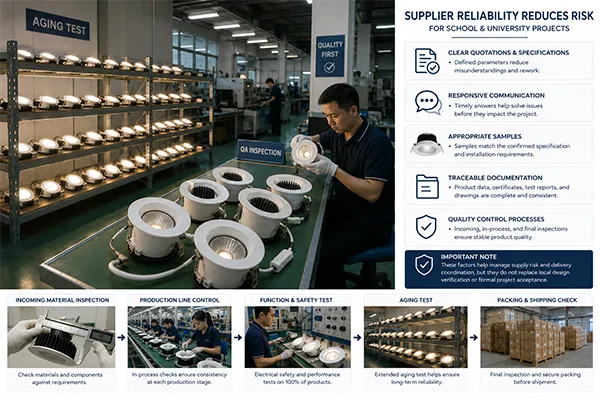
Reliable suppliers of LED downlights for schools and universities should provide clear quotations, consistent specifications, responsive communication, appropriate samples, traceable documentation, and quality-control processes. These factors help buyers manage changes and delivery coordination, but they do not replace local design verification or formal project acceptance.
Evaluate quality control in practical terms
Buyers should ask a supplier how it controls product consistency rather than relying only on broad marketing claims. Relevant questions include:
- Does the supplier conduct incoming inspection for key materials and components?
- How does the supplier verify product appearance, dimensions, electrical operation, and packaging?
- Is aging testing performed before shipment?
- Can the supplier provide inspection records or agreed quality documents for the order?
- How are approved samples, bills of materials, and production specifications controlled?
- What process applies if a project requires replacement or supplementary quantities?
At Upward Lighting, every product undergoes a 100% aging test lasting 4 to 8 hours before shipment. This is one part of our internal quality-control process. We use it to check product operation before dispatch and to support consistent delivery. However, an aging test does not by itself prove that a product meets every site-specific performance, design, or regulatory requirement.
Treat certifications as documents to verify
We can provide CE and RoHS documentation for applicable products and markets. Buyers should review the relevant documents, verify that they correspond to the quoted model and intended market, and confirm any additional local requirements with qualified project professionals.
CE and RoHS documentation should not be interpreted as automatic approval for every school or university project.11 Local electrical regulations, building rules, tender requirements, emergency-lighting provisions, fire-related requirements, and project acceptance procedures can differ by location.
Delivery coordination matters
Education projects often have phased construction, changing room schedules, and sample approvals that affect the purchase timeline. A supplier’s responsiveness can therefore be commercially important.
Our team aims to provide rapid quotation responses and coordinate with contractors, importers, distributors, and lighting brands on configurable orders. We also understand that small-batch support can be valuable for mock-ups, pilot rooms, replacements, or later project phases.
Still, buyers should build a realistic procurement plan that includes:
- Time for technical review and lighting calculations
- Sample production and approval
- Documentation review
- Mass-production scheduling
- Shipping and customs clearance
- Site receiving inspection
- Installation and project acceptance
I have found that the strongest supplier relationships begin with a clear specification and a realistic timeline. That approach reduces last-minute substitutions and makes it easier to identify risks before fixtures reach the site.
Frequently Asked Questions
What color temperature is best for school LED downlights?
There is no universal color temperature for every school or university space. The suitable option depends on room function, daylight, finishes, teaching activities, project specifications, and local design input. Buyers should select color temperature as part of the complete lighting brief rather than using one setting across every area.
What CRI should LED downlights for schools have?
The required CRI depends on the visual task and the project specification. General classrooms may have different needs from art studios, laboratories, or design spaces. Buyers should ask the lighting designer or engineer to confirm the required color-rendering performance, then request consistent supplier documentation for the selected model.
Can CE and RoHS documents guarantee approval for a school project?
No. CE and RoHS documents may be relevant to market access and environmental requirements, but they do not automatically satisfy all local school regulations, electrical rules, tender requirements, or project acceptance conditions. Buyers should verify applicable documents and consult qualified local professionals.
Should schools choose dimmable LED downlights?
Dimming can be useful in lecture halls, presentation rooms, multipurpose spaces, and areas with varying daylight.12 However, it requires compatible drivers, controls, commissioning, and a clear operating strategy. Buyers should confirm the control protocol and project requirements before selecting a dimmable downlight.
What should buyers request from an LED downlight supplier?
Buyers should request a detailed datasheet, dimensions, cutout information, photometric files where needed, driver details, color-temperature and CRI options, finish information, samples, production lead time, quality-control information, and relevant certification documents. They should also confirm the exact approved configuration in the purchase order.
Conclusion
LED downlights for schools and universities should be selected as part of a space-specific procurement process, not as interchangeable ceiling fixtures. Buyers should evaluate classroom tasks, glare risks, beam distribution, color quality, installation constraints, control needs, documentation, and supplier consistency. At Upward Lighting, we support contractors, brands, distributors, and project buyers with configurable downlight specifications, small-batch support, rapid quotations, and 100% 4–8-hour aging testing. Contact us to discuss your education-project downlight brief and request a specification-focused quotation.
"Educational Facilities Lighting Guide — LED for Schools", https://www.techlumen.gr/en/guide/educational-facilities-lighting-guide/. Lighting guidance for indoor workplaces and educational environments distinguishes lighting requirements by room function, visual task, and user activity, including teaching spaces, study areas, laboratories, and circulation zones. Evidence role: general_support; source type: institution. Supports: Lighting guidance differentiates recommended lighting conditions according to the visual tasks and functions of educational rooms and circulation areas.. Scope note: Specific criteria and legal applicability depend on the jurisdiction, project standard, and room design. ↩
"Calculation and Presentation of the Standard CIE UGR Table for Indoor ...", https://www.academia.edu/9504476/Calculation_and_Presentation_of_the_Standard_CIE_UGR_Table_for_Indoor_Lighting_Luminaires. Photometric design guidance explains that a luminaire's intensity distribution, mounting height, and spacing determine the illuminance pattern on a working plane and can produce non-uniform lighting when poorly coordinated. Evidence role: mechanism; source type: institution. Supports: Luminaire photometric distribution, mounting geometry, and spacing affect horizontal illuminance patterns and uniformity.. Scope note: Whether a particular layout creates objectionable bright or dark areas requires project-specific photometric calculation. ↩
"Lighting Ergonomics | Risk Management & Insurance", https://rmi.colostate.edu/ergonomics/officecomputer-ergonomics/lighting-ergonomics/. Visual-ergonomics literature recognizes reflected glare as a source of discomfort and reduced visibility when luminaires are reflected in display screens, glossy work surfaces, or teaching boards. Evidence role: mechanism; source type: research. Supports: Reflections from luminaires and bright surfaces can reduce visual comfort and screen or task visibility when viewed at unfavorable angles.. Scope note: The magnitude of reflected glare depends on surface reflectance, viewing direction, daylight, and the installed lighting geometry. ↩
"Science 1 G01 - Lighting Control - Teaching and Learning", https://kb.uconn.edu/space/TL/26231767077/Science+1+G01+-+Lighting+Control. Energy and lighting-control guidance for educational facilities describes the use of separately controlled lighting zones to support differing functions such as instruction, audiovisual presentation, and circulation. Evidence role: general_support; source type: government. Supports: Educational-space lighting controls may be zoned to accommodate different activities, including presentations, instruction, and occupancy patterns.. Scope note: The need for particular scenes or control zones must be determined from the room layout, audiovisual design, energy code, and operational brief. ↩
"Newsletter 71 | New York State Education Department", https://www.nysed.gov/facilities-planning/news/newsletter-71. Facility and electrical-safety guidance indicates that luminaires in specialist, wet, industrial-like, or laboratory environments may require selection based on environmental protection, cleanability, impact exposure, hazardous substances, and emergency-lighting coordination. Evidence role: general_support; source type: institution. Supports: Lighting selection for laboratories, workshops, wet areas, and other specialist spaces may be affected by environmental exposure, cleaning, mechanical impact, and emergency-lighting requirements.. Scope note: Applicable ratings and restrictions are determined by the specific hazards, local electrical code, and project risk assessment. ↩
"Impact of Thermal Dissipation on the Lighting Performance ...", https://pmc.ncbi.nlm.nih.gov/articles/PMC8776062/. Technical guidance on LED luminaires identifies optical components and luminous-intensity distribution as determinants of delivered light, while thermal management affects LED operating temperature and can influence light output and service life. Evidence role: mechanism; source type: government. Supports: Optical design and thermal conditions influence a luminaire's light distribution, output, and operating performance.. Scope note: The relative importance of each feature varies by luminaire design and cannot establish the performance of a specific product without test data. ↩
"Rethinking the Photometric Data File Format", https://www.led-professional.com/resources-1/articles/rethinking-the-photometric-data-file-format. Standardized photometric files such as IES and EULUMDAT formats encode luminaire intensity data for use in lighting-design and calculation software. Evidence role: definition; source type: institution. Supports: IES and EULUMDAT files provide standardized machine-readable photometric data used by lighting-calculation software.. Scope note: A photometric file supports modeling but does not by itself demonstrate compliance; the complete room model, assumptions, and applicable criteria must also be reviewed. ↩
"Development of a Color Quality Scale | NIST", https://www.nist.gov/publications/development-color-quality-scale-0. The Color Rendering Index is a standardized measure of how faithfully a light source renders test colors relative to a reference illuminant, so color-rendering performance is pertinent where reliable color discrimination is important. Evidence role: definition; source type: institution. Supports: CRI is a measure used to describe how a light source renders object colors relative to a reference illuminant, making color-rendering considerations relevant to color-critical tasks.. Scope note: CRI does not fully predict color preference or all aspects of color fidelity, and project requirements may use additional metrics. ↩
"Subpart 15.4 - Contract Pricing", https://www.acquisition.gov/far/subpart-15.4. Public-procurement guidance distinguishes a merely low initial price from the evaluation of technically compliant offers and, where relevant, life-cycle or total costs. Evidence role: general_support; source type: institution. Supports: Procurement guidance distinguishes lowest price from evaluation of technically compliant offers and life-cycle or total costs.. Scope note: This principle does not establish that any particular low-priced downlight will cost more; that conclusion requires a like-for-like specification and project cost analysis. ↩
"(PDF) The impact of supply chain management practice on ...", https://www.academia.edu/82048745/The_impact_of_supply_chain_management_practice_on_construction_project_performance. Construction supply-chain research identifies delayed submittals, inconsistent materials or specifications, and unreliable availability as factors that can increase coordination burdens and contribute to schedule disruption. Evidence role: general_support; source type: paper. Supports: Construction supply-chain research identifies late information, material changes, and unreliable delivery as contributors to project delay and coordination risk.. Scope note: The effect on a specific school project depends on contract terms, inventory planning, approval procedures, and the severity and timing of the discrepancy. ↩
"CE marking - Wikipedia", https://en.wikipedia.org/wiki/CE_marking. European Commission guidance explains that CE marking is a manufacturer's declaration that a product meets applicable EU requirements, while RoHS restricts specified hazardous substances in electrical and electronic equipment; neither designation alone substitutes for all national building, installation, or project-specific requirements. Evidence role: definition; source type: government. Supports: CE marking indicates a manufacturer's declaration of conformity with applicable EU requirements and is not a universal project-acceptance certificate; RoHS addresses restrictions on specified hazardous substances in electrical equipment.. Scope note: The exact legal obligations depend on the product category, applicable EU legislation, national implementation, and the location of installation. ↩
"Tunable Lighting Classroom Studies", https://www.energy.gov/cmei/ssl/tunable-lighting-classroom-studies. Educational-building lighting guidance describes dimming and daylight-responsive controls as means of adjusting electric lighting for varying daylight availability and operational activities such as audiovisual presentation. Evidence role: general_support; source type: government. Supports: Lighting-control guidance describes dimming and daylight-responsive controls as methods for adapting electric lighting to daylight and changing space use.. Scope note: Potential benefits depend on appropriate control zoning, compatible equipment, commissioning, occupant operation, and the room's daylight design. ↩