LED downlights for showrooms and exhibition spaces can look simple to procure, but a poor specification can leave products flat, walls uneven, and focal displays lost in general brightness. Buyers often begin with wattage or price, then discover installation, color consistency, and beam control issues later. We recommend starting with the display task and project risks instead.
LED downlights for showrooms and exhibition spaces should be selected around the items being displayed, the purpose of each zone, ceiling and installation constraints, and supply requirements. High CRI, a chosen color temperature, and a competitive price all matter, but no single specification works everywhere. Buyers should combine beam control, output, color quality, dimming needs, batch consistency, budget, and verified compliance documents into one practical procurement decision.
At Upward Lighting, we regularly receive inquiries that begin with one short request: “Please quote a 12W high-CRI downlight.” That is a useful starting point, but it does not define the visual objective. The stronger question is what visitors need to see, where they need to see it, and what the project team must avoid.
Why Should LED Downlights for Showrooms and Exhibition Spaces Start With the Display Task?
A showroom can contain glossy products, textured wall finishes, samples, signage, artwork, and changing promotions in the same footprint. If buyers choose fixtures before understanding those tasks, the result can be over-lighting in some areas and weak visual emphasis in others. We see this issue repeatedly during early project discussions.
Buyers should start LED downlight selection by identifying the objects, surfaces, and visitor paths that need light. Product displays may need focused accent lighting, while circulation areas often need comfortable ambient illumination. Wall graphics, shelves, feature tables, and changing exhibitions may each require different light distribution, output, aiming flexibility, or lighting layers.
Define What the Visitor Must Notice
The display task determines the lighting conversation. A jewelry counter, tile sample wall, car showroom, fashion display, and technology exhibition all present different colors, textures, distances, and reflective surfaces. A downlight that creates a clean effect above a reception area may not provide enough directional emphasis for merchandise on a vertical display.
We encourage buyers to map the space into functional zones before requesting quotations:
- Entrance and reception: These areas establish first impressions and require clear, comfortable general lighting.
- Circulation paths: These zones need safe orientation without competing with feature displays.
- Wall displays and graphics: These surfaces may need deliberate vertical illumination and careful spacing to reduce uneven scallops or shadows1.
- Shelves and product bays: These often benefit from tighter light control, depending on mounting distance and shelf depth.
- Feature products or plinths: These areas may need contrast and a more focused beam.
- Demonstration or consultation areas: These zones need balanced light for people, materials, and practical work.
One recurring issue is that a buyer requests a wide-beam recessed fixture for an entire showroom because it appears economical and simple to install. A wide beam can work well for general coverage, but it may spread light beyond the target and reduce the visual hierarchy around key products. Conversely, using only narrow beams can create excessive contrast, patchy floor brightness, and uncomfortable glare.
We do not treat every display-focused project as a downlight-only project. Depending on the ceiling, display geometry, and target surfaces, track lights, wall washers, linear lighting, or adjustable fixtures may also be relevant.
A practical procurement brief should include more than a fixture image. We suggest asking for ceiling plans, mounting heights, display layout, product colors, desired finishes, and control requirements. A qualified lighting designer or project engineer should review photometric calculations, glare risk, spacing, and final fixture placement for complex layouts.
How Do Beam Angles Affect LED Downlights for Showrooms and Exhibition Spaces?
A common problem is visually flat lighting. When every fixture has the same wide distribution, visitors may see brightness but not emphasis. When every fixture is narrowly focused, the space can become harsh and inconsistent. Beam angle selection should support the distance, target size, and intended visual contrast of each zone.
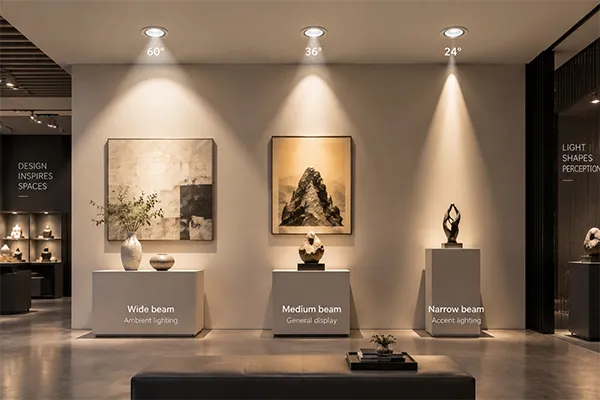
For LED downlights in showrooms and exhibition spaces, wider beams generally support ambient coverage, while narrower beams can emphasize smaller or more distant display targets2. The correct beam angle depends on mounting height, object size, fixture spacing, surface reflectance, and glare control. Buyers should compare beam data and sample performance rather than rely on a beam-angle label alone.
Match the Beam to the Mounting Geometry
Beam angle describes how widely light spreads from a fixture. It is important, but buyers should not treat it as an isolated number. A 24° beam from a 3-meter ceiling produces a very different result than the same 24° beam from a 6-meter ceiling. The distance between fixture and target changes both beam diameter and illuminance.3
As an approximate planning reference, the beam diameter can be estimated using this formula:
Beam diameter = 2 × mounting distance × tan(beam angle ÷ 2)4
For example, at a 3-meter mounting distance:
| Beam angle | Approximate beam diameter | Typical evaluation use |
|---|---|---|
| 15° | 0.8 m | Small focal objects or narrow displays |
| 24° | 1.3 m | Feature products, compact plinths, selected shelving |
| 36° | 1.9 m | Flexible display zones and moderate general emphasis |
| 60° | 3.5 m | General ambient coverage or larger open areas |
These figures are geometric estimates, not final lighting design values. Actual performance depends on the optical system, luminaire output, aiming, room reflectance, and maintenance conditions. Buyers should request the relevant photometric files or test documentation where available and have qualified professionals evaluate the final layout.
Avoid the “One Beam Angle Everywhere” Shortcut
We often hear a variation of this question: “Can we use a 60° high-CRI downlight for the whole project?” The honest answer is that it depends. Using a single configuration can simplify purchasing and maintenance, but it can also limit the exhibition effect.
A more controlled purchasing strategy may use:
- Wide beams for open circulation and base ambient light.
- Medium beams for product tables, shelves, or mixed-use display zones.
- Narrower beams for focal pieces, logos, texture, or feature exhibits.
- Adjustable fixtures where merchandise changes frequently and aiming flexibility is valuable.
The buyer should also consider glare. A highly concentrated beam can produce distracting brightness when the source is visible from common visitor angles. Deep anti-glare designs, suitable cut-off characteristics, careful placement, and appropriate aiming may help5, but the final result needs project-specific review.
Is High CRI Enough for LED Downlights in Display-Focused Spaces?
Buyers rightly ask about CRI because poor color rendering can make merchandise, artwork, finishes, and branded surfaces look unnatural. However, a high CRI figure alone does not guarantee that a display will look right6. The visual result also depends on spectrum, color temperature, beam direction, contrast, and the colors surrounding the display.
High-CRI LED downlights can support more faithful color appearance in showrooms and exhibition spaces, but CRI should be evaluated with color temperature, bin consistency, optical control, and the materials being illuminated. Buyers should request verified product documentation and, where appearance is critical, review physical samples under representative conditions.
Understand What CRI Does—and Does Not—Tell You
CRI, or Color Rendering Index, is a commonly used metric that indicates how faithfully a light source renders a set of reference colors compared with a reference illuminant.7 In many commercial specifications, buyers may compare CRI 80 and CRI 90 options. A higher CRI can be valuable for color-sensitive products, but it should not become an automatic premium requirement for every square meter.
For example:
- A fashion display may require closer attention to fabric color, skin tones, and texture.
- A paint, tile, or material showroom may need sample review because customers compare subtle finishes.
- A technology or automotive display may place more emphasis on highlights, controlled reflections, and brand-specific appearance.
- A general circulation zone may not require the same color-rendering priority as a product inspection counter.
We recommend that buyers discuss the target materials rather than requesting “the highest CRI available” by default. Higher-CRI LED packages can affect cost, efficacy, lead time, and available configurations. These are commercial and supply-chain considerations, not only lighting decisions.
Color Temperature Shapes the Perceived Environment
Color temperature also changes how a showroom feels and how materials appear.8 Warm, neutral, and cool white options can each have valid roles. We do not recommend one universal color temperature for every exhibition environment.
The right choice depends on:
- Brand identity and interior design intent
- Product colors and material finishes
- Daylight contribution
- Wall, floor, and ceiling reflectance
- Adjacent lighting systems
- Customer expectations in the local market
At Upward Lighting, we can discuss OEM/ODM options such as color temperature, CRI, wattage, beam angle, and surface finish. However, buyers should confirm available combinations early. Not every requested combination will have the same minimum order quantity, production timeline, cost structure, or optical performance.
Color consistency across the project also deserves attention.9 Buyers should ask suppliers about binning approach, batch management, and documentation. For large projects or phased rollouts, retaining an approved sample and defining an acceptance process can reduce disagreement later.
What Procurement Checks Matter Beyond the LED Downlight Specification?
A visually suitable fixture can still become a procurement problem if it does not fit the ceiling, work with the dimming system, arrive consistently, or meet the destination market’s documentation needs. Buyers need to assess the fixture and the supplier together. This approach reduces the risk of late substitutions and inconsistent project delivery.
The best LED downlights for showrooms and exhibition spaces balance lighting performance with installation fit, dimming compatibility, safety documentation, manufacturing consistency, customization feasibility, budget, and delivery reliability. Buyers should evaluate samples, drawings, test information, production controls, and supplier communication before committing to a large order.
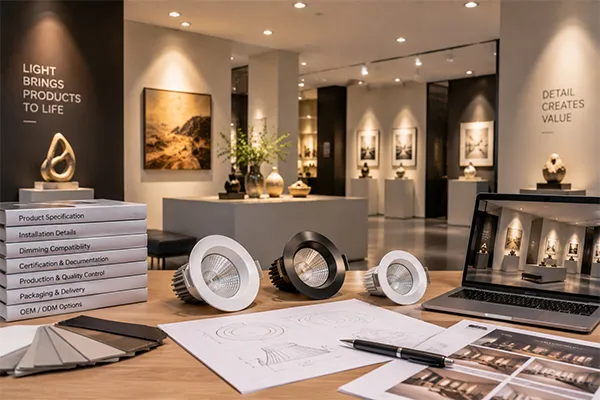
Review Installation Details Before Approving a Quote
A downlight may be attractive on paper but unsuitable for the ceiling build-up. We recommend reviewing the installation conditions before final selection:
| Procurement checkpoint | Why it matters |
|---|---|
| Cut-out size | Incorrect cut-outs can cause rework, visible gaps, or delayed installation. |
| Fixture height and driver space | Ceiling void depth may limit recessed fixture options. |
| Heat management | Insulation, enclosed ceiling conditions, and ventilation can affect suitability.10 |
| Trim and finish | White, black, or customized finishes should align with the ceiling and brand concept. |
| IP rating | The required level depends on the location and exposure conditions. |
| Driver location | Accessibility matters for maintenance and replacement planning. |
| Dimming protocol | Driver compatibility should be confirmed with the selected control system. |
Dimming deserves special attention. Terms such as TRIAC, 0–10V, DALI, and PWM describe different control approaches.11 A buyer should not assume that “dimmable” means compatible with every local dimmer or building-control system. We suggest confirming the exact driver model, dimming range, control protocol, and compatibility expectations before mass production.
Evaluate Supplier Controls and Evidence
As a manufacturer, we understand that project teams need fast quotations, but they also need a traceable approval process. At Upward Lighting, we conduct a 100% aging test before shipment, typically lasting 4 to 8 hours, as part of our internal production process. Buyers should still clarify the agreed inspection criteria, sample approval process, packaging requirements, and any application-specific testing needs.
When evaluating a supplier for showroom downlights, we suggest requesting:
- Product specification sheets with clear model references
- Dimension drawings and cut-out information
- Photometric files or reports when available
- Driver and dimming details
- A pre-production or approval sample
- Information about color-temperature and finish availability
- Packaging specifications for transit and local distribution
- Production lead time and expected capacity
- Warranty terms and after-sales process
- Relevant certification documents for the intended market
Our products hold CE and RoHS documentation for relevant market-entry requirements. Buyers should verify the current certificates, product-model scope, issuing details, and applicability to their destination market and project. Certification documents should support due diligence, not replace it.12
For complex exhibition layouts, we recommend that the project team involve a qualified lighting designer or engineer. They can review lux calculations, luminance balance, glare, emergency lighting coordination, local code requirements, and final placement. Our role as a manufacturer is to provide clear product information, customization discussions, samples, and production support within the agreed scope.
Frequently Asked Questions
What CRI should I choose for showroom LED downlights?
Many display-focused projects consider CRI 80 or CRI 90, but the best choice depends on the products, budget, and desired color appearance. Color-sensitive merchandise and material samples may justify closer evaluation. Buyers should compare samples and verify relevant product data rather than specify the highest CRI automatically.
Are LED downlights enough for an exhibition space?
LED downlights can provide useful ambient and accent lighting, but they may not suit every display task alone. Large vertical graphics, changing exhibits, narrow shelves, and feature objects may require track lights, wall washers, linear lighting, or adjustable fixtures. A qualified lighting professional should assess the complete layout.
Which beam angle works best for showroom downlights?
There is no single best beam angle. Narrow beams can emphasize small features, while wider beams can provide broader ambient coverage. The correct choice depends on mounting height, fixture spacing, target size, room finishes, and glare considerations. Buyers should review photometric data and sample installations.
Can LED downlights be customized for a branded showroom project?
Many downlight parameters can be customized, including color temperature, wattage, beam angle, CRI, and trim finish, subject to technical feasibility and order requirements. Buyers should discuss minimum order quantities, production lead times, sample approval, and supply continuity before finalizing a customized model.
What should buyers verify before ordering downlights from a supplier?
Buyers should verify dimensions, cut-out size, driver details, dimming compatibility, photometric information, color consistency expectations, samples, packaging, lead time, and relevant compliance documents. They should also confirm the exact model covered by each document and evaluate whether the supplier can support repeat orders.
Conclusion
The most effective LED downlights for showrooms and exhibition spaces are not defined by one wattage, CRI level, beam angle, or price point. Buyers should begin with the display task, then balance visual goals with beam control, color appearance, ceiling constraints, dimming requirements, budget, documentation, and supply reliability. At Upward Lighting, we support contractors, brands, distributors, and project buyers with OEM/ODM discussions, small-batch support, and responsive quotations. Contact us to discuss your downlight specification, sample needs, and procurement plan.
"Detroit Revs Up - Illuminating Engineering Society", https://ies.org/lda/detroit-revs-up-2/. Lighting-design guidance describes vertical-surface illumination as dependent on luminaire distribution, offset, and spacing; unsuitable spacing can create visible scalloping and non-uniformity on walls. Evidence role: general_support; source type: institution. Supports: Lighting-design guidance on using fixture placement, distribution, and spacing to achieve reasonably uniform illumination of vertical surfaces and to limit visible scallops and shadows.. Scope note: Recommended spacing remains dependent on the specific luminaire photometry, mounting geometry, and surface reflectance. ↩
"APS Lighting Equipment Guide - Evergreen Help Wiki", https://helpwiki.evergreen.edu/wiki/index.php/APS_Lighting_Equipment_Guide. Lighting-optics references explain that narrower beam distributions concentrate luminous flux on smaller target areas, whereas wider distributions spread light over broader areas and are commonly used for general coverage. Evidence role: mechanism; source type: education. Supports: Basic lighting-optics guidance explaining that beam spread affects the area illuminated and that narrow distributions are commonly used for accenting while broad distributions serve wider areas.. Scope note: Beam angle alone does not determine the final visual effect because output, aiming, mounting distance, and surrounding reflectances also affect illuminance and contrast. ↩
"[PDF] Radiometric Testing of Germicidal UV Products, Round 1", https://www.energy.gov/eere/ssl/articles/radiometric-testing-germicidal-uv-products-round-1-uv-c-towers-and-whole-room. Photometric guidance states that, for a point-like source under applicable conditions, illuminance decreases approximately with the square of distance, while the illuminated area expands as the beam travels farther from the luminaire. Evidence role: mechanism; source type: government. Supports: The inverse-square relationship between distance and illuminance, together with geometric beam expansion over distance.. Scope note: The point-source approximation is less exact for extended luminaires, near-field measurements, and installations with substantial reflected light. ↩
"(PDF) Practical cone beam algorithm - Academia.edu", https://www.academia.edu/19255964/Practical_cone_beam_algorithm. For an ideal conical beam, basic trigonometry gives an approximate beam diameter of 2d × tan(θ/2), where d is the distance to the target plane and θ is the beam angle. Evidence role: mechanism; source type: education. Supports: The geometric derivation of the diameter of a conical beam at a known distance and beam angle.. Scope note: This geometric estimate does not represent real luminaire intensity distributions, field-angle conventions, aiming, or reflected light. ↩
"Text-Alternative Version: Glare in LED Outdoor Lighting", https://www.energy.gov/cmei/ssl/text-alternative-version-glare-led-outdoor-lighting. Lighting standards and design guidance identify source luminance, viewing direction, shielding, luminaire position, and aiming as relevant factors in discomfort-glare control. Evidence role: mechanism; source type: institution. Supports: Lighting guidance on limiting discomfort glare through source shielding, luminance control, fixture position, and aiming.. Scope note: Whether a particular anti-glare design is adequate must be assessed for the actual observer positions, fixture photometry, and room layout. ↩
"Color Rendering | NIST", https://www.nist.gov/publications/color-rendering. Color-rendering research notes that a single CRI value does not fully describe spectral effects on fidelity, gamut, saturation, or preferred appearance, particularly for LED sources. Evidence role: general_support; source type: research. Supports: Research and standards discussions indicating that CRI does not fully characterize color fidelity, gamut, saturation, or observer preference under modern light sources.. Scope note: The finding supports the need for broader evaluation but does not establish that any specific high-CRI product will perform poorly in a given display. ↩
"Color rendering index", https://en.wikipedia.org/wiki/Color_rendering_index. The CIE general colour rendering index quantifies the average colour-rendering fidelity of a test source relative to an appropriate reference illuminant using standardized test colour samples. Evidence role: definition; source type: institution. Supports: The formal definition and measurement basis of the general colour rendering index, including comparison with a reference illuminant and standardized test colour samples.. Scope note: CRI is not a complete predictor of preference, saturation, or the appearance of all real materials. ↩
"Effect of warm/cool white lights on visual perception and mood in ...", https://pmc.ncbi.nlm.nih.gov/articles/PMC8481791/. Lighting and vision research reports that changes in correlated color temperature and spectral power distribution can alter perceived ambience and the appearance of illuminated colors and materials. Evidence role: general_support; source type: research. Supports: Research showing that the spectral characteristics represented in part by correlated color temperature can affect perceived ambience and color appearance.. Scope note: Correlated color temperature does not uniquely specify spectrum, so sources with the same nominal CCT may still produce different color-rendering results. ↩
"[PDF] THE ECONOMIC BENEFITS OF NIST'S ROLE IN THE MARKET ...", https://www.nist.gov/document/economic-benefits-nists-role-market-transition-solid-state-lighting-technology. LED color-consistency guidance uses chromaticity tolerances and binning concepts because nominally similar white-light products can exhibit perceptible differences in color appearance. Evidence role: expert_consensus; source type: institution. Supports: Recognized LED chromaticity specifications and guidance addressing color consistency, chromaticity tolerance, and binning.. Scope note: Perceptibility thresholds depend on adaptation, viewing conditions, adjacent materials, and the spatial arrangement of luminaires. ↩
"Recessed Lighting - Code Compliance Brief", https://basc.pnnl.gov/code-compliance/recessed-lighting-code-compliance-brief. Recessed-luminaire safety guidance warns that insulation contact, restricted ventilation, and enclosed installation conditions can affect heat dissipation and must be evaluated against the luminaire manufacturer's installation instructions and ratings. Evidence role: mechanism; source type: institution. Supports: Electrical-safety and installation guidance explaining that recessed luminaire thermal performance can be affected by insulation coverage, restricted airflow, and enclosure conditions.. Scope note: The suitability of a particular fitting cannot be inferred from general guidance; it depends on its tested construction, marking, driver arrangement, and installation instructions. ↩
"[PDF] Dimming LEDs with Phase-Cut Dimmers: The Specifier's Process for ...", https://www.pnnl.gov/main/publications/external/technical_reports/pnnl-22945.pdf. Lighting-control guidance distinguishes phase-cut, 0–10 V, DALI, and PWM control methods and notes that LED drivers must be designed and tested for compatibility with the selected control method. Evidence role: definition; source type: government. Supports: Technical guidance distinguishing phase-cut dimming, 0–10 V analog control, DALI digital control, and pulse-width modulation, and noting that driver compatibility is required.. Scope note: Compatibility still depends on the exact driver, controller, wiring arrangement, load range, and local electrical installation. ↩
"CE marking – obtaining the certificate, EU requirements - Your Europe", https://europa.eu/youreurope/business/product-rules-compliance/general-product-compliance/ce-marking/index_en.htm. Official product-compliance guidance treats declarations, technical documentation, and markings as elements of a conformity-assessment system; they must be applicable to the specific product and do not remove the need to verify relevant legal and project requirements. Evidence role: general_support; source type: government. Supports: Official market-surveillance and product-compliance guidance stating that conformity documentation is part of demonstrating compliance and must correspond to the applicable product, legislation, and responsible economic operator.. Scope note: Applicable obligations vary by destination market, product category, supply-chain role, and the regulations in force at the time of placement on the market. ↩