LED downlights for smart building applications can create procurement risks when buyers focus on app control or dimming before confirming the complete lighting and control architecture. A downlight may appear suitable on paper, yet the wrong driver, protocol, ceiling condition, or optical specification can create costly installation delays and post-installation complaints. We recommend defining the complete project requirement before requesting quotations.
LED downlights for smart building applications should be selected as components of an integrated lighting system, not as standalone “smart” products1. Buyers should match the luminaire, LED driver, dimming or control protocol, power configuration, ceiling installation, beam angle, color temperature, glare requirement, and project approval process. Final compatibility should be validated by the control-system provider, electrical contractor, and project design team before procurement.
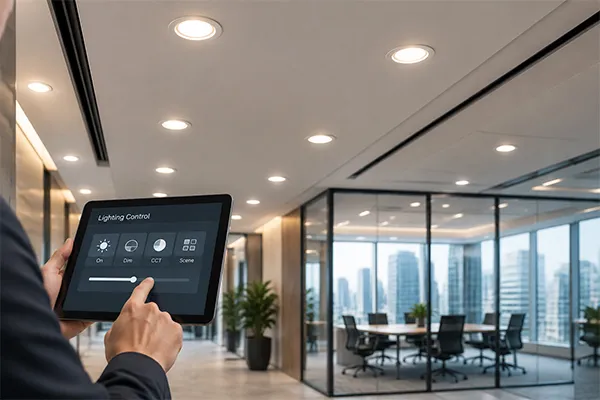
In our conversations with contractors, importers, and lighting brands, we often hear one question first: “Is this downlight smart?” We usually need to ask several questions in return. A successful smart-building lighting package depends on system planning, product consistency, installation details, and supplier coordination—not just a dimming function.
What Makes LED Downlights for Smart Building Applications “Smart”?
Many buyers face a familiar problem: they receive a request for smart lighting but get limited technical information from the project team. The term “smart” can then become a vague product label, which makes it difficult to compare quotations accurately.
LED downlights for smart building applications are “smart” when they are specified to operate reliably within the building’s intended control, monitoring, and operational strategy. A dimmable driver or mobile app alone does not make a downlight appropriate for a commercial smart-building project. The luminaire must support the selected system design and its real operating conditions.
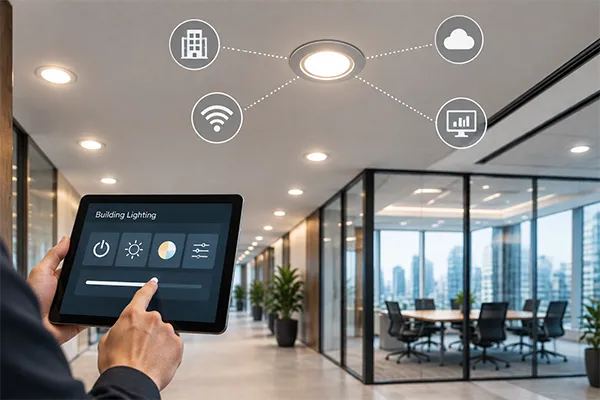
Smart Lighting Is a System Requirement
We encourage buyers to view a downlight as one part of a wider project system. Depending on the building, that system may include:
- Lighting control panels
- Sensors for occupancy or daylight response
- Wall controls and scene-setting devices
- Central monitoring platforms
- Emergency lighting arrangements
- Power supplies, wiring, and electrical protection
- Maintenance procedures for drivers and luminaires
A commercial office, hotel, retail store, education facility, or mixed-use development may use lighting controls for different reasons. One project may need scene control in meeting rooms. Another may need occupancy-based control in corridors. A third may need lighting schedules across several floors.
These needs affect the product specification. For example, a project may require a standard fixed-output downlight in a low-priority service area, while a conference room needs a compatible dimming solution with defined scene control. We do not assume that every fitting in the project needs the same driver or control capability.
App Control Is Not the Starting Point
We have seen buyers begin with a request for Bluetooth, Wi-Fi, voice control, or app operation. These features may suit certain residential or small commercial applications, but they do not replace a project control architecture.
A mobile app may be useful for local commissioning or simple user control. However, a smart-building project may require centralized management, controlled user permissions, scheduled operation, sensor integration, and documented maintenance procedures2. The project team should decide whether app access is relevant before it appears in the product specification.
In recurring quotation discussions, we often find that “app-controlled” is requested before the customer has confirmed who will provide the controller, who will commission the system, or how the luminaires will be grouped after installation.
For procurement teams, this distinction matters because a product feature can add cost without solving the actual project requirement. We recommend asking the following questions before requesting a smart downlight quotation:
- What lighting tasks must the system support?
- Who has selected the lighting control system?
- What control or dimming method does the project design specify?
- Will the luminaires operate individually, by circuit, by zone, or by scene?
- Who will be responsible for commissioning and post-installation support?
- Are there wiring, power, ceiling, or maintenance restrictions?
The answers help us quote the correct LED downlights for smart building applications instead of offering a generic “smart” product that may not fit the final system.
How Do LED Downlights for Smart Building Applications Need to Match the Control System?
A dimmable downlight can look like a simple solution, but dimming compatibility is one of the most common areas of misunderstanding. Buyers may assume that any dimmable fitting can work with any smart controller, dimmer, or automation platform.
LED downlights for smart building applications must use a driver and control arrangement that matches the project’s intended dimming or control protocol. “Dimmable” only describes a capability under specified conditions; it does not confirm universal compatibility.3 Buyers should verify the driver, input power, control interface, wiring method, and approved control equipment before placing an order.
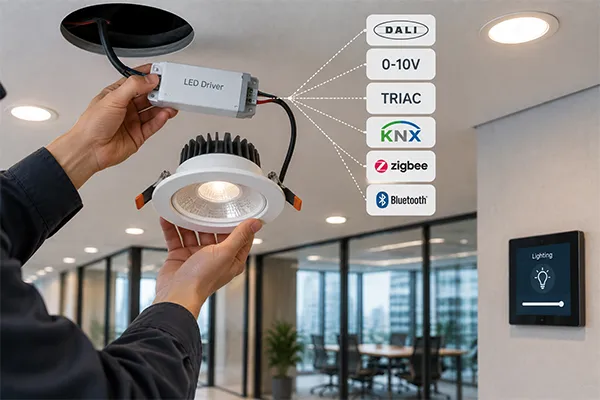
Confirm the Driver Before Confirming the Downlight
The LED driver is central to the performance of a controlled downlight.4 It converts and regulates power for the LED module, and it may also receive dimming or control signals. A driver that is suitable for one project may not be suitable for another.
We recommend that buyers request clear documentation for:
- Input voltage range
- Output current or constant-voltage configuration
- Dimming method
- Minimum and maximum load requirements
- Dimming range and expected low-end behavior
- Control terminal or wiring arrangement
- Driver location and service access
- Declared compatibility information from the relevant driver or control supplier
Different projects may use leading-edge or trailing-edge phase dimming, 0/1–10V control, DALI-based control, or other system-specific approaches. We do not present this list as a universal compatibility guide. Each protocol has its own wiring, addressing, driver, commissioning, and equipment requirements that must be evaluated by qualified project professionals.
Why “Dimmable” Is Not Enough
A dimmable LED downlight may not perform correctly if the dimmer type, driver characteristics, circuit loading, or wiring conditions do not match. Potential symptoms can include:
- Flicker at low dimming levels5
- Limited dimming range
- Inconsistent dimming among fixtures
- Audible noise from a dimmer or driver
- Failure to turn on or turn off as expected
- Unstable behavior after a control-system update or change
- Reduced reliability when the driver operates in unsuitable thermal conditions
We have received inquiries from customers who ask whether one dimmable downlight can connect to “any smart system.” We always treat that as a project verification question, not a product promise. The correct answer depends on the exact driver, controller, wiring layout, dimmer interface, and system design.
Create a Compatibility Matrix During Procurement
For larger projects, we recommend a simple compatibility matrix. It helps the purchasing team avoid comparing products only by wattage and unit price.
| Procurement Item | What Buyers Should Confirm | Why It Matters |
|---|---|---|
| Downlight body | Cutout, wattage, heat dissipation, IP rating, beam angle | Determines physical and optical suitability |
| LED driver | Input voltage, output type, dimming method, control terminals | Determines electrical and control compatibility |
| Control equipment | Controller, gateway, sensors, dimmers, panels | Determines system integration requirements |
| Wiring plan | Cable type, topology, circuit arrangement, control cable route | Affects installation feasibility |
| Commissioning plan | Addressing, grouping, scenes, test process | Reduces handover and support risks |
| Sample test | Actual luminaire, driver, and control device tested together | Identifies issues before mass procurement |
We recommend that the electrical contractor and control-system provider review this matrix. As a manufacturer, we can provide product-level technical information and sample support within the agreed scope. We do not replace the system integrator, electrical designer, or commissioning team.
Why Must Basic Lighting Performance Come Before Smart Features?
A project can have advanced control features and still deliver poor lighting. If the downlight produces glare, creates uneven illumination, uses the wrong color temperature, or does not fit the ceiling correctly, controls cannot solve the underlying problem6.
LED downlights for smart building applications still need strong basic lighting design. Buyers should specify aperture size, ceiling construction, wattage, beam angle, color temperature, CRI, glare control, IP rating, thermal conditions, and required illumination before selecting control features. Smart controls can manage light output, but they cannot correct an unsuitable luminaire selection.
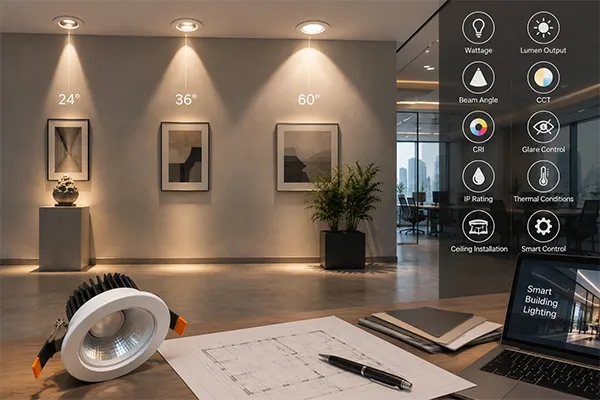
Start With the Lighting Task
The lighting task should guide the luminaire specification. A reception area, office workstation, hotel corridor, retail display zone, and washroom all have different needs. We recommend that buyers review drawings, reflected ceiling plans, ceiling height, furniture layout, and target lighting levels with the project lighting designer or technical team.
Key selection factors include:
| Specification | Procurement Question | Project Risk if Overlooked |
|---|---|---|
| Cutout size | Does the fixture fit the prepared ceiling opening? | Rework, adapter rings, delayed installation |
| Ceiling depth | Is there adequate clearance for the body and driver? | Driver compression, overheating, installation failure |
| Beam angle | Does the beam distribution suit spacing and ceiling height? | Dark spots, excessive overlap, uneven lighting |
| CCT | Does the color temperature match the interior concept? | Inconsistent appearance across zones |
| CRI | Is color rendering appropriate for the application? | Poor visual presentation of finishes or merchandise |
| Glare control | Is a deep anti-glare design required? | Occupant discomfort and visual complaints |
| IP rating | Does the environment need moisture or dust protection? | Unsuitable installation in wet or exposed areas |
| Finish color | Does the trim match the ceiling and design scheme? | Visible inconsistency in completed spaces |
Thermal Conditions Affect More Than Lifetime
Thermal management remains important in LED downlights for smart building applications. Recessed fixtures operate within ceiling voids, insulation conditions, and ambient temperatures that vary by project. A driver may also be placed remotely or integrated into the fitting body, depending on the design.
We do not make blanket lifetime or system-performance claims without project-specific assessment. However, we recommend that buyers consider thermal conditions because excessive heat can affect driver and LED performance over time7. Ceiling insulation, limited air movement, crowded service voids, and high ambient temperature areas should all be reviewed before final approval.
Sample Approval Should Simulate Real Conditions
A desk sample is useful, but it is not always enough. For meaningful evaluation, we suggest that project teams install trial samples in representative areas8 where possible. The test should reflect the actual ceiling, driver arrangement, control equipment, and viewing conditions.
A practical sample approval process may include:
- Confirming the physical cutout and ceiling depth.
- Reviewing finish color and trim appearance.
- Testing light distribution at the planned mounting height.
- Checking CCT consistency against adjacent lighting.
- Evaluating glare from normal viewing positions.
- Testing dimming or control behavior with the intended equipment.
- Recording approved part numbers, driver versions, and sample photos.
From our supply-side experience, a documented approved sample helps reduce confusion when orders move from quotation to production. It also gives purchasing teams a clearer reference for batch inspection.
How Should Buyers Procure LED Downlights for Smart Building Applications?
Procurement problems often begin when a project team finalizes a product name but not the full purchase specification. The buyer may later discover that the desired driver, trim color, certification document, or delivery date was not included in the original quotation.
Buyers should procure LED downlights for smart building applications through a documented specification, sample approval, supplier review, and batch-control process. The purchase order should clearly define technical parameters, control requirements, certifications, quantity, packaging, customization, inspection expectations, delivery schedule, and responsibilities for compatibility validation.
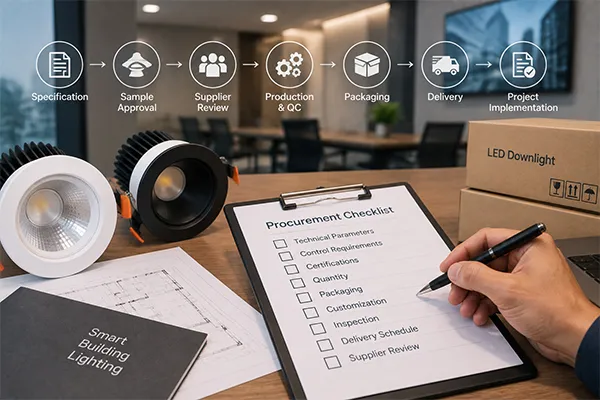
Build a Complete Request for Quotation
We recommend that contractors, importers, and lighting brands send a structured request for quotation rather than only asking for a price per unit. A clear RFQ allows us to assess whether standard products or OEM/ODM adjustments are required.
A useful RFQ for LED downlights may include:
- Product photos, drawings, or target design
- Required cutout and external dimensions
- Wattage and lumen-output target, if defined by the project
- CCT requirement, such as 3000K, 4000K, or another specified option
- CRI requirement
- Beam angle
- Trim and surface finish color
- Dimming or control-driver requirement
- Input voltage and market destination
- IP rating and installation environment
- Quantity by model and delivery phase
- Packaging and labeling requirements
- Required test reports or certification documents
- Target delivery date and destination port
- Sample quantity and approval process
At Upward Lighting, we can customize parameters such as color temperature, wattage, beam angle, CRI, and surface finish colors for relevant OEM/ODM projects. We recommend confirming feasibility, minimum order requirements, sample timing, and production lead time before a final commitment.
Evaluate Supplier Quality Controls
Price matters, but it should not be the only comparison point. A very low quotation may omit driver details, testing scope, packaging requirements, or certification documentation. Buyers should compare like-for-like specifications.
For example, our stated production practice includes a 100% aging test lasting 4 to 8 hours before shipment. This is a manufacturing quality-control step intended to identify early issues before dispatch. Buyers should still define their own inspection requirements and should not treat any single factory test as a substitute for project-specific acceptance testing.
Supplier due diligence can include:
- Product specification sheets and drawings
- Driver information and declared control capability
- Sample evaluation results
- Production inspection process
- Aging-test process
- Batch traceability approach
- Packaging standards
- Response time for technical questions
- Quotation validity and lead-time commitments
- Process for handling approved changes
Verify Certifications and Market Requirements
Certification requirements depend on the destination market, product configuration, and project application.9 We provide CE and RoHS documentation for applicable products, but buyers should verify the relevant documents, scope, product model, and market-entry requirements for their specific project.
Certification documents should be reviewed as part of procurement, not after goods arrive. The buyer, importer, project consultant, or compliance specialist should confirm whether additional approvals, labels, test reports, or local requirements apply.
We recommend that buyers keep the approved sample, specification sheet, driver details, certification file, and purchase-order revision history together. This document set is valuable if a project team needs to investigate a batch difference or replacement requirement later.
Plan for Batch Consistency and Delivery
For phased developments, consistency between batches matters. The project team may install products months apart, so CCT, trim finish, driver configuration, and physical dimensions should remain controlled10.
Before production, we recommend confirming:
| Item | What to Lock Before Production |
|---|---|
| Approved sample | Product code, finish, CCT, beam angle, driver |
| Bill of materials | Key components and approved alternatives policy |
| Labeling | Model number, voltage, wattage, batch marking |
| Packaging | Inner box, master carton, project labels |
| Inspection | AQL or agreed inspection method, if applicable |
| Delivery | Production lead time, shipment method, phased quantities |
| Reorder plan | Availability of the same approved configuration |
Small-batch orders can be useful for mock-ups, pilot installations, or market testing. However, buyers should discuss whether customized components affect minimum order quantities, pricing, and future repeat-order availability.
Frequently Asked Questions
Can a dimmable LED downlight work with any smart-building system?
No. A dimmable LED downlight is not automatically compatible with every smart-building system. Buyers should confirm the driver type, dimming interface, controller, wiring arrangement, electrical load, and commissioning method. The control-system provider and electrical contractor should validate compatibility before the order is released.
Are app-controlled LED downlights suitable for commercial buildings?
App-controlled LED downlights may suit some small commercial or localized applications, but an app does not replace a full building control strategy. Commercial projects may require centralized control, sensor integration, user permissions, scheduling, maintenance access, and documented commissioning procedures. The project team should define these needs first.
Which specifications should I include in an LED downlight RFQ?
We recommend including cutout size, wattage, CCT, CRI, beam angle, trim color, IP rating, input voltage, dimming or driver requirement, quantity, destination market, certifications, packaging, and delivery schedule. Buyers should also identify the approved control system if smart operation is required.
Why should buyers test downlight samples with the actual control equipment?
A physical sample test can reveal issues that specification sheets cannot show11, including dimming behavior, flicker, low-end performance, trim appearance, glare, ceiling fit, and interaction with the intended controller. The test should use representative project conditions whenever practical.
Do CE and RoHS documents confirm suitability for every project?
No. CE and RoHS documents may support relevant market and environmental compliance requirements12, but buyers should verify that the documents apply to the exact product model and destination market. Project-specific standards, electrical requirements, and local regulations may require additional review.
Conclusion
LED downlights for smart building applications should be selected through a complete project evaluation, not through a simple “smart” or “dimmable” label. We recommend that buyers first define the lighting task, installation conditions, and control architecture. They should then confirm driver compatibility, sample performance, certifications, batch consistency, customization needs, and delivery requirements. At Upward Lighting, we support contractors, importers, brands, and distributors with OEM/ODM downlight specifications, sample coordination, and structured quotations. Contact our team to discuss your project requirements before finalizing your LED downlight procurement.
"Integrated Lighting Resources", https://integratedlightingcampaign.energy.gov/resources. U.S. Department of Energy guidance describes lighting controls as system components whose performance depends on coordinated luminaires, controls, sensors, and commissioning. Evidence role: general_support; source type: government. Supports: Authoritative guidance that lighting controls are designed and evaluated as part of an integrated building lighting and control system.. Scope note: The guidance supports the system-level principle but does not prescribe a procurement decision for every downlight project. ↩
"[PDF] Smart Buildings: A Foundation for Safe, Healthy & Resilient Cities", https://pages.nist.gov/GCTC/uploads/blueprints/2020-SBSC-blueprint.pdf. Government guidance on commercial lighting controls identifies scheduling, occupancy sensing, and centralized control as common strategies for managing lighting energy use and operation. Evidence role: general_support; source type: government. Supports: Government or standards guidance describing scheduling, occupancy sensing, centralized control, and operational management as functions of commercial lighting-control systems.. Scope note: Individual projects may not require every listed function, and user-permission practices depend on the selected control platform. ↩
"[PDF] LED Dimming: What you need to know - eere.energy.gov", https://www1.eere.energy.gov/buildings/publications/pdfs/ssl/dimming_webcast_12-10-2012.pdf. Technical literature on LED dimming explains that compatibility is determined by the combined behavior of the LED driver, dimmer or controller, electrical load, and installation configuration rather than by a generic “dimmable” designation. Evidence role: mechanism; source type: research. Supports: Technical evidence that LED dimming performance depends on the interaction among the driver, dimmer or controller, load, and wiring configuration.. ↩
"LED Basics - Department of Energy", https://www.energy.gov/cmei/ssl/led-basics. LED-driver research describes the driver as the power-conversion and current-regulation stage that can also implement dimming and control functions for an LED luminaire. Evidence role: mechanism; source type: paper. Supports: Research explaining that LED drivers regulate electrical power to LEDs and implement dimming or control functions in controlled LED systems.. ↩
"[PDF] LED Dimming: What you need to know - eere.energy.gov", https://www1.eere.energy.gov/buildings/publications/pdfs/ssl/dimming_webcast_12-10-2012.pdf. Studies of LED lighting flicker report that temporal light modulation can result from interactions between LED drivers and dimming or power-control equipment, particularly under certain operating conditions. Evidence role: mechanism; source type: paper. Supports: Evidence that LED flicker can arise from driver, dimmer, and control interactions and may be pronounced during dimming operation.. Scope note: The evidence establishes a known mechanism and risk; it does not demonstrate flicker in a particular luminaire-controller combination without testing. ↩
"Text-Alternative Version: Glare in LED Outdoor Lighting", https://www.energy.gov/cmei/ssl/text-alternative-version-glare-led-outdoor-lighting. Lighting-design guidance treats glare control, light distribution, color quality, and physical installation as luminaire-design considerations, while controls primarily alter operation such as switching, scheduling, and light output. Evidence role: general_support; source type: research. Supports: Lighting-design guidance distinguishing luminaire optical characteristics from the operational adjustments provided by lighting controls.. Scope note: Controls may mitigate some operational effects, such as excess light output, but they cannot change the inherent optics or physical fit of a selected luminaire. ↩
"[PDF] High Operating Temperature Interconnects for LED Applications", https://energy.gov/sites/prod/files/2015/02/f19/bhatkal_interconnects_sanfrancisco2015.pdf. LED reliability research shows that elevated operating temperatures can affect LED optical performance and accelerate degradation of LEDs and associated electronic driver components. Evidence role: mechanism; source type: research. Supports: Evidence that elevated junction or ambient temperatures affect LED light output, color behavior, component reliability, and driver lifetime.. Scope note: Actual temperature effects and service life depend on the specific LED package, driver, heat sink, ambient environment, and operating profile. ↩
"[PDF] Outdoor Lighting Control System Fundamentals", https://www.energy.gov/sites/prod/files/2015/09/f26/outdoor-lighting-control-system-fundamentals_1.pdf. Professional lighting practice guidance uses mock-ups and in-situ evaluation to assess appearance, distribution, glare, and installation effects under conditions closer to the completed space. Evidence role: general_support; source type: institution. Supports: Professional lighting guidance supporting mock-ups or field evaluation under representative installation and viewing conditions.. Scope note: The appropriate scale and protocol for a mock-up vary with project complexity and applicable contract requirements. ↩
"Market Intelligence - Mexico - | International Trade Administration", https://www.trade.gov/market-intelligence-search/458. Official market-access guidance explains that product conformity obligations are determined by the applicable legislation, product characteristics, and jurisdiction in which goods are placed on the market. Evidence role: general_support; source type: government. Supports: Official information showing that conformity assessment and market-entry obligations depend on applicable product legislation and the market where products are placed.. Scope note: This general principle does not identify the full set of requirements for a specific downlight model or destination. ↩
"[PDF] LED Color Characteristics", https://www.energy.gov/sites/prod/files/2016/08/f33/led-color-characteristics-factsheet.pdf. LED lighting technical guidance notes that color consistency among luminaires depends on controlled LED chromaticity and product specification, making configuration control relevant where fixtures are installed together or over multiple phases. Evidence role: general_support; source type: research. Supports: Research or technical guidance explaining the importance of color consistency and controlled component specifications in LED luminaire installations.. Scope note: The acceptable degree of variation depends on the application, viewing conditions, and project specification. ↩
"[PDF] Exterior Lighting Control Guidance - Better Buildings Solution Center", https://betterbuildingssolutioncenter.energy.gov/sites/default/files/attachments/exterior-lighting-control-guidance.pdf. Lighting commissioning guidance calls for functional testing of installed lighting and controls to verify operation and performance under actual project conditions, supplementing product documentation. Evidence role: general_support; source type: government. Supports: Lighting commissioning guidance supporting functional testing of installed luminaires and controls to verify performance beyond submitted documentation.. Scope note: A sample test reduces uncertainty but cannot by itself establish long-term reliability or guarantee performance across the entire production batch. ↩
"RoHS Directive - Environment - European Commission", https://environment.ec.europa.eu/topics/waste-and-recycling/rohs-directive_en. European Commission materials explain that CE marking indicates conformity with applicable EU requirements, while the RoHS framework restricts specified hazardous substances in electrical and electronic equipment. Evidence role: definition; source type: government. Supports: Official European Commission explanations of CE marking and the Restriction of Hazardous Substances (RoHS) framework for electrical and electronic equipment.. Scope note: Whether either requirement applies, and whether documentation is sufficient, must be assessed for the exact product and applicable EU legislation. ↩