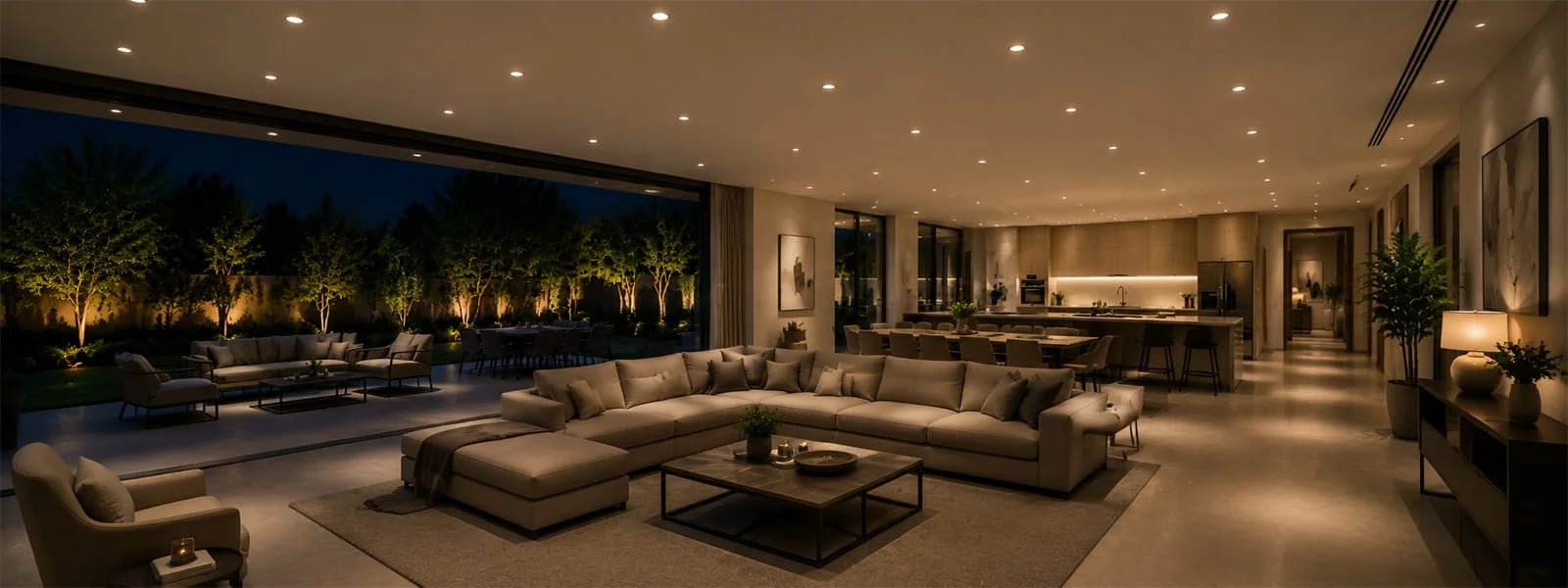
LED downlights for super luxury villas can look premium in a catalogue yet create disappointing results on site when buyers apply one specification across every room. Higher wattage, a trimless frame, or a deep recessed body does not automatically create luxury. I recommend matching output, beam angle, glare control, colour quality, finish, and dimming compatibility to each space.
The best LED downlights for super luxury villas are selected as a coordinated system, not as one universal “high-end” fixture. Buyers should specify each downlight according to ceiling height, task lighting needs, architectural focal points, surface materials, desired colour temperature, glare-control expectations, and the planned dimming or control system. A sample review and technical confirmation should happen before production.
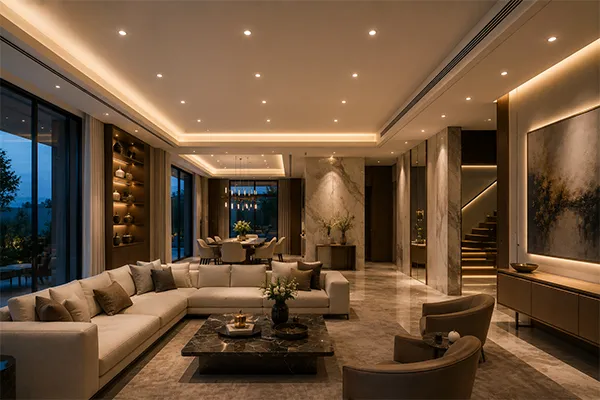
In discussions with villa contractors and purchasers, I often see a clear design intention but an incomplete procurement brief. The project team may ask for “premium trimless downlights” without confirming light output, beam distribution, cut-out dimensions, or dimming protocol. Those details are where a visually refined concept becomes a quote-ready product specification.
Why Do LED Downlights for Super Luxury Villas Need Space-by-Space Specifications?
LED downlights for super luxury villas need different specifications because each room has different ceiling conditions, visual priorities, materials, and tasks. A downlight that works well in a wardrobe or corridor may create excessive brightness, poor beam coverage, or unwanted glare in a bedroom, art wall, or formal living room.
A villa buyer can reduce procurement risk by defining each area before requesting a quotation. I usually encourage project teams to group spaces by their lighting purpose: general illumination, circulation, task lighting, accent lighting, or architectural emphasis.
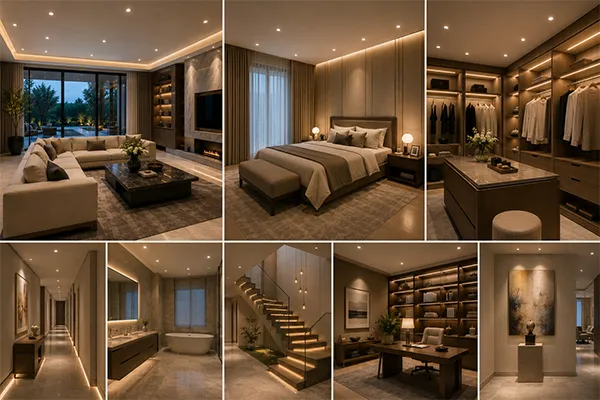
One Premium Fixture Is Not a Complete Lighting Strategy
A large villa may include double-height reception rooms, private bedrooms, hallways, bathrooms, dressing rooms, kitchens, staircases, wine areas, cinema rooms, and outdoor transition zones. These spaces do not need identical light.
For example, a deep-beam recessed fixture may suit a corridor with a controlled ceiling rhythm. The same narrow beam may leave dark gaps in a dressing area where the user needs clear visibility of clothing and finishes. Likewise, a high-output fixture may be appropriate for a double-height space, but it may feel harsh in a low-ceiling bedroom.
I have found that buyers benefit from asking a simple question for every zone:
What must this downlight illuminate, and what should remain visually quiet?
That question moves the discussion beyond generic labels such as “hotel-grade” or “luxury-grade.”
A Practical Room-by-Room Procurement Framework
| Villa Area | Main Lighting Need | Procurement Questions |
|---|---|---|
| Living room | Layered ambient light and architectural emphasis | What is the ceiling height? Are there artworks, stone walls, or feature furniture? |
| Corridor | Comfortable wayfinding and visual rhythm | What is the fixture spacing? Is low glare more important than high brightness? |
| Bedroom | Soft ambient light and bedside comfort | Is the downlight visible from the bed? Is warm dimming required? |
| Bathroom | Clear facial visibility and moisture-aware selection | What is the installation zone? Are additional mirror lights included? |
| Wardrobe | Accurate clothing colour and practical visibility | Is vertical illumination needed? What finish colours must be distinguished? |
| Kitchen | Task-oriented illumination | What work surfaces need light? Are pendants or under-cabinet lights part of the scheme? |
| Art wall | Controlled accent lighting | What beam angle suits the artwork size and wall distance? |
| Double-height area | Light reach and hierarchy | What mounting height is involved? Has a lighting calculation been prepared? |
I do not treat this framework as a replacement for a professional lighting design or calculation. A qualified lighting professional should evaluate application-specific layouts, mounting heights, reflective surfaces, and target illumination levels. However, it helps contractors and purchasing managers convert broad design language into clear supplier questions.
What I Ask Before Quoting
When I discuss a villa project with a purchaser, I try to collect the following information early:
- Reflected ceiling plans or fixture layout drawings
- Ceiling heights for each room type
- Preferred colour temperature, such as 2700K, 3000K, 3500K, or 4000K
- Required CRI and colour-consistency expectations
- Dimming or smart-control system details
- Cut-out size, trim type, and ceiling material
- Preferred finish, including white, black, brushed metal, or custom painted colours
- Target delivery schedule and quantity by model
This process does not make the project complicated. It makes the quotation more accurate and reduces the chance of ordering a visually attractive fixture that does not fit the actual application.
How Should Buyers Balance Output, Beam Angle, and Glare Control?
A super-luxury villa needs light that is sufficient for movement, tasks, and visual emphasis without making ceilings feel crowded or uncomfortable. Buyers should assess wattage and lumen output together with beam angle, mounting height, fixture spacing, and glare-control construction rather than treating any one number as proof of quality.
In my experience, specifications become more useful when a buyer describes the intended visual effect first. For example, “soft pool of light over seating” is more actionable than simply requesting “12W anti-glare downlights.”
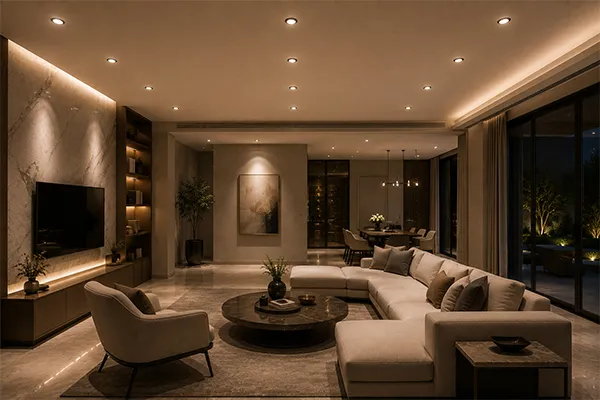
Wattage Does Not Define Luxury
Wattage describes electrical power consumption.1 It does not independently tell a buyer how bright a fixture will appear2, how evenly it will light a surface, or how comfortable it will feel to occupants.
A higher-wattage LED downlight may be suitable in some applications, especially where ceilings are high or where the fixture contributes to general illumination. Yet excess output in a low-ceiling lounge, bedroom, or hallway can make the room feel overlit.
I recommend that procurement teams request and compare:
- Rated wattage
- Declared lumen output
- Beam angle
- Photometric data where available
- Mounting height assumptions
- Recommended spacing guidance
- Dimming range and compatible drivers
- Glare-control design details
A supplier should be able to explain these items clearly. If a supplier only repeats “high lumen” or “premium chip,” the buyer still lacks the information needed to evaluate the fixture.
Beam Angle Shapes the Visual Result
Beam angle affects how light spreads from the ceiling to the target surface.3 Narrow beams often create stronger visual emphasis. Wider beams generally cover larger areas more softly, depending on mounting height and fixture output.
| Beam Distribution | Typical Procurement Use | Buyer Caution |
|---|---|---|
| Narrow beam, such as 15°–24° | Artwork, feature walls, focused architectural details | Can create sharp contrast or visible hotspots if spacing is not planned |
| Medium beam, such as 30°–40° | Living rooms, corridors, feature zones | Often versatile, but suitability still depends on ceiling height |
| Wide beam, such as 50°–60° | General ambient coverage, wardrobes, some bedrooms | May cause overlap or flatter visual hierarchy if overused |
These ranges are general references, not universal design instructions. The final choice should reflect ceiling height, spacing, reflectance, furniture layout, and the lighting designer’s calculations where applicable.
Deep Recessing Is a Feature, Not an Automatic Quality Guarantee
Many buyers request deep anti-glare LED downlights because the recessed light source can reduce direct viewing angles. That can be useful. However, I do not assume that a deep anti-glare body is automatically better for every villa area.
A deeper fixture may affect:
- Ceiling void requirements
- Installation access
- Heat management considerations
- Visible aperture size
- Light distribution
- Maintenance access
- Product cost
I recommend reviewing a physical sample in the intended ceiling finish whenever possible. A sample lets the project team assess the trim appearance, aperture depth, surface colour, reflector finish, and perceived glare from normal viewing positions.
What Colour Temperature and CRI Should LED Downlights for Super Luxury Villas Have?
LED downlights for super luxury villas should use colour temperature and CRI as connected specification choices. Warm light can support a relaxed residential atmosphere, while higher colour-rendering performance can help materials, art, skin tones, and furnishings appear more natural. Neither specification alone proves that a fixture is luxury-grade.
I often see requests for “CRI 90+” without a confirmed colour temperature, binning expectation, or sample approval process. CRI is important, but buyers should evaluate the complete colour-quality package before placing an order.
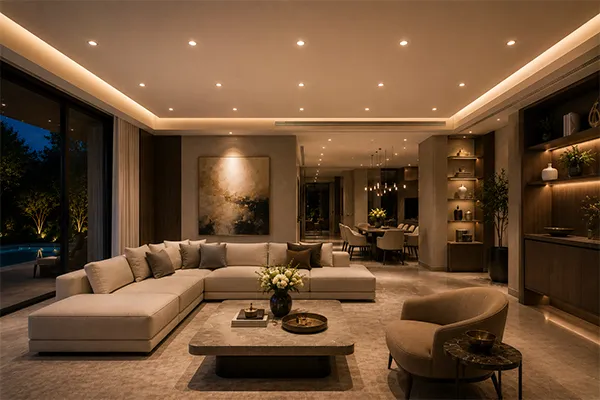
Colour Temperature Sets the Mood, but Context Matters
Colour temperature is commonly expressed in kelvin, or K.4 Lower values generally appear warmer, while higher values appear cooler or more neutral.5
For many high-end residential projects, 2700K and 3000K are frequent starting points. However, I do not recommend selecting a colour temperature from a catalogue image alone. Stone, timber, fabric, paint, metal, daylight exposure, and the client’s preferred atmosphere can all influence the final choice.
Here is a practical comparison:
| Colour Temperature | Typical Visual Character | Potential Villa Applications |
|---|---|---|
| 2700K | Warm, soft, residential | Bedrooms, lounges, hospitality-style relaxation areas |
| 3000K | Warm-neutral and versatile | Living areas, corridors, wardrobes, many general villa spaces |
| 3500K | Neutral with a cleaner appearance | Some kitchens, dressing areas, contemporary material palettes |
| 4000K | Brighter, cooler-neutral appearance | Utility-oriented spaces where the design team requests it |
I advise project teams to review samples against actual finish materials. A 3000K product can appear very different beside warm oak, pale marble, grey stone, gold metal, or high-gloss surfaces.
CRI Is Valuable, but It Is Not the Whole Story
Colour Rendering Index, or CRI, indicates how faithfully a light source renders colours compared with a reference source under defined conditions.6 A higher CRI is often relevant for luxury residential environments because buyers may care about the appearance of artwork, timber, textiles, cosmetics, stone, and clothing.
Still, I do not position CRI as a standalone proof of premium quality. Buyers should also ask about:
- Colour temperature tolerance
- Consistency between production batches
- Driver quality and dimming behaviour
- Beam uniformity
- Reflector and optical design
- Sample-to-order consistency
- Applicable test documentation
In a villa project, inconsistency may be more noticeable than a simple specification sheet suggests. A corridor with multiple downlights can reveal colour variation quickly7, especially on white ceilings or pale stone walls.
Sample Approval Should Be Part of Procurement Control
I recommend that the buyer approve samples before mass production when the project has strict visual requirements. The sample process can include:
- Checking the illuminated colour on key materials.
- Reviewing trim and reflector finishes.
- Comparing beam shape against the intended ceiling height.
- Testing dimming performance with the nominated system.
- Confirming cut-out size and installation method.
- Recording the approved specifications in the purchase order.
This process provides a clearer reference for both the buyer and supplier. It also reduces ambiguity when multiple models, colour temperatures, or finishes are included in the same villa order.
How Can Buyers Confirm Dimming and Control Compatibility?
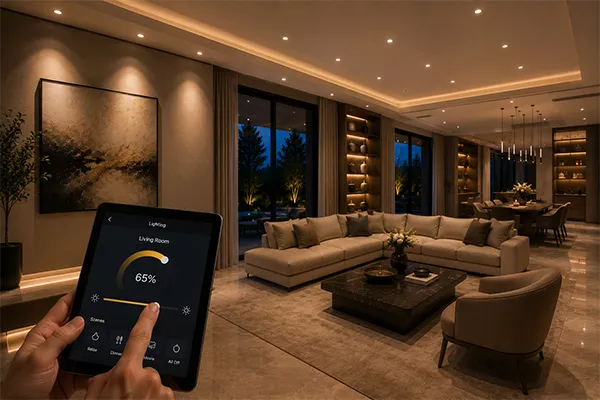
LED downlights for super luxury villas should be confirmed for dimming and control compatibility before production, not after installation. Buyers should identify the control protocol, dimmer brand or system, driver requirements, dimming range, and wiring conditions because an incompatible combination can cause flicker, limited dimming, noise, or unstable performance.8
A premium villa frequently includes layered controls, scene settings, automated shading, and smart-home integration. The downlight is only one part of that system. The driver and dimming interface can be equally important.
Ask About the System Before Selecting the Driver
A project may use phase-cut dimming, 0–10V, DALI, or another control arrangement.9 Each option has different requirements. I do not assume that “dimmable” means compatible with every dimmer or automation platform.
Before the buyer releases an order, I recommend confirming:
- Which dimming protocol the project requires
- Which dimmer, gateway, or control brand is specified
- Whether the driver is remote or integrated
- The available ceiling void and access conditions
- The number of fixtures on each control circuit
- Whether the project requires scene control or simple on/off dimming
- Whether a test sample can be connected to the planned control equipment
Common Procurement Risks
The following issues are not limited to villa projects, but they are especially important where finishing standards are high:
| Risk | Why It Matters | Buyer Action |
|---|---|---|
| “Dimmable” stated without protocol | The fixture may not suit the actual control system | Request the exact driver and dimming method |
| No system test | Compatibility issues may appear only on site | Test representative samples before bulk order |
| Driver access not considered | Future maintenance can become difficult | Confirm ceiling access and driver location |
| Mixed product batches | Dimming response may differ across models | Standardize approved models and drivers |
| Unclear minimum dimming level | Light may not dim low enough for the intended atmosphere | Ask for documented dimming range and test results |
I have seen project discussions become much smoother when the contractor shares the dimmer or automation specification at the quotation stage. That allows the supplier to propose an appropriate driver configuration rather than making assumptions.
Installation Conditions Matter Too
A control-compatible product can still be problematic if the installation conditions are not reviewed. Ceiling construction, insulation, ventilation, cut-out tolerances, driver location, cable routing, and access panels all affect practical installation.
I recommend that contractors verify:
- Final cut-out diameter
- Fixture height and ceiling void depth
- Driver dimensions
- Required ventilation or clearance guidance
- IP rating requirements for wet-area applications10
- Wiring and terminal requirements
- Access for future replacement
These are basic checks, but they can protect the project from expensive late-stage changes after ceiling finishes are complete.
How Should Contractors Evaluate a Supplier of LED Downlights for Super Luxury Villas?
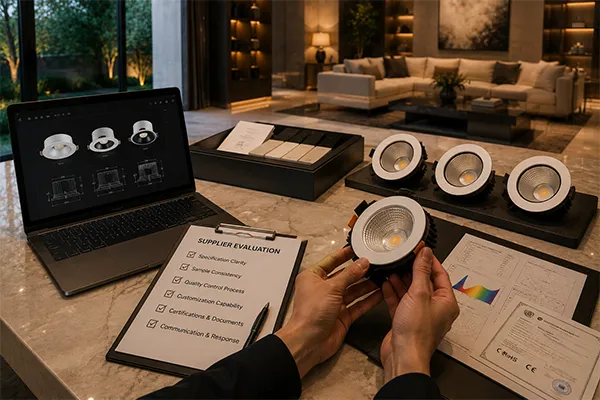
A supplier of LED downlights for super luxury villas should be evaluated on specification clarity, sample consistency, quality-control processes, customization capability, documentation, and communication speed. Buyers should verify certifications and product documents rather than relying on broad marketing terms such as “premium,” “imported,” or “five-star.”
A visually refined villa project depends on reliable execution. The supplier needs to support the procurement process with accurate information, manageable lead times, and repeatable production control.
Replace Marketing Labels With Confirmable Questions
I encourage buyers to ask questions that can be answered with documents, samples, drawings, or test records.
Instead of asking, “Is this your best luxury downlight?” I suggest asking:
- What are the available wattage, lumen, beam-angle, and CCT options?
- What is the cut-out size and fixture depth?
- Which drivers support the project’s dimming system?
- Can the supplier provide finish samples?
- Can the supplier support custom CRI, beam angle, trim colour, or wattage?
- What ageing test or quality-control procedure is used?
- What documentation is available for the required market?
- Can the supplier maintain the approved specification across repeat orders?
At Upward Lighting, I work with purchasers who need these details translated into practical quotation lines. Our team can customize parameters such as colour temperature, wattage, beam angle, CRI, and surface finish colours for suitable OEM/ODM orders. We also conduct a 100% ageing test before shipment, generally lasting 4 to 8 hours, as part of our internal quality-control process.
Buyers should still review product-specific documents and confirm that the selected configuration meets their project and market requirements. Certifications such as CE and RoHS should be treated as documents to verify for the applicable product and destination market.11
Supplier Evaluation Checklist
| Evaluation Area | What Buyers Should Request |
|---|---|
| Product specification | Datasheet, dimensions, cut-out, wattage, CCT, CRI, beam angle |
| Optical appearance | Physical sample, reflector finish, trim finish, beam review |
| Control compatibility | Driver details, dimming protocol, test arrangement |
| Quality control | Ageing-test process, inspection approach, batch identification |
| Compliance | Applicable declarations, test reports, and certification documents |
| Customization | MOQ, lead time, available finish and parameter options |
| Communication | Quotation turnaround, technical response time, revision control |
| Delivery | Production schedule, packing method, shipment planning |
Why Small-Batch Flexibility Can Matter
A luxury villa may require multiple fixture types in relatively modest quantities. The project might need one model for corridors, another for bedrooms, a narrow-beam version for feature walls, and custom finishes for selected areas.
For this reason, buyers may value suppliers that can support small-batch orders and coordinated model selection. At Upward Lighting, we support small-batch requirements where the configuration and production plan are feasible. I believe this flexibility helps contractors avoid over-ordering one unsuitable model simply to meet a high minimum order quantity.
The most reliable purchasing approach is not to search for a universal “best” downlight. It is to select a supplier that can respond clearly to the project’s technical and commercial requirements.
Frequently Asked Questions
What is the best colour temperature for luxury villa downlights?
I often see 2700K and 3000K used as starting points for luxury residential projects because they can support a warm, comfortable atmosphere. However, the final choice should be reviewed against actual stone, timber, paint, fabrics, daylight conditions, and the intended room function.
Are trimless downlights always better for super-luxury villas?
No. Trimless downlights can create a clean ceiling appearance, but they are not automatically superior in quality or suitability. Buyers should also check installation method, ceiling finish tolerance, maintenance access, glare control, beam distribution, and the overall visual relationship with the interior design.
Is CRI 90 enough for a luxury villa lighting project?
CRI 90 can be a useful requirement, but it is not enough by itself. I recommend assessing CRI alongside colour temperature, colour consistency, beam quality, dimming response, finish samples, and production consistency. Sample approval remains important for visually sensitive villa spaces.
Which dimming system should I use for villa LED downlights?
The right dimming system depends on the project’s electrical design, automation platform, required scene control, budget, and maintenance plan. Buyers should confirm the specified protocol, such as phase-cut, 0–10V, or DALI, with the lighting supplier and qualified electrical professionals before ordering.
What should I send a downlight supplier for an accurate quotation?
I recommend sending ceiling plans, quantities, ceiling heights, required cut-outs, preferred CCT, CRI, wattage or output targets, beam angles, trim finishes, IP requirements, dimming details, and delivery location. This information helps the supplier provide a more accurate and usable quotation.
Conclusion
LED downlights for super luxury villas should support a complete lighting experience, not just a premium-looking ceiling detail. I recommend that buyers evaluate each space separately and confirm output, beam angle, glare control, colour temperature, CRI, finish, installation conditions, and dimming compatibility before production. A reviewed sample and a clear, room-by-room specification can reduce avoidable procurement risk. If you are sourcing villa downlights, I invite you to send Upward Lighting your drawings, fixture schedule, and control requirements for a quote-ready product review.
"NIST Study Suggests Universal Method for Measuring Light Power", https://www.nist.gov/news-events/news/2019/12/nist-study-suggests-universal-method-measuring-light-power. The watt (W) is the unit of power, expressing the rate at which electrical energy is consumed or converted. Evidence role: definition; source type: government. Supports: That the watt is the SI-derived unit used to express power, including electrical power consumption.. ↩
"Purchasing Energy-Efficient Light Bulbs", https://www.energy.gov/cmei/femp/purchasing-energy-efficient-light-bulbs. Energy-efficiency guidance distinguishes lumens, which indicate light output, from watts, which indicate power use; fixtures with similar wattage can therefore provide different light output. Evidence role: general_support; source type: government. Supports: That lumens measure light output and that watts measure energy use, so wattage alone is not a direct measure of brightness.. Scope note: Apparent brightness in a room also depends on optics, surface reflectance, mounting position, and adaptation, not only on lumen output. ↩
"ANSI/IES LS-1-25, Lighting Science: Nomenclature and Definitions ...", https://ies.org/standards/definitions/. Luminaire beam angle characterizes the angular spread of emitted light and is therefore relevant to the size and intensity distribution of the illuminated area. Evidence role: mechanism; source type: research. Supports: That beam angle describes the angular spread of a luminaire's beam and affects the area over which its light is distributed.. Scope note: The resulting on-site distribution also depends on mounting height, aiming, spacing, and the luminaire's full photometric distribution. ↩
"[PDF] A correlated color temperature for illuminants", https://nvlpubs.nist.gov/nistpubs/jres/7/jresv7n4p659_A2b.pdf. Correlated colour temperature is conventionally expressed in kelvin (K), indicating the chromatic appearance of a light source relative to a blackbody reference. Evidence role: definition; source type: government. Supports: That colour temperature or correlated colour temperature in lighting is conventionally reported in kelvin (K).. Scope note: For most practical LED sources, the reported value is correlated colour temperature rather than the physical temperature of the LED. ↩
"Understanding LED Color-Tunable Products | Department of Energy", https://www.energy.gov/cmei/ssl/understanding-led-color-tunable-products. Lighting references commonly describe lower correlated colour temperatures as warmer in appearance and higher correlated colour temperatures as cooler or more neutral-white. Evidence role: definition; source type: government. Supports: That lower-CCT lamps are commonly characterized as warmer in appearance and higher-CCT lamps as cooler or whiter.. Scope note: Perceived warmth is influenced by surrounding materials, adaptation, daylight, and the source's chromaticity, so CCT is not a complete prediction of appearance. ↩
"Color rendering index", https://en.wikipedia.org/wiki/Color_rendering_index. The general colour rendering index (Ra) quantifies colour-rendering performance by comparing specified test-colour samples under a test illuminant with their appearance under an appropriate reference illuminant. Evidence role: definition; source type: institution. Supports: That the general colour rendering index is calculated by comparing the rendering of specified test colours under a test source with their rendering under a reference illuminant.. Scope note: CRI does not capture every aspect of colour preference, saturation, or fidelity for all objects and should not be interpreted as a complete colour-quality metric. ↩
"[PDF] Next Generation luminaire (NGL) Downlight Demonstration Project", https://betterbuildingssolutioncenter.energy.gov/sites/default/files/attachments/ngl-downlight-demonstration-project-hilton-columbus-downtown-report.pdf. Research and industry guidance on LED chromaticity consistency recognize that colour differences between nearby luminaires can be perceptible, making binning and batch consistency relevant in repeated lighting layouts. Evidence role: general_support; source type: research. Supports: That colour consistency between LED products is important because chromaticity differences among nearby luminaires may be perceptible.. Scope note: Whether a particular difference is noticeable depends on the magnitude and direction of the chromaticity shift, observer conditions, surfaces, and installation geometry. ↩
"[PDF] Today's Lighting Products: What You Need to Know - Department of ...", https://www.energy.gov/sites/prod/files/2015/02/f20/brodrick_grainger2015.pdf. LED dimming guidance reports that compatibility among the control, driver, and LED load is necessary for stable operation; mismatches can produce flicker, limited dimming performance, or other undesirable effects. Evidence role: mechanism; source type: research. Supports: That LED dimming performance depends on compatibility among the lamp or luminaire, driver, and control device, and incompatibility can lead to undesirable operating behavior.. Scope note: Specific symptoms vary by driver design, dimming method, load level, wiring, and the particular products tested. ↩
"[PDF] What's Next for Solid-State Lighting? - Department of Energy", https://www.energy.gov/documents/feb2015nemabrodrickpdf. Phase-cut control, 0–10 V control, and Digital Addressable Lighting Interface (DALI) are distinct lighting-control approaches with different signaling, wiring, and device-compatibility requirements. Evidence role: definition; source type: institution. Supports: That phase-cut dimming, 0–10 V control, and DALI are recognized but technically different approaches to lighting control.. Scope note: Individual implementations may add proprietary gateways or commissioning requirements beyond the core control method. ↩
"Ingress Protection (IP) ratings", https://iec.ch/ip-ratings. IEC 60529 defines IP codes used to classify the protection provided by electrical enclosures against ingress of solid objects and water, making the relevant IP rating an installation consideration in wet or splash-prone locations. Evidence role: definition; source type: institution. Supports: That IP codes classify the degree of protection electrical enclosures provide against ingress of solids and water.. Scope note: An IP code addresses ingress protection only; local electrical codes, luminaire installation instructions, and location-specific zoning rules may impose additional requirements. ↩
"CE marking – obtaining the certificate, EU requirements - Your Europe", https://europa.eu/youreurope/business/product-rules-compliance/general-product-compliance/ce-marking/index_en.htm. European Commission guidance explains that CE marking applies only where EU product rules require it and that RoHS establishes substance restrictions for applicable electrical and electronic equipment; conformity documentation should therefore be checked for the specific product and market. Evidence role: general_support; source type: government. Supports: That CE marking is associated with EU conformity obligations for applicable products and that RoHS restricts specified hazardous substances in electrical and electronic equipment.. Scope note: CE and RoHS applicability does not by itself establish compliance with all national, installation, safety, or contractual requirements in the destination market. ↩