

Quality LED downlights can affect far more than a project’s initial fixture cost. When buyers focus only on the lowest unit price, they may face inconsistent batches, replacement work, delayed installations, customer complaints, and difficult replenishment later. I believe the better approach is to evaluate downlights as a long-term supply and business-risk decision.
Quality LED downlights provide long-term business value by reducing the risk of installation issues, premature replacements, inconsistent repeat orders, customer returns, and brand damage. A higher purchase price may be justified when the supplier can support consistent specifications, appropriate quality controls, documented compliance, customization, and reliable replenishment for the intended market and application.
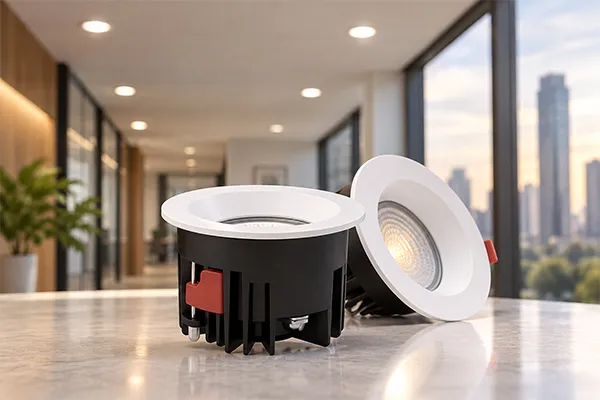
I have worked with importers, contractors, distributors, and private-label lighting brands that need more than a product that looks acceptable in a sample box. They need a downlight program that can support repeat orders, project handovers, market requirements, and changing customer expectations. That is where a more complete quality evaluation becomes useful.
Why Do Quality LED Downlights Reduce Total Business Exposure?
A low quotation can look attractive when purchasing teams compare a single wattage, lumen claim, or housing appearance. However, a cheaper fixture can create pressure later if it causes site revisits, returns, or specification confusion. I encourage buyers to look beyond the first invoice and assess the full commercial exposure.
Quality LED downlights can reduce total business exposure because they are more likely to support consistent installation, repeatable specifications, and smoother after-sales handling. Buyers should evaluate the total cost of procurement, including inspection, installation labor, replacements, customer claims, replenishment, and the effect of product consistency on their reputation.
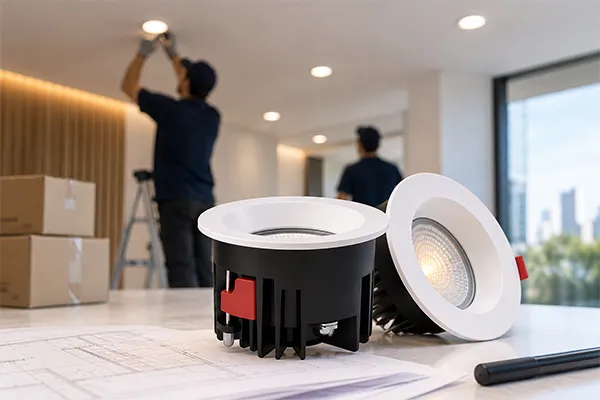
The Unit Price Is Only One Part of the Cost1
I often see procurement discussions start with a simple comparison: “Which supplier offers the lowest price for a 10W or 12W downlight?” That question matters, but it is incomplete.
A downlight has a wider business cost than its factory price. If a product fails, differs from an approved sample, or cannot be replenished with the same appearance and performance, the buyer may need to spend money in several places:
- Incoming inspection and sorting
- Installation labor and site access
- Contractor call-backs and travel
- Product replacement and shipping
- Warehouse handling for returns
- Customer service time
- Delayed project completion
- Discounting or credit notes
- Lost confidence in the buyer’s own brand
For a contractor, one replacement may require access equipment, ceiling work, coordination with the site manager, and a return visit.2 For an importer or distributor, a batch inconsistency may lead to claims from several resellers at the same time. For a local lighting brand, a poorly matched repeat order can affect the trust built with dealers and end users.
I do not assume that every low-priced downlight is poor quality. Some lower-cost options can be suitable for simple, clearly defined applications. The key is whether the product and supplier are appropriate for the commercial risk of the project or sales channel.
A Practical Total-Exposure Comparison
| Evaluation area | Lowest-price-only approach | Long-term procurement approach |
|---|---|---|
| Initial purchase | Focuses on unit cost | Reviews unit cost alongside risk |
| Product sample | Approves appearance only | Confirms key specifications and consistency |
| Installation | Assumes all units will perform alike | Considers access, labor, and replacement difficulty |
| Repeat orders | Treated as a future issue | Discussed before the first purchase order |
| Documentation | Requested only when needed | Reviewed against destination-market requirements |
| Supplier relationship | Transaction-based | Built around communication, control, and replenishment |
I recommend that buyers ask themselves a simple question: What happens if this downlight needs to be replaced six months after installation or reordered one year after launch? The answer often reveals whether the lowest quotation is truly the lowest business cost.
At Upward Lighting, I see this issue from the manufacturing side. Our role is not to promise that every application will perform identically under every site condition. Instead, we try to support buyers with clear specifications, production coordination, pre-shipment checks, and communication before problems become expensive.
How Should Buyers Evaluate Quality LED Downlights Beyond Wattage and Lumens?
Many buyers receive product lists that show wattage, lumen output, cutout size, and price. Those figures are useful, but they do not fully show how a downlight will behave across multiple production batches. A fixture can meet a basic headline specification while still creating commercial difficulties in color, fit, finish, or supply continuity.
Buyers should evaluate quality LED downlights by reviewing specification fit, batch consistency, component selection, thermal design, driver suitability, color consistency, finish quality, and the supplier’s documented quality-control process. Wattage and lumen claims should be considered alongside samples, agreed tolerances, and application-specific testing.
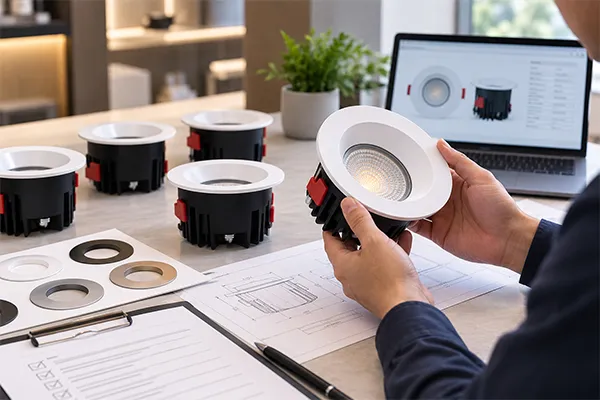
“Same Specification” Does Not Always Mean the Same Product Value
Two downlights may both be described as 12W, 3000K, and 90 mm cutout. Yet their commercial value can differ because of details that affect installation, appearance, and repeatability.
I suggest that buyers compare the following points:
-
Color temperature and color consistency
A 3000K label alone does not explain how closely products match each other visually.3 For hospitality, retail, and residential projects, visible variation between fixtures can create dissatisfaction. -
Color Rendering Index (CRI)
Higher CRI may be important where merchandise, finishes, food, or interior materials need more accurate color appearance.4 However, buyers should specify the target CRI and verify supporting documentation rather than relying only on a catalogue claim. -
Beam angle and optical control
A narrow beam can create focused accents. A wider beam can support general lighting. The wrong beam angle may result in uneven light distribution even if wattage and lumen figures appear suitable.5 -
Driver configuration
Driver quality, dimming compatibility, input requirements, and thermal conditions can influence actual performance.6 Buyers should confirm whether the proposed product suits local voltage, control systems, and installation environments. -
Housing, heat management, and finish
Material thickness, heat dissipation design, trim finish, spring strength, and cutout tolerance can affect installation quality and visual consistency.7 -
Batch-to-batch control
A sample can look good while later production differs.8 Buyers should discuss how key parameters are controlled and how changes are communicated.
Questions I Would Ask a Downlight Supplier
When I advise a purchasing team, I encourage them to ask direct questions rather than relying on broad terms such as “premium” or “high quality.”
| Buyer question | Why it matters |
|---|---|
| Can you confirm the agreed wattage, CCT, CRI, beam angle, and cutout size in writing? | It creates a clear purchasing reference. |
| Can you provide sample approval before mass production? | It helps align appearance and function. |
| How do you manage production changes or component substitutions? | It reduces surprise differences in repeat orders. |
| What aging or functional checks are completed before shipment? | It clarifies the factory’s internal controls. |
| Can you support the same specification for future replenishment? | It helps protect projects and private-label programs. |
| Which certificates or test documents are available for this model? | It supports market-entry verification. |
At our factory, we conduct a 100% aging test for 4 to 8 hours before shipment, depending on the product and order requirements. I present this as a manufacturing control measure intended to identify obvious functional issues before dispatch. It is not the same as independent laboratory validation, and it does not replace application-specific testing by the buyer or qualified professionals.
Why Do Quality LED Downlights Matter for Repeat Orders and Brand Reputation?
A downlight that operates correctly on installation day may still be unsuitable for a long-term product program. Importers, wholesalers, and lighting brands often need matching products months later. Contractors may need spare units for project maintenance. Without repeatable specifications, the first order can become the start of a future service problem.
Quality LED downlights matter for repeat orders because stable specifications, controlled appearance, and supplier continuity help buyers protect their brand reputation. A reliable replenishment process can be as important as the original product because customers expect later orders and replacement units to match the approved installation.
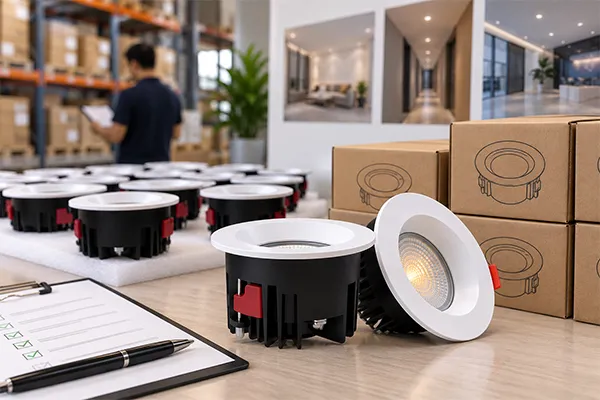
Replenishment Is a Procurement Requirement, Not an Afterthought
I have seen buyers focus heavily on the first container, first project, or first promotional order. That is understandable because the initial order creates immediate pressure. Still, many commercial problems appear later.
A distributor may sell a downlight range to electrical wholesalers and then receive requests for the same trim color, CCT, or beam angle months later. A contractor may require replacement units that fit existing ceiling cutouts and visually match installed fixtures. A private-label brand may need the same housing design and packaging format for its next market launch.
If the original supplier cannot maintain reasonable continuity, the buyer may need to manage difficult alternatives:
- Accept a visually different replacement
- Hold more inventory than planned
- Requalify another supplier
- Change catalogue specifications
- Offer compensation to customers
- Delay maintenance or project completion
For this reason, I suggest including replenishment expectations in the original supplier discussion. Buyers do not need to demand an unrealistic permanent guarantee. Markets, components, and regulations can change. However, they can ask suppliers how they manage product continuity, notice periods for changes, and available alternatives if a component is no longer available.
OEM and ODM Decisions Affect Long-Term Viability
Customization can strengthen a product program when it is managed carefully. At Upward Lighting, we support OEM/ODM requests involving:
- Color temperature
- Wattage
- Beam angle
- CRI
- Surface finish color
- Packaging and labeling requirements
These choices can help a buyer create a more suitable range for a local market or customer segment. However, I recommend that buyers avoid unnecessary variations unless they have a clear sales or project need. Each additional variation can affect minimum order quantities, stock planning, approval procedures, and replenishment complexity.
| Program type | Main priority | Procurement consideration |
|---|---|---|
| Standard distribution range | Availability and price stability | Keep core specifications simple and repeatable |
| Project-specific downlight | Installation and design fit | Confirm cutout, beam, CCT, controls, and delivery timing |
| Private-label range | Brand differentiation | Define packaging, finish, performance targets, and change control |
| Small trial order | Market validation | Request samples and clarify how scale-up will be handled |
I believe a supplier relationship becomes more valuable when it supports both the first order and the next decision. Fast quotation response, clear communication, flexible small-batch support, and supply-chain coordination can reduce friction when buyers need to react to customer demand.
How Can Buyers Match Quality LED Downlights to the Right Application and Market?
Not every application requires the same downlight design, specification level, or purchasing strategy. A residential renovation, retail chain, hotel corridor, office fit-out, and distributor stock program may all have different priorities. Buyers can waste money by over-specifying a simple application, but they can also create risk by under-specifying a demanding one.
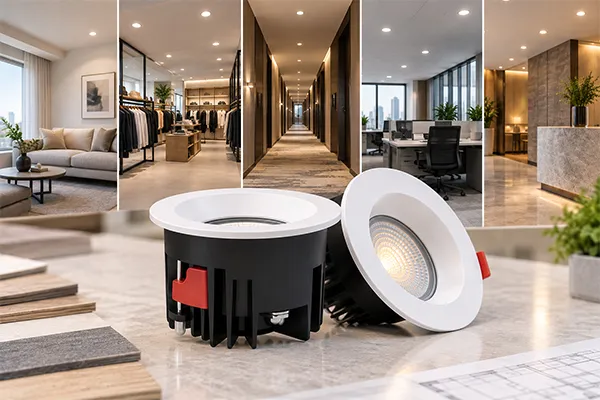
Buyers should match quality LED downlights to the actual application, installation conditions, target market, and replenishment plan. The correct choice depends on factors such as color temperature, wattage, beam angle, CRI, dimming needs, trim finish, required documents, order volume, and the cost of future replacement.
Start With the Application, Not the Catalogue Page
I recommend that buyers create a short application brief before requesting quotations. This brief does not need to be complicated. It should identify the factors that influence commercial suitability.
A useful brief may include:
- Installation location: residential, office, retail, hospitality, corridor, or exterior covered area
- Ceiling type and available cutout size
- Required input voltage and dimming method
- Preferred color temperature
- Target CRI
- Beam angle or lighting layout requirement
- Trim color and visible appearance
- Quantity for the initial order
- Estimated replenishment requirement
- Destination market and documentation needs
- Target delivery date
This process helps suppliers quote more accurately. It also helps buyers compare quotations on a like-for-like basis.9 Without a detailed brief, one supplier may quote a basic non-dimmable configuration while another quotes a different driver, finish, or CRI level. The lower quotation may not represent the same commercial offer.
Verify Documents for the Destination Market
At Upward Lighting, our products can be supplied with documents such as CE and RoHS for relevant models and market needs. I advise buyers to treat certifications and declarations as documents that require review against their specific destination market, product configuration, and customer requirements.
CE and RoHS documentation can support market-entry and environmental compliance processes in applicable contexts.10 However, those documents should not be treated as universal proof of long-term reliability, automatic approval for every market, or a substitute for the buyer’s own compliance review.
For more complex projects, I recommend involving qualified electrical, lighting, or compliance professionals. They can assess whether the selected downlight, installation method, control system, and documentation are appropriate for the actual application.
Build a Supplier Scorecard
A scorecard can help purchasing teams avoid making decisions only on unit price.
| Evaluation category | Suggested buyer review |
|---|---|
| Product specification | Does the product match the approved application brief? |
| Sample consistency | Does the sample reflect expected production quality? |
| Quality-control process | What internal checks does the supplier complete? |
| Documentation | Are relevant documents available and verifiable? |
| Customization capability | Can the supplier adjust required parameters responsibly? |
| Communication | Are quotations and technical answers clear and timely? |
| Delivery coordination | Can the supplier support the required production schedule? |
| Replenishment support | Can the supplier discuss future matching orders? |
| Commercial terms | Does the price fit the intended market and risk level? |
I find that a structured scorecard gives purchasing managers a clearer basis for supplier selection. It also creates a record that can be reviewed when a product range expands or a project team needs to explain its choice internally.
Frequently Asked Questions
Are quality LED downlights always more expensive?
Quality LED downlights are not always the highest-priced option, and the highest price does not automatically indicate the best fit. I recommend comparing specification accuracy, batch consistency, internal quality controls, documentation, supplier communication, and replenishment support alongside the unit price.
What should I check before importing LED downlights?
I suggest that importers confirm product specifications, sample approval, packaging, labeling, destination-market documentation, production lead time, inspection expectations, and repeat-order availability. Buyers should also verify that the selected configuration matches local voltage, installation practice, and customer requirements.
Does a 100% aging test guarantee downlight reliability?
No. A 100% aging test is a factory control process that can help identify obvious functional issues before shipment.11 It does not guarantee lifetime performance under all operating conditions, installation methods, voltage environments, or thermal conditions. Application-specific evaluation remains important.
Are CE and RoHS certificates enough for every market?
No. CE and RoHS documents may be relevant for certain products and markets, but buyers should verify their applicability to the exact model, destination, and sales channel. Local regulations, customer requirements, and project specifications may require additional review or documentation.12
How can a distributor plan for replacement downlights?
A distributor should define core specifications early, maintain clear SKU records, discuss continuity with the supplier, and hold reasonable service stock where practical. I also recommend documenting approved CCT, trim color, cutout size, beam angle, driver type, and packaging details for future matching orders.
Conclusion
The long-term business benefits of quality LED downlights come from lower operational risk rather than a simple higher-price argument. I encourage buyers to assess total exposure across installation, consistency, returns, replacements, repeat orders, compliance review, and customer trust. The best downlight is the one that fits the application, market, and supply plan with clear specifications and responsible supplier support. If you are sourcing a stable downlight range or developing an OEM/ODM program, contact Upward Lighting to discuss your project requirements and sampling needs.
"Analyzing Costs Using Total Cost of Ownership", https://psep.smeal.psu.edu/short-courses/supply-chain-accelerator/advanced-procurement-analyzing-costs-using-total-cost-of-ownership. Life-cycle costing guidance explains that procurement decisions may account for costs arising over a product’s use and maintenance in addition to its initial acquisition price. Evidence role: general_support; source type: institution. Supports: Life-cycle costing frameworks assess costs incurred during acquisition, use, maintenance, and end-of-life rather than relying only on the initial purchase price.. Scope note: Such frameworks are general procurement guidance and do not quantify the costs of a particular downlight project. ↩
"Facilities Maintenance | Canby OR", https://www.canbyoregon.gov/publicworks/page/facilities-maintenance. Studies of lighting life-cycle costs identify maintenance labor and replacement activities as costs that can materially exceed the price of an individual replacement lamp or fixture component. Evidence role: general_support; source type: paper. Supports: Lighting maintenance analyses treat labor, access, and replacement activity as contributors to the cost of maintaining installed lighting.. Scope note: The magnitude of these costs depends on ceiling height, site access, labor rates, and the particular installation. ↩
"[PDF] Color Maintenance of LEDs in Laboratory and Field Applications", https://betterbuildingssolutioncenter.energy.gov/sites/default/files/attachments/2013_gateway_color-maintenance.pdf. Technical guidance on LED color quality distinguishes nominal correlated color temperature from chromaticity variation, meaning products labeled with the same CCT can still show perceptible color differences. Evidence role: mechanism; source type: government. Supports: CCT describes the apparent color of a light source but does not fully specify chromaticity tolerances or the visual consistency of multiple LED products.. Scope note: Perceived differences also depend on the size of the chromaticity variation, viewing conditions, and adjacent materials. ↩
"LED Basics - Department of Energy", https://www.energy.gov/cmei/ssl/led-basics. Lighting guidance explains that color-rendering measures characterize how faithfully a source reveals object colors, a consideration that can be relevant where product, food, or interior-finish appearance is important. Evidence role: definition; source type: government. Supports: Color rendering metrics describe how a light source affects the perceived colors of illuminated objects relative to a reference illuminant.. Scope note: CRI is only one color-quality metric and does not alone determine whether a lighting scheme is suitable for a given application. ↩
"[PDF] Examining Perceptual Luminance Uniformity of Simulated Luminaire ...", https://www.energy.gov/eere/ssl/articles/examining-perceptual-luminance-uniformity-simulated-luminaire-patterns. Lighting-design references show that the distribution of light from a luminaire, together with mounting height and spacing, affects illuminance uniformity; total lumens and wattage alone are insufficient design inputs. Evidence role: mechanism; source type: education. Supports: Lighting-design methods use fixture photometry, mounting geometry, and spacing to predict illuminance distribution and uniformity.. Scope note: Actual uniformity must be evaluated for the specific room geometry, surface reflectances, mounting arrangement, and photometric file. ↩
"[PDF] LED Dimming: What you need to know - eere.energy.gov", https://www1.eere.energy.gov/buildings/publications/pdfs/ssl/dimming_webcast_12-10-2012.pdf. LED research and technical guidance identify driver behavior, dimming compatibility, input conditions, and junction temperature as factors that can affect light output, stability, and system performance. Evidence role: mechanism; source type: research. Supports: LED system performance depends on driver operation, control compatibility, electrical conditions, and thermal management.. Scope note: The effect of each factor varies by driver design, dimming protocol, installation environment, and luminaire construction. ↩
"[PDF] Are LEDs Ready for Recessed Downlight Applications", https://www1.eere.energy.gov/buildings/publications/pdfs/ssl/leds_may_applications.pdf. Engineering literature on luminaires recognizes that mechanical interface tolerances affect installation fit and that thermal-path design affects LED operating temperature and performance. Evidence role: mechanism; source type: paper. Supports: Luminaire mechanical fit and thermal design are relevant to installation integrity and operating temperature.. Scope note: This support does not establish that any particular housing thickness, spring design, or trim finish will perform adequately in every ceiling system. ↩
"[PDF] Establishing a framework for best practices for quality assurance ...", https://tsapps.nist.gov/publication/get_pdf.cfm?pub_id=936873. Quality-management guidance emphasizes the control of production processes and changes because an approved sample alone does not demonstrate continuing conformity of subsequent production. Evidence role: general_support; source type: institution. Supports: Quality-management systems use controlled production, inspection, and change-control processes to maintain conformity between approved specifications and manufactured output.. Scope note: The guidance supports the need for process control but does not show that a specific supplier’s later production will differ. ↩
"[PDF] Procurement Regulations for IPF Borrowers - Public Documents", https://thedocs.worldbank.org/en/doc/6c0602876d68949e80820507d90a14ed-0290012023/original/Procurement-Regulations-September-2023.pdf. Public-procurement guidance explains that clear specifications enable suppliers to prepare responsive offers and allow purchasers to evaluate submissions against common requirements. Evidence role: general_support; source type: institution. Supports: Clear, outcome-based technical specifications support consistent supplier responses and more transparent evaluation of offers.. Scope note: A detailed brief improves comparability but cannot eliminate differences in supplier assumptions, commercial terms, or product verification. ↩
"CE marking – obtaining the certificate, EU requirements - Your Europe", https://europa.eu/youreurope/business/product-rules-compliance/general-product-compliance/ce-marking/index_en.htm. European Commission guidance states that CE marking is used for products subject to applicable EU harmonisation legislation and that RoHS establishes restrictions on certain hazardous substances in covered electrical and electronic equipment. Evidence role: definition; source type: government. Supports: CE marking signals declared conformity with applicable EU requirements, while the RoHS framework restricts specified hazardous substances in applicable electrical and electronic equipment.. Scope note: Applicability depends on the exact product, applicable legislation, documentation, economic operator responsibilities, and destination market. ↩
"[PDF] A methodology for testing life-cycle performance of consumer products", https://nvlpubs.nist.gov/nistpubs/Legacy/IR/nbsir76-1157.pdf. Reliability-engineering literature describes burn-in as a screening method intended to detect some early-life failures before release, rather than as proof of a product’s full service life. Evidence role: mechanism; source type: paper. Supports: Burn-in testing is used to expose some early-life or latent defects under defined operating conditions before field deployment.. Scope note: Its effectiveness depends on test duration, stress conditions, failure mechanisms, and the relationship between the test and actual use conditions. ↩
"CE marking – obtaining the certificate, EU requirements - Your Europe", https://europa.eu/youreurope/business/product-rules-compliance/general-product-compliance/ce-marking/index_en.htm. Official product-compliance guidance notes that manufacturers and importers must identify the legal requirements applicable to their products and prepare the required conformity information for the market in which they are placed. Evidence role: general_support; source type: government. Supports: Electrical products may be subject to multiple applicable legal and technical requirements, and responsible economic operators must determine the requirements relevant to the product and market.. Scope note: The precise obligations cannot be determined without reviewing the product configuration, intended use, installation context, and destination jurisdiction. ↩