A professional LED downlight can look very similar to a consumer fixture on a product page, yet the two products may create very different procurement risks after installation or resale. I often see buyers compare wattage, cutout size, and price first, then discover that beam control, color consistency, or specification stability matters more. The solution is to compare each light against the actual job it must perform.
A professional LED downlight is selected and configured for a defined lighting task, installation context, specification, and repeat-order requirement. Consumer lighting products may be suitable for lower-risk residential or retail applications, but they are not automatically interchangeable with project-oriented fixtures. Buyers should evaluate optical performance, thermal design, visual comfort, component consistency, installation needs, documentation, and supplier control—not only price, lumen output, or appearance.
In my work with contractors, importers, distributors, and local lighting brands, I have found that the most useful question is rarely “Which light is better?” Instead, I ask, “Which light can meet the agreed requirement with an acceptable level of commercial and installation risk?” That distinction changes how buyers assess LED downlights.
What Makes a Professional LED Downlight Different?
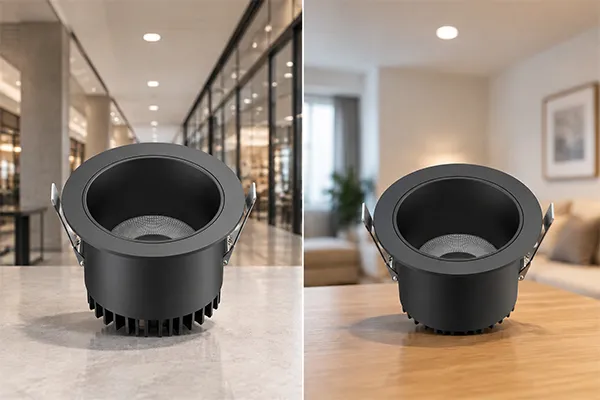
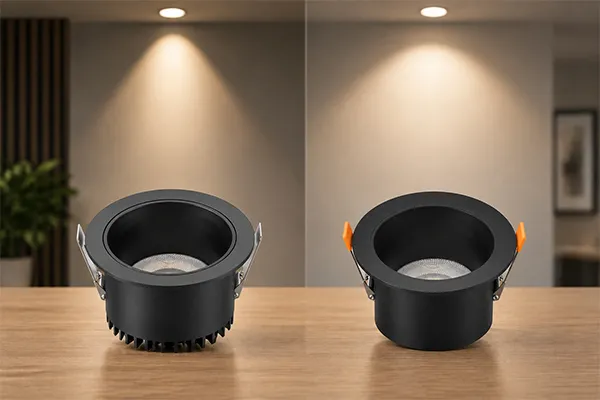
A buyer may face two recessed lights with the same 10W rating, similar trim color, and matching cutout size. This can make the decision seem simple. However, visual similarity can hide meaningful differences in light distribution, heat management, driver selection, and batch control. A professional LED downlight should be evaluated by its ability to meet a documented application requirement.
A professional LED downlight differs from a consumer-oriented product because it is usually specified around a controlled application requirement. That requirement may include beam angle, color temperature, CRI, glare control, wattage, installation method, finish, and order-to-order consistency. The distinction is not simply brightness, price, or brand positioning.
The fixture’s job matters more than its appearance
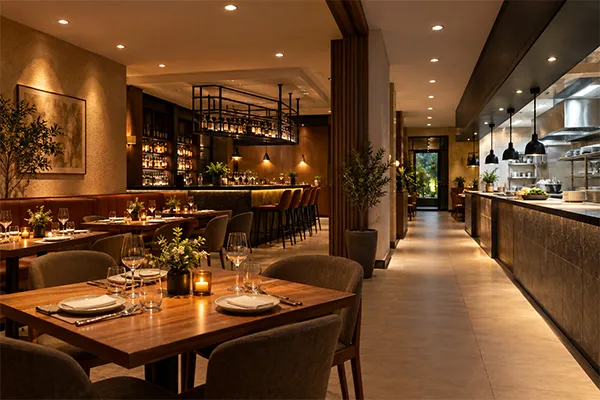
A downlight is not only a ceiling opening with a light source inside it. It has a visual and practical job to complete. For example, a hotel corridor may need consistent light spacing and a restrained visual effect. A retail display may require stronger color rendering and a more focused beam. A residential apartment may prioritize a clean appearance, accessible pricing, and simple replacement.
I regularly discuss this issue when buyers request OEM or ODM adjustments. A customer may begin by asking for a 12W recessed downlight. After discussing the installation height and lighting objective, the real requirement may become:
- 3000K rather than 6500K for a warmer hospitality environment
- A 24° beam instead of a 60° beam for accent lighting
- A higher CRI option for merchandise presentation
- A white, black, or custom surface finish for interior coordination
- A specific cutout tolerance for an existing ceiling design
- A dimmable driver compatible with the project’s control system
These are not minor purchasing details. They define whether the fixture is fit for purpose.
Consumer products can still have a valid role
I do not consider consumer lighting products inherently poor quality or unsuitable. Many consumer fixtures are appropriate for straightforward residential renovations, limited-scope retail upgrades, or applications where minor variation will not create significant commercial consequences.
The key issue is whether the buyer needs a controlled result across many units, multiple delivery batches, or a repeat-order program. A consumer-focused product may be sold around convenience, visual styling, and a standard configuration. A project-oriented selection often requires a more formal review of the required parameters.
| Evaluation area | Consumer-oriented fixture | Professional project-oriented fixture |
|---|---|---|
| Main selection basis | Price, style, basic output | Application fit and agreed specification |
| Typical buying volume | Single units or small retail quantities | Projects, distribution programs, repeat orders |
| Parameter flexibility | Often fixed standard options | May require defined OEM/ODM configuration |
| Consistency concern | May be less critical for isolated replacements | Important across installed areas and future batches |
| Installation review | Basic fit and electrical suitability | Cutout, ceiling depth, driver space, wiring, maintenance |
| Procurement risk | Lower when consequences are limited | Higher when delays, rework, or resale claims are possible |
A professional LED downlight is therefore not automatically “better” in every setting. It is a product category and selection process centered on controlled requirements. Buyers should match that process to the responsibility they carry.
Why Are Similar LED Downlights Not Always Interchangeable?
Similar LED downlights can create a false sense of certainty. Buyers may see the same wattage, 90 mm cutout, round trim, and listed lumen output, then assume either product can replace the other. This approach can cause problems when the delivered lighting effect, installation fit, or repeat-order result does not match expectations.
Two LED downlights are not interchangeable simply because their wattage, lumen figure, cutout size, or exterior appearance is similar. Buyers should compare beam distribution, color tolerance, driver characteristics, thermal structure, glare control, trim finish, installation dimensions, and the supplier’s ability to maintain the agreed configuration across the order.
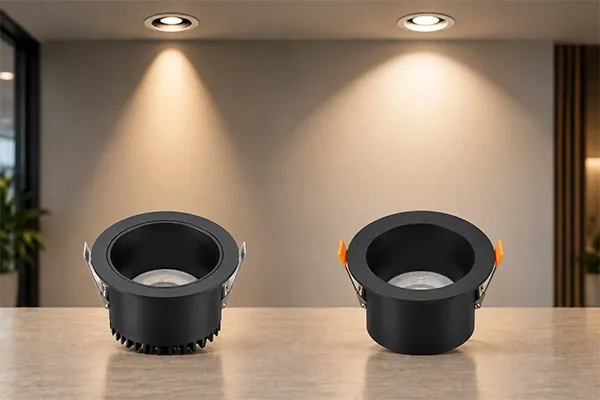
Lumen output does not describe the whole lighting result
Lumen output is useful, but it does not tell buyers where the light goes. Beam angle affects illuminance on the target surface, spacing between fixtures, perceived brightness, and visual comfort.1
For example, two fixtures may both list 900 lumens:
- A narrow beam may create a concentrated pool of light.
- A wide beam may distribute light more evenly across a larger area.
- A poorly controlled optic may create uncomfortable brightness at certain viewing angles.
- A deep anti-glare design may reduce direct source visibility but affect the apparent output.2
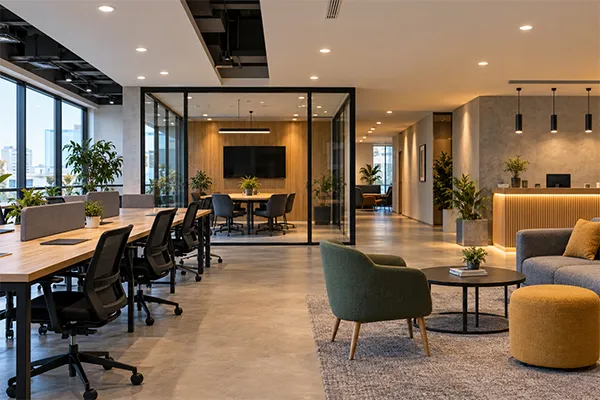
A buyer selecting fixtures for a reception area, corridor, showroom, office, or retail shelf should review the intended lighting layout rather than relying only on a lumen figure. For application-specific calculations, I recommend working with a qualified lighting designer, electrical engineer, or project professional.
Cutout size is only one installation dimension
I have seen buyers focus heavily on cutout size because it is easy to compare. It is important, especially for replacement projects, but it is not the only dimensional issue.
A practical installation review should include:
- Ceiling cutout diameter — Does the spring clip system match the actual opening tolerance?
- Fixture height — Is there enough void depth above the ceiling?
- Driver dimensions — Can the driver fit safely in the available space?
- Heat conditions — Is insulation, limited ventilation, or another heat source present?
- Ceiling material — Is the fixture suitable for gypsum board, metal ceiling, or another substrate?
- Wiring access — Can installers connect, inspect, and replace the unit appropriately?
- Trim coverage — Will the trim hide existing cutout irregularities if the project is a renovation?
A light that fits physically may still be unsuitable if the driver cannot be positioned correctly or if the installation environment differs from the intended use.3
Specification consistency becomes more important at scale
For a single residential room, a small variation between fixtures may be tolerated or never noticed. For a lobby, retail chain, apartment development, or distributor’s product line, consistency becomes a commercial requirement.4
This is where I encourage buyers to define the specification before requesting quotations. A clear specification can include:
Model structure, wattage, input voltage, color temperature, CRI, beam angle, cutout, trim color, dimming requirement, packaging, labeling, and required compliance documents.
At Upward Lighting, I discuss these configuration points with buyers before production, particularly for OEM/ODM orders. We can configure parameters such as color temperature, wattage, beam angle, CRI, and finish color. However, customization should not be treated as a substitute for proper technical evaluation. It is a tool for aligning the supplied product with a documented requirement.
Does a Higher Price Mean a Better Professional LED Downlight?
Price comparisons can become misleading when buyers assume that a higher price always proves superior quality—or that a lower price always means unacceptable quality. Both assumptions are too simple. The relevant question is what the price includes and whether those choices support the buyer’s application, specification, and risk profile.
A higher-priced professional LED downlight does not automatically provide a better result, and a lower-priced option is not automatically unsuitable. Price differences may reflect component selection, thermal design, optical design, driver requirements, finish options, packaging, quality-control processes, order quantity, and specification consistency.5 Buyers should compare like-for-like configurations before judging value.
Compare quotations on a like-for-like basis
A meaningful quotation comparison requires more than a unit price. I recommend asking suppliers to confirm the exact configuration behind each offer. A supplier may quote a lower price based on a standard driver, lower CRI option, different housing material, narrower warranty terms, or a simpler finish. Another supplier may be quoting a more demanding configuration.
A procurement comparison sheet can make differences visible:
| Comparison point | What buyers should confirm |
|---|---|
| Wattage and electrical input | Rated wattage, input voltage, frequency, power factor if relevant |
| Light quality | Color temperature, CRI, color consistency requirements |
| Optical performance | Beam angle, diffuser or reflector type, glare-control structure |
| Mechanical design | Housing material, trim finish, cutout range, fixture height |
| Driver | Brand or specification, dimming protocol, driver placement |
| Production control | Sample approval process, inspection approach, aging process |
| Documents | Applicable test reports, declarations, CE/RoHS documentation where required |
| Commercial terms | MOQ, lead time, packaging, spare-unit approach, payment terms |
The price gap may reflect specification control
In manufacturing discussions, price differences often begin with the requested configuration. A buyer may need a specific 3000K color temperature, black finish, high-CRI requirement, particular beam angle, and customized packaging for a local brand. Each decision can affect materials, sourcing, production setup, and inspection requirements.
At our factory, each product undergoes a 100% aging test before shipment, typically lasting 4 to 8 hours.6 I present this as a production quality-control step, not as proof that a fixture will perform perfectly in every future site condition. Buyers should still inspect samples, verify documentation, and assess the intended installation environment.
Certifications are documents to verify, not a shortcut
CE and RoHS are frequently discussed during supplier selection.7 These documents can be relevant to market access and compliance expectations, but buyers should not treat a logo on a carton or product listing as a complete technical evaluation.8
I recommend that buyers verify:
- The document applies to the exact product model or product family.
- The rated electrical and configuration details match the proposed item.
- The document is current and issued by an appropriate party.
- The destination market’s rules and project requirements are understood.
- Any additional local approvals are reviewed with qualified compliance professionals.
A professional LED downlight purchase should be based on the full product and supplier picture. Certification documents are one part of that picture.
How Should Buyers Specify a Professional LED Downlight for a Project?
A vague request creates avoidable risk. When a buyer asks only for “a good recessed downlight” or “the cheapest 12W option,” suppliers may quote products that appear comparable but are built around different assumptions. A clear specification gives every party a more reliable basis for pricing, sampling, and production.9
Buyers should specify a professional LED downlight by defining the lighting task, installation environment, visual requirements, electrical requirements, compliance needs, quantity, and repeat-order expectations. The best specification is detailed enough to prevent assumptions but practical enough for suppliers and installers to review before purchase.
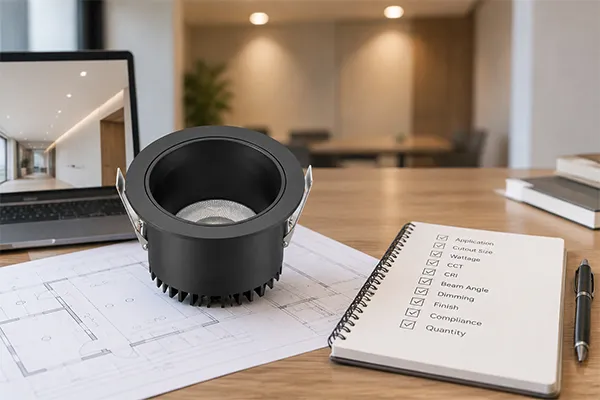
Start with the space and responsibility
I usually begin selection conversations with questions about the project rather than the product model. The buyer’s responsibility affects the depth of evaluation.
A contractor may need to prevent installation delays. An importer may need to protect a repeat-order program. A local lighting brand may need a consistent appearance across its catalog. A distributor may need an item that can be explained clearly to electrical channel customers.
These questions help establish the real requirement:
- What type of space will use the fixture?
- What is the ceiling height and lighting layout?
- Is the light for ambient, task, accent, or decorative lighting?
- Does the project need warm, neutral, or cool color temperature?
- Is color rendering important for retail goods, finishes, or hospitality interiors?
- Is dimming required? If so, which dimming system is used?
- Will future orders need the same visual and technical configuration?
- What market will receive the product?
- What documents must the buyer review before shipment?
Use samples as a decision tool, not a formality
A sample is valuable when it is reviewed against the actual requirement.10 I recommend that buyers inspect samples under conditions as close as practical to the intended use. A desk review of appearance alone may not identify optical, installation, or control compatibility issues.
A useful sample review process includes:
- Confirm the physical dimensions and cutout fit.
- Check the trim color, finish, and visible appearance.
- Review the beam pattern at a relevant mounting height.
- Compare color temperature and visual consistency between units.
- Test dimming compatibility where applicable.
- Confirm driver placement and wiring access.
- Compare the sample label and packaging against agreed requirements.
- Document approvals and any required changes before mass production.
I have found that written sample approval prevents many misunderstandings. It gives the buyer, supplier, and production team a shared reference point.
Create a practical procurement checklist
Before placing a project or channel order, buyers can use the following checklist.
| Area | Questions to ask |
|---|---|
| Application | What lighting task must the downlight perform? |
| Optical specification | Which beam angle, CRI, CCT, and glare-control level are needed? |
| Installation | What are the cutout, ceiling depth, driver space, and wiring requirements? |
| Visual result | What trim finish, shape, and consistency standard does the project need? |
| Electrical compatibility | What voltage and dimming/control requirements apply? |
| Supplier capability | Can the supplier confirm the configuration and support agreed packaging or labeling? |
| Quality process | What inspection and aging procedures are used before shipment? |
| Documentation | Which compliance and product documents must be verified for the destination market? |
| Repeat orders | How will the approved configuration be recorded for future orders? |
A professional LED downlight decision is stronger when the buyer can answer these questions before production starts. The aim is not to eliminate all risk. The aim is to make risks visible early, when they are easier to manage.
Can Consumer Lighting Products Be Used in Commercial Projects?
A consumer lighting product can sometimes be used in a commercial project, especially where the lighting task is simple, the installation is low risk, and the consequences of replacement or visual variation are limited. However, buyers should not approve a consumer product as a substitute based only on its retail popularity or attractive price.
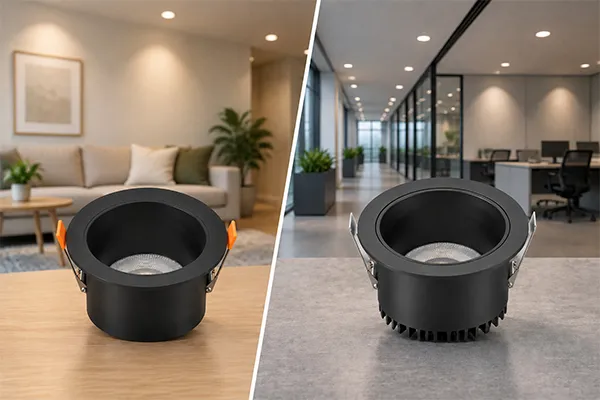
Consumer lighting products can be appropriate for some commercial environments, but buyers should assess them against project requirements before approving them. The product should match the lighting task, installation conditions, electrical requirements, visual expectations, maintenance plan, and consistency needs. A retail-oriented product is not automatically suitable for a multi-unit project or repeat-order program.
Use a risk-based approach
I suggest that buyers classify the application by the impact of a mismatch. This is often more useful than applying a broad “consumer versus professional” label.
A lower-risk application may include a small office refresh, temporary display area, or basic residential-style retail environment. A higher-risk application may include a branded retail rollout, hospitality project, public-facing development, or distribution program where buyers expect future replenishment.
| Project condition | Risk if the fixture differs from expectation | Selection approach |
|---|---|---|
| Small, isolated installation | Limited | Standard consumer product may be considered after basic checks |
| Renovation with uncertain ceiling conditions | Moderate | Verify fit, driver space, and installation method |
| Multi-room commercial fit-out | High | Use a documented specification and approved sample |
| Retail chain or branded rollout | High | Prioritize visual consistency and repeat-order control |
| Distributor/private-label program | High | Define parameters, packaging, documents, and future configuration records |
The larger commercial risk is often not the initial unit cost. The greater risk is learning after installation or resale that the product does not deliver the agreed beam effect, color appearance, fit, or repeat-order consistency.
Frequently Asked Questions
Is a professional LED downlight always more expensive?
No. A professional LED downlight may cost more when it includes specific optics, drivers, finishes, controlled parameters, or project-oriented quality processes. However, pricing depends on configuration, quantity, packaging, and commercial terms. Buyers should compare quotations based on the same specification rather than unit price alone.
Can I replace a professional downlight with a consumer downlight if the cutout size matches?
Not automatically. Matching cutout size only confirms one installation dimension.11 You should also compare fixture height, driver size, beam angle, color temperature, CRI, trim coverage, dimming compatibility, wiring requirements, and the visual effect expected in the space.
What specifications should I request from an LED downlight supplier?
I recommend requesting wattage, voltage, color temperature, CRI, beam angle, cutout size, fixture dimensions, trim finish, driver details, dimming compatibility, packaging details, applicable documentation, lead time, and quality-control information. You should also define repeat-order requirements if they matter to your business.
Are CE and RoHS certificates enough to approve an LED downlight?
CE and RoHS documentation can be important, but they are not the complete basis for approval. Buyers should verify that documents apply to the proposed model and destination market. They should also review application fit, installation conditions, samples, supplier capability, and any project-specific compliance requirements.
Why does beam angle matter when lumen output is the same?
Beam angle determines how light is distributed.12 Two fixtures with the same lumen output can produce very different results: one may create concentrated accent lighting, while another may provide wider ambient coverage. Buyers should select beam angle based on mounting height, fixture spacing, and the lighting task.
Conclusion
A professional LED downlight is not simply a brighter, more expensive version of a consumer fixture. The right choice depends on the lighting task, installation context, visual expectations, electrical compatibility, specification clarity, and commercial responsibility behind the order. I encourage buyers to compare products beyond wattage, lumens, appearance, and certification labels. At Upward Lighting, I work with contractors, importers, distributors, and lighting brands to translate required color temperature, wattage, beam angle, CRI, and finishes into clear product specifications. Contact us to discuss a sample, OEM/ODM configuration, or project-oriented downlight quotation.
"[PDF] Understanding LM-79 Reports - Better Buildings Solution Center", https://betterbuildingssolutioncenter.energy.gov/sites/default/files/attachments/understanding_lm79_reports.pdf. Photometric guidance explains that a luminaire’s beam distribution determines the spatial distribution of illuminance and is therefore relevant to fixture spacing and the resulting visual environment. Evidence role: mechanism; source type: institution. Supports: That an optical beam distribution affects illuminance patterns and spacing considerations in lighting layouts.. Scope note: Perceived brightness and comfort also depend on luminance, surface reflectance, mounting geometry, and observer position. ↩
"Dark Skies Initiative in Summit County, Utah | Protecting Nighttime ...", https://www.summitcountyutah.gov/2474/Dark-Skies. Research on visual discomfort and luminaire shielding indicates that source shielding and luminance distribution can reduce direct source visibility and alter observers’ brightness impressions. Evidence role: mechanism; source type: paper. Supports: That shielding geometry and source luminance influence glare and the visibility of a luminaire’s light-emitting elements.. Scope note: The magnitude of the effect varies with the optic, viewing angle, room luminance, and installation geometry. ↩
"1910.303 - General. | Occupational Safety and Health Administration", http://www.osha.gov/laws-regs/regulations/standardnumber/1910/1910.303. Luminaire safety and installation guidance requires equipment to be installed according to its rated conditions and manufacturer instructions, including provisions relevant to wiring, drivers, clearance, and heat dissipation. Evidence role: general_support; source type: institution. Supports: That luminaires must be installed in accordance with their instructions and rated environmental and thermal conditions.. Scope note: The applicable requirements depend on the product certification, jurisdiction, ceiling construction, and the luminaire’s stated installation instructions. ↩
"[PDF] LED Color Characteristics", https://www.energy.gov/sites/prod/files/2016/08/f33/led-color-characteristics-factsheet.pdf. LED lighting guidance identifies chromaticity variation and binning as relevant to visual uniformity, particularly where multiple luminaires are viewed together in a common space. Evidence role: general_support; source type: government. Supports: That LED color variation is managed through chromaticity binning and can be visible when luminaires are compared within an installation.. Scope note: Whether a particular variation is acceptable depends on the specified color-tolerance criterion, application, and viewing conditions. ↩
"[PDF] Understanding Fixture Design Tools", https://www1.eere.energy.gov/buildings/publications/pdfs/ssl/bair_msslc-boston2012.pdf. Analyses of LED luminaire design and manufacturing identify drivers, optical systems, thermal-management components, assembly requirements, and production volume as factors that can affect product cost. Evidence role: general_support; source type: research. Supports: That LED luminaire costs are affected by component selection, thermal and optical design, manufacturing processes, and production scale.. Scope note: A source can explain general cost drivers but cannot establish why any two suppliers’ quotations differ without their itemized specifications and commercial terms. ↩
"The Importance of Aging Testing for LED Lighting Fixtures", https://www.grinsafe.com/news/ensuring-quality-and-reliability-the-importance-of-aging-testing-for-led-lighting-fixtures/. Factory quality-control records or an independent audit should document whether each shipped unit received the stated pre-shipment aging test and the recorded test duration. Evidence role: case_reference; source type: other. Supports: That the stated factory performs 100% aging tests on the identified products and records the test duration before shipment.. Scope note: General information about burn-in testing cannot verify this manufacturer-specific practice or demonstrate field reliability. ↩
"RoHS Directive - Environment - European Commission", https://environment.ec.europa.eu/topics/waste-and-recycling/rohs-directive_en. European Commission guidance describes CE marking as indicating conformity with applicable Union requirements and describes RoHS as restricting specified hazardous substances in electrical and electronic equipment within its scope. Evidence role: historical_context; source type: government. Supports: That CE marking and the RoHS Directive form part of the European Union conformity and hazardous-substance framework for applicable electrical and electronic equipment.. Scope note: Applicability depends on the product, its intended market, and all relevant sector-specific legislation; CE marking is not a universal quality certification. ↩
"CE marking – obtaining the certificate, EU requirements - Your Europe", https://europa.eu/youreurope/business/product-rules-compliance/general-product-compliance/ce-marking/index_en.htm. Official EU guidance states that CE marking relates to conformity with applicable legal requirements and conformity-assessment obligations; it does not by itself establish suitability for a particular installation or lighting task. Evidence role: definition; source type: government. Supports: That CE marking is tied to conformity assessment and applicable legal requirements rather than being a general performance or quality endorsement.. Scope note: Additional project specifications, safety standards, and local market rules may apply beyond the requirements associated with a CE declaration. ↩
"Supply Chain Management - NIST", https://www.nist.gov/mep/supply-chain. Quality-management and procurement guidance emphasizes documenting product requirements so that suppliers can quote, produce, and verify deliverables against a shared specification. Evidence role: general_support; source type: institution. Supports: That documented requirements support consistent procurement, supplier communication, and verification of delivered products.. Scope note: A clear specification reduces ambiguity but does not alone ensure supplier capability, compliant installation, or product performance in service. ↩
"6.2.3.1. Choosing a Sampling Plan: MIL Standard 105D", https://www.itl.nist.gov/div898/handbook/pmc/section2/pmc231.htm. Quality-assurance practice treats sample inspection as a comparison against defined requirements and acceptance criteria, allowing deviations to be identified before broader acceptance or production. Evidence role: general_support; source type: institution. Supports: That inspection and acceptance activities should compare a supplied item with defined requirements or acceptance criteria.. Scope note: Sample approval is not a substitute for ongoing production controls, incoming inspection, or site-specific installation testing. ↩
"[PDF] Measure Guideline: Air Sealing Attics in Multifamily Buildings", https://www1.eere.energy.gov/buildings/publications/pdfs/building_america/measure_guide_air_sealing_attics.pdf. Electrical and building-safety guidance for recessed luminaires addresses installation conditions such as mounting, wiring, clearance, and contact with insulation in addition to the ceiling opening dimensions. Evidence role: general_support; source type: government. Supports: That recessed-luminaire installation must account for more than opening size, including mounting, wiring, clearances, and rated installation conditions.. Scope note: Specific requirements vary by electrical code, luminaire rating, ceiling assembly, and local authority requirements. ↩
"[PDF] CALiPER Application Summary Report 20: LED PAR38 Lamps", https://www1.eere.energy.gov/buildings/publications/pdfs/ssl/caliper_20_summary.pdf. Lighting education resources define beam angle as the angular width of a light beam, commonly measured between directions where luminous intensity falls to a specified proportion of its maximum value. Evidence role: definition; source type: education. Supports: That beam angle describes the angular spread of a luminaire’s emitted light, commonly referenced at a specified fraction of peak intensity.. Scope note: Beam angle alone does not fully describe a luminaire’s field distribution, glare characteristics, or the illuminance produced in a particular room. ↩