

RoHS compliance for LED downlights can look simple when a supplier sends a logo, declaration, or test report. However, procurement risks appear when that document does not match the exact model, wattage, driver, finish, or cable configuration you plan to import. We recommend verifying document scope before you place an order.
RoHS compliance for LED downlights requires buyers to confirm that supplier documentation applies to the exact product configuration being sold. A RoHS logo or general statement alone is not enough. Importers should check the model number, wattage, driver, cable, materials, document date, and declared product scope, then verify target-market requirements separately.
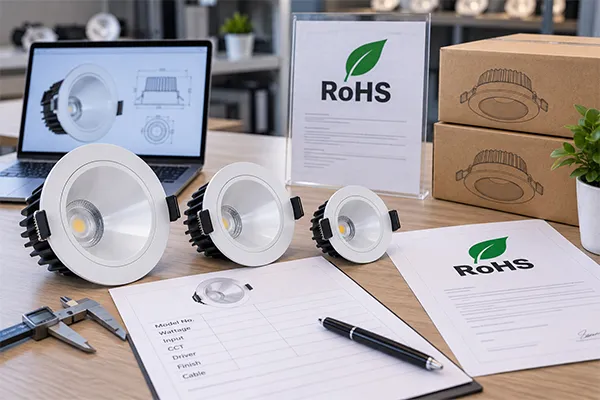
At Upward Lighting, we regularly receive documentation requests from importers, contractors, and lighting brands before production begins. In my experience, the most useful question is not, “Do you have RoHS?” It is, “Does this document explicitly correspond to my exact model, wattage, and configuration?”
What Does RoHS Compliance for LED Downlights Actually Mean?
Buyers often face a familiar problem: a supplier confirms that a downlight is RoHS compliant, but the quotation includes several wattages, trim colors, drivers, dimming options, and cable lengths. That creates uncertainty because a broad claim may not clearly apply to every selected variation.
RoHS compliance for LED downlights generally concerns whether relevant materials and components in the supplied product meet applicable substance-restriction requirements.1 For procurement purposes, buyers should focus on evidence scope: whether the supplier’s declaration, report, or material information covers the complete downlight and the exact configuration ordered.
RoHS Is Not Just About the Visible Downlight Housing
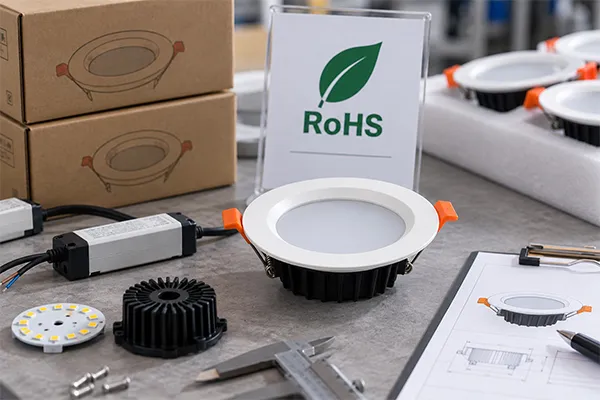
A recessed LED downlight may look like a simple product, but it is an assembly of several materials and components. The aluminum body is only one part of the product. A buyer should also consider the driver, LED module, wiring, connector, reflector, lens, spring clips, thermal interface materials, coatings, labels, and packaging where relevant to the supplier’s compliance documentation.
For example, two 12W downlights may share the same visible housing but use different internal drivers. One may have a non-dimmable driver, while another may have a triac-dimmable, 0–10V, or DALI driver. These versions should not automatically be treated as identical for document-scope purposes.
Why Product Scope Matters More Than a Logo
A RoHS logo on product packaging, a catalogue page, or a supplier website is not a complete procurement record.2 It may indicate that the supplier intends to offer compliant products, but it does not show which models, components, or production versions are covered.
When we prepare documents for export customers, we find that the following details help avoid confusion:
- Product model number
- Rated wattage
- Input voltage
- Driver type and dimming option
- Color temperature and LED specification
- Housing finish or coating
- Cable type, plug, and connector
- Trim style or installation version
- Document issue date and revision number
- Declared product range or model list
A useful RoHS file should help a buyer connect the paperwork to the physical product they intend to label, sell, and support.
A Practical Procurement View
I do not treat RoHS as a logo-checking exercise. I treat it as a document-matching exercise. If the purchase order says “Model DL-12W-BK, 3000K, triac dimmable, black finish, 1.5 m cable,” the supplier should be able to explain whether the submitted documentation covers that configuration.
This does not mean that every option always requires a completely new report. It means that the supplier should confirm applicability rather than asking the buyer to assume it. That distinction is important for importers, private-label brands, and distributors that need orderly product files for their own customer or market-entry processes.
Why Can One RoHS Document Fail to Cover Every LED Downlight Version?
A product family can create a false sense of security. Buyers may see a report titled with a series name and assume that it covers all wattages and configurations in the catalogue. Yet even small component changes can affect whether that assumption is justified.
One RoHS document may cover multiple LED downlight models only when its stated scope, model list, product description, and component relationship support that conclusion.3 Buyers should ask suppliers to confirm coverage for each ordered variant rather than assuming every item in a series is included.
Common Changes That Need Supplier Confirmation
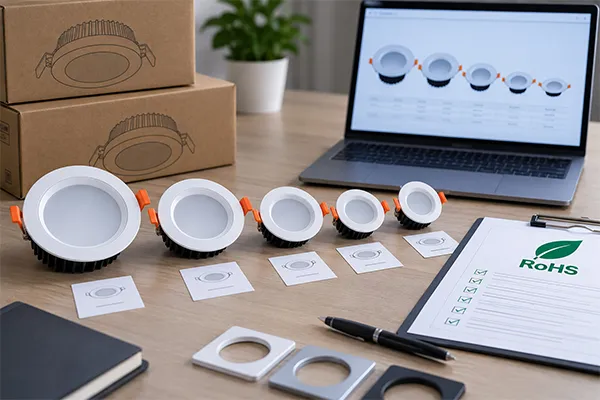
Not every product variation creates the same documentation question. Still, the following changes deserve direct confirmation from the supplier because they may involve different materials, electronics, or sourced parts:
| Product change | Why buyers should ask | Example procurement question |
|---|---|---|
| Wattage | Higher wattage may use a different LED board, heat sink, or driver | “Does the 20W version appear in the document scope, or is it covered by a confirmed equivalent configuration?” |
| Driver option | Drivers contain electronic components and may come from different sources4 | “Does the RoHS file apply to the selected DALI driver?” |
| Finish color | Powder coating, paint, plating, or surface treatment may differ | “Does the black finish use the same declared material system as the white finish?” |
| Cable and plug | Cable insulation, plug materials, and connector assemblies can differ5 | “Does the document cover the 1.5 m cable with the UK plug option?” |
| Trim or frame style | A different trim can use different coatings or decorative parts | “Is the black anti-glare trim included in the stated product range?” |
| LED module | Different CCT, CRI, or LED suppliers can mean a different component set | “Does the file cover the 90 CRI LED module specified for this order?” |
The “Same Housing” Assumption Can Be Risky
I have seen customers focus on the external dimensions and assume that all versions are the same product. From a sourcing perspective, that is understandable. A 3-inch, 4-inch, or 6-inch recessed downlight can share the same appearance across several electrical options.
However, product identity for documentation review is often more detailed than appearance. A 9W fixed downlight with a standard driver may not have the same internal build as a 12W dimmable version. Likewise, a white residential model may not match a black commercial version if the coating process or component sourcing differs.
Questions I Recommend Asking Before a Purchase Order
Before finalizing an LED downlight order, I recommend that buyers send the supplier a concise configuration list. This gives the supplier a practical opportunity to match documents to the order.
A useful request could include:
- The exact supplier model number.
- Wattage and electrical input.
- Color temperature and CRI requirement.
- Beam angle and reflector style.
- Driver brand, driver type, and dimming protocol.
- Housing color and finish.
- Cable length, plug, or terminal specification.
- Required private-label marks and packaging details.
- Target sales market or intended destination.
- A direct request for written confirmation of RoHS document applicability.
I would ask the supplier to respond in writing, ideally on the quotation, specification sheet, compliance statement, or document transmittal email. A clear written response is easier to retain in a product file than a general verbal assurance.
How Should Buyers Review RoHS Compliance Documents for LED Downlights?
A document can look professional while still being difficult to connect to the actual goods. Buyers do not need to become laboratories or legal specialists, but they should review whether the paperwork is internally consistent and whether the supplier can explain what it covers.
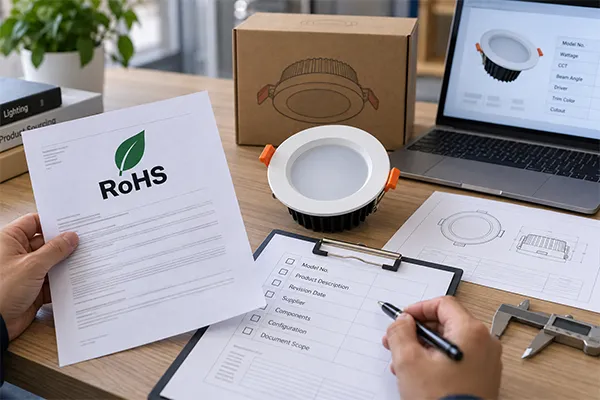
To review RoHS compliance for LED downlights, buyers should compare each document against the purchase specification. Check the listed model, product description, revision date, supplier identity, covered components, and configuration details. If the relationship is unclear, request a written scope confirmation before production or shipment.
Start With a Simple Document-Matching Checklist
I suggest comparing the supplier’s documents with the same discipline used for samples, artwork approvals, and packing lists. The objective is not to make a legal determination. The objective is to identify gaps early enough for the supplier to clarify them.
| Review item | What to compare | Potential concern |
|---|---|---|
| Supplier name | Does it match the manufacturer, trading company, or stated responsible party? | The document comes from an unrelated entity without an explained supply-chain relationship. |
| Product identity | Does the model number or product description match the quotation? | The report refers only to a generic “LED lamp” or another product series. |
| Configuration scope | Does it identify wattage, driver, finish, or applicable variants? | The ordered version is not listed and no written confirmation is provided. |
| Document date | Is the file current enough for your internal process? | The document is old and the supplier cannot explain whether components changed. |
| Product completeness | Does it relate to a complete downlight or selected materials only? | The supplier provides a housing-material statement but no driver or assembly explanation. |
| Consistency | Do model names match across quotation, datasheet, label artwork, and documents? | Different names create traceability problems. |
| Revision control | Is there a report number, declaration date, or revision reference? | The buyer cannot distinguish current files from older versions. |
Ask What the Document Represents
Not all RoHS-related files mean the same thing. A supplier may provide a declaration, a third-party report, a material declaration, or component-level supporting information.6 Each can be useful, but buyers should avoid treating them as automatically interchangeable.
For example:
- A supplier declaration may state that specified products meet a stated requirement.
- A test report may describe the samples, materials, or items tested within its stated scope.
- A component document may relate only to a driver, cable, LED board, or housing material.
- A technical file may contain multiple supporting documents that need to be read together.
The key question remains: What exactly does this document cover, and how does it connect to the downlight we are ordering?
Keep a Product-File Trail
For brands and importers, I recommend retaining a clear record for every approved SKU. A practical internal folder can include:
- Approved quotation and purchase order
- Product datasheet
- Product photos and label artwork
- Bill of materials summary or component confirmation where available
- RoHS-related declaration or report
- Supplier confirmation email for model/configuration coverage
- Revision history for driver, LED module, cable, or finish changes
- Applicable target-market compliance documents reviewed by qualified personnel
At Upward Lighting, we can help customers identify the relevant model and configuration in the documents we provide. However, buyers should independently verify what their target market requires and seek qualified regulatory or legal guidance where application-specific decisions are needed.
How Are CE and RoHS Different for LED Downlights?
Many procurement conversations combine CE and RoHS into one request. That is understandable because both terms often appear in LED product catalogues. Still, buyers should not assume they are the same document, the same process, or interchangeable proof of compliance.
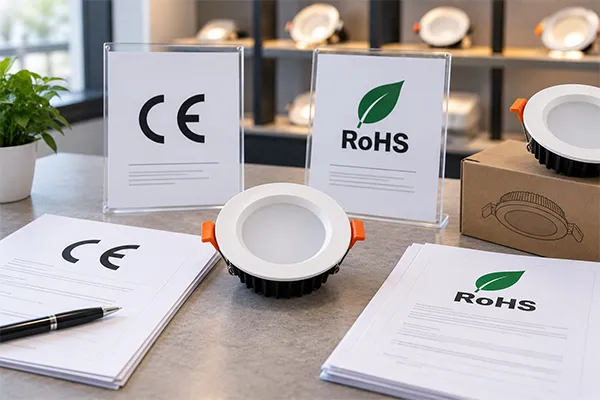
CE and RoHS are separate compliance considerations for LED downlights.7 RoHS addresses restricted substances in relevant electrical and electronic equipment materials and components, while CE-related obligations concern broader applicable requirements for products placed on relevant markets.8 Buyers should review each requirement separately for their target market and product configuration.
Why the Distinction Matters During Sourcing
A buyer may ask, “Does this downlight have CE and RoHS?” The supplier may answer yes, but that short exchange does not explain the underlying document scope or whether the item is suitable for a specific market, installation type, or sales channel.
For procurement teams, it is more useful to separate the questions:
| Procurement question | Why it matters |
|---|---|
| What RoHS-related document applies to this exact model? | It helps verify material and component scope for the ordered product. |
| What CE-related documentation is available for this version? | It helps the buyer review broader applicable product requirements separately. |
| Does the driver change affect the available documents? | Driver changes can affect technical documentation and product configuration. |
| Which market will the product enter? | Requirements can vary by jurisdiction and product use case. |
| Who is responsible for final market-placement obligations? | Roles can differ among manufacturer, importer, brand owner, and distributor.9 |
Avoid “Universal Passport” Thinking
A RoHS declaration, a CE mark, or a report should not be presented as a universal passport for every country or commercial situation. Market-entry requirements can depend on destination, product category, labeling, electrical safety expectations, documentation responsibilities, and the role of the economic operator.10
For example, a lighting brand selling under its own name may have different documentation and traceability responsibilities than a contractor buying fixtures for a single project. A product intended for indoor residential use may also require a different evaluation path from a fixture used in a specific commercial or outdoor application.
I recommend that buyers state their destination market and application early in the quotation process. This helps the supplier provide relevant product information, but it does not replace the buyer’s own market-specific review.
Use Separate Approval Gates
For larger LED downlight programs, I recommend using separate internal approval gates:
- Commercial approval: price, MOQ, lead time, payment terms, and packaging.
- Product approval: sample appearance, wattage, CCT, CRI, beam angle, cutout, and driver performance.
- Documentation approval: model scope, document consistency, labeling, and records.
- Market review: target-market requirements assessed by appropriate internal or qualified external personnel.
- Pre-shipment approval: final SKU, labels, carton marks, and configuration match.
This structure helps prevent a common mistake: approving a sample and then assuming that every production variation has identical documentation coverage.11
What Should Importers Ask a LED Downlight Supplier Before Ordering?
A rushed quotation process can lead to vague compliance conversations. Buyers may receive an attractive price, confirm the sample, and only request documents shortly before shipment. By then, any uncertainty about driver options, finishes, or model coverage can delay the order.
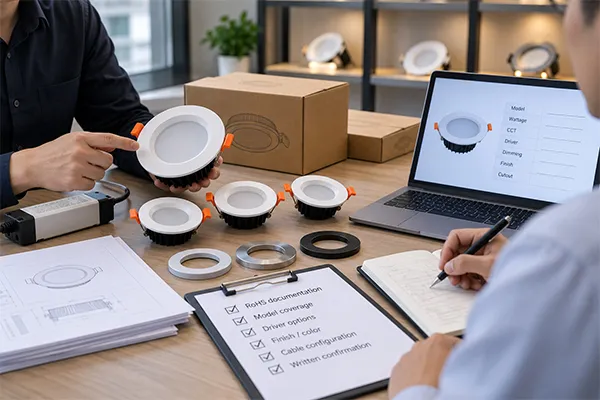
Before ordering LED downlights, importers should ask suppliers for configuration-specific RoHS documentation, written applicability confirmation, and traceable product specifications. The supplier should be able to identify whether the documentation corresponds to the selected model, wattage, driver, cable, finish, and intended product version.
A Supplier Email Template Buyers Can Use
I often suggest that customers make their request specific. A short but detailed email can produce a more useful response than a broad request for “all certificates.”
Please provide the available RoHS-related documentation for the following LED downlight configuration:
Model: [model number]
Wattage: [wattage]
CCT/CRI: [specification]
Driver: [non-dimmable/triac/0–10V/DALI and driver reference]
Finish: [white/black/custom color]
Cable/plug: [specification]
Target market: [country or region]Please confirm in writing whether the submitted documents explicitly apply to this exact configuration and whether they relate to the complete product or selected components only.
Signs of a More Transparent Supplier Response
A responsible response does not need to be lengthy, but it should be specific. I would look for suppliers that can:
- Identify the exact model or relevant product series.
- Explain whether the ordered wattage is included.
- Confirm the selected driver option.
- State whether a finish, cable, or trim variation affects the document scope.
- Clarify whether documents relate to complete products, assemblies, or components.
- Provide document dates, references, and revision information where available.
- Flag when additional verification is needed instead of making overly broad claims.
At Upward Lighting, we work with customer specifications before production so that downlight parameters such as wattage, color temperature, beam angle, CRI, driver selection, and finish are clear. We also perform a 100% aging test for 4 to 8 hours before shipment as part of our production quality-control process.12 However, aging tests are not a substitute for RoHS documentation review, and neither should be confused with a market-specific legal determination.
Build Compliance Questions Into Supplier Selection
Documentation quality can reveal something important about supplier management. A supplier that maintains clear model records, change-control communication, and configuration-specific confirmations may be easier to work with over the long term.
During supplier evaluation, I recommend scoring more than price:
| Evaluation area | Questions to ask |
|---|---|
| Product traceability | Can the supplier connect documents to exact SKUs and order configurations? |
| Change management | Will the supplier notify you before changing drivers, LEDs, cables, or finishes? |
| Response speed | Can the supplier answer document-scope questions quickly and clearly? |
| Manufacturing control | Does the supplier have documented inspection and aging procedures? |
| Customization capability | Can OEM/ODM requirements be recorded without losing product traceability? |
| Documentation discipline | Are declarations, reports, datasheets, and label details consistent? |
For private-label LED downlight programs, this discipline can reduce surprises after a product reaches your warehouse, customer, or project site.
Frequently Asked Questions
Is a RoHS logo on an LED downlight enough for importers?
No. A RoHS logo may indicate a supplier claim, but it does not show whether the claim applies to your exact product configuration. Importers should request supporting documentation and confirm the model number, wattage, driver, cable, finish, and relevant product scope in writing.
Does one RoHS report cover all LED downlight wattages?
Not automatically. Different wattages may use different LED modules, heat sinks, drivers, cables, or other components. Buyers should review the report scope and ask the supplier to confirm whether the exact ordered wattage and configuration are covered.
Does RoHS documentation need to cover the complete LED downlight?
Buyers should ask this question directly. Some files may relate to complete products, while others may support only selected components or materials. A complete procurement review should clarify how the available documents relate to the assembled LED downlight being purchased.
Are CE and RoHS the same for LED downlights?
No. CE and RoHS are separate compliance considerations. RoHS concerns restricted substances in relevant product materials and components, while CE-related requirements can involve broader obligations. Buyers should not use one as a substitute for the other and should verify target-market requirements separately.
What should I send a supplier when requesting RoHS documents?
Send the exact product specification: model number, wattage, driver type, dimming option, CCT, CRI, finish, cable, plug, and destination market. Ask the supplier to confirm in writing that the document applies to that exact configuration and explain whether it covers the complete product.
Conclusion
RoHS compliance for LED downlights is strongest when buyers can connect the supplier’s documents to the exact SKU they plan to import, brand, and sell. A logo or generic statement is only a starting point. I recommend checking model scope, wattage, driver, cable, finish, and complete-product relevance before production begins. At Upward Lighting, we support importers and lighting brands with configuration-based product information, OEM/ODM communication, and responsive document coordination. Contact us with your LED downlight specification to request a quotation and documentation review for your proposed order.
"European Union Reduction of Hazardous Substances ...", https://www.waru.edu/artifact/european-union-reduction-hazardous-substances-rohs-and-waste-electrical-and-electronic. Directive 2011/65/EU restricts the use of specified hazardous substances in electrical and electronic equipment, subject to its defined scope, exemptions, and maximum concentration values. Evidence role: definition; source type: government. Supports: RoHS restricts specified hazardous substances in electrical and electronic equipment placed on the EU market.. Scope note: The directive determines legal scope by equipment category and exemptions; it does not itself establish compliance for a particular downlight configuration. ↩
"RoHS", https://en.wikipedia.org/wiki/RoHS. Under Directive 2011/65/EU, manufacturers of covered electrical and electronic equipment must prepare technical documentation, carry out internal production control, draw up an EU declaration of conformity, and affix CE marking where the applicable conditions are met. Evidence role: general_support; source type: government. Supports: RoHS requires manufacturers to prepare technical documentation and an EU declaration of conformity before placing covered equipment on the market.. Scope note: These obligations are EU legal requirements and do not prescribe every procurement record a private buyer should retain. ↩
"EN IEC 63000:2018: RoHS Technical Documentation Guide", https://www.regilient.ai/blog/en-iec-63000-2018-rohs-technical-documentation. IEC 63000 specifies technical-documentation requirements for demonstrating that electrical and electronic products have been assessed for restricted substances, making identification of the product and the supporting evidence material to a conformity assessment. Evidence role: general_support; source type: institution. Supports: Technical documentation for restricted-substance assessment should provide evidence supporting conformity of the product covered by the documentation.. Scope note: The standard describes documentation practice; whether a particular model family is covered remains dependent on the actual product design, supply chain, and documentation. ↩
"Lutron Electronics Co., Inc. ex-parte meeting at the U.S. ...", https://www.energy.gov/gc/articles/lutron-electronics-co-inc-ex-parte-meeting-us-department-energy. The U.S. Department of Energy describes an LED driver as an electronic power supply that regulates the power delivered to an LED or LED array. Evidence role: definition; source type: government. Supports: An LED driver is an electronic power supply that regulates power supplied to LEDs.. Scope note: This definition establishes the driver's electronic function but does not show that a given supplier uses different driver sources across its product variants. ↩
"IEC 60320", https://en.wikipedia.org/wiki/IEC_60320. Electrical cable assemblies are composed of conductors, insulating materials, and terminations or connectors, so a change in cable or plug specification can change the constituent assembly supplied with an electrical product. Evidence role: general_support; source type: institution. Supports: Electrical cable assemblies comprise conductors, insulation, and termination or connector components that may be separately specified.. Scope note: This general engineering principle does not determine whether a particular cable or plug change affects RoHS compliance. ↩
"EN IEC 63000:2018: RoHS Technical Documentation Guide", https://www.regilient.ai/blog/en-iec-63000-2018-rohs-technical-documentation. IEC 63000 recognizes multiple forms of supporting evidence for restricted-substance technical documentation, including supplier information, material declarations, and analytical test data where appropriate. Evidence role: definition; source type: institution. Supports: Restricted-substance technical documentation may rely on supplier declarations, materials declarations, analytical test results, and other supporting information.. Scope note: The acceptability and sufficiency of any individual document depend on the product, supply-chain evidence, and applicable legal requirements. ↩
"Understanding the RoHS Recast, RoHS-3, and the CE Mark", https://greensofttech.com/blog-2025-understanding-the-rohs-recast-rohs-3-and-the-ce-mark/. European Commission guidance explains that CE marking is used for products subject to applicable EU harmonisation legislation, whereas the RoHS Directive is one specific legal instrument restricting hazardous substances in covered electrical and electronic equipment. Evidence role: definition; source type: government. Supports: CE marking indicates conformity with applicable EU harmonisation legislation, while RoHS is a specific directive governing hazardous-substance restrictions in covered equipment.. Scope note: The precise legislation applicable to a downlight depends on its characteristics, intended use, and market placement. ↩
"RoHS Directive - Environment - European Commission", https://environment.ec.europa.eu/topics/waste-and-recycling/rohs-directive_en. EU product-law guidance states that CE marking may be affixed only where a product complies with all applicable EU harmonisation legislation, while Directive 2011/65/EU establishes hazardous-substance restrictions for electrical and electronic equipment within its scope. Evidence role: mechanism; source type: government. Supports: CE marking is tied to conformity with all applicable EU harmonisation legislation, and RoHS establishes substance restrictions for covered electrical and electronic equipment.. Scope note: This framework does not identify every directive or standard applicable to every type of LED downlight. ↩
"EU - Labeling/Marking Requirements", https://www.trade.gov/country-commercial-guides/eu-labelingmarking-requirements. EU product-law guidance distinguishes the obligations of manufacturers, importers, and distributors and explains that an economic operator placing a product on the market under its own name or trademark assumes manufacturer responsibilities. Evidence role: mechanism; source type: government. Supports: EU rules distinguish manufacturers, importers, and distributors, and a party placing a product on the market under its own name or trademark can be treated as a manufacturer.. Scope note: The treatment of a particular brand owner depends on the relevant legislation and the facts of how the product is placed on the market. ↩
"The Blue Guide on the implementation of the product rules ...", https://single-market-economy.ec.europa.eu/news/blue-guide-implementation-product-rules-2022-published-2022-06-29_en. The European Commission's Blue Guide explains that responsibilities for product conformity, documentation, traceability, and corrective action are allocated among economic operators and depend on the applicable EU harmonisation legislation. Evidence role: general_support; source type: government. Supports: EU product legislation assigns distinct obligations to manufacturers, importers, distributors, and other economic operators under applicable harmonisation rules.. Scope note: The guide is EU-focused and should not be treated as a complete account of obligations in non-EU destination markets. ↩
"7.5.3 Control of Documented Information Explained [ISO ...", https://www.iso-9001-checklist.co.uk/7.5.3-control-of-documented-information-explained.htm. ISO 9001 requires organizations to plan and control changes to quality-management systems and to retain documented information needed to provide confidence that processes and outputs meet requirements. Evidence role: general_support; source type: institution. Supports: Quality-management systems require organizations to control changes affecting production and documented information.. Scope note: ISO 9001 is a general quality-management standard and does not specifically establish RoHS document coverage for every production variant. ↩
"LED downlight recommendations for warm white", https://www.facebook.com/groups/MyEfficientElectricHome/posts/6810809302296788/. Upward Lighting's dated quality-control procedure and corresponding production records should document the stated pre-shipment aging-test duration and whether the test is applied to all units. Evidence role: case_reference; source type: other. Supports: Company quality-control records or a published quality-control procedure should document whether all relevant products receive a 4-to-8-hour aging test before shipment.. Scope note: A company-authored procedure or record is primary evidence of its own practice and is not independent verification of performance or regulatory compliance. ↩