Sustainable LED downlights can look convincing on a specification sheet, yet buyers still face early replacements, inconsistent batches, and costly maintenance when components are poorly matched. I have seen many procurement discussions focus only on wattage and lumens. I believe a better solution is to evaluate sustainability across the downlight’s full usable service life.
Sustainable LED downlights are lighting products selected for efficient operation, stable long-term performance, and lower replacement risk—not simply for low wattage or “green” marketing claims. Buyers should assess efficacy, thermal design, driver quality, component matching, manufacturing consistency, and compliance documentation together. A downlight that lasts reliably in its intended environment can reduce maintenance disruption and material waste more effectively than a higher-efficacy product that fails prematurely.1
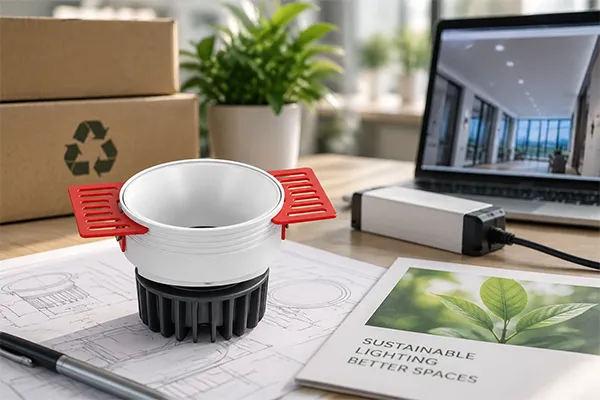
From a manufacturing-side perspective, I find that sustainability becomes more practical when buyers turn it into a procurement checklist. The goal is not to find one perfect environmental label. The goal is to select LED downlights that can perform consistently, remain suitable for the application, and avoid unnecessary replacement cycles.
Why Are Sustainable LED Downlights More Than Low-Wattage Products?
Buyers often see low wattage as a shortcut to sustainability. That assumption creates risk when a lower-power downlight uses an undersized heat sink, a weak driver, or unsuitable materials. I understand why procurement teams focus on watts, but the resulting product may create more waste if it requires replacement earlier than expected.
Sustainable LED downlights are more than low-wattage products because their environmental value depends on stable performance over time. Low power consumption matters, but buyers should also assess driver reliability, heat dissipation, lumen maintenance, installation conditions, and replacement frequency. A downlight that consumes less power but fails early may not deliver the practical sustainability outcome a project team expects.
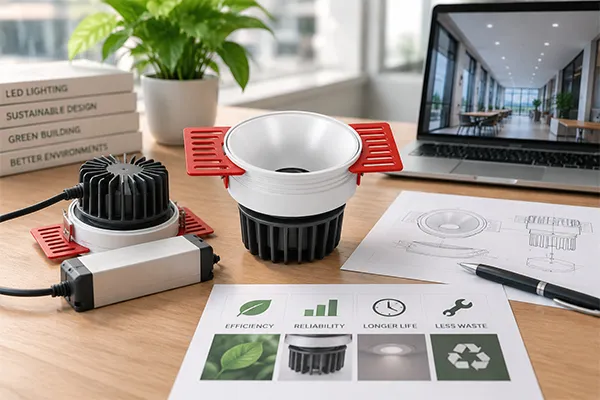
Wattage Is Only One Operating Metric
Wattage tells buyers how much electrical power a downlight consumes under stated test conditions. It does not explain the full product design. A 10W LED downlight may appear more sustainable than a 15W model, but the comparison is incomplete without considering light output, optical losses, thermal performance, and the actual needs of the installation.
For example, a buyer should ask whether the lower-wattage model still provides adequate illuminance for its intended ceiling height and room function. If the product does not provide enough usable light, a project may need more fixtures. That outcome can change the total material, installation, and maintenance requirement.
In my OEM/ODM discussions, I encourage customers to compare the whole lighting solution rather than one fixture rating alone. Buyers can begin with these questions:
- Does the selected wattage provide sufficient lumen output for the application?
- Is the beam angle appropriate for the spacing and mounting height?
- Does the downlight use a driver designed for the specified input voltage and operating environment?
- Does the heat sink appear proportionate to the LED power and fixture construction?
- Does the product specification state a realistic operating temperature range?
- Can the supplier provide consistent components across repeat orders?
Efficacy Is Useful, but It Is Not a Complete Sustainability Score
Luminous efficacy, usually stated in lumens per watt, helps buyers understand how efficiently a fixture converts electrical power into visible light.2 It is an important comparison point. However, a high efficacy figure alone does not prove that a downlight is sustainable, durable, or suitable for a project.
A product can achieve a strong initial lumen-per-watt result while still using a driver with limited long-term stability. A product can also deliver high initial output but experience faster lumen depreciation if thermal conditions are not managed well.3 For this reason, I suggest buyers review both initial performance and the design choices that may influence performance over time.
| Evaluation point | What buyers may see | What buyers should also ask |
|---|---|---|
| Wattage | 7W, 10W, 15W, or 20W | Is the power level appropriate for the required lighting task? |
| Lumen output | A high initial lumen figure | Under what conditions was the figure measured? |
| Efficacy | Lumens per watt | Does the product balance efficacy with thermal and driver design? |
| Lifetime claim | A stated number of operating hours | What test basis, operating conditions, and limitations support the claim? |
| Green label | General sustainability wording | Which specific product attribute does the claim actually cover? |
I do not treat an LED downlight as sustainable by default simply because it uses LED technology. I consider whether the overall design can help a buyer avoid premature replacement and unnecessary maintenance work.
The Practical Procurement View
A more useful sustainability question is: Will this downlight continue to provide appropriate light in its intended conditions for a reasonable service period?
That question moves the conversation beyond marketing language. It also helps importers, distributors, and project teams identify products that may create warranty disputes, replacement orders, or inconsistent field performance later.
How Do Drivers and Thermal Design Affect Sustainable LED Downlights?
A downlight may have a good LED chip specification and an attractive housing, yet its service life can still be limited by heat and electrical stress. I often find that buyers compare lumen output first and ask about the driver later. In practice, both elements deserve attention during supplier evaluation.
Drivers and thermal design affect sustainable LED downlights because they influence electrical stability, component temperature, lumen maintenance, and the likelihood of premature failure. Buyers should evaluate the LED module, driver, heat sink, housing structure, and installation environment as a connected system. Proper component matching can help reduce replacement frequency and the material waste associated with failed fixtures.
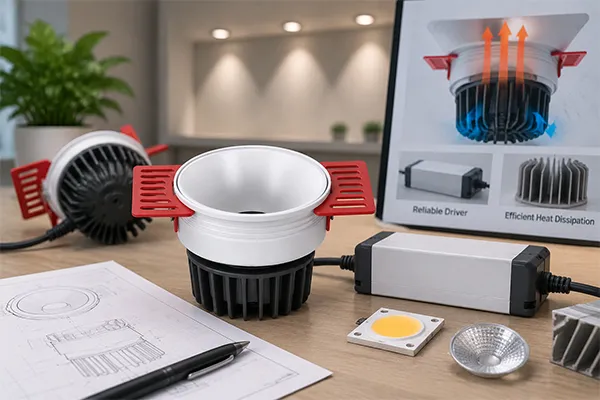
Why the LED Driver Matters
The LED driver converts and regulates incoming electrical power for the LED light source.4 Its quality and suitability can influence flicker behavior, output stability, dimming compatibility, and operating life.5 The driver is not a minor accessory. It is a critical part of the downlight system.
From a manufacturing-side perspective, I suggest that buyers discuss these driver-related points with suppliers:
- Input-voltage compatibility: The driver should match the destination market and the project’s electrical supply conditions.
- Dimming requirement: A dimmable downlight should be evaluated with the relevant dimming method, such as phase-cut, 0–10V, DALI, or another specified control system.
- Driver location: An external driver may offer different servicing and thermal characteristics than an integrated driver, depending on the design.
- Component sourcing consistency: Buyers should ask whether the supplier can maintain driver configuration across repeated production batches.
- Protection features: Suppliers can explain the driver’s stated protections, but buyers should verify documents and suitability for the specific application.
I have had buyers ask for the lowest possible price while also requesting high efficacy, dimming functions, small dimensions, and a long service-life expectation. Those requirements can conflict. A very compact fixture has less space for heat dissipation and driver design. A responsible supplier discussion should make these trade-offs visible rather than hiding them behind a broad “high quality” claim.
Heat Has a Direct Effect on Design Risk
LEDs produce less heat than traditional light sources in some comparisons, but they still generate heat that must be managed.6 The issue is not whether heat exists. The issue is whether the fixture can move heat away from temperature-sensitive components under realistic installation conditions.
Recessed LED downlights can face additional thermal challenges because ceiling voids vary. Insulation, restricted airflow, high ambient temperature, and dense fixture spacing can all influence operating conditions.7 An LED downlight that performs acceptably in an open test setup may experience different thermal conditions after installation.
I recommend that buyers ask suppliers to clarify:
- The fixture’s intended installation method
- Whether the product is designed for insulated or non-insulated ceiling conditions
- The stated ambient-temperature limits
- The housing and heat-sink material
- The relationship between wattage, fixture size, and thermal structure
- Whether the aging process is part of routine production control
At Upward Lighting, we perform a 100% aging test before shipment, typically lasting 4 to 8 hours depending on the product requirement. I view this as a production quality-control step, not as a complete prediction of lifetime in every application. Buyers should still evaluate the product for their own project conditions and request appropriate documentation.
A short production aging test can help identify immediate issues. It cannot replace application-specific engineering review, long-term reliability evaluation, or proper installation practice.
What Sustainable LED Downlight Trends Should Procurement Teams Watch?
Many sustainability trends are presented as product features. I think buyers should look beyond trend language and identify which developments improve procurement decisions. The useful trends are the ones that help teams reduce specification ambiguity, maintain consistent supply, and select products that fit the actual application.
The most relevant sustainable LED downlight trends include higher system efficacy, improved thermal structures, flexible OEM/ODM specifications, maintainability discussions, and stronger documentation expectations. Buyers should treat these trends as evaluation areas rather than automatic proof of environmental performance. The best choice remains a downlight that matches the project’s technical, commercial, and operating requirements.
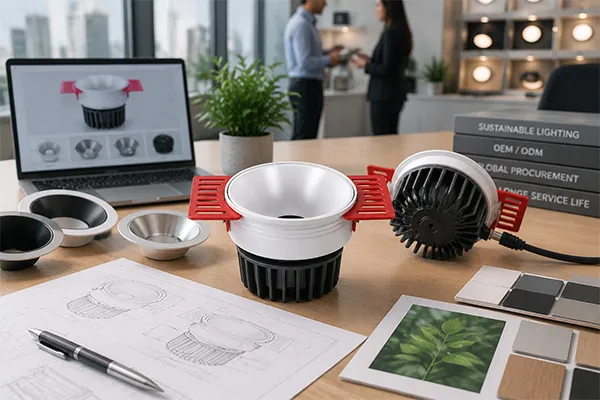
Trend 1: System-Level Efficiency Instead of Isolated LED Claims
I see more professional buyers asking about the complete fixture instead of only the LED chip. This is a positive shift. A fixture-level assessment can include the LED module, optical cover, reflector, driver, heat sink, and housing.
The buyer should distinguish between an LED source specification and a finished downlight specification. Optical losses, driver efficiency, and thermal conditions can all affect the final fixture output.8 A supplier should explain what the published data represents.
Trend 2: More Application-Specific Customization
OEM and ODM customization can support more responsible procurement when it helps buyers avoid over-specification or under-specification. A project may need a particular color temperature, beam angle, CRI level, cutout size, wattage, trim color, or dimming function. A standard product that does not suit the project can create installation problems or poor user satisfaction.
In our customer discussions, common customization requests include:
- Color temperature: Such as warm, neutral, or cool white options for different interior concepts
- Wattage: To match lighting calculations and local product positioning
- Beam angle: To support general lighting, accent lighting, or wall-washing effects
- CRI: To meet project expectations for color appearance
- Surface finish: Such as white, black, silver, or custom trim colors
- Packaging and branding: For local brands, distributors, and private-label programs
Customization does not automatically make a product sustainable. However, correct specification can reduce the risk of buying a fixture that is unsuitable for the application and later replaced.
Trend 3: Greater Attention to Maintenance Burden
Project teams increasingly consider who will replace a failed fixture, how access will be managed, and whether repeat orders can match the installed product. These questions matter especially in hotels, retail sites, offices, residential developments, and commercial interiors with difficult ceiling access.
A low purchase price can become less attractive when replacement requires labor, site coordination, downtime, and shipping. I believe maintenance burden is one of the most practical ways to discuss sustainability in B2B lighting procurement.
Trend 4: Better Documentation Requests
Buyers are asking more detailed questions about product documents, material compliance, and market access. This trend supports better supplier selection. However, buyers should still review each document carefully and confirm relevance to the exact product configuration, destination market, and intended use.
How Should Buyers Verify Sustainable LED Downlight Claims?
Sustainability claims can be broad, vague, or difficult to compare. I have seen labels such as “eco-friendly,” “energy-saving,” and “green lighting” used without explaining the underlying product characteristics. Buyers should not rely on these phrases alone when they are sourcing for long-term projects or private-label distribution.
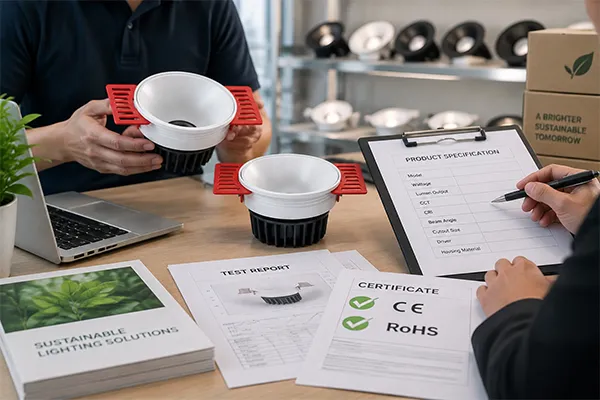
Buyers can verify sustainable LED downlight claims by requesting product-specific specifications, checking component and production details, reviewing applicable compliance documents, and comparing products under the same stated conditions. CE and RoHS documents may support market-access and material-compliance discussions, but buyers should not treat them as complete evidence of environmental performance or long-term reliability.9
CE and RoHS Have Important but Limited Roles
CE and RoHS are often requested by buyers, particularly in markets where relevant requirements apply. These documents can be important for market access, safety-related conformity processes, and restricted-substance compliance discussions. However, I do not present CE or RoHS as complete sustainability certifications.
A buyer should understand the difference:
| Document or claim | What it may help address | What it does not prove by itself |
|---|---|---|
| CE documentation | Conformity-related market access requirements for applicable products and markets | Full environmental lifecycle performance or long-term field reliability |
| RoHS documentation | Restricted-substance compliance considerations | Recyclability, low carbon impact, or product durability in every application |
| Lumen-per-watt figure | Initial energy-performance comparison | Thermal quality, driver reliability, or replacement frequency |
| Lifetime statement | Supplier’s stated design or test expectation | Guaranteed performance in every ceiling, climate, or control system |
| “Eco-friendly” label | General marketing position | A measurable and verified sustainability outcome |
Buyers should verify that documentation corresponds to the specific model, input configuration, and destination-market requirement. A document for one version of a downlight may not automatically apply to every customized wattage, driver, or control option.10
A Practical Supplier Verification Checklist
When I speak with purchasing managers and product teams, I recommend a clear, repeatable review process. This approach helps buyers compare suppliers on more than price.
Product and performance checks
- Request a detailed specification sheet for the exact model.
- Confirm wattage, lumen output, color temperature, CRI, beam angle, cutout, dimensions, and input voltage.
- Ask whether stated lumen output refers to the complete fixture.
- Confirm the intended installation environment and ambient-temperature assumptions.
- Review dimming compatibility if the project requires controls.
Construction and component checks
- Ask about the heat-sink material and housing construction.
- Discuss driver type, driver brand or configuration, and component consistency.
- Confirm whether key components may change without buyer approval.
- Review the relationship between fixture size and rated wattage.
- Request sample evaluation before placing a large order.
Manufacturing and commercial checks
- Ask how the supplier manages incoming materials and finished-product inspection.
- Confirm aging-test practices and what those checks are intended to identify.
- Discuss lead times, minimum order quantities, and small-batch support.
- Clarify how the supplier handles repeat orders and specification changes.
- Confirm packaging requirements for shipment, storage, and local distribution.
I believe samples are especially important. A specification sheet gives buyers a starting point, but a sample lets the technical team review finish quality, installation fit, light appearance, glare control, dimming behavior, and general construction.11 Qualified professionals should evaluate application-specific lighting, electrical, and installation decisions.
How Can Suppliers Support More Responsible LED Downlight Procurement?
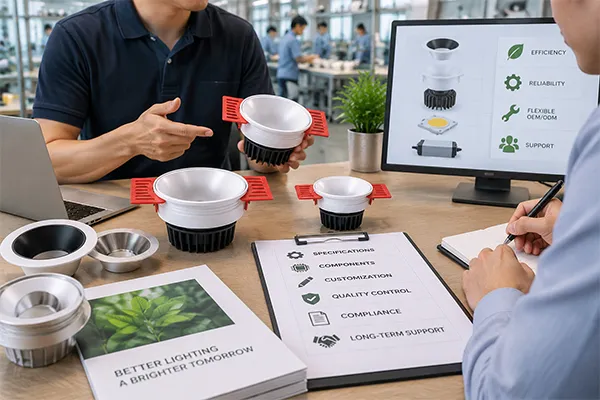
Buyers cannot make a sound sustainability decision without clear information from suppliers. I believe suppliers should communicate both product strengths and product limitations. A supplier who only highlights high lumens, low prices, and broad environmental claims makes comparison more difficult.
Suppliers can support responsible LED downlight procurement by providing accurate specifications, explaining design trade-offs, maintaining component consistency, offering suitable customization, and responding clearly to technical questions. Sustainable LED downlights require transparent supplier communication because buyers need to evaluate reliability, compatibility, compliance documents, and repeat-order consistency before making a purchasing decision.
Transparency Is More Useful Than Perfect-Sounding Claims
From my perspective in Zhongshan LED manufacturing, the best supplier relationship begins with clear requirements. Buyers should provide the target market, product application, voltage, desired performance, control requirements, order quantity, and certification expectations. Suppliers should then explain what configuration is feasible.
For example, a buyer may request:
- A very slim recessed LED downlight
- High lumen output
- High CRI
- Dimming capability
- A low target price
- Small order quantities
- Fast delivery
Each request is reasonable on its own. Yet the complete combination may require trade-offs. The supplier should explain whether a different housing size, driver option, or wattage would produce a more balanced result. I find that these discussions create better outcomes than simply selecting the cheapest available configuration.
Consistency Matters for Brands and Distributors
For local lighting brands, wholesalers, and importers, consistency is a commercial issue as well as a quality issue. A repeat order should not create unexpected changes in appearance, light color, cutout size, driver behavior, or packaging unless the buyer has approved them.
At Upward Lighting, we support OEM/ODM discussions around color temperature, wattage, beam angle, CRI, and surface finish. We also support small-batch orders where feasible. I believe this flexibility can help buyers create product ranges that suit their market without forcing a one-size-fits-all specification.
Still, I recommend that buyers document approved samples and critical specifications. They should also define which changes require written approval. This process supports clearer communication for both parties.
Frequently Asked Questions
Are LED downlights automatically sustainable?
No. LED downlights can offer efficient lighting, but LED technology alone does not make a product sustainable. Buyers should assess the complete fixture, including efficacy, driver quality, thermal management, installation suitability, component consistency, and expected replacement risk.
Is a higher lumen-per-watt rating always better for LED downlights?
A higher lumen-per-watt rating is useful for comparing energy performance, but it is not the only decision factor. Buyers should also consider glare, beam angle, driver quality, heat dissipation, color quality, fixture construction, and whether the light output suits the intended application.
Do CE and RoHS prove that an LED downlight is environmentally friendly?
No. CE and RoHS can be relevant documents for conformity and restricted-substance compliance, depending on the product and market. They do not independently prove full environmental performance, recyclability, long-term reliability, or reduced lifecycle impact. Buyers should verify the relevance of all documentation.
Why is thermal management important in recessed LED downlights?
Thermal management matters because elevated operating temperatures can affect LEDs, drivers, and other fixture components.12 Recessed installations may have limited airflow or insulation nearby. Buyers should evaluate the fixture’s intended installation conditions, housing design, wattage, and stated temperature limits.
What should I request from an LED downlight supplier before ordering?
You should request a product-specific specification sheet, sample, applicable compliance documents, driver details, installation information, aging-test process information, packaging details, lead time, and repeat-order controls. A qualified technical review is advisable for application-specific projects.
Conclusion
Sustainable LED downlights should be evaluated as lifecycle procurement decisions rather than simple low-wattage products. I recommend that buyers compare efficacy with driver quality, thermal management, fixture construction, operating conditions, and supplier consistency. CE and RoHS documents can support important compliance discussions, but they are not complete proof of sustainability or long-term performance. If you are sourcing LED downlights for a brand, distribution program, or project, I invite you to discuss your required specifications with Upward Lighting so we can help you assess a suitable OEM/ODM configuration.
"Life Cycle Assessment of a modular LED luminaire and ...", https://upcommons.upc.edu/bitstreams/7a8f3095-d7c1-4f9f-affb-7484099d6e76/download. Life-cycle assessments of lighting products recognize that longer service life can reduce replacement-related material and maintenance burdens, although the relative benefit depends on energy use, operating hours, and the specific product design. Evidence role: general_support; source type: research. Supports: Lifecycle-assessment evidence that product longevity and reduced replacement can lower material use and maintenance-related impacts.. Scope note: A general lifecycle source does not directly compare the particular downlight models described in the article. ↩
"LEDS - National Institute of Standards and Technology", https://tsapps.nist.gov/publication/get_pdf.cfm?pub_id=842492. Luminous efficacy is commonly expressed in lumens per watt and describes the amount of visible light produced per unit of electrical power input. Evidence role: definition; source type: government. Supports: The definition of luminous efficacy as light output in lumens per unit of electrical power, commonly expressed as lumens per watt.. ↩
"[PDF] Understanding Fixture Design Tools", https://www1.eere.energy.gov/buildings/publications/pdfs/ssl/bair_msslc-boston2012.pdf. LED reliability studies report that elevated operating temperatures can accelerate luminous-flux degradation and reduce lumen maintenance over time. Evidence role: mechanism; source type: paper. Supports: Experimental or review evidence that elevated LED operating temperature affects light output degradation and lumen-maintenance behavior.. Scope note: The magnitude of degradation varies with LED package, drive current, heat path, and test conditions. ↩
"[PDF] LED Dimming: What you need to know - eere.energy.gov", https://www1.eere.energy.gov/buildings/publications/pdfs/ssl/dimming_webcast_12-10-2012.pdf. An LED driver is a power-supply device that conditions the incoming electrical supply and regulates the electrical output required by an LED load. Evidence role: definition; source type: government. Supports: The function of an LED driver in converting or conditioning supply power and regulating current or voltage for LED operation.. ↩
"[PDF] LED Dimming: What you need to know - eere.energy.gov", https://www1.eere.energy.gov/buildings/publications/pdfs/ssl/dimming_webcast_12-10-2012.pdf. LED-system guidance and reliability literature identify driver design and compatibility as factors affecting current regulation, temporal light modulation, dimming performance, and system reliability. Evidence role: mechanism; source type: research. Supports: Technical evidence that driver characteristics influence LED current regulation, temporal light modulation, dimming operation, and reliability.. Scope note: The statement does not establish the performance of any particular driver or downlight configuration. ↩
"[PDF] Lighting Designer Roundtable on Solid-State Lighting", http://www1.eere.energy.gov/buildings/publications/pdfs/ssl/designer_roundtable_report_final_apr08.pdf. LED lighting can produce less waste heat than many conventional light sources, but heat generated at the LED junction and in electronics must still be conducted away to preserve performance and reliability. Evidence role: mechanism; source type: government. Supports: That LEDs can reduce waste heat relative to conventional lamps while still requiring heat removal from the LED junction and associated electronics.. Scope note: Heat generation and comparison outcomes depend on the lamp type, system efficiency, and installation conditions. ↩
"[PDF] Are LEDs Ready for Recessed Downlight Applications", https://www1.eere.energy.gov/buildings/publications/pdfs/ssl/leds_may_applications.pdf. Recessed-luminaire guidance notes that insulation contact, limited airflow, and elevated ambient conditions can alter heat dissipation and must be considered in fixture selection and installation. Evidence role: mechanism; source type: institution. Supports: That recessed-luminaire installation conditions can restrict heat dissipation and raise component operating temperatures.. Scope note: Applicable installation rules and temperature ratings differ by jurisdiction, luminaire classification, and product instructions. ↩
"[PDF] 2019 Solid-State Lighting R&D Opportunities - Department of Energy", https://www.energy.gov/sites/prod/files/2020/01/f70/ssl-rd-opportunities2-jan2020.pdf. Luminaire performance is determined by the complete optical, electrical, and thermal system; therefore, source-level LED ratings do not by themselves represent finished-fixture output or efficacy. Evidence role: mechanism; source type: research. Supports: That luminaire-level luminous output and efficacy reflect optical, electrical, and thermal losses beyond the nominal LED-source specification.. Scope note: The exact losses depend on the optics, driver, LED operating point, and thermal design of the individual luminaire. ↩
"CE marking – obtaining the certificate, EU requirements - Your Europe", https://europa.eu/youreurope/business/product-rules-compliance/general-product-compliance/ce-marking/index_en.htm. EU guidance describes CE marking as a conformity indication under applicable Union legislation and RoHS as a restriction on specified hazardous substances in electrical and electronic equipment; neither framework alone assesses complete life-cycle environmental performance or field reliability. Evidence role: definition; source type: government. Supports: The regulatory scope of CE marking and the RoHS restriction of specified hazardous substances in electrical and electronic equipment.. Scope note: Which legal requirements apply depends on the product, destination market, and applicable legislation. ↩
"CE marking – obtaining the certificate, EU requirements - Your Europe", https://europa.eu/youreurope/business/product-rules-compliance/general-product-compliance/ce-marking/index_en.htm. Conformity-assessment guidance requires manufacturers to ensure that technical documentation and compliance assessment remain valid for the product placed on the market, including after relevant design or configuration changes. Evidence role: general_support; source type: government. Supports: That manufacturers must ensure conformity assessment and technical documentation remain appropriate when product characteristics or configurations change.. Scope note: Whether a particular variation requires new testing or documentation depends on the applicable regulation and the significance of the change. ↩
"Previewing Your Project: What a Digital Lighting Mockup ...", https://www.sundownoutdoorlighting.com/blog/previewing-your-project-what-a-digital-lighting-mockup-reveals. Lighting-design guidance recognizes mock-ups and sample installations as useful for assessing visual appearance, glare, control response, and installation outcomes under project-specific conditions. Evidence role: general_support; source type: institution. Supports: That lighting mock-ups or sample installations are used to assess visual quality, glare, control behavior, and installation suitability in context.. Scope note: A sample assessment is not a substitute for formal photometric testing, electrical safety evaluation, or long-term reliability testing. ↩
"[PDF] High Operating Temperature Interconnects for LED Applications", https://energy.gov/sites/prod/files/2015/02/f19/bhatkal_interconnects_sanfrancisco2015.pdf. LED reliability literature identifies operating temperature as a significant factor in luminous-flux maintenance and in the aging of electronic components used in LED driver systems. Evidence role: mechanism; source type: paper. Supports: That component temperature is a major reliability factor for LEDs and associated electronic driver components.. Scope note: Temperature sensitivity and failure mechanisms vary among LED packages, driver components, and luminaire designs. ↩