LED downlight technology has moved far beyond simply replacing older lamps with a lower-wattage alternative. I often see buyers focus on price and lumen output first, only to face glare complaints, inconsistent color, premature failures, or difficult installation later. A better approach is to evaluate the complete downlight system, supplier controls, and application fit.
The evolution of LED downlight technology has changed purchasing decisions from comparing wattage and unit cost to assessing integrated performance. Modern LED downlights combine LEDs, optics, heat sinks, drivers, housings, and installation details in one system.1 Buyers should evaluate light quality, thermal design, electrical reliability, consistency between batches, certifications, and suitability for the intended ceiling and room use—not brightness alone.
In my work with LED downlight production, inspection, and aging tests, I have learned that two fixtures can look nearly identical from the outside while behaving very differently after installation. The details below explain why that happens and how importers, contractors, distributors, and lighting brands can make more informed sourcing decisions.
How Has LED Downlight Technology Changed from Lamp Replacement to Integrated Design?
Early LED downlight buying often centered on a simple promise: replace a conventional light source, use less energy, and reduce maintenance. That message was easy to understand, but it can create problems when buyers overlook heat, beam control, drivers, dimming needs, and ceiling conditions. Modern procurement needs a broader view.
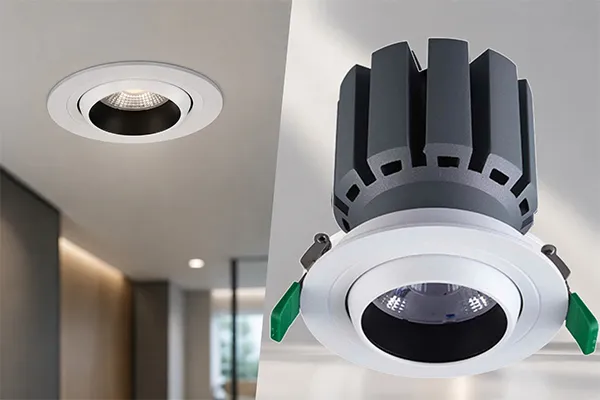
LED downlight technology has evolved into an integrated fixture design in which the LED source, heat sink, optic, driver, trim, housing, and mounting structure must work together. A downlight’s real performance depends on the interaction of these components. Buyers should therefore compare complete product specifications and production controls rather than treating wattage or appearance as the only decision criteria.
From replaceable lamps to integrated LED fixtures
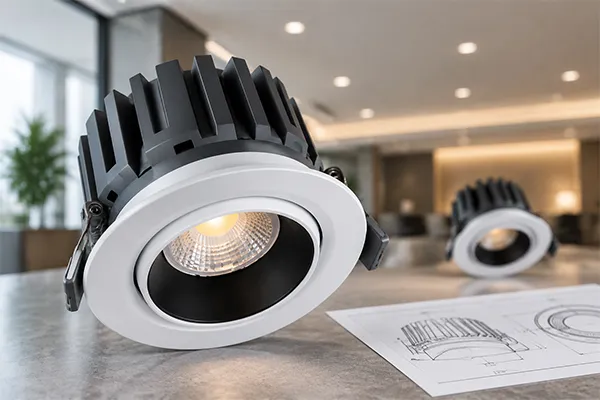
Traditional recessed lighting often used a lamp, a separate socket, and a housing. The buyer could replace the lamp when it failed. In contrast, many current LED downlights use integrated LED modules. This approach can support slimmer fixture profiles, improved optical control, and simpler product styling. However, it also means that the quality of the entire fixture matters more.
I view an integrated downlight as a small system rather than a single commodity item. Each part affects another part:
- LED source: Influences light output, color consistency, CRI, and expected lumen maintenance.
- Optic or diffuser: Shapes the beam, reduces or increases glare, and affects light distribution.
- Heat sink: Transfers heat away from the LED and internal electronics.
- LED driver: Converts incoming power and regulates current to the LEDs.
- Housing and trim: Affect appearance, installation, airflow, corrosion resistance, and mechanical fit.
- Springs and mounting parts: Affect installation efficiency and retention in the ceiling.
A lower-cost model may use a similar visible trim and diffuser but differ in aluminum mass, driver design, LED binning, wiring, or assembly process. These differences may not be obvious in a catalog photograph.
Why thermal design became a procurement issue
LEDs are often described as efficient, but they still generate heat.2 A downlight must manage that heat effectively to support stable output and color performance over time.3 Heat management is particularly important in recessed installations because the fixture may have limited airflow around it.4
The heat sink material, shape, contact surfaces, thermal interface materials, and overall fixture construction can all influence heat transfer. I do not treat any single feature, such as “die-cast aluminum,” as automatic proof of quality. Buyers should instead ask how the fixture is built and tested for its intended application.
For example, I recommend that buyers compare:
| Evaluation Area | Questions to Ask a Supplier | Why It Matters |
|---|---|---|
| Heat sink design | What material and construction are used? | Affects thermal transfer and fixture stability |
| Installation environment | Is the product intended for insulated, enclosed, or ventilated ceiling conditions? | Ceiling conditions can change operating temperature |
| Driver placement | Is the driver integrated or external? | Influences servicing, thermal exposure, and installation space |
| LED module | What LED type and color consistency approach are used? | Affects visual consistency between fixtures |
| Optical system | What are the beam angle and glare-control features? | Affects visual comfort and application fit |
What I have observed in production
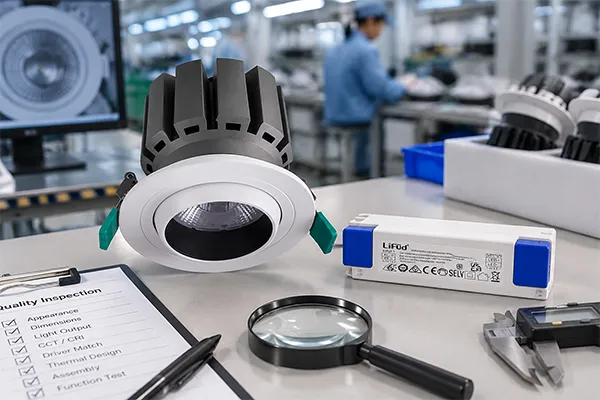
During production inspection, I have seen how minor assembly variables can matter. A poorly seated thermal pad, inconsistent screw torque, incorrect wire routing, or a driver installed too close to a heat source may not change the external appearance. Yet each variable can affect product behavior over time.
This is why I encourage buyers to request samples and evaluate them as complete fixtures. A product sample cannot predict every field condition, but it can help a purchasing team compare construction, installation method, light appearance, driver operation, and fit with the target market.
Why Is More Wattage Not Always Better in LED Downlight Technology?
Many sourcing discussions still start with a request for “higher lumens at the same wattage” or “the brightest option for the lowest price.” Those requests are understandable, especially in competitive tenders. However, excessive brightness, poor beam selection, or unsuitable color temperature can create a worse user experience rather than a better one.
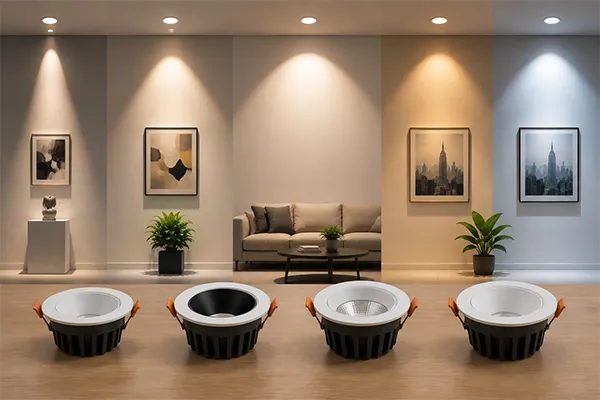
In LED downlight technology, higher wattage and higher lumen output are not automatically better because lighting quality depends on beam angle, mounting height, glare control, room use, color temperature, CRI, spacing, and ceiling conditions. Buyers should select a balanced specification that supports the intended visual task and project environment rather than choosing the highest output available.
Lumens must be considered with distribution
Lumen output tells buyers how much visible light a fixture produces, but it does not fully explain where the light goes.5 A narrow beam can create a bright spot directly below the fixture. A wider beam can distribute light more broadly but may deliver less intensity at a specific point.6
For this reason, two downlights with similar lumen ratings can produce different visual results. The optic, diffuser, reflector, beam angle, and installation height all influence the final appearance.
A buyer sourcing LED downlights for a retail display, corridor, hotel room, office, or residential kitchen should not assume that the same beam angle is appropriate for every area. I recommend that project teams define the intended use before finalizing a specification.
Key lighting variables buyers should compare
| Variable | What It Indicates | Procurement Consideration |
|---|---|---|
| Wattage | Electrical power consumption | Compare it with delivered performance, not alone |
| Lumen output | Total visible light output | Confirm whether the level suits the application |
| Beam angle | Width of light distribution | Match it to mounting height and visual objective |
| CCT | Warm, neutral, or cool appearance of light | Align with local preferences and project design |
| CRI | Color-rendering capability | Consider where accurate color appearance matters |
| UGR or glare data, where available | Potential visual discomfort | Request relevant documentation for commercial projects |
| Dimming compatibility | Driver and control behavior | Verify compatibility with the intended dimmer or system |
Visual comfort is part of product value
I have seen buyers reject a fixture not because it failed electrically, but because the installed light felt harsh, uneven, or visually inconsistent. These issues can lead to return requests, rework costs, and complaints from contractors or end users.
Glare is one example. A high-output LED source can appear uncomfortable if the optic does not control brightness well or if the fixture is used in the wrong location.7 A deep anti-glare design, reflector arrangement, or suitable diffuser may improve visual comfort in some applications, but buyers should assess the actual product and installation context.
Color temperature is another important variable. A 3000K downlight can create a warmer atmosphere, while 4000K can appear more neutral. Neither choice is universally better. The correct decision depends on the project brief, local preferences, adjacent lighting, interior materials, and intended atmosphere.
I always advise customers to avoid approving a downlight solely from a datasheet. A physical sample installed in a representative environment usually reveals more about glare, color appearance, trim finish, and beam distribution.
Avoid “one-specification-for-every-project” purchasing
Standardization can simplify inventory management, but over-standardization can create application problems. A distributor may need a core range of common wattages, CCTs, and cutout sizes. However, it is still useful to offer options for different market needs.
At Upward Lighting, we can support OEM/ODM adjustment of parameters such as wattage, color temperature, beam angle, CRI, and surface finish color. I believe this flexibility is most useful when it is based on a defined project requirement rather than on a request for maximum specifications in every category.
For application-specific lighting calculations, electrical design, code interpretation, or emergency-lighting requirements, buyers should consult qualified local lighting and electrical professionals. A manufacturer can provide product information, but project suitability requires site-specific evaluation.
What Makes Visually Similar LED Downlights Perform Differently Over Time?
A common sourcing risk is assuming that products with similar dimensions, trim colors, and stated wattage are interchangeable. In reality, visually similar fixtures may contain different LED packages, drivers, heat sinks, wiring, and assembly controls. Those differences can affect consistency, reliability, and customer satisfaction.
Visually similar LED downlights can perform differently because their internal thermal management, LED selection, driver quality, optical components, wiring, and assembly consistency may differ. Buyers should inspect samples, compare technical documents, review quality-control processes, and assess supplier responsiveness before selecting a product based primarily on unit price.
The driver is a critical but often overlooked component
The LED driver regulates electrical current to the LED module.8 A stable driver is important for consistent operation, dimming performance where applicable, and protection against certain electrical variations. Yet the driver is often hidden inside the fixture or above the ceiling, so buyers may focus more on the visible trim.
I recommend that buyers ask practical questions about the driver:
- Is the driver integrated or external?
- What input-voltage range does it support?
- Is the driver compatible with the planned dimming method?
- What driver protections are specified?
- Can the supplier maintain the same driver configuration across repeat orders?
- What is the supplier’s process if a component substitution becomes necessary?
Component substitutions deserve special attention. Supply chains can change, and some substitutions may be technically acceptable. However, buyers should ask suppliers to communicate material or component changes clearly, especially for approved long-term product lines.
LED selection and color consistency
LED selection influences more than brightness. It can affect CCT consistency, CRI, and visual uniformity across a project.9 If a contractor installs fixtures from different production batches, visible color variation can become a concern in spaces with continuous ceilings or closely spaced downlights.
I do not suggest that every project requires the same level of color-consistency control. A high-end hospitality project and a general utility space may have different expectations. Still, buyers should define their target market and request suitable information from suppliers.
Useful sample-evaluation checks include:
- Compare several fixtures side by side in the same environment.
- Check whether CCT appearance looks consistent across samples.
- Observe the fixture after it has operated for a period of time.
- Review trim color, diffuser appearance, and beam uniformity.
- Test installation springs, cutout fit, and driver connections.
- Confirm labeling, packaging, and instruction requirements for the destination market.
Manufacturing consistency matters at scale
A prototype can look excellent, while a large delivery can still create problems if production control is weak. This is why supplier selection should include more than a sample review.
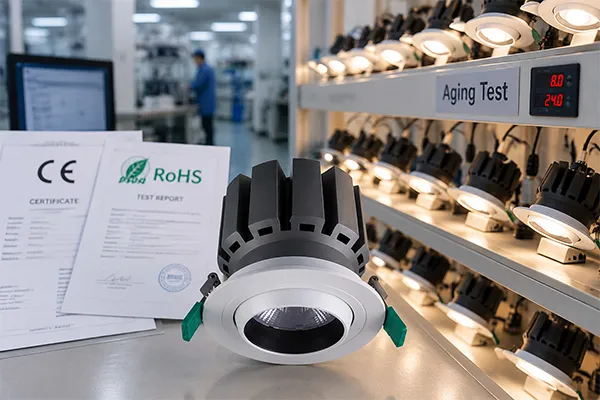
In our own production process, we use 100% aging tests before shipment, typically lasting between 4 and 8 hours, depending on the product and order requirements. This process helps us screen for certain early manufacturing issues, such as obvious non-functioning units, abnormal driver behavior, or assembly-related problems that appear during operation.
However, I am careful not to present aging tests as a guarantee that no future field failures will occur. A short production aging test cannot fully reproduce every installation environment, voltage condition, thermal condition, handling event, or years of operating hours.10 It is one quality-control measure, not a substitute for product design validation or project-specific evaluation.
A practical supplier scorecard
| Supplier Evaluation Factor | What Buyers Can Review | Potential Risk if Ignored |
|---|---|---|
| Sample consistency | Multiple units from the same sample set | Variation may appear after approval |
| Aging-test process | Duration, coverage, records, and criteria | Early manufacturing defects may go undetected |
| Incoming material control | Checks for LEDs, drivers, housings, and wiring | Uncontrolled component variation |
| Assembly inspection | Visual, electrical, and functional checks | Loose connections or cosmetic inconsistency |
| Change-control communication | Notification process for component changes | Approved specifications may drift |
| Delivery capability | Lead time, packaging, export experience | Delays and damaged goods |
| Technical response | Speed and clarity of quotations and answers | Slow resolution during project pressure |
For importers, wholesalers, and local brands, stable repeatability often creates more long-term value than a small reduction in initial purchase price. A low-cost fixture that causes replacement labor, claims, and damaged customer trust can become expensive quickly.
How Should Buyers Evaluate Certifications and Aging Tests for LED Downlight Technology?
Certifications and testing are important in the lighting supply chain, but buyers should understand what each document or process does—and does not—demonstrate. Confusion in this area can lead to unrealistic expectations or incomplete supplier evaluations.
For LED downlight technology, certifications such as CE and RoHS support relevant market-access, safety, and environmental compliance requirements when valid and applicable, while aging tests help screen for certain manufacturing defects before shipment. Neither certifications nor aging tests alone prove that a downlight will suit every project or remain failure-free throughout its full service life.
Certification documents support compliance review
CE and RoHS are frequently requested by European-market buyers and by customers serving markets that use related compliance expectations.11 These documents can be important parts of a procurement file. However, I recommend that buyers verify the scope, validity, product model coverage, issuing party, and relevance to the destination market.
A certification document should be reviewed as part of a wider due-diligence process. It should not be treated as proof that a product is automatically superior in every performance category.
At Upward Lighting, our products hold certifications such as CE and RoHS. We provide relevant documentation for buyer review, but I encourage customers to confirm that documents match the exact product configuration and their target-market requirements. A customized driver, wattage, or construction may need its own compliance consideration.
Aging tests help detect early issues
Aging tests operate fixtures for a defined period before shipment. In manufacturing, this is often called burn-in or run-in testing.12 The goal is to identify certain early failures that may appear soon after assembly.
Aging can help reveal:
- Non-functioning LED modules
- Driver defects that appear under operation
- Wiring or connection issues
- Abnormal flicker or unstable output in some cases
- Some assembly errors that become visible when energized
Aging cannot fully reveal:
- All long-term material degradation
- Every site-specific thermal condition
- Damage caused during transport or installation
- Incorrect dimmer compatibility
- Future power-quality issues at the installation site
- All application-specific lighting performance concerns
Build a layered quality-verification process
I suggest that professional buyers use a layered review rather than relying on one document, one test, or one sample.
- Define the application requirements. Clarify cutout size, wattage, CCT, CRI, beam angle, voltage, dimming needs, trim finish, and target price level.
- Review technical documents. Check datasheets, drawings, labeling, certification documentation, and packaging requirements.
- Evaluate physical samples. Inspect construction, light appearance, installation method, driver arrangement, and finish quality.
- Assess supplier controls. Ask about incoming inspection, aging procedures, final inspection, and component-change management.
- Confirm commercial capability. Review MOQ, quotation speed, customization options, production lead time, export packaging, and communication.
- Arrange professional project review when needed. Complex or regulated installations require qualified local input.
This process takes more time than comparing only unit prices. Yet it can reduce the risk of receiving an LED downlight range that does not match the expectations of contractors, distributors, or end users.
Frequently Asked Questions
What is the most important factor when buying LED downlights?
The most important factor is application fit. Buyers should consider light output, beam angle, CCT, CRI, glare control, ceiling conditions, driver requirements, and installation method together. A low price or high lumen rating alone does not confirm that a downlight is suitable for the intended project.
Are higher-lumen LED downlights always better?
No. Higher lumens can be useful in some applications, but excessive output or an unsuitable beam angle may create glare, uneven lighting, or unnecessary energy use. Buyers should match output and distribution to the room function, mounting conditions, and visual-comfort requirements.
Does CE certification mean an LED downlight is high quality?
CE documentation can support compliance with applicable market requirements, but it does not by itself prove superior long-term reliability, light quality, or application suitability. Buyers should verify the documentation and also evaluate samples, construction, supplier quality controls, and product specifications.
Does a 100% aging test guarantee no future LED downlight failures?
No. A 100% aging test can help identify certain early manufacturing or assembly issues before shipment. It cannot simulate every real installation condition or guarantee that no future failures will occur. It should be viewed as one part of a broader quality-control process.
What should distributors ask an LED downlight supplier before placing a repeat order?
Distributors should ask about component consistency, driver configuration, LED color consistency, change-control procedures, packaging, lead time, certifications, aging-test coverage, and warranty handling. They should also confirm whether the supplier can maintain approved specifications across future production batches.
Conclusion
The evolution of LED downlight technology has made lighting procurement more sophisticated. Buyers now need to look beyond wattage, appearance, and initial unit price. I recommend evaluating the complete fixture system, including LEDs, optics, thermal design, drivers, housing, production consistency, documentation, and intended application. Certifications and aging tests are valuable tools, but neither replaces careful supplier qualification and professional project assessment. If you are sourcing a stable LED downlight range for wholesale, distribution, brand development, or a project, contact Upward Lighting to discuss samples, OEM/ODM options, and product specifications.
"[PDF] Solid State Lighting LED Product Development and Manufacturing ...", https://www.energy.gov/documents/ledrtprdctmfg-reportoct2016pdf. U.S. Department of Energy guidance describes LED luminaires as integrated systems whose LED sources, drivers, optics, and thermal-management features jointly affect performance. Evidence role: definition; source type: government. Supports: That LED luminaires are systems in which LEDs, drivers, optics, and thermal management are designed to operate together.. ↩
"[PDF] Are LEDs Ready for Recessed Downlight Applications", https://www1.eere.energy.gov/buildings/publications/pdfs/ssl/leds_may_applications.pdf. U.S. Department of Energy technical materials explain that LEDs generate heat that must be conducted away from the device, because elevated junction temperature can reduce light output and lifetime. Evidence role: mechanism; source type: government. Supports: That LEDs produce heat during operation and that junction temperature affects LED performance and reliability.. ↩
"[PDF] Color Maintenance of LEDs in Laboratory and Field Applications", https://betterbuildingssolutioncenter.energy.gov/sites/default/files/attachments/2013_gateway_color-maintenance.pdf. Research on LED reliability reports that higher operating or junction temperatures can accelerate luminous-flux depreciation and contribute to chromaticity change over time. Evidence role: mechanism; source type: research. Supports: That elevated LED operating temperature can adversely affect lumen maintenance and color stability.. Scope note: The magnitude of these effects depends on the LED package, drive conditions, thermal path, and operating environment. ↩
"[PDF] Chapter 5: Lighting, HVAC, and Plumbing - eere.energy.gov", https://www1.eere.energy.gov/buildings/publications/pdfs/commercial_initiative/sustainable_guide_ch5.pdf. Thermal studies of recessed LED luminaires show that restricted convection and surrounding ceiling conditions can raise component temperatures relative to more ventilated installations. Evidence role: mechanism; source type: research. Supports: That recessed or enclosed installation conditions can alter luminaire heat dissipation and operating temperature.. Scope note: Actual temperatures depend on housing geometry, insulation contact, ceiling construction, ambient temperature, and fixture rating. ↩
"[PDF] Photometric units and nomenclature", https://nvlpubs.nist.gov/nistpubs/bulletin/06/nbsbulletinv6n4p543_A2b.pdf. National Institute of Standards and Technology photometry references define luminous flux in lumens as total visible-light quantity; directional distribution requires additional photometric information such as luminous intensity. Evidence role: definition; source type: government. Supports: That lumens measure luminous flux, while intensity and distribution describe how light is directed through space.. ↩
"Understanding Light Beam Angles - Ledvance", https://www.ledvance.com/en-us/professional-lighting/insights/blog/lighting-basics/light-beam-angle. Lighting-design teaching materials explain that narrower distributions concentrate luminous intensity into a smaller area, whereas wider distributions spread light over a larger area and change illuminance at the target surface. Evidence role: mechanism; source type: education. Supports: That a luminaire's beam spread affects the area over which its light is distributed and the illuminance achieved at a given distance.. Scope note: The resulting illuminance also depends on mounting height, aiming, spacing, room reflectances, and the luminaire's full photometric distribution. ↩
"What to measure and report in studies of discomfort from ...", https://www.energy.gov/eere/ssl/articles/what-measure-and-report-studies-discomfort-glare-pedestrian-applications. Lighting research on discomfort glare identifies source luminance and apparent size, contrast with the background, and position relative to the observer's view as important determinants of visual discomfort. Evidence role: mechanism; source type: research. Supports: That discomfort glare is related to source luminance, contrast, position in the field of view, and background conditions.. Scope note: Perceived glare is context-dependent and cannot be inferred from lumen output alone. ↩
"[PDF] The Energy and Operational Impacts of Using 0-10V Control for LED ...", https://www.energy.gov/documents/ssl-impacts-010v-led-streetlightsdec2023pdf. U.S. Department of Energy LED guidance describes drivers as power supplies that convert available electrical power and regulate the current supplied to LED packages or modules. Evidence role: definition; source type: government. Supports: That LED drivers provide controlled electrical power, commonly regulated current, to LED loads.. ↩
"[PDF] LED Color Characteristics", https://www.energy.gov/sites/prod/files/2016/08/f33/led-color-characteristics-factsheet.pdf. U.S. Department of Energy materials on LED color quality explain that chromaticity bins and LED selection influence the color consistency observed among luminaires. Evidence role: mechanism; source type: government. Supports: That LED chromaticity variation and binning practices affect color consistency among LED products.. Scope note: Color uniformity in a completed project also depends on optics, drive current, temperature, aging, and viewing conditions. ↩
"Environmental Conditioning and Accelerated Testing - calce, umd", https://calce.umd.edu/environmental-conditioning-and-accelerated-testing. Reliability literature distinguishes production screening from design qualification and life testing: short burn-in procedures may reveal selected early defects but cannot by themselves demonstrate lifetime performance under all field stresses. Evidence role: general_support; source type: research. Supports: That short screening tests detect selected early defects but do not fully predict long-term field reliability across varied operating conditions.. Scope note: Predictive value improves only when test stresses and failure mechanisms are demonstrably relevant to the intended application. ↩
"RoHS Directive - Environment - European Commission", https://environment.ec.europa.eu/topics/waste-and-recycling/rohs-directive_en. European Commission guidance states that CE marking signifies conformity with applicable EU harmonisation requirements, while the RoHS framework restricts certain hazardous substances in electrical and electronic equipment. Evidence role: historical_context; source type: government. Supports: That CE marking may be required where applicable EU harmonisation legislation applies and that RoHS restricts specified hazardous substances in electrical and electronic equipment.. Scope note: The applicable directives, standards, documentation, and conformity-assessment obligations depend on the exact product and the market in which it is placed. ↩
"[PDF] A methodology for testing life-cycle performance of consumer products", https://nvlpubs.nist.gov/nistpubs/Legacy/IR/nbsir76-1157.pdf. Reliability-engineering references define burn-in as operating equipment for a specified initial period to screen for certain early-life or infant-mortality failures. Evidence role: definition; source type: education. Supports: That burn-in is an initial operation or stress period used to identify some early-life failures before deployment.. Scope note: Burn-in effectiveness depends on the test duration, load, temperature, failure mechanisms, and screening criteria. ↩