Energy efficient LED downlights can look simple on a specification sheet, yet buyers often face a difficult gap between low wattage claims and real project performance. A downlight that saves power but produces glare, uneven light, poor color quality, or early maintenance issues can create costly problems. I believe the future lies in verified, application-specific lighting systems rather than wattage reduction alone.
The future of energy efficient LED downlights is about delivering the right lighting result with the least practical energy input over time. I recommend that buyers assess lumen output, beam distribution, glare control, color quality, thermal design, driver quality, lumen maintenance, and compatible controls together. A lower-wattage downlight is only efficient when it still meets the space’s visual, operational, and maintenance requirements.
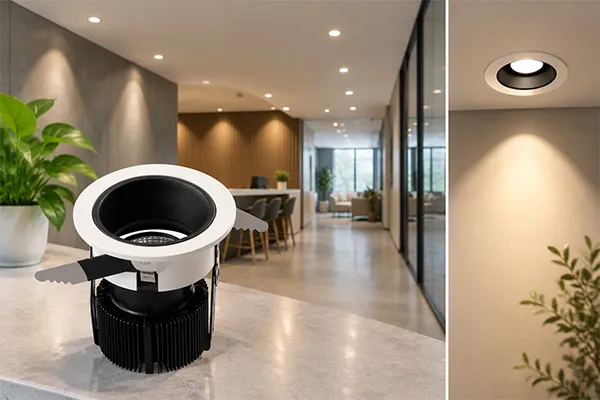
I work with contractors, importers, lighting brands, and purchasing teams that want a clear answer to a familiar question: “Which LED downlight uses the fewest watts?” I usually encourage them to start elsewhere. The better question is what the room needs people to see, do, and experience over the life of the installation.
How Will Energy Efficient LED Downlights Be Specified in the Future?
I often see buyers begin with a target wattage because it appears easy to compare. That approach can create risk when two products with similar wattage produce very different lighting results. I help customers move from a product-first decision to a task-first specification, so their energy-saving goals do not compromise usability or visual comfort.
Energy efficient LED downlights will increasingly be specified by the lighting task instead of wattage alone. I recommend that buyers define required brightness, mounting height, beam angle, glare expectations, color temperature, color rendering, and operating hours before selecting a wattage. This process helps teams compare downlights on useful delivered performance rather than a single headline number.
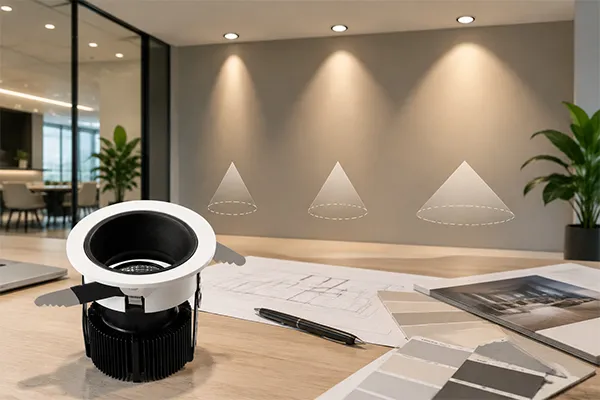
I Start With the Space, Not the Wattage
A downlight used in a hotel corridor serves a different purpose from one used above a retail display, in a residential kitchen, or in a hospital waiting area. Each space has different visual tasks, ceiling conditions, operating patterns, and expectations for comfort.
For that reason, I encourage procurement teams to prepare a short application brief before requesting quotations. The brief does not need to be complicated, but it should answer practical questions:
- What type of space will use the downlight?
- What is the ceiling height and ceiling construction?
- Is the lighting general illumination, accent lighting, or task lighting?
- What illumination level does the project designer or local standard require?
- How many hours per day will the lighting operate?
- Does the project need dimming, sensors, or emergency-lighting compatibility?
- Does the customer prioritize low glare, high CRI, high output, or a specific aesthetic?
- Which market will receive the product?
I have had OEM/ODM conversations where a buyer initially requested the lowest possible wattage for a commercial project. After discussing the mounting height and required beam spread, we found that the original configuration could have left dark areas between fittings. In that situation, selecting a different beam angle or spacing plan could be more useful than simply reducing wattage.
I Compare Delivered Lighting, Not Label Claims Alone
A watt is a measure of electrical power, not a complete measure of lighting quality.1 Lumens describe light output, but initial lumens alone also do not tell the full story. Buyers need to consider how effectively the fixture sends useful light toward the intended surface.
For example, a narrow beam can create higher brightness directly below the fitting, while a wider beam can improve uniformity across a larger area.2 Neither option is automatically more energy efficient. The appropriate choice depends on the lighting layout and the task.
| Specification factor | Why I review it | Procurement question |
|---|---|---|
| Wattage | Indicates electrical input | Does the power level fit the required output and control strategy? |
| Lumen output | Indicates initial light quantity | Is the output adequate for the design target? |
| Beam angle | Affects spread and spacing | Will the beam create useful coverage at the mounting height? |
| UGR or glare-related design3 | Affects visual comfort | Is glare control important for offices, hospitality, or public spaces? |
| CRI | Affects color appearance | Does the application need accurate product, food, skin-tone, or finish rendering? |
| Color temperature | Affects visual atmosphere | Does the selected CCT suit the project concept and local preference? |
| Dimming compatibility | Supports control strategies | Does the driver work with the intended dimming protocol? |
I do not present one combination as best for every project. A low-wattage, wide-beam downlight may suit a corridor with closely spaced fixtures. A retail display may instead require a more focused beam and stronger color rendering. The future of specification is not one universal “efficient” model. It is a set of balanced choices that supports the intended environment.
Why Do Energy Efficient LED Downlights Need Long-Term Performance Review?
I understand why buyers focus on initial price, watts, and lumens. These figures are easy to place in a comparison table. However, a lighting project operates after shipment, installation, and commissioning. I believe the more useful evaluation includes the components and production controls that influence consistency and performance over time.
Energy efficient LED downlights need long-term performance review because initial efficiency does not fully describe operating stability.4 I recommend that buyers assess driver design, heat dissipation, LED selection, manufacturing consistency, aging-test procedures, and warranty terms. These factors can affect lumen maintenance, color consistency, replacement exposure, and the reliability of the installed lighting system.
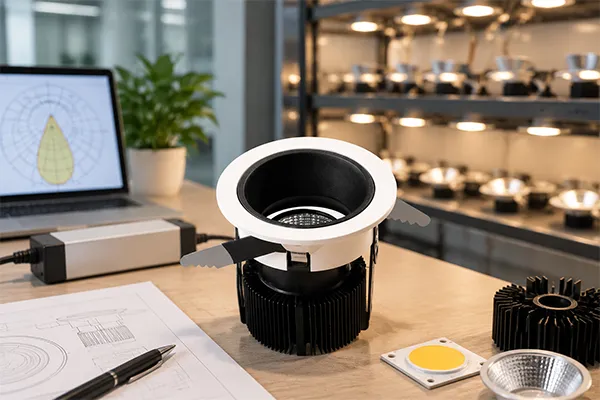
I Look Beyond Initial Efficacy
Initial efficacy, commonly expressed as lumens per watt, can be useful for comparing products under defined test conditions. Still, I treat it as one input rather than a final buying decision. A product can look attractive in an initial specification comparison but raise questions when the driver, thermal path, optical materials, or assembly controls are not properly evaluated.
I generally encourage buyers to request clear and comparable documentation. Depending on the project and market, this may include:
- Product data sheets with model-specific electrical and photometric information.
- Driver brand, driver specification, and dimming compatibility details.
- Photometric files or test information when the lighting design requires it.
- Thermal-design information and installation limitations.
- Samples for visual and functional assessment.
- Batch-identification and quality-control procedures.
- Warranty scope, exclusions, and claim-handling process.
- Applicable compliance documentation for the destination market.
At Upward Lighting, we conduct a 100% aging test of 4 to 8 hours before shipment as part of our factory quality process. I describe this as a pre-shipment screening measure, not as proof of long-term site performance or lifetime energy savings. Buyers should still evaluate the complete product specification, installation conditions, and supplier documentation for their own application.
I Treat Thermal Design as a Commercial Risk Factor
LED downlights generate less heat than many older lighting technologies, but they still produce heat that must be managed. Poor heat dissipation can affect component stress and may influence light output stability, color behavior, and driver reliability.5 Recessed installations can also create challenging conditions because ceiling cavities vary in airflow, insulation, ambient temperature, and available space.6
I recommend that project teams confirm the following before final approval:
- The permitted ambient operating range.
- The required ceiling cut-out and installation depth.
- Whether insulation contact is permitted or restricted.
- The clearance needed around the fitting and driver.
- The compatibility of the trim, housing, and ceiling material.
- The effect of enclosed ceiling spaces on the intended installation.
- The driver replacement approach, where maintenance access matters.
I have seen customers focus carefully on the visible trim finish while overlooking the installation environment. That is understandable, especially for private-label product lines where appearance drives early decisions. Yet the housing, heat path, driver placement, and assembly quality can be equally important in controlling after-sales exposure.
I Evaluate Batch Consistency for Repeat Orders
For importers, distributors, and brands, a good approved sample is not enough. I recommend a process that considers whether subsequent batches can maintain similar appearance and performance. This is particularly important for large developments, phased projects, and product lines with repeat purchasing cycles.
Useful controls can include approved samples, documented specifications, incoming-inspection criteria, agreed labeling, and pre-shipment inspection requirements. Buyers should also discuss acceptable variation for color temperature, finish color, packaging, and accessory configuration. These details help protect consistency across the supply relationship.
What Trade-Offs Shape the Future of Energy Efficient LED Downlights?
I regularly explain that lighting specifications involve trade-offs. Buyers may want high output, high CRI, low glare, compact size, deep dimming, excellent appearance, low cost, and minimum power consumption in one product. These goals can coexist in some cases, but they should not be assumed to come without design, cost, or performance implications.
Energy efficient LED downlights require balanced trade-offs between output, color quality, glare control, size, cost, and power use. I recommend that buyers rank their project priorities before comparing products. A specification that is excellent for retail color rendering may not be the most suitable option for a basic corridor, while a low-glare office design may require different optics from a high-output utility space.
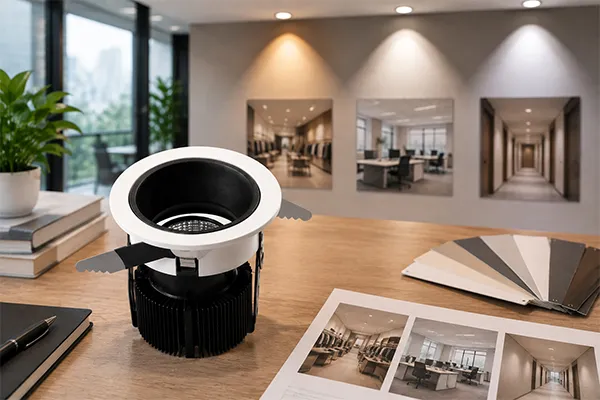
I Match CRI to the Visual Task
Color Rendering Index, or CRI, describes how naturally a light source renders colors compared with a reference source.7 Higher CRI can be valuable in applications where color judgment matters. Retail, hospitality, food presentation, beauty, galleries, and premium residential environments may all have stronger color-quality expectations.
However, I do not advise buyers to request the highest CRI available without considering the intended use. A higher-CRI configuration can affect output, efficacy, cost, and component selection.8 The right decision depends on the project’s visual priorities.
| Application example | Typical specification focus | Trade-off I would discuss |
|---|---|---|
| Office circulation area | Comfort, uniformity, operating cost | High CRI may not be the first priority |
| Retail display | Color quality, directional light, visual appeal | More focused optics or higher CRI may affect cost and efficacy |
| Hotel room | Comfort, dimming, warm visual atmosphere | Deep dimming and low glare need driver and optic review |
| Residential kitchen | Task visibility, color quality, style | Beam placement matters as much as wattage |
| Utility or storage area | Functional brightness, practical cost | A simpler configuration may be appropriate |
I Consider Glare as Part of Lighting Efficiency
I believe glare control belongs in an energy-efficiency discussion because uncomfortable light can undermine the usefulness of the energy being consumed.9 If occupants find a space visually harsh, a project may require changes in layout, additional fixtures, or operational adjustments. Those outcomes may reduce the practical value of an initially low-power specification.
Deep recessed designs, reflectors, diffusers, optical lenses, and beam-control methods can influence visual comfort. Yet each approach also affects fixture dimensions, appearance, output, and cost. I recommend that buyers request samples and review them in a representative setting whenever the project has demanding comfort requirements.
I treat “efficient” as useful light for the intended task, not merely the lowest power number printed on a carton.
I Use Customization With a Clear Decision Process
As an OEM/ODM manufacturer, we can customize parameters such as wattage, color temperature, beam angle, CRI, and surface finish color. I find that customization delivers the strongest value when the customer has defined the application clearly.
For example, a lighting brand may need a consistent 3000K private-label range with several trim colors for hospitality customers. A contractor may need a specific cut-out size and beam option to fit a renovation project. A distributor may want a practical range of models that serves multiple customer segments without creating excessive stock complexity.
I recommend that buyers avoid too many small variations unless there is a clear sales or project need. A well-controlled product family can simplify stocking, inspection, replacement, and customer support.
Can Smart Controls Improve Energy Efficient LED Downlights?
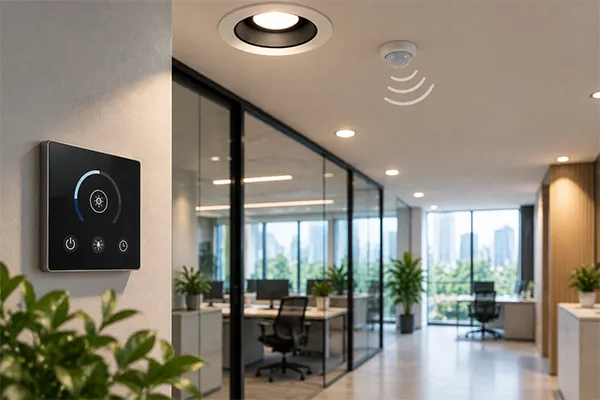
I see growing interest in dimmable and connected downlights, especially among commercial project teams and lighting brands. Controls can support a more responsive lighting system, but they are not automatic savings devices. I advise buyers to examine how the space is actually occupied and how the selected control system will be installed, commissioned, and maintained.
Smart controls can improve the system efficiency of energy efficient LED downlights when they match real occupancy, daylight availability, user behavior, and commissioning requirements.10 I recommend that buyers select dimming methods, sensors, timers, or connected controls only after defining the operating scenario. Poorly matched control logic can create user frustration, compatibility issues, or limited practical benefit.
I Start With Operating Patterns
A meeting room, hotel corridor, warehouse aisle, washroom, retail store, and private home all have different operating patterns. A sensor can be useful where occupancy is intermittent and predictable. Daylight-responsive dimming may be relevant near windows or skylights. A simple dimmer may better suit a residential or hospitality setting where users want direct control over mood and brightness.
I encourage teams to ask:
- Is the space occupied continuously or intermittently?
- Is daylight available, and does it change meaningfully throughout the day?
- Do occupants need manual override?
- Will frequent switching affect user comfort or perceived safety?
- Who will commission the control system?
- Who will maintain sensors, gateways, or control settings?
- Is the selected LED driver compatible with the intended protocol?
I Verify Driver and Control Compatibility Early
A control system is only as reliable as its compatibility across fixtures, drivers, dimmers, sensors, and wiring methods. I recommend that buyers identify the dimming protocol early. Common options may include phase-cut dimming, 0–10V, DALI, or other system-specific approaches.11 Each option has different installation and commissioning considerations.
I do not assume that a “dimmable” label alone answers all compatibility questions. A project should confirm the actual driver model, minimum dimming level, dimmer or controller compatibility, wiring requirements, and expected behavior at low output. Sample testing is particularly useful for large projects or branded product lines.
I Keep Control Design Proportionate
Not every project needs connected lighting. A simple, well-matched control strategy can be more practical than a complex system that is difficult to commission or explain to users. I recommend that buyers compare the operational benefit against added product cost, installation labor, commissioning needs, and long-term support responsibilities.
For a basic commercial corridor, scheduled switching or sensor-based control may be sufficient if it matches the building’s usage. For a premium office, a more integrated approach may be appropriate if the electrical contractor and facility team can support it. The key is not to assume that more technology automatically creates better efficiency.
Frequently Asked Questions
What makes an LED downlight energy efficient?
I consider an LED downlight energy efficient when it provides appropriate useful light for the application with controlled power use and dependable system design. Buyers should assess wattage, lumen output, optics, glare control, driver quality, thermal management, and controls rather than relying on one specification.
Are lower-wattage LED downlights always better?
I do not consider lower wattage automatically better. A lower-wattage fitting may be unsuitable if it cannot meet the required brightness, beam spread, uniformity, or visual-comfort target.12 I recommend evaluating wattage alongside the complete lighting layout and intended task.
Should I choose high-CRI LED downlights for every project?
I recommend high-CRI LED downlights when color appearance is important to the application. Retail, hospitality, food, and premium residential spaces may benefit from stronger color rendering. However, buyers should balance CRI with output, efficacy, budget, and the actual visual requirements of the space.
Do smart LED downlight controls always reduce energy use?
I do not assume that smart controls always reduce energy use. Controls can help when occupancy patterns, daylight conditions, user behavior, and commissioning are properly considered. A poorly configured sensor or incompatible dimming system can create operational problems without delivering meaningful practical benefit.
How should buyers evaluate an LED downlight supplier?
I recommend that buyers review samples, specifications, quality-control procedures, production consistency, lead times, customization capability, communication speed, and compliance documents relevant to the destination market. Buyers should verify certifications and application suitability independently, especially for regulated or safety-sensitive projects.
Conclusion
The future of energy efficient LED downlights is not a race toward the lowest wattage. I believe it is a more disciplined approach to specifying useful light, stable performance, appropriate color quality, controlled glare, and practical controls for each application. Buyers should evaluate product and supplier capability together, including documentation, samples, batch consistency, thermal design, and driver compatibility. At Upward Lighting, I work with project buyers and lighting brands to turn these requirements into practical OEM/ODM downlight specifications. Contact us to discuss your next downlight range, project requirement, or small-batch customization plan.
"[PDF] Literature review of lighting standards", https://nvlpubs.nist.gov/nistpubs/Legacy/IR/nistir5202.pdf. A watt is the SI-derived unit of power, whereas lumen output measures visible light quantity; neither measure alone describes all aspects of lighting quality or suitability for a visual task. Evidence role: definition; source type: government. Supports: Definitions of watts as electrical power and lumens as a measure of light output.. Scope note: The source defines the metrics but does not evaluate a particular downlight design. ↩
"[PDF] Examining Perceptual Luminance Uniformity of Simulated Luminaire ...", https://www.energy.gov/eere/ssl/articles/examining-perceptual-luminance-uniformity-simulated-luminaire-patterns. Luminaire beam distribution determines how luminous flux is distributed on the task plane, influencing localized illuminance, fixture spacing, and illumination uniformity. Evidence role: mechanism; source type: institution. Supports: Lighting-design guidance explaining that luminaire distribution and beam spread affect illuminance patterns, spacing, and uniformity.. Scope note: Actual results depend on mounting height, room geometry, surface reflectance, and the specific luminaire photometry. ↩
"Perception of discomfort glare in relation to the CIE Unified ...", https://www.sciencedirect.com/science/article/pii/S2950362026000019. The Unified Glare Rating (UGR) is a standardized method for estimating discomfort glare in an interior lighting installation. Evidence role: definition; source type: institution. Supports: The definition and intended use of the Unified Glare Rating as an indicator of discomfort glare.. Scope note: A calculated UGR is dependent on the defined observer position, room geometry, surface properties, and luminaire data. ↩
"[PDF] LED Luminaire Reliability: Impact of Color Shift - Department of Energy", https://www.energy.gov/sites/prod/files/2017/04/f34/lsrc_colorshift_apr2017.pdf. Initial luminous efficacy is a point-in-time performance metric; LED system performance over service life also depends on lumen maintenance, thermal conditions, and the reliability of associated electronic components. Evidence role: general_support; source type: government. Supports: Guidance that LED system performance over time is affected by factors beyond initial efficacy, including thermal conditions, drivers, and lumen maintenance.. Scope note: Lifecycle behavior varies by product construction, operating environment, duty cycle, and test method. ↩
"[PDF] LED Luminaire Reliability: Impact of Color Shift - Department of Energy", https://www.energy.gov/sites/prod/files/2017/04/f34/lsrc_colorshift_apr2017.pdf. Elevated temperatures at LED and driver components can accelerate material and electronic degradation, with consequences for luminous output, chromaticity stability, and system reliability. Evidence role: mechanism; source type: research. Supports: Research or technical guidance showing that elevated operating temperature affects LED degradation, color stability, and electronic-driver life.. Scope note: The magnitude of thermal effects depends on component design, junction temperature, ambient conditions, and operating duration. ↩
"[PDF] No-Regrets Remodeling - eere.energy.gov", https://www1.eere.energy.gov/buildings/publications/pdfs/building_america/no_regrets_remodeling_ornl.pdf. Recessed luminaires operate within an enclosure whose insulation contact, clearances, airflow, and ambient temperature can affect thermal conditions and permitted installation configurations. Evidence role: mechanism; source type: institution. Supports: Installation guidance explaining that recessed-luminaire thermal conditions are affected by enclosure, insulation, clearance, and airflow.. Scope note: Permitted conditions must be determined from the specific luminaire’s safety marking and manufacturer installation instructions. ↩
"Color rendering index", https://en.wikipedia.org/wiki/Color_rendering_index. The general colour rendering index is a standardized metric that characterizes the fidelity with which a test light source renders specified colour samples relative to an appropriate reference illuminant. Evidence role: definition; source type: institution. Supports: The standardized basis of the general colour rendering index and its comparison with a reference illuminant.. Scope note: CRI does not fully predict all aspects of perceived color quality, such as gamut preference or color vividness. ↩
"[PDF] 2019 Solid-State Lighting R&D Opportunities - Department of Energy", https://www.energy.gov/sites/prod/files/2020/01/f70/ssl-rd-opportunities2-jan2020.pdf. Studies of LED spectral design report that improving color-fidelity measures may entail trade-offs in luminous efficacy, depending on the selected spectrum and performance target. Evidence role: general_support; source type: paper. Supports: Research documenting that engineering for higher color fidelity can involve trade-offs with luminous efficacy in LED spectra and packages.. Scope note: The trade-off is not fixed: particular phosphors, LEDs, optical systems, and target color temperatures can yield different outcomes. ↩
"Lighting Quality - Department of Energy", https://www.energy.gov/cmei/ssl/lighting-quality. Lighting-efficiency guidance commonly treats energy use together with the provision of appropriate illumination, visual comfort, and task visibility, rather than treating low power demand as the sole performance objective. Evidence role: expert_consensus; source type: government. Supports: Lighting-quality guidance recognizing visual comfort and task performance as relevant considerations alongside energy efficiency.. Scope note: This framework does not establish that every glare-control measure reduces total energy use in every installation. ↩
"[PDF] Exterior Lighting Control Guidance - Better Buildings Solution Center", https://betterbuildingssolutioncenter.energy.gov/sites/default/files/attachments/exterior-lighting-control-guidance.pdf. Occupancy-based and daylight-responsive controls can reduce lighting energy consumption by reducing output or operating time when spaces are unoccupied or daylight is sufficient. Evidence role: general_support; source type: government. Supports: Evidence that occupancy sensing and daylight-responsive controls can reduce lighting energy use when matched to building operation and properly commissioned.. Scope note: Savings are site-specific and depend on occupancy patterns, daylight availability, control settings, commissioning, and user override behavior. ↩
"[PDF] LED Dimming: What you need to know - eere.energy.gov", https://www1.eere.energy.gov/buildings/publications/pdfs/ssl/dimming_webcast_12-10-2012.pdf. Phase-cut dimming, 0–10 V control, and DALI use different electrical or digital control interfaces and therefore require drivers, controllers, and wiring arrangements designed for the selected method. Evidence role: definition; source type: institution. Supports: Technical descriptions of DALI, 0–10 V, and phase-cut dimming methods and their differing interface requirements.. Scope note: Compatibility must still be verified for the exact driver, controller, load range, and installation configuration. ↩
"[PDF] Changing architecture to incorporate LED lighting", https://www.energy.gov/sites/prod/files/2017/02/f34/hershman_architecture_longbeach2017_1.pdf. Lighting design practice evaluates whether an installation provides the required illuminance, distribution, uniformity, and visual comfort for its intended tasks; wattage alone cannot establish those outcomes. Evidence role: expert_consensus; source type: institution. Supports: Lighting-design guidance requiring evaluation of illuminance, distribution, uniformity, and visual comfort for the intended task.. Scope note: Required criteria differ by jurisdiction, building type, task, and applicable project standard. ↩